



Abstract
Stress is a core issue to be addressed in lifestyle medicine. Not only does it influence disease directly (eg, cardiovascular disease), it also indirectly affects health by having a negative influence on other behaviors such as sleep and physical activity. The importance of stress is further highlighted by the fact that it is one of the most highly ranked health risks for employees globally. Practitioners are encouraged to attend to both significant life stressors and those that are encountered daily. Stress reduction strategies are further discussed.
‘Most would agree that it is far better to prevent heart disease, type 2 diabetes, or obesity than to treat them.’
A few salient concepts should be considered and addressed by any lifestyle practitioner regardless of the patient being treated. For example, a focus on prevention should be a major goal when dealing with a host of diseases that are treated through lifestyle changes. Most would agree that it is far better to prevent heart disease, type 2 diabetes, or obesity than to treat them.1,2 An ounce of prevention truly is worth a pound of cure. 3 Optimal practice also addresses health from environmental, behavioral, medical, and motivational perspectives. In addressing disease from these multiple perspectives, we have the greatest chance to both treat and prevent it. Attending to factors that promote the development of disease, negatively affect treatment outcomes, and decrease the likelihood of patients adhering to recommended lifestyle change is also critical. Stress is an issue that meets each of these criteria. 4
Stress can be described in a medical sense as the rate of wear and tear in the body, 5 or more generally as an aversive event (ie, physical, mental, or emotional) that threatens the well-being of an individual. As discussed in this issue by Rossi et al, 6 stress is one of the modifiable risk factors associated with infertility. Although its impact on infertility is a relatively new concept, the role that stress has on health behaviors in general has been studied for quite some time. Several of the first studies on stress observed its impact on cardiovascular disease. Seminal research by Friedman and Rosenman 7 demonstrated that people who engage in a “chronic and incessant struggle to achieve more in less time” were at higher risk to have coronary heart disease. In time, this behavioral pattern became known as Type A personality. 8 In current literature, it is referred to as Type A behavior pattern (TABP). 9
Considerable debate regarding how well TABP predicts cardiovascular disease exists; however, there is a clear and consistent association between the two.10-12 Although several characteristics and moods are included in TABP (eg, hostility, impatience, irritability, frustration), 13 compelling evidence suggests that stress (and one’s response to it) is the major factor driving the adverse health outcomes in these individuals.14,15 Even more concerning is that stressors are associated with cardiovascular risk factors beginning as early as childhood.16,17 Overall, the connection between stress and cardiovascular disease is both long-standing and strong.
Impact on Other Positive Health Behaviors
The role that stress has on health extends beyond that of cardiovascular disease and fertility. For example, stress has been shown to increase the length of time needed for injuries to heal, 18 affect aging processes, 19 and decrease immune function, 20 and this is by no means an exhaustive list. Although stress has a direct consequence on health, it also has an indirect one. Stress likely has its most profound influence on health in its interaction with multiple other behaviors that support well-being. For example, high levels of stress affect the quality of sleep and make it less likely one will engage in physical activity.
Sleep
Stress has been shown to negatively affect sleep behaviors. 21 Observational studies have produced an abundance of literature regarding this occurrence. Daily mental tasks requiring elevated tension have resulted in highly variable sleep patterns. 22 Stressful life events in adolescents with and without major depressive disorder alter slow-wave sleep in both groups. 23 Experimental studies confirm these observational findings. Presleep stress (ie, an aversive film) increased the number of awakenings and distorted overall sleep patterns. 24 Furthermore, when an intellectually challenging test was given to university students that resulted in feelings of inferiority (ie, the stressor), students’ sleep patterns were heavily affected. 25
Physical Activity and Exercise
A strong association has been found between higher levels of stress and physical activity (PA). 26 Although a greater emphasis has been placed on how high levels of PA lead to lower levels of stress, a reverse relationship may exist.27,28 Observational studies have demonstrated this link. Specifically, chronically stressed populations, including medical school students, 29 first-time mothers, 30 and cancer survivors 31 all have been shown to exhibit low levels of PA. Although numerous observational studies have provided a link between stress and PA, there is conflicting evidence regarding the association between the two.32,33
Observational studies have established a link between increased stress and decreased PA, and experimental studies have reaffirmed this inverse relationship. Phenomenon triggering acute stress has been shown to produce a significant reduction in PA.34-36 For example, children were randomized to a passive reading (control) or a public speaking (stress) condition. After participation in the respective condition, children were given the opportunity to exercise. Children in the public speaking condition were less likely to engage in PA. 34 Case controlled studies have found a similar pattern between stress and PA. Parents of a child who had just received a cancer diagnosis reported lower levels of PA than parents of a healthy child, 35 and parents of a child with a cancer diagnosis had lower levels of PA three months after diagnosis compared to matched controls. 36
Far-Reaching Impact
Given the clear and extensive impact of stress on health, the pervasiveness of stress is an area of considerable concern. Stress and life in a Westernized world have almost become synonymous. However, Westernized societies are not the only ones to deal with the issue of high levels of stress. In a recent global survey, employers overwhelmingly rank stress as the major health risk faced by their employees (see Figure 1). A significant increase in stress over the past few decades has been observed in the general population. 37 This progression may be especially true for women, less-educated individuals, and those with lower incomes. Although sources of stress are extremely diverse and should be assessed at an individual level, some of the most common sources of stress include money, work, health concerns, and personal safety. 38 The most reported behaviors used to cope with stress included watching TV, surfing the Internet, napping, eating, drinking alcohol, and smoking. 38
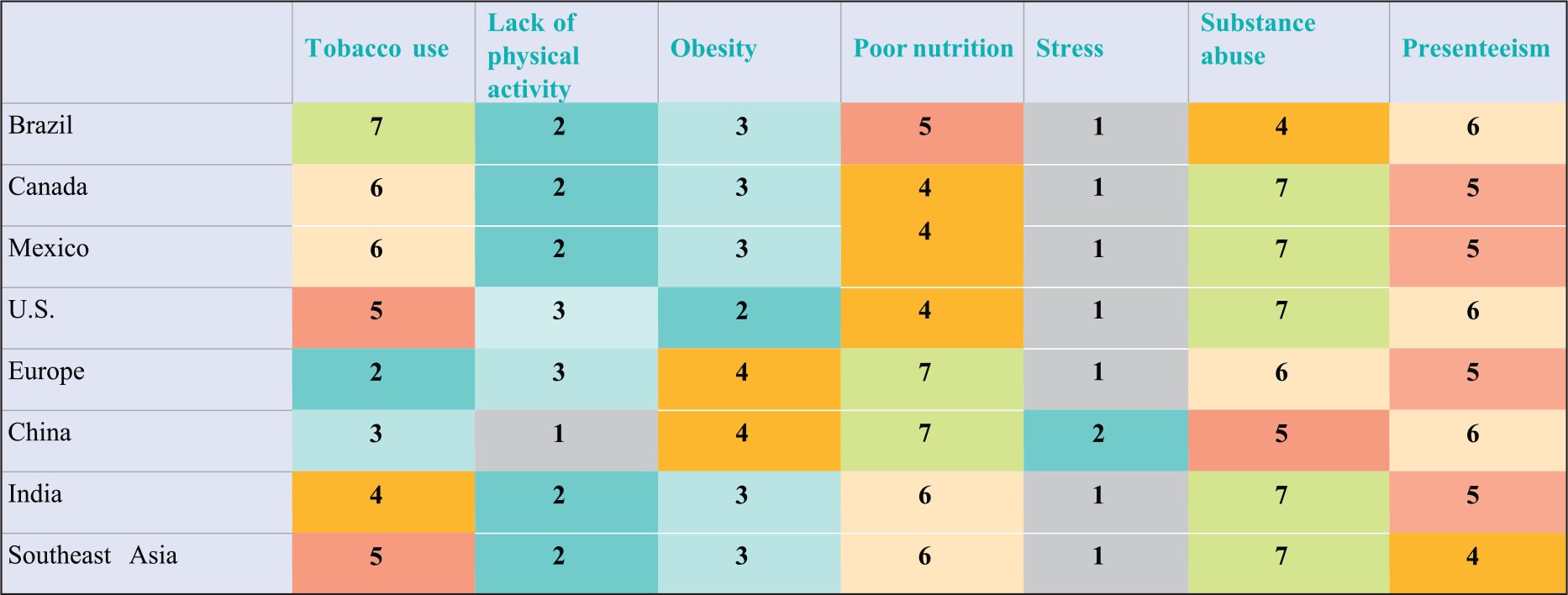
Lifestyle risk factors that are a workforce issue.
Treatment
Practitioners in lifestyle medicine should be prepared to help their patients cope with issues that cause large amounts of stress suddenly (eg, divorce, birth of child) or chronic issues that create constant lower levels of stress (eg, work concerns, dealing with chronic illness). Stress management techniques are numerous and include relaxation (eg, diaphragmatic breathing, guided relaxation), behavioral approaches (eg, distraction, time management), or cognitive strategies (eg, humor, positive self-statements). 39 Patients should identify which technique they feel would be the most effective and most likely to be used outside of the office. The chosen technique should be practiced before the stressful event occurs. It may be most beneficial for time in the office to be dedicated to practicing these techniques. Patients should demonstrate mastery with the chosen technique. The concept of “overlearning” may further increase the likelihood that the relaxation strategy will be effective when the stressor occurs.
Conclusion
Stress is a significant lifestyle issue that should be addressed in order to promote overall wellness. By attending to patients’ stress, practitioners not only address an issue that is directly associated with disease but also address behaviors that support health, such as sleep and exercise. However, stress reduction is often “tacked on” to existing interventions and often is not a primary focus. 39 Given that stress has a negative impact on so many individuals, health care professionals should consider it a priority in providing treatment.
Footnotes
Acknowledgements
This work is a publication of the Department of Health and Human Performance, University of Houston (Houston, Texas).