



Abstract
Choking is a preventable, but common cause of morbidity and mortality in the pediatric population, with children younger than 3 years at greatest risk. A number of factors place children at higher risk for choking, including narrower airways, immature dentition, underdeveloped chewing and swallowing ability, and high levels of activity and distractibility. Candy, meat, and bone are responsible for more than half of nonfatal food-related choking, while the hot dog is the most common food associated with choking fatalities. Coins, button batteries, small toys, and toy parts are the leading causes of nonfatal choking not due to food, while latex balloons are the leading cause of nonfood-related choking fatalities. Pediatric choking is an important public health concern that needs to be addressed during well-child visits and through increased public education. Parents and child caregivers should receive training in cardiopulmonary resuscitation and choking rescue maneuvers. Increased efforts are also needed in the areas of public policy, choking surveillance, and food design and labeling.
‘Choking is a leading cause of morbidity and mortality in the pediatric population . . .’
Introduction
Choking is defined as “the blockage or hindrance of respiration by a foreign-body obstruction in the internal airway, including the pharynx, hypopharynx, and trachea.” 1 Choking is a leading cause of morbidity and mortality in the pediatric population, with children younger than 3 years at the greatest risk. Young children are at especially increased risk because of their tendency to put objects in their mouth, immature dentition, inability to adequately chew their food, poor coordination of swallowing, and smaller airway.
Epidemiology of Nonfatal choking
The true incidence of nonfatal choking is difficult to assess because many patients who experience choking do not seek medical attention. In 2002, the Centers for Disease Control and Prevention (CDC) published a report analyzing National Electronic Injury Surveillance System–All Injury Program (NEISS-AIP) data for emergency department (ED) visits in the United States by children 0 to 14 years of age during 2001 with a diagnosis of nonfatal choking. The NEISS-AIP database captures a nationally representative sample of patients treated for injuries in US hospital EDs. The NEISS-AIP is maintained by the Consumer Product Safety Commission (CPSC) with support from the CDC’s National Center for Injury Prevention and Control. 2 Of the estimated 17 537 episodes of nonfatal choking among children ≤14 years, 59.5% involved a food item, 31.4% were associated with a nonfood item, and 9.1% had an unknown cause. 3
A more recent analysis of NEISS-AIP data from 2001-2009 focusing exclusively on nonfatal food-related choking showed that, on average, an estimated 12 435 children aged 0 to 14 years visited an ED in the United States annually for a nonfatal food choking episode, which is the equivalent of 34 children per day. The nonfatal choking rate was 20.4 episodes per 100 000 population during the study period. The majority of the choking episodes occurred at home (89.8%), and most patients were treated and discharged from the ED (87.3%). Children 0 to 4 years of age had the highest rates of choking. 4 Both studies found that nonfatal choking rates were highest among children less than 1 year of age and the rate of choking decreased with increasing age.3,4
Coins are the nonfood items most commonly associated with pediatric choking, causing an estimated 13% of choking episodes among children ≤14 years in 2001. 3 Other nonfood items often associated with choking among children include balloons, marbles, pen caps, button batteries, and small toys or parts of toys. Chapin et al 4 found that of all food-related choking episodes among children resulting in a visit to an ED, hard candy caused the most choking episodes (15.5%), followed by other candy (12.8%), meat–not including hot dogs (12.2%), and bone (12%). Combined, these 4 food categories accounted for more than half of the choking episodes with a known food type included in the study. Their analysis also showed that patients who choked on hot dogs, seeds, nuts, or shells were more likely to be admitted to the hospital than those who choked on other types of food. 4
Epidemiology of Fatal Choking
The CDC reported that of the 160 US children ≤14 years who died from choking in 2000, 41% choked on food items, and 59% on nonfood items. 3 It is estimated that food-related choking accounts for the death of 1 child every 5 days in the United States, and that hot dogs are the most common specific food associated with pediatric food-related choking death. 5 In 2008, Altkorn et al 6 published a 10-year retrospective review of choking among children 14 years and younger collected at 26 pediatric hospitals in the United States and Canada. They found that hot dogs were responsible for the most fatalities (16%), followed by candy (10%), grapes (8%), meat (7%), and peanuts (7%). In that study, all of the fatalities from hot dogs occurred among children younger than 4 years. 6
Latex balloons are the leading cause of nonfood-related choking deaths among children. 7 During 2010-2012, at least 47 children died of choking on a toy or toy part. Following balloons, small balls and toys were the next leading causes of pediatric nonfood choking death. 8 Magnets, coins, and button batteries have also been implicated in choking deaths among children. 7
Mechanics of Choking
Young children are at increased risk for choking for a number of reasons. As their motor skills develop, they are better able to independently explore their environment, and young children frequently explore new objects with their mouths. Young children have immature dentition, initially lacking molars necessary to grind food; and even after molars erupt, many children are unable to chew effectively until age 4 or 5 years. 1 In addition to their physical immaturity, toddlers may be more distractible while eating. Running, laughing, or talking as they eat can put them at increased risk for choking. 7 Another risk factor for choking is a well-intentioned older sibling, who shares toys or food items that may be inappropriate for a younger child. The narrower airways of young children make it easier for small objects to cause a partial or complete obstruction. According to Poiseuille’s law, flow through a tube is inversely related to the fourth power of the tube’s radius. Therefore, any obstruction of an airway significantly reduces air flow. 9
Obstruction of a child’s airway by a foreign body can occur at any level from the pharynx to the bronchi. One review of 2624 bronchoscopic procedures for foreign body aspiration found that the foreign body was recovered from the right mainstem bronchus in almost half of the cases. 10 Inflammation of the airway mucosa surrounding a lodged foreign body is common, especially with an organic foreign body, further decreasing the radius of the airway and restricting air flow. The most common complications of an airway foreign body include atelectasis, pneumonia, and bronchiectasis. 11
The physical characteristics of objects influence their likelihood for causing choking. Foods that are cylindrical in shape, similar in diameter to the airway, and compressible, such as hot dogs, grapes and gel candy, pose the greatest risk for complete upper airway obstruction.4,5 Items that conform to the airway, such as an uninflated (or fragment of a) latex balloon, are particularly dangerous because they can completely obstruct air flow.
Diagnosis and Management
Approximately half of pediatric patients with foreign body aspiration do not have a history of a choking episode when initially seen by a health care provider, and many are misdiagnosed for more than a month before the correct diagnosis is made. 12 A meta-analysis of studies on airway foreign bodies found that the diagnosis was delayed by more than 24 hours in almost 40% of the cases. 11 The longer the foreign body is present, especially if organic material, the higher the risk for complications.10,13,14(p335) The clinical presentation differs with the degree of obstruction, and can vary from asymptomatic to respiratory collapse and death. Symptomatic pediatric patients most commonly present with cough, dyspnea, foreign body sensation, or throat pain. Those with a delayed diagnosis will often report persistent cough or wheeze. On physical examination, findings range from normal to acute respiratory distress, but most commonly include decreased air entry and breath sounds, abnormal or asymmetric breath sounds, tachypnea, nasal flaring, wheezing, or stridor. 11
When a foreign body in the airway is suspected, patient history and physical examination are essential to making the correct diagnosis. A chest radiograph may be helpful if the aspirated item is radio-opaque, and may reveal subcutaneous or mediastinal emphysema, unilateral air trapping, atelectasis, or pneumothorax if a foreign body is present, though none of these are pathognomonic for foreign body aspiration. Bronchoscopy is the gold standard for diagnosis and is also the treatment of choice for airway foreign body removal.
In addition to patient morbidity and mortality, pediatric airway foreign bodies represent an important burden on health care resources. A retrospective review of the Kids’ Inpatient Database (KID) found that among 2771 pediatric patients admitted for foreign body airway obstruction in the United States in 2003, the average length of stay was 6.4 days, with 2.4 procedures performed on average per patient, resulting in a mean hospital charge per patient of $34,652. 15 The KID was developed as part of the Healthcare Cost and Utilization Project by the Agency for Healthcare Research and Quality and provides information about pediatric “health care utilization, access, charges, quality, and outcomes” for all payers. 16
Choking Prevention
Anticipatory guidance is an important part of the well-child visit and allows the health care provider to discuss many essential topics, including, but not limited to development, nutrition and growth, injury prevention, and parental concerns. Multiple studies have demonstrated the effectiveness of injury prevention counseling as part of anticipatory guidance.17,18 Health care providers should begin discussing choking prevention and feeding safety at the first encounter with parents and child caregivers and then reinforce these messages at subsequent well-child visits. Key points to address include the following:
Children should be supervised by an adult when eating.
Limit activity and distractions—children should sit at a table to eat, they should not be running, playing, or lying down while eating.
Cut food into small pieces for young children. For example, hot dogs should be diced, not simply cut horizontally into “coins.” Grapes and cherry tomatoes should be quartered before serving.
High-risk food items, such as popcorn, hard candy, and gum, should be avoided by young children.
Special attention should be given to children with neurologic deficits or developmental delays because these children are often at increased risk for choking.
Older siblings should be advised not to share food or small toys with younger children.
Children younger than 3 years should not be given toys with small parts.
Young children should not play with coins or latex balloons.
Consider using a Small Parts Test Fixture to evaluate items for choking risk (Figure 1).
Follow age recommendations on toy packaging.
Parents and other child caregivers should be trained in basic first aid, including cardiopulmonary resuscitation and choking rescue maneuvers. Physicians can refer parents to the American Academy of Pediatrics (AAP) Web site on choking for basic information on how to respond to a choking emergency (http://www.healthychildren.org/English/health-issues/injuries-emergencies/Pages/Responding-to-a-Choking-Emergency.aspx). In addition, parents and child caregivers should be encouraged to participate in a first aid/cardiopulmonary resuscitation training course through the American Red Cross (http://www.redcross.org/take-a-class) or the American Heart Association (http://www.heart.org/HEARTORG/CPRAndECC/FindaCourse/Find-a-Course_UCM_303220_SubHomePage.jsp).
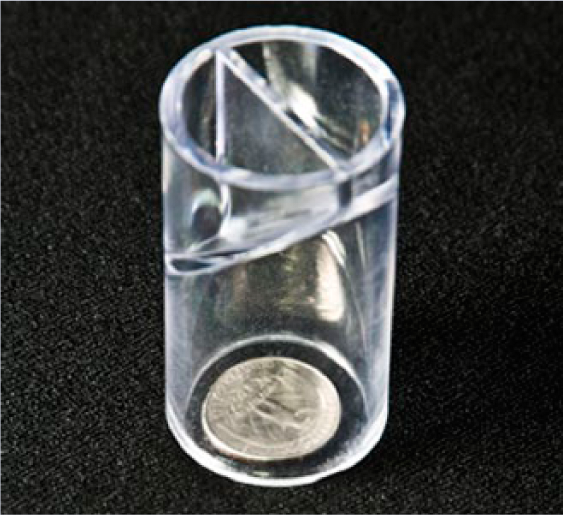
Small Parts Test Fixture.
Federal Regulation of Choking Hazards
The CPSC has surveillance systems, legislation, and regulations in place to protect children from choking on consumer products such as toys, but there are no comparable protections in place in the United States to prevent pediatric choking on food. In 2010, the AAP issued a revised policy statement on the prevention of choking among children. 1 Among the AAP recommendations was that the Food and Drug Administration should implement systems to address food-related choking, including national surveillance and reporting of food-related choking incidents, hazard evaluation, enforcement of choking hazard-related recalls, and public education. Additional product codes could be added to the NEISS-AIP to improve the capture of food type-specific choking data. AAP recommendations also include mandatory labeling of high-risk foods, recalls of foods deemed to pose an unacceptable choking hazard, and changes in food manufacturing, when possible, to avoid characteristics that are known to increase choking risk. Currently, decisions regarding food design and labeling are left up to manufacturers, and although some voluntarily include choking warning labels on their high-risk foods, most do not.
In addition, the AAP proposes that the CPSC continue to work to improve the effectiveness of product recalls and prevent the resale of recalled merchandise. The AAP policy statement proposes increased anticipatory guidance by pediatricians, dentists, and other health professionals regarding choking prevention and appropriate food and toy selection. And last, the AAP recommends that parents, teachers, and child caregivers be trained in cardiopulmonary resuscitation and choking rescue maneuvers to improve outcomes of choking among children. 1
Conclusions
Choking is a preventable but common cause of morbidity and mortality in the pediatric population. Children have developmental characteristics that put them at particularly high risk of choking on both food and nonfood items, such as toys, coins, button batteries and latex balloons. This important public health issue should be addressed through a comprehensive multilevel effort that includes public policy and enforcement, improved surveillance of food-related choking episodes, improvements in food design and labeling, and broad educational campaigns. In addition, health care providers should counsel parents and child caregivers during well-child visits about choking prevention and recommend training in cardiopulmonary resuscitation and choking rescue maneuvers.