




Abstract
It is no secret that two thirds of American adults are overweight or obese. At least one third of children and youth share this problem. As a result, the Dietary Guidelines for Americans 2010 stress balancing calories eaten with calories burned. The body burns calories, or energy, through the functions of living and through physical activity.
The recommendation’s goal is better weight management. ChooseMyPlate.gov is the new Web site that provides tools to help individuals achieve dietary recommendations. It offers 2 simple tips for better balancing calories:
Enjoy your food but eat less.
Avoid oversize portions.
Portion Power—it is one practical answer to better weight management. Reducing the amount of food you eat decreases calories, which helps with weight management.
Larger Portion Sizes Mean More Calories Consumed
Compared with the food intake in the 1970s, Americans are consuming more calories each day. Recent food intake data (2005-2008) show that men consume about 200 calories a day more, whereas women consume more than 250 calories a day more. Research has identified increased portion sizes as one major factor in this alarming increase in daily calorie intake—and weight gain. Consuming more than 100 extra calories a day, every day, for a year, without additional exercise, can add 10 pounds of weight gain.
The bigger the portion, the more people tend to eat. A simple way to cut back on calories is to eat smaller portions of the foods you usually eat. For example, instead of a full bowl of cereal, try a half bowl with nonfat milk. Cut your pepperoni pizza into 8 slices, instead of 6. You can enjoy 2 slices of pizza and still save calories.
Check out how portions have increased. Take the Portion Distortion Quiz from the National Heart, Lung and Blood Institute (http://hp2010.nhlbihin.net/portion/).
Use the MyPlate Guide to Help Balance Your Portions
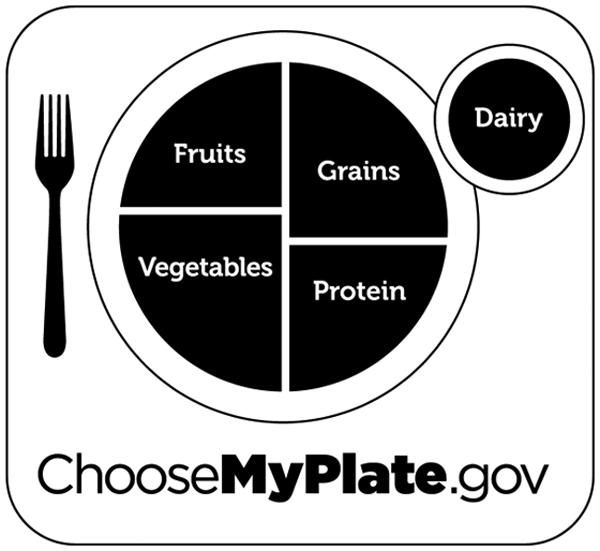
There’s a new visual aid to support the 2010 Dietary Guidelines. Pictured on this page, the MyPlate graphic replaces the MyPyramid food guidance graphic. MyPlate shows how the American plate should look, based on 5 food groups. Vegetables and fruits take up half the plate. They are rich in nutrients and typically lower in calories. Grains, preferably whole grains, take up a quarter of the plate. Lean protein takes up the final quarter. Low fat dairy is represented by a small glass.
Portion Tips for Eating In
Eat on smaller plates to help control portion sizes.
Serve individual plates of food in the kitchen, rather than serving family-style from bowls at the table. Avoid second and third servings from on-the-table serving dishes.
Use tall thin glasses rather than short, wide glasses for beverages such as milk or juice. Tall thin glasses appear to hold more than the short wide glasses.
“Spoil your dinner,” advises the Centers for Disease Control and Prevention. If you get hungry between meals, eat a small healthy snack. A piece of fruit or a serving of low-fat dairy is a good idea.
Read the Nutrition Facts label to check the number of calories in the stated serving size.
Tap the Power of Single-Serve Packaging
Research shows that replacing some meals with nutritious, single-serve frozen or ready-to-eat meals can help control portions and results in greater weight loss compared with cooking from scratch and portioning out food.
Single-serve frozen meals, which are readily available in all grocery stores, can also help you “resize” your knowledge of adequate portions.
For the occasional savory or sweet treat, use single-serve 100-calorie packs or 100-calorie individual microwave popcorn packs.
Small boxes of raisins and single-serve fruit in juice can pack for lunch or snack.
Make your own single-serve packs of raw veggies for easy use.
Portion Tips for Snacking
Nuts are not only nutrient rich but also full of calories. Pick a portion in the shell. Research shows people typically eat smaller portions if they shell as they eat. This tip also makes sense for seeds in shells, such as sunflower and pumpkin.
Put snacks in a bowl or container rather than eating from the package. Choose whole grain savory snacks or popcorn over those made with refined grains.
Make your own portion-controlled snack packs from larger packages.
Resource to Learn More
The Food Label and You—A video from the U.S. Food and Drug Administration (http://www.fda.gov/Food/LabelingNutrition/ConsumerInformation/ucm246815.htm)
Recommendations and Comments From My Health Care Provider
Footnotes
Information in the fact sheet is adapted from Centers for Disease Control and Prevention. How to Avoid Portion Size Pitfalls to Help Manage Your Weight,  ; Wright JD, Wang C-Y. Trends in intake of energy and macronutrients in adults from 1999 through 2007-2008. NCHS Data Brief No. 49, November 2010; Table 69, Trend Tables, Health, United States, 2010; Marchiori D, Waroquier L, Klein O. Smaller food item sizes of snack foods influence reduced portions and caloric intake in young adults. J Am Diet Assoc. 2011;111:727-731; Honselman CS, Painter JE, Kennedy-Hagan KJ, et al. In-shell pistachio nuts reduce caloric intake compared to shelled nuts. Appetite. 2011;57:414-417.
Science of Choices Fact Sheets are sponsored by the ConAgra Foods Science Institute. This handout is from your health care provider and provides a general overview that may not apply to everyone. Be sure to discuss how to use this information with your health care provider.