



Abstract
The current study aimed to evaluate the impact of charcoal grilling in the generation of various polycyclic aromatic hydrocarbons in the tissues of 5 different organs (leg, chest, wings, liver, and heart) of falcated ducks (Mareca falcata) before and after pasting them with different condiment recipes (R1, R2, R3, and R4). All condiment-pasted and control samples before/after charcoal grilling were pursued in RP-HPLC for quantification of unknown PAHs. Tissues from grilled raw leg meat of the control sample showed significantly higher (P ≤ .05) concentration (42.40 ng/g) of overall PAHs as compared to all other grilled samples. However, overall PAHs concentration (9.99 ng/g) in charcoal grilled tissues of leg meat pasted with R4 condiment recipe was decreased 76.43% significantly (P ≤ .05) as compared to all other recipes of pasted charcoal grilled samples. All PAHs, particularly naphthalene, fluorene, phenanthrene, and acenaphthalene were decreased significantly (P ≤ .05) to none detectable level in all tissue samples when grilled after treating with R4 condiment recipe. All condiment recipes reduced total PAHs level below MRL’s set by the international guidelines. Recipe R4, a rich source of antioxidants, significantly neutralized and reduced the generation of PAHs in duck leg meat tissue sample during wood charcoal grilling.
Introduction
Poly aromatic hydrocarbons (PAHs) contaminating food, 1 petrochemical products, and eatable crop leaves are the main sources of exposure of PAHs to human health. 2 Various factors such as environmental pollutants in urban areas, 3 industrial procedures in food processing ,and adopted or conventional cooking of food may potentially aggravate the contamination of food. Entry of PAHs from water, air, and soil leads to contamination of food, 4 while smoking tobacco presents a potential source. 5
PAHs, a mixture of pollutants, when exposed to the human body may consistently result in different symptoms of diarrhea, vomiting, nausea, inflammation, skin, and eye irritation to varying degrees. PAHs such as benzo [a] pyrene, anthracene, and naphthalene are involved directly in skin irritation, while benzo [a] pyrene and anthracene sensitizes the skin for an allergic response experimentally both in animal trials and human studies. 6 DNA damage induced by PAH exposure has been demonstrated in literature archives. 7
Long-term exposure to PAHs causes gene mutation leading to cell damage and increased mortality. 8 Development of the PAHs mainly occur at high temperature during food processing adopted procedures such as grilling and frying. PAH concentrations in duck breast meat undergoing different cooking procedures for different durations (.5 to 1.5 h) depicted the highest concentration of overall PAHs in charcoal grilled duck meat without skin, followed by charcoal grilling with skin, smoking, roasting, steaming, and liquid smoke flavoring. 9
Previously, meat processing was evaluated through different cooking techniques such roasting, grilling, and frying at high temperature which lead to the production of PAHs. 10 Similarly, in another study, the levels of individual PAH were high (200 μg/kg) in smoked fish and meat. High levels of PAHs in barbecued meat have been increased to 130 μg/kg, while levels were low (.01–1 μg/kg) in uncooked food samples. Latterly, it was emphasized that food processing procedures or different cooking steps such as grilling, roasting, smoking, and barbecuing are potential sources for the production of PAHs in food being cooked. 11
Effective strategy in cooking food may reduce the risk of detrimental effects of PAHs to human health. 12 Marinating meat with a mixture of different condiments before cooking is used to increase flavor and texture of food. 13 Such pretreatment strategies can influence the formation of different PAHs depending upon the type of condiment being used. Condiments can increase or decrease the formation of PAHs. Condiments such as onion and garlic with antioxidant properties can decrease the formation of PAHs. 12 Previously, addition of onion to 30 g/100 g of meat and garlic in 15 g/100 g of meat resulted in 60% and 54% reduction in levels of 6 PAHs, respectively. 14
Therefore, the current study is focused to assess the potential role of different locally available condiment recipes in the generation of the 8 PAHs: naphthalene (Nap), fluorine (Fle), phenanthrene (Ahe), anthracene (Ant), pyrene (Pyr), acenaphthalene (Ace), fluoranthene (Flu), and benzo [a] pyrene (BaP), while grilling different duck organs tissue samples with wood charcoal as grilled duck tissue is scarcely studied for generation of PAHs during heat treatment.
Materials and Methods
Collection of Samples
Fifteen commercially available falcated ducks (Mareca falcata) were purchased from a local market of Faisalabad, Central District of Punjab Province, Pakistan. Birds were sacrificed following guideline of Ethical Review Board, Government College University, Faisalabad (ERB/131). Different organs such as foreleg, chest, wings, liver, and heart in triplicate were collected with a sharp knife.
Sample Preparation
The tissue samples of the organs (leg, chest, wings, liver, and heart) were washed thoroughly with distilled water until clean and kept in open space to dry well. 50 g of tissue from each organ as sample was pasted with the respective condiment recipe (R1, R2, R3, and R4), stayed overnight (12 hours period), and grilled well by exposing the tissue samples horizontally over blowing flames of wood charcoal (200 °C–250 °C) till time (7–10 min) until it attained a dark brown golden color as a gesture of well grilled appearance. The tissue sample was removed from the heat source and cooled under normal conditions and proceeded to freeze drying along with the respective control sample. Five (5) grams of tissue from each of the triplicate (grilled and un-grilled) was freeze dried and further processed through grinding using a home grinder while adding methanol (10 mL) to ensure homogenization. Ten (10) g of material from each homogenized sample was weighed and poured in a round bottom flask (500 mL) already having a volume of 2M, KOH (50 mL) in methanol: water (9:1 v/v). The resulting mixture was saponified through a reflux procedure in a water bath already settled at 70°C for 2 h. The mixture was cooled to room temperature, and n-hexane (50 mL) was added along with distilled water (50 mL) and kept overnight. After a 24 h period, the layer of n-hexane was completely separated from the aqueous media through a separating funnel. The aqueous layer was again extracted using n-hexane (20 mL). In the combined extractions of n-hexane, anhydrous sodium sulphate (10 g) was added to remove water, if present. The anhydrous n-hexane was filtered and dried at 35°C through a rotary evaporator and re-constituted in dichloromethane (2 mL).
Clean-up Process
The sample was loaded to a pretreated column along with little anhydrous sodium nitrate over the sample. The mobile phase consisting of pet-ether: dichloromethane (4:1) was used for separation to isolate the color imparting portion, which was concentrated to dryness through a rotary evaporator. The contents were re-constituted in HPLC grade acetonitrile (2 mL) and filtered through a syringe filter (.45 μm, pore size, Milli Pore, USA) for HPLC analysis.
Preparation of Standards
Stock solution (100 ppm) of each targeted reference standard of PAHs was prepared by dissolving 10 mg of each standard compound in a 100 mL volumetric flask. Acetonitrile was added to make the volume up to the mark. To prepare 20 ppm solution of each standard, 5 mL of the 100 ppm solution was diluted with acetonitrile up to 25 mL using a 25 mL flask.
High Performance Liquid Chromatography (HPLC) Analysis
Analytical Parameters Accomplished by HPLC Method for the Analysis of PAHs (Naphthalene, Anthracene, Pyrene, Fluorene, Phenanthrene, Acenaphthene, Fluoranthene and Benzo [α] pyrene).

RSD: relative standard deviation; LOD: limit of detection; LOQ: limit of quantification (LOD x 3); Supelco C18 Discovery column, 5 μm particle size, column temperature 30°C, flow rate: 1.25 mL min−1; mobile phase-acetonitrile: water, (70:30 v/v); wavelength: 246 nm.
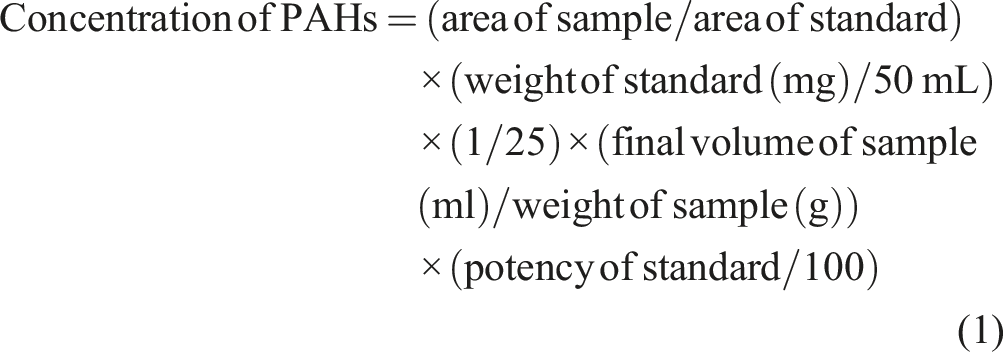
Between- and Within-Day Precision (%RSD) and Accuracy of PAHs.


Chromatogram showing mix of standards (0.1 µg/mL): 1; naphthalene, 2 and 3; acenaphthene, phenanthrene, 4; anthracene, 5; fluorene, 6; flouranthene, 7; pyrene, 8; benzo [α] pyrene.
Statistical Analysis
Data generated was statistically analyzed by two-way analysis of variance (two-way ANOVA) by employing GraphPad Prism 6.0 GraphPad Software 2365 Northside Dr Suite 560 San Diego, CA 92108.
Results
PAHs Concentration in Leg Meat Tissue (ng/g ± SEM)
Total PAHs Concentration (Mean ± SEM) Ng/G in Raw and Condiment Recipes (R1, R2, R3, and R4) Pasted Duck Organs Before and After Wood Charcoal Grilling.
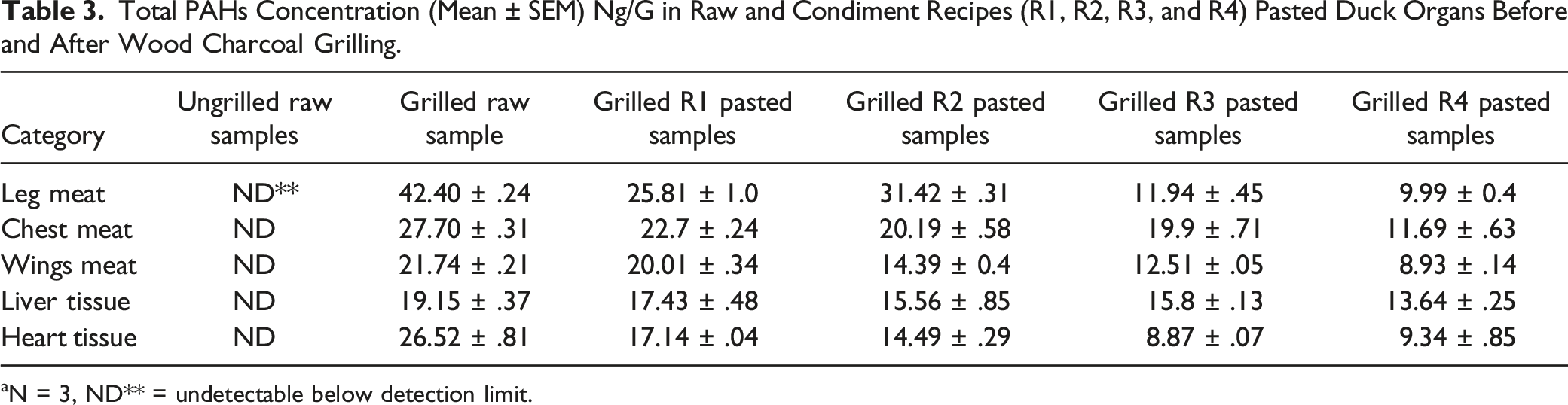
aN = 3, ND** = undetectable below detection limit.

PAHs concentration (ng/g ± SEM) harvested during coal grilling in leg meat samples before and after pasting with R1, R2, R3, and R4 condiments combinations (P ≥ .05).

Chromatograms coal grilled duck leg meat pasted condiment IV recipe.
PAHs Concentration in Chest Meat Tissue (ng/g ± SEM)
Mean PAHs concentration (27.70 ± .31 ng/g) was also found significantly (P ≤ .05) higher in wood charcoal grilled raw chest meat tissue samples as compared to control (raw chest meat tissue samples without grilling) and charcoal grilled condiment recipes pasted chest meat tissue samples R1 (22.7 ± .24 ng/g), R2 (20.19 ± .58 ng/g), R3 (19.9 ± .71 ng/g), and R4 (11.69 ± .63 ng/g). Mean PAHs concentration (11.69 ± .63 ng/g) in grilled R4 condiment pasted chest meat tissue samples was found significantly (P ≤ .05) decreased as compared to charcoal grilled R1, R2, and R3 condiment pasted chest meat tissue samples (Table 3). Different PAHs such as phenanthrene (8.69 ng/g), naphthalene (4.37 ng/g), and acenaphthalene (4.82 ng/g) were found significantly (P ≤ .05) higher in wood charcoal grilled raw chest meat tissue samples as compared to found in R1, R2, R3, and R4 condiment pasted chest meat tissue samples (Figure 4). However, naphthalene and acenaphthalene concentrations were found significantly (P ≤ .05) decreased, while PAHs anthracene and pyrene were reduced to an undetectable level in R4 condiment pasted wood charcoal grilled chest meat tissue samples as compared to polycyclic aromatic hydrocarbons found in wood charcoal grilled raw chest meat tissue samples and tissue samples harvested from all other condiment (R1, R2, and R3) pasted chest meat samples. Moreover, PAHs BaP was found significantly (P ≤ .05) higher in R2 and R3 condiment pasted chest meat tissue samples as compared chest meat tissue samples collected from all other groups. PAHs concentration (ng ± SEM) harvested during coal grilling in chest meat samples (n = 3) before and after pasting with R1, R2, R3, and R4 condiments combinations (P ≥ .05).
PAHs Concentration in Wings Meat Tissue (ng/g ± SEM)
Similarly, in wood charcoal grilled raw wings meat tissue samples without any condiment treatment, the mean PAHs concentration (21.74 ± .21 ng/g) was found significantly higher (P ≤ .05) as compared to control (raw wings meat without grilling) and wing meat tissue samples pretreated with condiment recipes R1 (20.01 ± .34 ng/g), R2 (14.39 ± .40 ng/g), R3 (12.51 ± .05 ng/g), and R4 (8.93 ± .14 ng/g) as shown in Table 3. Poly aromatic hydrocarbons such as phenanthrene (5.69 ng/g) and acenephthalene (3.70 ng/g) were found significantly (P ≤ .05) higher in wood charcoal grilled raw wings meat tissue samples without any condiment treatment as compared to wood charcoal grilled wings meat tissue samples pretreated with condiment recipes R1, R2, R3, and R4 (Figure 5). Mean PAHs concentration in R4 condiment pasted wing meat grilled samples was significantly (P ≤ .05) reduced as compared to grilled raw wings meat tissue without any condiment treatment and grilled condiment recipes R1, R2, and R3 pasted wings meat tissue samples. Anthracene was found significantly (P ≤ .05) higher in grilled R1 condiment pasted wings meat tissue samples as compared to all other groups. However, PAHs naphthalene, acenaphthalene, fluorine, and anthracene concentration were significantly (P ≤ .05) reduced to an undetectable level in charcoal grilled R4 condiment pasted wings meat tissue samples as compared to polycyclic aromatic hydrocarbons found in wood charcoal grilled wings meat and other condiment (R1, R2, and R3) pasted wings meat tissue samples. PAHs concentration (ng ±SEM) harvested during coal grilling in wings meat samples before and after pasting with R1, R2, R3, and R4 condiments combinations (P ≥ .05).
PAHs Concentration in Liver Tissue (ng/g ± SEM)
PAH concentrations (19.15 ± .37 ng/g) were found significantly (P ≤ .05) higher in wood charcoal grilled raw liver tissue samples without prior condiment treatment as compared to control (raw tissue of liver samples without heat treatment) and charcoal grilled condiment recipes pasted liver tissue samples R1 (17.43 ± .48 ng/g), R2 (15.56 ± .85 ng/g), R3 (15.8 ± .13 ng/g), and R4 (13.64 ± .25 ng/g) as shown in Table 3. Concentrations of naphthalene (5.90 ng/g) and anthracene (4.31 ng/g) were found significantly (P ≤ .05) higher in wood charcoal grilled raw liver tissue samples without prior condiment treatment as compared to control (raw tissue of liver samples without heat treatment) and charcoal grilled condiment (R1, R2, R3, and R4) recipes pasted liver tissue samples (Figure 6). PAHs concentration in grilled R4 condiment pasted liver tissue samples was found significantly (P ≤ .05) decreased as compared to grilled raw liver tissue samples and grilled R1, R2, and R3 condiment pasted liver tissue samples, while concentration of phenanthrene was found significantly (P ≤ .05) higher in grilled R3 condiment pasted liver tissue samples as compared to tissue samples of all other groups. However, concentrations of naphthalene and acenaphthalene levels were significantly (P ≤ .05) reduced to an undetectable level in grilled R4 condiment pasted liver tissue samples as compared to poly aromatic hydrocarbons found in wood charcoal grilled liver tissue without condiment treated samples and other grilled condiment (R1, R2, and R3) pasted liver tissue samples. PAHs concentration (ng ± SEM) harvested during coal grilling in liver meat samples before and after pasting with R1, R2, R3, and R4 condiments combinations (P ≥ .05).
PAHs Concentration in Heart Tissue (ng/g ± SEM)
In wood charcoal grilled heart tissue without condiment treated samples, PAHs concentration (26.52 ± .81 ng/g) was found significantly higher (P ≤ .05) as compared to control (raw heart tissue samples without heat treatment) and coal grilled condiment pasted heart tissue samples R1 (17.14 ± .04 ng/g), R2 (14.49 ± .29 ng/g), R3 (8.87 ± .07 ng/g), and R4 (9.34 ± .85 ng/g) as shown in Table 3. Concentration of naphthalene (4.36 ng/g) and acenaphthalene (3.82 ng/g) and BaP (5.01 ng/g) were found significantly higher (P ≤ .05) in wood charcoal grilled heart tissue without condiment treated samples as compared to raw heart tissue samples without heat treatment and wood charcoal grilled condiment R1, R2, and R3 pasted heart tissue samples as shown in Figure 7. Mean PAHs concentration in wood charcoal grilled R4 condiment pasted heart tissue samples was found significantly (P ≤ .05) decreased as compared to grilled raw heart tissue samples without condiment treatment and grilled heart tissue samples pretreated with condiment recipes R1, R2, and R3, while concentration of phenanthrene was found significantly (P ≤ .05) higher in grilled R1 and R3 condiment pasted heart tissue samples as compared to ungrilled and grilled tissue samples collected from all other groups. However, concentrations of PAHs fluorine, acenaphthalene, anthracene, and BaP levels were found significantly (P ≤ .05) reduced to an undetectable level in wood charcoal grilled R4 condiment pasted heart tissue samples as compared to poly aromatic hydrocarbons found in wood charcoal grilled heart tissue samples pasted with condiment recipes R1, R2, and R3. PAHs concentration (ng ± SEM) harvested during coal grilling in heart meat samples before and after pasting with R1, R2, R3, and R4 condiments combinations (P ≥ .05).
Discussion
Composition of Different Condiment Recipes Used in the Study.

Control/raw or wood charcoal ungrilled samples from all duck organs did not show the presence of any of the selected 8 PAHs found below the limit of detection. However, leg meat tissue samples among wood charcoal grilled samples without any prior condiment treatment depicted highest levels (42.40 ng/g), while minimum level (19.15 ng/g) of PAHs was observed in wood charcoal grilled raw liver tissue sample without any prior marinating of condiment treatment. All other wood charcoal grilled samples showed the PAHs within these limits. Leg meat tissue samples without any prior condiment treatment showed highest level of fluorene (17.7 ng/g) and BaP (12.52 ng/g), while minimum levels of anthracene (1.73 ng/g) were observed in liver tissue samples without any prior condiment treatment. Highest levels of overall PAHs level in charcoal grilled raw leg meat tissue samples without prior condiment treatment and lowest in wood charcoal grilled raw liver tissue samples without marinating with any condiment might be due to varying degree of physiochemical characteristics of each organ. Previously, it was found that polluted water, air, soil deposits, and burning of biological material like wood charcoal in open atmospheric conditions might act as source of PAHs in ungrilled as well as grilled samples.3,22 Literature highlights extensively that intake of 90% of total PAHs occur through food ingestion (European commission, 2011). Meat grilling at high temperatures produced considerable amounts of cooking toxicants (HAs) and polycyclic aromatic hydrocarbons. 23 More than 25 HAs have been isolated and identified in cooked foods since their discovery roughly 30 years ago. 24 They are split into 2 groups: aminoimidazo-azaarenes (also known as “thermic HAs”) and amino-carbolines (also known as “pyrolytic HAs”). At temperatures between 150 and 250°C, complicated processes involving creatine/creatinine, free amino acids, and sugars result in the formation of thermic HAs. 25 Pyrolytic HAs have a less clear path to synthesis than thermic HAs, however, it has been claimed that they can be formed by pyrolysis of proteins or amino acids heated at higher temperatures (>250°C) and are not creatine-dependent. 26
Percentage Reduction of PAHs After R1, R2, R3, and R4 Condiment Pasted Different Duck Organs as Compared to PAHs Concentration in Raw Coal Grilled Duck Organs.

The levels of fluorene (2.29 ng/g) and BaP (.43 ng/g) concentrations were reduced below the MRL (5 ng/g) set by European Commission guidelines, while naphthalene, acenaphthalene, and fluoranthrene remained undetectable in modified condiment IV pasted wood charcoal grilled leg meat samples. Concentration of naphthalene and acenaphthalene was reduced, while anthracene and pyrene were absent in R4 condiment pasted wood charcoal grilled chest meat samples. While phenanthrene was found significantly high in modified condiment I and modified condiment III pasted heart meat samples as compared to all other groups.
However, naphthalene, acenaphthalene, fluorine, and anthracene concentration were reduced to an undetectable level in modified condiment 1V pasted wood charcoal grilled wings meat tissue samples, while phenanthrene was increased in modified condiment III condiment pasted liver samples as compared to all other groups. However, naphthalene and acenaphthalene levels were reduced to an undetectable level in modified condiment IV pasted wood charcoal grilled liver samples. However, fluorine, acenaphthalene, anthracene, and BaP levels were reduced to an undetectable level in modified condiment IV pasted wood charcoal grilled heart samples as compared to polycyclic aromatic hydrocarbons found in wood charcoal grilled chest meat and other condiment pasted chest meat samples (modified condiment I, II, and III). It was found that cooking of duck meat by roasting and charcoal grill lead to increased levels of PAHs to 130 μg/g and 320 μg/g, respectively. However, formation of PAH levels was decreased to 8.6 µg/g while steaming the duck meat. 35 In grilled fish meat samples, PAH levels were found between 9 ng/g and 130 ng/g. 36 Furthermore, levels of different PAHs such as pyrene and fluorine in chicken were detected to be higher after oil frying. 37
PAHs are generated by pyrolysis of organic materials like protein, lipids, and carbohydrate at higher temperature of 200°C, however, increased temperature leads more PAHs synthesis. 38 Presence of more fat contents in meat and dripping of oil at intense hot flame 17 during wood charcoal grill lead PAHs adhesion over exposed surface of meat in the current study. Moreover, major mechanism of PAHs formation might be formed through free radical reactions. 39 Therefore, results of the current study confirmed that the antioxidant and polyphenols that have free radical scavenging activity could inhibit PAHs generation 40 during wood charcoal grilling.
PAHs formation in food is affected by food processing methods (grilling, roasting, and frying) among many risk factors such as temperature, fat content, oil dripping, and direct exposure of food to heating source. 41 As a result, food contains contaminants (European Commission, 2002). PAHs, due to its lipophilic nature, enter the food chain and accumulate in lipophilic compartments of the body. 42 PAHs generation also depends on the composition of food or type of meat being cooked when exposed to heat treatment.
Previously, Janoszka (2011) studied the impact of onion (30g) as additive in pork meat (100g) to reduce the formation of PAHs to 60% during pan frying and 90% reduction while in gravies. Addition of garlic (15/100g) reduced the production of PAHs to 54% in meat samples, while 13.9 to 79% in gravies formulation of meat. 14 In our study, marinating the duck leg meat sample with modified condiment-IV recipes consisting of maximum condiments as a source of antioxidants before wood charcoal grilling neutralized and reduced the generation of PAHs to 76.43% below MRL of 30 μg/kg for total PAHs set by the European Union Directive, 2011.
The additives as condiments such as onion, garlic, lemon juice, and clove powders are rich sources of antioxidants in the form of phenols and flavonoids which possess the ability to scavenge the free radical and also inhibit the production of overall PAHs level during wood charcoal grilling.
Conclusion
Wood charcoal grilling is an active source for the generation of PAHs. Maximum concentration of PAHs is found in leg wood charcoal grilled samples. However, varying concentrations of PAHs in wood charcoal grilled different organ samples of falcated duck pretreated with different condiment recipes may be due to the presence of different levels of fat contents in each organ. Condiments paste of onion, garlic, lemon juice, and clove powders is a rich source of antioxidant in the form of phenols and flavonoid which possess the ability to scavenge the PAHs as free radical and inhibit the generation of overall concentration of PAHs during wood charcoal grilling.
Supplemental Material
Supplemental Material - Condiment Recipes Lead to Reduced Generation of Carcinogenic Polycyclic Aromatic Hydrocarbons in Duck Variety Meat During Charcoal Grilling
Supplemental Material for Condiment Recipes Lead to Reduced Generation of Carcinogenic Polycyclic Aromatic Hydrocarbons in Duck Variety Meat During Charcoal Grilling by Gulshan Shahid, Muhammad Yousaf, Haseeb Anwar, Imran Mukhtar, and Abdul Basit in Dose-Response
Footnotes
Acknowledgments
Project was supported technically by the Department of Chemistry, Government College University Faisalabad. Ms. Gulshan Shahid is a Ph D Scholar who performed the experiment, prepared the initial manuscript, and completed the project under the supervisor Dr Muhammad Yousaf, in the Department of Chemistry, Government College University, Faisalabad, Pakistan. Imran Mukhtar analyzed the results. While Dr Haseeb Anwar refined and Abdul Basit read the final manuscript.
Declaration of conflicting interests
The author(s) declared no potential conflicts of interest with respect to the research, authorship, and/or publication of this article.
Funding
The author(s) received no financial support for the research, authorship, and/or publication of this article.

Data Availability Statement
Data reported in the current study are available on request.
Supplemental Material
Supplemental material for this article is available online.
References
Supplementary Material
Please find the following supplemental material available below.
For Open Access articles published under a Creative Commons License, all supplemental material carries the same license as the article it is associated with.
For non-Open Access articles published, all supplemental material carries a non-exclusive license, and permission requests for re-use of supplemental material or any part of supplemental material shall be sent directly to the copyright owner as specified in the copyright notice associated with the article.
