



Abstract
Medicinal plants are gaining popularity over synthetic medicines because antibiotic resistance demands the alternative source of medication. In the present research, the crude protein extraction of 4 medicinal plants Cassia fistula, Saccharum officinarum, Albizia lebbeck and Cymbopogon citrates was carried out. Crude protein extraction was done by 2 different buffers i.e. Tris NaCl buffer and PBS buffer. Protein confirmation was done by Bradford assay in the spectrophotometer. Antibacterial potential was checked and compared against Escherichia coli, Bacillus subtilis, Neisseria gonorrhoea, Bacillus cereus and Proteus mirabilis. Antibacterial assay was performed by disc diffusion method, agar well method and zones of inhibition were calculated. The study results indicated that Tris NaCl extracts’ antimicrobial potential is higher than that of the PBS buffer. On disc diffusion method the Tris NaCl buffer extracts of Cymbopogon citrates showed maximum zone of inhibition 11 mm and 9 mm against Bacillus subtilis and Bacillus cereus respectively and control chloramphenicol showed maximum zone of inhibition 26 mm against Bacillus subtilis. Cassia fistula showed maximum zone of inhibition of 7 mm against Bacillus cereus while Saccharum officinarum and Albizia lebbeck didn’t show the any antibacterial activity. On the other hand, Protein extracts from PBS buffer didn’t show zone of inhibition against any bacteria. Only Albizia lebbeck showed minute zone of inhibition against Neisseria gonorrhea. On well diffusion method, Cassia fistula Tris NaCl protein extract showed the maximum zone of inhibition 20 mm and 18 mm against Proteus mirabilis and Bacillus subtilis respectively. While Albizia lebbeck PBS protein extract showed the maximum zone of inhibition 19 mm and 17 mm against Bacillus subtilis and Bacillus cereus. The results revealed that the protein extract of Albizia lebbeck, Cymbopogon citrates and Cassia fistula can be used tosynthesize antimicrobial drugs to treat the bacterial infections.
Keywords
Introduction
Medicinal plants are serving very valuable from the pharmacological point of view from all over the realm. The uses of medicinal plants are becoming popular with advancing time and offer the human with new remedies. 1 In the traditional system, various ethnic plants are being utilized to diagnose, deter, and abolition bodily, psychological and neurological imbalance. 2 Therapeutic effects of many of the medicinal plants have been confirmed for neurological diseases, 3 fungal diseases, 4 diabetes, 5 diseases of lungs and respiratory system, 6 children’s diseases, 7 hyperlipidemia, 8 obesity, 9 liver diseases, 10 cardiovascular diseases, 11 migraine 3 and many other diseases.
Different types of researchon medicinal plants and utilizing them are valuable resources for overcoming many diseases at present. This helps to get to know much more about the medicinal plants and assemble new drugs that will lead to the pharmaceutical industry’s advancement. 12 Due to the positive impact of these researches on medicinal plants during the past years, most of the pharmaceutical industries are exceedingly relying on wild population for the abstraction of medicinally important chemical substances. 3 This also helps in synthesizing new drugs with medicinal value that can combat disease better way thancommercially available synthetic and potent but harmful drug. 13
Saccharum officinarum plant is famous in relieving complaints like jaundice, dysuria, anuria, and other urinary diseases. 14 Around 250,000 existing plants hold a widevariety of bioactive chemicals than any chemical based library developed by humans. Phytochemicals are present in different parts of plant tissues; these include fruits, seeds, herbs and vegetables. Methanolic and ethanolic extracts of Saccharum officinarum leaves possess encouraging antioxidant activity. 15 These extracts also possess in vitro anti-inflammatory activity. 15 Saccharum officinarum leaves and juice has several medicinal constituent including fatty acid, alcohol, phytosterols, phenols, terpenoids, flavonoids and glycosides. 14 Cymbopogon citrates is widely used in conventional medicine for treating numerous disorders like nervous and digestive system problems. It mainly acts as antispasmodic, pain killer, anti-inflammatory, anti-pyretic, diuretic and sedative. 16 Cymbopogon citrates is also extensively used in the food, pharmaceutical, cosmetic and medicinal industries because of its essential chemical constituents. 17 Its antioxidant potential and activities against microbes and fungus have also been documented by carrying out studies on various extracts of Cymbopogon citrates. 18 Majority of the plant chemical constituents like essential oils, peptides etc. show significant antimicrobial properties and which could be further explored on an advanced basis to produce novel antimicrobial formulations. 19 Albizia lebbeck also has a significant antibacterial activity. Studies indicated that Shigella was the most sensitive bacteria to the Albizia lebbeck. 20 Albizia lebbeck also showed the antibacterial activity with high zone of inhibition against Escherichia coli, Bacillus subtilis, Klebsiella pneumonia, Pseudomonas aeruginosa, Proteus vulgaris, Staphylococus aureus and Salmonella typhii. 21 On the other hand, Casssia fistula is well known for its antibacterial activity. 22 Casssia fistula had potent antibacterial activity against S. typhosa at a dose lower than 1000 mg/kg. 23
The antimicrobial peptides (AMPs) form the first line of defense in the plant’s protective mechanisms and is tangled in innate immunity. 24 The antimicrobial activity of AMP has been reported in many researches against fungi, viruses and bacteria that confirm that AMPs are involved in host plant resistance against pathogen attack. 25 AMPs are extensive in nature and are produced in both animals and plants. They are the most antique peptides synthesized during host defense mechanism. 26 Once produced and activated, defensive proteins efficiently inhibit fungus, gram-positive and gram-negative bacteria. 27 Plants protect themselves against pathogen attack by synthesizing several types of proteins (AMP) such as glucanases, chitinases, defensins, catalase and glycoprotein etc. These proteins directly or indirectly play their role in defence mechanisms that leads to pathogen death. These proteins can also protect the host by inducing and potentiating several other plant defencing mechanisms. 28 Some of These proteins possess antimicrobial activities by performing hydrolytic action on cell wall components of pathogen. 29 These peptides act as antimicrobial agents against pathogens that defend the plant by different pathways. First they result in the formation of pores in pathogens’ membranesor they induce the alteration in the membrane permeability by interrupting the electrostatic charge on its. 30 A number of plant AMPs like defensins have been identified and purified from several plant species that express a wide range of remarkable biological activities regarding the defence. These biological activities include, ion-channel blocking and antifungal and antibacterial activity. 30 Many parts of plants such as leaves and seeds contain these proteins that definitely impede pathogen action. Different solvents are used for the extraction of therapeutically essential compounds from the leaves. This research study aimed to extract medicinally important phytochemicals specifically the antimicrobial peptides from the 4 medicinally important plants that belongi to the Poaceae and Fabaceae families. Several AMP have been documented in these families, so we selected these 2 families’ plants to extract proteins to perform the antimicrobial assay.
Materials and Methods
Plant Sample Collection
Collection of fresh, intact plant leaves was done from the nursery of The Women University Multan, Pakistan. Plants were identified and confirmed by the Department of Botany, The Women University Multan, Pakistan. Samples were washed, dried and cut into small pieces through sterilized scissor.
Extraction of Antibacterial Protein/Peptide by Tris NaCl Buffer
Extraction of antimicrobial peptides was done by grinding fresh 1gm leaves of each plant in 3.3 ml of 1 Molar Tris-HCl (pH 7.5) and 0.5 Molar NaCl. The sample buffer mixture was incubated for 12 hours at 4°C. After that, samples were centrifuged at 12,000 rpm for 20 minutes in a centrifuge at 4°C. After centrifugation, the resulting supernatant was analyzed for protein concentration determination. 31
Determination of Protein Concentration by Spectrophotometer
Total protein content of each of the leaf protein extract was checked spectrophotometrically at 595 nm. Bradford method was performed by forming a BSA (Bovine Serum Albumin) stock solution in a concentration of (2 mg/ml) for PBS and (1 mg/ml) for extracts of Tris NaCl samples. Bradford reagent was prepared and diluted 1:4 times by mixing 3 ml of the reagent with 12 ml of distilled autoclaved water. The reagent was then filtered by Whatman #1 paper immediately before use. Bradford reagent was prepared according to the recipe given. 33
Test Organisms/Bacterial Organisms
The test organisms used in the study were supplied by the Culture Collections of the Department of Microbiology and Molecular Genetics, The Women University Multan. The organisms used in the study were Escherichia coli, Bacillus subtilis, Bacillus cereus, Proteus mirabilis and Neisseria gonorrhoea
Antibacterial Assay
Organisms were grown on the Luria-Bertani Agar Media and were incubated for night at 37°C for 24 hours. Antibacterial assay of the protein extracts was carried out by Agar Disc diffusion method. Zones of inhibition were measured. Chloramphenicol, commercially prepared disc in a concentration of 10 ug / disc was used as positive control.
Disc Diffusion Method
Discs (6 mm) of Watman filter paper 1 were made. Plant extracts containing a measured amount of (20 µg) protein samples were loaded on individual disc and placed on the plates. Plates were incubated for 24 hours at 37°C in an incubator. Each sample’s activity was checked by measuring the zones of growth inhibition developed in millimeters with the help of a graduated scale. 34
Well Diffusion Method
Bacterial susceptibility to the plants was determined by agar well diffusion method as described by. 35
Results
Concentration of Plant Protein Sample in Spectrophotometer
Absorbance of protein extracts of each plant leaf sample was calculated on spectrophotometer at 595 nm. Concentration of plant protein samples extracted through different buffers was given in Table 1. The maximum protein concentration of 6073 ug/ml was found in Cassia fistula extract by Tris NaCl buffer while the protein concentration of same plant with PBS buffer with freeze thaw cycles was 2438 ug/ml and without freeze thaw cycles was 2019 ug/ml. According to the table results, the protein concentration in plant extracts in Tris NaCl buffer was higher than extracts in PBS buffer. Extraction in PBS buffer was done by passing the extracts with and without freeze-thaw cycles. The concentration of protein was higher in PBS buffer without freeze-thaw cycles, as protein concentration in Saccharum officinarum with PBS buffer with freeze-thaw cycles was 503 ug/ml while in the without freeze-thaw cycles it was 889 ug/ml. The concentration of the same plant from Tris NaCl buffer was 2043 µg/ml that was greater than the PBS buffer extraction protein concentration.
Concentration of Plant Protein Samples Extracted Through Different Buffers.

Disc Diffusion Method
Antibacterial activity of protein extracts through Tris NaCl buffer
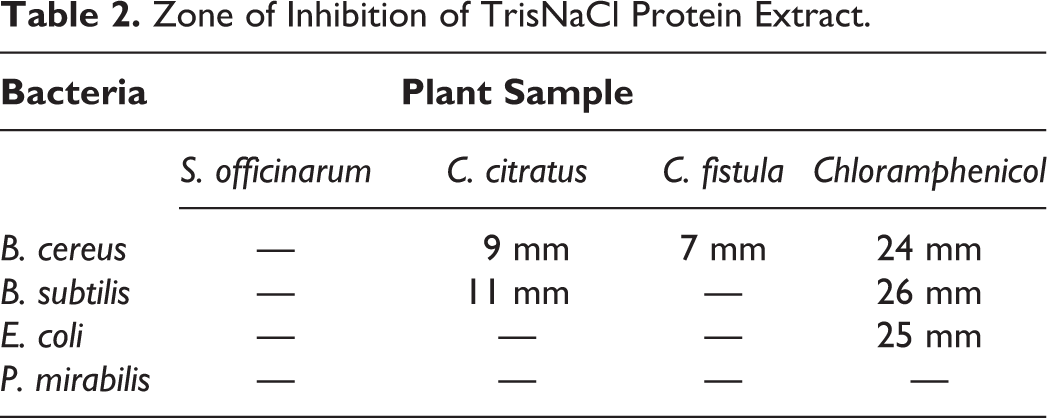
Zone of inhibition of different bacterial strains was determined by using the protein extract of plants and Chloramphenicol. Protein extracts of Cymbopogon citratus showed a zone of inhibition 11 mm against the B. subtilis and Cassia fistula showed zones of inhibition 7 mm against Bacillus cereus (Figure 1). Cymbopogon citratus also showed zone of inhibition 9 mm against Bacillus cereus. While no zones of inhibition were shown against remaining bacterial organisms. Protein extracts of other plants Saccharum officinarum and Albizia lebbeck were not shown any zone of inhibition against bacteria (Figures 1 and 2). Control was Chloramphenicol, commercially prepared disc in a concentration of 10 µg / disc that showed maximum zone of inhibition 26 mm against B. subtilis (Table 2).

Zone of inhibition of crude protein extracts through TrisNaCl buffer

Zone of inhibition of crude protein extracts through TrisNaCl buffer
Zone of Inhibition of TrisNaCl Protein Extract.
Antibacterial activity of protein extracts through PBS buffer
Antibacterial assay was performed by using disc diffusion method against Bacillus subtilus, Bacillus cereus, Proteus mirabilis, and Neisseria gonorrhea. Protein extracts didn’t show any zone of inhibition against any bacterial organism. While Albizia lebbeck showed minor antibacterial activity against Neisseria gonorrhea (Figure 3).

Zone of inhibition of crude protein extracts through PBS buffer
Well Diffusion Method
Antibacterial activity of protein extracts through Tris NaCl buffer
Zone of inhibition of different bacterial strains was determined by using the protein extract of plants. Protein extracts of Cassia fistula showed zone of inhibition 15 mm, 18 mm and 20 mm against the B.cereus, B. subtilis and P.mirabilis respectively. Albizia lebbeck showed zones of inhibition 14 mm against Bacillus subtilis (Figure 4). While no zones of inhibition were shown against remaining bacterial organisms. Protein extracts of other plants Saccharum officinarum and Cymbopogon citratus were not show any zone of inhibition against bacteria (Figures 4 and 5)
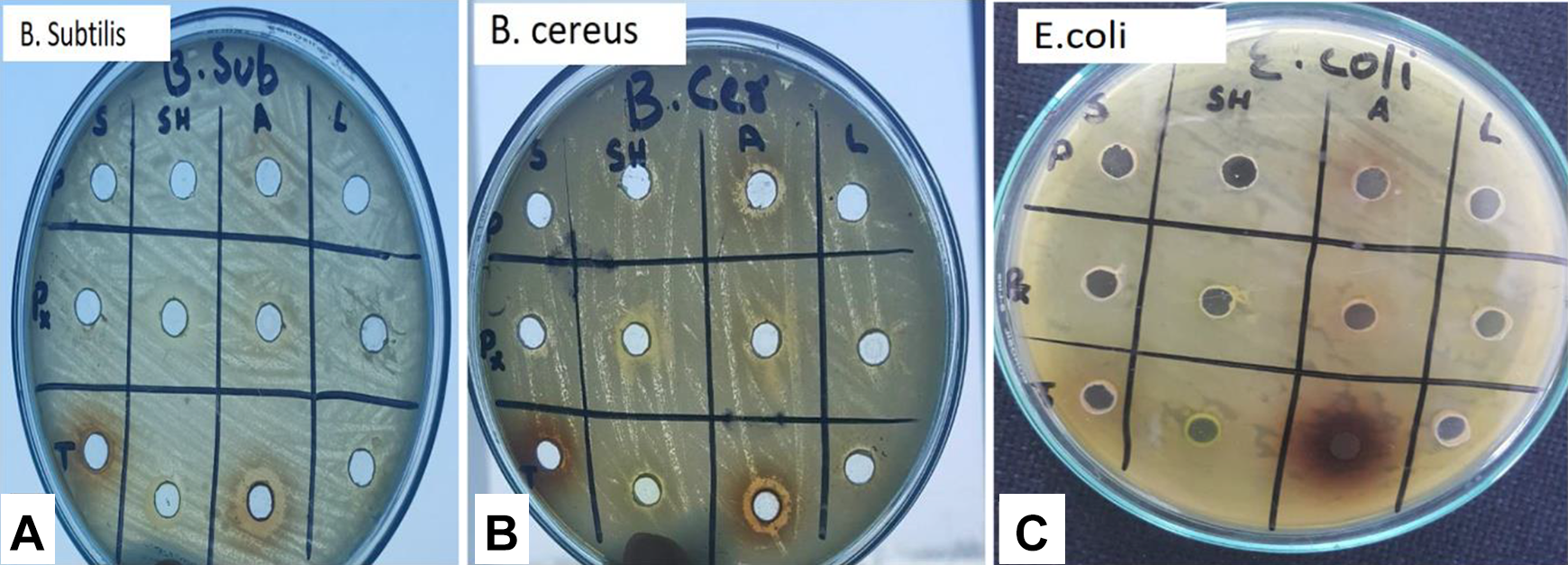
Zone of inhibition of crude protein extracts through Tris NaCl buffer using well diffusion method

Zone of inhibition of crude protein extracts through Tris NaCl buffer
Antibacterial activity of protein extracts through PBS buffer without freeze-thaw
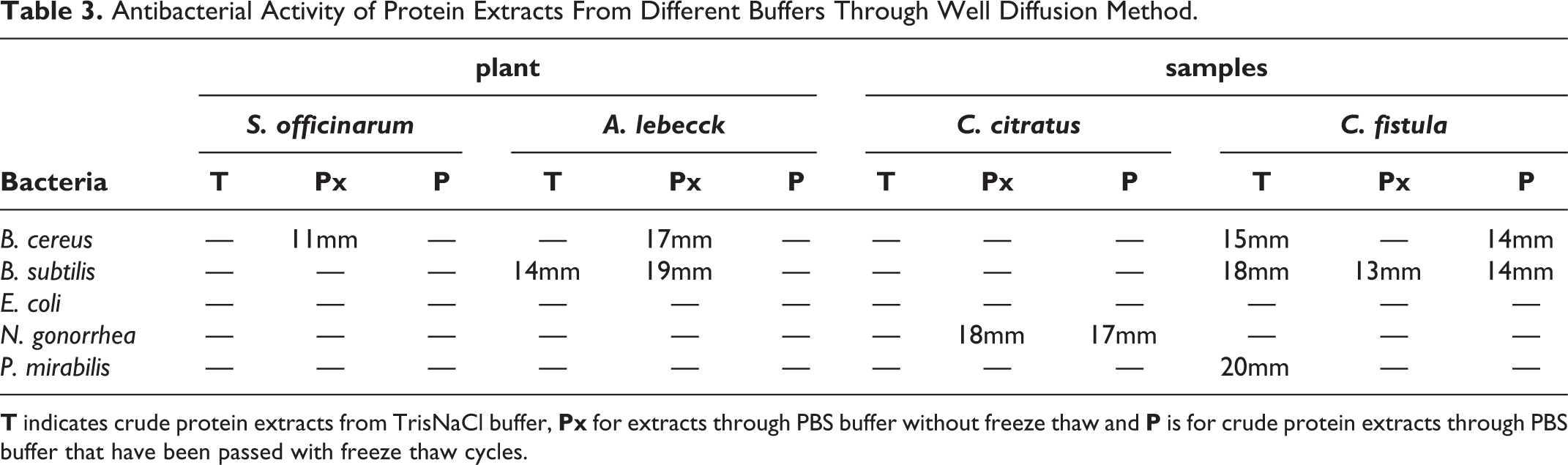
Antibacterial assay was performed by using well diffusion method against Bacillus subtilus, Bacillus cereus, Proteus mirabilis, E.coli and Neisseria gonorrhea. Protein extracts of Saccharum officinarum and Albizia lebbeck showed zone of inhibition 11 mm and 17 mm against B. cereus respectively (Table 3). Cymbopogon citrates showed zone of inhibition 18 mm against N. gonorrhea and C. fistula showed zone of inhibition 13 mm against B.subtilis.
Antibacterial Activity of Protein Extracts From Different Buffers Through Well Diffusion Method.
Antibacterial activity of protein extracts through PBS buffer with freeze-thaw
Antibacterial activity of different plant protein extracts was done using agar well diffusion method. Cymbopogon citrates showed a zone of inhibition 18 mm against N. gonorrhea. Protein extracts of Cassia fistula showed zone of inhibition 14 mm against B. cereus 14 mm against B. subtilis. While no zones of inhibition were shown against remaining bacterial organisms. Protein extracts of other plants Saccharum officinarum and Albizia lebbeck did not show any zone of inhibition against bacteria.
Discussion
Many medicinal plants are considered possible antimicrobial drugs and along with that, they have also considered a source for novel chemicals with antibacterial activity. Different plant extractions have been done in many studies and suggested them as antimicrobial elements. Antimicrobial activities of several plants have been studied that include Annona muricata,
36
Nigella sativa,
37
Spirulina platensis,
38
Adathoda vasica,
39
Cymbopogon citratus
40
etc. Keeping in mind the antimicrobial activity of peptides, this study was conducted to extract the crude proteins from 4 medicinally important plants named Cassia fistula, Saccharum officinarum, Cymbopogon citratus and Albizia lebbeck. Antibacterial activity of these plants was checked against Escherichia coli, Bacillus subtilis, Bacillus cereus, Pseudomonas aurigenosa, Proteus, Neisseria gonorrhoea. In this study, 2 buffers Tris NaCl and PBS buffer were used for the protein extraction. The maximum protein concentration of 6073 ug/ml was found in Cassia fistula extract by Tris NaCl buffer. While same plant’s protein concentration with PBS buffer with freeze-thaw cycles was 2438 µg/ml and without freeze-thaw cycles was 2019 ug/ml. Protein concentration in plant extracts in Tris NaCl buffer was higher than extracts in PBS buffer. The concentration of protein was higher in PBS buffer without freeze thaw cycles, as protein concentration in
In this study, plant protein extract of Tris NaCl buffer showed the zone of inhibition for bacterial strains. Plant protein extract of PBS buffer did not show any zone of inhibition for bacterial strains however Albizia lebbeck showed minor zone of inhibition for Neisseria gonorrhea on disc diffusion method. Tris NaCl protein extract of Cymbopogon citratus showed maximum zone of inhibition 11 mm against the B. subtilis and 9 mm against Bacillus cereus. Cassia fistula showed zones of inhibition 7 mm against Bacillus cereus on the disc diffusion method. While on the agar well method, Cassia fistula Tris NaCl protein extract showed the maximum zone of inhibition 20 mm and 18 mm against Proteus mirabilis and Bacillus subtilis respectively. While Albizia lebbeck PBS protein extract showed the maximum zone of inhibition 19 mm and 17 mm against Bacillus subtilis and Bacillus cereus. Chloramphenicol showed maximum zone of inhibition 26 mm for B. subtilis. Nyamath & Karthikeyan 53 demonstrated the antibacterial activity of ethanol extract of Cymbopogon citratus against Staphylococcus aureus with 12.50 mm zone of inhibition. Cymbopogon citratus has also an excellent dye adsorption with antibacterial properties. 54 Akeel et al. 55 conducted study to evaluate the antimicrobial effect of crude peptide extracts from seeds of 6 plant seeds. Extraction was done in Sodium phosphate citrate buffer and Sodium acetate buffer. Allium ascolinicum sodium phosphate citrate extract showed maximum zone of inhibition 17 mm, 17 mm and 15 mm against Escherichia coli, Proteus vulgaris and Staphylococcus aureus. Ali et al. 56 demonstrated the moderate antimicrobial activity Albizia lebbeck extract against the Aspergillus niger, Bacillus subtilis, Vibrio mimicus, Staphylococcus aureus, Salmonella typhi, Shigella dysenteriae and Candida arrizae. Bobby & Wesely 21 also described the antimicrobial activity against Escherichia coli, Bacillus subtilis, Klebsiella pneumonia, Pseudomonas aeruginosa, Proteus vulgaris, Staphylococus aureus and Salmonella typhii.
In our study the crude protein extraction was carried out using Tris NaCl buffer and PBS buffer. The Tris NaCl extracts of Cassia fistula showed maximum anti-bacterial activity against gram-positive bacteria while the crude protein extracts of Saccharum officinarum didn’t show any significant antibacterial activity against any gram positive and gram negative tested microorganism. However on the agar well method, the PBS proteins extract of the plant show the 11 mm zone of inhibition against Bacillus cereus. This negative antibacterial activity of proteins of Saccharum officinarum supports the previous study of De-Paula et al. 57 that tested defensing proteins Sd1, Sd3, Sd5against gram positive and gram negative bacteria including Kocuria rhizophila, Bacillus subtilis, Escherichia coli and Staphylococcus aureus. Proteins showed no antibacterial activity against tested microorganisms. 57 Kadhim et al., 22 were analyzed the antibacterial activity of Cassia fistula against 11 disease causing bacteria. The diameters of zones of inhibition were ranged from 1.00 ± 0.05 to 6.02 ± 0.23 mm for all assays. 22 In another study, flowers of Cassia fistula were used for the extraction of chemically active compounds using different solvents. Hexane, methyl alcohol, chloroform, ethyl acetate, and water extracts were taken and screened against pathogens like bacterial and fungal microbes. Upon results, all of the extracts showed antibacterial activity against Gram-positive organisms with minimum inhibitory concentrations between 0.078 and 2.5 mg/ml. 58
Conclusion
Present study results concluded that Tris NaCl protein extract of Cymbopogon citratus and Cassia fistulawere more effective against the bacterial strains as compared to PBS buffer extract. Cymbopogon citratus has antibacterial activity against Bacillus subtilis, Bacillus cereus with zone of inhibition 11 mm, 9 mm respectively and Cassia fistula has antibacterial activity against Bacillus cereus with 7 mm zone of inhibition. While PBS protein extract of Albizia lebbeck showed the maximum antibacterial activity against Bacillus subtilis, Bacillus cereus. Anti-bacterial activity of these protein extract suggests that these protein extract of plants can be used against the bacterial infection to improve human health.
Footnotes
Declaration of Conflicting Interests
The author(s) declared no potential conflicts of interest with respect to the research, authorship, and/or publication of this article.
Funding
The author(s) received no financial support for the research, authorship, and/or publication of this article.