



Abstract
This commentary describes the origin and the main results of experimental work on adaptive stress responses at the university town Jena in Germany. These cooperative research activities exemplify the heuristic power of the hormesis phenomenon.
Germany is well equipped with medieval castles. Some of them have been renovated and are often used as museums but others have been furbished up as places for scientific meetings. This report is aimed to describe the key role of Dornburg castle as a crystallization point for dose response researchers in the university town Jena in Germany. Dornburg castle was build 1000 years ago by the first German Emperor Otto I. as a typical palatinate (Figure 1). Now, after German reunification the Eastern German university in Jena overtook responsibility for the giant building and reconstructed it as a place for scientific meetings. Dornburg castle near Jena in Germany (copperplate, 17th century). This is a copper plate, which might be ordered digitally via: https://skd-online-collection.skd.museum/Details/Index/975518.
More than 10 years ago the Jena nutritionist Michael Ristow used this university offer and occasionally organized seminars in the castle to discuss brand-new experimental data. These gatherings were aimed to find colleagues at Jena University who shared his growing interest in dose dependent effects of toxins on his favorite model organism Caenorhabditis elegans.
Before long, Ristow was quite successful with his intention, especially after presenting thrilling data on the effects of arsenite on the life span of C. elegans, which was published later in Aging Cell
1
(Figure 2). The vitalizing and life span promoting effect of low doses of toxic arsenite resembling well hormesis provoked immediate enthusiasm of colleagues not only from Biological and Medical Faculties of the Jena University but also from independent biomedical institutes in Jena region. Most of the scientists were attracted by the obvious question: Effects of increasing doses of arsenite on life span of C. elegans (adapted from
1
). This is chosen from Ref. [1] Schmeisser et al. Copyrights have to be taken from John Wiley & Sons Ltd.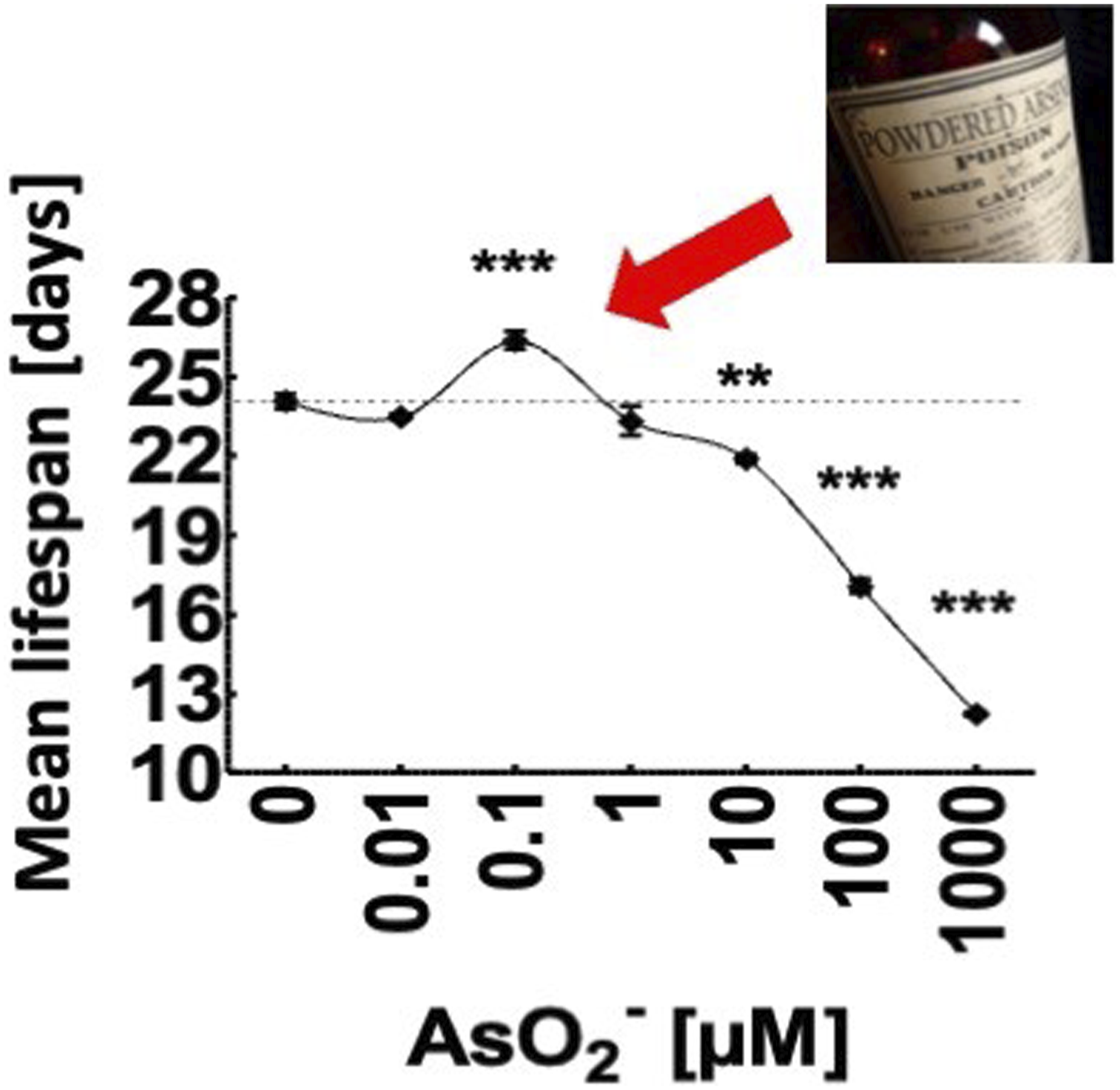
How these intriguing, vitality increasing hormetic effects are controlled at the molecular level?
Inspired by Ristow’s findings, numerous biomedical researchers in Jena surprisedly noticed tight relations of their experimental approaches, models, and questions to the dose dependent effects of arsenite on the worm C. elegans. Ongoing research efforts on the effects of environmental challenges have been broaden from toxins to other stressors. Hence, the biochemist Thorsten Heinzel joined Michael Ristow in investigations of metabolic stress. Using preferentially mouse models, the biochemist Britta Qualmann and the medic Christian Hübner asked for the dose dependent effects of neuronal stress. Promoting a liaison of sepsis medicine and cell biology, Michael Bauer and Reinhard Wetzker started to explore the striking relations of environmental stress responses to microbial infections. Finally, Zhao-Qi Wang a Jena resident researcher of DNA repair processes expanded his research activities to different kinds and doses of genotoxic stress. Widespread experimental efforts on the molecular signature of adaptive stress responses became focus of biomedical research in Jena.
Realizing the enormous potential of this topic, the allied scientists mentioned above in 2011 decided to go for collaborative funding by German Research Council DFG. The joint application was successful in 2012 and allowed for 9 years experimental research on the molecular mechanisms mediating the vitalizing effects of low doses of toxins and other environmental stress agents. Funding permanently provided resources for about 20 experimental projects in the frame of the Research Training Group (RTG) “Molecular Signatures of Adaptive Stress Responses,” which have been structured according to 4 types of environmental stress (Figure 3). In addition to DFG funding the innovative research program attracted enthusiasms of local scientific communities and earned support from Friedrich-Schiller-University, University Hospital, and Leibniz-Institute on Aging in Jena, which all leaned financial and infrastructural support. Four focal points of stress research in Jena. This figure contains several elements taken from the internet. How to handle it?
Four core research areas have been designed by the cited Jena researchers, who also overtook responsibility for the management of the ongoing experimental work of the RTG.
According to the funding role of the German Research Council the RTG was obliged to install an Advisory Board for the ongoing research and educational activities. Fortunately, the consortium succeeded to allure 3 internationally acknowledged representatives of stress and signaling research: Edward Calabrese from University of Massachusetts in Amherst, Suresh Rattan from Aarhus University in Denmark, and Matthias Wymann from Basel University in Switzerland. These scientists were invited for the kick-off meeting of the Research Training Group in 2012 at Dornburg castle. Subsequently, a series of symposia and workshops on “Molecular Signatures of Adaptive Stress Responses” have been organized by the management of the Research Training Group attracting key scientists in the field coming from Germany, Europe, and Overseas including China as a special focus. Dornburg castle became a hotspot for discussing latest results of experimental stress research and hormesis phenomena.
Now in 2021, the Jena Research Training Group is looking back to 9 years of experimental work on adaptive stress responses. Main results on molecular signatures of metabolic stress,2,3 neuronal stress,4-6 infectious and inflammatory stress,7,8 and also genotoxic stress9,10 have been published in renowned Journals of the field.
Unquestionably, all these research products are results of team work revealing the enormous heuristic power of the hormesis phenomenon.
Footnotes
Acknowledgments
The grant support by the German Research Foundation (DFG) of the Research Training Group (RTG) 1715 is gratefully acknowledged.
Declaration of Conflicting Interests
The author(s) declared no potential conflicts of interest with respect to the research, authorship, and/or publication of this article.
Funding
The author(s) received no financial support for the research, authorship, and/or publication of this article.
