




Abstract
Cotton (Gossypium hirsutum) wilt is one of the destructive disease caused by Fusarium oxysporum f. sp. vasinfectum and lead to 100% yield loss under favorable conditions. This study aims to estimate the potential of biological control agents Saccharothrix algeriensis NRRL B-24137 (SA) and chemical fungicides against cotton wilt pathogen under in-vitro and in-vivo conditions. The in-vitro study revealed that carbendazim showed maximum mycelia growth inhibition with a mean of 91% over control, which was further validated in glasshouse assay. In-vitro dual culture test of biocontrol agents with F. oxysporum determined that SA had a potential to inhibit mycelia growth by 68% compared to control. Further in glasshouse assay, the combination of the SA and carbendazim (10 µg/mL) showed a significant (p < 0.05) disease control. Moreover, results demonstrated that carbendazim and SA remarkably decreased the disease development up to 83% and subsequently, significant improvement was observed in the plant growth parameters (plant length, root length, and plant weight) compared to untreated plants. Conclusively, exploration and utilization of bioagent for fungal diseases in cotton may provide a better line with maximum efficacy and with lesser adverse effects, which will pave a way toward better consequences in fungal treatments.
Introduction
Cotton, Gossypium hirsutum L., is one of the most important cash crops for human beings, which commercially playing key roles in the world economy. 1 Though its main purpose is not food, but still placed among the top 10 most widely grown crops in the world. 2 G. hirsutum (king of fibers) also known as “white gold” contributes to more than 95% of global cotton. 3,4 It is the 5th oil-producing plant followed by soybean, palm-tree, colza, and sunflower respectively and second-best potential source for plant proteins after soybean. 5 It is commercially grown in over 90 countries, extensively produced in China, India, USA, Pakistan, and Uzbekistan and is about 2 to 5% of world cropland. 6
Overall, more than 60 diseases affect the cotton 7 but cotton wilt disease caused by Fusarium oxysporum f. sp. vasinfectum is the most threatening factor in cotton producing regions like Australia, Brazil, India, China and Pakistan. 8 Fusarium wilt is known to cause yield loss ranged from 0.4-1.0% worldwide. 9 In Pakistan F. oxysporum f. sp. vasinfectum has been reported as pathogen of largest kharif cotton crop which is grown on 12% of total cultivated area and causing serious economic loss. 7 The F. oxysporum is an ascomycetes pathogen that can survive in the soil or debris for many years in dormant form by building chlamydospores. 10 Roots are the vulnerable site for penetration of F. oxysporum in plants, especially root wounds caused by nematodes. 11 The symptoms of wilt disease are drying, foliage wilting and withering of older leaves, stunting of plants, discoloration of the plant crown, reduced fruit production, and eventually plants become malformed and die. Furthermore, cortical tissues and internal vasculature of plant crowns changes from orange to brown discoloration. 12
Fusarium wilt is controlled by various strategies like cultural technique, chemical control, crop rotation and biocontrol agents, and every technique has its value. 13,14 Recently, chemical and biological controls are widely accepted worldwide and despite the hazards of chemical control including environmental pollution and human diseases, there are many reported fungicides such as Carbendazin, Thiophanate methyl, Thiovit and Dithane M-45 available in the market which is being used for control of wilt disease. Owing to recent community fears about the adverse effects of these chemicals, there is increasing interest around the globe in sustainable and environmentally friendly agriculture. 15
On the other hand, most of research have focused toward biocontrol as a promising choice for controlling soil-borne illnesses for sustainable agriculture. In literature, it had been revealed that some bacteria may contribute to decrease the cotton wilt disease such as Bacillus spp. Pseudomonas spp., Streptomyces spp. and many endophytic bacteria. 16 -18 PGPR are known to have positive impact on plant physiology but also reported to control various phytopathogens. 19,20 Beneficial microbes secrete different secondary metabolites such as one that have biocontrol activities. 21 -24 Sa. algeriensis NRRL B-24137 (SA) is an aerobic, gram-positive rare actinobacteria that is known to produce numerous bioactive metabolites, belong to pyrrothine like dithiolopyrrolone derivatives. 25 -27 Sa. algeriensis NRRL B 24137 have been reported to have antibacterial and antifungal properties. 25,26,28 Therefore, SA is used for this study against F. oxysporum f. sp. vasinfectum to evaluate its antifungal potential.
In the present study, an actinomycetes Saccharothrix algeriensis NRRL B-24137 isolated from Saharan soil Algeria 29 was used in combination with low dose of fungicide carbendazim against fusarium wilt of cotton under in vitro and in vivo conditions to assess the feasibility of integrated control.
Materials and Methods
Isolation of Fungal Pathogen
For the isolation of Fusarium, cotton plants characterized with visible wilt symptoms were collected from the cotton field and roots sections (1-2 cm long) were used. Root sections were rinsed with tap water to remove dust particles and surface sterilized with 5% sodium hypochlorite (for 2 min) and after rinsed thoroughly 3-4 times with sterilized water. Air dried root pieces were transferred to petri plates containing potato dextrose agar (PDA) (Difco, USA) growth medium supplemented with streptomycin sulfate (300 mg/L), and incubated for 7 days at 24-25 °C. After visible mycelial growth, the hyphal tips from the advancing mycelium were taken and transferred into the culture slants containing PDA medium for purification, identification, and maintenance of pure culture. 30
Morphological and Biochemical Identification
PDA medium was used to for colony characteristics observation such as pigmentation and growth rate. For the examination of conidial morphology and check the chlamydospores presence, SNA medium was used. Morphological identification was performed according to Bentley et al. 31
Pathogenicity Test
After identification, Fusarium oxysporum was evaluated for its disease causing ability. For this the cotton plants (variety: FH20) was used. Fresh and disease free cotton seeds were taken from Ayub Agricultural Research Institute (AARI), Faisalabad, Pakistan. Cotton seeds were surface sterilized with 2% sodium hypochlorite for 2 min followed by washing twice with sterile distilled water. In plate assay, seeds were grown on moistened sterilized filter paper. After seedling germination, 2 mm mycelial plug of the F. oxysporum was provided as inoculum and after 7 days of inoculation, symptoms were observed. Pot experiment was also performed for pathogenicity test. Cotton seeds were sown in sterilized soil. At the 3-4 leaflets stage, 5 mm mycelial plug of 7 days old pathogen culture was inoculated at 2 opposite corners of the pot. The disease incidence was recorded after 30 days of inoculation. Uninoculated (UI) control was also maintained. The plants were watered regularly on alternate days. 32
In-Vitro Evaluation of Chemical Fungicides Against F. Oxysporum
Four different commercial fungicides (carbendazim, acrobate, benlate, and capritop) were screened at 4 different concentrations (10, 20, 50 and 100 ppm) to evaluate antifungal activity against Fusarium wilt. 33 Details of fungicide including their trade names and active ingredients are provided in (Table 1). For evaluating the efficacy and inhibitory effect of fungicides, F. oxysporum mycelial plug of 5 mm was transferred at the center of PDA plates comprising different concentrations of fungicides separately in each plate with control without any fungicide. All the plates were incubated for 7 days at 27 ± 2 °C and then diameters of fungal growth on plates containing fungicides were recorded and compared with F. oxysporum growth in the control plate. Experiments were performed in Complete Random Design (CRD) with 3 replications. The fungicide with best results was used for further experiments. The linear colony growth was recorded at 24 hr. interval up to 168 hr. The percent inhibition of growth (PIG) formula was used to assessed the effectiveness of each fungicide against the test pathogen. 34
Details of Fungicides.


where;
C: Colony growth of test pathogen in the control plate
T: Colony growth of test pathogen in the treated plate
Percent growth inhibition (PGI)
In-vitro Antifungal Potential of Saccharothrix Algeriensis Against F. Oxysporum
The antagonistic activity of the Saccharothrix algeriensis (SA) was tested against the F. oxysporum by the streak method. The SA culture was streaked 1 cm away from the one edge of the sterilized petri plate containing ISP-2 medium. Mycelial colony of the pathogen F. oxysporum was seeded perpendicular to the bacterial streak on the opposite side of the petri plate. Petri plates without SA were maintained as control followed by incubation for 7 days at temperature (27 ± 2 °C). The antifungal activity was evaluated by measuring the distance of inhibition between target fungi and SA colony margin. 22 Experiment was performed in triplicate.
Fungicide Tolerance of Saccharothrix Algeriensis NRRL B-24137
The effect of fungicide on SA was evaluated by growing the culture in carbendazim amended medium. The concentration of carbendazim was 50 ppm.
Evaluation of Antifungal Potential of Biocontrol Saccharothrix Algeriensis and Fungicide Carbendazim Against F. Oxysporum in Greenhouse
Pot experiment was performed with treatments as follows: T1 (Control: plants without SA + fungicide), T2 (plants with F. oxysporum), T3 (plants with SA), T4 (seeds treated with carbendazim) and T5 (plants treated with F. oxysporum + SA + carbendazim). Cotton seeds were dipped in SA suspension 35 (108 CFU/ml) and dried under laminar flow and 3 seeds per pot were sown while non-treated dry seeds (dipped in 1% methylcellulose) act as control. For evaluation of combine effects, seeds were dipped in SA suspension and then implanted in the soil drenched with 10 µg/mL carbendazim. 36 The soil moisture and temperature (25 ± 2 °C) was kept at an optimum level during the whole period of the experiments. 37 When plants were at the level of 6 true leaves, 10 µL conidial suspension of F. oxysporum was prepared by the method 38,39 taken in 5 ml syringe and injected into the plant above the soil at level of the first internode using a 22-gauge needle.
After 45 days of sowing, the plants were uprooted and different parameters like disease incidence, root length (cm), plant length (cm) and weight (g) were recorded. All experiments were performed in triplicate.
Statistical Analysis
All experiments are performed in triplicate. Data are expressed as the mean ± standard error of the mean. Statistical analyses were performed using GraphPad Prism 5.0 (Graphpad Prism Software, San Diego, CA). One-way analysis of variance (ANOVA) followed by Tukey’s test was performed. All p-values < 0.05 were considered statistically significant.
Results
Isolation and Identification of Fusarium spp
F. oxysporum show whitish scattered woolly cottony mycelial growth on PDA, which turned into pink or purple on the reverse side (Figure 1A). Microscopic observation showed the formation of large quantity of thin-wall asexual microconidia and macroconidia on mycelia (Figure 1B). Microconidia were small, single or bicelled and oval-shaped, whereas, macroconidia were sickle shaped, falcate with 3 to 4 septate.

Pathogenicity Test of F. Oxysporum
Pathogenicity test was conducted on FH20 cotton variety in plate assay and pot assay. In plate assay, the appearance of the symptoms was started after 24 hr. of inoculation and after 7 days brown and dead roots were observed (Figure 2A). During pot assay, Fusarium wilt infected plants exhibited yellowing, drying and drooping of leaves and plants showed the stunted growth (Figure 2B) compared to UI (Figure 2C). The number of germinated plants was also reduced compared to uninoculated plants.

In-Vitro Evaluation of Chemical Fungicides Against F. Oxysporum
Chemical fungicides carbendazim, acrobate, benlate, and capritop were employed against F. oxysporum in vitro and results showed that carbendazim was proved to be better one against F. oxysporum by evaluating the mycelia growth with a mean of 91% growth inhibition over control followed by benlate (63%), cabriotop (57%), and acrobate (53%). Mycelia growth (cm) (Figure 3A) and growth inhibition (%) (Figure 3B) demonstrated the dose dependent effects of chemical fungicides employed in this study.

In-vitro Antifungal Potential of Saccharothrix Algeriensis Against F. Oxysporum
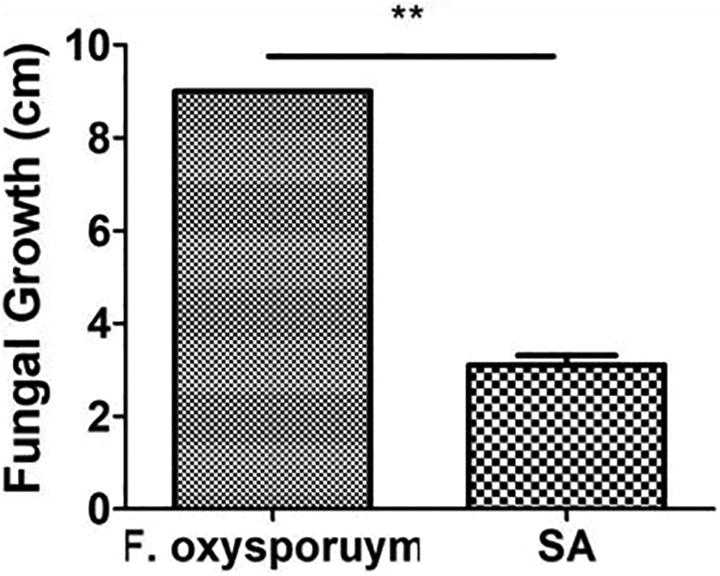
In-vitro dual culture technique revealed SA inhibit mycelial growth (68%) compared to F. oxysporum control (Figure 4). It exhibited that SA has appreciable antagonistic potential toward the fungus responsible for cotton wilt disease. Therefore, SA was used to evaluate the combined effect with chemical fungicide carbendazim to control cotton wilt disease
Antifungal Potential of Saccharothrix Algeriensis and Fungicide in Greenhouse
In combined treatments i.e. biocontrol microorganism SA and carbendazim 10µg/ml results demonstrated that combine treatments were proved effective by increasing the disease reduction rate up to 83% (Figure 5). Moreover, it was found that plant length (Figure 6A), root length (Figure 6B) and plant weight (Figure 6C) were also revived remarkably after the combined treatment compared to the F. oxysporum influenced stunted growth in cotton wilt disease. These findings are consistent with in-vitro plate assay results. The above mentioned indicators such as plant length (Figure S1A), root length (Figure S1B) and plant weight (Figure S1C) were also observed for individual treatments of SA and carbendazim 10 (µg/ml) against F. oxysporum with same concentration used in the combined treatment and found less effective.


Measurements of lengths and weight of plants in in-vivo glasshouse assay after the combined treatment of SA and Carbendazim: The growth of plants were measured with or without infection with F. oxysporum, and then with combined treatment of Sa and Carbendazim in in-vivo glasshouse assay. Control treatment consisted of non-treated cotton dry seeds. The soil temperature was maintained at 25 ± 2 °C and the soil moisture was kept at an optimum level. After 45 days of sowing, plant length (A), root length (B) and plant weight (C) were recorded. ***p < 0.001 vs F. oxysporum.
Discussion
Cotton wilt disease is economically significant disease responsible for markedly higher annual loss. 8 Normally, fungicide are applied to control the wilt disease that is effective against soil borne pathogens. Meanwhile, research interest to find out biological control is increasing due to negative impact of fungicide on the environment. This study may play active contribution to manage Fusarium wilt disease caused by a pathogen (Fusarium oxysporum f.sp. vasinfectum) in the cotton crops. The plant pathogens are influencing drastically to limit the production of crops, which ultimately threat to economic loss. The F. oxysporum pathogen is both soil and seed-borne, 40 therefore, its management is difficult. The utilization of fungicides for this purpose is widely being employed around the globe.
In this study, different fungicides available in market (carbendazim, acrobate, benlate, and capritop) were evaluated against F. oxysporum by in vitro assays. Among these, carbendazim in all concentrations was found to be remarkably superior showing average 91% growth inhibition of fusarium throughout the experiments followed by benlate (63%), cabriotop (57%), and acrobat (53%) compared to control. There was a positive association between concentration and inhibition of the pathogen growth. It was observed that inhibition of the pathogen growth also increased with increasing concentration of all fungicides which are in complete agreement with those of Dahal et al. 41
In the current research, carbendazim was found to be the most potent chemical in all concentration against the wilt pathogen as it almost totally inhibited the fungus mycelium growth. This result was in congruent with the findings of Patil et al., 42 Maheshwari et al., 43 Srivastava et al. 44 and Dahal et al. 41 Khanzada et al. 45 and Narayanan et al. 46 who found complete inhibition of F. oxysporum by carbendazim. Rajput et al. 27 reported best result with carbendazim to reduce the mycelial growth of F. oxysporum f. sp. vasinfectum whereas, Allen et al. 14 also reported carbendazim to be very effective to inhibit the mycelial growth of F. oxysporum f. sp. vasinfectum. Sultana et al. 47 found that when fungicide viz. carbendazim and benlate were used at 100 ppm, complete inhibition of colony growth of F. oxysporum was observed in in-vitro conditions. Carbendazim fungicide which proved to be the best in the lab was further evaluated in the glasshouse.
Fungicides are widely being used in the world, and most of these chemicals are considered hazardous to life on earth, because these chemical enters into the food web and causes damage the life directly or indirectly at various points of food web, therefore, preference should be given to exploration of biological agents for the management of fungal diseases especially cotton wilt disease. 48
In our study, antifungal potential of Sa. algeriensis NRRL B-24137 against the Fusarium wilt disease were tested in vitro and glasshouse assay. SA was found to be effective biocontrol agent toward F. oxysporum. Biological control of F. oxysporum, the causal agent of cotton wilt using antagonistic bacteria, has not been much studied. Sahi et al. 49 studied the biocontrol of Fusarium oxysporum, using Trichoderma sp. in vitro and observed inhibition of the mycelial growth. Kumari et al. 50 and Anis et al. 51 used antagonistic bacteria to control soil-borne pathogens and found effective biocontrol agents. Our results are completely in agreement with other studies, in which it was found that PGPRs like Pseudomonas, Bacillus, and Trichoderma, isolated from the rhizospheres regions of host crop plants were effective enough to manage the plant pathogens. 52 -54 Moreover, Karimi et al. 55 evaluated various PGPR isolates of Pseudomonas and Bacillus against Fusarium wilt, which subsequently increased the growth parameter of plants. While, evaluated the combined effect of fungicide and SA, it is demonstrated that treatment with SA in combination with carbendazim may provide better protection against cotton wilt disease incidence, which are consistent with findings of 56 in which Bacillus and carbendazim remarkably decrease the fusarium wilt disease incidence and subsequently improved the other vegetative growth parameter . Similar result also reported in another study in which bioagent P. fluoresces and carbendazim in combine form also significantly decrease the disease incidence against Fusarium wilt in chick pea as compared to used alone. 57 Andrabi et al. 58 found that seed treatment with carbendazim and Trichoderma harzanium increased the rate of disease reduction by 93.75% over control. The present study was also in complete agreement with Bouzoumita et al. 56 which found that combine treatment with bioagent Enterobacter and carbendazim remarkably decreased the disease incidence.
Further, it is proposed that effective management of cotton wilt disease may possible through the combined use of fungicides and biocontrol agents. In fact, the management of pathogen Fusarium oxysporum f. sp. vasinfectum by biocontrol agent SA was comparatively less effective compared to carbendazim at dose 100µg/ml. while combining the SA and reduced concentration of carbendazim proved to be more effective and due to eco-friendly nature, biocontrol agent SA is more desirable for the control of fusarium wilt in cotton. Thus, the work illustrated the possibility of using biocontrol agent SA for the improvement and control of wilt disease in cotton caused by Fusarium oxysporum f. sp. vasinfectum. The combination of a biological control agent with chemical fungicide with very low dose might reduce the risk of the occurrence of fungicide resistance and improve the reliability of disease control compared with that provided using bacteria alone. Investigating the efficacy of the selected antagonists integrated with a reduced fungicide, even at very low concentrations as inert substrates, the combination treatments were able to reduce plant disease significantly. Finally, these findings paved toward finding the biological control agents that should be further investigated as an alternative measure for reducing the risk associated with the use of synthetic fungicides.
Conclusion
However, an integrated strategy may allow more reliable disease control under circumstances, where there is a history of fungicide groups failing as a result of the emergence of resistant strains or where biological control agents may not perform well such as at low temperatures. Such a versatile approach may also lead to reduce chemical fungicide application rates, with associate benefits at residue levels in food and environmental contaminations. It further may pave the way in exploration of other bioagent for better results and consequences. Further, this study may be extended in the future to see the deep insight of the molecular mechanism, which is responsible for the inhibition of cotton wilt disease by F. oxysporum after the employment of combined treatment of SA and carbendazim and also the mechanism of mutual drug interactions.
Supplemental Material
Supplemental Material, Supplementary_Information - Saccharothrix Algeriensis NRRL B-24137 Potentiates Chemical Fungicide Carbendazim in Treating Fusarium Oxysporum f.sp. Vasinfectum-Induced Cotton Wilt Disease
Supplemental Material, Supplementary_Information for Saccharothrix Algeriensis NRRL B-24137 Potentiates Chemical Fungicide Carbendazim in Treating Fusarium Oxysporum f.sp. Vasinfectum-Induced Cotton Wilt Disease by Rizwan Asif, Muhammad Hussnain Siddique, Shahbaz Ahmad Zakki, Muhammad Hidayat Rasool, Muhammad Waseem, Sumreen Hayat and Saima Muzammil in Dose-Response
Footnotes
Declaration of Conflicting Interests
The author(s) declared no potential conflicts of interest with respect to the research, authorship, and/or publication of this article.
Funding
The author(s) received no financial support for the research, authorship, and/or publication of this article.

Supplemental Material
Supplemental material for this article is available online.
References
Supplementary Material
Please find the following supplemental material available below.
For Open Access articles published under a Creative Commons License, all supplemental material carries the same license as the article it is associated with.
For non-Open Access articles published, all supplemental material carries a non-exclusive license, and permission requests for re-use of supplemental material or any part of supplemental material shall be sent directly to the copyright owner as specified in the copyright notice associated with the article.
