



Abstract
Several investigations have focused on studying the suppressing influence of Salvadora persica (miswak) on oral microbes; however, studies regarding its fungicidal activity versus human aspergillosis-related illness are still scarce. The current research was designed to evaluate the fungicidal action of S persica aquatic root extract in terms of radial growth rate and inhibition zone (IZO) versus 3 pathogenic Aspergillus species, namely, A niger, A flavus, and A fumigatus in vitro. The results revealed that the plant extract (50 and 100 mg/mL) exhibited a prohibiting influence on the growth of the tested fungal species. The high concentration (100 mg/mL) of the plant extract was efficient in prohibiting the growing rate of the tested Aspergillus species after 6 days exposure period. Aspergillus niger and A flavus showed the largest inhibition ratios (60% and 54.4%, respectively) and IZO (33.00 ± 0.05 mm and 25.50 ± 0.18 mm, respectively) versus the control counterparts. Aspergillus fumigatus showed the minimum inhibition ratio (39%) and IZO (20.31 ± 0.05). The present data showed that the extract of S persica possesses potential fungicidal influence versus the tested pathogenic Aspergillus species and this may support the utilization of this extract as a promising antifungal agent versus aspergillosis.
Introduction
Aspergillus species are foodborne molds that adversely cause food spoilage by producing mycotoxins as secondary metabolites. 1 There are more than 300 species, but some of them can cause the most common human illness, including Aspergillus fumigatus, Aspergillus niger, and Aspergillus flavus. 2 Available reports have demonstrated that A niger and A flavus secrete harmful tumorigenic mycotoxins such as ochratoxin A, fumonisin B2, and aflatoxins. 3,4 These mycotoxins can cause severe ailments, including hepatotoxicity, nephrotoxicity, lung toxicity, mutagenicity, teratogenicity, immunotoxicity, and neurotoxicity. 4 -7 Aspergillus fumigatus is produced by many immunosuppressive mycotoxins, including gliotoxin, which can cause metabolic disorder via suppression of the metabolic gene expressions. 8 Generally, it has been found that mycotoxins affect the immune jobs of immunocytes as well as the immune messengers (cytokines), leading to susceptibility to many chronic disease and tumorigenesis. 9
Extracts of many plant have shown potential influences versus infectious pathogens and can be utilized for therapy of microbial disease. 10,11 Salvadora persica L, also known as miswak (Salvadoraceae family), is broadly utilized in many countries as chewing sticks. The roots, stems, and twigs of miswak have been utilized for oral hygiene. 12 It has found that the extracts (aqueous and methanolic) of miswak have multiple therapeutic efficacy versus pathogen-induced dental plaque and periodontitis. 13 Miswak has potential antibacterial and antifungal influences on periodontal microbes, such as Lactobacillus acidophilus, Staphylococcus aureus, Pseudomonas aeruginosa, and Candida albicans 14 Many studies have focused on examining the suppressing efficacy of miswak on oral pathogens, but fungicidal efficacy of this plant versus foodborne microbes such as Aspergillus species is scarce. 15
Therefore, the goal of this study was to investigate in vitro the antifungal suppressing effect of S persica L. aqueous root extract on the growth of pathogenic fungi, namely, A niger, A flavus, and A fumigatus.
Materials and Methods
Salvadora Pensica
Salvadora pensica roots were harvested from Taif Botanical Garden, Saudi Arabia, and authenticated by a taxonomist in the Department of Biological Science, King Abdulaziz University, Jeddah, Saudi Arabia.
Tested Organisms
Toxigenic fungi, A niger, A flavus, and A fumigatus, were obtained from the Microbiology Unit, King Fahad Hospital, Jeddah, Saudi Arabia. The fungi were cultured on Sabouraud dextrose agar (SDA) media (Oxioid CM 41) at 25°C ± 2°C for 6 days and recognized in accordance with the study by McClenny. 16
Salvadora pensica Aqueous Root Extract Preparation
Salvadora pensica root samples were washed carefully and left to dry at room temperature and then powdered. The root powder was mixed with distilled water (1:5, wt/vol) in a blender for 5 minutes and stored at −4°C overnight. The supernatant was centrifuged at 2000 rpm for 10 minutes. Finally, the extract was filtered by bacterial millepore filtration. 17 The filtrate was freeze dried utilizing a lyophilizer.
Effect of S pensica on the Fungi Radial Growth
Different concentrations (50 mg and l00 mg/mL) of S Pensica root extract were mixed separately with 40 mL of SDA media, then poured into sterile Petri dishes (9 cm in diameter) and left to be solidified. Mycelia disks (6 mm diameter) were removed from the growing margins of the tested fungi cultures (A niger, A flavus, and A fumigatus) and transferred on the surface of SDA agar media and then incubated at 25°C ± 2°C for 6 days. Controls of A niger, A flavus, and A fumigatus without the plant extract were also involved in the experiment. Three replications for each concentration were carried out. The growth inhibition for each tested fungal species at different concentrations (50 and 100 mg/mL) was monitored after 2, 4, and 6 days by measuring the radial growth diameter and calculating the percentage of inhibition versus the control counterparts. 18
Antifungal Screening of S pensica Extract
The agar well diffusion assay was carried out for evaluating the antifungal activity of S pensica root extract. 19 Suspensions of Aspergillus species, namely, A niger, A flavus, and A fumigatus (103-104/mL), were cultured on Mueller Hinton Agar medium. Wells (7 mm diameter) were made in the agar medium utilizing sterile cork borer and placed onto the incubated plates. Solution of S pensica root extract in sterile bidistilled water (100 mg/mL) was added into labeled medium plates. Controls of A niger, A flavus, and A fumigatus without the plant extract were also included in the experiment. The experimental plates were then incubated at 25°C for 6 days, and the growth of each fungus was then monitored. The suppressing impact of the plant extract on the fungal growth was estimated by determining the inhibition zone (IZO) diameters (in millimeters) produced after incubation. The experiment was achieved in triplicate, and the average of IZOs was calculated.
Statistical Analysis
Data were analyzed utilizing analysis of variance. The results were calculated as mean ± standard deviation. Results were significant at P ≤ .05.
Results
Effect of S Pensica Root Extract on Radial Growth Rate of Aspergillus Species
The efficacy of S pensica root extract different concentrations (50 and 100 mg/mL) on A niger, A flavus, and A fumigatus radial growth after different exposure periods (2, 4, and 6 days) are shown in Figures 1 –3. The percentages of growth inhibition at different concentrations versus the control counterparts after 6 days exposure time are listed in Table 1. The results showed that the different concentrations of S pensica extract used have suppressing impact on growth of A niger (Figure 1), A flavus (Figure 2), and A fumigatus (Figure 3). The high concentration (100 mg/mL) of the plant extract was efficient in inhibiting the growth of the tested Aspergillus species after 6 days exposure period. Aspergillus niger was the most susceptible one to the plant extract with maximum inhibition ratio (60%) followed by A flavus (54.4% inhibition) versus the control counterparts. Aspergillus fumigatus showed the minimum percentage of inhibition (39%).

Radial growth diameter (mm) versus different concentrations (50 and 100 mg/mL) of Salvadora pensica extract, showing its suppressing effect on Aspergillus niger growth rate at different exposure periods. **Significant at P ≤ .01 compared to the control untreated fungus (zero concentration).

Radial growth diameter (mm) versus different concentrations (50 and 100 mg/mL) of Salvadora pensica extract showing its suppressing effect on Aspergillus flavus growth rate at different exposure periods.

Radial growth diameter (mm) versus different concentrations (50 and 100 mg/mL) of Salvadora pensica extract showing its suppressing effect on Aspergillus fumigatus growth rate at different exposure periods. **Significant at P ≤ .01 compared to the control untreated fungus (zero concentration).
Inhibitory Effect of Plant Extract on the Radial Growth of Fungal Strains After the 6-Day Incubation Period (Radial Growth Diameter, mm).a
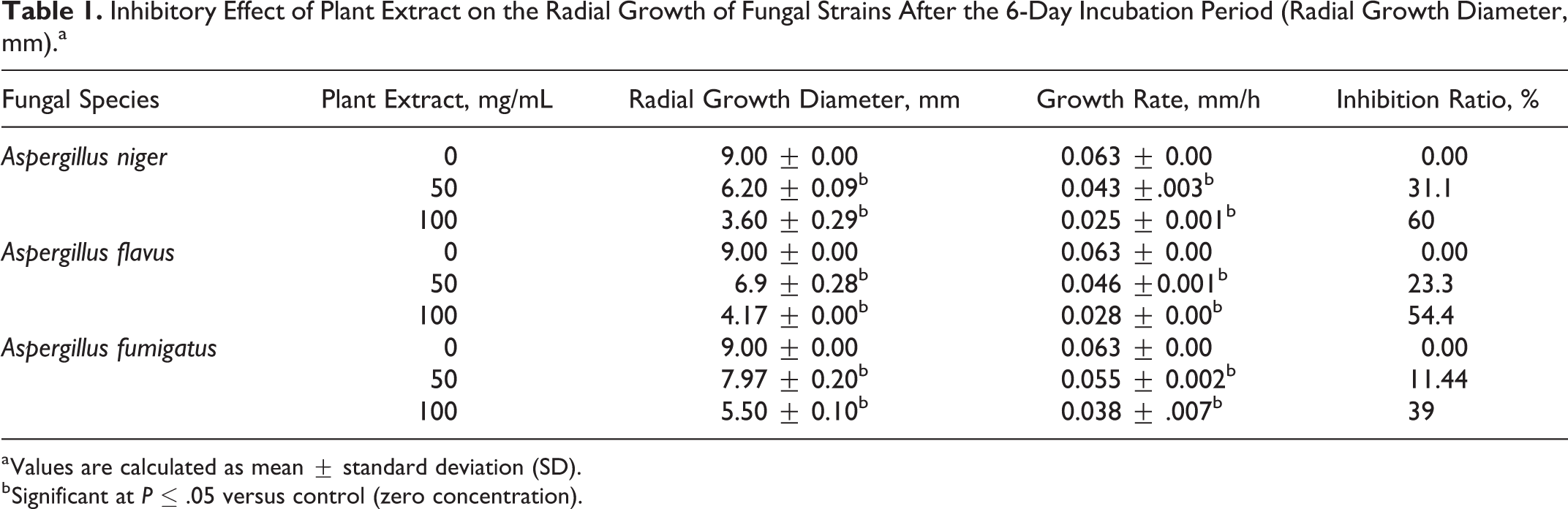
a Values are calculated as mean ± standard deviation (SD).
b Significant at P ≤ .05 versus control (zero concentration).
Antifungal Activity of S Pensica Root Extract
The growth inhibitory effects of S pensica root extract against A niger, A flavus, and A fumigatus in terms of IZO are shown in Table 2 and Figures 4 and 5, respectively, for A niger and A flavus. The data showed that the plant extract exhibited suppressing effect on the growth of the tested fungal strains as confirmed by the high IZO. Aspergillus niger was the most sensitive fungus to the plant extract, as it recorded the highest IZO versus the 2 other strains (P ≤ .01).
Diameter of IZO of Salvadora Pensica Against Aspergillus Species on the Sabouraud Dextrose Agar.a

a Data are calculated as mean ± standard deviation (SD) of triplicate independent experiments.
b Significant at P ≤ .01 compared to A niger.
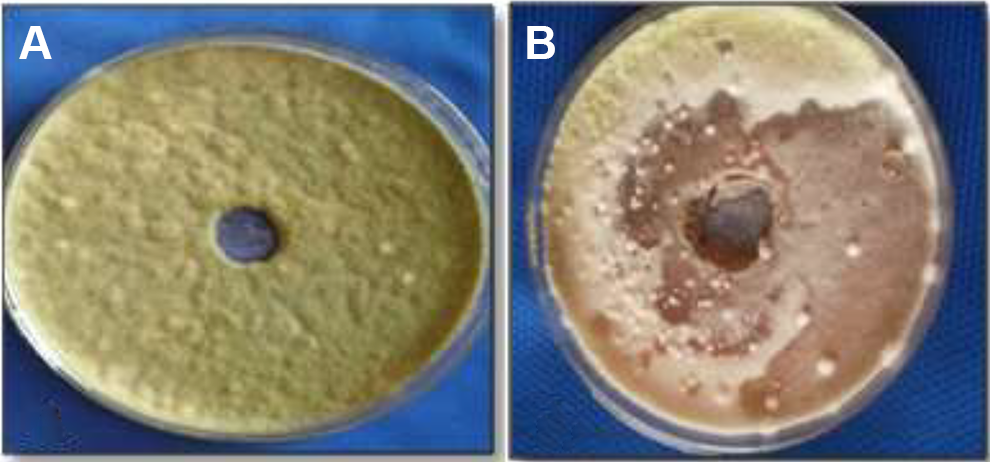
Inhibition zones (IZO) of Aspergillus niger treated with Salvadora pensica root extract. A, Control untreated fungus grown on Sabouraud dextrose agar with no IZO. B, The IZO of A niger treated with S pensica extract.
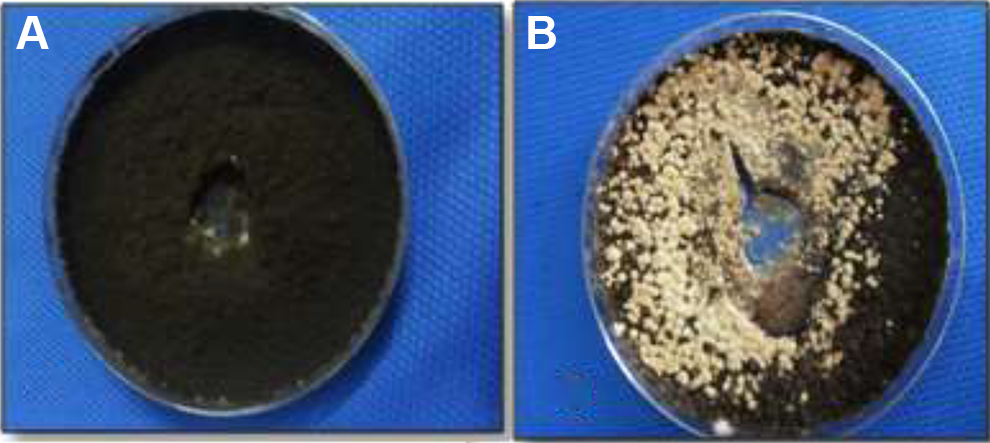
Inhibition zones (IZO) of Aspergillus flavus treated with Salvadora pensica root extract. A, Control untreated fungus grown on Sabouraud dextrose agar with no IZO. B, The IZO of Aspergillus flavus treated with S Pensica extract.
Discussion
The powerful fungicidal efficacy of many natural extracts on the fungal growth has been under investigations by many studies. 4,20 Much emphasis was given to natural product for their potent antifungal efficacy versus aflatoxigenic fungi. 4 In the current work, the antifungal efficacy of S pensica root aqueous extract (50 and 100 mg/mL) on the growth of Aspergillus species, namely, A niger, A flavus, and A fumigatus, were investigated by measuring radial growth diameter and IZO. Both concentrations of S pensica extract (50 and 100 mg/mL) were effective in suppressing the growth of the 3 tested fungi. The high concentration (100 mg/mL) of the extract was efficient in prohibiting the growth of the tested Aspergillus species after 6 days exposure period. Aspergillus niger was the most susceptible fungus to the plant extract which showed the greatest inhibition ratio (60%) followed by A flavus with a percentage inhibition of 54.4 versus the control counterparts.
The antifungal influence of S pensica extract on the growth of studied Aspergillus strains in term of IZO was carried out at 100 mg/mL, as it was the most efficient concentration in repressing the growth of fungal species. The extract mostly suppressed the growth of A niger, as it recorded the highest IZO (33.00 ± 0.05) followed by A flavus (25.50 ± 0.18). Aspergillus fumigatus was less sensitive to the plant extract as it recorded the minimum IZO (20.31 ± 0.05), compared to other species. This result may confirm that A niger was the most susceptible fungal strain to the plant extract. Baur et al 21 have reported that the microbe is resistant if the IZO is below 8.00 mm and sensitive if it is above 11.00 mm. According to this report, our result may suggest that the plant extract effectively has an inhibitory fungicidal influence against the 3 tested fungal species. The present fungicidal property of the plant extract is compatible with other studies. An in vitro research revealed that the aqueous extract of miswak had prohibiting efficacy on growing rate of Candida albicans that may ascribe to its high sulfate concentration. 22,23 Also, it has found that S persica miswak has potent antimicrobial influence versus Streptococcus sp, Staphylococcus aureus, and Enterococcus faecalis. 24,25 Another investigation has revealed that S persica miswak exhibits powerful antibacterial efficacy versus oral microbes related to periodontitis and dental caries. 13 The antimicrobial effects of S pensica root extract have been attributed to its various phytochemical components, including NaCl, KCl, saponins, fluoride, salvadorine, vitamin C, sulfur, silica, nitrate (NO3−), cyanogenic glycoside, and benzylisothiocyanate. 17,24 Some authors stated that some anionic components naturally present in plant can exert antimicrobial action versus many microbes. 17 NO3− can prohibit the active transport of proline in Escherichia coli as well as aldose in E coli and E faecalis. 26 It also suppress the active transport, the oxidative phosphorylation, and the oxygen uptake by Pseudomonas aeruginosa and S aureus. 26 SCN− Thiocynate in miswak functions as a substrate for lactoperoxidase to generate hypothiocyanite (OSCN−) in the presence of H2O2. OSCN− can interact with sulfhydryl groups in bacterial enzymes, leading to bacterial death. 27 Sulfur present in miswak has a bactericidal influence. 28 Also fluoride, which is a component in miswak, can react with glycolytic enzymes in bacteria. 28
Conclusion
The current study revealed that the aqueous extract of S persica miswak showed strong fungicidal impact against Aspergillus species, and this may support the utilization of this extract as an antifungal agent versus aspergillosis-related diseases.
Footnotes
Declaration of Conflicting Interests
The author(s) declared no potential conflicts of interest with respect to the research, authorship, and/or publication of this article.
Funding
The author(s) received no financial support for the research, authorship, and/or publication of this article.