




Abstract

Publication of the human evidence of a threshold dose for acute, radiation-induced leukemia 1 has led to discussion and criticism about the use of LNT-based units of dose (rem and sievert), which are surrogates for risk, 2 instead of the absorbed dose unit gray (1 Gy = 1 J/kg), which is independent of the type of radiation . Since the United Nations Scientific Committee on the Effects of Atomic Radiation (UNSCEAR) 1958 report 3 gives dose in rem, Figure 2 in the study by Cuttler 1 indicates dose in the same units. A question about the uncertainty of the threshold dose reported was also raised. This letter addresses these 2 issues and presents evidence for the more accurate threshold dose: 1.1 Gy, 68% confidence interval (CI: 0.60-2.1).
In the study by Heyssel et al, Figure 3 shows that the neutron dose in Zone D, 2000 to 2999 m from ground zero, is an order of magnitude or more lower than the gamma dose. 4 Therefore, the dose that Hiroshima atomic bomb survivors in Zone D received may be changed from 2 rem to 2 rad or 0.02 Gy.
For Zone C, Cuttler’s study 1 assigned a dose of 1 Sv (100 rem) instead of 0.5 Sv (50 rem) to address the footnote in the UNSCEAR 1958 report 3 (p165) stating, “Almost all cases of leukemia in this zone occurred in patients who had severe radiation complaints, indicating that their doses were greater than 50 rem.” However, a more accurate assignment of dose may be made using human evidence in the OECD Nuclear Energy Agency (NEA) report on the radiological and health impact of the 1986 Chernobyl NPP accident 5 in which many workers suffered acute radiation syndrome.
The following statements appear in Chapter IV of this report: All of the dosimeters worn by the workers were overexposed and did not allow an estimate of the doses received. However, information is available on the doses received by the 237 persons who were placed in hospitals and diagnosed as suffering from acute radiation syndrome. Using biological dosimetry, it was estimated that 140 of these patients received whole-body doses from external irradiation in the range 1-2 Gy, that 55 received doses between 2 and 4 Gy, that 21 received between 4 and 6 Gy, and that the remaining 21 received doses between 6 and 16 Gy.
5
(p32)
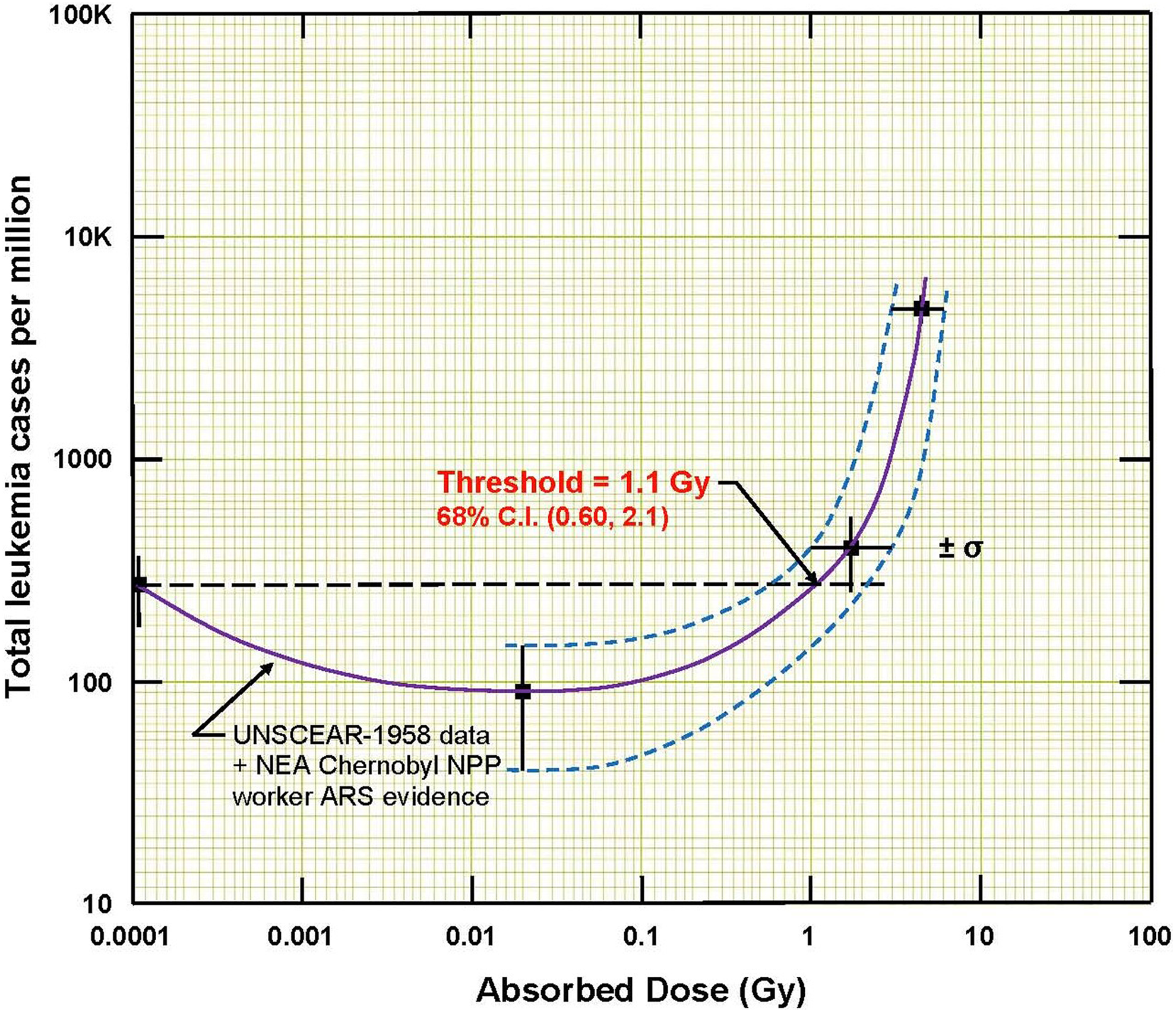
Total number of radiation-induced leukemia cases per million versus absorbed radiation dose for the Hiroshima atomic bomb survivors. Evidence of a threshold is apparent at 1.1 Gy, CI: 0.60-2.1. (CI indicates confidence interval) The incidence of radiogenic leukemia is only 0.5% of the survivors who were in the high radiation zones.
The dose to initiate leukemia (cancer of blood-forming tissues) is high, and the incidence is only 0.5% of the survivors in the high radiation zones A and B, which is very surprising.