




Abstract
Radon (222Rn) and its decay products are the major sources of natural radiation exposure to general population. The activity concentrations of unattached and attached short-lived 222Rn and thoron (220Rn) progeny in indoor environment of some dwellings of the Jalandhar and Kapurthala districts of Punjab had been calculated using the deposition-based progeny sensors (DRPS/DTPS) and wire-mesh-capped (DRPS/DTPS) progeny sensors. The observed concentration of attached 222Rn and 220Rn progeny showed the variation from 5 to 21 Bq·m−3 and 0.3 to 1.7 Bq·m−3, respectively. The activity concentration of the unattached 222Rn and 220Rn progeny varies from 1 to 5 Bq·m−3 and 0.1 to 0.6 Bq·m−3, respectively. The average unattached fraction of 222Rn and 220Rn progeny is 0.2 and 0.1. The average value of the indoor aerosol concentration attachment rate of 222Rn and 220Rn progeny is 2251 cm−3, 24 ms−1, and 617 ms−1. Relation among the unattached fraction and attachment rate is established, and the obtained results of dose conversion factors show the significance of the nano-sized 222Rn decay products in 222Rn dosimetry.
Introduction
Radon (222Rn) is a colorless, odorless, tasteless radioactive element that occurs in the state of gas. Radon decays by α emission and gives birth to its short- and long-lived decay products. Of all these decay products, about 10% to 60% of Polonium-218 remains as positively charged ion. 1,2 Charge transfer and recombination with negatively charged ions are the main neutralization processes for these ions or nuclei. Due to these processes, this large fraction of positively charged ions becomes neutral before attaching to the indoor aerosol particles. Several studies have also shown the influence of impurities, trace gases, and water vapors in air on the neutralization and cluster formation of radioactive Po ions. 3,4 Investigations have shown that due to the deposition velocities of the 222Rn, decay products are highly influenced by indoor environment conditions and the deposition velocity for the unattached fractions is more as compared to the attached fraction. 5 -7 In particular indoor conditions, a large fraction of 222Rn decay products get attached to the aerosol particles. A small fraction remains free or unattached. Aerosol attachment is the process by which an unattached 222Rn and 220Rn decay product or cluster, which undergoes random motion like any gas molecule, strikes and sticks to an aerosol particle. The concentration of the unattached 222Rn decay products is highly affected by the attachment rate of decay products to the aerosol particles, recoil, deposition of the decay products to the walls and other available surfaces in the indoor environment, ventilation rate, and 222Rn emanation rate. The relationship between the indoor aerosol particles and 222Rn decay products has been studied and reported by various authors. 8,9
This study is the first to report the attached, unattached progeny concentration and unattached fraction of 222Rn and 220Rn in the indoor environment of the Jalandhar and Kapurthala district of Punjab. Primary objectives of the present investigation focus on the precise estimation of 222Rn and 220Rn decay product concentration and dose conversion factors (DCFs) to show the contribution of the nano-sized decay products of radon to the annual dose. The relationship between the 222Rn and 220Rn decay products with indoor aerosols has been discussed in the article.
The Study Area
The state of Punjab stretches from 29°32°’ to 32°32°′N latitude and 73°55°’ to 76°50°′E longitude, occupying a land of 50 362 km2 in the northwestern part of India. Sandy loam to clayey with an average pH value of 8.15 is common in Doaba region (Jalandhar, Kapurthala, Hoshiarpur, and Nawanshahr districts) of Punjab, making alkalinity and salinity problem for this place. The alluvial soil of Jalandhar and Kapurthala districts is widely described as arid and brown soil or tropical arid brown soil. The major type of soil in southwestern Punjab is desert soil and sierozem soil, and in the Eastern Punjab, it is loamy to clayey. 10 Figure 1 shows the map of the study area.
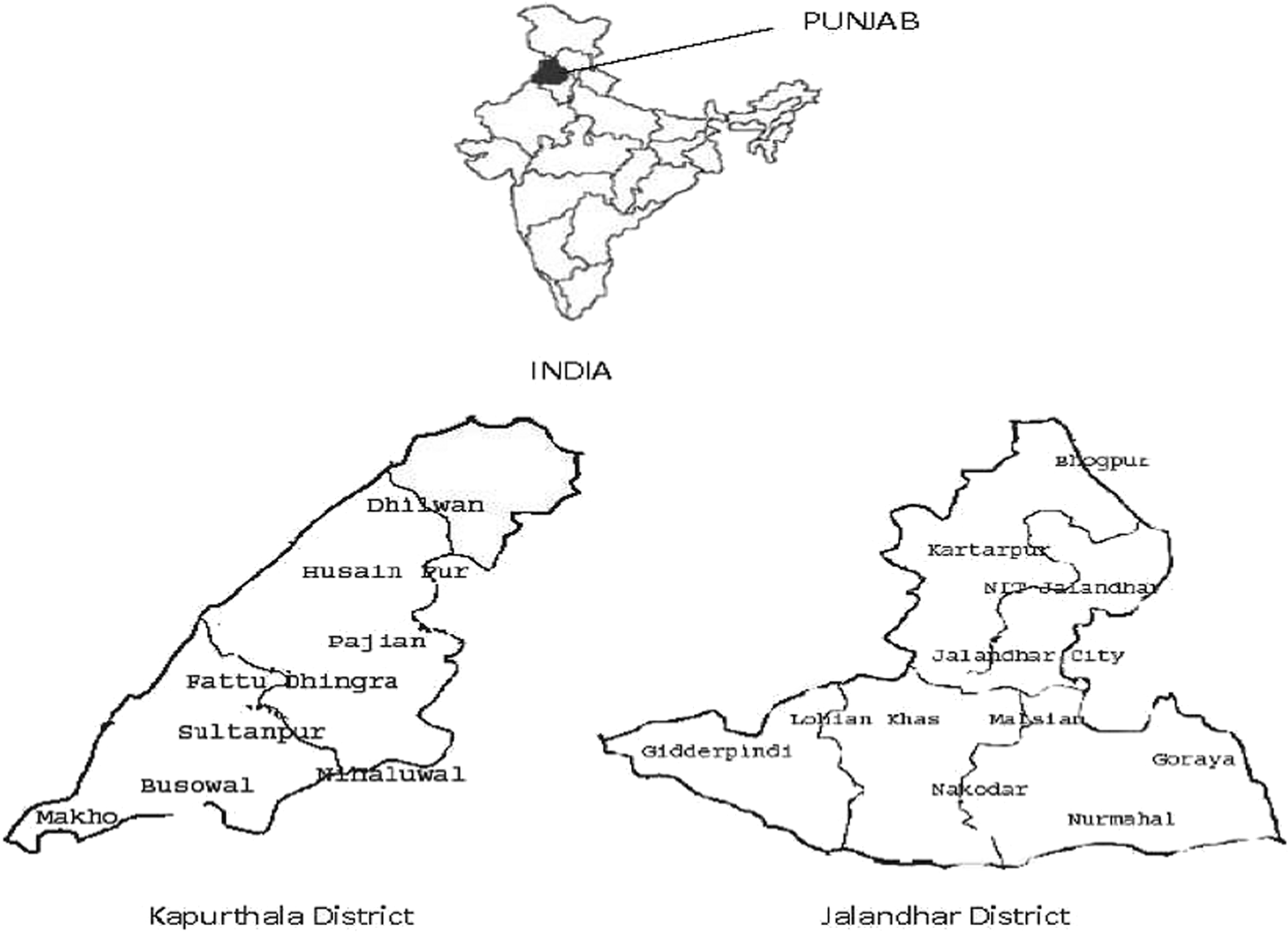
Map of the study area.
Methodology
Deposition-Based Progeny Sensors (DRPS/DTPS)
The concept of DTPS is based on registering solely the α-tracks originating from the deposited activity of 212Po. Since the system is intended for use in the deposition mode, aluminized polyethylene is chosen as the absorber material to avoid uncontrolled static charges from affecting the deposition rates. Similarly in DRPS, the absorber is a combination of aluminized mylar and cellulose nitrate of effective thickness of 37 μm to detect mainly 7.67 MeV α-particles emitted from 214Po. 11
Wire-Mesh-Capped DRPS/DTPS
Wire-mesh-capped DRPS/DTPS consists of DTPS/DRPS capped with mesh-type wire screen. The mesh-type wire screen consists of 200-type wire mesh (79 mesh cm−1, wire diameter: 0.005 cm). One centimeter was taken as the optimum distance, where the effect of the fine fraction trapped on the wire mesh onto the tracks registered in the detector is negligible. 12
Wire-mesh-capped DRPS/DTPS and DTPS/DRPS were suspended during winter season for 3 months of exposure in the dwellings of villages of Jalandhar and Kapurthala districts of Punjab. From each location of the study area, 5 different residential houses and 1 dwelling from each house were selected. The dwellings having similar type of ventilation conditions and building materials were selected for the deployment of progeny sensors. The major type of building material used in the construction of these dwellings was bricks, cement, sand, marble, and concrete. All these dwellings were poorly ventilated and were isolated from other rooms of the house. The progeny sensors were suspended at a distance of about 20 cm from the walls and 1.5 m from the floor. After the exposure of 3 months, the detectors were etched in 2.5N NaOH solution at 60oC for 90 minutes in the etching bath. After etching, the developed α-tracks were counted using spark counter, and the track density was evaluated in order to determine the concentration of progeny nuclei using Equations 1 and 2. 11,12


where EERC and EETC are the equilibrium equivalent of 222Rn and 220Rn progeny concentration; TR and TT are the track densities observed in DRPS and DTPS; and B, t, and S are the background counts, exposure time, and sensitivity factors, respectively.
Measurement of Attachment Rate (X)
The attachment rate of the 222Rn progeny to the aerosol particles in the indoor environment is calculated according Equations 3 and 4. 13,14


where EERCa, EERCua, EETCa, EETCua, and λ1 and λ2 are, respectively, the concentration of attached 222Rn progeny, unattached 222Rn progeny, attached 220Rn progeny, unattached 220Rn progeny, and decay constant of respective nuclei of 222Rn and 220Rn progeny.
Aerosol Concentration (Z)
The aerosol concentration (Z) in terms of unattached fraction of 222Rn progeny (f) is estimated by Equation 5. 8

Estimation of DCFs
Dose conversion factor of 4 mSv WLM−1 is recommended by the International Commission on Radiological Protection (ICRP) for the living dwellings using epidemiological approach. We have tried to calculate the DCFs separately for nasal (DCFN), mouth (DCFM), and combined nasal and mouth (DCFC) breathing using the dosimetric approach as given by the Porstendorfer. 15

For a public adult, the contribution of nasal to the total breathing is 86%. 16 On the basis of this nasal and mouth contribution to total breathing, DCF for combined breathing (DCFC) has been calculated.
Estimation of Effective Dose
The effective dose for the residents of the study area has been estimated using Equation 7 given by Nero 17 and the calculated values of DCFN and DCFC.

Results and Discussions
Measurement of Indoor Decay Products and Aerosol Particle Concentration
The activity concentration of 222Rn and 220Rn progeny in the dwellings of the studied area is measured and summarized in Table 1. The observed activity concentration of 222Rn and 220Rn progeny varied from 10 to 26 and 0.6 to 1.9 Bq·m−3, with an average concentration of 18 and 1.4 Bq·m−3, respectively. The results indicated that the average attached 222Rn and 220Rn progeny concentration is 14 and 1.2 Bq·m−3. The unattached progeny of the 222Rn and 220Rn in the studied area showed an average activity concentration of 4 and 0.2 Bq·m−3. Low concentration of the aerosols in the dwellings may result in low concentration of indoor attached progeny, which may increase the amount of unattached fraction. This is also a reason for the existence of disequilibrium between the parent 222Rn or 220Rn gas and its decay products. Under the poorly ventilated environmental conditions of the living dwellings, the value of the unattached fraction of 222Rn (f) and 220Rn (f1) altered from 0.1 to 0.5 and 0.1 to 0.4. The indoor aerosol concentration (Z) showed variation from 828 to 4734 cm−3. There is an inverse relationship between the aerosol concentration and the unattached fraction. As the aerosol particle concentration in the indoor environment increases, the process of attachment of the decay products with the aerosol particles dominates over the process of deposition of the progeny particles on the available surfaces. The attachment rate of 222Rn (RX) and 220Rn (TX) progeny varied from 5 to 54 ms−1 and from 130 to 1521 ms−1. An attempt has been made to investigate the relation between the aerosol concentration and the attachment rate. High value of the RH and processes like burning and cooking increase the aerosol concentration and also the attachment process. So, a positive relation between these 2 parameters is expected. From the observed data, a strong linear relationship is observed between Z and RX (RX = 0.01 × Z − 5.03), but the correlation coefficient of the linear relation between TX and Z is less significant (R 2 = .6), as shown in Figures 2 and 3. Increase in the concentration and size of the aerosol particles tends to increase the attachment rate due to the large number of interactions between the aerosol particles and decay products and thereby decreasing the unattached fraction. The obtained results showed an exponential relation between the attachment rate and unattached fraction of 222Rn progeny (Figure 4), with a positive and significant correlation coefficient (R 2 = .83). This exponential relation can be expressed as RX = 87.4 exp(−f/0.13) + 3.35. As perceived from Figure 5, no such relation is found to exist in the case of the 220Rn decay products.
Calculated Values of Different Indoor Parameters of the Studied Dwellings.
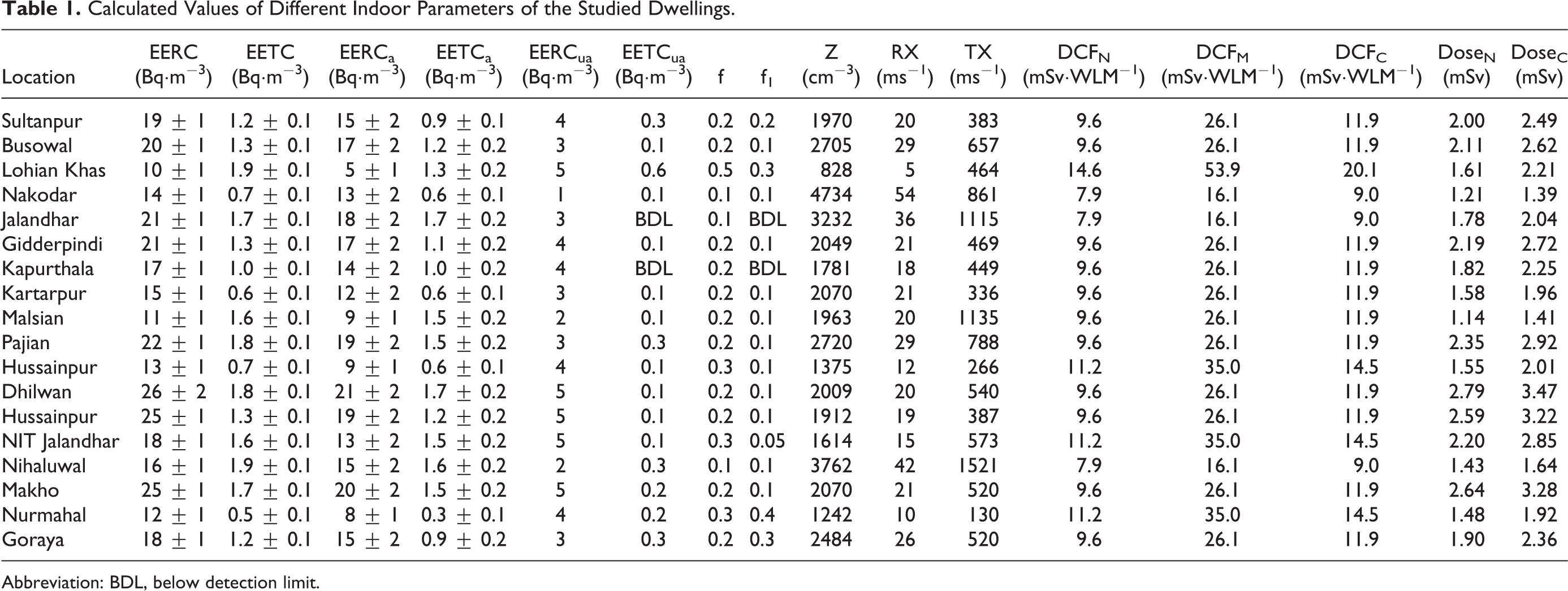
Abbreviation: BDL, below detection limit.

Relation between RX and Z.

Relation between TX and Z.

Relation between RX and f.
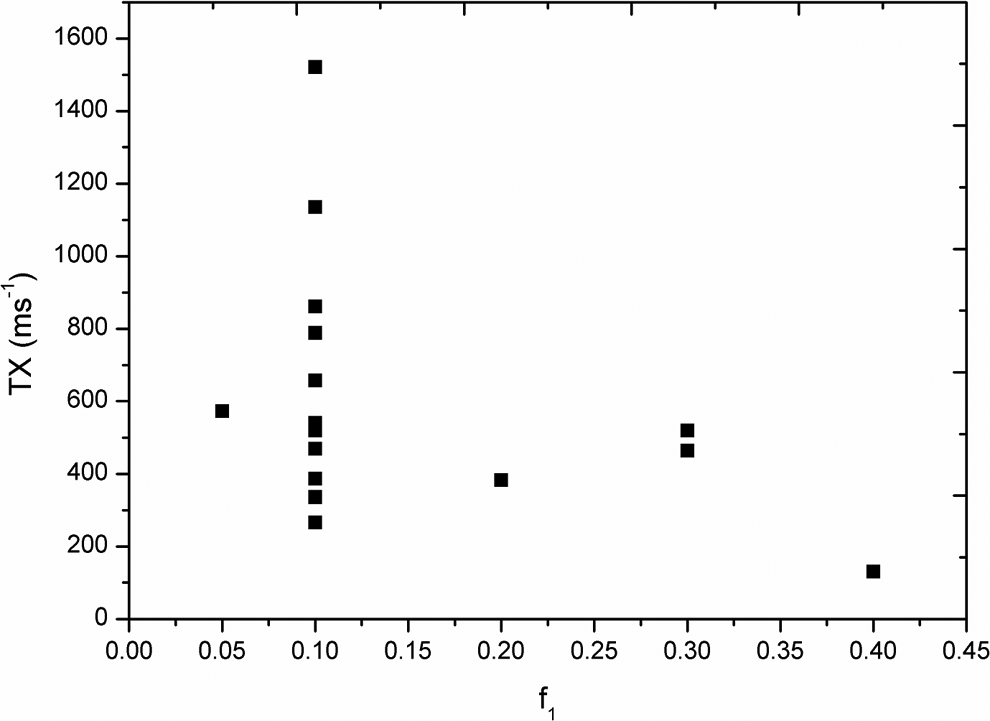
Relation between TX and f1.
Estimation of DCFs and Corresponding Doses
The DCFs recommended by ICRP on the basis of epidemiological studies are widely used for the dose estimation purposes in the indoor environment. For working 5 mSv WLM−1 and 1 for living dwellings 4 mSv WLM− are the value of DCF given by ICRP. 18 Birchall and James 19 used a dosimetric approach to calculate the DCF on the basis of the unattached fraction. The estimated value of the DCF according to this study is 15 mSv WLM−1 for the living dwellings, which is 3 times higher than the value of DCF given by the ICRP. In the present study, DCFs have been calculated separately for the nasal (DCFN), mouth (DCFM), and combined nasal and mouth (DCFC) breathing. The arithmetic mean value of the DCF in case of nasal, mouth, and combined breathing is 9.9, 27.5, and 12.3 mSv WLM−1, respectively. The corresponding average value of doses for nasal (DoseN) and combined (DoseC) breathing is 1.91 and 2.37 mSv. The highest value of the DCF obtained is in the case of mouth breathing, lesser in case of combined breathing, and lowest in case of nasal breathing. The variation in the DCF with the unattached fraction is shown in Figure 6.
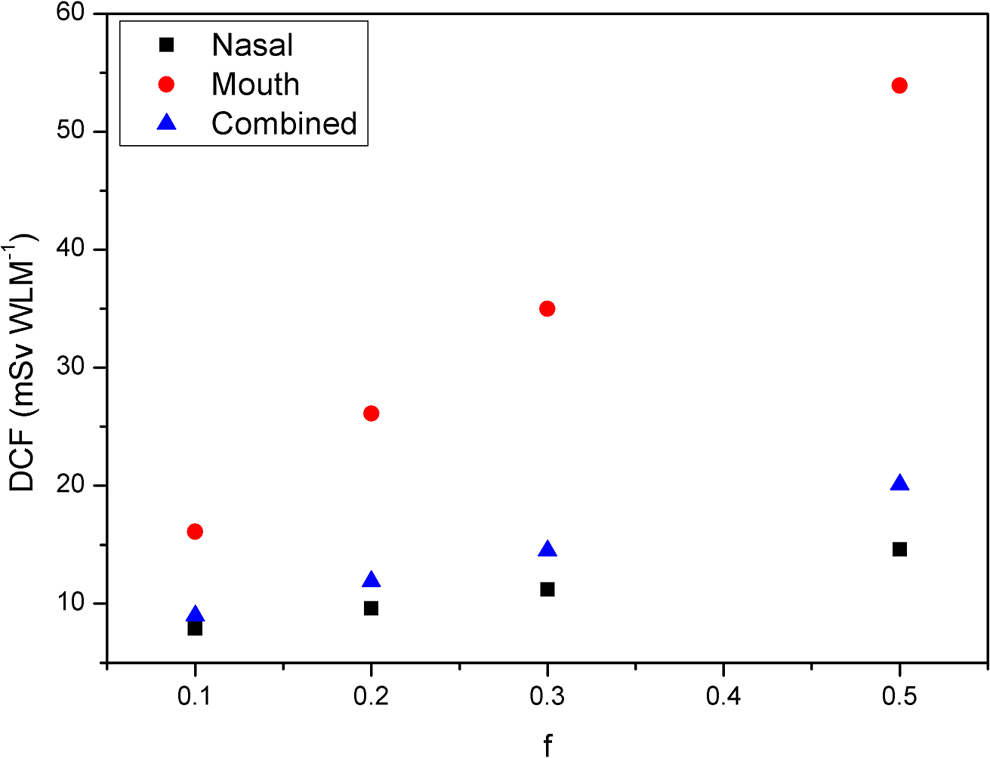
Variation in dose conversion factor (DCF) with breathing type and unattached fraction.
Conclusion
The arithmetic mean value of the unattached fraction of 222Rn and 220Rn decay products is 0.2 and 0.1, respectively, for the surveyed dwellings. In the indoor air of the studied dwellings, the aerosol concentration altered from 828 to 4734 cm−3. The attachment rate of the decay products with the aerosol particles varied from 5 to 54 ms−1 for 222Rn progeny and from 130 to 1521 ms−1 for 220Rn progeny.
The results obtained by the dosimetric and epidemiological approach are different. The obtained results show the significance and toxic behavior of the nano-sized 222Rn decay products in 222Rn dosimetry.
Footnotes
Authors’ Note
The inhabitants of the study area are highly appreciated for their kind support in accomplishing the present work.
Acknowledgments
The authors are thankful to the Ministry of the Human Resource and Development (MHRD) and Director of Dr B R Ambedkar NIT Jalandhar for providing the fellowship and instrument facilities
Declaration of Conflicting Interests
The author(s) declared no potential conflicts of interest with respect to the research, authorship, and/or publication of this article.
Funding
The author(s) received no financial support for the research, authorship, and/or publication of this article.