



Abstract
In this study, methacrylamide (MAAm) was employed as the grafting monomer, and silk fabrics were modified by free radical polymerization using a potassium persulfate–sodium bisulfite redox initiation system. Grafted silk fabrics with different weight gains were prepared, and the effects of MAAm grafting on wrinkle recovery, moisture regain, water vapor permeability, air permeability, tensile properties, antibacterial activity, abrasion resistance, and washing durability were systematically evaluated. Results show that with increasing graft weight gain, the crease recovery angle and moisture absorption improved, whereas air permeability decreased markedly. At lower grafting levels, the increase in tensile strength per unit width exceeded the increase in fabric areal density. However, at higher grafting levels, the strength increment became smaller relative to the density increase. Grafting also substantially reduced elongation. At 33.20% graft weight gain, compared with ungrafted silk, the dry crease recovery angle increased by 14.0%, moisture regain by 24.0%, and water vapor transmission by 4.8%; in contrast, air permeability decreased by 58.0% and elongation by 32.7%. Antibacterial activity against S. aureus was slightly enhanced, whereas activity against E. coli declined. In addition, grafting had a pronounced negative effect on initial abrasion resistance but improved long-term wear resistance. Collectively, this study comprehensively discusses the advantages and disadvantages of MAAm grafted silk fabrics from different perspectives, and reveals the relevant mechanisms of their impact on performance, filling a gap in research on the influence of MAAm grafted silk fabrics on their performance. It also offers a useful reference for producers and consumers in the manufacture and selection of grafted silk products.
Introduction
Silk, a natural protein fiber, is characterized by its soft texture, elegant luster, excellent moisture absorption and breathability, and good biocompatibility. Known as the “queen of fibers,” it is widely applied in the textile industry and biomedical fields. 1 However, natural silk is costly and prone to wrinkling and yellowing during use and laundering. Its low wet resilience and poor abrasion resistance also restrict its functional performance.2,3
To enhance the performance of silk fabrics, researchers worldwide have explored various modification strategies. Current approaches include physical, chemical, biological, and feeding modifications, 4 with chemical modification being the most widely applied. This method exploits the reactive groups on silk protein molecular chains (such as carboxyl, hydroxyl, amino, and phenolic hydroxyl groups) to introduce functional groups, monomers, or macromolecular chains via chemical reactions, thereby modifying fibers or fabrics.5,6 Chemical grafting has been employed to improve antibacterial activity,7,8 ultraviolet resistance, 9 wrinkle resistance, 10 flame retardancy,11,12 hydrophobicity, 13 and dyeability. 14 Nonetheless, some chemical modifications, while improving targeted properties, can disrupt the natural structure and tactile qualities of silk, compromising its comfort and mechanical integrity, and reducing its practical value.
Methacrylamide (MAAm) is a commonly used monomer for grafting silk and achieving weight gain, 15 already applied in garments such as ties and suits. Studies indicate that MAAm not only achieves a high graft ratio and increases silk mass (thereby lowering production costs), but also enhances its physical and chemical properties, improving wearability. For example, Huang et al. 16 grafted silk yarns with compound monomers triethylene glycol dimethacrylate (TEGDMA) and methacrylamide (MAA), achieving a grafting rate of approximately 58% under optimal process conditions. This composite monomer graft modification effectively enhanced monomer utilization, altered the surface morphology and chemical structure of silk yarns, while preserving their intrinsic aggregated structure. Jutarat Prachayawarakorn and Kryratsamee 17 demonstrated that silk grafted with methylmethacrylate (MMA) and MAAm exhibited greater dye uptake for acid, basic, and curcumin dyes, together with improved fastness to washing, light, and perspiration. In a subsequent study, the same group showed that HEMA and MMA grafting enhanced acid, reactive, and curcumin dye uptake, as well as washing fastness of degummed silk dyed with curcumin. 18 Similarly, Liu Tao et al. 19 used radiation-induced MAAm grafting to improve wrinkle resistance, weight gain, and wearability of silk fabrics.
Historically, early investigations of MAAm grafting emphasized its potential in achieving high weight gain and in non-textile applications. 16 More recent studies have shifted toward evaluating performance improvements in silk fabrics and their relevance to the textile and apparel industry, whereas less attention has been paid to potential drawbacks. To provide a balanced assessment of the overall influence of MAAm grafting on silk fabrics, this study employs a potassium persulfate (KPS)–sodium bisulfite (SH) redox initiation system to graft MAAm onto silk fabrics. By systematically analyzing the comprehensive properties of the grafted fabrics, including moisture absorption and breathability, wrinkle resistance, mechanical properties, abrasion resistance, antibacterial performance and washing durability, the mechanisms by which grafting influences these properties were elucidated. This work fills a research gap regarding the performance of MAAm-grafted modified silk fabrics and provides a practical reference for the production and selection of grafted silk products.
Materials and methods
Materials
MAAm (CP, 98%) was obtained from Shanghai Aladdin Biochemical Technology Co., Ltd. Potassium persulfate (ACS, 99%) and formic acid (AR, 88%) were also purchased from Shanghai Aladdin Biochemical Technology Co., Ltd. Sodium bisulfite (LR, 85%) was supplied by Energy Chemical, and anhydrous sodium carbonate (AR) was obtained from Tianjin Yongda Chemical Reagent Development Center. LB broth medium and agar powder were purchased from Sangon Biotech (Shanghai) Co., Ltd. Deionized water was prepared in the laboratory. Raw plain crepe silk fabrics were acquired from Zhejiang Misai Silk Co., Ltd.
Degumming of silk fabrics
Degumming was carried out according to Appendix C, “Determination of Sericin Content,” of GB/T 1798-2008 Testing Methods for Raw Silk. 20 Pre-weighed dry silk fabric samples were treated in a 0.5 g/l sodium carbonate solution at a liquor ratio of 1:100 and maintained at 98 ± 2°C for 30 min with continuous stirring to ensure uniform removal of sericin. The fabrics were then rinsed three times with distilled water at 50°C–60°C. Samples were dried to constant weight in an oven at 80°C. The degummed silk fabrics were subsequently used as substrates for grafting.
Preparation of MAAm-grafted silk fabrics
MAAm was employed as the grafting monomer, and a KPS–SH redox system served as the initiator. The MAAm concentrations were set at 20%, 40%, 60%, and 80% (on the weight of fabric, abbreviated as o.w.f. hereafter), producing grafted fabrics with weight gains of 0%–40%. The grafting procedure was as follows: MAAm monomer was first dissolved in water at a liquor ratio of 1:20 to achieve the required concentration, and the solution pH was then adjusted to 3 using formic acid. The KPS–SH initiator system, with a molar ratio of 10:3 and a total dosage of 4% relative to the monomer weight, was prepared prior to use. The mixture was stirred uniformly, after which pre-weighed degummed silk fabrics were added. The beaker was subsequently placed in a water bath with magnetic stirring. When the temperature reached 80°C, the initiator was added, and the reaction was maintained for 60 min. Finally, the fabrics were removed, thoroughly washed with water, and dried at 60°C. The graft weight gain (GWG) was calculated using equation (1):

where: m1 is the mass of the silk fabric before grafting (g); m2 is the mass of the silk fabric after grafting (g).
Homopolymer removal
Soxhlet extraction was performed using acetone as the solvent to remove homopolymer residues from the fabric surface. The sample was placed in a cellulose extraction thimble, and 150 mL of acetone was added to the round-bottom flask. The acetone was maintained at a gentle boil using a water bath, and the extraction was carried out continuously for 24 h.21,22
Characterization
Micromorphology analysis of silk fabrics before and after grafting
The surface micromorphology of silk fabrics before and after grafting was examined using an Ultra 500 field-emission scanning electron microscope (FE-SEM, Zeiss, Germany) at an accelerating voltage of 3.0 kV. Samples were sputter-coated with gold prior to imaging.
Fourier transform infrared (FTIR) spectroscopy analysis
Functional groups of silk fabrics before and after grafting were analyzed using a Nicolet 5700 FTIR spectrometer within the scanning range of 400–4000 cm−1, which average over 32 scans.
X-ray diffraction (XRD) analysis
Crystalline structures were characterized at room temperature using an X-ray diffractometer (Empyrean, Malvern Panalytical, Netherlands) in conventional wide-angle scanning mode. Cu-Kα radiation (λ = 1.5406 Å) was used as the X-ray source with an operating voltage of 40 kV. The diffraction patterns were recorded over a 2θ range of 5°–50° with a scanning step size of 0.1°/step.
Crease recovery angle test
The crease recovery angle was measured according to GB/T 3819-1997 standard using a YG541E automatic laser crease recovery tester. Samples were cut into the specified “凸” shape and conditioned under standard atmospheric conditions (20 ± 2°C; 65% ± 4% relative humidity). Each sample was folded along the crease line, loaded with a weight, and measured after 5 min of recovery. For wet-state tests, samples were immersed in 500 mL of distilled water for 10 min, blotted with filter paper, and tested using the same method. Five replicates were tested in both warp and weft directions, and average values were reported. 23
Moisture regain test
Moisture regain was determined according to GB/T 9995-1997 standard. Samples were conditioned in a GDWJS-100A constant temperature and humidity chamber (20 ± 2°C; 65% ± 4% relative humidity) for 24 h, and their mass was recorded as G. The samples were then oven-dried at 105°C for 2 h, and the dry mass was recorded as G0. Moisture regain (MR) was calculated according to equation (2):

where: MR is the moisture regain; G is the conditioned mass of the degummed fabric after moisture equilibrium (g); G0 is the oven-dried mass of the degummed fabric (g).
Water vapor transmission test
The water vapor permeability of silk fabrics was determined according to GB/T 12704.2-2009 standard using an FX3150 water vapor permeability tester. Each sample was mounted to cover the permeation cup and placed in a constant temperature and humidity chamber (20 ± 2°C, 65% ± 4% relative humidity). The mass change of the cup within 1 h was recorded, and the water vapor transmission rate was calculated using equation (3):

where: WVT is the water vapor transmission rate, g/(m2·h); ∆m is the mass difference between two mass measurements of the same test assembly with the sample (g); ∆m’ is the mass difference between two mass measurements of the same test assembly with the blank sample (g); A is the effective test area (m2); t is the test time (h).
Air permeability test
Air permeability was measured according to ASTM D737-2018 Standard. Tests were conducted under controlled conditions (20 ± 2°C; 65% ± 4% relative humidity) using a KES-F8 air permeability tester (Kato Tech Co., Ltd., Japan). Fabric specimens (5 × 5 cm) were tested at a pressure of 20 Pa·V−1. Three replicates were tested, and average values were reported.
Tensile performance test
Tensile properties were determined according to GB/T 3923.1-2013 standard using an Instron 3367 universal testing machine. Samples were conditioned for 24 h under standard atmospheric conditions (20 ± 2°C; 65% ± 4% relative humidity) prior to testing. The rectangular specimen has dimensions of 5 cm × 30 cm, and the tensile rate was 100 mm/min. Five replicates were tested in both warp and weft directions and average values were reported.
Antibacterial activity test
Antibacterial activity was assessed according to GB/T 20944.3-2008 standard. Each sample was tested in triplicate, and average values were reported. Escherichia coli (E. coli, ATCC 8099) and Staphylococcus aureus (S. aureus, ATCC 6580) were used as the test strains. Control cotton fabrics and test fabrics were cut into 5 × 5 mm fragments, and (0.75 ± 0.05) g of each was sterilized before use. The sterilized fabrics and controls were immersed in Erlenmeyer flasks containing bacterial suspensions of specified concentration, followed by incubation at 37 ± 1°C with shaking for 18 h. Bacterial concentrations were measured before and after incubation, and the antibacterial rate (Y) was calculated using equation (4):

where: Y is the antibacterial rate (%); Wt is the concentration of viable bacteria in the flask containing the control sample after 18 h of shaking contact (CFU/mL); Qt is the concentration of viable bacteria in the flask containing the test fabric after 18 h (CFU/mL).
Abrasion resistance test
Abrasion resistance was measured according to GB/T 21196-2007 standard using a YG401S Martindale abrasion and pilling tester. Silk fabric specimens were circular with a diameter of 38.0 ± 0.5 mm and were abraded against worsted wool fabric under a pressure of 9 ± 0.2 kPa. The number of rubs and the corresponding mass loss were recorded.
Washing durability test
To preliminarily assess the impact of environmental conditions on fiber stability, with reference to standard GB/T 3921-2008, we used commercial silk and wool detergent as the detergent, with a liquor ratio of 1:50, a washing time of 30 min per wash, and a temperature of 40°C. After each wash, the fabric was gently squeezed to remove water and dried. Subsequently, the washed silk fabrics were selected for testing the weight gain rate and antibacterial performance to evaluate their washing durability.
Results and discussion
Effect of MAAm dosage on the graft weight gain
The purpose of grafting silk is to introduce foreign polymers onto silk fibers to modify their physical and chemical properties. 24 The principle is that monomers containing double bonds (grafting agents) are incorporated into silk fibroin molecules, and polymerization is initiated by an initiator to form branched polymers, thereby increasing silk weight 25 or enhancing performance. By adjusting the monomer concentration in the reaction system, silk fabrics with different graft weight gains were obtained. The experimental results are presented in Table 1.
Graft weight gain of silk fabrics at different MAAm dosages.

Grafting reaction mechanism
The initiation mechanism of the KPS-SH redox initiation system used in this experiment is as follows 26 :


R represents silk fiber, and M represents monomer. In the chain initiation stage, the initiator undergoes thermal decomposition to generate primary free radicals SO4⁻·. When SH is added to the initiator, an oxidation–reduction reaction occurs between SH and KPS, producing free radicals SO4⁻· and SO3⁻·, which can initiate the formation of primary free radicals from the active groups on the silk surface. The SO4⁻· radicals attack the silk via chain transfer to generate silk-based free radicals, while the monomer MAAm is initiated in the aqueous phase to form monomeric free radicals. In the chain propagation stage, the monomeric free radicals and the silk-based free radicals undergo graft copolymerization chain-growth reactions, and the monomeric free radicals also participate in homopolymerization in the aqueous phase. Finally, in the chain termination stage, the chain growth between monomeric free radicals and silk-based free radicals terminates, and the homopolymerization of monomeric free radicals ceases. 27
Surface morphology and chemical structure
The surface morphologies of silk fabrics before and after grafting are shown in Figure 1. At lower graft weight gains, the fiber surfaces remain smooth and clean without homopolymer residue, with no obvious differences from the ungrafted fibers. 28 When the graft weight gain reaches 33.20%, a small number of granular particles appear on the fiber surface (Figure 1(e)), attributed to polymer particle formation caused by self-polymerization of MAAm at higher concentrations. As seen in Figure 1(a) to (e), fiber diameter increases with graft weight gain, consistent with previous reports on vinyl monomers, where a linear relationship between grafting degree and fiber dimensions was observed. 16

Surface morphology of MAAm-grafted silk fabrics: (a1, a2) raw silk, (b1, b2) MAAm-SF1, (c1, c2) MAAm-SF2, (d1, d2) MAAm-SF3, and (e1, e2) MAAm-SF4.
To verify MAAm grafting, Fourier transform infrared (FTIR) spectroscopy was performed. Due to the strong interference from the intrinsic amide peaks of silk, the assessment of grafting should be based on the new characteristic peaks unique to the grafted polymer. The spectra (Figure 2) show new characteristic peaks at 1386 and 1205 cm−1, corresponding to the bending vibration of –CH3 and stretching vibration of C–N in poly (methacrylamide), respectively. And these characteristic peaks increase with increasing grafting ratio. Absorption bands at 1162 and 976 cm−1 correspond to the β-sheet structure of silk fibroin. 29 Their reduced intensities in grafted samples indicate that grafting agents were introduced into the silk backbone. The characteristic absorption peak of the silk amide band III is at 1232 cm−1, and samples with different grafting ratios all show corresponding infrared absorption at this position. 15 These results strongly support the occurrence of MAAm grafting on silk fabrics.

FTIR spectra of MAAm-grafted silk fabrics.
XRD patterns (Figure 3) show diffraction peaks at 20.6° and 24.7° in all samples. The peak at 20.6° corresponds to the β-sheet crystalline structure of silk II, while the peak at 24.7° reflects contributions from both silk I and silk II. 30 With increasing graft weight gain, the 24.7° peak weakens, indicating reduced crystallinity. This effect can be attributed to polymerization of MAAm, which generates internal strain, alters microcrystal orientation, and disrupts microcrystals, thereby decreasing crystallinity.

XRD of MAAm-grafted silk fabrics.
Wrinkle resistance
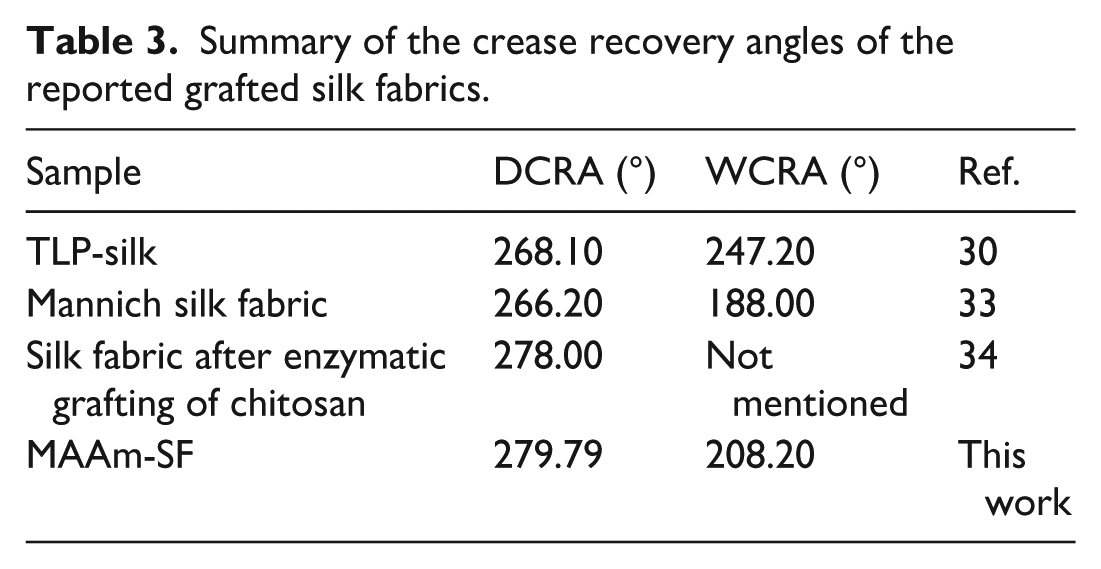
Silk fabrics are prone to wrinkling during use, limiting their appearance and comfort. 31 The crease recovery angle is an indicator of wrinkle resistance, reflecting the ability of fabrics to recover from deformation and folds. 32 The crease recovery angles of grafted silk fabrics are summarized in Table 2. With increasing graft weight gain, both dry and wet crease recovery angles improved. At 33.20% graft weight gain, the dry crease recovery angle (DCRA) increased from 245.5° (ungrafted) to 279.8°, a 14.0% improvement. The wet crease recovery angle (WCRA) increased from 192.9° to 208.2°, a 7.9% improvement. This enhancement is attributed to reactive groups in silk, such as –OH and –NH2. During graft polymerization, MAAm reacts with these groups, forming a stable network structure on the fiber surface. Such chemical crosslinking strengthens intermolecular interactions, restricting slippage of molecular chain segments under stress. This fixation improves wrinkle resistance, consistent with previous reports.10,33 In addition, MAAm grafted silk fabrics exhibit better wrinkle resistance than other reported grafted modified silk fabrics31,34,35 (Table 3).
Crease recovery angles of MAAm-grafted silk fabrics.

SD represents the standard deviation (n = 5); DCRA represents dry crease recovery angles; WCRA represents wet crease recovery angles.
Summary of the crease recovery angles of the reported grafted silk fabrics.
Moisture absorption, water vapor permeability, and air permeability
To evaluate the effect of grafting on the moisture absorption behavior of silk fabrics, the moisture regain was measured before and after modification (Figure 4). The results show that moisture regain increases following grafting with MAAm. At a graft weight gain of 33.20%, the moisture regain reaches 12.4%, which is 24.0% higher than that of the untreated sample, indicating that graft modification enhances fabric hygroscopicity. The standard moisture regain of raw silk is 11.0%. Because sericin is more hygroscopic than fibroin, degummed silk exhibits lower moisture regain than raw silk containing sericin under standard atmospheric conditions. After grafting, however, the introduction of hydrophilic groups from MAAm leads to an increase in moisture regain. Thus, moisture regain under standard atmospheric conditions may also serve as an indicator for distinguishing pure silk fabrics. The water vapor transmission rate of silk fabrics is shown in Figure 5(a). Compared with untreated silk, grafted fabrics exhibit slightly higher water vapor transmission. At 33.20% graft weight gain, the water vapor transmission rate reaches 2665.54 g/(d·m2), a 4.8% improvement over the ungrafted sample. This enhancement is attributed to the incorporation of amide groups (–CONH2) via MAAm grafting, which increases hydrophilicity and fabric moisture regain. In addition, hydrolysis or crosslinking within fibers partially disrupts crystalline regions and increases the proportion of amorphous regions, thereby facilitating moisture transport. 36 However, for consumers purchasing silk products by weight, higher regain may be disadvantageous. Nevertheless, moisture regain can also provide a preliminary quantitative measure for verifying silk authenticity.

Moisture regain of MAAm-grafted silk fabrics.

Water vapor transmission and air resistance of MAAm-grafted silk fabrics: (a) water vapor transmission rate (WVTR) and (b) air resistance.
The effect of grafting on air permeability is presented in Figure 5(b). Air resistance increases with graft weight gain, rising sharply beyond 20%. At 33.20% graft weight gain, air resistance increases from 0.157 (ungrafted silk) to 0.248 kPa·s/m, corresponding to a 58.5% decrease in air permeability. This reduction can be explained by two factors. First, fiber diameter increases with grafting, reducing the inter-yarn gaps. Second, some micropores within silk fibers are blocked, weakening the capillary effect and restricting airflow. Therefore, graft modification significantly reduces fabric air permeability and negatively influences wearing comfort.
Tensile properties
The effect of MAAm grafting on the mechanical performance of silk fabrics was investigated through tensile testing, and the results are shown in Figure 6. As seen in Figure 6(a), the load–displacement curves of silk fabrics exhibit nearly identical shapes before and after grafting, indicating that the fundamental deformation behavior remains unchanged. The tensile strength results (Figure 6(b)) show that fabric strength first increases and then decreases with increasing graft weight gain. At 11.78% graft weight gain, tensile strength peaks at 341.5 N/cm, representing a 30.7% improvement compared with ungrafted silk. This increase exceeds the growth rate of fabric areal density, suggesting that the enhancement arises not only from thicker fibers but also from structural reinforcement. On one hand, grafted MAAm monomers form covalent cross-linked networks among silk fibers, strengthening intermolecular bonding and improving tensile performance. 24 On the other hand, fiber thickening increases the effective load-bearing area (reflected in higher areal density), which further contributes to higher breaking strength per unit length. When graft weight gain continues to increase, tensile strength per unit width declines. At 33.20% graft weight gain, tensile strength remains 17.2% higher than that of ungrafted silk; however, this increase is smaller than the growth rate of fiber cross-sectional area or areal density. This reduction is attributed to two factors: (i) oxidative damage to fibers caused by the initiator, and (ii) diminished molecular orientation and crystallinity of silk fibers as grafting progresses. Thus, the mechanical strength of grafted fabrics reflects the combined effects of crosslinking, oxidative damage, and structural disruption.

Tensile properties of MAAm-grafted silk fabrics: (a) load–displacement curves and (b) tensile strength and breaking elongation.
Breaking elongation results (Figure 6(b)) show that MAAm-grafted fabrics exhibit lower extensibility than ungrafted silk. This decrease arises from intermolecular cross-linking within fibers, which restricts the slippage of macromolecular chains 34 and reduces toughness. 37
Antibacterial properties
Antibacterial performance was evaluated for silk fabrics with different graft weight gains, and the results are summarized in Table 4. In the table, #1 refers to untreated cotton fabric, which served as the control for verifying microbial growth and assessing antibacterial activity of silk fabrics against E. coli and S. aureus. The colony growth of the samples and control during testing is shown in Figures 7 and 8 (dilution factor 104). According to GB/T 20944.3-2008, which specifies the evaluation criteria for textile antibacterial activity, fabrics are considered antibacterial when the bacteriostatic rate against E. coli or S. aureus exceeds 70%. As shown in Table 4, the bacteriostatic rates of ungrafted silk (SF) against both strains were higher than 70%, confirming the inherent antibacterial activity of pure silk. The natural antibacterial property of mulberry silk has been attributed to oxidoreductases, antimicrobial peptides, and other bioactive components. A large number of –NH2 groups in these components interact with negatively charged proteins and polysaccharides on nearby bacteria, thereby disrupting the bacterial membrane and causing abnormal cytoplasmic distribution, thus inhibiting bacterial growth. 38 In addition, –NH2 groups in silk fibroin can be protonated to –NH3⁺ in acidic environments, enabling them to inhibit microbial respiration through adsorption, thereby exerting bactericidal effects. 39 After MAAm grafting, the antibacterial activity against E. coli initially decreased slightly, but the bacteriostatic rate gradually improved as graft weight gain increased. MAAm is a highly hydrophilic monomer, and the hydrophilicity of the silk fabric surface exhibits a positive correlation with the MAAm graft weight gain. 40 For E. coli, its hydrophobic cell wall has a weak affinity for hydrophilic surfaces. At low graft weight gain, the limited enhancement in surface hydrophilicity fails to offset the masking of intrinsic antibacterial sites on the silk matrix by grafted MAAm chains, thus leading to a decrease in antibacterial efficiency. In contrast, at high graft weight gain, the highly hydrophilic surface constructs a robust hydration layer via water molecule adsorption, which effectively repels bacterial adhesion through the hydration shell effect, resulting in a distinct rebound in antibacterial efficiency. 41 In contrast, the bacteriostatic rate against S. aureus increased markedly, reaching 99.99% across all grafted samples. This is because the negatively charged teichoic-acid on the surface of S. aureus interacts strongly with the polar groups of the hydrophilic MAAm side chains, achieving highly efficient adsorption and antibacterial activity even with low graft weight gain. 42 Therefore, all grafted samples achieved an antibacterial rate of 99.99%. These results indicate that MAAm graft modification tended to reduce antibacterial activity against E. coli, while significantly enhancing resistance to S. aureus. Further, the MAAm graft silk fabrics exhibited better antibacterial properties to other reported properties of grafted modified silk fabrics43–45 (Table 5).
Antibacterial activity of MAAm-grafted silk fabrics.


Antibacterial effect of MAAm-grafted silk fabrics against E. coli: (#1) cotton control, (a) ungrafted silk, (b–e) grafted silk with weight gains of 5.25%, 11.78%, 21.27%, and 33.20%.

Antibacterial effect of MAAm-grafted silk fabrics against S. aureus: (#1) cotton control, (a) ungrafted silk, (b–e) grafted silk with weight gains of 5.25%, 11.78%, 21.27%, and 33.20%.
Summary of the antibacterial activity of the reported grafted silk fabrics.

Abrasion resistance
The Martindale abrasion test was used to evaluate the wear resistance of silk fabrics. The surface morphologies before and after abrasion were examined by SEM (Figure 9). Within 500 abrasion cycles, the surface microstructures of MAAm-grafted silk fabrics remained nearly unchanged compared with ungrafted samples, suggesting that grafting did not cause immediate structural damage under low abrasion levels.

SEM images of MAAm-grafted silk fabrics under Martindale abrasion: (a1–4) ungrafted silk; (b1–4) MAAm-SF1; (c1–4) MAAm-SF2; (d1–4) MAAm-SF3; (e1–4) MAAm-SF4 Where 1-4 represent the abrasion cycles of 0, 100, 200, and 500, respectively.
To further assess abrasion resistance, the mass loss rates of silk fabrics were measured (Figure 10). During the first 10,000 abrasion cycles, grafted silk fabrics exhibited significantly higher mass loss than ungrafted fabrics, indicating reduced initial abrasion resistance. This effect is attributed to the presence of grafted MAAm and its polymers on the fiber surface, which made the grafted fabrics more vulnerable to surface damage and material loss during early-stage abrasion. However, when the number of abrasion cycles exceeded 15,000, the mass loss rate of ungrafted fabrics gradually approached and eventually exceeded that of grafted fabrics, with the difference becoming more pronounced as abrasion cycles increased. This reversal is explained by the crosslinking introduced during grafting, which enhanced fiber–fiber bonding. At higher abrasion levels, this structural reinforcement conferred improved resistance to wear, making the grafted fabrics more durable than ungrafted silk. Further, the MAAm graft silk fabrics exhibited better abrasion resistance to other reported properties of grafted modified silk fabrics 46 (Table 6).

Abrasion mass loss rate of MAAm-grafted silk fabrics.
Summary of the abrasion resistance of the reported grafted silk fabrics.

Wash durability
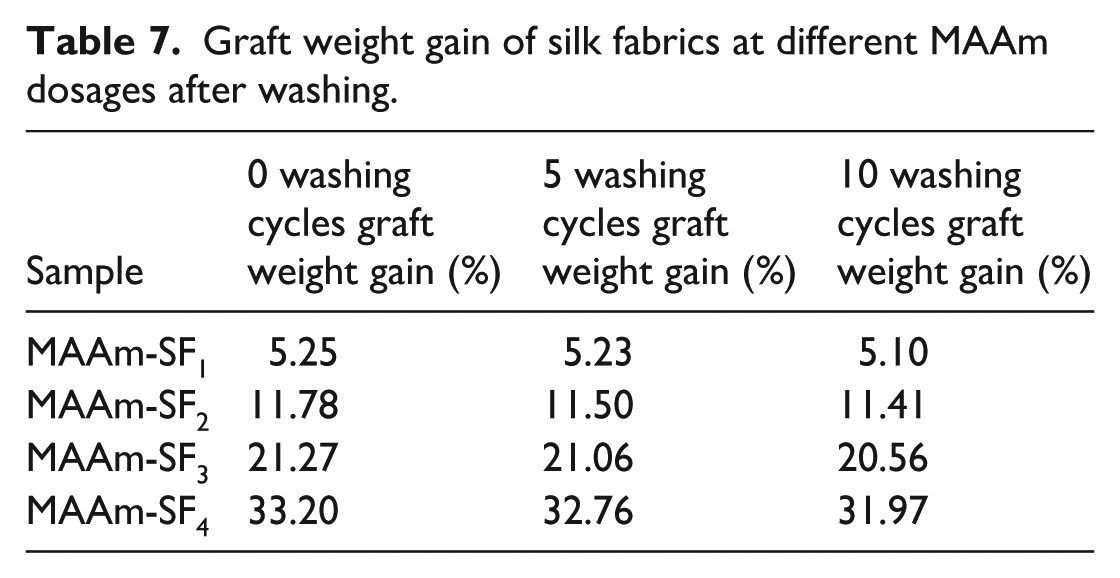
By comparing the grafting weight gain and antibacterial properties of MAAm-grafted silk fabrics before and after washing, their wash durability was evaluated. As shown in Table 7, the grafting weight gain of the MAAm-grafted silk fabrics exhibited a slight decreasing trend as the number of washing cycles increased. After five washing cycles, the retention rate of graft weight gain remained around 99.0%, and after 10 washing cycles, it was still approximately 96.0%. This indicates that the grafted layer is firmly bonded to the fibers and did not significantly detach due to washing and mechanical action, demonstrating that the fabrics maintain good grafting stability. 47
Graft weight gain of silk fabrics at different MAAm dosages after washing.
As indicated by the antibacterial rate data of MAAm-grafted silk fabrics before and after washing in Table 8, all samples exhibited no significant decrease in the inhibition rates against E. coli and S. aureus after 10 washing cycles. The maximum reduction in the inhibition rate against E. coli was 0.68%, while the inhibition rates against S. aureus remained above 99.63% after washing. According to GB/T 20944.3-2008, an antibacterial rate above 70% is recognized as indicative of an antibacterial effect, demonstrating that the MAAm-grafted silk fabrics possess adequate wash durability and antibacterial performance against both E. coli and S. aureus. With increasing graft weight gain, all samples maintained antibacterial property retention after washing, suggesting that modifications with different grafting levels can form a stable and wash-resistant antibacterial interface. In summary, the MAAm-grafted silk fabrics retained stable performance after washing, 48 showed good wash durability, and meet the durability requirements for practical applications.
Antibacterial rates of MAAm-grafted silk fabrics before and after washing.

Conclusions
In this study, MAAm was used as the grafting monomer, and a KPS–SH redox initiation system was used to graft natural silk fabrics via free radical polymerization. The properties of the grafted fabrics were systematically evaluated, leading to the following conclusions:
(1) Graft weight gain and structure: MAAm produces a strong graft weight gain effect, with fiber diameter increasing noticeably at higher grafting levels. At low grafting levels, fiber morphology remains largely preserved, whereas at high levels, polymer particle deposition is observed on the fiber surface. Crystallinity decreases to some extent after grafting.
(2) Wrinkle resistance and moisture-related properties: MAAm grafting enhances the wrinkle resistance and moisture regain of silk fabrics, with improvements becoming more pronounced as graft weight gain increases. At 33.20% graft weight gain, the crease recovery angle increases by 14.0%, moisture regain by 24.0%, and water vapor permeability by 4.8% relative to ungrafted silk. Moisture regain may also serve as a practical indicator for determining whether a fabric has undergone grafting.
(3) Air permeability and tensile properties: Air permeability decreases significantly after MAAm grafting, with a 58.0% reduction at 33.20% graft weight gain, which negatively affects fabric comfort. Tensile strength per unit length initially increases, exceeding the rate of areal density growth at low grafting levels, but declines relative to areal density at higher grafting levels. Grafting also substantially reduces elongation of the fabrics.
(4) Compared with ungrafted fabrics, the grafted fabrics show a slightly reduced antibacterial effect against E. coli, while inhibition against S. aureus is markedly enhanced, reaching 99.99%.
(5) Abrasion resistance: During the first 10,000 abrasion cycles, grafted fabrics exhibit reduced abrasion resistance compared with ungrafted silk. However, beyond 15,000 cycles, the abrasion resistance of grafted fabrics improves, exceeding that of ungrafted samples due to fiber crosslinking.
(6) MAAm-grafted silk fabrics exhibit excellent washing durability. After 10 washing cycles, the graft weight gain retention rate reaches 96.0%, indicating stable grafting structure. In terms of antibacterial performance, the inhibition rates against E. coli and S. aureus remain above 99.0% after washing, confirming their long-lasting and effective antibacterial properties.
Footnotes

Funding
The authors disclosed receipt of the following financial support for the research, authorship, and/or publication of this article: This work was supported by “Three Agriculture Nine Parties” Science and Technology Collaboration Projects of Zhejiang Province (Grant No. 2023SNJF024).
Declaration of conflicting interests
The authors declared no potential conflicts of interest with respect to the research, authorship, and/or publication of this article.