



Abstract
This study presents a first-time comprehensive characterization of Alpinia malaccensis (A. malaccensis) fibers extracted from the pseudostems of the Zingiberaceae family to evaluate their suitability as reinforcement in bio-composite applications. The physicochemical composition, thermal stability, crystalline structure, morphology, and tensile properties of the fibers were systematically investigated using FTIR, TGA, XRD, SEM, and single-fiber tensile testing. The fibers exhibited a high cellulose content of 75.94%, resulting in superior tensile strength (1164.99 MPa) and stiffness (28.44 GPa). Moderate hemicellulose (14.27%) and lignin (6.14%) contents contributed to balanced flexibility and good interfacial compatibility with polymer matrices. SEM analysis revealed a fine fiber diameter of 40–50 µm with uniform longitudinal alignment, promoting efficient stress transfer. In addition, the low density (0.53 g/cm³) and moderate moisture content (10.19%) indicate suitability for lightweight and dimensionally stable composite structures. The results demonstrate that A. malaccensis fibers are a high-performance, sustainable reinforcement material with strong potential to replace synthetic fibers in eco-friendly composite applications.
Keywords
Introduction
The growing dependence on natural fibers reflects a global shift toward renewable, green raw materials for the fabrication of value-added engineering components. The exploration of new plant-based fiber sources is a crucial step toward sustainable development, as it promotes environmental responsibility while simultaneously creating socioeconomic benefits through value addition to agricultural residues and income generation for rural communities. This transition has become increasingly important due to the environmental, health, and disposal concerns associated with conventional synthetic fibers such as glass, ceramic, and aramid fibers, which are non-biodegradable, energy-intensive, expensive, and pose serious inhalation and carcinogenic risks upon prolonged exposure.1,2
Recent studies have strongly emphasized replacing petroleum-based materials with plant-derived and sustainable alternatives across multiple engineering sectors. Rajendran et al. 3 highlighted the role of bio-based materials in reducing environmental impact and advancing green and sustainable energy systems. In parallel, the incorporation of high-performance fibers and nanomaterials into cementitious composites has shown promising structural applications, exemplified by the development of green fiber-reinforced concrete railway sleepers exhibiting enhanced mechanical performance and durability.4,5 Furthermore, the valorization of industrial byproducts and lignocellulosic waste streams has enabled the development of sustainable geopolymer binders, reinforcing circular economy, and waste-to-wealth concepts. 6
Natural fibers offer several advantages over synthetic counterparts due to their renewable origin, biodegradability, low cost, and minimal ecological footprint. Conventional fibers such as flax, hemp, jute, kenaf, cotton, and sisal have been widely explored for diverse engineering applications.7,8 Their adoption has expanded into transportation, aerospace, marine, textile, medical, sports, and domestic applications, driven by increasing performance optimization and sustainability demands.9,10 The mechanical performance of natural fiber-reinforced composites is highly influenced by the lignocellulosic composition of the fibers, particularly cellulose, hemicellulose, and lignin contents, which govern strength, stiffness, flexibility, and interfacial bonding characteristics. 11 Consequently, the increasing global reliance on bio-based fibers has encouraged the exploration of unconventional and underutilized plant resources.
In fiber-reinforced composites, reinforcing fibers serve as the primary load-bearing component, significantly enhancing structural integrity and mechanical performance.4,12 In this context, Alpinia malaccensis (A. malaccensis) has emerged as a promising yet underexplored natural fiber source. A. malaccensis is a rhizomatous perennial herb belonging to the Zingiberaceae family, growing up to 3 m in height and widely distributed across tropical regions of Asia, including Bangladesh, Sri Lanka, and Indo-China. Traditionally, the plant has been cultivated for its rhizomes, which are extensively used in food seasoning and pharmaceutical applications for treating nausea, vomiting, and wound healing, while its pseudostems remain largely unutilized.
The pseudostems of A. malaccensis exhibit an erect, cylindrical, and fibrous morphology, with fibers aligned along the longitudinal tensile axis, an attribute favorable for load-bearing and structural applications.13,14 Owing to their high cellulose and lignin contents, these fibers demonstrate strong potential as reinforcements in bio composites.15,16 However, despite its wide availability and favorable morphology, no comprehensive scientific investigation has previously reported the physicochemical, thermal, and mechanical characteristics of A. malaccensis fibers in the context of natural fiber-reinforced composites (NFRCs).17,18
This study presents the first comprehensive characterization of A. malaccensis fibers to evaluate their suitability as alternative reinforcement materials for NFRC manufacturing. 19 The chemical composition, particularly cellulose and lignin contents, was analyzed due to their critical influence on fiber strength, stiffness, and durability. 20 Advanced characterization techniques including X-ray Diffraction (XRD), Fourier Transform Infrared Spectroscopy (FTIR), Thermogravimetric Analysis (TGA), single-fiber tensile testing, and Scanning Electron Microscopy (SEM) were employed to evaluate the structural, thermal, mechanical, and morphological properties, as well as fracture behavior of the extracted fibers.
The tensile performance, crystallinity, thermal stability, and structural integrity of A. malaccensis fibers were systematically compared with those of other established natural fibers to benchmark their reinforcement potential. Recent studies on related Zingiberaceae fibers, such as Alpinia galanga pseudostem fibers, have demonstrated their effectiveness as lightweight and eco-friendly reinforcements for materials engineering applications. 17 Similarly, chemically modified Pseudoxytenanthera bamboo fibers have shown enhanced tensile properties and improved interfacial morphology, highlighting their suitability for sustainable composite development. 15 Alkaline-treated Bambusa tulda fibers have also exhibited improved mechanical, structural, and thermal properties, supporting their application in green composites for construction and infrastructure. 9
Furthermore, fabric-based natural reinforcements such as sisal have been reported to significantly influence the tensile and flexural behavior of cementitious composites, with reinforcement layering playing a crucial role in load transfer efficiency. 11 Hybrid systems incorporating bamboo fibers and microparticles have demonstrated enhanced mechanical performance and sustainability benefits for future construction applications. 9 Complementary studies on jute, kenaf, and pineapple leaf fiber-reinforced polymer composites further validate the effectiveness of natural fibers when combined with optimized matrix systems and processing strategies. 21
Collectively, these studies establish a strong scientific foundation for exploring novel plant-based fibers as high-performance green reinforcements. The present work contributes to this growing body of knowledge by systematically evaluating A. malaccensis fibers derived from pseudostem waste, thereby advancing sustainable material development and opening new pathways for eco-friendly, high-performance composite design.
Materials and methods
Harvesting of A. malaccensis fibers
As depicted in Figure 1(a), Alpinia malaccensis (Burm. f.) Roscoe is a herbaceous plant with rhizomes that may grow up to 3 m tall. This perennial, which is not cultivated enough, grows in the tropical parts of Asia, like Bangladesh, Sri Lanka, and Indo-China. 22 For this research, A. malaccensis pseudostems were collected from Jawaharlal Nehru Tropical Botanical Garden and Research Institute (JNTBGRI), Trivandrum, Kerala, India. The species was taxonomically identified from credible literature, and a voucher specimen was deposited (CATH Herbarium 23001). Pseudostems were harvested with high attention to ensure optimal biocomposite grade fibers. All steps were done in a manner that retained the fibrous structure’s integrity. Precision harvesting and processing ensured ideal biocomposite grade fibers.

Images of A. malaccensis plant and its fibers. (a) Plant view of A. malaccensis, (b) Pseudostems of A. malaccensis, and (c) Raw fibers of A. malaccensis.
The singular surface properties of the tensile testing fibers required a very high degree of uniformity. Such uniformity required rigorous testing for fibers of diameters between 40 and 50 µm. A LEICA optical stereo microscope was employed to meticulously measure the fiber diameters, later confirmed with Scanning Electron Microscopy (SEM). The microstructural analysis enhanced understanding of the material properties, making the materials suitable for further engineering applications.
Fiber extraction and specimen preparation
Figure 1(a) shows the A. malaccensis plant, while Figure 1(b) illustrates the pseudostem of A. malaccensis and the fiber extraction process, which involves a controlled alkaline treatment beginning with the harvesting of fresh pseudostems to obtain high-quality fibers. The pseudostems are properly cleaned to remove dirt and impurities prior to being cut into sections of convenient lengths of 10–15 cm. In order to remove excess water, the cut stems are heated in a hot chamber to make them ready for the next treatment.
A solution of 5% sodium hydroxide (NaOH) is then prepared into which the dried stems are immersed for a time of 2–6 h at ambient temperature. This process adequately dissolves the lignocellulosic matrix, and additional binding compounds facilitate the efficient separation of fibers. The stems are then washed adequately with running water to drain out any remaining NaOH. To further process the fibers, there is an optional step of neutralizing them with a gentle 1% acetic acid or vinegar. The softened outer covers are then delicately peeled or scraped off, exposing the underlying fibers. These fibers are separated or combed manually to make them finer and more uniform.
After extraction, the raw fibers are slowly desiccated in a hot oven (40–50°C) to eliminate moisture content without losing their structural integrity. They are then carefully examined for uniformity and cleanliness. To ensure that their quality is not affected and they are not contaminated, the dry fibers are kept in tightly sealed containers under dry and cool conditions until they are needed. The alkaline treatment is also important in upgrading the fiber properties by its surface roughening, improving tensile strength and stiffness, and decreasing the moisture absorption. For the purpose of having uniformity of fiber properties, all treated fibers, as illustrated in Figure 1(c), are safely stored in sealed packets maintained at 23°C and 65% relative humidity.
Evaluation of properties of A. malaccensis fibers
Structural, compositional, and thermal profiling of fibers
Individual fibers were measured for their diameters using the LEICA DM750M optical stereo microscope. To confirm the precision, measurements were cross-verified against SEM (JEOL JSM-6390LV). Upon examination under the microscope, fibers within the specified range of 40–50 μm were selected. The chosen fibers were carefully tested to obtain their mechanical properties via tensile testing.
The compositional makeup of the raw fibers was examined for lignocellulosic part as per the accepted technique. 23 The water retention (moisture) from the raw samples was monitored using the oven-drying method. 24 Additionally, sample density was measured by employing a pycnometer which is compliant to the ASTM D8171-18 standards. 26 The water absorption capacity was determined by submerging the fibers in distilled water at intervals of 10, 30, and 60 min and retrieving them following the ASTM D570-98 standards.25,26
To have an extensive characterization of the fibers, FTIR spectroscopy was carried out employing a Shimadzu IR Prestige-21 instrument to evaluate the functional groups present in the samples. Thermal profiling was also analyzed via TGA employing a Perkin Elmer TGA 6000 instrument, from which the decompositions were derived. XRD plots were also used to determine the crystallite structure to gain detailed information about the crystalline cellulose composition of the raw A. malaccensis fibers.
Assessment of tensile properties
Following ASTM D3822-07, a standard generally used to evaluate the mechanical attributes of plant-based textile raw fibers and threads, tensile testing was performed on individual A. malaccensis fibers to determine their tensile strength along the fiber axis and elastic modulus. A computerized UTM, INSTRON 3345 machine with a load capacity of 100 N was used to conduct experiments.
Morphological analysis using SEM
The morphological features of the surface and fractured regions of A. malaccensis fibers were examined using a SEM, JEOL JSM-IT510 model with a resolution range of X5–X300000. The examinations were performed in low vacuum mode with an increasing voltage of 20 kV, capturing high-precision profiles at various scales of magnification to reveal intricate structural details.
Results and discussion
Lignocellulosic estimation of A. malaccensis fibers
The lignocellulosic composition of A. malaccensis fiber as detailed in Table 1 depicts that it contains 75.94% cellulose, 14.27% hemicellulose, 6.14% lignin, and 3.65% ash. The high cellulose content is indicative of a strong and stiff fibrous structure, which is advantageous for reinforcement applications in composite materials due to enhanced mechanical performance and biodegradability. 27 Hemicellulose and lignin, while present in lower quantities, contribute to the flexibility and bonding properties of the fiber matrix. 28 The low ash content reflects minimal inorganic residue, which reduces the risk of fiber degradation during high-temperature processing. 29
Chemical characterization of A. malaccensis fibers.

Compared to other plant-based fiber resources (Table 2) namely ramie (68.6%), flax (71%), and Sansevieria ehrenbergii (80%), A. malaccensis exhibits a competitive cellulose content, positioning it as a promising candidate for high-performance bio-composites. The hemicellulose content of 14.27% also supports good interfacial bonding due to its amorphous and hydrophilic nature, comparable to that in fibers like Coccinia grandis (13.42%) and kenaf (8%–13%). The moderate lignin content (6.14%) ensures sufficient rigidity without compromising the fiber’s flexibility and processability, unlike fibers such as coir, which have excessively high lignin content (41%–45%). The ash content of 3.65%, while slightly higher than that of sisal and flax, remains within acceptable limits, minimizing adverse effects on thermal processing and enhancing overall fiber compatibility with polymer matrices.
Comparison chart on chemical properties of available natural resources.

FTIR study
FTIR spectroscopy analysis, as depicted in Figure 2, further confirms the presence of the primary chemical constituents of the fiber. The observed broad absorption band at 3337.96 cm⁻¹ signifies O–H vibrational bands from hydroxyl functionalities in hemicellulose and cellulose. The absorption band at 2904.07 cm⁻¹ is due to C–H vibrational mode from the aliphatic chains in the polysaccharide backbone. Peaks at 1625.07 and 1314.11 cm⁻¹ are associated with aromatic skeletal vibrations and CH₂ bending, characteristic of lignin. 40 The strong band at 1033.22 cm⁻¹ corresponds to C–O stretching, primarily attributed to cellulose. The FTIR data align with the lignocellulosic profiling data, affirming the predominance of cellulose and the presence of minor components like lignin and hemicellulose.
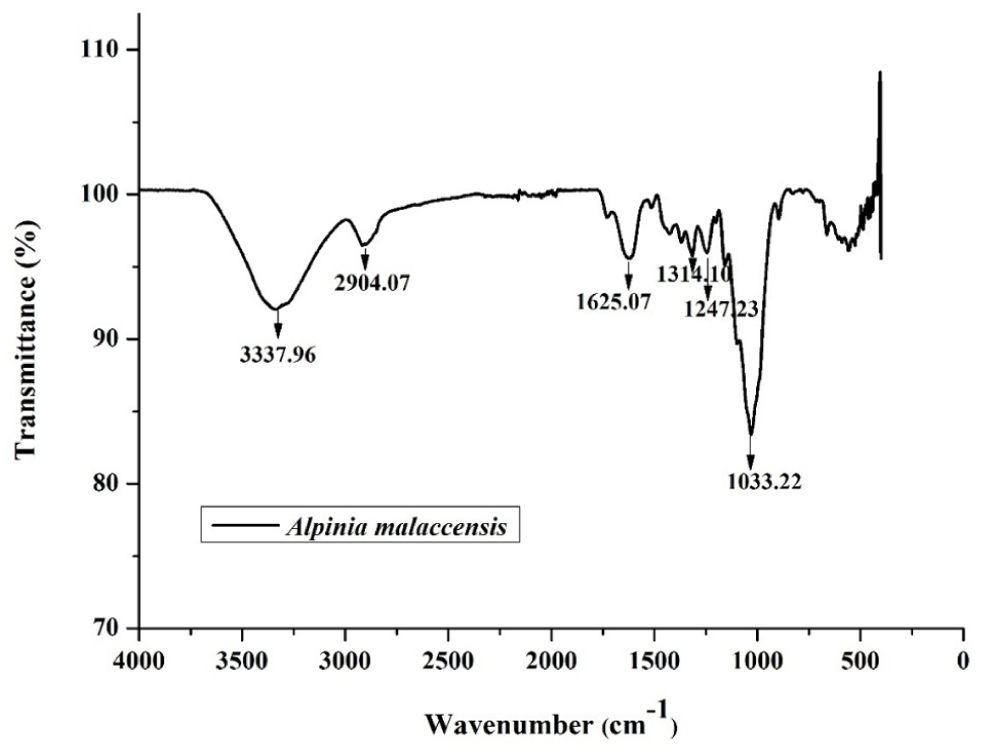
FTIR plot of A. malaccensis fiber.
XRD evaluation
XRD evaluation of A. malaccensis fiber shows (Figure 3), prominent peaks at 2θ = 16.05° and 22.27°, characteristic of the (110) and (200) planes of cellulose I structure. The crystallinity index (CI) of the fiber is evaluated to be 66.69%, which is relatively high for natural fibers and suggests a significant proportion of well-organized crystalline cellulose domains. 41 This high crystallinity correlates with the fiber’s high cellulose content and contributes to its rigidity, thermal resistance, and tensile strength. 42 The crystallite size is estimated to be 19.95 nm, which falls within the nanocrystalline range, further enhancing the mechanical potential of the fiber for composite reinforcement applications. 43

XRD plot of A. malaccensis fiber.
TGA-DTG analysis
TGA and DTG curves as depicted in Figure 4, demonstrate the thermal stability of A. malaccensis fiber. An initial weight loss is observed below 100°C signifies the moisture evaporation. The major decomposition phase occurs between 250°C and 400°C, with a DTG peak at around 320°C corresponding to cellulose and hemicellulose degradation. 44 A secondary degradation peak near 400°C is attributed to the slower thermal breakdown of lignin, which degrades over a wider temperature span, reflecting its intricate aromatic structure. The final char residue at temperatures beyond 500°C is consistent with the measured ash content (3.65%). The fiber exhibits typical thermal degradation behavior of lignocellulosic materials, confirming its suitability for thermal processing and incorporation in polymer matrices. 45
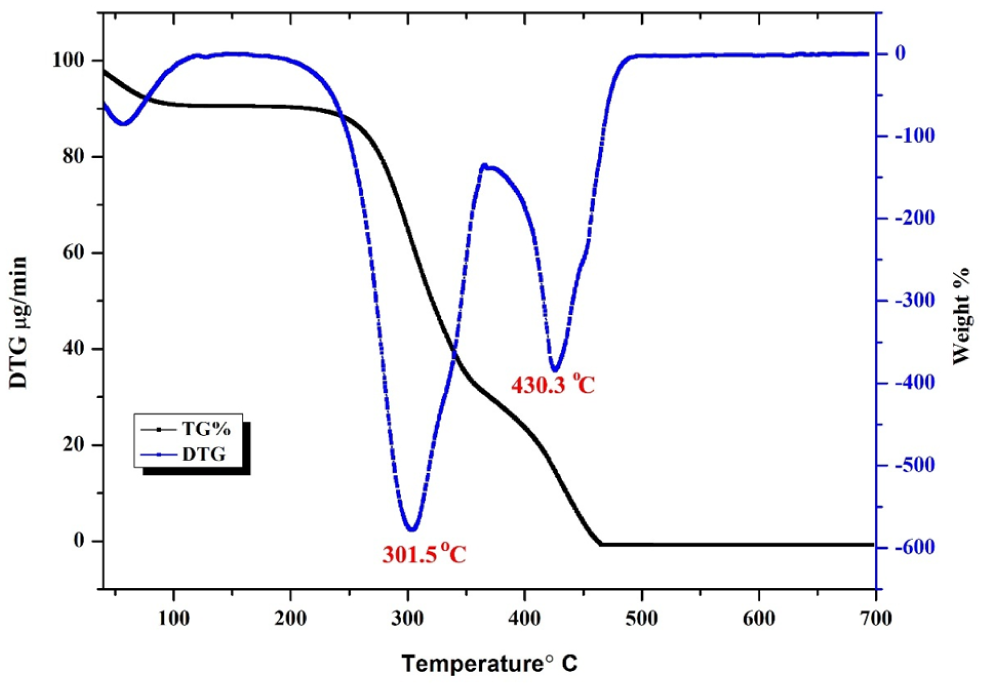
TGA and DTG plots of A. malaccensis fiber.
Physical characterization
Microscopic analysis
The fiber diameters of A. malaccensis were precisely measured using optical microscopy and SEM as illustrated in Figures 5(a) and 6(b), respectively. The optical micrograph (Figure 5(a)) shows consistent fiber thickness, with diameters span from 41.4 µm to 42.5 µm. These measurements were further validated by SEM analysis (Figure 5(b)), which also confirmed fiber diameters in the range of approximately 42.2–42.6 µm. The SEM image reveals well-aligned fibrillar structures with minimal surface defects, indicating good morphological uniformity along the fiber’s longitudinal axis. This consistency is critical, as uniform fiber diameters contribute to reliable stress distribution and enhanced interfacial bonding in composite matrices. For this reason, only fibers with diameters between 40 and 50 µm were chosen for further tensile testing. Its potential as efficient natural reinforcements in composite applications is further supported by the controlled selection process, which guarantees that the mechanical properties obtained are representative of structurally consistent fibers.29,46

Optical and SEM images of single fibers of A. malaccensis species. (a) Optical image of A. malaccensis fiber and (b) SEM image of A. malaccensis fiber.

Stress versus strain plot and fracture surface morphology of A. malaccensis fiber. (a) Stress versus strain plot of A. malaccensis fiber from tensile test and (b) Fracture surface morphology of A. malaccensis fiber using SEM.
Evaluation of physical attributes of A. malaccensis fibers
Table 3 lists the physical characteristics of A. malaccensis fibers, such as moisture content, density, and water absorption, which are crucial markers of their suitability for a range of industrial uses.
Summary of physical parameters of A. malaccensis fibers.

Compared to commonly used raw natural fibers like flax (1.4–1.5 g/cm3), hemp (1.47 g/cm3), and coir (0.6–1.2 g/cm3), the density of A. malaccensis fibers was found to be 0.53 g/cm3. Because of its relatively low density, A. malaccensis is lightweight and therefore a perfect reinforcement for sectors like the transportation and aviation industries, where weight minimization is essential. The fiber’s suitability for use in composite manufacturing is further enhanced by the moderate lignin content (6.14%), which guarantees a balance between stiffness and workability.
A. malaccensis was found to have a moisture content of 10.19%, which falls within the range seen for natural fibers like bamboo (10%–15%) 47 and coir (8%–12%).8,48 The comparatively moderate moisture content in A. malaccensis fibers indicates good dimensional stability. Moisture content affects fiber durability and resistance to microbial degradation. Hemicellulose (14.27%) and a regulated ash content (3.65%) guarantee that these fibers retain sufficient flexibility while preventing an excessive amount of inorganic residue, which might otherwise impair processing effectiveness.
Because A. malaccensis fibers are naturally hydrophilic, they exhibit a significant water absorption capacity of 128.77% in 10 min, 147.18% in 30 min, and 155.59% in 60 min. This is explained by the high percentage of cellulose (75.94%) and the abundance of hydroxyl groups, which are characteristic of members of the Zingiberaceae family. Fibers from this botanical group are known for their well-developed vascular structures and porous morphology, which enhance moisture uptake. Compared to other natural fibers such as pineapple (201.32%) and banana (450.45%). 25 A. malaccensis exhibits moderate but significant moisture retention, suggesting good interfacial compatibility with hydrophilic matrices in composite applications. While this hygroscopic nature can improve fiber-matrix adhesion, particularly in waterborne systems, it may also necessitate surface modifications, such as alkali or silane treatments, to reduce moisture sensitivity and enhance dimensional stability in structural or outdoor-use composites.
Mechanical characterization of A. malaccensis fibers
The mechanical performance of A. malaccensis fibers as detailed in Table 4 is a crucial factor in determining their suitability for structural and composite applications. A. malaccensis’s tensile stress was measured at 1164.99 MPa, which is similar to high-performance natural fibers like hemp (550–1100 MPa) and flax (500–1500 MPa). 49 Its high cellulose content (75.94%), which offers superior rigidity and load-bearing capacity, is largely responsible for its high tensile strength. Cellulose’s high crystalline content improves the fibers’ structural integrity, making them a viable option for reinforcing polymer composites.
Tensile test results of A. malaccensis fibers.

The tensile modulus of A. malaccensis fibers was determined to be 28,438.46 MPa, which translates to outstanding stiffness and resistance to deformation upon tensile loading. In comparison with other widely available fibers, for example, jute (10,000–30,000 MPa) and coir (4000–6000 MPa). 49 A. malaccensis has higher modulus values and can be used for applications that need high stiffness, for example, automobile panels and building materials. The relatively moderate content of hemicellulose (14.27%) accounts for fiber flexibility and is also responsible for compatibility with polymer matrices, ensuring increased mechanical stability of the fiber during composite utilization. The tensile strain of A. malaccensis was measured to be 0.0348, which correlates favorably with other natural fibers’ behavior. This value of strain shows an even blend of ductility and rigidity that is beneficial for applications where load-bearing requires strength as well as elongation. The limited amount of lignin (6.14%) improves the tensile behavior of the fiber by minimizing inherent brittleness while providing adequate rigidity for structural functions.
Physically, A. malaccensis has a good fiber diameter of 40–50 µm, classifying it as one of the finer of the natural fibers, which in turn is ideal for better fiber-matrix adhesion in composites. Having a good level of moisture content (10.19%) provides stability without risking the loss of mechanical performance due to too much water absorption. The density of A. malaccensis (0.53 g/cm³) and with its uniformly distributed fibers in the longitudinal direction, as indicated from SEM micrographs in Figure 5(b), further improves its tensile performance. The uniform distribution reduces defects and improves stress transfer along the fiber length, minimizing premature failure. Moreover, the small fiber diameter is responsible for efficient stress distribution and plays a crucial role in the tensile strength and modulus.
The stress-strain behavior of A. malaccensis fiber, as depicted in Figure 6(a), was evaluated through tensile testing to assess its mechanical performance and load-bearing capacity. The resulting stress-strain curve provides valuable insights into its elasticity, tensile strength, and failure characteristics, aligning with previous studies on plant fibers. SEM analysis of the fiber post-fracture offers a deeper understanding of its structural integrity, failure mechanisms, and microstructural response under mechanical stress. The fractured surface exhibits a combination of brittle and ductile failure modes, reflecting a well-balanced interplay between stiffness and flexibility. The presence of fibrillar pull-outs and fiber splitting, as shown in Figure 6(b), suggests efficient stress transfer within the cellulose-rich structure, contributing to its impressive tensile strength. Additionally, microvoids and rough fracture surfaces, observed in SEM images (Figure 6(b)), highlight the influence of hemicellulose and lignin in governing fiber deformation and energy dissipation during loading. The fiber’s uniform longitudinal alignment and fine diameter (0.04–0.05 mm) enhance mechanical interlocking, making it highly suitable for reinforcing polymer matrices in bio-composites.
The mechanical performance of A. malaccensis fibers was evaluated through tensile testing, and the results were compared with other natural fibers, as detailed in Table 5. The tensile stress, tensile modulus, and strain behavior of A. malaccensis exhibit remarkable superiority over many commonly used natural fibers, indicating its potential for structural and composite applications.
Comparative analysis of tensile properties of natural fibers with A. malaccensis.

A. malaccensis demonstrated an impressive tensile stress of 1164.99 MPa, which significantly surpasses that of jute (393–773 MPa), coir (138.7 MPa), and bagasse (290 MPa). Notably, its strength is also higher than that of sisal (511–535 MPa) and hemp (690 MPa), which are widely regarded as strong natural fibers. The tensile strength of A. malaccensis even exceeds that of well-known reinforcement fibers like kenaf (930 MPa) and Sansevieria ehrenbergii (50–585 MPa). The tensile modulus of A. malaccensis was recorded at 28.44 GPa, positioning it competitively among natural fibers. While it falls within the range of flax (27.6 GPa) and kenaf (53 GPa), it is notably higher than that of pineapple fibers (1.44 GPa), jute (26.5 GPa), and Arundo donax (9.4 GPa). This high modulus reflects the fiber’s ability to resist deformation under applied stress, making it suitable for high-performance composite applications. The tensile strain of A. malaccensis was remarkably low at 0.0348, indicating its high stiffness and limited elongation under tensile stress. Compared to natural fibers like coir (30%) and Sansevieria ehrenbergii (2.8%–21.7%), the strain value suggests that A. malaccensis fibers are highly rigid, which can be advantageous in structural applications requiring high dimensional stability. The potential of A. malaccensis fibers as an environmentally friendly and sustainable reinforcement material is highlighted by their favorable physical characteristics, ideal chemical composition, and superior tensile properties. A. malaccensis is a promising material for bio-composites, automotive components, and lightweight structural materials because of its high strength, excellent modulus, and fine diameter. It is also a more environmentally friendly option than traditional synthetic fibers.
Conclusion
The major findings of the present study are summarized as follows:
✧ Alpinia malaccensis fibers were successfully extracted from pseudostem agro-waste and comprehensively characterized for the first time as a potential green reinforcement material.
✧ The fibers exhibited a high cellulose content (75.94%), which directly contributed to their exceptional tensile strength (1164.99 MPa) and high stiffness (28.44 GPa), placing them among the strongest reported natural fibers.
✧ The balanced hemicellulose (14.27%) and lignin (6.14%) contents provided an optimal combination of flexibility, durability, and improved compatibility with polymer matrices, enhancing their suitability for bio-composite applications.
✧ SEM analysis revealed a fine fiber diameter (40–50 µm) with uniform longitudinal morphology, facilitating efficient stress transfer and superior mechanical performance.
✧ The fibers demonstrated a low density (0.53 g/cm3) and moderate moisture content (10.19%), contributing to lightweight characteristics and dimensional stability in composite systems.
✧ Thermal analysis showed a high thermal stability, with a maximum decomposition temperature of approximately 340°C, confirming compatibility with conventional polymer processing temperatures.
✧ XRD analysis indicated a relatively high crystallinity index (66.69%), reflecting a well-organized cellulose structure responsible for enhanced mechanical and thermal properties.
✧ The combined physicochemical, mechanical, thermal, and morphological characteristics establish A. malaccensis fibers as a sustainable and high-performance alternative to synthetic reinforcement fibers.
✧ The utilization of A. malaccensis pseudostems offers an effective route for value addition to agricultural waste, supporting circular economy principles and environmentally responsible composite development.
Footnotes
ORCID iDs

Author contributions
All authors are equally contributed to Conceptualization, Methodology, Writing–original draft, Writing–review & editing.
Funding
The authors received no financial support for the research, authorship, and/or publication of this article.
Declaration of conflicting interests
The authors declared no potential conflicts of interest with respect to the research, authorship, and/or publication of this article.
Data availability statement
The data that support the findings of this study are available on request from the corresponding author.* The data are not publicly available due to privacy or ethical restrictions.
AI declaration
During the preparation of this work, the authors used Grammarly to improve language clarity, grammar, and spelling. After using this tool, the authors reviewed and edited the content as needed and take full responsibility for the final version of the manuscript.