



Abstract
Researchers are working hard to handle the intricate interplay and interconnected relationships between fiber properties, process parameters, and consumer requirements in yarn manufacturing. These relationships make a complex network and researchers tried to develop prediction models through artificial neural network (ANN). This paper provides a systematic and comprehensive up to date (2024) overview on applications of ANN in the textile yarn manufacturing (fiber to yarn) sector. In addition, diverse methodologies, approaches, and specific applications of ANN in fiber to yarn are criticized in this study. The limitations, challenges, and future scopes of this subject have been explored by synthesizing the selected relevant publications in the field of textile yarn manufacture and ANNs. The study contributes to the theoretical and practical implications through this review and concludes with a valuable future opportunity. Notwithstanding the fact that the research shows a clear improvement in the implementation of ANN in the yarn manufacturing sector, substantial work remains to be done in these areas.
Keywords
Introduction
Nowadays, people typically satisfy their second fundamental need—that of textiles and clothing—without considering the consequences. Globalization has facilitated the manufacturing of textile and clothing products in poor nations by taking advantage of low labor costs and relaxed environmental and working standards regulations. 1 Textile manufacturing is dynamic, evolving in conjunction with the state of the art in science and engineering. 2 Yarn production is an essential initial phase in the worldwide textile industry when the yarn is made from fibers and/or filaments. The characteristics of yarn are a crucial factor in creating appealing and essential clothing. 3 Ring spinning is widely regarded as the most prominent spinning process when compared to other spinning systems including rotor, vortex, and friction spinning. This is because it produces superior-quality yarn and utilizes highly adaptable technology. 4 The yarns undergo additional preparation stages such as winding, doubling, twisting, and waxing, depending on the desired clothing type. 5
The structure and physical characteristics of yarns are mainly determined by the characteristics of the fibers used, the spinning technique employed (such as ring, rotor, and vortex spinning), and other process variables including draft, twist-insertion rate, rotor speed, nozzle pressure, etc. 6 The intricate interplay between fiber properties, process parameters, yarn structures that are raised to a complex network of interconnected relationships, necessitating the development of prediction models. 7
The characteristics of fiber, sliver, and yarn can be forecasted using the statistical and experimental framework of artificial neural networks (ANNs). While ANN is more robust and capable of self-validation and instruction in complicated, multiparameter, and nonlinear scenarios those do not have easily identifiable or direct analytical solutions.8–12
Pareira et al. 13 explored the application of Fuzzy logic, ANN, and expert systems as tools of artificial intelligence (AI) in textile industries. Chattopadhyay 14 explained the ANN model in detail and predicted the yarn characteristics from fiber properties as input materials. A number of reviews by scholars such as Sikka et al., 15 He et al., 16 Mukhopadhyay and Suddiquee, 17 Chattopadhyay and Guha 18 highlighted the applications of AI tools specially ANN in various operations from fiber to clothing in textile industries.
In the textile and clothing sectors, there is a complex relationship of numerous elements. Due to significant fluctuations in raw materials characteristics, complex processing stages, and limited control on process parameters, the correlation between these variables and yarn properties depends on human expertise. 19 However, it is impractical for individuals to retain all the specific details of process-related data over time. 20 The majority of yarn manufacturing sections are transitioning from traditional to automated and sophisticated systems that utilize cutting-edge technology. 21 The testing results on various parameters of fibers and yarns takes long time which awaits the yarn manufacturers for long time and disrupts the continuity of production flow. The yarn manufacturers are seeking faster evaluation of fibers, intermediate materials, and yarns. 22 With the significant enhancement of computational capacity over the preceding decade, ANN can effectively learn from datasets to uncover the unknown relationships among the various variables. 20
Over the last decade, substantial advances have been made in the use of ANN in textile processing, which contributes to sustainability in the clothing industry. Nevertheless, research has been somewhat divided, with ANN concentrating exclusively on material advancements while overlooking the process prediction. For the convenient of academicians and professionals of yarn manufacturing, the study aims to make a comprehensive and systematic literature review on the scope of ANN in yarn manufacturing. This review investigates the scholars’ findings and application of ANN on fibers, slivers, roving, and yarn that are manufactured through the utilization of contemporary spinning techniques like ring, rotor, and air-jet. This paper also provides a critical analysis of the scopes, limitations and challenges, along with the promise of employing intelligent techniques on the yarn manufacturing process, to establish a solid foundation for future scholarly investigations.
The present study contributes to the current body of literature by investigating the utilization of ANN within the scope yarn manufacturing industry.
This research investigates the existing ANN application on attributes of fibers, slivers, roving, and yarn that are manufactured through the utilization of ring, rotor, and air-jet spinning techniques. Additionally, identify future research directions for forecasting the characteristics of materials in process at each stage of the short-staple yarn manufacturing industry.
For the first time, the current study presents a novel approach to conducting a systematic and thorough assessment of the utilization of ANN in the yarn production industry, focusing specifically on scholarly publications sourced from Scopus.
Paper selection and review process
This evaluation examines scholarly articles that are included in the Scopus database. The Scopus search engine was employed to search for the precise keyword ‘Artificial Neural Network and fiber and yarn’ with restrictions to the English language on January 8, 2024. The search time for the articles’ spans from 1996 to 2024. A total of 150 documents were identified, with 79.3% being journal articles and 13.3% being conference papers. The categorization of the documents is depicted in Figure 1. The materials are additionally classified according to their subject area and shown in Figure 2. The documents consist of 21.20% papers related to engineering and 30.06% about material sciences. Following a series of consecutive sorts, a total of 67 articles were selected for review. Only the field study about the process of converting fiber into yarn has been taken into account while excluding any reviews or studies that are not relevant to the yarn manufacturing technology. Figure 3 illustrates the process of selecting articles.

Documents by type.

Documents by subject area.
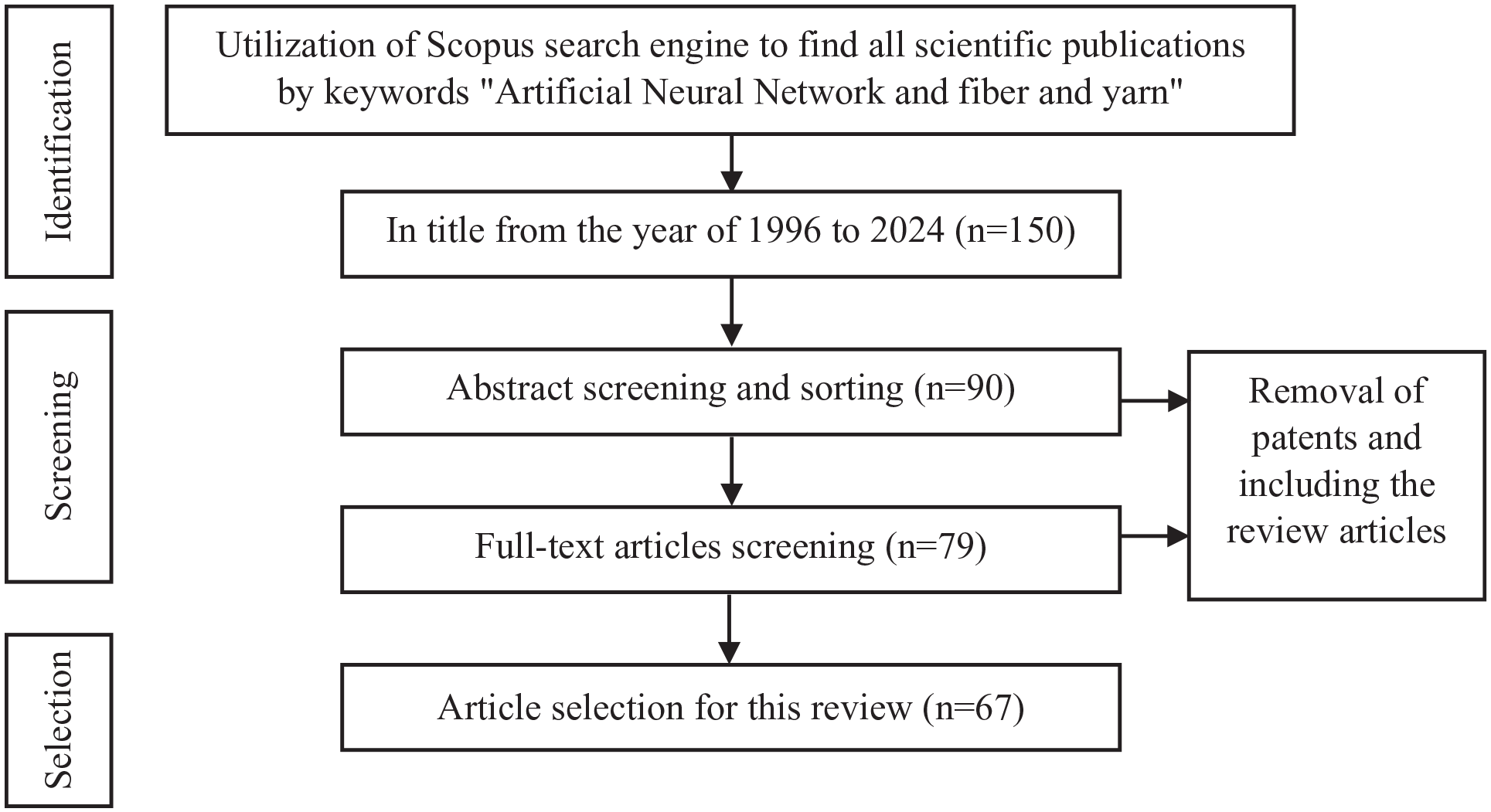
Paper selection outline for the review.
An overview of Artificial Neural Networks (ANNs)
The ANNs are statistical learning models used in cognitive science and machine learning. These models mimic biological neural networks (BNN). Its algorithms are designed to achieve a certain purpose, and it learns and stores knowledge using synaptic weights like the human brain. 13 Synaptic weights, numerical values provided to neuron connections, help neural networks learn and adapt to new inputs. The network’s experience can change these weights. ANN cannot solve the problem alone; it must be integrated into a system engineering technique. 23 Neural networks are powerful because of their parallel distribution structure and capacity to learn and generalize. Generalizations allow neural networks to operate well with untrained inputs. ANNs have a unique neuron connection ‘architecture’. Connection weights are calculated using an activation function and ‘training’, ‘learning’, or ‘algorithm’.24,25 However, it has multiple drawbacks, such as direct convergence to local minima, slow convergence, or lack of convergence, overfitting, and an ambiguous optimal number of hidden network layers.26,27
Network selection
A variety of function approximation problems have been solved using feed-forward neural networks. By adding units to the input, hidden, and output layers, the neural network can be constructed as Figures 4 and 5. The network must be trained using back-propagation on the specified data sets. This requires adjusting network parameters like the number of hidden layers, the number of units inside each layer, the activation function, the learning rate, and the training cycles. 14

Artificial neural network without hidden layer. 14
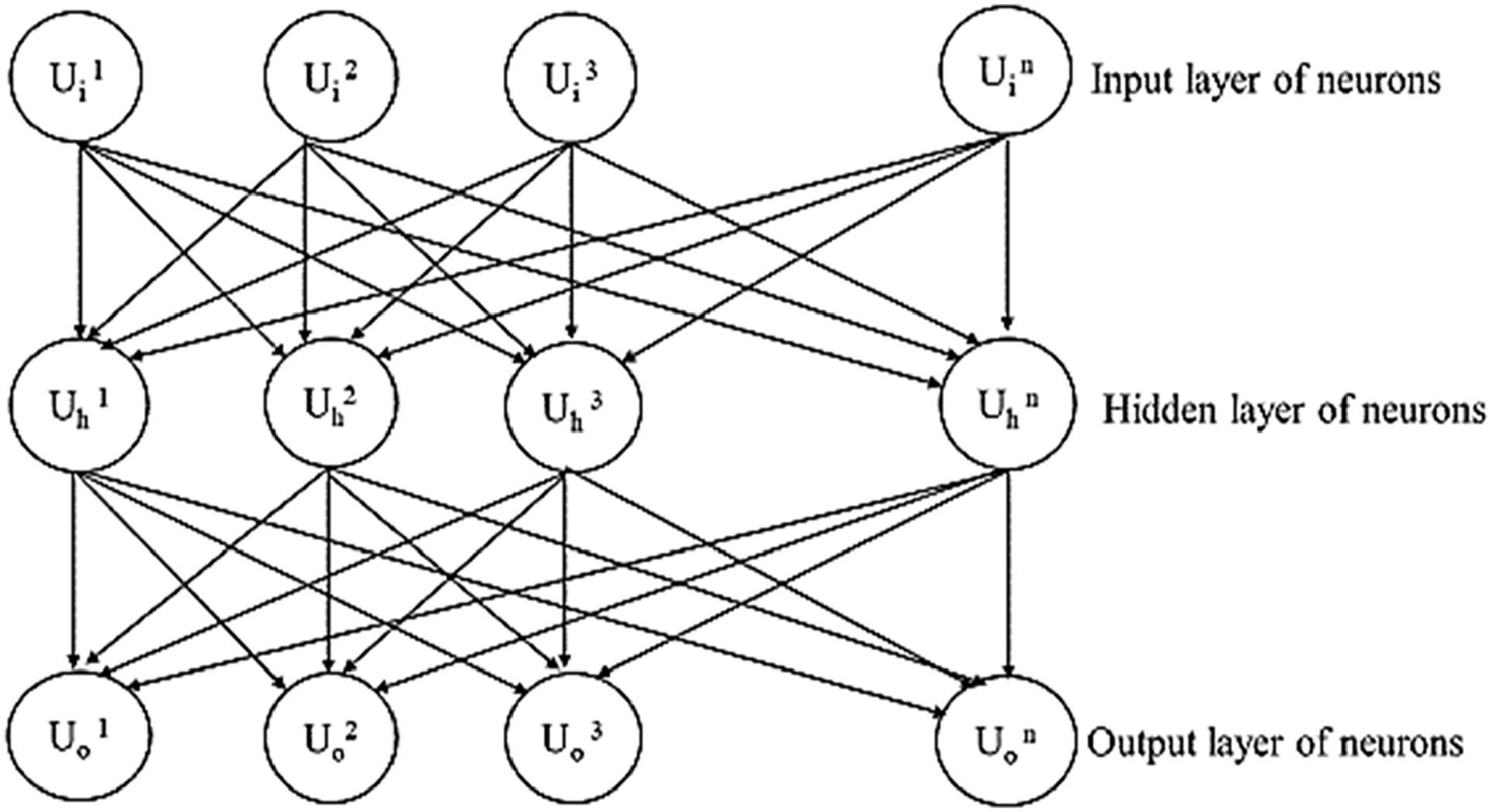
Artificial neural network with hidden layer. 14
Optimizing network parameters
Hidden layers exponentially increase processing time. Thus, single-hidden-layer neural networks that mimic yarn properties might be better. The number of hidden units greatly affects model success.28,29 An excessive number of units might prolong training and cause overfitting. Exercises with each dataset will determine the hidden layer’s unit count. Training of a network with a learning rate of 0.1 is simple and straightforward process, and network error drops rapidly and eventually minimize the errors. 14
Data and performance estimation
Artificial Neural Networks (ANN) utilize the backpropagation technique, which involves a variable learning rate and numerous linear regressions. These methods have demonstrated efficacy in the field of fiber grading, sliver roving, and yarn quality prediction in the spinning industry. 15 The evaluation of models’ performance is commonly measured using many metrics, such as the correlation coefficient (R), R-square (R2), Mean Absolute Error (MAE), Mean Square Error (MSE), Root Mean Square Error (RMSE), Mean Error (ME), and Relative Error (RE).16,30 These are measured with following equations (1) to (7). A model can be evaluated with a high degree of accuracy when the RMSE is at the minimum and R2 is high (i.e. ⩾0.8) 31


Here Mi, Pi, and
ANN in the yarn manufacturing industry
Desired quality of products in the yarn manufacturing is assured through the evaluation of various physical and mechanical properties of components such as fibers, slivers, rovings, and yarns. Generally, this procedure is complex, time consuming, and necessitates the involvement of proficient operatives and the application of expensive machinery.20,33 ANN research aims to reveal this complex functional relationship between fiber and yarn structure. Identifying yarn traits allows for the optimization of qualities for different usage and lowering costs as well. 34 In the mid-1990s, researchers used ANN, a computer program that learns mathematical correlations between yarn and fiber properties, to predict yarn qualities from fiber parameters. 35 Management may perceive a neural network trained in this manner as a valuable instrument for decision-making. 18 The degree of uniformity in the yarn significantly impacts the quality of the textile, as well as its effect on subsequent processes and the appearance of the fabric. 19 Forecasting yarn quality measurements is consistently a prominent area of study for textile experts. 36 Yarn property modeling is a fascinating area of research in the realm of textile engineering. 37
Prediction in fiber properties
In the textile and clothing industries, raw material qualities determine product quality and market value.38–41 Every spinner encounter difficulty in manufacturing high-quality yarn while minimizing expenses. The machine-learning technology can predict yarn quality in the cotton spinning trade, replacing human skill. 42 An overview of the application of ANN in the prediction of correlation between fiber and yarn characteristics has been shown in Table 1.
ANN in the prediction on fiber properties and correlation between fiber and yarn.

Das and Chakraborty 43 developed an ANFIS to make a relationship between fiber and yarn characteristics. This system relies on six input variables of cotton fibers, including strength, fineness, elongation, length, uniformity, and short fiber content. Their prediction ability was thoroughly validated based on the estimated values of R, Mean Absolute Percentage Error (MAPE), RMSE, ME, and Variance Performance Index (VPI). The investigation asserted that the ANFIS model incorporated the beneficial characteristics of both the fuzzy control system and the neural network. Farooq et al. 44 developed a predictive algorithm to estimate cotton fiber maturity. ANN inputs were fiber length, strength, uniformity index, and linear density, and output was fiber maturity. The network’s projected values were compared to the tested values to get the MAE. Training networks were validated using 10% cross-validation. The MAE of 0.0491 between real and projected values indicated high neural network modeling accuracy. Majumdar et al. 45 demonstrated the feasibility of yarn engineering by creating a model that can convert yarn into fibers using ANN. The yarn’s tenacity, breaking elongation, unevenness, and hairiness index served as the input parameters in the model. The observed MAE of prediction for Spinning Consistency Index (SCI) and micronaire were 4.38% and 1.92%, respectively. Jayadeva et al. 46 investigated the potential application of neural networks in assessing the significance of fiber qualities concerning yarn properties, specifically lea strength in Count Strength Product (CSP), unevenness, and defects. The relative significance of input parameters was assessed using two distinct methods: ‘skeletonization’ for trimming neural networks and a newly constructed first-order sensitivity analysis. The sensitivity analysis was determined to be highly effective.
The physical characteristics of fiber, including maturity, SCI, and linear density, have been estimated from other metrics obtained through High Volume Instrument (HVI). The essential characteristics of strength, trash content, and color grade remain unexamined. The existing approach concentrates exclusively on a single aspect of raw materials in the yarn manufacturing sector: the challenges associated with fiber production, comprising both natural and synthetic fibers, including ginning process and fiber baling till retention. Majumdar 45 presented a model to predict the yarn properties from fiber properties and also showed a reverse model from desired yarn properties to required fiber properties. This study presented the scope of ANN in prediction of output characteristics based on input and vice versa.
Prediction in blending, mixing, and sliver properties
The uniformity of yarn has a growing importance in the textile sector, with sliver evenness being a crucial aspect in ensuring the production of high-quality yarn. 47 To widen the product mix and minimize the product costs while ensuring desired quality, manufacturers are practicing blending and mixing of various fibers. An overview of the application of ANN in the prediction of correlation between fibers, intermediates, and yarn characteristics has been shown in Table 2.
Application of ANN in Prediction on blending, mixing, and sliver properties.

Yang et al. 48 produced mélange yarn from blended pre-dyed fiber and used ANN and Modular ANN (MANN) to forecast recipes better. The study used 500 training and 100 blind test samples of 19.4 tex ring spun dyed yarns for 100% cotton knitted apparel. The 60 dye formulations produced fibers with 1.85–2.32 dtex fineness. The 500-tex of rovings were drafted 30 times in the ring frame during yarn manufacture. Correlation Coefficient (CC), RMSE, training execution time (T), and Color Measurement Committee color difference assessed trained networks. MANN beats ANN in correlation, error, and training time. For 100 testing samples, the MANN model’s projected spectrum’s average CMC was 1.26, significantly higher than in practice (0.60), yet it still works well for recognizing pre-dyed fibers’ basic structures. Farooq 49 used draw frame features to train an ANN model to predict sliver cohesion. Cotton, polyester, and a cotton-polyester blend were studied. The materials were processed with draw frame variables. The study showed that ANN can accurately estimate cohesive force in drafted slivers. Abd-Ellatif 50 predicted the appropriate LAP for production and material conditions using ANN. In the blow room, extra-long, long, and medium-long staple Egyptian cotton was collected. The most critical elements were considered when creating ANNs. The inputs were fiber length, homogeneity, fineness, sliver liner density, evenness, and main draft gauge. They developed five statistical models to determine the optimal LAP value using the most critical fiber and process characteristics. ANN model performance was compared to statistics models. Farooq and Cherif 51 determined the draw frame variables’ effects on sliver and yarn quality. Training neural networks with the Levenberg-Marquardt method and Bayesian regularization was hybrid. This method improved network generalization. Performance was assessed by cross-validating each training network. Finally, they developed a sliver and yarn quality predicting system.
The notion of auto-leveling in the finisher draw frame and the adjustment of LAP and LI are critical factors that influence the properties of the drawn sliver and the produced yarn. Nonetheless, the draft concept and the frequency of doubling in draw frames and comber machines, along with technical parameters such as feed per nip, nips per minute, top comb penetration, and cylinder comb settings, have been constrained research in predicting the characteristics of materials processed in the short staple fiber spinning industry. The research on ANN application for in-process-materials along with various technical parameters are still demanding.
Prediction in ring-spun yarn characteristics
The future applications of yarns are significantly impacted by the quality of their manufacturing process. 52 Precise yarn quality prediction is essential in spinning mills to maintain consistent production, ensure superior product quality, and efficiently control costs. 53 The ring-spinning technology employs a variety of yarn types, including core-spun compact, solo, and siro, mélange, and slub, each of which is regulated by a unique set of parameters. 54 Roving properties, process parameters of ring frame such draft, twist, twist multipliers, spacer and size, traveler weight, and spindle speeds are the main factors that determine ring spun yarn quality.55,56 An overview of the Application of ANN in the prediction of ring-spun yarn characteristics has been shown in Table 3.
Application of ANN in prediction of ring-spun yarn characteristics.

Ghanmi et al. 57 validated the use of Fuzzy expert systems with back-propagation ANN for global yarn quality prediction. Several variables include yarn fineness and twist per meter, in addition to fiber length, strength, fineness, and elongation. The data showed that the hybrid models could use the input factors that were chosen to predict the new yarn quality index very well. Abd-Elhamied et al. 58 assessed ring-spun and compact yarn strength, elongation percentage, coefficient of variation in mass, and defects using image processing and ANN. Two cotton mills, ring spinning and compact spinning provided yarn samples. Back-propagation neural networks were fed feature vectors. Each of two systems has three modules to evaluate yarn properties. Multilayer network topologies improve network performance and parameter modeling. A cost-effective method assessed yarn quality for several varieties.
El-Geiheini et al. 59 conducted a study to construct a cost-effective image processing-ANN system to model yarn tenacity and elongation. Using an appearance tester, the lab wound yarn samples around the blackboard. The specimens were digitally photographed. Two ANNs were trained via Levenberg-Marquardt backpropagation after filtering and scaling. Network training used 80% of the data, validation and testing 10%. Picture enhancement and multilayer neural networks enhanced yarn quality estimate. Doran and Sahin 60 suggested utilizing ANN and SVM to predict cotton elastane core yarn quality. The best models predicted most yarn quality metrics. Optimized models in MAPE and R exceeded 90% with the required model. Predictions of cotton elastane core yarn irregularity, yarn hairiness, and Resskilometer quality were 91%, 93%, and 95% accurate. They state additional experiments improve ANN and SVM. Experiments and larger training sizes can cause the model to store more data, increasing its inaccuracy. Ahmad 12 designed a simplified graphical user interface for ANN, which was verified on a novel dataset. Input factors were yarn count, twist, and fiber properties. The study produced 32 cotton ring-spun yarns using 12 cotton blends. Yarn counts ranged from 6.96 to 24.06 Ne, and twists from 338 to 921 turns per meter. After yarn strength testing, ANN analyses were done. Comparisons were made using real data and the Soloviev relationship used to predict cotton yarn tensile strength. ANN results were better than Soloviev’s. Kavitha et al. 61 used ANN with and without PCA in ring spinning. The collection includes 1000 samples of conventional and typical ring spinning conditions. Spindle speed, top roller pressure, traveler mass, temperature, current, and voltage are used to train ANN and PCA models. The rates of end breakage, yarn irregularity, and yarn imperfection were projected. PCA reduced input data dimensionality. PCA-ANN model performance and classification accuracy have improved. Ghanmi et al. 62 created a hybrid model by combining two soft computing methodologies, namely ANN and fuzzy expert system. This model was used to analyze the yarn qualities and assign an index value between 0 and 1 to each combination of these properties. The hybrid model was trained using fiber characteristics, yarn count, and twist level as inputs. The output of the model is a quality index that encompasses the key physical attributes of ring-spun yarn. Unal and Ozdil 63 analyzed the diameter of cotton ring spun yarns by employing regression and ANN models, with a focus on the qualities of the cotton fibers. The derived equations and networks were also compared with the yarn diameter of cotton ring-spun yarns, as established by Peirce. 87 The findings demonstrated that the generated regression equation provided a reliable calculation of yarn diameter in comparison to Pierce’s equations. Almetwally et al. 64 studied cotton/spandex core-spun yarn breaking strength, elongation, and work of rupture using ANN and multiple regression. The company made 40 30/1 Ne cotton/spandex core-span yarns. The yarn had a spandex filament with 22, 33, 44, and 78 dtex liner densities. All-cotton yarn sheath. 2.4, 2.8, 3.3, 4, and 4.4 drawing ratios were used for each filament. Individual yarn samples were made using twist multipliers 4.0 and 4.2. Using MSE, Mean Bias Error (MBE), and R2, the two models were tested. The study found that ANN predicts better than multiple linear regression. Mozafary and Payvandy 65 used clustering and ANN to predict yarn quality. In one year, the quality control laboratory collected almost 150,000 data points. The data included fiber characteristics, manufacturing process parameters, and yarn quality measures. Clustering and ANN were used to predict yarn quality in unevenness, nep, thinness, and thickness. The data-mining method outperformed the ANN in accuracy. Das et al. 66 developed mathematical formulas to predict cotton yarn strength and irregularity based on fiber properties. A genetic algorithm (GA) uses ANN equations to find the best yarn-spinning fibers based on natural selection and survival of the fittest. Tenacity and unevenness were desired for a spinning mechanism. Ghosh et al. 67 improved yarn strength and raw cotton quality with ANN and regression models. Elitist multi-objective evolutionary algorithms using Non-dominated Sorting Genetic Algorithm II solved problems most efficiently. Multi-objective optimization maximized cotton yarn strength and minimized SCI. The evolutionary algorithm is a unique multi-objective optimization method that finds multiple optimal solutions in one simulation run.
Bo 68 predicted cotton ring-spun yarn end breakage using ANN and MLR. The ANN model inputs were front roller speed, spindle speed, nip gauge, rear draft zone time, and ring yarn twist, while the output was end breakage rate. Validating the MSE and R2 for test data prediction measured model performance. Results showed that ANN outperformed various linear models. Soltani et al. 69 suggested a new way to predict the migratory patterns of siro, solo, compact, and conventional ring-spun solar yarns. Spun yarns’ physical and mechanical properties and current requirements were investigated. The improved ANN method predicted spun yarn migration. The results showed that ANN models can reliably predict yarn migratory qualities based on physical and mechanical factors. Bo 70 modeled ring-spun polyester/cotton yarn end breaking with a three-layer BP neural network. An FA506 ring frame machine spun 50% cotton and 50% polyester into 18.2 tex yarn. Ring-spun yarn end breakage was compared to front roller delivery, spindle speed, nip gauge, break draft, and roving twist using the backpropagation neural network model. The simulation accuracies were good, and extending the experimental database for network training may improve the BP neural network approach. Admuthe and Apte 71 used ANFIS and subtractive clustering to predict yarn properties. The trial included 30 cotton varieties. Fiber length, strength, micronaire, maturity, short fiber content, and elongation were inputs. After training both systems, 100 samples were tested to predict yarn properties including unevenness ratio (UR), thin place, thick place, elongation, and count. Overall, the ANFIS approach was tested on numerous datasets and compared to the ANN model. Bo 72 predicted polyester/viscose/cotton ring-spun yarn hairiness using multiple linear regression and ANN algorithms with processing parameters. The yarn was 40% polyester, 40% viscose, and 20% cotton. At 14.6 tex, yarn was fine. A mixed-effects regression model with five process parameters predicted yarn hairiness. Regression model predictions were less reliable than ANN model predictions. Furferi and Gelli 73 created a feed-forward backpropagation ANN model to help technicians predict yarn strength. Instead of spinning yarn, this method uses roving properties to create accurate forecasts. Blending fibers from a spinning mill in Prato, Italy produced six roving kinds. Each was measured for fiber strength, length, yarn twist, and count. Huijun and Xinhou 74 predicted 50 Ne combed yarn unevenness by using BP ANN. The micronaire, length, uniformity, strength, whiteness, yellowness, and neps were input parameters, as were yarn unevenness, knots (+50%), and neps (+140%). Every projected coefficient above 0.93763, and yarn evenness and knots (+50%) predicted correlation coefficients exceeded 0.94247. Majumdar 75 improved cotton yarn hairiness prediction with ANN and adaptable neuro-fuzzy inference models. Cotton fiber mean length, short fiber content, maturity, and yarn linear density were model inputs. Even in unseen test samples, the method estimates cotton yarn hairiness 2% inaccurately. Admuthe and Apte 76 employed an ANN and a Genetic Algorithm technique to predict the fiber characteristics necessary for achieving the target yarn quality and to optimize their cost. The hybrid approach technique is proposed as a powerful model that has the potential to greatly enhance the predictability and profitability of the yarn production business. Khan et al. 77 tested MLP and MLR ANN models to predict worsted-spun wool yarn hairiness. Many toppings, yarn, and process characteristics affected projections. Different top specs and processing parameters were tested in 75 yarn sets. MLP model showed yarn hairiness-input parameter correlation nonlinearity, performing marginally better. The MLP model’s sensitivity analysis showed that yarn twist, ring size, and average fiber length most affected yarn hairiness. Majumdar et al. 53 used ANN and neural-fuzzy systems to predict ring-spun yarn irregularity. ANN, neural fuzzy, and linear regression models were compared for prediction accuracy. All three models predicted well, although the ANN and neural-fuzzy models outperformed the linear regression model. The neural-fuzzy system’s language rules show how input factors affect yarn consistency. Mwasiagi et al. 78 changed design variables to test neural networks’ ability to forecast cotton ring-spun yarn breaking elongation. Two transfer functions differed significantly from training functions. Levenberg-Marquardt outperformed the other five training functions. Input component analysis ranked yarn twist, yarn count, fiber elongation, length, length consistency, and spindle speed highest. Üreyen and Gürkan 79 developed an ANN model to predict ring cotton yarn qualities using High Volume Instrument (HVI) fiber property measurements. The ANN model was compared to a statistical regression model for effectiveness. A total of 180 cotton ring-spun yarns were made from 15 blends. Yarn counts and twist multipliers were limited to 20–35 Ne and 3.8–4.6 TM. Tenacity and breaking elongation of the yarn were measured and analyzed using an ANN. Finally, the R2 value of ANN and regression models were assessed. Mwasiagi et al. 80 examined how ANN algorithms predicted cotton yarn strength, elongation, and evenness. Kenyan spinning mills provided cotton lint and carded ring-spun yarn samples. To reduce interjection differences, machinery technology, work culture, quality, and maintenance rules should be as same as possible. The main inputs were fiber qualities, processing parameters, and yarn quality. Chen et al. 81 created a soft computing model to predict yarn strength using fiber and yarn properties. To discover the most important fiber quality and yarn properties for the small-scale ANN model, they were ranked. Also, an ANN model was created to analyze the relationship between fiber quality, yarn properties, and tenacity. Results show ANN model makes accurate predictions. Beltran et al. 82 developed an MLP-based mill-worsted spinning performance prediction tool. Sixteen variables predicted spinning efficiency and yarn quality. Cross-section fiber count, Unevenness (U%), thin areas, neps, yarn toughness, break elongation, thick areas, and spinning ends-down were inputs. Using mill-specific commercial data, the model matched expected values. MLP performed consistently across randomly selected independent test data. Based on Sirolan Yarnspec’s projected results, the ANN technique improves mill-specific forecast accuracy. Babay et al. 83 modeled ring yarn hairiness with a backpropagation neural network and linear regression. With the HVI, fiber properties were measured. Data and process characteristics like twist and yarn count predicted hairiness. A leverage-based local overfitting control model selection method selected the right architecture. Less training and generalization mistakes made the neural network model better. These errors were less than the hairiness standard deviation in 5% Uster data. The linear model returned 0.8893, whereas R2 between observed and projected hairiness was 0.9353. Neural models held more or equal confidence than linear forecasts. Beltran et al. 84 examined tested ANNs’ ability to predict worst-case spinning performance. Sirolan Yarnspec randomly created 250 training data sets. Each dataset contained produced inputs and Yarnspec predicted outputs. They recommended improving yarn prediction for unevenness, cross-sectional diameter, thin areas, thick areas, and tenacity. Majumdar and Majumdar 85 evaluated the anticipated effectiveness of mathematical, statistical, and ANN models. A prediction was made regarding the breaking elongation of ring-spun cotton yarns. Cotton fibers and yarn count were inputs to the models. The HVI instrument measured cotton fiber properties’ importance, which the ANN model assessed. Shanmugam et al. 86 Predicted micro-spun yarn CSP by backpropagation ANN model effectively. The study examined fiber span length, bundle strength, fineness, breaking elongation, uniformity ratio, and matured fiber %. The neural network with five hidden neurons in a single layer and a 12-epoch made better predictions. To predict Count Strength Product (CSP), the ANN and regression models were compared. The neural network model had 60% lower MSE than the regression model.
The majority of applications of ANN in yarn manufacturing have been thoroughly addressed and effectively presented in literature concerning the technical parameters of ring frames and process variables to forecast yarn characteristics such as irregularity, thick places, thin places, neps, imperfections, hairiness, strength, and elongation. Compact spinning is a pivotal aspect of the contemporary advancement of ring spun yarns, enhancing process efficiency and the quality of final garments through reduced hairiness and increased strength. There is still scope in application of ANN in prediction the characteristics of compact, core-spun, slub, mélange, and other fancy yarns.
Prediction in rotor- and vortex-spun yarn properties
The selection and design of machine components have a considerable impact on the quality and performance of rotor-spun yarn. 88 Vortex-spun yarn has core and wrapping. Since fiber separation happens everywhere on the fiber bundle’s outer edge, multiple wrapper fibers create a ring spun look with improved durability. 89 An overview of the application of ANN in the prediction on rotor- and vortex-spun yarn characteristics has been shown in Table 4.
Application of ANN in prediction on rotor- and vortex-spun yarn characteristics.

Ghanmi et al. 90 developed a hybrid model using ANN and fuzzy expert systems. ANN predicted yarn toughness, breaking elongation, and irregularity. These three outputs predicted the innovative quality index using fuzzy expert system. R, RMSE, MAE, and MRPE assessed the prediction model’s accuracy. Analysts found the hybrid model predicted rotor-spun yarn quality accurately. Erbil et al. 91 conducted a stepwise MLR investigation produced a Levenberg-Marquardt-trained ANN model with backpropagation. A comparison of both models’ prediction performance followed. Statistical and ANN models predicted the tensile properties of ternary mix open-end yarns made from polyester (PES), viscose (CV), and polyacrylonitrile (PAN) fibers with six blend ratios and three linear dens Next, prediction model statistical performance criteria were evaluated. For breaking strength and elongation, ANN and MLR models were built. MLR research shows yarn count and polyester ratio affect breaking strength statistically. This significance has 1% confidence and R2 = 0.938. These data suggest the blend’s PES ratio influences yarn strength. The statistical study found that PAN content, yarn count, mixing method, and polyester ratio effect breaking elongation. R2 = 0.589 and 1% confidence support this result. However, ANN predicted breaking strength better. Ghorbani et al. 92 studied how rotor type, diameter, doffing-tube nozzle, and torque-stop affect polyester/cotton rotor-spun yarn hairiness. The study characterized yarn hairiness using ANN and regression models. Hairiness was best predicted by two-hidden-layer networks. The study used optimal network-based partial derivatives to evaluate input variable relevance. The rotor type and diameter affected blended yarn hairiness most and least, respectively. Moghassem et al. 93 used three draw-frame machine parameters to forecast cotton rotor-spun yarn breaking strength. Comparing GEP and ANN models’ performance. The two proposed models’ MSE and R2 values differed by 33.01% and 4.96% in forecasting test data. Zhao 30 constructed an ANN model to forecast the level of hairiness in cotton/polyester blended yarn manufactured by rotor spinning. Their outcome indicators, including MSE, MAE, and MAPE, exhibited a significant level of concurrence between the anticipated and experimental results. This implies that the neural network is an exceedingly efficient instrument for forecasting results. Pei and Yu 94 used ANN and numerical simulation predicted vortex yarn tenacity depending on process and nozzle parameters. The vortex-spinning nozzle’s fiber-airflow interaction and fiber movement were simulated numerically. The jet orifice diameter and yarn delivery speed predicted yarn strength. MLP neural networks predicted modal fiber vortex yarn strength. A good correlation coefficient and little relative errors exist between predicted and measured tenacities. This suggests ANN can predict accurately. Shanbeh et al. 95 applied an ANN-based predictive model of breaking strength and unevenness of cotton waste rotor-spun yarn comprising ginning waste. Rotor parameters, ginning waste proportion, and yarn linear density were inputs to the ANN models. To produce the best prediction models, ANN model parameters including learning, momentum rate, hidden layers, and hidden processing elements were optimized. The maximum error in forecasting testing data breaking strength and mass variation was 8.34% and 6.65%. Bo 96 used the ANN model to predict cotton yarn hairiness during rotor spinning. The opening roller rpm, diameter, rotor rpm, and rotor diameter were process factors of the rotor spinning machine. The ANN model with the back-propagation method can predict cotton rotor-spun yarn hairiness based on processing factors. Ghosh and Chatterjee 97 predicted the properties of cotton yarn, such as tenacity, breaking elongation, evenness, and hairiness using SVM regression approach. The qualities of the fibers and ring and rotor spinning were used to design this yarn. The expected accuracy of SVM and ANN models was compared. The expected simplification accuracy of both models was assessed using k-fold cross-validation. SVM models outperformed ANN models in predicting yarn characteristics. Majumdar 98 investigated two methods for predicting ring and rotor yarn hairiness. The ANN and linear regression models used cotton fiber properties and yarn count. A correlation coefficient of 0.92 and an MAE < 4% indicated great prediction accuracy for the models. The ANN model demonstrated superior performance compared to regression in the prediction of ring yarn hairiness. Nurwaha and Wang 99 utilized a hybrid neuro-fuzzy system to predict cotton rotor spun yarn strength based on fiber quality. Their approach combines ANN with fuzzy logic benefits. They also evaluated how different fiber quality affected rotor-spun yarn strength. Fiber strength, length, homogeneity, and thread count improve rotor-spun yarn strength. Conversely, micronaire, yellowness, and short fiber content weaken yarn. Demiryürek and Koç 100 developed an ANN and statistical model to forecast polyester/viscose blended open-end rotor spun yarn irregularity. A rotor spinning machine handled seven polyester/viscose sliver blend ratios with four rotor speeds and four yarn counts. Backpropagation MLP neural networks and mixer process crossing regression models (simplex lattice design) predicted yarn unevenness. The ANN and simplex lattice designs predict well and are more reliable than the ANN alone. Demiryürek and Koç 101 developed two models to predict the breaking elongation (%) of polyester/viscose mixed rotor-spun yarns: an artificial neural network (ANN) model and a statistical simplex mixing process crossing regression model. The input parameters utilized in the back propagation feed forward artificial neural network (ANN) model consisted of the blended ratio, yarn count, and rotor speed. The output parameters were identified as the breaking elongation of the yarns. The ANN model exhibited more reliability in comparison to the statistical model. Majumdar et al. 102 used a hybrid neuro-fuzzy system to predict cotton yarn tenacity using HVI fiber metrics like strength, elongation, length, uniformity index, micronaire, reflectance, and yellowness. 4.1 and 4.8 twist multipliers were used to make ring and rotor yarns. Train the neuro-fuzzy inference system with HVI fiber test results and compare its predictive performance to ANN and regression models. Majumdar et al. 103 used linear regression, ANN, and neuro-fuzzy models to predict rotor yarn elongation. Cotton fiber characteristics and yarn fineness are inputs for the models. The study examined how yarn count and cotton fiber characteristics affect rotor elongation. Model predictions were compared for accuracy. The prioritization of findings was achieved by data analysis and the use of ANN model. Jackowska-Strumillo 104 presented ANN-based yarn spinning model architecture. To mimic the spinning process and analyze yarn quality parameters like tenacity, hairiness, and flaws, partial models were developed. Feed-forward neural networks were employed for modeling purposes. Yarns produced in rotor frame by blending of flax and cotton slivers and 100% cotton slivers. Majumdar 105 developed ANN model to predict the tensile strength of individual yarns created by ring and rotor spinning techniques, using fiber characteristics as input. The input parameters comprised seven fiber attributes and yarn count. The yarn tenacity exhibited an MSE of less than 5% for ring-spun yarns and less than 2% for rotor-spun yarns. The study also evaluated the relative importance of cotton fiber properties and thread count on the strength of individual yarns. Jackowski et al. 106 did an experimental work on the BD 200S rotor spinning machine used rotor rotational speed, opening roller speed, and yarn linear densities. An additional draw frame sliver fed the spinning machine. The partial hybrid yarn mass variation coefficient model considers yarn and sliver linear densities. The ANN estimated yarn mass variation coefficient from silver linear density and tenacity variation. A modest one-hidden-layer multilayer perceptron network was employed for this assignment. Basu et al. 107 developed an ANN model to predict the properties of air-jet yarn by assessing process data. An attempt was made to utilize a reverse model to predict process variables in air-jet spinning that would lead to specified yarn characteristics. A backpropagation algorithm was implemented using a neural network that consisted of only one hidden layer. The inverse model is expected to play a vital role in the control, modeling, and prediction of the spinning process.
A substantial amount of research is necessary to forecast the vortex yarn and yarn produced from other modern spinning techniques. The domain of innovative technology continues to allow for the prediction of spun yarn produced from friction, wrap, and electrojet spinning methods.
Prediction in spliced yarn properties
The electronic clearer in the winding machine eliminates yarn faults of significant scale that have been stored in the memory. 5 This technique has also been utilized for the purpose of connecting yarn ends, commonly referred to as splicing of broken ends. 108 The tension, cradle pressure, winding speed, and traverse ratio are the most important technological factors for a winding machine. 109 The great performance of pneumatic splicing is essential for uniform yarn that involves turbulent airflow over yarn ends.110,111
Ünal 112 examined how splicing, fiber, and yarn characteristics affect strength and elongation. Eight cotton types were utilized to make yarns with three fineness and three twist coefficients. Spliced yarn tenacity and elongation were analyzed using ANN and response surface models. Yarn twist and count were chosen based on fiber quality and machine factors like opening air, splicing air, and splicing time. Air pressure during splicing impacts yarn strength and stretching, according to ANN models. In prediction, ANN models outperformed response surface models. This is because ANN models explain non-linear connections better. Unal 113 used ANN and response surface models to predict cotton ring spun yarn’s preserved spliced diameter. Eight cotton kinds were used to make yarns with three fineness and three twisting level. Fiber properties were measured using an AFIS testing machine. The ANN model predicted spliced diameter better than response surface models for ring-spun cotton yarn (Table 5).
Application of ANN in prediction in spliced yarn properties.

A least number of studies was identified on the prediction of spliced and conditioned yarn from the technical parameters of winding and yarn conditioning operations. The winding speed, winding tension, winding angle, splicing pressure, splicing duration, splicing length, and the settings of electronic yarn clearers are the key factors that should be prioritized in predicting the characteristics of spliced yarn. These significant factors may indicate the potential for optimal productivity and quality of spun yarns, as well as the finished textile product.
Discussion and future perspectives
Nowadays, the management exercises control over the manufacturing process and product quality through the utilization of technical personnel and skilled operators. The utilization of the ANN model as an analytical instrument can aid in the selection of material specifications and enhance processing parameters based on the anticipated results of the models. 63 Feedforward and backpropagation techniques are two of the most common applications of ANN in the textile and apparel sectors. Because of the intricate nonlinear relationship among the raw material parameters, spinning method, and yarn properties, it is challenging to develop a prediction model based on product requirements.23,114 The examination primarily emphasized in forecasting of ring-spun yarn properties. Research studies were scarce concerning the prediction on vortex-spun yarn quality and process variables, whereas a moderate number of studies concentrated on the quality of rotor-spun yarn. The ANN exhibited better results than any other models except the SVM unveiled better prediction performance than ANN. 97
Among the selected articles, none was on blow room settings, comber noil adjustment, and yarn conditioning. Further research is necessary to precisely determine the frequency of spinning ends down and neps utilizing the ANN. Further mill-specific data and breakthroughs in the ANN simulations are necessary to enhance the forecasts of quality parameters. 20 Hence, there is a substantial possibility to do research with ANN. In addition, robust learning methods are required to enhance the ANN models to be capable to handle from fiber to yarn. Predicting yarn characteristics can reduce both the time and money required for testing. No study has been discovered examining the correlation between manufacturing cost, time, and price of spun yarns. Therefore, there is ample opportunity for research in this area.
The wide range of processing procedures and equipment is a challenge in evolving a universal experimental model that can precisely envisage yarn characteristics across different mills. The Uster Statistics are universally acknowledged as the exclusive globally-accepted quality benchmarks for fiber, sliver, roving, and yarn in the yarn manufacturing sector. 115 It is necessary to have a unified worldwide platform of yarn quality that could be also accomplished by the implementation of ANN.
The waste was also reduced due to the optimal exploitation of fiber during twisting. The reduction of pneumafil waste, end breakage rate, and the enhancement of productivity are critical area that are unveiled in prediction of ring spun yarn characteristics. The economic viability is also crucial. The minimization of ring frame waste lessens its direct influence on manufacturing expenses, hence impacting economic sustainability and the working conditions of personnel in the industry. The present research trend is creating eco-friendly and cost-effective clothes from yarn manufacturing waste. Nevertheless, the waste are being utilized through dependence on the process. A significant amount necessitates further repurposing. By merging diverse electro-mechanical processes, they can be utilized for sustainable energy sources. The application of ANN can also be employed in this field to forecast the characteristics of spun yarn. Moreover, this preference depends mostly on selection of cost of raw materials and process control in spinning industries.
Conclusion
In current study, a thorough analysis of the literature that focused on the use of ANN on yarn quality prediction was undertaken. The review examined the attributes of raw materials in the spinning industry, the processing of materials through various phases, and the final output of the initial phase of backward linking in the textile and garment sectors. This assessment demonstrated that ANN is capable to predict the characteristics of in-process materials and final product of spinning industry. The challenges that are associated with textile spinning will be the subject of additional research to facilitate the replacement of human judgment with intelligent systems. Before the data is put into an ANN, training, such as using process-captured online data, is necessary. Various hybrid models integrating with ANN like Genetic Algorithms, Decision Trees, and SVM can optimize the parameters of spun yarns and enhance the architecture of the ANN, thereby strengthening the model as well as improving forecasting accuracy. This study has explored the theoretical implications through a systematic review and comprehensive analysis of scholarly papers. It has practical implications for industrial specialists in predicting yarn qualities without testing, which solves real-life problems in the spinning industry. Finally, the study ended by providing future directions that can serve as a valuable guide for researchers in their subsequent research endeavors.
Footnotes
ORCID iDs

Funding
The author(s) received no financial support for the research, authorship, and/or publication of this article.
Conflicting interests
The author(s) declared no potential conflicts of interest with respect to the research, authorship, and/or publication of this article.