



Abstract
Red clay is widespread in southern China, exhibiting undesirable properties of softening upon contact with water and cracking after losing water. Using red clay as roadbed filler frequently results in a series of geotechnical hazards such as foundation settlement and slope instability. Consequently, it is necessary to improve the engineering properties of red clay. Using natural plant fibers offers improved environmental sustainability and greater economic advantages compared to traditional methods involving lime and cement. In this study, palm fibers were used to improve the properties of red clay. The aim was to quantitatively analyze the influence of palm fiber content and length on the unconfined compressive strength (UCS) of red clay, study the capacity of palm fibers to inhibit soil desiccation cracking, and explore the underlying mechanisms by conducting UCS and desiccation tests. The results show that the UCS and residual strength of red clay can be significantly enhanced by palm fiber, and the soil damage form will be changed from brittle damage to ductile damage. Particularly noteworthy, the content of 0.45% palm fiber with a length of 20 mm increased the UCS by 43.4%. Palm fiber also effectively inhibited soil desiccation cracking, the content of 0.3% palm fiber with a length of 20 mm reduced the crack ratio by 54.4%. This study presents a novel approach for improving red clay, offering valuable insights for the use of palm fiber-improved red clay in road construction and slope protection projects.
Introduction
In engineering construction, a multitude of problematic soils is frequently encountered. Mishandling these problematic soils may potentially damage the integrity of engineering structures. Effectively and economically addressing problems related to problematic soils is an imperative challenge that engineers must confront. 1 Red clay is a type of distinctive clayey soil extensively distributed in southern China, with a reddish-brown or brown-yellow color, emerging from the interplay of physical weathering, chemical weathering, and laterization processes. Its undesirable properties of softening upon contact with water and cracking after losing water cause a series of engineering hazards, such as slope instability, non-uniform foundation settlement, and roadbed subsidence. 2 To ensure the smooth progress of engineering projects in red clay regions, improving the soil engineering performance has always been a focal concern of academic and engineering interest, which has significant engineering practical value in mitigating geological hazards associated with red clay. 3
Conventional approaches to addressing red clay-related issues primarily encompass soil replacement4,5 and chemical modification.6 –9 Nonetheless, soil replacement proves impractical in regions with extensive red clay distribution. Although chemical modification substantially improves the strength of red clay, it concurrently alters the soil pH and potentially harming plant growth. Environmentally friendly soil improved approaches are gradually replacing traditional chemical modifications, such as nano-additives, 10 nano-graphite powder, 11 and fibers. Natural and synthetic fibers have been used to improve problematic soils for a long time, 12 including corn fibers, palm fibers, polypropylene fibers, and grass fibers. These have consistently exhibited the capacity to improve soil strength and ductility. Additionally, these fibers possess numerous advantages, including cost-effectiveness, construction convenience, and environmental compatibility.13 –18 Exploring fiber-improved modifications for red clay to address its engineering challenges holds substantial practical significance and engineering value.
There is a consensus that fibers play a pivotal role in substantially enhancing soil strength. Fibers used for soil improvement can be categorized into natural and synthetic types. Synthetic fibers primarily encompass polymer materials, such as polyvinyl alcohol fiber, polypropylene fibers, and carbon fibers. These fibers exhibit excellent ductility and durability, rendering them valuable contributors to soil improvement, often in conjunction with cement, slag, and other cementitious agents. For instance, combining polyvinyl alcohol fibers with cement to improve soil leads to heightened soil strength compared to cement-improved soil. 19 The composite improvement of clay with polypropylene fibers 20 and slag significantly enhances the soil mechanical properties and durability. Carbon fibers are efficacious in improving UCS of soil, altering its damage form from brittle to ductile. 21 The combination of xanthan gum and polypropylene fibers to improve red clay have been shown to improve the soil strength and mitigate its propensity for brittle failure. 14 Additionally, natural fibers encompass coconut, hemp, and sisal fibers, which are relatively low-cost compared to synthetic fibers and are good for ecological and environmental protection. Soil improvement investigations have substantiated the efficacy of coir fibers as reinforcement, resulting in substantial improvements in UCS and California bearing ratio. 22 Moreover, for the red clay mixed with hemp fibers, its residual strength has improved significantly, with the constraining effect of fibers leading to slower crack propagation post-failure and a significant improvement in ductility.23,24
In addressing the adverse tendencies associated with desiccation cracking in clayey soil, fiber improvement emerges as an effective strategy to curb such cracking phenomena. The stresses induced by soil shrinkage during the desiccation process of clayey soil result in the initiation of desiccation cracks. The presence of discrete fiber forms exerts a notable mitigating impact on desiccation cracking in clayey soil. 25 Using digital image processing, quantitative analyses of the desiccation cracking process in clayey soil reveal that the mixture of fibers leads to notable improvements. After crack stabilization, the crack ratio, fractal dimension, and average crack width exhibit a discernible reduction.26 –30
The aforementioned studies have corroborated the capacity of fibers to significantly improve soil strength and inhibit soil desiccation cracking. Traditional soil improvement research has predominantly concentrated on strength improvement, with limited exploration of the effects of improvement on crack initiation. This paper is not a single study of soil strength or crack characteristics, it combines them to conduct a systematic study. Nevertheless, a consistent guideline for the appropriate dosage and length of incorporated fibers remains elusive due to the diversity in soil and fiber characteristics. Consequently, conducting corresponding tests to determine the fiber parameters becomes essential. Palm fiber is a type of naturally renewable plant fiber, exhibiting advantageous properties such as corrosion resistance, strong tensile properties, and cost-effectiveness. These properties align palm fiber with the requisites of soil improvement in harmony with ecological and environmental preservation. Furthermore, there are abundant palm fiber resources in southern China, and red clay is also widely distributed. Employing palm fiber for red clay improvement is consistent with the principle of adaptability and utilizing local resources. Reinforcing red clay with palm fibers serves to eliminate the spoil disposal and benefits environmental conservation. The use of locally sourced palm fibers in engineering construction saved manpower, materials, finances, and shorten construction timelines. However, there is currently a scarcity of research reports on the outcomes of palm fiber improvement for red clay.
This study focuses on the investigation of problematic soil (red clay) in southern China. Natural palm fiber is employed as a physical improvement for red clay. UCS tests and desiccation tests are conducted to explore the influence of palm fiber dosage and length on the improved soil strength and crack characteristics, analyze the mechanism of palm fiber in improving red clay, and propose the necessary technical parameters. These findings offer insights for utilizing improved red clay as roadbed filler and can lead to diminished soil disposal requirements and reduced project costs. Additionally, these outcomes contribute to ecological conservation efforts in red clay regions.
Materials and methods
Materials
The tested soil was typical red clay sourced from Shao yang, Hunan, China. It was obtained at a depth of 2.5–4.0 m and exhibited a brownish-yellow color, as shown in Figure 1(a). The red clay had a liquid limit of 67.7%, a plasticity index of 39.4%, and a clay content (soil particles < 0.002 mm) of 62.8%. The basic physical and mechanical properties are presented in Table 1, and the grain size distribution curve is presented in Figure 2. According to the Test Methods of Soils for Highway Engineering in China (JTG3430-2020), the soil’s grain size distribution and plasticity index categorize it as high-liquid-limit red clay.

Palm fiber microscope magnification: (a) red clay, (b) uncut palm fiber, (c) trimmed palm fiber, and (d) microscope magnification.
Physical and mechanical properties of red clay.


Grain size distribution curve of the red clay.
The palm fiber employed in this study was processed from palm leaves, has an average diameter of 0.3 mm, a density of 1.32 g/cm³, and a reddish-brown color. Notably, it is pliable and malleable, as show in Figure 1(b). The used palm fiber was cut into lengths ranging from 10 mm to 30 mm and retained a straight form in Figure 1(c). Figure 1(d) reveals that the palm fiber has rough surface and a longitudinal mesoscopic texture. The physical properties of the palm fiber are presented in Table 2.
Physical and mechanical properties of palm fibers.

Methods
Soil preparation
The red clay was air-dried naturally, then crushed with a wooden hammer and passed through a 2 mm sieve. Subsequently, the sieved soil was mixed with distilled water and palm fibers to form a soil mixture. This mixture was then placed within a sealed plastic bag for 48 h to ensure even water distribution. The resulting mixed soil was used for (UCS) tests and desiccation tests.
UCS test
The key experimental parameters encompass moisture content, compaction degree, fiber length, and fiber content. The selection of moisture content and compaction degree according to the optimal moisture content and compaction criteria for roadbed filler. Previous research has indicated that fiber lengths between 5 mm to 30 mm and fiber contents ranging from 0.1% to 1% are suitable. Accordingly, for this paper, the soil samples were prepared with a moisture content of 20% and a compaction degree of 90%. The palm fiber lengths employed were 10, 20, and 30 mm, while the palm fiber content was chosen as 0.15%, 0.3%, and 0.45%. A total of 13 sets of samples were prepared, which included the unimproved soil as a reference. The samples were cylindrical with 100 mm height and 50 mm diameter. To ensure the reliability of the test results, each set of samples included three replicates. The tests were performed using a strain-controlled UCS (Figure 3) apparatus with a rate of 3.1 mm/min. The test was halted when the axial strain reached 8%.
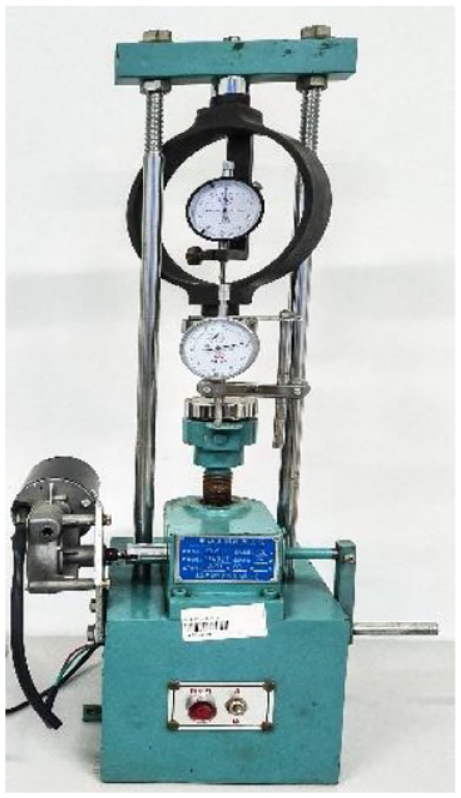
UCS apparatus.
Desiccation tests
A homemade apparatus (Figure 4) was used to conduct desiccation tests. It included a steel support frame, a Nikon D5100 camera, two heating lamps, two LED lights, and an electronic balance. The heating lamps were rated at 500W and positioned approximately 50 cm from the soil sample surface to maintain a controlled surface temperature of 50°C–60°C. The LED lights were rated at 20W and provided uniform and sufficient illumination to the sample surface. An electronic balance, with a precision of 0.01 g, displayed real-time changes in mass and recorded the sample mass at 1 min intervals through a connected USB disk.

desiccation tests device diagram.
For sample preparation in desiccation cracking tests, refer to the UCS test. Palm fiber lengths of 10, 20, and 30 mm. with dosages of 0.15%, 0.3%, and 0.45%, resulting in the preparation of 10 samples, including an unimproved sample. The samples had a moisture content of 20%, a compaction degree of 90%, and dimensions of 250 mm×250 mm×15 mm. The samples were compacted within a square container using static compaction. The container used for sample preparation was constructed from welded 2 mm thick steel plates, featured internal dimensions of 250 mm×250 mm×50 mm. To enhance friction between the sample and the container bottom and facilitate cracking, a 1000-grit sandpaper was affixed to the container base. During sample preparation, the mixed soil material with measured mass was placed in the container. A static pressure of 10 t was then applied using a press to form a 15 mm thick soil sample. A 0.5 mm-thick layer of flour (non-reactive with red clay) was sprinkled onto the sample surface to obscure its natural color, facilitating crack identification and crack parameter extraction.
To conduct the desiccation tests, the sample was placed on the electronic balance of the desiccation test apparatus, and heating lamps were activated to irradiate the soil samples. Images were captured every 15–30 min, and the electronic balance began recording mass changes simultaneously. The test concluded when the difference between two consecutive electronic balance readings was less than0.01 g.
Soil sample images captured at various time underwent digital image processing through MATLAB.
28
The sequence for analyzing crack images comprises image binarization, morphological processing, filtration, skeleton extraction, and deburring. As shown in Figure 5. Image binarization separated crack and non-crack areas by employing black and white pixels. Morphological processing was used to alter pixel values to accentuate the cracks in the image. Filtration effectively eliminated image noise. Skeleton extraction refined the cracks to extract the skeletons of single-pixel-width cracks. Deburring led to smooth crack images, enabling the calculation of the total crack length on the soil surface. This process allowed for the assessment of crack ratio, average crack width, and total crack length over time. The processed images contained black pixels representing soil cracks, with the proportion of black pixels relative to the whole image signifying the soil crack ratio.
27
The crack ratio

where

Crack image processing process: (a) reference, (b) binarization, (c) morphological processing, (d) filtration, (e) skeleton extraction, and (f) deburring.
Results and discussion
Influence of palm fiber dosages on UCS
The UCS of the soil with various palm fiber dosages is illustrated in Figure 6.

Relationship between palm fiber content and UCS.
Figure 6 indicates that the UCS exhibits a rising-then-declining pattern as palm fiber dosage increases. For instance, considering 20 mm long palm fiber, as the palm fiber dosage increased from 0% to 0.15%, 0.3%, 0.45%, and 0.6%, the corresponding UCS was 355, 424, 480, 509, and 459 kPa. The improved UCS increased by 19.4%, 35.2%, 43.4%, and 29.3%, respectively, compared to the unimproved soil. A peak in UCS is observed when the palm fiber dosage reaches 0.45%. Similar trends are also observed for other palm fiber lengths. Hence, while palm fibers can enhance the soil strength, excessive dosage is not advantageous; there exists an optimal dosage.
Palm fiber, as a type of fiber, is distributed discretely within the soil, forming a three-dimensional mesh skeleton structure that enhances the soil integrity and toughness. Nevertheless, excessive dosage can lead to fiber overlap and entanglement, hindering uniform dispersion and thereby diminishing strength. 31 Coconut coir fiber is a kind of natural plant fiber, which can effectively improve the soil load-bearing capacity and deformation properties by fostering frictional interactions between the fibers and soil particles. 32 Cotton straw fiber can enhance soil cohesion, but an overly high fiber content can counterproductively diminish the reinforcement effect of fiber-reinforced soil. 16 When palm fiber was used for improving Shanghai clay, the soil strength showed an increasing trend followed by a decrease with the increasing length of palm fiber. A 0.5% palm fiber content demonstrated the most significant effect in terms of strength improvement, 33 which similar to this study.
Influence of palm fiber length on UCS
Figure 7 shows the influence of palm fiber length on the UCS of red clay.

Relationship between length of palm fiber and UCS.
Figure 7 indicated that the UCS exhibits a rising-then-declining pattern as palm fiber length increases. For instance, considering 0.45% palm fiber dosage, palm fiber lengths of 10, 20, and 30 mm result in UCS of 442, 509, and 477 kPa, respectively. Comparing 10 mm palm fiber lengths, the improved UCS with lengths of 20 mm and 30 mm increased by 15.2% and 7.9%. It is evident that the optimal reinforcement of red clay was achieved with 20 mm palm fiber length. Those observation is similar to the results obtained by Zhang 34 in improving red clay with polypropylene fiber.
The increase in fiber length results in a corresponding rise in interlocking force between the fibers and soil particles, macroscopically manifesting as enhanced strength in the improved red clay. The UCS improved with 30 mm palm fibers is lower than that of 20 mm palm fibers. This could be attributed to excessive overlapping of longer palm fibers, hampering uniform distribution and possibly forming localized weak surfaces within the soil. Praveen and Kurre 17 used coir fibers to improve clayey soil and observed increased soil stiffness and shear strength. Similar effects were noted when comparing palm fibers and coir fibers for soil improvement.
Deformation analysis of red clay reinforced
The damage patterns of the UCS for unimproved and improved soil (palm fiber length 20 mm) are illustrated in Figure 8, with their respective stress-strain curves presented in Figure 9.

The damage patterns of samples with different palm fiber dosage.

Stress-strain curves of samples with different palm fiber dosage.
It can be observed that the unimproved sample and samples with a 0.15% fiber dosage exhibit a distinct shear surface with an approximate angle of about 70° in Figure 8. The sample with a 0.3% dosage exhibits bulge damage. There is no obvious single shear surface, characterized by radial bulging and staggered positioning, concentrating cracks primarily at the bulge locations, displaying mild damage. The samples with 0.45% and 0.6% dosages have no noticeable shear surfaces, presenting a bulge shape with good integrity. The spatial network formed by randomly distributed fibers within the soil structure effectively restrains soil particle movement, mitigates sample deformation, and bolsters soil toughness, thereby upholding sample integrity even under damage conditions.
Figure 9 show that before the stress-strain curve reaching its peak strength, the peak strength increases with the increase in fiber dosage, and the corresponding axial strain also gradually increases. The UCS of the unimproved sample and samples with a 0.15% fiber dosage experiences a sharp reduction after reaching peak strength, resulting in residual strength ranging from 28% to 40% of the peak, indicating brittle damage. In contrast, samples with 0.3% and 0.45% fiber dosages exhibit a more gradual reduction in soil strength as axial strain increases after reaching peak strength. The higher the dosage, the flatter the curve after the peak strength, indicating ductile damage with residual strength ranging from 60% to 75% of the peak.
The unimproved sample typically exhibit brittle damage. The mixture of pliable palm fibers into the soil results in ductile damage since the palm fibers bend without breaking under deformation. Most fiber-improved samples exhibit post-strengthening behavior. This is attributed to the compaction of soil particles around the fibers due to sample deformation, reducing internal voids, increasing the contact area between fibers and soil, and consequently raising frictional forces. 13
The damage patterns of samples with different palm fiber lengths for the improved soil UCS (0.3% fiber dosage) are shown in Figure 8, while the corresponding stress-strain curves are showed in Figure 9.
As depicted in Figure 10, the unimproved sample and samples with a 10 mm palm fiber length exhibit a distinct single shear surface inclined at approximately 70°. When the palm fiber length is 20 mm, there is no prominent single damage surface, and the samples exhibit radial bulging damage. For a palm fiber length of 30 mm, the radial bulging becomes more pronounced, leading to an increased fragmentation surface and concentrated damage around the bulging area. In general, with increasing palm fiber length, the radial bulge of the damage surface becomes more prominent, accompanied by an increased number of fragmented pieces.

The damage patterns of samples with different palm fiber lengths.
Figure 11 indicates that the variation in peak soil strength with increasing palm fiber length, displaying an initial increase followed by a decrease. Simultaneously, the strain necessary to reach peak strength incrementally rises. Beyond the point of peak strength, longer palm fibers lead to a gentler slope in the axial stress curve. Thus, Consequently, selecting the suitable length of palm fiber can significantly enhance the peak and residual strength of the soil.

Stress-strain curves of samples with different palm fiber length.
The stress-strain curves for various palm fiber lengths exhibit greater similarity when sample deformation is small. Conversely, as deformation increases, the improving impact of palm fibers on the soil becomes more evident. This improvement can be attributed to the tensile forces exerted by palm fibers that restrain internal sliding within the soil. With longer palm fibers, the interweaving between fibers becomes more significant. As one segment of palm fibers experiences displacement, other fibers restrict this displacement. Furthermore, deformation in any segment of palm fibers induces changes in various directions within the interwoven fibers, imposing spatial constraints on the soil. This formation of a spatial stress zone curbs soil lateral and vertical deformation, thereby augmenting the residual strength of the sample. 12
Cracking pattern of palm fiber-improved soil
Figure 12 shows the crack patterns of red clay improved with 20 mm palm fiber lengths. Each sample is labeled with the time of the first crack appearance and crack stabilization. The times of the first crack appearance are 90, 120, 150, and 120min, with respective times of crack stabilization at 420, 450, 510, and 480 min, corresponding to palm fiber dosages are 0%, 0.15%, 0.3%, and 0.45%. This indicates that as palm fiber dosage increases, the crack appearance time and crack stabilization time exhibit a trend of initial increase followed by decrease. The incorporation of palm fiber delays the cracking process because the palm fiber offsets a portion of the soil tensile stress. Consequently, the samples must continue to lose water to accumulate sufficient tensile stress for cracking to appear.

Evolution of cracks in samples with different palm fiber contents: (a) unimproved sample, (b) 0.15% fiber content, (c) 0.3% fiber content, and (d) 0.45% fiber content.
Figure 12(a) reveals that cracks formed in the unimproved sample show a reticulate pattern, dividing the sample into smaller cells with varying crack widths. Conversely, the improved samples exhibit a reduction in the number of cracks and a noticeable narrowing of crack widths. The sample with 0.3% palm fiber dosage exhibits the lowest level of crack development. Nevertheless, even samples with 0.15% and 0.45% palm fiber dosage show evident improvements in restricting crack development. Thus, palm fibers can effectively inhibit crack development in the red clay.
Influence of palm fiber dosage on cracks
Figure 13 shows the influence of palm fiber dosage on cracks.

The relationship between crack characteristics and palm fiber content: (a) crack ratio and (b) crack width.
As shown in Figure 13, a significant decrease the crack ratio and average crack width as the palm fiber dosage increases. Taking the example of 20 mm palm fibers, compared to the unimproved sample, the crack ratio decreases by 45.13%, 54.42%, and 52.81% for fiber dosages of 0.15%, 0.3%, and 0.45%, respectively. Correspondingly, the average crack width decreases by 24.86%, 30.77%, and 35.41%. Overall, the sample with 0.3% palm fiber dosage exhibit the lowest crack ratio, while the crack width decreases as the palm fiber dosage increases, albeit at a gradually slowing rate.
After soil desiccates and contracts due to moisture loss, soil particles separate, leading to the initiation of cracks at weak areas of the soil. The formation of cracks can result in a series of changes in soil compressive strength, permeability, and porosity, which in turn affect the basic physical and structural properties of the soil. Fiber as a kind of reinforcing material, can play a role in inhibiting the further development of soil cracks. They achieve this through mechanical interactions at the interfaces between soil particles, bearing a portion of the soil tensile stress, thus inhibiting the further development of soil cracks, significantly improve the stability and integrity of the soil. Shorter fibers tend to distribute more uniformly in the soil, while longer fibers can provide greater soil tensile stress during crack development. However, excessively long fibers may affect their dispersion in the soil. Therefore, there is a need for an appropriate range of fiber lengths when improving soil with fibers. Combining with Figure 12, it is evident that a 0.3% fiber dosage yields effective inhibition of soil cracks, reducing the crack development and propagation in the depth direction. This observation is similar to the study results by Halim et al. 35 that fiber has obvious inhibition on the soil desiccation cracking development.
Influence of palm fiber length on cracks
Figure 14 illustrates the influence of palm fiber length on cracks.

Relationship between crack indicators and palm fiber length: (a) crack ratio and (b) crack width
As shown in Figure 14 with the increase in palm fiber length, the crack ratio and average crack width initially decrease and then increase. For a palm fiber dosage of 0.3%, the crack ratios for palm fiber lengths of 10, 20, and 30 mm are 4.28%, 4.16%, and 5.19%, respectively. Compared to the unimproved soil, these represent reductions of 53.1%, 54.4%, and 43.1% in crack ratios. Thus, it is evident that incorporating 20 mm palm fibers results in the lowest crack ratio. In contrast, the crack average widths of samples with corresponding palm fiber lengths of 10, 20, and 30 mm are 1.78, 1.64, and 2.108 mm, respectively. Relative to the unimproved soil, this corresponds to reductions in average crack width of 24.9%, 30.8%, and 11.0%, respectively. Therefore, considering both crack ratio and width, incorporating 20 mm palm fibers achieves the lowest level of crack development in the improved red clay.
During the evolution of soil cracks, the surface moisture of the soil evaporates first, causing internal moisture migration, tension development, crack initiation and propagation. Compared to the unimproved soil, the improved soil exhibits a decrease in crack ratio and width initially as the length of palm fiber increases. The soil at the crack locations remains bridged by fibers, mitigating the further development of cracks and enhancing the soil stability and integrity. In this paper, it was observed that palm fibers with a length of 20 mm exhibited the most effective inhibition of cracks, which is similar to the research results of Chaduvula et al., 25 who studied the effect of polyester fibers on desiccation cracks.
Mechanism analysis
Mechanism of red clay cracking
Under saturated conditions, the desiccation of red clay results in water evaporation. Free water within the pores begins to escape and evaporate, while air enters the pores in the surface layer of soil particles. This change in humidity causes an increase in surface tension, ultimately transitioning the soil surface into an unsaturated state. Simultaneously, the phenomenon of matrix suction becomes evident,36,37 which is determined by equation (2):

where
Analysis of palm fiber reinforcement
Mechanism of palm fiber improvement
Palm fiber, a flexible natural fiber with a coarse surface texture, enhances friction with the soil matrix (Figure 15). Upon mixing palm fiber with red clay, the fiber tightly adheres to soil particles due to soil mass compression (Figure 16). Palm fibers are randomly and uniformly distributed throughout the soil at various angles, intertwining to form a network structure. This structure restrains the displacement of soil particles, enhancing shear resistance and overall soil strength. As the palm fiber dosage increases, it can endure greater tensile stress, enhancing load transfer and distribution capabilities, further improving the soil integrity and stability. However, exceeding the optimal palm fiber dosage results in fiber overlap due to density. This overlap substitutes some of the fiber-to-soil particle contact, weakening the bond at the fiber-soil interface. Excessive palm fiber weakens soil particle adhesion and the fiber bridging role, which in turn weakens the red clay strength.

Single palm fiber: (a) scale 1000um and (b) scale 300um.

The distribution of palm fiber in red clay.
As the palm fiber length increases, their presence within the soil transitions from being laid flat to becoming curved, continuously intertwining to form a network structure. This structure acts as a skeleton for the soil, providing effective structural confinement. Simultaneously, the anchoring length of palm fibers within the soil also increases, enhancing the frictional resistance between palm fibers and soil particles. This elevated frictional resistance restricts slippage at the fiber-soil interface, resulting in an increase in soil strength. However, when the palm fiber length exceeds a certain threshold, excessive bending of the fibers can lead to entanglement, forming weak planes within the soil. That weakens the overall soil integrity and counteracts the reinforcing effect of palm fibers. 40
Inhibitory mechanism of palm fiber on cracking
The saturated improved soil comprises soil particles, palm fiber, and free water (Figure 17(a)). The soil transitions into an unsaturated state as water evaporates and induces surface tension. Tensile forces draw soil particles together, and nearby palm fibers also borne the tensile stress (Figure 17(b)). The tensile stress is primarily borne by the soil particles during the initial stages of soil shrinkage. Subsequently, as the soil particles draw closer together, nearby palm fibers also experience tensile force. As the water film tension T gradually increases due to evaporation, internal tensile stress within the soil increases. When the combined tensile stress of palm fibers and soil particles is insufficient to resist the soil tensile strength, cracks begin to initiate (Figure 17(c)). As initial cracks further develop, a structure resembling “reinforced concrete” develops between the palm fibers and the neighboring soil, which inhibits the cracks further develop. This influence is manifested macroscopically as a reduction in crack propagation rate. The cracks transition from wide to long, gradually evolving into finer and smaller cracks. Consequently, the crack ratio and width decrease (Figure 17(d)). Furthermore, the friction between palm fibers and soil, as well as between soil particles, can resist greater tensile stress, thereby requiring a higher humidity change to promote further crack development. With the palm fiber dosage increase, the contact area between soil particles and palm fibers, as well as between palm fibers, increases. The intertwined and wrapped palm fibers encase closely packed soil particles, and the increased frictional resistance effectively inhibits cracking, significantly reducing the crack ratio and width in macroscopic scale. Nevertheless, as the palm fiber dosage reaches a certain level, excessive palm fibers can lead to clustering and entanglement. Consequently, the frictional resistance between palm fibers and soil particles diminishes, gradually weakening the effectiveness of crack inhibition within the soil.

Palm fiber reinforced schematic images: (a) saturated soil, (b) surface tension, (c) co-tension of palm fiber and soil particles, and (d) surface tension continues to increase.
As the palm fiber length increases, the originally palm fiber linear shape transforms into curve shape, facilitating the formation of intertwined three-dimensional network structure among the palm fibers. This structure conducive to inhibiting the soil crack development. Nevertheless, excessively long palm fibers are prone to tangling and entwining within the soil. This uneven distribution of palm fibers can result in the formation of stress-weakened zones, thereby diminishing the effectiveness of crack inhibition.
Conclusion
This study investigated the UCS and crack characteristics of palm fiber-improved red clay through UCS tests and desiccation tests. The following conclusions are drawn:
(1) The incorporation of palm fiber can significantly improve the red clay strength. The UCS of the improved soil shows an initial increase followed by a decrease with increasing palm fiber dosage and length. When the palm fiber dosage is 0.45% and the length is 20 mm, the UCS of the improved soil is enhanced by 43.4% compared to the unimproved soil.
(2) Improved soil samples with lower palm fiber dosage exhibit distinct shear damage surfaces upon deformation failure, while a moderate amount of palm fibers results in bulge damage without evident shear surfaces. As the palm fiber dosage and length increase, the axial strain corresponding to the peak strength gradually rises, residual strength increases, and the samples demonstrate ductile damage behavior.
(3) Palm fiber can effectively inhibit the initiation and development of cracks in the red clay. With increasing palm fiber dosage, both the crack ratio and average crack width decrease significantly. Additionally, as the palm fiber length increases, the crack ratio and average crack width initially decrease and then increase. For a palm fiber dosage of 0.3% and a length of 20 mm, the crack ratio of the improved soil is reduced by 54.4% relative to the unimproved soil.
(4) The use of palm fiber improved red clay as roadbed filler in southern China aligns with the principles of adapting to local conditions and using local resources. Since palm fiber can simultaneously improve the strength of red clay and inhibit crack development, and has the advantages of environmental friendliness and inexpensive. Consequently, this method holds significant ecological and economic benefits.
(5) This paper has only conducted a preliminary study on the UCS and crack characteristics of red clay improved with palm fiber through laboratory tests. To facilitate broader practical applications in engineering projects, more comprehensive and practical research is necessary, considering factors such as compressibility, permeability, durability, and construction techniques.
Footnotes
CRediT authorship contribution statement
Aijun Chen: Conceptualization, Methodology, Investigation, Writing-original draft, Writing - review &editing. Chuanyang Ding: Data collection,Resources, Writing-review & editing. Chaohua Li: Data collection, Resources, Writing-review &editing. Shanshan Zhao: Conceptualization, Funding acquisition.
Declaration of conflicting interests
The author(s) declared no potential conflicts of interest with respect to the research, authorship, and/or publication of this article.
Funding
The author(s) disclosed receipt of the following financial support for the research, authorship, and/or publication of this article: This work was supported by the Guangxi Natural Science Foundation (No. 2022GXNSFAA035485), Guangxi Science and Technology Base, and Talent Special Project(No. AD20238063).
