



Abstract
In this paper, the full-color-gamut grid color mixture model containing 601 grid points is constructed by ternary double coupling blending of seven primary-color fibers, and the spinning method of full-color-gamut melange yarn is given by combining with three-channel NC rotor spinning technology. A modified S-N color prediction model was constructed by selecting 55 uniformly distributed grid points for yarn and fabric production from the full-color-gamut grid color mixture model as samples for solving the reflectance conversion coefficients. On this basis, the method of predicting the color value of a melange yarn based on its primary-color fiber composition and blending ratio and predicting the primary-color fiber composition and blending ratio based on the color value of a melange yarn using the parameters of the nearest sample grid point is proposed, and six samples with different blending ratios in six color mixing regions of the full-color-gamut grid color mixture model are designed for validation. The results showed that the average color difference between the predicted color and the actual color of the melange yarn is 1.15, the predicted primary-color fiber composition of the melange yarn is consistent with the actual composition, and the average error between the predicted blending ratio and the actual blending ratio is 3.95%. The method proposed in this paper can effectively predict the color value and blending ratio of melange yarn.
Keywords
Introduction
Color mixing includes three mixing methods: light mixing, pigment mixing, and color fiber mixing. Based on Newton’s principle of three primary colors, any visible color can be obtained by mixing three primary colors. Color is a three-dimensional vector that can be expressed in terms of hue, lightness, and saturation. In Xue et al., 1 a color model for full-color-gamut regulation in the range of 0°–360° hue, 0–1 saturation, and 0–1 lightness was constructed, providing a digital color regulation method for realizing Newton’s principle of three primary colors.
It is an effective method to innovate the color of melange yarn by adjusting the mixing ratio of colored fibers in rotor spinning.2–4 In Sun et al., 5 a coordinated control mechanism of the feeding speed ratio of three primary-color slivers, blending ratio of yarn, and yarn color was constructed based on three-channel numerical control (NC) rotor spinning, and a full-color-gamut color mixture model was constructed through grid blending of seven primary-color fibers such as red, yellow, green, cyan, blue, magenta, and gray, providing a digital spinning method for spinning full-color-gamut color yarns.
Due to the spatial juxtaposition of color fiber mixing in the textile field, yarn colors obtained by using seven primary color fibers grid blending and three channel NC rotor spinning have different color mixing effects with additive mixing of light and subtractive mixing of pigments.6–8 By adjusting the hue difference, lightness difference, and saturation difference among blending color fibers, as well as the uniformity of blending, better color mixing effects can also be achieved at a specific visual distance.9,10 Based on this technological background, it is necessary to construct a color model and color prediction theory for melange yarn when carrying out innovative textile color design. The two major functions of color prediction theory are to predict the color of melange yarns based on the color value (reflectance) of primary color fibers and their blending ratios and to predict the color value and mixing ratio of blended fibers based on the color of yarns or fabrics. They are also known as the forward prediction function and the reverse prediction function of color prediction theory. In the existing literature, color prediction models such as Stearns-Noechel (S-N) algorithm, Kubelka-Munk algorithm, Friele algorithm, and neural network algorithm have been constructed.11–14
In this paper, aiming at solving the difficult problems of color prediction and color reproduction of rotor melange yarn, first of all, a full-color-gamut grid color mixture model including 601 grid points was constructed through ternary double coupling mixing of seven primary-color fibers, and a full-color-gamut melange yarn spinning method was constructed combining three-channel NC rotor spinning technology. Secondly, 55 grid points were selected from the full-color-gamut grid color mixture model to produce yarns and fabrics, and used as samples to solve the reflectance conversion coefficient in the S-N color prediction model. Finally, based on the full-color-gamut grid color mixture model, the S-N color prediction algorithm is modified. The parameters of the nearest sample grid points are used to predict the color value or the primary-color fiber composition and blending ratio of melange yarn, achieving bidirectional prediction of the color value and blending ratio, thereby solving the problem of color prediction and color reproduction of rotor melange yarn.
Full-color-gamut grid color mixture model of seven primary-color fibers
Preparation of seven primary-color fibers
Six color dyes within the color hue range of red, yellow, green, cyan, blue, and magenta with high color yield and pure color are preferred for dyeing the fibers, and six color fibers
Weight discretization of seven primary-color fibers
Assuming the discrete gradient is 10%, then the discretization sequence of seven primary-color fiber weights is as follows:


Ternary double coupling color mixture model
Assuming

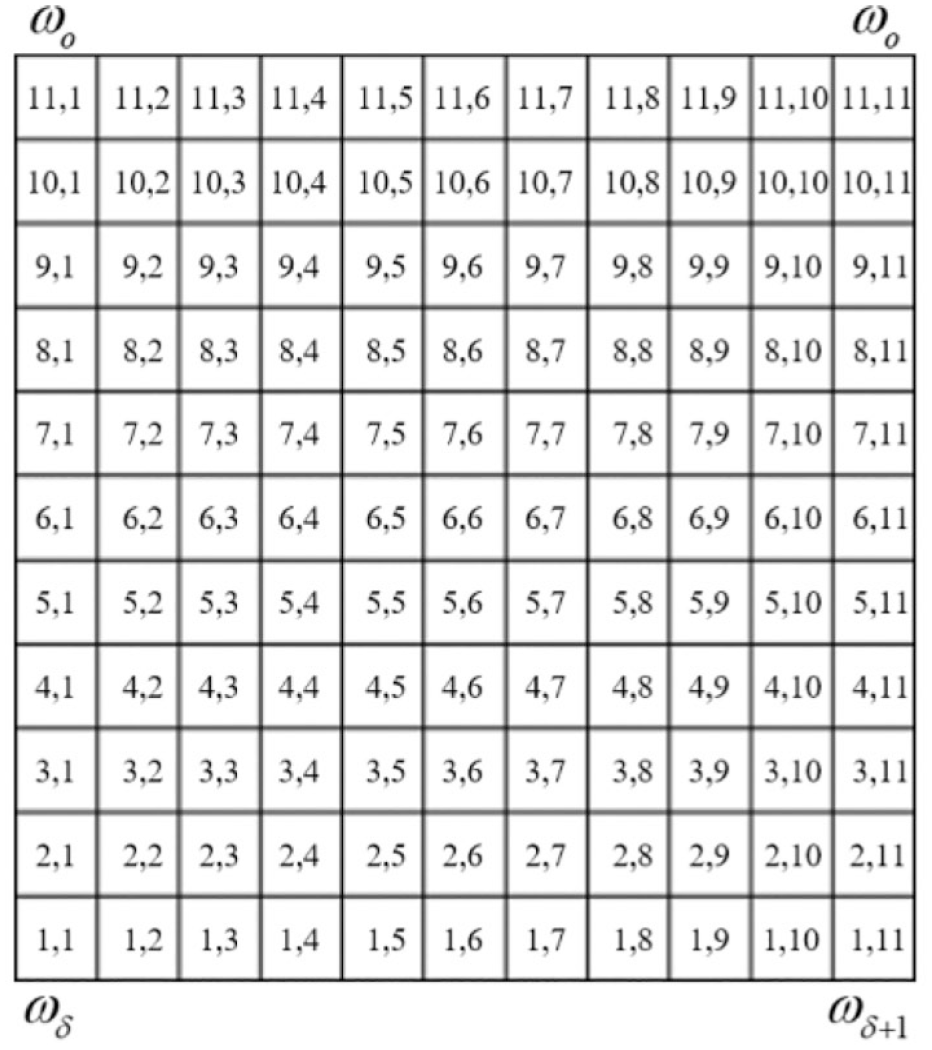
Ternary double coupling grid color mixture model.
Assuming that the blending ratio of primary-color fibers in the mixed sample corresponding to each grid point is

If the color value

Full-color-gamut grid color mixture model
Based on the above-mentioned ternary double coupling grid color mixture model, six color mixing regions such as

Full-color-gamut grid color mixture model.
To uniformly represent all grid points in the full-color-gamut color mixture model, let



The above constructed full-color-gamut grid color mixture model is rectangular with 11 rows and 60 columns, which is visually different from the commonly used color-matching circular model. Therefore, the rectangular grid color mixture model is converted into a circular grid color mixture model by grid point coordinate transformation, as shown in Figure 3. The coordinates of each grid point can be expressed in polar coordinates as follows:


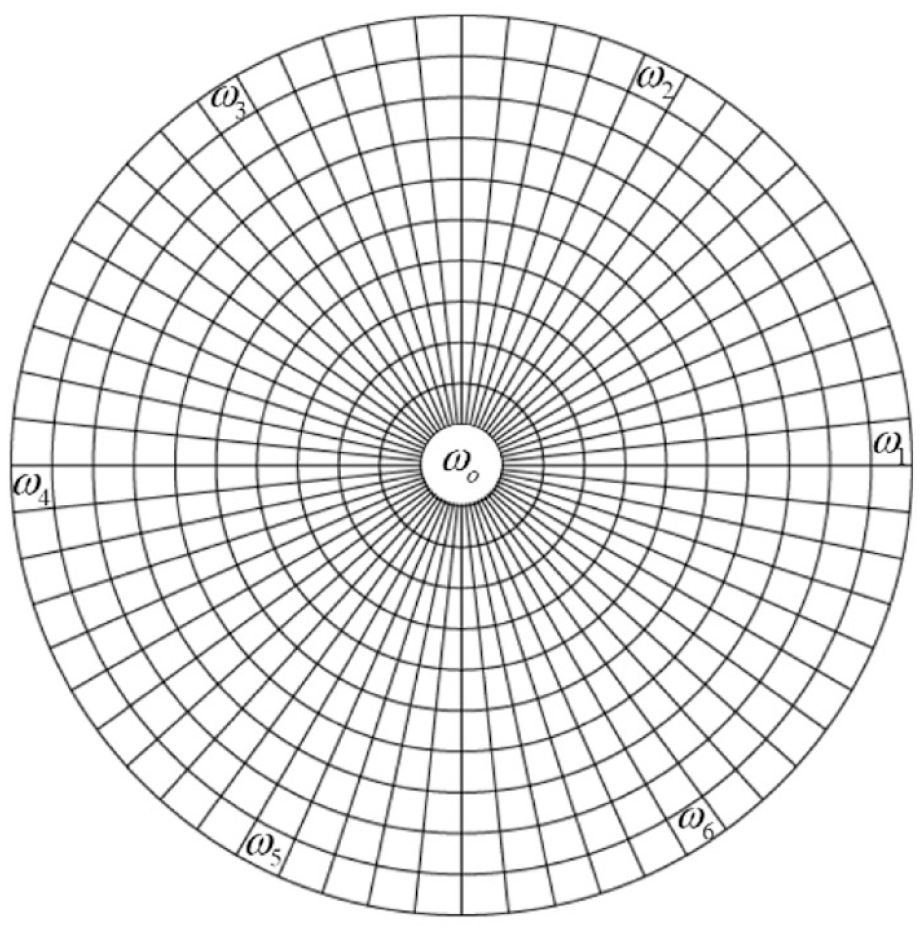
Circular full-color-gamut grid color mixture model.
Spinning method of full-color-gamut melange yarn
Three-channel NC rotor spinning controls the blending ratio and color value of the yarn by independently adjusting the roving feeding speed of the three channels.
15
Based on the three-channel NC rotor spinning, full-color-gamut melange yarn can be spun according to the full-color-gamut grid color mixture model. Assume that during the spinning process, the feeding speeds of three rovings with a linear density of

As seen from equation (8), the process parameters of rotor melange yarn can be obtained through the blending ratio of the corresponding grid points in the full-color-gamut grid color mixture model, thereby spinning the yarn.
Assuming that the mixing ratio of grid points in the full-color-gamut color mixture model is

Assuming that the feeding speed of the three roving for melange yarn is

Construction of modified S-N color prediction model
Construction of a modified S-N color prediction model based on seven primary-color fibers grid blending
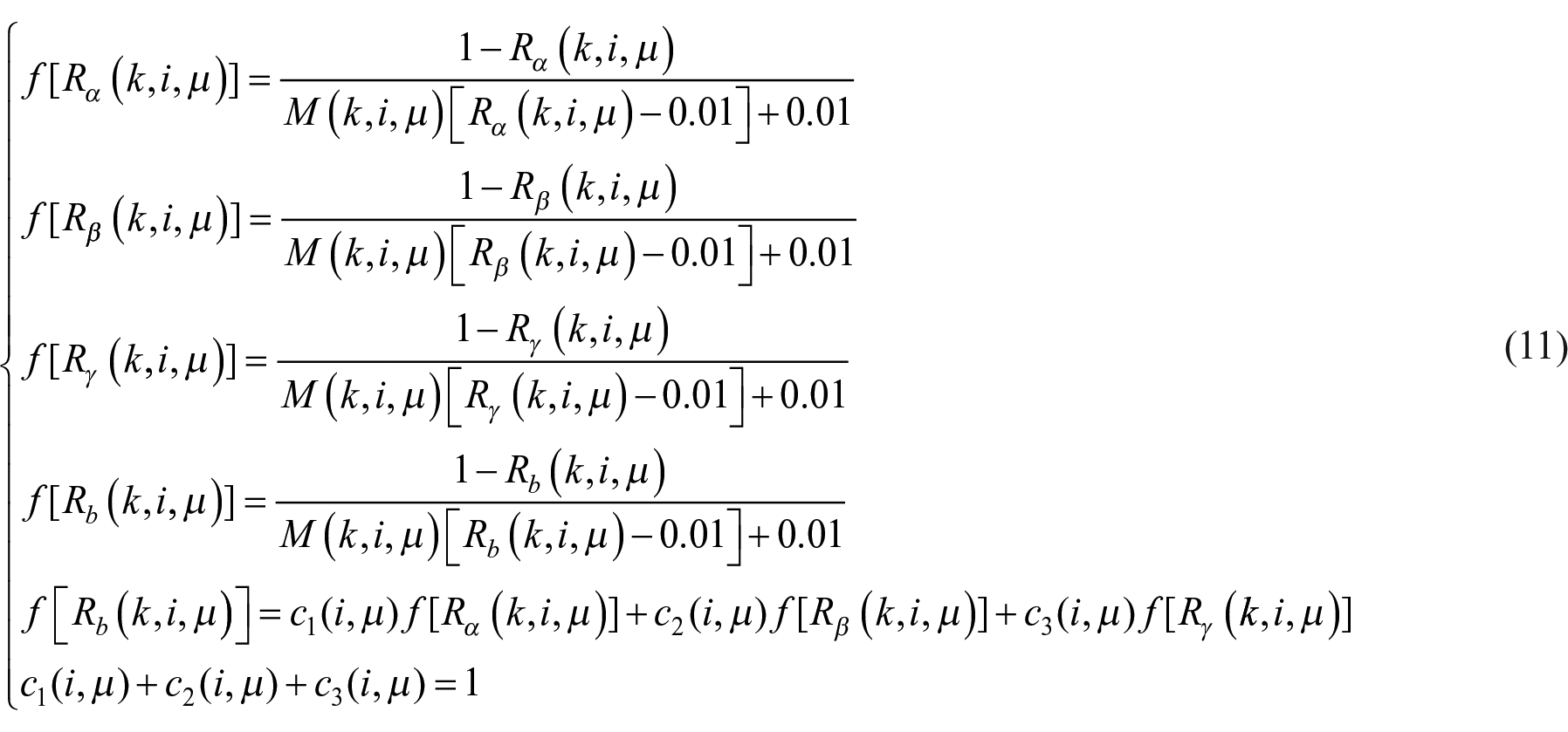
Since there is not a simple linear relationship between the reflectance of the melange yarn formed by blending the primary-color fibers and the reflectance of the primary-color fibers, the S-N color prediction model constructs an intermediate function by introducing a reflectance conversion coefficient (M) to describe the relationship between the reflectance of the primary color fibers, the mixing ratio of the primary color fibers, and the reflectance of the melange yarn. It is widely used to predict mixed colors of textile fiber materials.16,17
Assuming that the reflectance values of the three colored fibers selected from the seven primary-color fibers are
Where,
In the above-mentioned S-N color prediction model, the reflectance conversion coefficient is an unknown variable, which needs to be solved to build a complete S-N color prediction model. According to equation (11), the reflectance conversion coefficient solution equation can be derived as equation (12).
Equation (12) shows that the reflectance conversion coefficient is a variable associated with both wavelength and the blending ratio of the primary-color fibers. When solving it, it is necessary to take the reflectance values of the mélange yarns with different wavelengths and blending ratios as the basis.


Sample Grid Point selection for S-N color prediction model
The color values of the selected seven primary colors of red (

Mapping chromatography of full-color-gamut grid color mixture model.
Fifty-five evenly distributed grid points were selected from 601 grid points in the full-color-gamut grid color mixture model as sample grid points for yarn and fabric production. Using the YS6010 spectrophotometer, the reflectance values of 55 fabrics were measured as the basis for calculating the reflectance conversion coefficient. The distribution of 55 sample grid points in the full-color-gamut grid color mixture model is shown in Figure 5. The blending ratio of primary-color fibers corresponding to 55 sample grid points is shown in Table 1.

Distribution of sample grid points in the full-color-gamut grid color mixture model.
Blending ratios of primary-color fibers of sample grid points.

Among them, the three primary-color fibers of mixed samples 1# to 9# are red-yellow-gray; the three primary-color fibers of mixed samples 10# to 18# are yellow-green-gray; the three primary-color fibers of mixed samples 19# to 27# are green-cyan-gray; the three primary-color fibers of mixed samples 28# to 36# are cyan-blue-gray; the three primary-color fibers of mixed samples 37# to 45# are blue-magenta-gray; the three primary-color fibers of mixed samples 46# to 54# are magenta-red-gray.
Calculation of reflectance conversion coefficient
According to the parameters of the 55 sample grid points selected above, 55 knitted fabrics of melange yarn were produced. Their reflectance values at 31 wavelengths in the 400–700 nm range were measured using the YS6010 spectrophotometer. By substituting the reflectance values into equation (12) and solving them using MATLAB software, 55 × 31=1705 reflectance conversion coefficients corresponding to 55 sample grid points of melange yarn fabrics at 31 wavelengths in the 400–700 nm range can be obtained, thereby constructing a complete S-N color prediction model that can predict the color of melange yarn and the proportion of blended fibers.
Among them, the reflectance conversion coefficient corresponding to the fabric formed with only one kind of primary-color fibers cannot be directly solved using equation (12). Still, it can be solved using the method of calculating the limit based on the symbolic solution of the reflectance conversion coefficient, as shown in the following Equations:


Where,
Color prediction of melange yarn
The color prediction of melange yarn includes forward prediction and reverse prediction. Forward prediction is the color value prediction of melange yarn based on the color value (reflectance) of primary-color fibers and its blending ratio. Reverse prediction is the prediction of the primary-color fiber composition and blending ratio based on the color value of a melange yarn.
Based on the full-color-gamut grid color mixture model, this paper proposes a method for predicting the color value of melange yarns using the reflectance conversion coefficient of the nearest sample grid point based on the primary color fibers and their blending ratio and also proposes a method for predicting the blended fibers and their blending ratio of melange yarns using the primary color fibers and reflectance conversion coefficient of nearest sample grid point based on the color value of melange yarns, so as to realize the bidirectional color prediction of full-color-gamut melange yarn.
In this paper, based on considering the effect of wavelength on the reflectance conversion coefficient, we also consider the impact of blending ratios of primary-color fibers on the reflectance conversion coefficient and solve the corresponding reflectance conversion coefficients in six color mixing regions separately, and then substitute them into the S-N color prediction algorithm for color prediction. Compared with the original S-N color prediction model, the method proposed in this paper can predict color from three dimensions, such as hue, saturation and lightness, in the full-color-gamut, and can also build a full-color-gamut color mixture model independently by selecting the primary-color system and its blending mode according to the demand for color prediction, which improves the accuracy of color prediction.
Color value prediction of melange yarn
When the color values and blending ratios of the three primary-color fibers in the target melange yarn have been determined, the process of predicting the color values of the target melange yarn is described below. Firstly, the sample grid point nearest to the blending ratio of the target melange yarn is searched from the full-color-gamut grid color mixture model, and the reflectance conversion coefficient of the sample grid point is used as the reflectance conversion coefficient of the target melange yarn. Secondly, based on the modified S-N color prediction model, the reflectance function of the three primary color fibers is obtained from the reflectance values of the three primary-color fibers and the reflectance conversion coefficient of the target melange yarn, and the reflectance function of the target melange yarn is further obtained by combining the blending ratio of the three primary-color fibers. Finally, the reflectance of the target melange yarn is calculated based on the mathematical relationship between the reflectance and the reflectance function of the target melange yarn and then converted into L*a*b* color values to complete the color value prediction of the melange yarn.
Determination of reflectance conversion coefficient
Assuming that the target melange yarn



Color value prediction of melange yarn based on the modified S-N color prediction model
Based on the modified S-N color prediction model, the reflectance conversion coefficient


Assume that the reflectance of the target melange yarn

Then, the L*a*b* color value of the target melange yarn


In equation (20), X (i, µ)

Where:
Evaluation of color value prediction effect
The color difference equation

Blending ratio prediction of melange yarn
When the color value of the target melange yarn has been determined, the process of predicting the primary-color fibers and their blending ratio in the target melange yarn is described below. Firstly, the sample grid point nearest to the color value of the target melange yarn is searched from the full-color-gamut grid color mixture model, and the corresponding primary-color fiber and reflectance conversion coefficient of the sample grid point are used as the primary-color fibers and reflectance conversion coefficient of the target melange yarn. Then, based on the modified S-N color prediction model, the least square method is used to calculate the blending ratio of the three primary-color fibers through the reflectance of the melange yarn and the reflectance of the three primary-color fibers, thereby completing the prediction of the blending ratio of the melange yarn.
Determination of primary-color fibers composition and reflectance conversion coefficient
Assuming that the target melange yarn
Based on the full-color-gamut grid color mixture model, using the 55 sample grid points selected above as the search domain, the sample grid point



Blending ratio prediction of melange yarn based on the modified S-N color prediction model
Based on the modified S-N color prediction model, the blending ratio of the target melange yarn can be predicted using the least square method as follows.
The spectral power distribution

The standard chromaticity observer tristimulus values

The reflectance functions of the target melange yarn

The first derivative of reflectance

Where, D(k) can be expressed as follows:

The reflectance function of the three primary-color fibers at 31 wavelengths from 400 to 700 nm is expressed by the matrix

The blending ratio of three primary-color fibers in target melange yarn is expressed by the matrix

Then, the blending ratios matrix

Evaluation of blending ratio prediction effect

Experimental
Production of melange yarn and fabric
Experimental raw materials are fine-staple cotton dyed with reactive dyes, which is formed roving with a linear density of 450 Tex and a twist of 68 turns/m through the processes of opening-cleaning, carding, drawing, and roving, purchased from Youngor Color Spinning Co., Ltd. (Anhui, China).
The melange yarn was spun on the HFX-03-T three-channel NC rotor spinning machine produced by Suzhou Huafei Electronic Technology Co., Ltd. (Jiangsu, China), with a linear density of 32 Tex and a twist of 672 T/m. The basic process parameters of the machine are as follows: the rotating speed of the rotor is 20,000 rpm, the rotating speed of the carding roller is 6000 rpm, the speed of the winding roller is 18.5 m/min, and the speed of the guide roller is 18 m/min.
The melange yarns were knitted into the fabric by the HC21 K small circular knitting machine produced by Hongcheng Textile Machinery Electronics Co., Ltd. (Jiangsu, China). The fabric specifications are: weft plain knitted fabric, the length of a single loop is 0.6 cm, the transverse fabric density is 102 loops/10 cm, and the longitudinal fabric density is 160 loops/10 cm.
Measurements of fabric color values
The YS6010 spectrophotometer produced by Shenzhen Threenh Technology Co., Ltd (Shenzhen, China) is selected to test the color value of knitted fabric of melange yarn. During sample testing, the D65 light source, 10° field of view, 25.4 mm aperture, and SCI mode are used, and the average value is taken for five tests of each sample.18–20
Results and analysis
The knitted fabric of melange yarn and their reflectance
According to the parameters of 55 sample grid points in the full-color-gamut grid color mixture model, the corresponding process parameters can be calculated for yarn and fabric production. The 55 kinds of knitted fabrics of melange yarn obtained are shown in Figure 6. Using the YS6010 spectrophotometer to measure the color of fabrics, the reflectance curves of fabrics at 31 wavelengths from 400 to 700 nm are obtained, as shown in Figure 7.
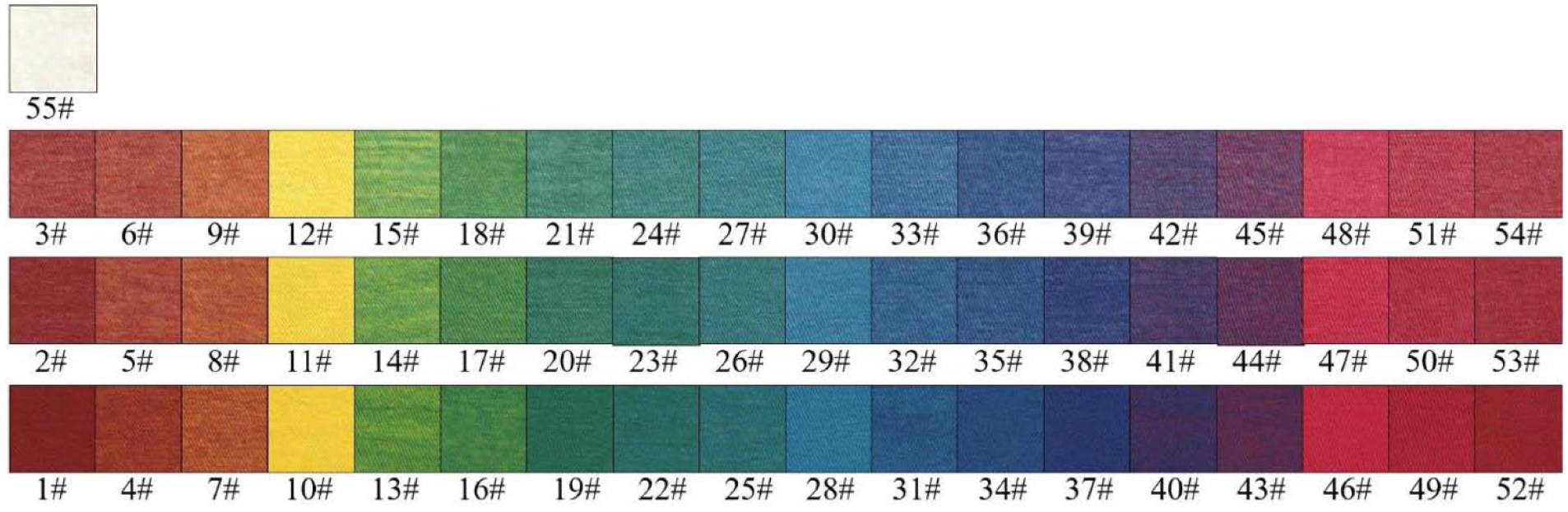
The knitted fabric of melange yarn.

Reflectance of knitted fabric of melange yarn: (a) Reflectance of fabrics 1#~9#, (b) Reflectance of fabrics 10#~18#, (c) Reflectance of fabrics 19#~27#, (d) Reflectance of fabrics 28#~36#, (e) Reflectance of fabrics 37#~45#, (f) Reflectance of fabrics 46#~55#.
Results of reflectivity conversion coefficient solution
By substituting the reflectance of 55 kinds of knitted fabrics of melange yarn into equations (12)–(15) and using MATLAB software to solve, a total of 55 × 31 = 1705 reflectance conversion coefficients for the corresponding sample grid points of the fabrics at 31 wavelengths from 400 to 700 nm can be obtained. The scatter diagram of the reflectance conversion coefficient distribution at different wavelengths is shown in Figure 8. The scatter diagram of the reflectance conversion coefficient distribution at different blending ratios is shown in Figure 9.

Scatter diagram of reflectance conversion coefficient distribution at different wavelengths.
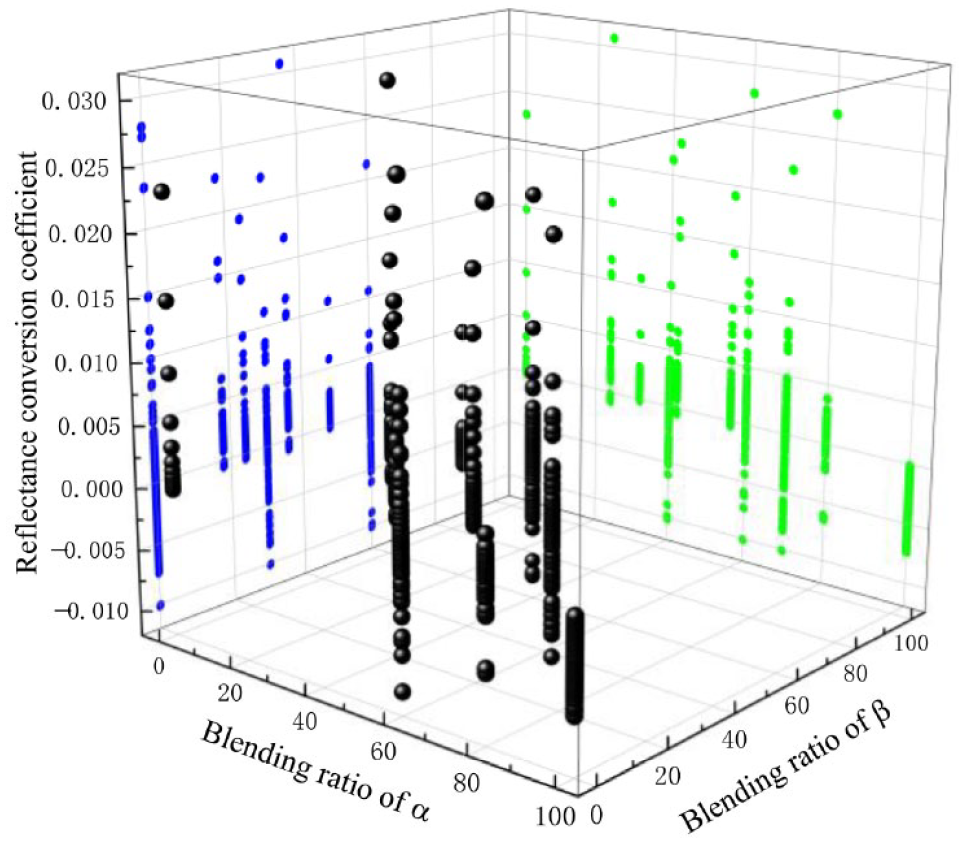
Scatter diagram of reflectance conversion coefficient distribution at different blending ratios.
Figures 8 and 9 show that the reflectance conversion coefficient is mainly distributed between −0.005 and 0.005, with different values at different wavelengths and blending ratios. It indicates that the reflectance conversion coefficient is a variable associated with both wavelength and blending ratio. When using the S-N color prediction model, the impact of changes in wavelength and blending ratio should be considered.
Results and analysis of color value prediction for melange yarn
Among the six color mixing regions of the full-color-gamut color mixture model, six samples with different fiber blending ratios were selected for yarn and knitted fabric production to validate the color prediction method proposed in this paper and to evaluate the color prediction effect. The primary-color fiber combinations and blending ratios corresponding to the six samples are shown in Table 2.
The primary-color fibers composition and blending ratios of six samples.

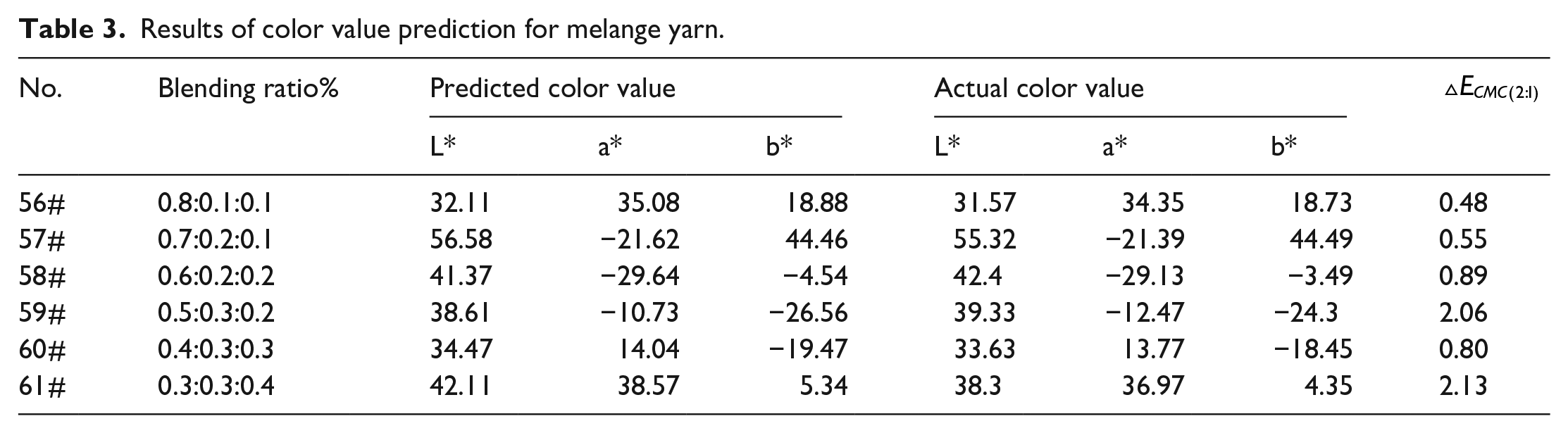
Based on the S-N color prediction model, the predicted reflectance of melange yarn 56#–61# was calculated from the reflectance of the three primary-color fibers and the blending ratio, and the predicted color values were further obtained. Based on the full-color-gamut grid color mixture model, the corresponding process parameters of melange yarn 56#–61# were calculated for the production of yarn and knitted fabric, and the color value of melange yarn fabric was measure by YS6010 spectrophotometer to obtain the actual reflectance and actual color values of melange yarn. The comparison of predicted reflectance curves and actual reflectance curves of melange yarn fabrics 56#–61# are shown in Figure 10, and the predicted color values and the measured color values are shown in Table 3, and the comparison of the predicted colors and the actual fabric photos is shown in Figure 11.

The comparison of the predicted reflectance curves and actual reflectance curves.
Results of color value prediction for melange yarn.

The comparison of the predicted color and actual fabric photos.
From Table 3, it can be seen that the average color difference value between the predicted color and the actual color of the melange yarn is 1.15. According to the national standard GB/T 250–2008, the color difference is at level 4–5, which indicates that the predicted color matches well with the actual color, and the method proposed in the paper can effectively predict the color of the melange yarn.
Results and analysis of blending ratio prediction for melange yarn
Based on the modified S-N color prediction model, the measured color values of melange yarns 56#–61# were used to predict the combinations of primary-color fibers and their blending ratios in melange yarns, and the predicted combinations of primary color fiber and their blending ratios of blended yarns 56#–61# were obtained. The comparison of the actual combinations of primary-color fiber and their blending ratios with the predicted combinations of primary-color fiber and their blending ratios is shown in Table 4.
Results of blending ratio prediction for melange yarn.
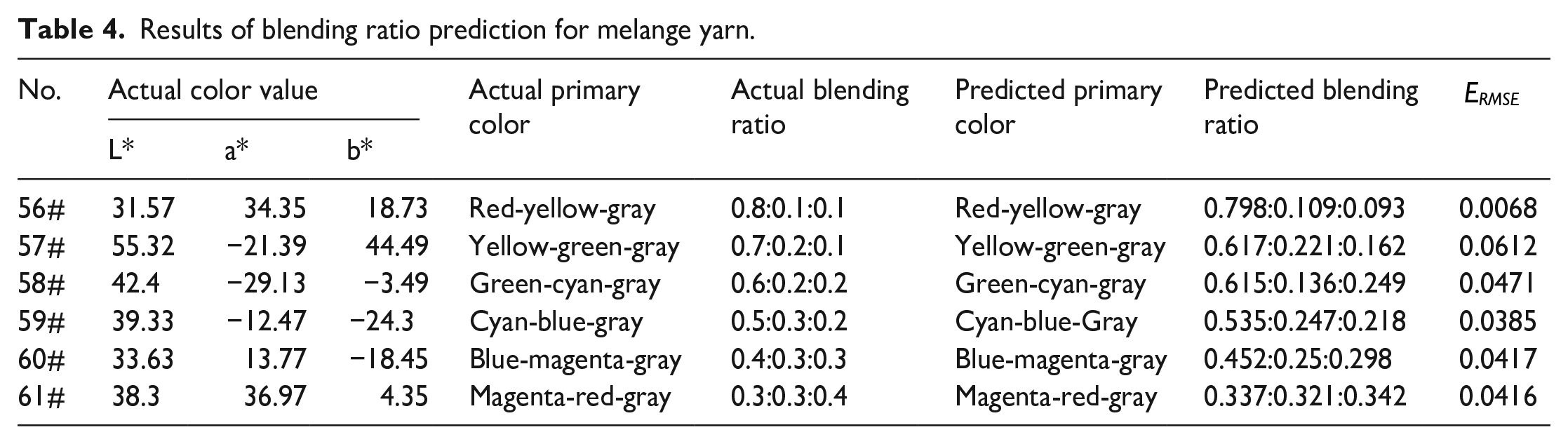
From Table 4, it can be seen that the predicted combinations of primary-color fiber of melange yarns are consistent with the actual combinations of primary-color fiber, and the average
Conclusion
In this paper, to solve the problems of color prediction and color reproduction of rotor melange yarn, firstly, a full-color-gamut grid color mixture model is constructed by blending seven primary-color fibers according to the ternary double coupling color mixture model, based on which the mixing color can be controlled in the range of 0°–360° hue, 0–1 saturation, and 0–1 lightness by regulating the blending ratio of primary-color fibers. The 55 grid points uniformly distributed within the full-gamut-color grid color mixture model are selected for yarn and fabric production, and the obtained fabrics are used as samples for the S-N color prediction model, and then the S-N color prediction model for the full-gamut color space is constructed by solving for the reflectance conversion coefficient. For the need to prepare target melange yarn with any proportion of primary-color fibers blend and predicting its color, the nearest sample grid point is searched from the blending ratio of the target melange yarn, and the reflectance and color value of the target melange yarn are obtained from the reflectance conversion coefficient of that sample grid point. For the need to predict the primary-color fiber composition and blending ratio for a target melange yarn with arbitrary color value, the nearest sample grid point is searched by the color value of the target melange yarn, and the primary-color fiber composition and blending ratio of the target melange yarn are obtained by the reflectance conversion coefficient and primary-color fiber composition of this sample grid point. Finally, six samples with different blending ratios were selected for yarn and fabric production in six color mixing regions of the full-color-gamut grid color mixture model constructed by seven primary colors to validate the method for color prediction and blending ratio prediction of melange yarns proposed in the paper.
The results showed that the reflectance conversion coefficient is a variable associated with both wavelength and blending ratio, and the impact of changes in wavelength and blending ratio should be considered when using the S-N color prediction model for color prediction of melange yarn. The average color difference between the predicted color and the actual color of the melange yarn is 1.15, the predicted primary-color fiber composition of the melange yarn is consistent with the actual combination, and the average
Footnotes
Declaration of conflicting interests
The author(s) declared no potential conflicts of interest with respect to the research, authorship, and/or publication of this article.
Funding
The author(s) disclosed receipt of the following financial support for the research, authorship, and/or publication of this article: This work was supported by the Fundamental Research Funds for the Central Universities (JUSRP12029 and JUSRP52007A) and the “Jian Bing” and “Ling Yan” Research Fund in Zhejiang Province (2022C01188).
