



Abstract
3D virtual prototyping for garment development, although not much exploited and appreciated by the clothing industry in the early days of its appearance two decades ago, has now been explored (research-wise) extensively especially in the pandemic period and its impact on the whole supply chain of garments and fashion products. This virtual prototype which allows the company to visualize the status and condition of a clothing product that may be thousands of kilometers away, providing insights into how products can be better designed, manufactured, operated and serviced before companies invest in physical prototypes and assets, is often called digital twin. At the same time, laser-cut as a creative design technique on clothing materials have emerged in recent times, as fashion moguls are seeing the benefits that the technology presents. Laser cut technology with its benefits of accuracy, speed, precision, applicability in various materials, flexibility in geometry, interoperability with other systems like CAD/CAM and CIM, sustainability in resources and source of inspiration for several upcoming designers, provides an excellent approach for creating bridges between the past, the present and the future in history of fashion design. The aim of this paper was to provide a decision-making framework for the selection of an effective digital twinning process with the use of two different 3D virtual prototyping tools. For this purpose, a methodological framework is proposed which guides the creator according to the final use of the digital garment twin: evaluation of actual fit and actual representation of the produced physical, or as a shared digital asset for an exclusive digital environment.
Introduction
The recent global pandemic fostered the digital transformation of the textile and fashion industry. 3D virtual prototype gained momentum in product development. Digital twin and digital passport of fashion products have been introduced as new paradigm in the EU. Digital twin is the virtual prototype which allows the company to visualize the status and condition of a clothing product that may be thousands of kilometers away, 1 providing insights into how products can be better designed, manufactured, operated and serviced 2 before companies invest in physical prototypes and assets. Today, technological advancements have enabled organizations to utilize the benefits offered by Digital Twins (DTs) in multiple domains. 3 Especially in pandemic period we can see a push toward the utilization of DTs. With the growing popularity of fast fashion and the multitudes of options available for customers in the textile industry there is a huge scope for the utilization of DTs in this domain. 3 Digital Twins can be utilized to create new styles and designs and be offered to satisfy customer’s specific wishes. This can also be simulated in a specific demographic to understand its acceptance, and analyze what sort of clothing is currently trending in the market. 4 Moreover, according to McKinsey & Company, 5 the industry of apparel, fashion and luxury is one of those which understood the new growing opportunity metaverse brings, and is already implementing initiatives toward that direction; digital twinning is one of them. Digital version of a company’s fashion assets can not only act as an inspiration to the creative teams internally or as a mean to enhance processes more effectively. It can also upgrade their value as future ownership of the company’s consumers. A digital twin can provide customized clothing products to customers, based on their preferences which ultimately can contribute to plan design and reduce cycle production time and waste. 6 According to Kuzmichev and Yan, 7 brands using 3D digital garment design and development processes are recorded up to a 75% reduction in sampling, and a 50%–75% reduction in time spent on product development.
Impact of laser-cut technology in fashion creation
According to Bogue, 8 “laser cutting is a thermal process whereby a focused laser beam is used to melt material in a localized area.” A plethora of custom laser designs have emerged in recent times, as fashion moguls are seeing the benefits that the technology presents. After they were introduced in the 1960s, the fashion designers are widely adopting laser cutting in garment manufacturing. There are plenty of reasons for the designers to use this method. Laser cut has extreme accuracy as far as the details are concerned, leaves clean cuts and also seals the fabric edges to prevent fraying. 9 The behavior of the material during laser cutting is influenced by its inherent properties, such as composition, density, thickness, and surface characteristics. One key factor that affects the visualization of laser-cut edges is the ability of the textile material to absorb or reflect the laser energy. Some textile materials have a higher absorption rate, meaning they readily absorb the laser energy and convert it into heat. These materials tend to exhibit clean, precise, and well-defined edges when laser cut. Natural fibers, such as cotton or silk, typically have varying responses to laser cutting due to their composition and structure. Synthetic fibers, like polyester or nylon, often have a more consistent response due to their uniformity and predictable characteristics. 10 states that this technology is also fast, easy and precise and simultaneously enables mass production, which is essential for design. Another advantage is that it is applicable in many different materials like silk, nylon, leather, neoprene, polyester, and cotton. Laser cut technology has a great flexibility in terms of geometry: complex geometries, individual designs, prototypes and small scale products can be manufactured by laser cutting. 11 In addition, due to ability to apply CAD/CAM and CIM system in design, it is possible to manufacture absolutely identical designs in less time and with high quality. 11 Laser cut technology is also, a sustainable method of design that can reduce waste and increase efficiency for surface design and garment construction processes. 11
These assets/benefits of laser cutting technology, inspire many fashion designers to use it in the creation of their garments with Iris Van Herpen (https://www.irisvanherpen.com/), Azzedine Alaia (https://www.maison-alaia.com/us), Martijn Van Strien (https://www.notjustalabel.com/martijn-van-strien), Cut Cuutur (https://cutcuutur.com/), to name but a few. Fashion creators find a unique opportunity to blend their own culture with technology, uplifting the traditional motifs on contemporary designs in an innovative way. This means the conversion of traditional complex decorative elements like the patterns of Persian tiles or Pucuk Rebung Motif which is a traditional Malay motif, into a contemporary design that enhances a simple casual everyday garment.12,13
Apart from contemporary fashion items, this technology is also used in costume design, because of the high accuracy and attention to great detail. Costume designers can select images of several embellished costumes of their preferable era, and edit them manually or in illustrator in order to convert the embellishments into geometrical shapes. 14 Then with the aid of other CAD/CAM programs they can apply these geometries to any pattern/ ready garment and make it ready for laser cutting.13,15 This is an excellent approach for creating bridges between the past, the present and the future in history of fashion design. Moreover, in fashion accessories such as jewelry, laser cutting can be used to produce new and unusual designs to produce a fusion of apparel design and jewelry style. 9
Before the use of laser cutting, the cutting stage in the production of garments faced many problems; it is time-consuming, costly, and lacks of commitment to production deadlines. 16 Its use however, made a great change offering new opportunities and unlimited possibilities in matters of complex geometries, scales and boundless number of exact copies. It contributed to raising the efficiency of cutting cloth, leather and other materials through computer hardware and software.17,18
3D Digital product creation
In recent times, more and more designers, in plenty of design fields, are merging craftsmanship with technology during the development of a new product. Fashion industry could not be an exception of this progress. Especially nowadays, the growth of better educated consumers and mass-customization needs, points out the demand for technological applications in new environments/spaces like virtual reality with the development of virtual clothing, during the creation and development of garments. 19 Virtual prototyping practice and technologies are developing fast and moving from the traditional industrial sectors that have pushed their development (automotive, aeronautical) to new sectors, like the one of fashion, although not relevant to the foreworded, but as economically important. 20 Using digital tools like 3D Cad software to create the digital twin of a garment have significant advantages for the whole textile and clothing ecosystem, but require high need for fashion experts who are equipped with new digital skills and mindset.
Firstly, the 3D concept is an important step in the design process. Designers till recent times only used pencil and sketches or 2D patterns for the generation of their ideas. The creative output of this preliminary process then passes through the classical product development cycle, to sewing the prototypes to get a 3D garment shape as close as possible to the original stylist’s idea (2D-to-3D stage), and after innumerable iterations finally reaches the production stage. 21 CAD/CAM programs allow designers to unleash their creativity in a real-life visualization of designs in no time. 22 Additionally, one of the greater advantages of virtual prototyping is that garments can be designed while monitoring their fit to the silhouette of a specific person directly, without his or her physical presence. 23 Designers have the opportunity to visualize the finished product and create photorealistic images with specular texture maps and send them to their customers for final approval.
Technology in fashion for digital twinning, not only increases designers’ creativity, but has also a great influence on environmental impact analysis. Fashion production makes up 10% of humanity’s carbon emissions according to the Geneva Environment Network. 24 Brands using 3D digital garment design and development processes are recorded up to a 75% reduction in sampling, and a 50%‒75% reduction in time spent on product development. 7 Moreover, working to create better sizing fit and communication sizing fit can reduce the ecological impact of clothing purchasing. 25 With the fit maps provided by each 3D software program designers can predict the perfect fit for each body skipping the procedure of numerous samples, manufacturing only the final garment. Along these lines, shipping of prototype back and forth many times because of traditional prototyping process, can be eliminated. 26
To sum up, 3D apparel technology allows users to check the actual fit of garments on virtual models that could also be customized with the actual customers’ dimensions, make adjustments and reduce the need for numerous paper patterns and fit-checking. 22 Fewer prototypes mean less energy spent on shipping and transportation, fewer chemicals used in preparing fabrics and reduced waste. 22 Moreover, these 3D digital tools enhance interdisciplinary collaboration between creative industries like gaming, visual arts, architecture and so on with fashion, adding a new perspective into the creative process. In general, product development process is a cycle which is related to a large group of people. Especially in cases like the global pandemic, 3D technology proved extremely useful because designers, pattern makers, product development team and manufacturers had the opportunity to work remotely, visualize the same digital twin and make sure that everyone understands the type of modification needed to be done. 27
I-mannequin project
The i-MANNEQUIN (https://i-mannequin.iti.gr/) project is associated with the development of a system for automatic digitalization, rapid prototyping and setting of parameters for clothing 3D models. The main idea of the project is to develop the first “Digital Pattern,” which will be a parametric structure model with geometric and semantic elements, that will provide fast pattern modeling and semi-automatic digitization of existing garments, from 3D models or and simple photos, using artificial intelligence technologies. Moreover, with the use of a modern 3D visualization and simulation tool, it will be possible to interactively parameterize the patterns providing the possibility to produce new personalized clothes by combining various garment patterns.
Methodological framework
In order to demonstrate the applicability of the proposed framework on a case study, authors selected a high profile clothing manufacturer brand with laser-cut garments. The brand is based in Northern Greece and is created by a team of young architects and designers. It aims to promote digital fabrication methods, like laser-cut, implemented in clothing and accessory design and creation. This concept maps digital design methods to digital fabrication techniques, through a three-phase workflow – 2D or 3D modeling, textile and material adjustment, and fabrication (laser cutting, 3D printing).
For the research purpose of this paper, authors present two methods of developing a virtual version of a laser-cut garment, using 3D virtual prototyping design software; Browzwear V-Stitcher and CLO3D in particular. The following garment styles belong to the brand’s Spring-Summer 2022 Collection. This development of the digital twins was also part of the “i-mannequin” project.
With the first method, laser-cut holes are drawn and cut inside the software while with the second, holes are represented as transparent color. Both methods create the same visual effect in the end, but with the latter, laser cuts are not real but rather an “optical illusion”/visual representation.
In Figure 1, two styles of the laser-cut brand are presented. For the purpose of this research, authors have developed the digital twin of the style on the right using a 3D virtual prototyping fashion design software.

Brand’s apparel.
Method 1: Digital twin – virtual prototype
As already mentioned, with the first method, the digital version of the garment style has been developed in order to represent exactly the holes derived from laser-cutting the fabric. Both 3D software have been tried but CLO3D was selected, because V-Stitcher cannot handle well the creation of many points, especially points created after making the holes; system requirements are very demanding during simulation. CLO3D on the other hand, managed created points after creating the holes, better. The steps were followed as below:
- Import dxf 2D pattern files in Clo3D (dxf pattern files were firstly developed by the pattern designer of the clothing manufacturer in Modaris 2D CAD system by Lectra (https://www.lectra.com/en)).
- Virtual stitching of pattern and arrange of the garment on the avatar.
- Fabric selection from the library and color selection from color palette.
- Run simulation.
Figure 2 shows the garment on both 2D and 3D views.

3D and 2D view of garment.
The following step is the development of the laser cut holes. In order to do that, a picture of any format (e.g. jpg or png) of the laser cut pattern of the garment is needed. (See Figure 3).

Laser cut pattern (png file).
Figure 4 shows the placement of the 2D laser-cut image in the selected 2D pattern of the dress garment. This can be done in Object browser on the right, in the Graphics tab. Drag & drop it to the parts of selected pattern pieces, and then modify it to fit into the part with the gizmo.

Import laser cut pattern.
Copying the laser-cut image for every pattern piece can result to stage shown in Figure 5. Special notification, to use images only to the one side of the garment since pattern pieces are mirrored; this means that every change made to one piece, is transferred to the mirrored one too (e.g. holes).

2D and 3D view after importing the laser-cut pattern.
Using the internal tools given by CLO the user can start drawing over the shapes of the laser cut pattern. After having drawn some shapes of the same pattern, the user can copy and paste the rest to accelerate the process. An example is shown on Figure 6 (left).

(Left) drawing the shapes, (right) cutting the shapes.
After the user has completed all the shapes on a pattern piece, he/she deletes its laser cut image and proceeds to create holes and external shapes Selects all the shapes and with “right click” selects cut. This will create smaller pieces that need to be deleted after the cut is finished. Simply moves away the parts that are needed and selects all the other parts to be deleted as shown on Figure 6 (right). Figure 7 shows the final simulated garment after trimming fabric from the drawn pieces (holes).

2D and 3D view after cutting out all the laser cut shapes.
Figure 8 shows the front, ¾ left, left and back side view of the finished dress.

Multi-view of the finished apparel.
Method 2: Digital twin – “Optical illusion”/visual prototyping
Unlike the first method, the second method is better done with the VStitcher software, as CLO3D is facing some issues with the transparency of the laser cut image. In particular, two different try-outs have been made in CLO to achieve the “optical illusion” result, but with no success. Firstly, the texture of fabric was replaced with the laser cut piece but the system translated all the parts of the garment that the fabric was set on, as a percentage of transparent. The second try involved adding a new fabric and set its opacity level to 0. Afterward, laser cut image was placed as a graphic like in the first method. This resulted to no capability of picking the garment in the 3D simulation with the hand tool and transparency issues like the previous try-out also. VStitcher works better with this method with no challenges to face and completes the process easily and efficiently. The only challenge is the image editing needed in order to make laser cut holes and background transparent. Using an open-source image editor like GIMP the desired result can be achieved.
In the GIMP environment we continue as following:
- Open the image of the 2d pattern and then using the “select by color” tool, select the white background while on a high threshold (e.g. 60), so the user can pick any light shadows of the color (e.g. light gray).
- Use the “Bucket fill” tool with the appropriate color to fill the background with black and each part of the apparel with red color, as shown on Figure 9.
- Notice that there are still remaining some white outlines and the holes are still white. By selecting the picture with the “rectangle selection” tool and then deselecting the red color with “select by color tool” and “ctrl + click,” the user can now paint brush black all the remaining outlines and holes. Changing the brush to really high size will speed up the process.
- After all white outlines are cleared out and holes are filled with black color, the user changes back the color added to the parts (red) back to white (Figure 10).
- Selecting the Layer tab then Transparency and then Color to Alpha, allow us to select a color to be transparent (Figure 11). Black is chosen as color in order to be transparent. The end result is shown on Figure 12.
- Export it as png file and the laser cut pattern is ready to be imported into VStitcher, after the creation of the virtual garment.
- Import dxf file of the garment into VStitcher, virtually stitch the pattern pieces, pick the original color of the garment and then select the right fabric. The created garment is shown on Figure 13 in both 2D and 3D views.

Selecting by color and filling the parts with bucket.

Clearing the outlines and return to white color.
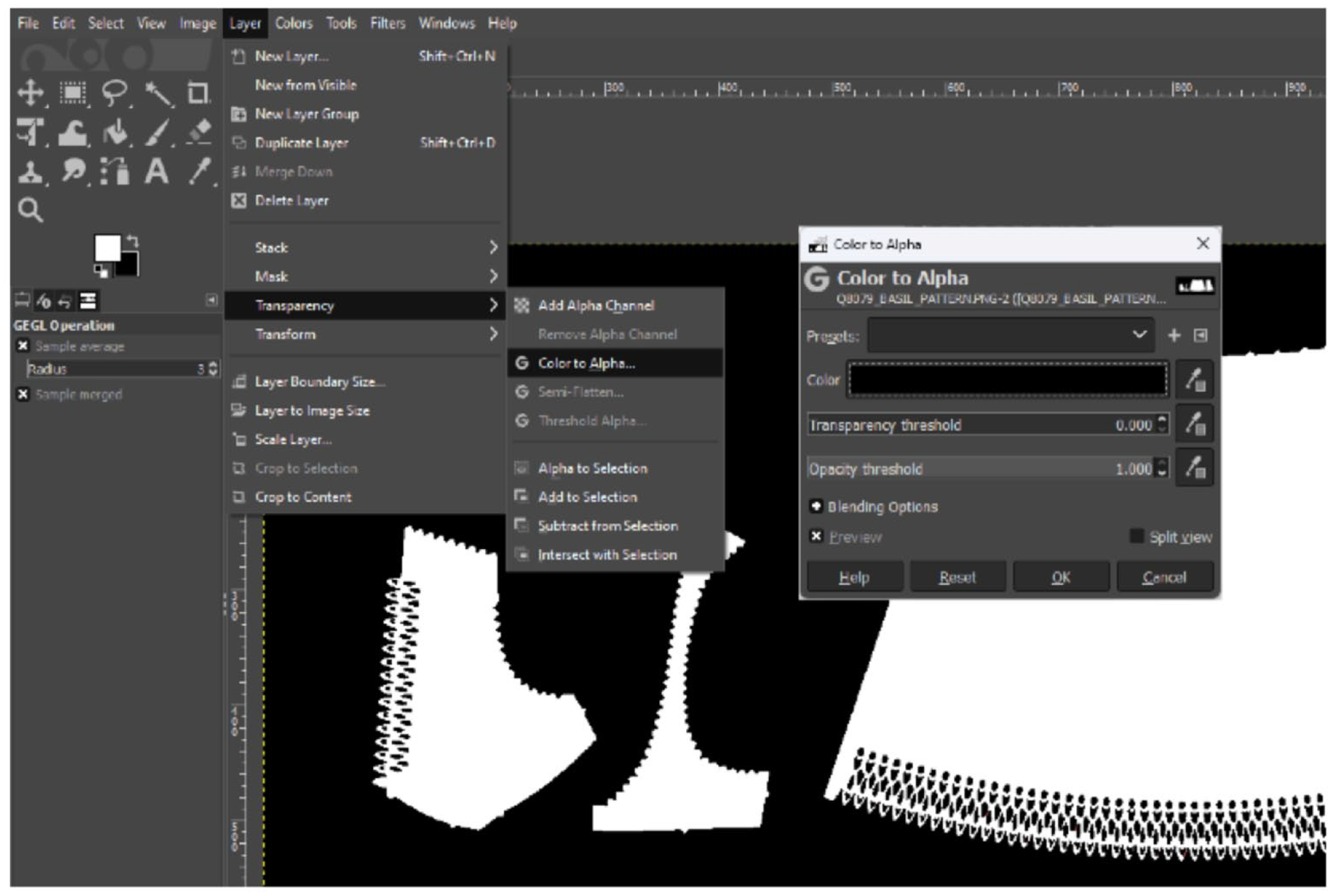
Setting transparent background.

Apparel parts with transparent background.

2D&3D view of garment.
The user now has to import the laser cut pattern that he/she exported from GIMP into VStitcher. In order to do that he/she chooses Artwork and then adds Artwork on the Materials tab. Can also modify the artwork to fit into each part of the garment, after cloning it times the parts of the garment that has laser cuts.
One thing to notice is that the user has to add the artwork in both sides (front and back), so the transparency exists in both ends (Figure 14).

Import artwork.
Choosing the artwork from the materials allows to modify the settings of it on the right panel. Figure 15 shows the settings changed. Below authors describe some of the changes made.
● Hide background:
enables the transparent background
● Use Lower Layer Maps:
enables the texture of the fabric used
● Color Blending:
allows to change the color

Artwork settings.
Figure 16 shows the end results of the 3D garment.
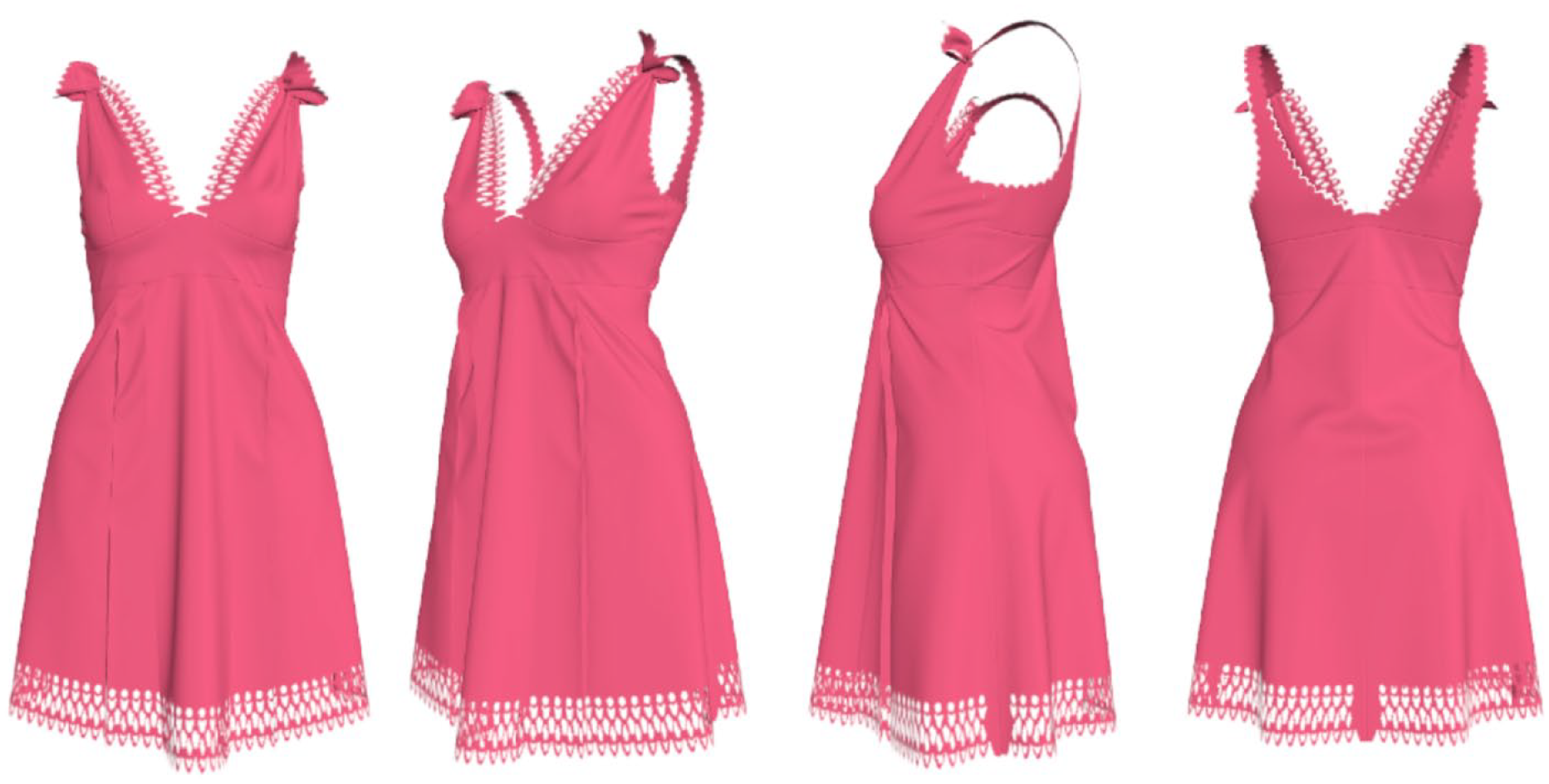
Multi-view of the finished apparel .
Comparison and conclusions
As already mentioned, both methods develop the digital twin of the laser-cut dress shown in Figure 1. The visual representation of both methods can be seen in magenta color in Figure 17. However, in the same image the vertices show that with the “optical illusion” method, the actual holes are not transferred into the garment’s body; meaning that there are no holes on the garment.

Vertices of object files of Method 2 (left) and Method 1 (right).
Producing laser-cut garments is not an easy task. Although it is more cost-effective than traditional methods of fabrication, offers versatility in fabric material and advantages in low environmental impact of production, challenges the designer especially when it comes to developing new concepts and ideas while communicating internally within a fashion company during the decision making process. The integration of 3D Prototyping not only in the product development process but also in the creation phase of any digital clothing product twin for the physical, digital or phygital consumer-brand interaction made significant progress lately. When it comes to applying laser-cut fabrication on a clothing product, 3D comes with restrictions, not insuperable ones.
The adopted framework shows that current virtual product development tools for fashion garments are capable to provide reliable manufacturing solutions in the low volume production, for clothing brands that require a correct visual representation of a physical laser-cut garment in its digital twin. Depending on the 3d garment, the user chooses the appropriate method for digital twinning the laser-cut garment. If it is for dressing a virtual character, for example in a game as a skin, then the first method is suitable, but if the optical use is only needed, then the second method, is faster and more efficient. The second method can also be selected for on-demand clothing production eliminating inventory related costs regarding material and other resources or for co-designing, including the final customer in the design of the final selected clothing laser-cut product.
Footnotes
Declaration of conflicting interests
The author(s) declared no potential conflicts of interest with respect to the research, authorship, and/or publication of this article.
Funding
The author(s) disclosed receipt of the following financial support for the research, authorship, and/or publication of this article: This research has been co-financed by the European Regional Development Fund of the European Union and Greek national funds through the Operational Program Competitiveness, Entrepreneurship and Innovation, under the call RESEARCH—CREATE—INNOVATE (project code: T2EDK-04770).
