



Abstract
In order to understand consumers’ cognition of clothing style and design clothing products more in line with people’s emotional needs, a garment style perceptual image prediction model based on PSO-BP neural network was constructed by taking professional dress as an example. Firstly, the professional dress samples were screened and the style design elements were deconstructed and coded. The Kansei engineering theory and factor analysis method were used to determine the representative adjectives, so as to reduce the cognitive dimension of the target users for the style characteristics and perceptual image of the dress. Then, using the sample style design element code as the input layer and the user’s perceptual image evaluation score as the output layer, the PSO-BP neural network’s perceptual image prediction model for professional dress styles is constructed. Finally, the sample data were input into the PSO-BP model, BP neural network and GA-BP model for simulation and calculation, and the error analysis of the results proved that the PSO-BP prediction model is effective and advanced. Designers can use this model to quickly transform customers’ perceptual needs with dress style design elements, so as to improve the scientificity of design decision-making and better meet customer needs.
Introduction
With the progress of science and technology, as well as the ever-changing fashion trends, people have higher expectations for the style and design details of clothing. They are no longer satisfied with the basic wearing needs of clothing. Instead, they pay more attention to the pursuit of diversification and individualization of clothing styles, hoping to reflect their unique insights into fashion through personalized fashion customization. This transformation drives the product market to change from seller’s market to buyer’s market, forming the market mechanism oriented by consumer demand, and entering the market era with diversified and changing demands. For the women’s clothing customization industry, women’s clothing design is no longer limited to the designer’s cognition of clothing, but also the research on the buyer’s perceptual needs. 1 However, how to use scientific methods to understand consumers’ cognitive differences in clothing and design clothing products more in line with people’s emotional needs is a difficult point for designers in their work.
Kansei Engineering was proposed by Japanese researcher Mitsuo N in 1995. He defined Kansei Engineering as a customer-oriented product development technology and a translation technology that converts customers’ feelings and intentions into design elements. Through the mining of consumers’ emotional needs and quantitative analysis to guide the design of products in line with people’s feeling expectations. Since then, the Kansei engineering technology has been growing and spreading to European, American and Asian countries. After more than 20 years of research and development, Kansei Engineering theoretical system has been successfully applied in many fields, such as automobiles, 2 home appliances, 3 daily necessities design, 4 human-computer interaction design, 5 service design, 6 and other fields. In recent years, the focus of research has also shifted to physiological aspects such as human brain function, 7 perception and emotion cognition, 8 and its connotation has been further enriched and expanded.
Style is the material element that determines the fashion shape and function. In view of people have different personalized needs for clothing styles, if company want to gain an advantageous position in the current fierce market competition, it must gain insight into consumers’ emotional preferences and personalized needs for clothing styles, so as to meet consumers’ emotional needs. In order to obtain clothing products that are more in line with people’s emotional needs and help companies better understand consumers’ perceptual psychology, researchers have carried out perceptual evaluation research on clothing styles, such as the overall image evaluation of sports pants, 9 women’s trousers, 10 one-piece swimwear, 11 and other categories, as well as perceptual evaluation the clothing parts styles such as jeans waist, 12 collar, 13 sleeves, 14 etc. However, these researches mainly focus on the perceptual discussion of clothing styles. Zhang and Mu 15 uses regression analysis to find out the design elements that have significant influence on the perceptual image of consumers and quantify the degree of their influence. Chen and Cheng 16 used the correlation analysis method to find out the mapping relationship between the design elements of professional female vest styles and the perceptual image of consumers, and established a model that can predict consumers’ perceptual intentions through multiple linear regression analysis. Li et al. 17 applied quantitative theory I to build a model between perceptual factors and style design elements. This model can transform people’s perceptual needs and men’s suit style design elements, so as to effectively be used in the perceptual evaluation of men’s suit style. Although the above researches have adopted linear theory to quantify the relationship between consumers’ emotional cognition and clothing style design elements, the relationship between them is relatively complex, and a simple linear model may not be able to accurately map the nonlinear relationship between them.
In recent years, artificial neural network (ANN) technology has gradually become a research hotspot. Artificial neural network is an information processing model developed from the imitation of biological neural processing system and human’s unique learning and cognitive behavior. In Kansei engineering research methods, artificial neural network is often used to establish the relationship between modeling design elements and users’ image perception, which can be systematic excavate the perceptual image of the product and transform it into the design element of the product. At present, BP neural network with three-layer structure is used to establish the complex relationship between input and output variables, such as Zhu and Chen 18 used BP neural network to quantitatively analyze the elements and perceptual image of the overall modeling design of the family service robot, and BP neural network was used to predict and simulate, which provided a reference for the overall modeling design of the family service robot. Cheng et al. 19 proposed a prediction model based on BP neural network, it effectively solves the matching problem between modeling features and perceptual images in modeling image research, assist designers to quickly identify key modeling features and perceptual image targets, which improves the scientificity of design decision-making. Chen and Cheng 20 developed a product pattern design system by combining Kansei engineering theory with BP neural network. At present the neural network algorithm has been used to realize the intelligent and personalized recommendation of product design, but the BP neural network model has not been optimized. Although BP neural network has some advantages such as simple structure and strong nonlinear fitting ability, it also has some disadvantages such as easy to fall into local minimum, slow convergence speed and overfitting. To address the shortcomings of traditional BP neural networks, some scholars have utilized Genetic Algorithm (GA) to optimize BP neural networks and proposed a product modeling design evaluation model.21,22 However, GA algorithm has some problems such as slow convergence, many parameter settings and dependence on initial population selection. Compared with GA algorithm, Particle Swarm Optimization (PSO) is simple to calculate and requires fewer adjustment parameters. Using PSO algorithm to optimize the initial weight and threshold of BP neural network can avoid it falling into local extreme values. At the same time, the convergence speed is increased.23,24
Generally speaking, although in the aspect of clothing style design, some researchers have carried out the experiment of consumers’ emotional evaluation of clothing style or parts, however, it is mainly to establish the evaluation matrix and judge the style belonging of different styles of clothing, and there is a lack of research on the matching relationship between consumer perceptual image and style design elements. At present, only a few researchers use linear theory to explore, and this method also has obvious defects. The combination of BP neural network algorithm and Kansei Engineering to optimize product design and make the design intelligent is just beginning. In addition, due to the defects of the BP neural network algorithm itself, the accuracy of the established consumer perceptual demand model is not high, and this method has not been applied to the design of clothing styles. Therefore, this paper takes professional women’s dresses as the research object, and objectively quantifies the mapping relationship between dress style design elements and consumers’ perceptual images by constructing the PSO-BP neural network model of professional dresses, so as to provide designers with clothing style design materials consistent with consumers’ emotional image, and help enterprises to recommend clothing products that meet consumers’ emotional needs.
Experimental methods
Sample selection of professional dresses and deconstruction and coding of style design elements
A total of 100 pictures of professional women’s dresses with better sales on the Internet are collected. Then five fashion designers were invited to select representative professional women’s dresses from the 100 samples. At last, 20 professional women’s dresses were finally selected as perceptual evaluation samples. And in order to reduce the influence of color on the experimental results, all sample pictures are decolorized, as shown in Figure 1.

Experimental sample.
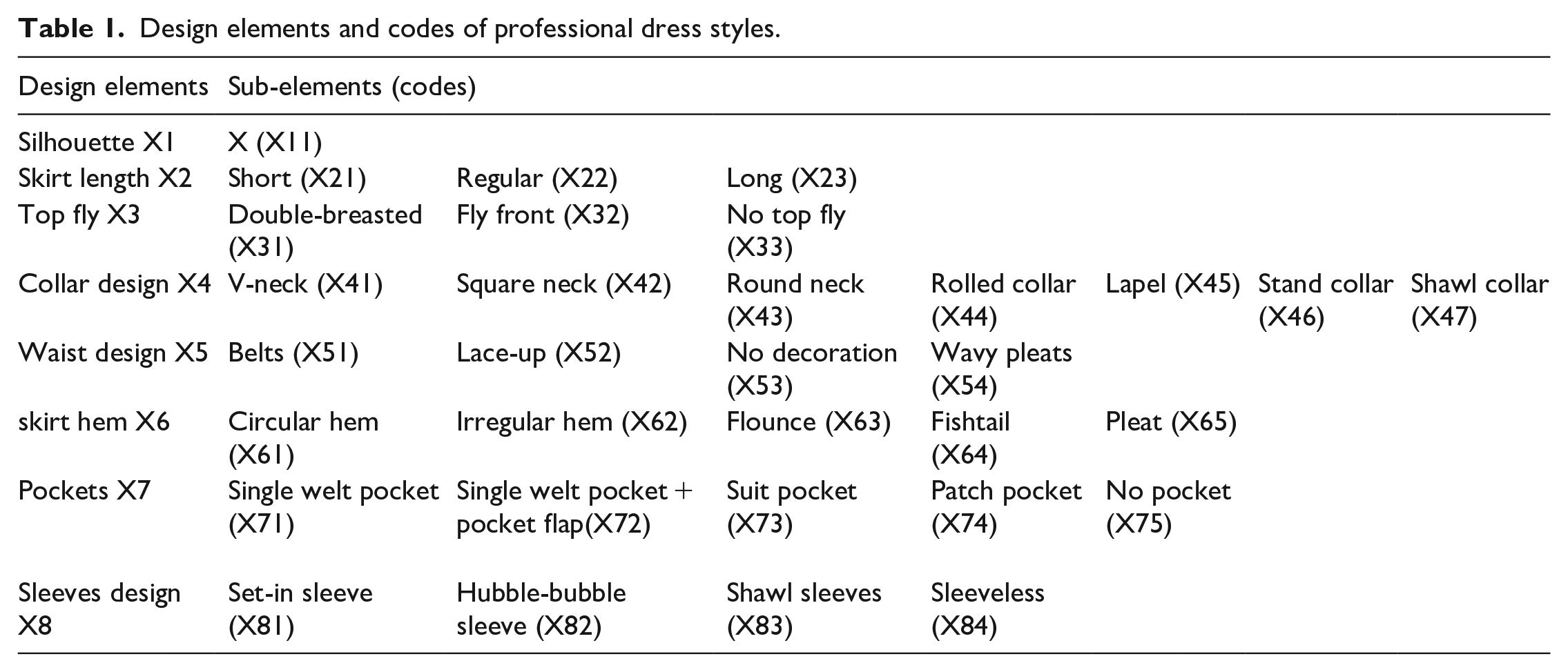
The modeling features of clothing styles are composed of the main modeling features and the secondary modeling features. The main modeling features have a greater impact on the modeling image, while the secondary modeling features have a weaker impact. Therefore, this paper researches the relevant literature on clothing style and discusses with professional clothing designers, and uses the analytic hierarchy process to screen the primary and secondary styling characteristics of dresses, remove the secondary features that have a weak influence on the modeling image and easily interfere with the judgment of target users, and determine the main features that can best reflect the characteristics of dress style, including eight design elements of silhouette, skirt length, collar, sleeves, waist design, top fly, skirt hem, and pockets. At the same time, according to the morphological disassembly method, each design element contains different sub-elements. Design elements and sub-elements are coded, as shown in Table 1. Because all of the samples have the same X silhouette, so it is used as a constant, the remaining seven design elements are researched.
Design elements and codes of professional dress styles.
Collection and screening of perceptual adjectives
Extensive collection of adjectives about clothing style evaluation in clothing related magazines, books, papers and other materials. Then, these adjectives are screened, and after removing those adjectives that are not commonly used, have obvious meanings of praise and criticism, and have unclear meanings, five fashion designers are invited to classify the perceptual adjectives with similar meanings, and then identify a representative perceptual adjective in each category of adjectives, finally, six pairs of adjectives were selected from the 50 pairs, as follows: professional - casual; modern - classic; steady - lively; unique - usual; feminine - tough; simple - complicated.
Questionnaire preparation and scoring method
Questionnaire design
Perceptual evaluation of professional dress styles using semantic difference method.
In this research, the tested objects are the style diagrams of 20 professional women’s dresses, and the evaluation scale is 6 sets of perceptual adjectives used to describe the styles of professional women’s dresses. Five sensory magnitudes are used to evaluate, take modern-classic as an example: 1 point = very modern; 2 points = modern; 3 points = neither modern nor classic; 4 points = classic; 5 points = very classic.
Respondent
Due to the influence of factors such as consumers’ understanding of fashion trends and differences in cultural level, they have different perceptual cognition of clothing. However, consumers with professional knowledge of clothing have objective cognition of clothing, from which more accurate analysis results can be obtained.
Investigation method
This paper mainly invites the respondents to subjectively evaluate and score the emotional image of each female dress tested through a combination of online and offline methods.
Data processing and analysis
First of all, the collected perceptual evaluation data was processed by means. Then, in order to eliminate the correlation between perceptual adjectives and reduce the complexity of model operation, the main perceptual factors were extracted by factor analysis method, and then representative adjectives were selected from each of the main perceptual factors for further analysis.
PSO-BP neural network algorithm
Particle Swarm Optimization (PSO) is a swarm intelligence algorithm, its basic idea is to simulate the migration and foraging behavior of birds, each random particle initialized by PSO is imagined as a bird, and each particle represents a potential optimal solution. Each particle has an initial speed and direction, and the particle continuously corrects the movement direction and speed by calculating the optimal value of the individual and the optimal value of the group in the iterative process, and finally finds the optimal solution. The position of the particle should be judged according to the fitness value calculated by the fitness function.
Suppose the group includes N particles, the search space is D-dimensional, d = 1, 2, . . ., D, and the velocity and position of the particles are updated according to equations (1) –(3):


In the formula:
BP neural network is an information processing method to simulate the structure of biological nervous system. It is a kind of back-propagation neural network, the basic learning rule is to interactively update the weights and thresholds of neurons in the negative gradient direction of the objective function. And its nonlinear mapping relationship can effectively reflect the relationship between the input vector and the target vector. In product design, it can be used to construct the mapping model between user perceptual cognition vector and modeling feature vector. Although the traditional BP neural network model has strong self-learning ability, and can consider multiple factors at the same time to calculate complex problems and inaccurate information, it still has many shortcomings in the practical application, such as overfitting, easy to fall into the local optimal, and low prediction accuracy.
Therefore, this paper introduces PSO algorithm into BP neural network, which can avoid BP neural network falling into local minimum in training, improve the training speed of neural network, and make it have higher accuracy by using the advantages of better global search performance and fast convergence speed of PSO algorithm. The process of constructing perceptual image model of professional dresses based on PSO-BP, as shown in Figure 2. The specific steps of optimizing BP neural network by PSO algorithm are as follows:

The steps of constructing perceptual image model of professional dresses style based on PSO-BP.
(1) Determine the structure of BP neural network. According to the sample data to determine the network input layer and output layer node number; according to the number of hidden layer nodes, BP neural network training results are compared to determine the number of hidden layer nodes; set activation function and training function.
(2) Set PSO algorithm parameters. According to the structure of the BP neural network, set the basic parameters of the PSO algorithm, such as particle dimension d, population size N, learning factors c1 and c2, maximum particle velocity Vmax and termination conditions, and establish the PSO-BP model. The particle dimension d of the PSO algorithm is determined by formula (4).

In the formula: n is the number of neurons in the hidden layer of the BP neural network; m is the number of neurons in the input layer;
(3) Initialize the particle’s position and velocity.
(4) Set the fitness function. In this paper, the root mean square error is used as the fitness function of the particle, and the fitness value of the particle is calculated by formula (5).

In the formula: M is the total number of input learning samples; L is the number of output network neurons;
(5) Update the individual extreme value of the particle and the global extreme value of the particle swarm according to the fitness value. The individual extreme value of the particle is Gbest, the group extreme value is Zbest, and the fitness value of the particle is compared with the individual extreme value. If the fitness value is better than the current Gbest value of the particle, the fitness value becomes the new Gbest value of the particle. If the Gbest value of all particles is better than the current Zbest value, the Gbest value becomes the new Zbest value.
(6) According to equations (1) and (2), in each iteration, the velocity and position information of the particles are continuously updated through the individual optimal position and the global optimal position.
(7) Determine if termination requirements are met. If it is satisfied, terminate the iteration and use the result as the initial weight and threshold of the BP neural network, otherwise return to the third step.
(8) Train the BP neural network. When the network training error meets the set allowable error or the maximum number of iterations, the training is stopped and the model is built.
Construction of perceptual image prediction model of professional dress style
Analysis of perceptual evaluation data of professional dress style
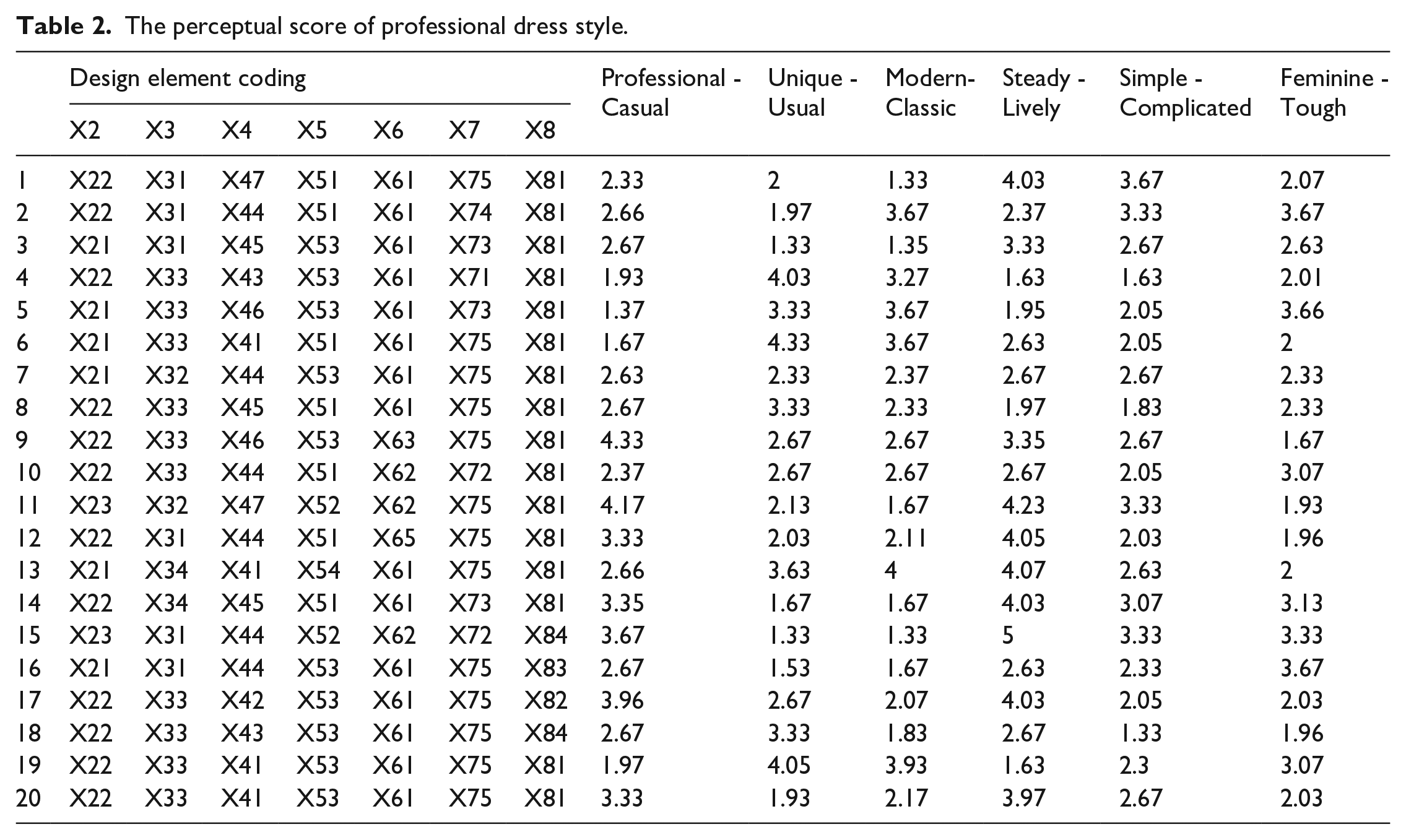
In this survey, a total of 80 questionnaires were distributed and 65 valid questionnaires were collected. Firstly, the mean value of the questionnaire data is processed, and finally the perceptual scores of professional dress style are shown in Table 2.
The perceptual score of professional dress style.
In order to reduce the cognitive dimension of users’ style features and obtain more accurate evaluation results of users’ perceptual images, factor analysis was carried out on the above data. First, the validity of the data is analyzed by using the Bartlett sphericity test, in which the test statistic (KMO) value is 0.753 > 0.50, indicating that the variables are highly correlated. The approximate chi-square value of Bartlett’s sphericity test was 180.231 (with 93 degrees of freedom), and its significance was 0.002 less than 0.01. The analysis of the output results showed that there was a strong correlation between the variables, which was suitable for factor analysis.
Then, rotating principal component analysis was performed on the above data using Caesar’s normalized maximum variance method, and two principal components were selected according to the principle that the eigenvalue was greater than or equal to 1 and the accumulative variance contribution rate was greater than or equal to 80%, as shown in Table 3. Considering that the principal component analysis after rotation can reduce or eliminate the interference caused by random factors in the original data on the correlation between indicators and principal components, this research the component matrix of principal component analysis after rotation is described, and the rotation converges after seven iterations. The results are shown in Table 4.
The total variance of interpretation.

Component matrix of perceptual adjective.

It can be seen from Tables 3 and 4 that, (1) the initial eigenvalue of principal component 1 is the highest (4.066), which is highly correlated with the adjectives Professional - Casual, Modern - Classic, and Steady - Lively; (2) The initial eigenvalue of the second principal component is (1.693), which is highly correlated with the adjectives Unique - Usual, Simple - Complicated, and Feminine - Tough. And finally, this research selects an adjective with the largest absolute contribution degree from component 1 and component 2 as the representative vocabulary of this component for further analysis. The final perceptual adjectives were selected as Modern - Classic and Unique - Usual.
Parameter setting of PSO-BP model
BP neural network structure
A single hidden layer BP neural network is used, the number of neurons in the input layer is 7, and the number of neurons in the output layer is 2. At present, because there is no reasonable analytical formula to determine the number of neurons in the hidden layer, therefore, the empirical formula (6) is used in this paper to obtain the number of neurons in the hidden layer, n is within the range of [4, 13]. By analyzing the training results of the BP neural network under different n values in the interval, it is determined that the number of neurons in the hidden layer is 6. Therefore, the topology of the BP neural network in this research is 7-6-2.

In the formula: α is a constant in the interval [1, 10].
The activation function in BP neural network usually adopts nonlinear sigmoid type function and linear purelin type function. Among them, the sigmoid function can control the output value within a small interval, including the logarithmic sigmoid function (logsig) and the tangent sigmoid function (tansig). The input and output values of the purelin function can take any function. In this research, the transfer functions of the neurons in the middle layer and the neurons in the last layer are the logsig type function and the purelin type function respectively. The number of learning times of the network is set to 10,000, and the error target value is 0.001, using the traignd method for training.
PSO algorithm parameters
Calculated according to formula (4), the particle dimension d is 62, the population size N is 30, the maximum number of iterations kmax is 60, the learning factor c1 = c2 = 2, the value interval of particle velocity is [−1, 1], and the inertia weight of linear decreasing is selected and calculated according to formula (3).
Data normalization processing
The design elements of professional dress styles obtained from the questionnaire and the corresponding mean value of perceptual image evaluation were used as input, using MATLAB software programing, through the PSO-BP network to train the mapping model between the perceptual evaluation value and the professional dress modeling design element variables, in order to ensure the uniformity and accuracy of the training data, the mapminmax function is used in the MATLAB software to normalize the mean value of the perceptual image evaluation of the sample.
Simulation calculation and result analysis
Use the first 15 data in Table 2 as the training set to train the PSO-BP neural network, assign the weights and thresholds optimized by the PSO algorithm to the BP neural network, and perform multiple training on the BP neural network to obtain network training results with higher accuracy. At the 18th generation, the fitness value has reached the lowest, that is, when the PSO algorithm is trained to the 18th generation, it has converged to the optimal weight threshold, and the MSE reaches the training target accuracy of 0.0022, indicating that the training accuracy of this network is high and meets the training target requirements.
In order to verify the effectiveness of the model, the remaining five groups of data were input into the trained model for verification, the results are shown in Figure 3. It can be seen that the predicted value curve is basically consistent with the measured value curve, and the fitting degree of the trained data and the trained data in the network is R = 0.9323, indicating that the network has a good fitting degree and can accurately predict the style perceptual image of professional dress.

Comparison between the real value and the predicted value of the perceptual image of representative adjective.
In order to further verify the application effect of the model in this paper, the BP model and the GA-BP model were used for comparative analysis. The comparison of the relative errors of the three models is shown in Table 5.
Comparison of the relative errors of the three models.

As can be seen from Table 5, the average relative error and average absolute error of BP neural network model prediction results are 14.6, 19.7, 37.6, 40.8, respectively, which are far larger than other models. Although the two groups of error values of GA-BP neural network model prediction results are smaller than those of BP neural network, compared with the PSO-BP model constructed in this paper, the errors are also larger. For the PSO-BP model, the minimum average relative error is 1.92, and the minimum average absolute error is 4.6. This shows that the BP neural network optimized by PSO algorithm can effectively avoid the shortcomings of traditional BP neural network which is easy to fall into local optimum, and can converge to the target error faster. At the same time, it can significantly improve the prediction accuracy of the professional dress style image.
Conclusion
Taking professional dresses as an example, this research use the theory and method of Kansei engineering and the constructed PSO-BP model, the logical relationship between the style design elements of professional dress and the user’s perceptual image is quantitatively analyzed, transform users’ ambiguous emotions into quantitative data, making users’ emotional needs more controllable in the design process. Designers can use the predictive function of the model to realize the style design of professional dresses quickly and accurately according to the emotional needs of users, and provide users with targeted design schemes, which makes up for the shortcomings of comparing and evaluating design schemes solely based on the subjective experience of designers in the traditional design process, and improves the efficiency of personalized customization of clothing. The overall model design of clothing involves many complicated factors. In the future, try to research the combination of dress style, color, pattern, and fabric style, so as to form a systematic and universal decision-making method for dress overall shape design to guide design practice.
Footnotes
Declaration of conflicting interests
The author(s) declared no potential conflicts of interest with respect to the research, authorship, and/or publication of this article.
Funding
The author(s) disclosed receipt of the following financial support for the research, authorship, and/or publication of this article: This paper was supported by 2022 Fujian Province Education Science “Fourteen Fifth Plan” Project (No. FJJKBK22-011) and 2023 Minjiang University Faishu Charity Foundation Donated Funds Research Project (No. MFS23010).
