




Abstract
Nanotechnology has made biocompatible nanofibers grow in the healthcare industry. Herein, a cellulose acetate (CA) electrospun membrane was characterized by nanofibers of 438 (nm) in diameter between virus and bacteria, pore areas of 36.3%, and a pore size of 395 ± 263 (nm). This structure led to excellent air-water transfer through pore connectivity, contributing to sufficient wettability, air permeability, and water vapor transmission rate (WVTR). The air permeability of pristine CA membranes became predictable through multiple linear regression, based on the correlation to thickness, bulk density (Pearson’s coefficients: 0.754, −0.538). Nonetheless, the tensile strength of the pristine CA needed to be reinforced by spray coating with waterborne polyurethane (WPU) and graphene oxide (GO). The WPU/GO 6:1 (v/v) ratio was optimal due to the increase in ultimate tensile stress to 132.96% due to a synergy of GO’s covalent bonds with WPU’s hard segments and elongation at break to 113.40% from WPU polyols. The WPU/GO 6:1 coated CA membrane possessed still comparable air permeability (36.53 l/m2/s), and WVTR (5736 g/m2/day). Its rapid wetting transition from the Cassie-Baxter’s to Wenzel’s state was attributed to GO’s hydrophilic functional groups. These achievements in reinforcement of tensile strength and wettability would pave the way for filtration, and wound dressing.

Introduction
The increasing growth of healthcare sector and dangers of harmful emissions and microorganisms, particularly viruses, have been the driving forces behind the development of nanofiber markets. These nanofibers can be widely used for biomedical applications from wound dressing to air filtration. These applications require moderate breathability and excellent wettability to protect the skin.1,2 For skin cell regeneration, a burn wound dressing requires high-water retention to cool a burn injury and prevent trans-epidermal water loss, along with the prevention of bacterial infections. 3
With the potential for the aforementioned biomedical applications, cellulose acetate (CA) from biomass resources is biocompatible, biodegradable, non-toxic, and feasible to fabricate and control its processing parameters via electrospinning.4 –6 Electrospinning is a promising way to manipulate the diameter of fibers and porosity of membranes in combination with a functional coating.7,8 The pore size is one of the filtration attributes of nanofibrous membranes because it allows the passage or blocks the movement of microorganism. 9 The electrospun membranes should filter out coronavirus particles between 65 and 125 nm when used in face masks and above 300 nm particles in surgical masks. 10 Electrospinning provides nanofibrous membranes with excellent air permeability and large surface-area-to-volume ratio.1,11 –14 Esmaeili et al. 15 and Anjum et al. 16 studied that the porosity, specific surface area, and size of the vapor or water molecules contribute to water permeation and antimicrobial activity. These characteristics enable electrospun CA nanofibrous membranes to be used for wound dressing, drug release, air filtration, and tissue scaffolds. However, the mechanical properties of the CA nanofibers might have to be reinforced for end-uses.7,17,18
The tensile strength of CA nanomembrane can be reinforced by covering surfaces with carbon-based materials, carborundum, or just carbon itself such as graphene or graphite. Aboamera et al.11 found that the reinforcement of tensile strength is attributed to intrinsic covalent bonds between the carbon atoms of graphene oxide (GO). By adding GO, not just can tensile strength be improved, but also antibacterial activity can be expected as a secondary effect.19 –23 This effect is ascribed to the GO oxygen functional groups, such as hydroxyl, epoxy, carboxyl, and carbonyl groups, which generate reactive oxygen species.19,20,24,25 Wan and Chen 26 fabricated waterborne polyurethane (WPU)-GO composite dispersions that enhanced the tensile strength and elongation at break of the composite.
In addition to the tensile strength, wettability can also benefit from GO coating, because GO hydroxyl groups allow water vapor to transport easily across the membrane. Besides this surface chemistry of functional groups, wetting behavior is influenced by a variety of parameters, including interfacial energy, surface roughness, and the size of pores where the air is trapped. 27 The wetting properties of a solid surface can be evaluated by measuring water contact angle (WCA), and Figure 1 illustrates several WCA models to match each optimal state.28 –32 For flat surfaces of zero curvature, Young’s theory in Figure 1(a) explains the theoretical state of WCA on a smooth and homogeneous surface. The Young’s WCA was modified for rough and homogenous surfaces by the Wenzel equation in Figure 1(b), the contact angle of which was expanded for porous surfaces with air-filled pockets by the Cassie-Baxter equation in Figure 1(c). In this study, the Wenzel and Cassie-Baxter models were appropriate for the WPU/GO coated CA membranes. As Figure 1(d) shows, Cassie’s equation is suitable when smooth and rough surfaces co-exist heterogeneously, yet it is very difficult to measure the ratio of each fractional area exactly in practice.

In contrast to the early models and equations above, several geometric approaches have been broadened to conceptualize interfacial energy from 2D planes to three-phase boundaries. Gibbs and Pethica introduced the concept of line tension in Figure 1(e) to explain extraneous free energy on the air-liquid interfaces, the curvature of which determines intrinsic contact angles (
While GO improves the wettability of coated CA membranes, polyurethane (PU) serves as a protective layer that enhances flexibility and water resistance. Zhou et al. 33 reported that WPU is more breathable than conventional PU because of its more hydrophilic moieties dispersed in water, with an assistance of ionomer such as 2,2-dimethylol propionic acid (DMPA). However, WPU dispersions can reduce the use of volatile organic solvents and compounds, thereby making them less toxic and more environmentally friendly.33 –35 Since WPU comprises hard segments of isocyanates and soft segments of polyols, its two-phase structure imparts versatile properties, such as self-healing, due to its reversible covalent bonds and crosslinkages.21,36,37 Zhou et al. 38 developed breathable, water repellent, and stretchable membranes with porous structures by doping alkyl and polycarbodiimide through one-step waterborne electrospinning. Esmaeili et al. 15 improved the waterproofness, breathability, and antibacterial properties of nanofibrous CA/PU mats for wound dressings by hydrothermal reduction of GO/silver and curcumin.
To enhance the potential for biomedical applications, this study aimed to fabricate a biocompatible CA electrospun nanofibrous membrane and increase its tensile strength through coating with GO, WPU, and WPU/GO mixed dispersions. To improve the performance of the coated CA nanofibers, this study evaluated the effects of WPU/GO coating on the following four aspects: morphological properties, mechanical properties in tensile strength, air-water vapor permeability, and wettability. Finally, this research sheds light on the relations between structural characteristics and breathability statistically to suggest the optimal coating conditions for durable, breathable, and wettable CA nanofibrous membranes. These findings would be anticipated to be fundamental data in a variety of relevant industries.
Materials and methods
Materials
Cellulose acetate (CA, 55%) was purchased from Kanto (Japan) through Daejeung chemicals (South Korea), where acetone (99.5%), and dimethylformamide (DMF) solvents were obtained. Graphene oxide (GO, UHC-GO) of a concentration of 6.2 g/l (8 wt%) was obtained from UniNanoTech (South Korea), and its graphene oxide platelets were 0.5–5.0 μm in size. Semitransparent waterborne polyurethane (WPU, AU-309) dispersed in water without emulsifiers, which was supplied by Chemical Hub (South Korea). This WPU possesses both hydrophilic ionomer (DMPA) as hard segments and hydrophobic polyols as soft segments. The anionic WPU was characterized by its solid content of 39 wt% to 41 wt%, and the viscosity of lower than 1000 cps.
Fabricating Methods
Electrospinning
To fabricate electrospun membranes consisting of nano-scaled fibers, the solutions of cellulose acetate (CA) and binary solvents were prepared, as follows. In the solvents with 15 mL DMF and 15 mL acetone of ratio 1/1 (v/v), the CA of 22.5 wt% was mixed in an Erlenmeyer flask at 60 °C with a magnetic stirrer rotated at 600 rpm for 4 h. The CA solution was electrospun by means of the ES-robot electrospinning machine (NanoNC, South Korea) with a metal needle of 0.819 mm in outer diameter (equivalent to 21 gauge), and a drum collector. The distance was 12.5 cm from the tip of the needle nozzle to the collector rotating at 250 rpm with aluminum foils wrapped above, as shown in Figure 2(a). The CA electrospinning solution was fed at the flow rate of 1 mL/h per needle, under the applied voltage of 17.5 kV, for 11 h at 19 °C ± 4 °C and 32% ± 10% RH.
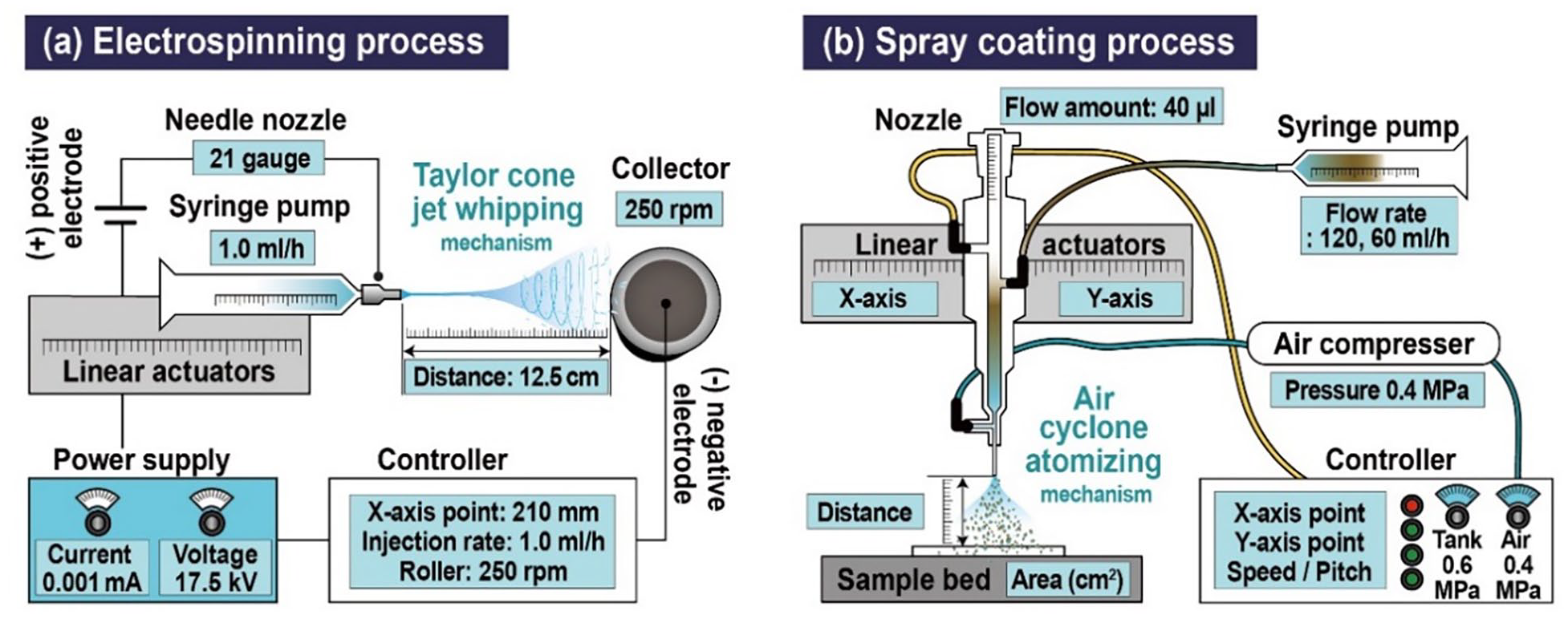
Mechanism and processing parameters in (a) electrospinning, and (b) spray coating.
Spray coating
In this study, the spray coater (SRC-100, E-flex, South Korea) was used to preserve pores of the CA nanomembranes for air and water permeability. The mechanism of this spray coater is a simple method to shatter coating solution into very fine particles by air. A metal nozzle is atomized by air cyclone, and it can be moved to fill coating areas by controlling the distance points of linear actuators. As shown in Figure 2(b), two crucial parameters are the flow rate and air pressure that are involved in the amount and quality of coating. In this study, each parameter was set at the flow rate of 120 mL/h mostly and 60 mL/h occasionally, then shattered by the air pressure of 0.4 MPa.
Table 1 presents five types of coating solutions varied in the concentration of WPU, each component’s content, and the mixture ratio of WPU/GO (sample-B to F). The composition of pristine WPU resin was 40 wt% with water of 55 wt% and N-ethyl-2-pyrrolidone of 5 wt%. For sample-D, 10 mL distilled water was added to an equivalent volume of WPU to halve the WPU concentration to 20 wt%. To make sample-E, the pristine GO of 5 mL was mixed into the pristine WPU resin of 30 mL in an Erlenmeyer flask at 30 ℃ with a magnetic stirrer rotated at 1200 rpm for 1 h. Sample-F was also made in the same way. To compare with those of the pristine CA nanofibers (sample-A), five coated nanofibers were evaluated in morphological, mechanical, functional, and physical properties in the next steps.
Specification of coating solutions.

Morphological characterization
The morphology of CA nanofibrous membranes was characterized through a scanning electron microscope (SEM) (EmCrafts, South Korea) at the applied voltage of 15.0 kV in the magnifications of 3000, 5000, and 10,000. The CA nanomembranes were coated with gold via the G20 ion sputter coater for 120 s. After the diameters of CA fibers and coating particles were measured through the Virtuoso v.1.21 software program, the average of the CA fibers in 148 cases and WPU particles in 74 cases were obtained.
The key to the CA membrane’s morphology is a porous structure, specified by the fraction of porosity, pore size, surface roughness, and bulk density. First, the porosity, which is the ratio of pore areas in the nanomembranes, was analyzed in inverse proportion to that of coating particles and nanofiber areas by using ImageJ. The SEM images were converted to binary areas of pores and fibrous moieties in black and white by adjusting threshold grayscales. Second, the pore sizes were measured by using Avizo 3D Pro (Thermo Fisher Scientific), and the range of effective pores was limited from 100 to 1000 nm. Third, the ImageJ plugin, “SurfCharJ” were used to measure the roughness profiles of root-mean-square roughness (Rq). Each measurement was repeated five times per coating condition. Last, the bulk density of the pristine CA-membranes was also measured as introduced in the literature. 39 All CA pristine samples were cut into squares of 3 cm × 3 cm, and the air in the samples was removed by means of a vacuum pump. Next, the samples were weighed in a dry state (Md) before being immersed in 20 mL cold water (4 °C). After 90 s, the weight in a buoyant state (Mb) was measured in water to obtain the values of bulk density. Then, the samples were wiped with a wet cloth to prevent water on the surface from being removed, and the weight in the wet state (Mw) was obtained. The porosity and bulk density were obtained from equations (4) and (5)


where
Mechanical properties of tensile strength and elastic modulus
Tensile stress, extension, and elastic modulus of the CA nanofibers were measured with the AG-500NX universal testing machine (Shimadzu, Japan), according to the ISO 13935-2: 2014, with modified in this study. 40 The specimens were prepared in size of 25 mm × 150 mm (gauge length 100 mm), then fastened by a screw-type of flat grip. Next, a preload of each intrinsic mass per sample was applied after zero calibration to prevent pretension. The strain-stress curves were plotted at the speed rate of 10 mm/min, with five measurements per coating condition. The initial force 2 N was applied to obtain initial modulus.
Moisture transmission and air permeability
Functional properties of the CA nanomembranes were evaluated in two aspects: water vapor transmission, and air permeation. The water vapor transmission rate (WVTR) of the CA specimens with each coating condition was measured five times by following the KS K 0594: 2021 standard. 41 According to these standards, calcium chloride of 33 g was contained upright in aluminum cups with a 60 mm-opening in diameter. The cup was covered by a piece of the CA specimens with conditioned in advance in a thermo-hygrostat (TPAV-48-20, Isuzu, Japan) at 20 °C and RH 65% overnight. Then, the cup was sealed with butterfly nuts and paraffin tapes, then it was placed at 40 °C and RH 90% for 1 h. Next, the cup was weighed and returned to the thermo-hygrostat in the same condition. After another hour, the cup was weighed. This test was repeated five times per coating condition. Then each mean WVTR of each coating condition was calculated, as followed by equation (3):

where
Air permeability of the CA nanomembranes was tested by using the Frazier method with the FX3300 tester (Textest, Switzerland), following ISO 9073-15:2007 standard. 42 The air permeability is a metrics of the air flow rate passing a unit area or unit volume of a specimen under different pressures from one side of the specimen to the other. 43 The CA specimens covered the clamping area of 38.3 cm2 under the constant pressure of 125 Pa. The airflow was measured five times per coating condition of the CA membranes.
Wetting properties
Water contact angles (WCA) of CA nanomembranes were measured six times per sample by using the Theta Lite optical tensiometer (Bolin Scientific, Sweden) at room temperature. The camera recorded scenes where the water droplet of 4.5 μL was fallen and absorbed on the CA nanofibers for 10 s. The distance between the tip of a water droplet and the nanofibers was 2 cm. By using the OneAttension software, the WCA was formulated by Young-Laplace equations in equation (4):

where
Results and discussion
Structural formation of pristine CA nanomembranes
To identify the cause and effects of porous-fibril structures before coating, this study examined the relation between one electrospinning parameter “injection rate” and the structural characteristics of CA nanomembranes. For electrospinning the CA fibers, one needle nozzle was used in most cases, furthermore, multiplied by five ones. The injection rate of electrospinning was equally 1 mL/h per needle nozzle under the control of the other factors identically. The purpose of using a multi nozzle with five needles was to save processing time from 11 to 2.2 h theoretically in Figure 3(a).

Diagrams of (a) effects of injection rate on porous structures, (b) air-impermeable structures, and (c) excellent permeable structures with Venturi effects.
The number of needle nozzles did not make substantial differences except thickness and density. The electrospun CA membranes with a multi-nozzle was normally thicker than the ones with a single nozzle. This tendency was attributed to split of the applied voltage into five electric fields. The other reason is the interference of jet whipping due to the overlaps of charged particles from five Taylor cones. Resultantly, a vast stack of the electrospun fibers via the multi-nozzle was accumulated five times, increasing density, and reducing porosity.
This structural changes in thickness, density, and porosity could affect the air permeability and water-vapor transmission and wettability of the pristine CA. The mechanism how thin membranes sucked air can be explained by “Venturi Effect,” theorized by Giovanni Venturi. When the air passes through narrow tubular pores, the air pressure become lower and the air velocity quicker, 45 as illustrated in Figure 3. In general, non-porous materials have a proportional relation of thickness to volume or mass, whereas the relation cannot be applied to porous materials. The thickness of membrane should be considered in aspects of the volume of pores or porosity. The bulk density, associated with thickness, results from the number and diameter of electrospun fibers, as shown in Figure 3(b) and (c). These porous morphologies and structural properties were compared before and after coating with WPU/GO dispersion in next section.
Surface morphology of CA nanomembranes coated with WPU/GO
To compare the surfaces of pristine CA nanofibrous membranes and those of various coated samples, uniformity of electrospun fibers, morphology of coating particles, and pore openness were examined. Figures 4(a) and 5(a) demonstrates that the pristine CA nanomembranes possessed uniform and smooth fibers. The fiber diameter on average was 438 nm ± 192 nm, which is within the range of virus and bacteria in size, as seen in Figure 5(c). Figure 4(b) illustrates the translucent GO sheets like torn sails hung onto the CA fibers. These GO coating sheets of oxygen-functional groups made numerous spaces to transfer water molecules, resulting from excessive -OH groups.25,46 In contrast to GO shapes, Sample-C and D commonly had globular shapes of PU particles in Figure 4(c and d), which an average diameter was 4.5 μm, ranged from 1 to 12 μm, close to that of the red blood cell (8 μm) in Figure 5(d) and (e). 47 The particle size and amount of sample-C (PU 40 wt%) and sample-D (PU 20 wt%) resulted from PU content. These particle morphologies were also consistent with WPU/GO coating in the 6:1 or 9:1 ratio. In Figure 4(e) and (f), the WPU/GO coated nanomembranes were characterized by spherical PU particles as well as thin GO sheets with rising their thickness by 14.40%‒33.05% compared to that of pristine sample-A.
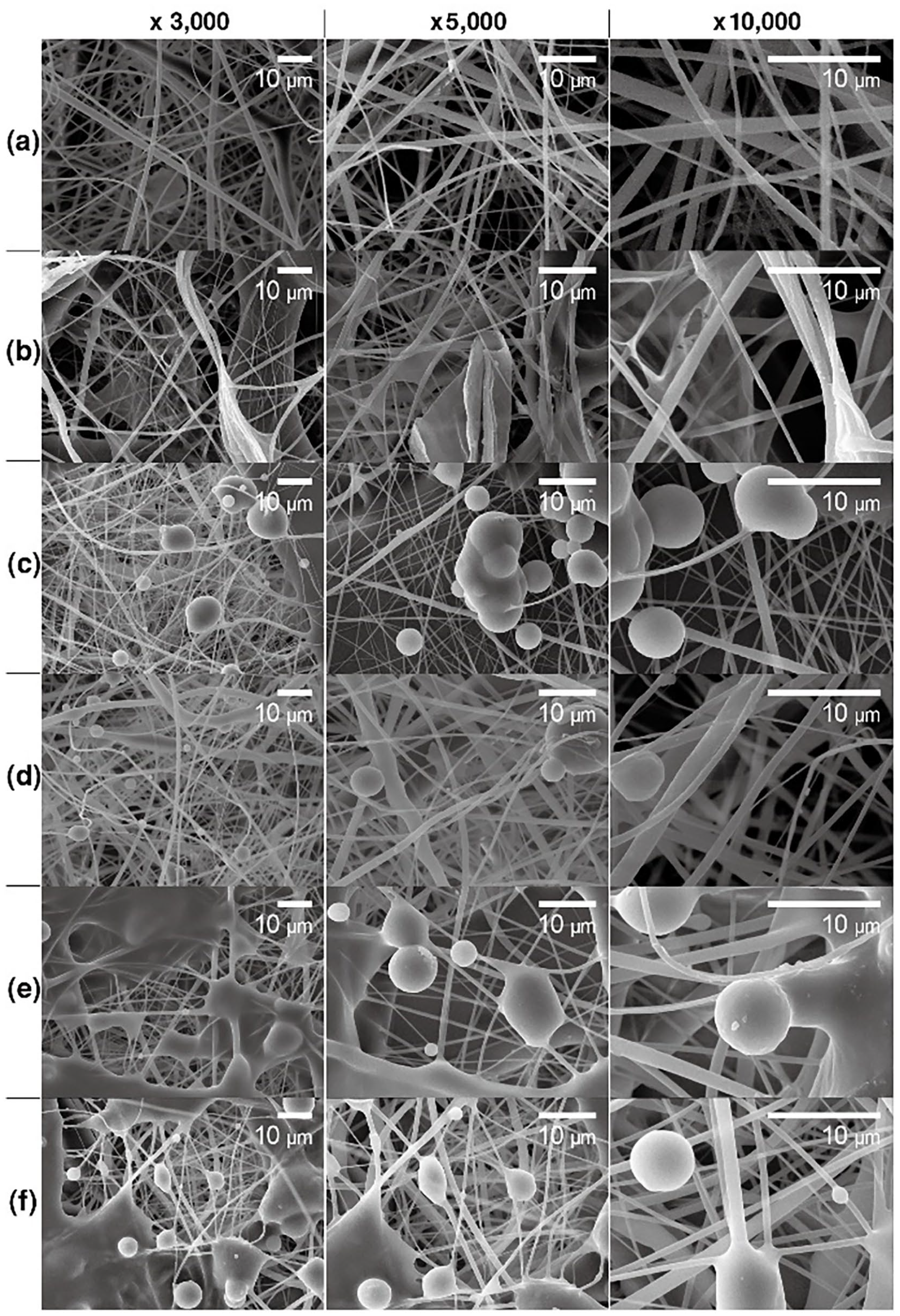
Structural morphologies of CA nanomembranes in (a) the pristine state, (b) coated with GO 8 wt%, (c) coated with WPU 40 wt%, (d) coated with WPU 20 wt%, (e) coated with WPU/GO 6:1 (v/v), and (f) coated with WPU/GO 9:1 (v/v).

(a) Measurements of CA fiber diameters, (b) enlargement of WPU/GO coating particles, histograms of size distribution in (c) CA nanofibers, (d) PU coating particles, and (e) size diagrams for comparison. 47
Another characteristic of WPU/GO coating was the interconnectivity between the CA fibers and the particles, of which formation was amorphous and cohesive. When the WPU/GO dispersion was hydrogen bonded, WPU urethane groups and carboxyl groups formed a strong and dense cross-linkage because of GO carboxyl and hydroxyl groups.25,38 In this case, the WPU/GO coating particles could be agglomerated, thereby decreasing the pore areas between WPU/GO and the nanofibers, as indicated in Table 2. The porosity of CA nanomembranes was reduced because of the WPU/GO coating conditions; the pore areas of sample-E and F were half that of sample A (36.3%), and the surface roughness (Rq) of those was increased by 21.9% and 28.8%. These morphological change in porosity and roughness affected the mechanical strength of CA coated nanomembranes.
Morphological characteristics of each coating sample.

The pore area (%) denotes the residue of surface areas (%), which is (100-pore area) (%).
Enhancement of tensile properties
To study the coating effects on robustness and find the optimal condition of coating, tensile strength, and elasticity of the coated CA nanomembranes were examined, as presented in Figure 6. This study found that the synergic effect of WPU/GO composite coating increased both tensile force and elongation at breaks when WPU and GO were coated jointly rather than separately. In terms of ultimate tensile strength, the sample-E coated with WPU/GO in a 6:1 ratio exhibited a maximum breaking force of 12.99 N, which was 32.96% higher than the pristine sample-A (9.77 N) in Figure 6(a). According to the GO content ratio from 0.8 wt% to 1.1 wt%, the tensile strength of sample-E was higher than that of sample F. This improvement was attributable to the GO and WPU cross-linking reaction that exhausted WPU carboxyl groups and made the residual groups of WPU hard segments diisocyanate reinforce the strength of WPU/GO coated CA membranes.10,38 On the other hand, Figure 6(b) explains the coating effects on elongation of the CA membranes. The elongation at break of sample-C increased greatest by 41.75% over that of sample-A, followed by that of sample-F by 31.96%, then that of sample-E by 13.40%. Therefore, it was extrapolated that the elongation at break increased with the PU content (40.0, 36.0, 34.4 wt%).

Comparisons of (a) ultimate force of tensile stress, (b) elongation at break, and (c) Young’s modulus among various samples.
In terms of elasticity, Figures 6(c) and 7 demonstrate Young’s moduli of CA membranes in two aspects by experimentally measuring the slopes of the tangent and statistically estimating coefficients from linear models at yield strength. The sample-C had the lowest Young’s moduli of 156.86 MPa, and the sample-D nearly the same that of 166.91 MPa, whereas the sample-B was most stiff, followed by sample-F. Except for sample-C, which was the most elastic in the tangent slope, the coefficients estimated in linear models generally match the results of tangent slopes. In general, the curve fit had enough high R squared value (R 2 : the coefficient of determination) to estimate the Young’s modulus at the initial strain in Figure 7. The curve for the Young’s modulus in the sample group A to F had a minimum sum of square (S.S) residual with a statistical significance at 0.001 level, as a result of one-way ANOVA indicated.

Estimated linear plots for initial modulus of CA nanomembranes with various coating conditions.
In sum, this study found that the sample-E was the toughest with the highest applied force (12.99 N) before fracture and moderate elasticity without lowering the pristine Young’s modulus (218.84 Pa) much. The tensile strength and elongation of the WPU/GO coated CA nanomembranes were reinforced by approximately 32.96% and 13.40% than the pristine one. This reinforcement of elasticity and stiffness was imparted by coating with WPU/GO in a 6:1 ratio, resulting from the GO/WPU cross-linkages and the PU hydrogen bonds between hard and soft segments. Moreover, the tensile strength of CA nanofibers could be boosted by dipping into Potassium chloride solution. 48 In this study, the tensile strength of CA nanomembranes is expected to increase as the membranes become thicker.
Correlation between breathability and structural characteristics
To confirm the effects of various coating solutions on breathability, water vapor transmission rate (WVTR) and air permeability of CA coated nanomembranes were assessed. Figure 8(a) demonstrates all the samples possessed moderate performance of WVTR, around 6000 g/m2/day. To compare and evaluate the breathability of commercial fabrics in this study, the WVTR of cotton woven fabrics (plain, 60 Ne, 104~105 × 91 ends × pick/inch) was measured three times in the same method to that of CA nanomembranes. As the result, the cotton fabric showed its WVTR of 6058 g/m2/day, which was almost close to those of CA nanomembranes coated with/without WPU/GO. The WVTR of sample-E was the lowest (5736 g/m2/day) reduced by 4.4% from that of pristine sample-A, followed by those of sample-C and sample-F. Nonetheless, this decrease was negligible because the movement of air or water vapor was not impeded by coating particle obstruction. The WVTR of sample-B narrowly outperformed that of sample-A due to a synergistic effect with increasing the adsorption of the GO hydrophilic functional groups during water vapor penetration. The irregular pore shapes from GO coating also presumably enabled water or vapor to be captured rather than spherical pores, as consistent with the literature. 49 Moreover, the water vapor transmission of WPU coated membranes such as sample-C and D could be enhanced by increasing the content of WPU hydrophilic components and by controlling pore size for permitting only vapor rather than water.8,15
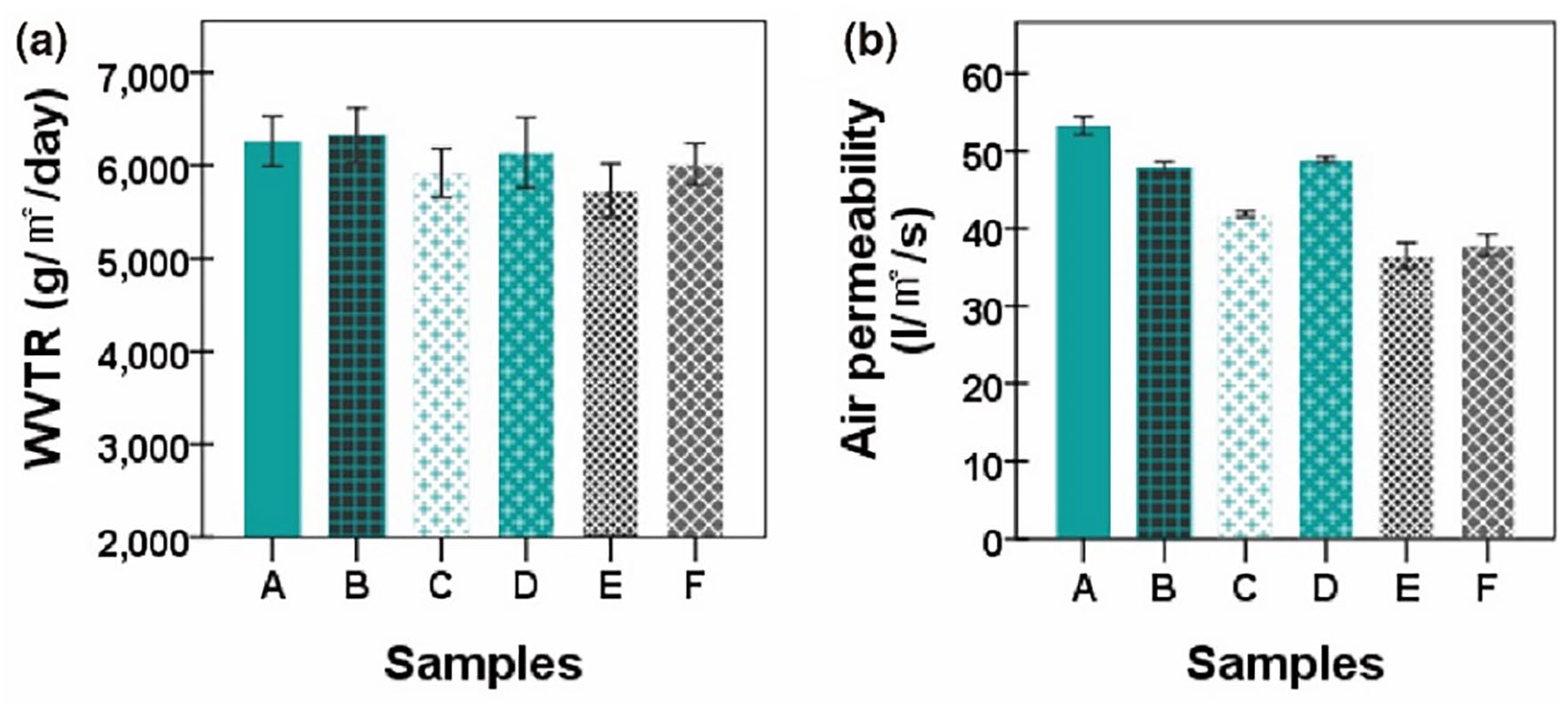
Comparisons of each mean (a) in water vapor transmission rate (WVTR), and (b) in air permeability.
On contrary to the WVTR, the air permeability of WPU/GO coating samples decreased by about one-third of the pristine CA nanomembranes as illustrated in Figure 8(b). The sample-E had the lowest airflow (36.53 l/m2/s), which was down 31.55% from the sample-A (53.37 l/m2/s). This downwardness resulted from its narrow pore areas (half that of sample-A). The WPU/GO coating with a large surface area to volume reduced pore openness and increased CA fibrous interconnectivity, as confirmed in Table 2 and Figure 4. The WPU/GO coating, however, did not significantly reduce the air permeability of sample-E, since its air permeability was still as great as that of conventional cotton gauze fabrics (25.53 l/m2/s). 50 These WVTR and air permeability of coated CA nanomembranes achieved enough great breathability for biomedical applications.
In this study, the impacts of WPU/GO coating on physical, functional characteristics were discussed under statistical analyses in three perspectives: Firstly, t-test were conducted to study whether the spray-coating parameter of coating speed has the effect on the WVTR of coated CA membranes. Table 3 indicates that two types of coating injection rate (60 ml/h, and 120 ml/h) brought about a significant difference in the average WVTR by 28.071 g/m2/h (equivalent to 673.704 g/m2/day), statistically significant (p < 0.05). This result indicates that a larger amount of water vapor permeated when the CA membranes were coated with a smaller amount of coating solution. This is obviously because coating particles covered the porous area between CA nanofibers, as confirmed in Figure 4. In sum, the coating injection rate differentiated the WVTR.
T-test results of WVTR in two groups of coating speed.

Secondly, bivariate correlation analyses were conducted to figure out the effects of spray-coating itself on thickness and porosity of all coated samples. Table 4 indicates that the types of coating solution and conditions were involved in thickness (Pearson (+)0.365) weakly, and the pore area (Pearson (−)0.622) strongly. Both correlations were statistically significant (p < 0.01). Namely, spray-coating relates to the thickness of the coated samples, a certain extent, but not strongly.
Correlations between coating conditions and variables of CA membrane morphological properties.

Correlation is significant at the 0.01 level (two-tailed).
Lastly, Tables 5 and 6 present correlations of air permeability in all sample groups totally, and in each group of the CA membrane individually. In all the samples (count: 43–47), the air permeability exhibited a moderate correlation with the thickness (Pearson coefficient: 0.428) and a weak correlation with WVTR (Pearson coefficient: 0.367), which were significant at the levels of 0.05 and 0.01, respectively. In individual sample groups, the air permeability of the pristine CA (sample-A) increased as the thickness increased and the density bulk decreased, with statistical significance (p < 0.01, p ⩽ 0.05). As the pristine CA had higher bulk density, more air permeated. This reciprocal relation between the air permeability and bulk density was consistent with the literature. 49
Correlations of air permeability in all groups and in each individual group.
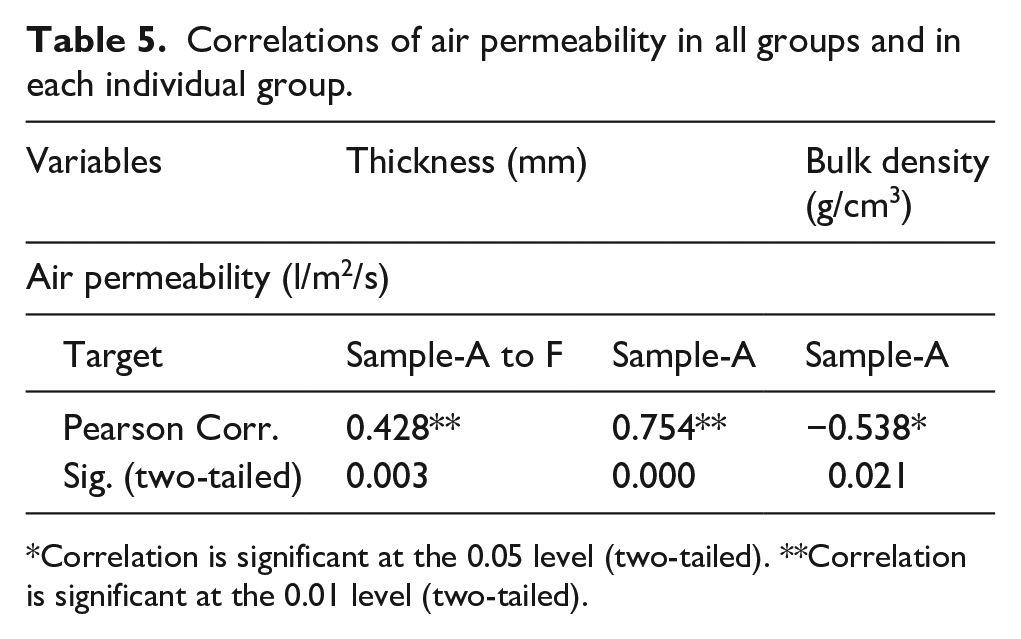
Correlation is significant at the 0.05 level (two-tailed). **Correlation is significant at the 0.01 level (two-tailed).
Correlations to water vapor transmission in all groups and in each group.

Correlation is significant at the 0.05 level (two-tailed). **Correlation is significant at the 0.01 level (two-tailed).
On the other hand, the air permeability revealed strong correlations with the WVTR of sample-B, D, E, and F, except sample-A, with Pearson coefficients ranging from 0.8 to 0.9. Exceptionally, the air permeability of sample-B decreased as its WVTR increased, with a negative Pearson coefficient of (−)0.957. This was attributed to the hydrophilic reaction of GO hydroxyl groups on surfaces with water vapor, thus penetrating moisture but blocking air, as mentioned. This relationship of the sample-B between air permeability and WVTR indicates the effects of coating on surface chemistry as well as the effects of coating particles on porous surfaces of the coated CA membranes.
Even though the WPU/GO coating particles partially covered the surfaces and pore areas, the pores of the CA nanomembranes remained considerable in Figure 4 and Table 2. Because of the remaining pores, it was proven that the coated CA membranes were breathable, as confirmed in Figure 8. To demonstrate the breathability, airflow was penetrated vertically through the membranes from bottom to top, and air bubbles in 200 mL water emerged on the upside of the membranes. When airflow in the low pressure of 0.5 bar passed, small bubbles in 200 mL water came up through the membranes in Figure 9(b) and (c). On the other hand, a large number of huge bubbles were foamed up under high air pressure of above 1.0 bar in Figure 9(d) and (e). As a result, the CA membranes were proven to be breathable.

Air bubbles penetration through CA membranes, (a) filtration equipment, (b and c) small air bubbles in water under low pressure, (d and e) large bubbles under high air pressure.
Wettability through nanofibrous pores
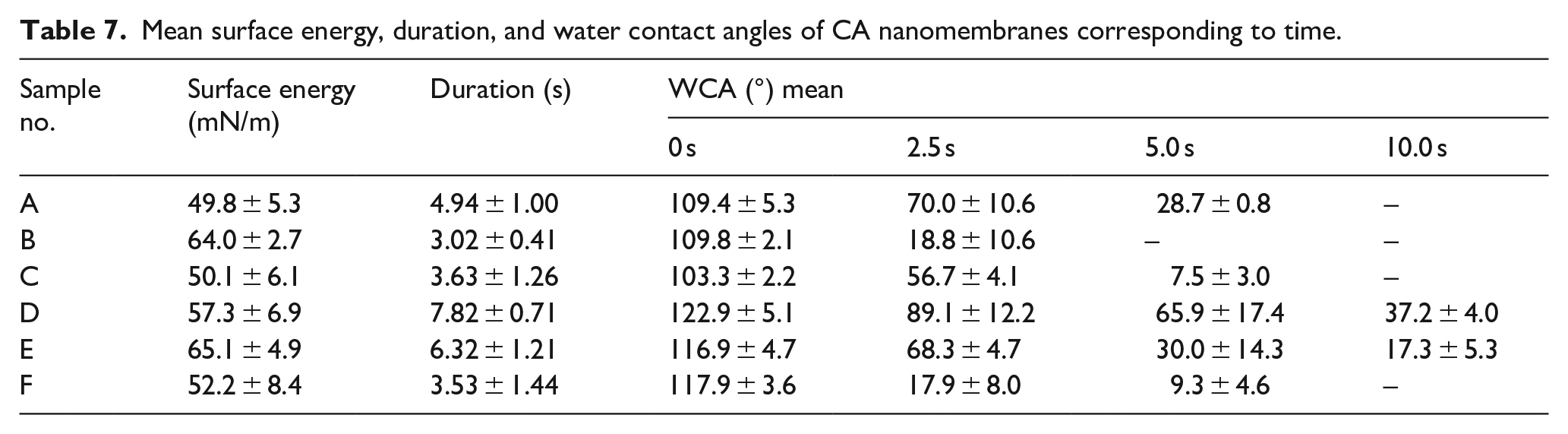
To investigate the wettability under various coating conditions, this study examined the water contact angle (WCA) and wetting duration of all sample groups. As a result, most samples presented excellent wettability, due to the pore connectivity. Well-connected pores of less than 0.99 mm facilitate water transport, as consistent with these results that the pristine CA had the pore diameter of 130–660 nm (Table 2). Figure 10(a) 51 indicates that the pristine sample-A was sufficiently wettable within 10 s, and its average WCA was 28.7° ± 0.8° 5 s after water dropped in Table 7. The wetting behavior of WPU/GO 6:1 was shown in Figure 10(b). The wetting behavior of sample-B was the fastest, because of its the surface chemistry of hydrophilic GO functional groups.
Mean surface energy, duration, and water contact angles of CA nanomembranes corresponding to time.

(a) Wetting behavior, (b) water contact angle of sample-E, and (c) wetting duration of all groups.
In comparison of wetting duration, the sample-D showed the longest time with a wetting delay at 1−5 s. This wetting duration resulted from the air trapped in pores where hairy CA nanofibers increased surface roughness. This phenomenon occurred during the transition from the Cassie-Baxter state to the Wenzel state after the air pocket was filled and wetted by the water droplet as discussed in Figure 1(b) and (c). On the other hand, the wetting duration of sample-B, C, and F was shorter than that of sample-A, as shown in Figure 10(c). This short duration might be attributed to smaller pore in diameter than those of sample-D and E (467 ± 268 nm, 438 ± 258 nm), as indicated in Table 2. This result was consistent with the literature.52,53 In sum, the overall wettability of the CA nanomembranes was excellent, because of the porous structures with pore connectivity, implying the possibility of biomedical applications for transporting nutrients, cells, and healing agents in liquid or gas states. 15
Cause and effects of porous structures on breathability and strength
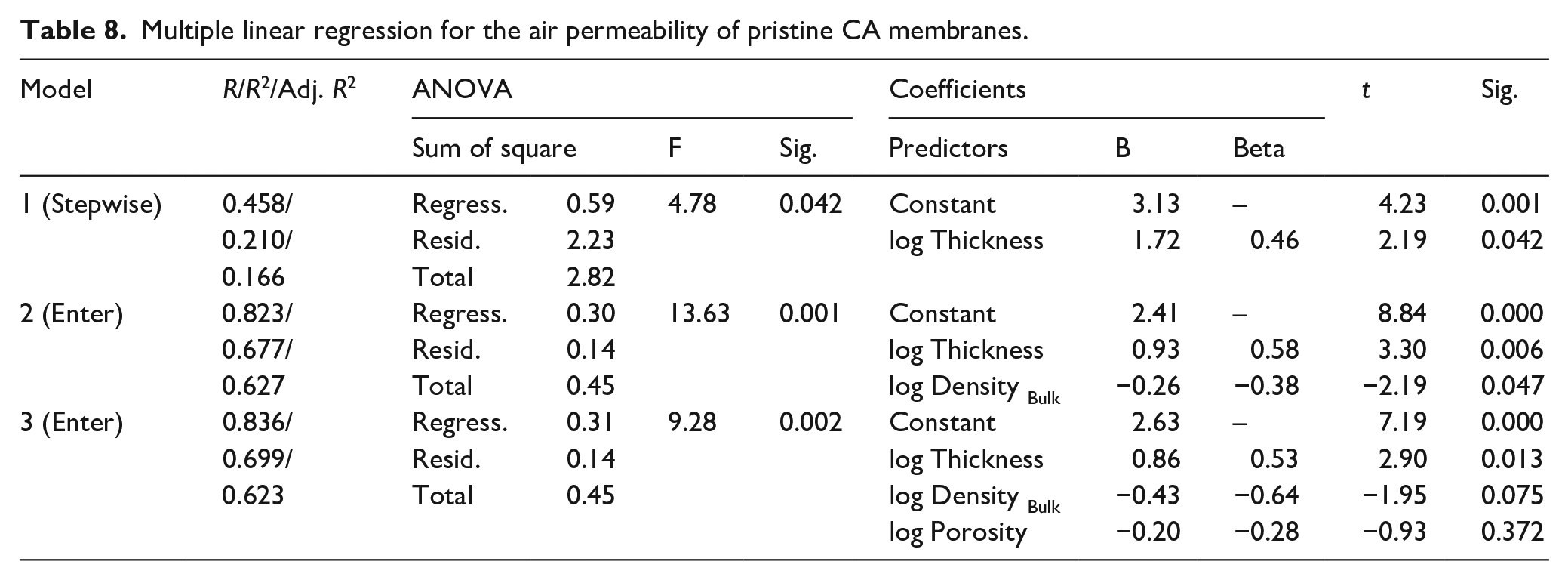
So far, the breathability of WPU/GO coated CA membranes was examined in air and water transports through the porous path between nano-scaled fibers and micro-scaled coating particles. These porous structures contributed to water-air pathway as proven in the results of air permeability and wettability. The structural characteristics of the pristine CA membranes were used for predicting air permeability through multiple linear regression analyses. First, independent variables of air permeability, “thickness,” “porosity,” and “density bulk” were selected as crucial predictors with high Pearson coefficients (Table 5). The values of the predictors were transformed into those of log base 10 to improve normality and accuracy. Second, three liner regression models were obtained through “step-wise” and “enter” selection for the fittest predictors and R-squared (R2) (p ⩽ 0.05) in Table 8. A high R2 implies a good explanation of the variable to fit a regression line. The model 3 had the greatest explanation power (R2: 0.699) yet a lower adjusted R2 (0.623) than that of model 2 (0.627). Besides, t-value of the “porosity” predictor in model 3 exceeded the significant level. Last, during residual dianostics, these models had good fits for homogeneity in residual plots, normality in P-P plots, and independence. The Durbin Watson values of each model were acceptable from autocorrelation. Variance Inflation Factor (VIF) of the former were fine, whereas the model 3 showed 1.340, 4.324, 3.697 of three coefficients, showing its multicollinearity. 54 For these reasons, this study selected the second regression model, in conclusion.
Multiple linear regression for the air permeability of pristine CA membranes.
The linear regression of equation (5) was established as follows:
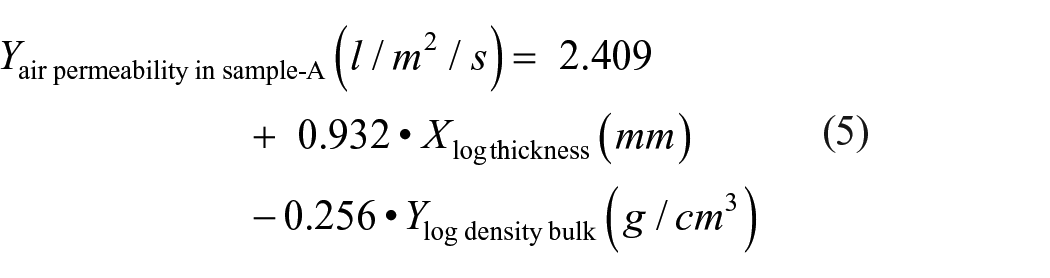
According to equation (5), the measured values of air permeability in four cases were compared to the calculated estimates. Resultantly, the four cases showed an accuracy of 92.63%, 96.36%, 99.35%, and 99.49%, half of which reflected highly exact within a 0.5% error rate. So far, this study has identified the impact of pore structures on the air permeability of the pristine CA membrane, predicted its regression model with thickness and bulk density, and verified the accuracy of the regression equation with real cases from experiments.
To apply the effects of porous structures on air-water penetrating, a microwave-assisted self-healing technique was attempted. This treatment could lead to the reduction of GO absorbed microwave energy from the water molecules permeated along pore pathway.55,56 The coated CA membranes with WPU/GO 6:1 and 9:1 (v/v) were cut or torn. The addition of distilled water before the microwave treatment might enable WPU backbones to interact with oxygen functional groups of GO, then GO converted the microwave energy to heat energy.56,57 The microwave-assisted treatment took 10 min. Then, the cut or torn CA pieces were attached to each other, and ended up withstanding a certain amount of weight. In this study, no extra experiments were conducted to confirm self-healing efficiency. Nevertheless, this study found the potential for self-healing from pores for air, water, and healing agents.
Conclusion
To fabricate reinforced, breathable, and wettable CA nanofibrous electrospun membranes, the WPU/GO dispersion in various ratios was prepared for spray-coating. The pristine electrospun CA nanomembrane comprised its average 36.3% pore areas, and fibrous areas that characterized the fiber diameter of 438 ± 192 (nm), which is intermediate size of bacteria and virus. After coated, the CA nanofibers were interconnected with GO sheets and spherical PU particles of 4.51 ± 1.87 (μm). Among five spray-coating conditions, the WPU/GO in a 6:1 ratio was optimized in this study. The CA nanomembrane coated with WPU/GO 6:1 increased its tensile stress by 32.96% (12.99 N) and achieved its Young’s modulus of 218.84 MPa. Meanwhile, the WPU/GO 6:1 coated CA membranes did not severely decrease its WVTR (5736 g/m2/day) nor its air permeability (36.53 l/m2/s). Most coated membranes showed superior wettability of rapid absorbing water within 10 s since pore connectivity, size, air trapped, and hydrophilic GO also influenced. Despite limitations of production size, and quantity this study gives rise to fundamental backgrounds for potential in wound dressing and filtration.
Footnotes
Declaration of conflicting interests
The author(s) declared no potential conflicts of interest with respect to the research, authorship, and/or publication of this article.
Funding
The author(s) received no financial support for the research, authorship, and/or publication of this article.
