



Abstract
In the present study, the buckling behavior of delaminated plate in woven fabric composite laminates was studied. For this purpose, at first, the structure of woven fabrics was defined as shape functions. Then, the continuous analysis was used to study the bucking of delaminated plates. Based on the Rayleigh–Ritz method, the related formulations were developed to predict the critical buckling load of composite laminates. Three types of woven fabrics (viz. Plain, Twill, and Satin architecture) were used as reinforcements for polyester composites. The 8-ply laminated composites were fabricated using Vacuum Infusion Process (VIP). The results of buckling test showed that the critical buckling loads of laminates reinforced with Plain, Twill, and Satin woven fabrics are 1.35, 1.12, and 1.48 kN, respectively. Also, the results of analytical method are compared with experimental results and those achieved by the finite element method of analysis using ABAQUS software. Compared with experimental results, the maximum error of analytical and FE models is about 17% and 10%, respectively.
Introduction
Laminated Composites have been increasingly used in different applications such as aerospace, marine, and automotive industries due to their high specific modulus and specific strength. For these applications the fabric reinforced composites are preferred to the fiber reinforced composites because of biaxial reinforcing and structural integrity, in contrast they are encountered with delamination phenomenon. Delamination is one of the most common defects of laminated composites under compressive loads. During recent decades many researchers have studied buckling and delamination behavior of composite plates.1–20 Chai et al. 1 performed a theoretical and fundamental study on one dimensional delamination bucking of laminated plates using beam-column delamination theory. They showed that the dimensions of the delamination, the load at which it is introduced and the fracture energy influences the buckling delamination behavior of laminated plate. Based on the first attempt, Chai and Babcock 2 developed a two-dimensional model to predict compressive failure in delaminated composites, and found that the fracture energy, disbond depth, and elastic properties of the materials from both sides of the delaminating interface.
Wang et al.3,4 studied compressive stability of fiber-reinforced composites theoretically and experimentally. They analyzed the influence of some effective parameters that is, delamination length, crack position, number of delaminations, and composite plate length on the critical compressive stress and buckling modes. Kim et al. 5 presented an analytical solution for predicting delamination buckling and growth of a thin fiber reinforced-plastic layer in laminated wood beams under bending. Li et al. 6 studied postbuckling behavior of 3D braided plates subjected to biaxial compression and found that the geometric and physical properties have a significant effect on the postbuckling behavior of braided composites. Hosseini-Toudeshky et al. 7 generated a numerical model to predict embedded and through-the-width delamination propagation using layerwise-interface elements.
In order to investigate the mechanical properties of fabric-reinforced composites, it is necessary to model the structure of fabric as reinforcement of composites. Many attempts have been performed to model the structure of fabrics.15–21 Ishikawa and Chou15,16 presented three analytical models that is, “mosaic model,” “bridging model,” and “fiber undulation model” for structure of woven fabric. Using these models, they predicted the stiffness and strength of composites reinforced with woven fabrics. Ganesh and Naik 19 extended the geometrical model presented by Ishikawa and Chou 15 to two dimensional model using modified shape functions. They investigated the effect of fabric geometry on the failure behavior of plain weave reinforced composites. 21
Different methods have been used to study the buckling behavior of composites.11,22–25 Chen 22 used Shear Deformation Theory to study the elastic buckling and postbuckling of an axially loaded beam-plate with a through-the-width delamination. It is found that the effect of shear deformation always lowers the critical buckling load and the ultimate load of the delaminated plate. Ovesy and Kharazi 23 used First order Shear Deformation Theory to study compressional stability behavior of composite plates with through-the-width and embedded delaminations. They found that the FSDT method was capable to analyze mixed mode of local buckling of the delaminated sublaminates with the global buckling of the base laminate. Singh and Singh 24 applied Inverse Hyperbolic Shear Deformation Theory to analyze buckling of three dimensional braided composite plates under uniaxial loading. They proved that the IHSDT accurately predicts the buckling responses of the braided composite plates. Kharazi et al. 25 used different plate theories that is, CLPT, FSDT, and HSDT to analyze through-the-width and embedded delaminations and explained the differences between the assumed theories.
It is well known that the fabric structure has main role in the mechanical properties of fabric-reinforced composites. For this reason, the geometry of fabrics has received a great deal of attention by researchers.21,26–30 Alif et al. 26 concentrated on the effect of weave pattern on mode I of delamination. They defined an index, named weave index, ng, which indicates the interlacing counts between the warp and weft yarns and found that the delamination resistance increased with the increase in weave index.
Literatures showed that the fabric structure affects buckling behavior of fabric-reinforced composites. Also, the effect of weave pattern on the buckling behavior of fabrics has been investigated. It is noted that however most of the previous studies are based on experimental investigating when theoretical studies are rather scarce. In the present study, it is attempted to show the effect of fabric structure on the buckling behavior of delaminated plate in woven fabric composite laminates. For this purpose, the structure of fabrics is defined as shape functions developed by Ishikawa and Chou. 15 In order to analyze the bucking of delaminated plates, the continuous analysis developed by Wang et al. 30 is used. Based on the Rayleigh–Ritz method, the related formulations are developed to predict the buckling load of composite plates. The results of analytical method are compared with experimental results and those achieved by the finite element method of analysis using ABAQUS software.
Theoretical background
The buckling load of delaminated plate is determined using continuous analysis method. 30 In this method, the delaminated region is considered as a continuous body with a force system added at discrete points. In Figure 1(a), the model of delaminated plate is shown as a1 and a2 regions. Figure 1(b) shows the continuous analysis model for delaminated regions in which the body has no delamination, but a force system is added at discrete points in delaminated regions.
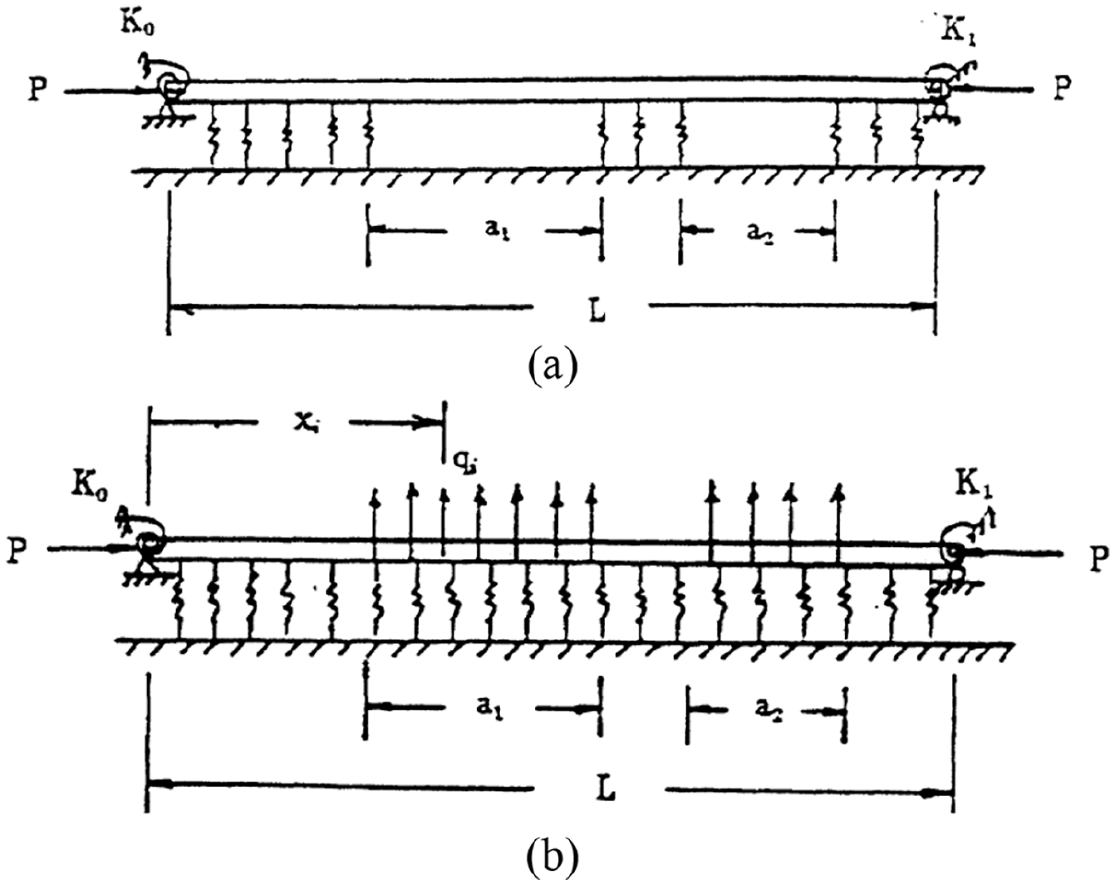
A delaminated beam-plate under compression: (a) actual model and (b) model for continuous analysis. 30
It is well known that the differential equation of buckling of an isotropic plate is:

Where,
w: Deflection of mid-plane
D: Flexural rigidity of the plate
q: Lateral load
An orthotropic composite plate has different flexural rigidity which is defined as matrix

In order to use Rayleigh-Ritz method, it is necessary to obtain potential energy of a system which is obtained as follow:

Where:
U: Starin energy of system
Ω: External work
Considering the bending deformation of plates during buckling, the energy terms are given by:


Where, the K is defined as follow:

Therefore, the equation (5) becomes:

Where, △ X is the length of delaminated part.
For a rectangular composite plate subjected to the compressive stress

Since, the woven fabrics are used as reinforcement of composites the unit-cell of the weave pattern is considered 15 as shown in Figure 2.

The unit-cell of woven fabrics. 15
Considering the Figure 2, the shape functions of warp and fill yarns in the structure of fabric are 15 :

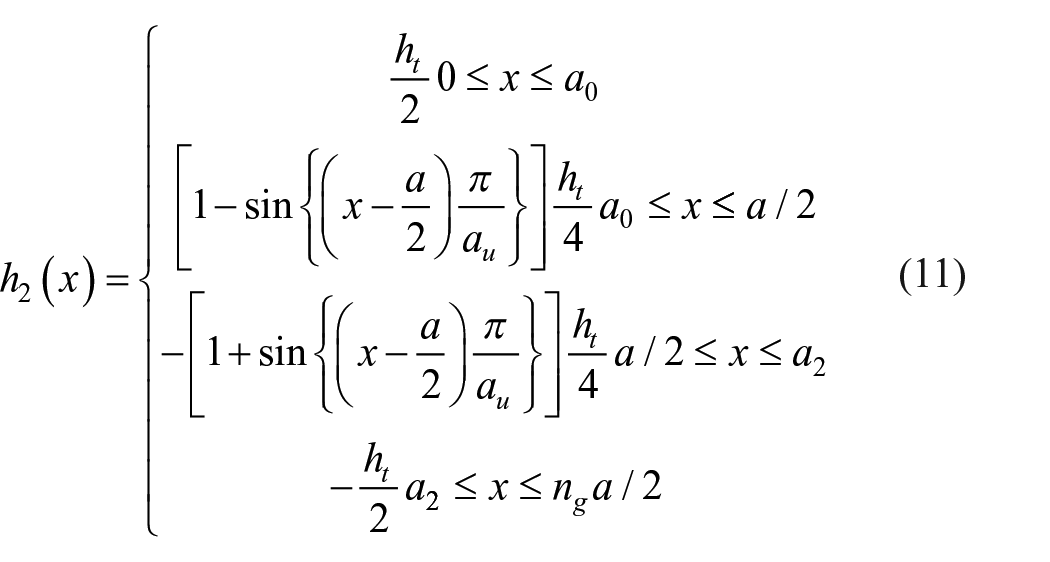


Where:
a: Width of the yarn’s cross section
The theoretical basis of the present investigation
Based on the classical laminated plate theory, the constitutive equations are given by:

Considering the


The M, F, and W are denoted to matrix, fill(weft) and warp, respectively.
According to the geometry of the unit-cell, the cross section of warp yarns are considered as straight parts and weft yarn is treated as crimped yarns with angle of

Where,
Considering the angle of weft yarn (

In which:





Where,
Assuming that the transvers deflection of plate under unidirectional stress is into n sinusoidal half-waves in the x-direction, the solution to equation (9) can be taken in the form:

Substituting equation (18) into equation (9):

Based on the Rayleigh-Ritz method:

The resulting bucking Eigen-value problem is solved and consequently the critical buckling load is obtained as follow:

The equation (21) indicates that the critical buckling load of structures is entirely related to the stiffness matrix of composite, and in the case of unidirectional stress is depend on
Materials and methods
Materials
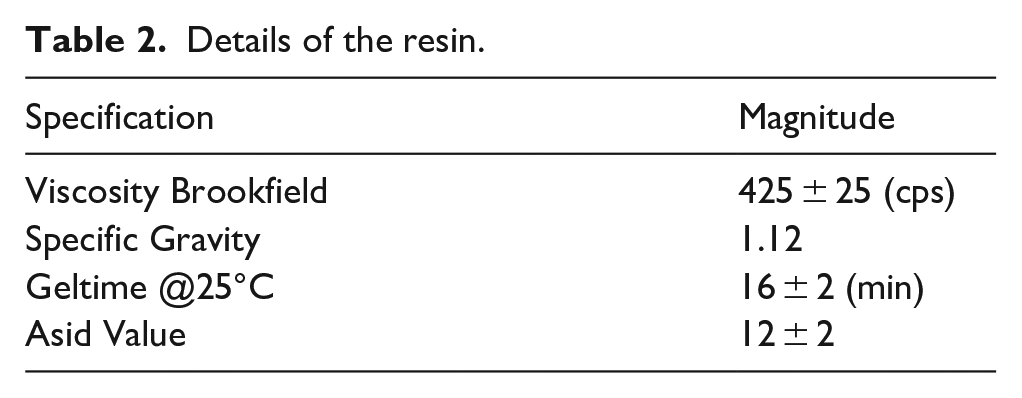
Three types of E-glass woven fabrics with different structures (Plain, Twill, and Satin) were used to prepared composite plates (Figure 3). The physical properties of fabric are shown in Table 1. Unsaturated polyester resin was used as matrix. The details of matrix are indicated in Table 2.

Different pattern of glass woven fabrics: (a) plain, (b) twill, and (c) satin.
Physical properties of fabrics.

Details of the resin.
Composite fabrication
Different methods and materials are used to fabricate various types of composites (Table 3). The composites were fabricated using Vacuum Infusion Process (VIP). As shown in Figure 4, the vacuum bag was sealed using sealant tape. T-fitting was set on the edges. Eight layers of each type of fabrics were laid dry into the mold and the vacuum is applied. Resin was readily absorbed into the laminate. The Hydrogen Peroxide and Cobalt were used as hardener and catalyzer, respectively. The lay-up sequence of laminates is [0/90/0/90]s. Prepared samples were put into the oven for the post-curing process at 80°C. It is worth mentioning that the volume fraction of plain, twill, and satin composite samples is 54.87%, 56.32%, and 61.06% respectively.
Materials and methods followed by other researchers.


Vacuum infusion process.
In order to manufacture laminated composites with through-the-width delamination, Aluminum films of 9 mm thickness were introduced between the seventh and the eighth plies to form a macro defect. Placing the Aluminum films between intra-layers causes the perturbation of interface and cohesive properties between fabric layers and resin, so the laminate did not have the perfect interface and under compressional loading, layers tend to delaminate from each other. The summary in Table 3 is reported to compare the materials and methods of this research to other literature materials mentioned in this article.
Tensile test
Samples were cut into the dimension of 25 mm × 250 mm to prepare three specimens for the tensile test according to ASTM D3039 as shown in Figure 5. The tensile tests were carried out on the samples with a gage length of 200 mm and jaw speed of 2 mm/min using INSTRON (Model 5566) tensile tester. To measure longitudinal and transverse modulus of composites, the samples were stretched in warp and weft directions, respectively.

Tensile test samples.
In order to measure shear modulus of composites, the off-axial-tensile test was carried out on the prepared samples. The samples were stretched in the 45° direction. The shear modulus (

Where;
Buckling test
Three specimens of each samples were cut into dimension of 40 mm × 150 mm in weft direction. The compressive test was performed on the samples using DARTEC testing machine equipped with gage length of 100 mm and 50 kN load cell. The jaws are displaced with rate of 0.01 mm/s. The boundary condition of plate is Clamped-Free as shown in Figure 6.
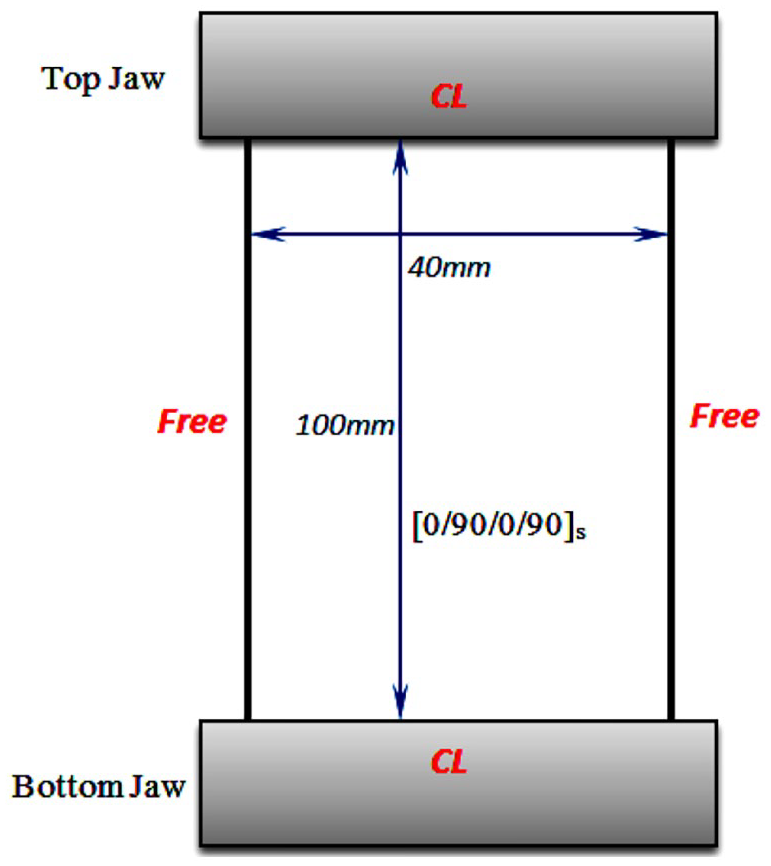
Samples condition in compressive test.
The lateral displacement of samples under compressive load was measured using Displacement Control device as shown in Figure 7 and actual buckling samples which fractured and delaminated shown in Figure 8.

Displacement control device.
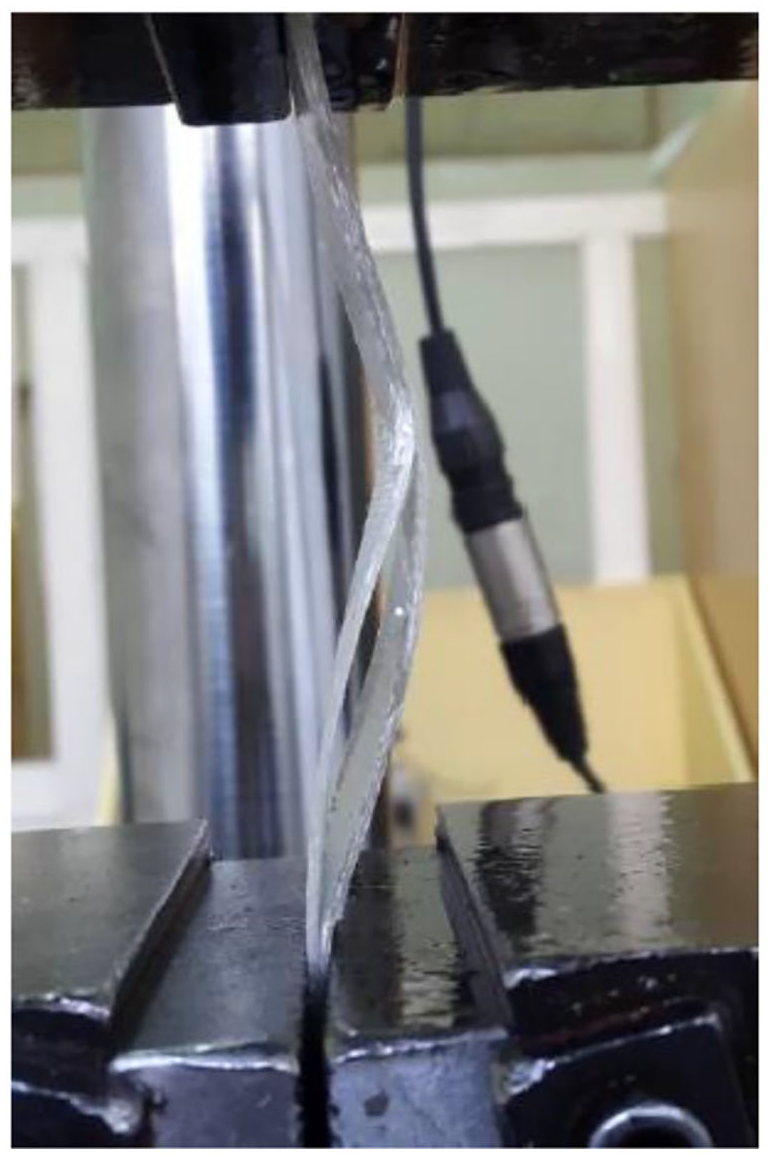
Delaminated samples after buckling test.
Results and discussion
The results of the tensile test are shown as stress-strain curves through Figure 9(a) and (b). The tests were repeated three times for each sample. As shown, in most cases, especially in the strain of 0.5%–1.5%, the stress-strain diagram is approximately linear. Therefore, the tensile modulus of samples was measured as the slope of curves in the region of 0.5%–1.5%. Wang et al. 32 also observed the similar trends for uniaxial tensile test of 4 to 18 layers of glass plain weave fabric and two types of Kevlar plain weave fabric reinforced composites. They showed that the load-displacement curves in the region of 0%–3.5% displacement (mm) is approximately linear and the slope of the Kevlar sample is bigger than the glass samples.

Stress-strain curve of composites reinforced with plain, twill and satin woven fabric: (a) longitudinal (warp) direction and (b) transvers (weft) direction.
The results of the off-axial-tensile test are shown in Figure 10. The diagrams show that stress-strain behavior of samples in the 45° is not linear, but in the strain of 0.25%–0.75% it can be assumed linear. Therefore, the tensile modulus in the direction of 45° was measured as slope of curves in the region of 0.25%–0.75%. It should be noted that the maximum strain of laminates during bucking deformation is less than 1%. Hence, this assumption is not very far from the real state.
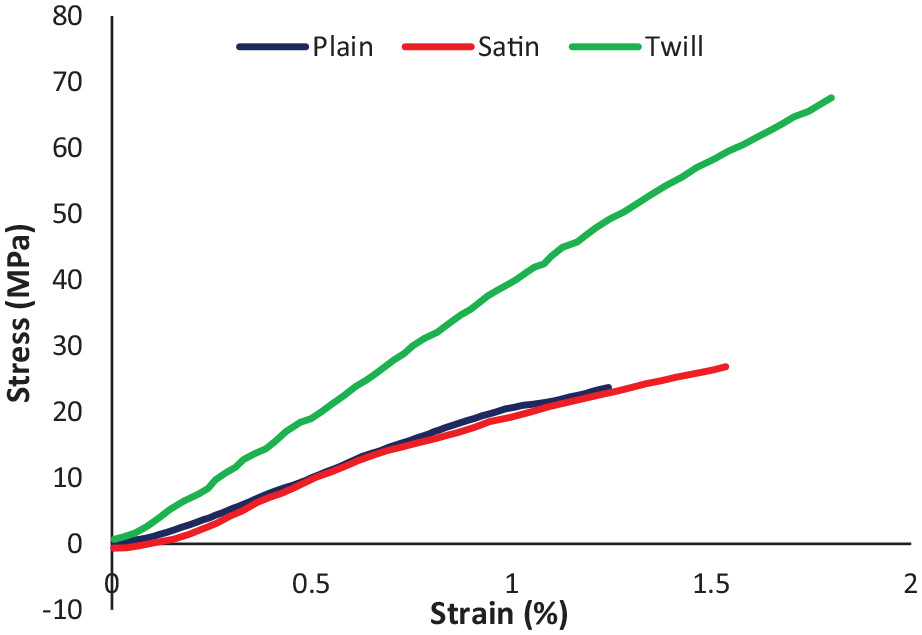
Stress-strain curve of composites reinforced with plain, twill, and satin fabrics in 45° direction.
The values of measured elastic modulus as slope of stress-strain curves in different directions along with calculated shear modulus of samples are summarized in Table 4. As listed, elastic modulus in warp direction (
Properties of laminas.


Schematic of basic patterns: (a) Plain, (b) Twill, and (c) Satin.
Figure 12 shows the results of the buckling test as the load-transverse deflection of composite reinforced with different fabrics. The critical buckling load for each sample was calculated as the average of three tests referring to the load-transverse deflection curves. The recorded buckling loads were 1.35, 1.12, and 1.48 kN to 8-ply laminates of Plain (PC8), Twill (TC8), and Satin (PS8) samples, respectively. Since, the samples were subjected to compressive load in the weft direction, the trend of variation in buckling load of different samples is consistent with the variation of elastic modulus in the weft direction. It is obvious that the modulus E2 has the main role in their buckling behavior. Therefore, it is expected that the SC8 laminate has the maximum elastic modulus in the weft direction due to the long floats (direct part of yarns) in this direction. The recorded results showed the maximum critical buckling load is for SC8 laminate as expected. This trend is observed for other samples. Parlapalli et al. 33 investigated the effect of buckling behavior on delamination for 32 layers of UD glass fiber reinforced composites stitched by two types of Kevlar yarns. They used three methods to calculate the critical buckling load from the experimental data which are the Southwell plot, Vertical displacement plot, and membrane strain plot.

Load-transvers deflection of composites: (a) Plain, (b) Twill, and (c) Satin.
The buckling behavior of 8-ply laminates was modeled by ABAQUS 6.13-4 software. Each ply was simulated as a Part. Using the values of Table 4, the properties of plates (Parts) were defined. The 8-ply laminates were formed by assembling of eight plates (Parts). After meshing, the boundary conditions were introduced considering the statue of samples in jaws of testing machine. The simulated laminates were subjected to the compressive load, and bucking force was predicted. The main steps of modeling are shown in Figure 13. Ismail et al. 34 studied the effect of buckling behavior on the delamination of six layers glass reinforcement woven fabrics with two magnitudes of volume fractions. They also observed the delamination area at FE simulation via ANSYS program and compare the buckling load of FE simulation with the experimental buckling load. The summary Table 5 is reported to compare the FE model of this research to other literatures models used in this article.
FE model followed by other researchers.


Different steps of FE modeling of buckling behavior: (a) geometry of laminate, (b) assigning properties to the parts, (c) defining the boundary conditions, and (d) delaminated parts.
The analytical buckling load was calculated using equation (21). The results of experimental, analytical and FE modeling of critical buckling load are shown in Table 6. Both analytical and FE results were compared with experimental results as error percentages. Considering the magnitudes of errors, it can be concluded that the both analytical and FE models are able to predict the critical bucking load of woven composites, reasonably. As observed, the results of FE model are closer to the experimental results than that of analytical model. All methods have recorded the maximum critical buckling load for SC8 sample. As pointed out, the reinforcement of SC8 laminate is Satin fabric which has the maximum floats in weft direction. The long floats lead to increase tensile modulus and consequently increase the buckling load. In the other hand, the minimum critical buckling load was recorded for TC8 laminate by all methods. Although the TS1 lamina has the maximum shear modulus, but the buckling load of TC8 laminate is minimum. This fact confirms that the shear modulus of lamina has the minimum effective on the critical buckling load.
Values of critical buckling loads of laminates.

Conclusion
The buckling behavior of woven fabric reinforced composites was investigated analytically and experimentally. For this purpose, the critical buckling load of laminated composites was modeled using continuous analysis and Rayleigh-Ritz method. Three types of woven fabric with different structures that is, Plain, Twill, and Satin, were used as reinforcement of composites. Then, composite laminates were fabricated by staking eight laminas using VIP method. The buckling test was carried out on prepared laminates. The results of experimental test confirmed that the structure of fabrics affects the buckling behavior of composites, so that the buckling load of 1.35, 1.12, and 1.48 kN for PC8, TC8, and SC8 laminates was recorded, respectively. It is attributed to the tensile modulus of laminas which are affected by the structure of reinforcements. The long direct parts of yarn in the structure of fabrics lead to increase the critical bucking load of composites. It can be concluded that the fabric structure has main role on the buckling behavior of woven fabric reinforced composites. Also, the analytical and FE models were used to predict the critical buckling load of different structures. The maximum error of analytical model is about 17%, while for FE model is about 10%.
Footnotes
Declaration of conflicting interests
The author(s) declared no potential conflicts of interest with respect to the research, authorship, and/or publication of this article.
Funding
The author(s) disclosed receipt of the following financial support for the research, authorship, and/or publication of this article: Amirkabir University of Technology has funded this research.
