



Abstract
Using glass fiber and polyester fiber as raw materials, stab-resistant properties of co-woven-knitted fabric are explored in this paper. A quasi-static stab-resistant performance test was conducted to study the stab-resistant characteristic of co-woven-knitted fabric pierced by a knife according to the puncture, displacement of puncture and puncture strength, and other parameters, recorded during the experiment. Three angles, 0°, 45°, and 90°, were chosen to explore the relationship between angles and puncture strength. Results indicate that the continuous shear resistance of multiple fibers in woven fabric and the weft-knitted yarns gathered after the locking effect in knitted fabrics work together during the experiment. It shows an increase of anti-shear effect of the fabric and an improvement of the anti-puncture ability. The puncture angles influence the puncture strength, and 45° shows the largest puncture force.
In recent years, global terrorism and extremist religious forces have occurred from time to time, with violent attacks on police officers and knife killings one after another. Stab-resistant materials are essential supplies in the field of military and national defense ministries and police security departments against those threats. 1 Stab-resistant body armor made with fabric is lighter and more comfortable compared with conventional all-hard metal materials. In order to adapt to various protection requirements, researchers have developed different fabric structures for stab-resistant textiles. 2 In addition to traditional woven fabrics, knitted fabrics, non-weft unidirectional fabrics, non-woven fabrics, the multi-axial warp-knitted fabrics, multi-axial weft-knitted fabrics, and biaxial fabrics have been increasingly developed recently. 3 The structure of the fabric is different, and its mechanical properties, the molding performance, and protection performance are also different. 4
For woven fabric, UHMWPE, aramid, glass, nylon fibers are usually employed as materials for stab-resistant body armor. To further reinforce the fabric, strengthening agents such shear thickening fluid (STF), 5 polymeric resin, 6 thermoplastics, 7 and hydrogel with high toughness and strength 8 are used to strengthen the stab-resistance of the composite fabric. For knitted fabric, warp-knitted spacer fabric and warp-knitted fabric like scale structure has a promising stab-resistant application prospect due to their great flexibility and stab-resistance performance. 9 For nonwoven fabric, polyamine and polyamide-based nonwoven fabrics with heat treatment obtains better puncture resistant Property than needle-punch treatment. 10 Additionally, the nonwoven fabric can be combined with other fabrics by needle-punching processing to improve the stab-resistance of fabric. 11
Although many of these existing stab-resistant products can play a role in stab-resistant. But most of them just develop products based on a certain stab resistance standard and cannot meet higher requirements in practical applications. Therefore, three-dimensional woven knitted mixed braided structural composites, also called co-woven-knitted (CWK) composite fabric, are increasingly taken into consideration as a stab-resistant material. In this structure, the warp and weft yarns in the woven fabric are inserted into the weft-knitted fabric at the same time.
A large number of scholars have studied the mechanical properties of CWK fabric. Among them, its tensile property has been investigated a lot. With several experiments, CWK fabric shows good tensile property employed as reinforcement material 12 and shows good linearity under the axial stretch with higher initial elastic modulus and fracture strength. 13 Moreover, the energy absorption characteristics and tensile damage mechanism of CWK composites has been analyzed under quasi-static and high strain rate impact tensile. 14 It was found that the composites have good energy absorption properties and energy absorption and energy regeneration increase significantly with the increase of strain rate. The tensile property of CWK fabric reinforced with polyethylene resin from different directions is also investigated. 15 The experimental results show that the tensile properties of transverse and longitudinal direction are better than those of oblique direction. In terms of the structure of the fabric, the woven structure is beneficial to the structural stability 16 while the knitted structure gives the fabric greater extensibility and elasticity. 17 With the combination of the two structures, the strength and energy absorption capacity of the composite fabric can be enhanced, thus improving the stab resistance. 18
However, there are few in-depth studies in regard to the mechanism of stab resistance and factors that affect stab resistance of CWK fabric. 19 And in the theoretical research of our own, there is no dynamic analysis and research on changes in tool tip speed, impact force, and energy absorption. Therefore, there is a limitation of development and application in the field of stab-resistance of CWK fabric.
This article presents a study on stab-resistant property of co-woven-knitted fabric. CWK fabrics were fabricated with two types of fibers: E-glass fiber and high-strength polyester fiber. The structure of CWK fabric and experimental parameters are firstly introduced. Then, dynamic analysis of the entire quasi-static anti-stab process including two parts of CWK fabric is illustrated. Lastly, the relationship between the maximum penetration force and different puncture angles is explained. The exploration of the anti-stab mechanism of CWK fabric provides a wide range of references for the application of CWK fabrics in the industrial field.
Experimental setup
Materials
The CWK fabric structure designed in this experiment is shown in Figure 1. The knitted structure adopts 1 + 1 rib weave, the coils on the front and back are staggered. To enhance the stability of the material and improve the mechanical properties of the fabric, the warp and weft yarns are interwoven into the knitted structure, forming a varying plain weave. The plain weave structure is flat and stable, and the mechanical balance is good in a unit body including four front coils and four reverse coils, two warps, and eight wefts. Among them, eight weft yarns are divided into two groups by warp yarns, each group of four wefts is divided into three parts by loops, one weft in the upper and lower parts, two wefts in the middle. Since the glass fiber is untwisted filament, the two wefts in the middle will merge together, the appearance is one weft.
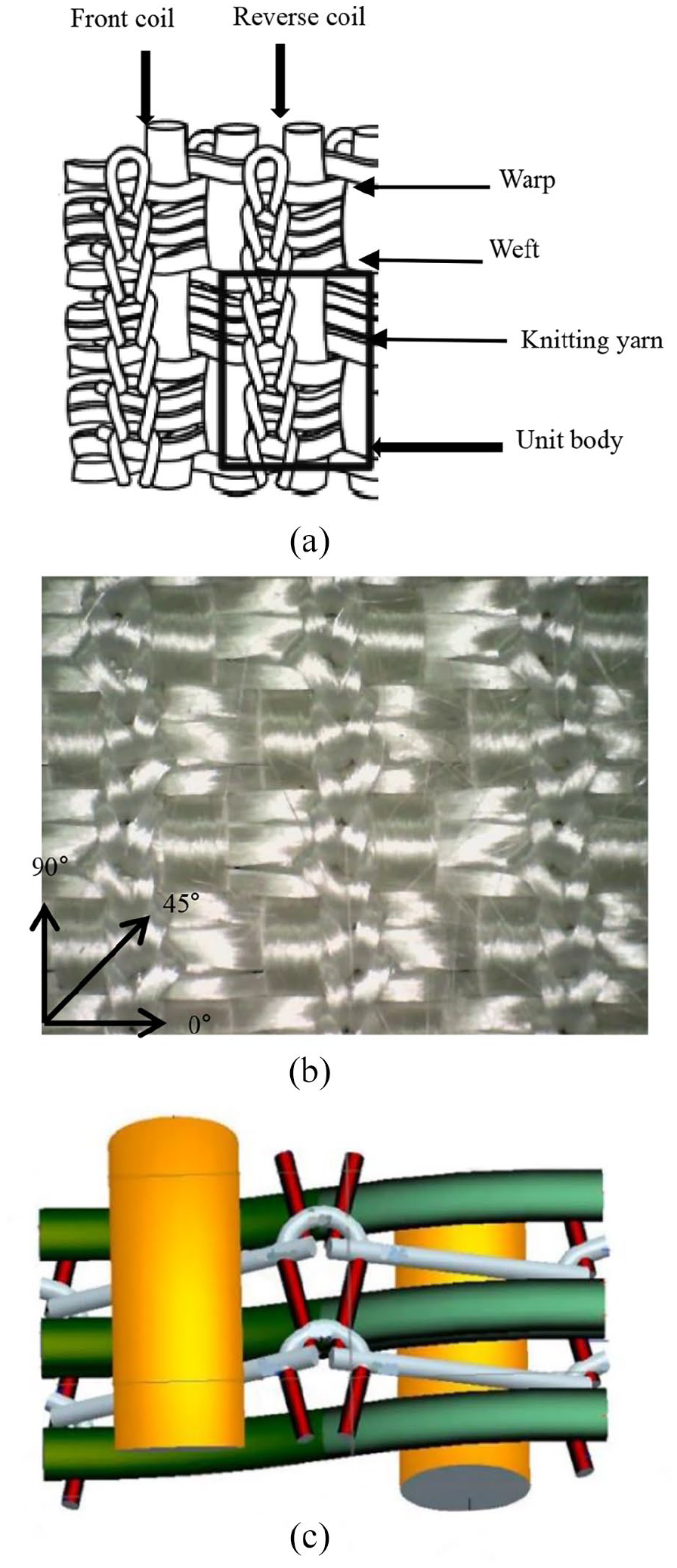
Co-woven-knitted fabric: (a) structure diagram, (b) fabric map, and (c) model diagram.
The experimental fabric was woven on a modified flat knitting machine. The gage is 7-pin/25.4 mm. The raw material is E-glass fiber as the warp and weft yarn and high-strength polyester fiber is employed as the knitting yarn. Table 1 shows the specifications of these yarns from Taian, Shandong Province. High-strength polyester fiber obtains high strength, good flexibility, and dimensional stability. The strength and elastic modulus of glass fiber are high while its elastic elongation is small which is not suitable for fabricating loops of knitted fabrics. However, its mechanical properties are excellent in the non-crimped state.
Specifications of the yarns.

Experimental standards and instruments
This article uses GA 68-2008 “Stab resistance body armor for police” of China to conduct quasi-static anti-stab experiment. Compared with other stab-resistant measurements abroad, the biggest difference is that this measurement stipulates that there can be no tool penetration after the stabbing test. The puncture performance of CWK fabric is investigated referring to GA 68-2008 anti-stab standard. The quasi-static anti-stab device used in the experiment is produced by Yangzhou Yuanfeng Instrument Company. The universal material meter model YF-900 is shown in Figure 2.

Universal material machine YF-900.
Experimental method
When testing, clamp the sample between ring clamps with a diameter of 8 cm, the tool is lowered at a speed of 20 mm/min to simulate a quasi-static process. The instrument automatically records the curve of the puncture force of the fabric with the puncture depth and puncture time during the anti-puncture process.
In order to study the relationship between the stab resistance of the fabric and the angle of the penetration surface, specimens with a diameter of 8 cm are prepared. Taking the latitude as 0° (cutting warp yarns vertically), the warp direction is 90° (cutting weft yarns vertically), the diagonal direction is 45°, and the puncture resistance of the fabric was tested from 0°, 45°, and 90° directions respectively. The piercing experiment diagram is shown in Figure 3.

Schematic diagram of piercing experiment with different angles.
Results and analysis
Test results of quasi-static stab resistance
As shown in Figure 4, it is the picture of the fabric after penetration. Take the average value of the puncture force obtained in each puncture direction and get the maximum penetration force at different piercing angles, as shown in Table 2. Figure 5 shows the curve of the puncture depth and puncture force of the fabric during the puncture process.

The picture of CWK fabric after penetration from 0°, 45°, and 90° directions.
Penetration angle and maximum penetration force.


Curve of penetration force versus penetration depth of CWK fabric.
CWK fabric structure on puncture performance
Materials involved in this test are high-strength polyester and glass fiber. High-strength polyester fiber has high strength and glass fiber has high strength, elastic modulus, and low elasticity. The tensile strength and rigidity of the fabric are relatively large. Simultaneously, the warp and weft yarns are inserted into the weft knitting loops in an untwisted state to improve the tensile strength and stiffness of the fabric. Thus, the tensile strength of CWK fabric is much greater than its shear strength under the action of the cutter. 17 During the piercing process of the fabric, yarn slippage, and shear failure are the main failure forms.
In the process of fabrics, on the one hand, the warp and weft yarns in woven structure is not easy to slip. Hence, the tip of the knife is mainly used for continuous shearing of a single fiber during puncture. On the other hand, the loop structure of weft-knitted fabric can be deformed with external force and the yarn is prone to slipping. The penetration of the knife tip will cause the yarn around it to pull and slip. The yarn has agglomeration phenomenon and the fabric will show a locked state. CWK fabric is used as a woven and knitted fabric, combining the advantages of the two structures. When the fabric is damaged by shearing, the continuous shearing resistance of multiple fibers in the woven fabric and the locking effect of the knitting weft-knitted loop yarns play a role together. To some extent, the anti-shearing effect of the fabric is increased, and the stab resistance is improved. 12
The puncture curve of CWK fabric can be divided into two parts: the non-pierce stage of the fabric and the instant that the fabric is pierced, which is can be seen in Figure 5. Before the fabric is pierced, the puncture force increases almost proportionally with the increase of puncture depth. When the maximum penetration force is reached, the fabric is pierced and the puncture force drops instantly. The overall trends of the three curves are the same, which shows that the puncture angle has no significant effect on the relationship between puncture force and puncture depth. 13
Impact of puncture angle on maximum puncture force
As shown in Table 2, there is a difference in the maximum puncture force with different piercing angles. Among them, the maximum piercing force of the fabric in the 45° direction is the largest, the 90° direction is second, and the 0° direction is the weakest.
When puncturing at 45°, weft-knitted loops are prone to deformation, more slipped yarns gather toward the position of the cutter, so the locking effect of the coil is obvious. In the meanwhile, the slippage of the yarns can disperse the impact of the cutter to a certain extent. And the cutter simultaneously shears the warp and weft yarns. Moreover, the more the number of stressed yarns, the more resistance the tool receives. Consequently, the maximum puncture force is relatively large.
When puncturing in 90° and 0° directions, the cutter is only blocked by the yarns in one direction, Thus, the maximum puncture force is 45° lower than the puncture angle. Furthermore, the shearing force on the weft and warp yarns is relatively large. Since the number of weft yarns per unit length of the fabric is greater than the number of warp yarns, when puncturing in the 90° direction, the shearing force on the fabric is large and the maximum puncture force is large.
Conclusions
The insertion of warp and weft yarns into the weft knitting can not only control the degree of anisotropy of the knitted composite material accurately, but also can increase the volume content of the fiber. Tensile strength, stiffness, energy absorption property, shearing resistance of the fabric can be enhanced. And the stab-resistance is improved with the increasing of the anti-shearing effect of the fabric to some extent.
The woven fabric is interwoven with warp and weft yarns and the tip of the knife is difficult to penetrate into the fabric with tight structure. The maximum penetration force is related to the piercing angle while the puncture angle has no significant effect on the relationship between puncture force and puncture depth. With the same organizational structure, the puncture resistance is the strongest along the 45° direction, the second is along the 90° direction, the puncture performance along the 0° direction is the weakest.
Footnotes
Declaration of conflicting interests
The author(s) declared no potential conflicts of interest with respect to the research, authorship, and/or publication of this article.
Funding
The author(s) received no financial support for the research, authorship, and/or publication of this article.
