



Abstract
The present study aims to extract a natural brown colourant from Ficus religiosa for cotton dyeing using the microwave radiation process. The colourant was isolated in aqueous and acidic media before and after microwave treatment (MW) for up to 6 min. The dye variables have been optimised for the development of new shades with good fastness characteristics, 1–5 g/100 mL of sustainable chemical and bio-mordants have been used. It has been found that irradiated aqueous extract (RE) containing 3 g/100 mL of salt at 55°C for 45 min has given high colour yield onto cotton fabric (RS) after microwave treatment for 4 min. The utilization of 2% of Al, 2% of Fe, 3% of tannic acid (T.A.) as pre chemical mordant whereas 4% of Al, 5% of Fe, 2% of tannic acid as post chemical mordant has given good colour characteristics. In comparison 3% of acacia and 4% pomegranate while 4% of Acacia and 2% of pomegranate extracts as post-bio-mordant have given excellent colour characteristics. It is concluded that MW treatment has an excellent sustainable efficacy to isolate colourant from Ficus Religiosa bark powder for cotton dyeing, whereas the inclusion of bio-mordants has made the process more sustainable and environmental friendly.
Introduction
Environmental pollution is day by day rising due to extensive use of fuel, carcinogenic chemicals and finishing products. 1 In any industry such chemicals are being used which when eluted in the form of effluent are not easily biodegradable. 2 These carcinogens when interact with water channels make them contaminated which, in turn, destroy soil fertility, bacterial action of soil as well as of crops growth. 3 These contaminated water channel when mixed with rivers, canals, small streams, destroy water quality parameter which resist the necessary photosynthesis of plants, fungi, algae that are beneficial for animals ecosystems. 4 Now since last decade a strict observation is being made on such processes which are destroying the beauty of the globe, ecosystem and health of the community. 5 Many world protection associations and institutions are spreading awareness to stop the frequent use of such carcinogens, and to spend money to introduce sustainable products in all walks of life.6,7
Many fields are now using sustainable products and giving the world a new trend to move towards green technology. 8 Of these products, plant-based colourants which are now being utilised in all walks of life such as textile, food, cosmetics, flavours, electronics. 9 These colourants are extracted under low conditions and have good biological and medicinal characteristics.10,11 Even their effluents have no disposal issue and the residue wastes when are mixed with soil has ability to act as fertiliser. 12 Being an asset of the nature, these colourants have eye catching, soothing and sustainable colours onto matrix. 13 Mostly these colours are extracted from waste materials such as foliage, flowers, dried stems, barks etc. 14 Another most important feature is the revival of the art of cultural heritage to show off wide spectrum of herbal based colourants in all applied fields. 15
These plant-based colourants are now under considerations and being standardised for their potential application in textiles, electronics as DSCC, perfumes, flavours etc. 16 It has been observed that poor fastness and low colour yield are the two factors for their decline. Conventional methods have been used to extract the colourant but these methods did not show any beneficial aspects on view of saving cost, time, energy and labour. 17 For shade fastness, the salt of Al, Cu, Co, Fe, Ni have been used but global protection agencies told that the use of Cu, Co, Sn, Ni salt should be banned because their effluents are carcinogenic.18,19 Now modern methods such as microwave, ultrasonic, ultraviolet, plasma have been considered for effective isolation of colourant and bio-mordants as possible substitute of toxic salts have been introduced for getting colour fast shades.20,21 Among modern methods, MW treatment is the cheap, selective and viable source of heating to get effective yield from crude plant powder.22,23 Its gives high yield by rupturing plant cell wall to make strong with solvents. 24 By this way the rapid mass transfer is occurred into the solvent which upon dyeing given high yield. 25 The other factor for the benefit of using MW rays is the surface scaling of cellulosic fibres without harming its chemical nature. 26 Bio-mordants have dual aspects that is, simultaneous action as dye shade developer and transfer of biological properties onto fabric to make process more greener sustainable. 27 For mordanting instead of carcinogenic salts, plant based molecules have been included. These molecules have dual nature where it acts as colourant as well as can cause transfer of biological characteristics onto fabric. 28
In this study Peepal bark (Ficus religiosa L.) has been explored as potential source of tannin-based reddish brown nature dye for cellulosic fabric using microwave radiations. 29 This Ficus plant being member of family is found around the globe. Its extract has also shown antiprotozoal, antibacterial, antiviral, anthelmintic, anti-amnesic, analgesic, antiulcer, anti-diabetic characteristics. Its extract is also used to cure asthma, diarrhoea, jaundice, fertilisation, wounds.30,31 Its bark extract contains many bio-molecules such as but tannin is the main potent component that yields reddish-brown colour onto fabrics.32,33 Cellulose contains β-1,4-D(H)-glycopyranose building blocks bonded through 1, 4-glyosidic linkage. Each unit has three hydroxyl group C-6, C-2 and C-3, where due to these hydroxyl group, the chain is packed via intermolecular and intramolecular H-bonding. 34 Mostly the interaction of functional site of dye is occurred with these hydroxyl groups of the cellulosic unit present in the amorphous region. 35
In view advantages of MW rays for colourant extraction and bio-mordant for new shade production the recent study has been aimed to explore cloning nature of Peepal bark-based tannin dye.
assess the effect of MW rays on physiochemical nature of cotton fabric
make new shades using green chemical bio-mordants
Assess the colour fast shades with afford to better ratings
Material and method
The crude powder of periderm (bark) of Peepal (FicusReligiosa) has been collected and sieved (20 meshes). Plant powders acting as the source of biological mordants have been ground, sieved and stored. Cotton fabric (20 = GSM) after pre-treatment with neutral soap has also been stored for the colouration process. The rest of the chemicals used for Isolation, dyeing, mordanting and fastness procured were commercial (Pakistan-made).
Dye extraction and irradiation process
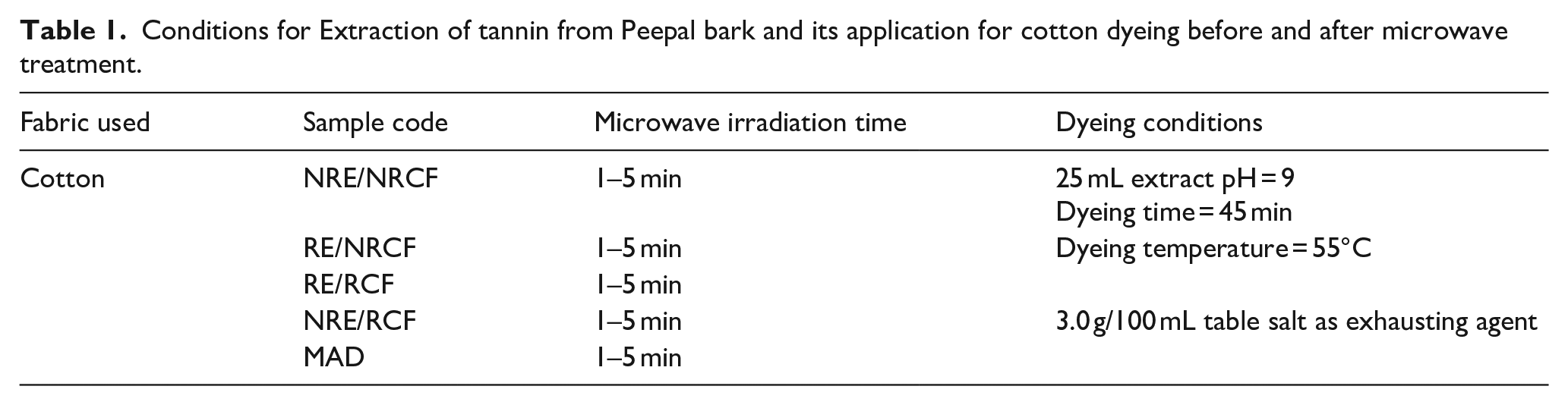
Aqueous (water solubilised) and acidic (acid solubilised) extracts have been prepared by taking 4 g of powder with 100 mL of media at boiling. Extracts and soaped cotton fabrics were given MW rays treatment up to 10 min, with the interval of 2 min. After the irradiation process, the dyeing process has been adopted as discussed in Table 1.
Conditions for Extraction of tannin from Peepal bark and its application for cotton dyeing before and after microwave treatment.
Mordanting treatment
Using optimum irradiation and extraction conditions, the set of experiments was designed to optimised extract pH (5–11), salt amount for exhaustion (1.0–6.0 g/100 mL), dyeing temperature (35°C–95°C) and dyeing time (25–85 min). For shade production 1.0–5.0 g of two bio-mordants (acacia and pomegranate) and 1.0–5.0 g of three sustainable chemical mordants (salts of Al and Fe and Tannic acid (T.A.)) were used. For the application of these mordants, the solutions were boiled in water using given amount and employed before and after dyeing by following already given method of Habib et al.
Analysis of fabrics
The undyed cotton fabric before and after microwave treatment for 3 min have been subjected for physicochemical analysis (SE and FTIR). 36 For analysis of dyed fabrics Data colour, SF 600 equipped with the light source (D 6510° observer) was used to get colour characteristics. For observing shade fastness, ISO standards for light washing and rubbing were used and the results were compared at greyscale.
Results and discussion
Microwave rays as domestic available cheap source of heating isolation is gaining fame day by day. This is because it has three excellent benefits. 37 Firstly it does not cause any harm to the functional efficacy of main molecule during extraction process. 38 Secondly this treatment by giving excellent mass transfer kinetics enhances the product yield by consuming less solvent, time and energy during effective solvent (medium)-plant molecule (colourant) interaction via rupturing plant cell wall. 39 Thirdly, these rays have ability to modify the surface of substrate (fabric) for significant sorption of stuff (colourant) without altering its chemical nature. 21 In this study these three benefits have been observed during isolation of colourant from Peepal bark (Ficus religiosa L.) in water (aqueous) and acid solubilised media (acidic) for dyeing. The results given in Figure 1(a) and (b) show that aqueous medium, the irradiation of extract and fabric (RE/RC = 4 min) has given high colour yield of (K/S = 12.652) whereas using acidic medium, the irradiation of fabric and extract (RE/RC = 3 min) it has given good colour yield (K/S = 5.7633). In comparison the aqueous extract (NRE) and fabric (NRC) before radiation has given lower yield (K/S = 1.532) and acidic extract and fabric before radiation has also given less yield colour (K/S = 1.6961).

(a) Effect of microwave treated and un-treated heat solubilised extract (aqueous) of Peepal bark for dyeing of treated and un-treated cotton fabrics and (b) effect of microwave treated and un-treated acid solubilised extract (acidic) of Peepal bark for dyeing of treated and un-treated cotton fabrics.
The colour coordinates given in Table 2 show that mostly bio-coloured fabrics in aqueous and acidic media are brighter and reddish yellow in hue. But the fabric dyed (RE/RC = 4 min) in aqueous medium is darker in done (L* = 42.8) and reddish yellow in hue (a* = 30.82; b* = 33.58). The fabric dyed (RE/RC = 3 min) in acidic medium is brighter (L* = 53.10) in shade and reddish yellow in tone (a* = 26.91; b* = 32.57). The other aspect is irradiation of fabric, which has also played its role well. The results given in Figure 2(a) and (b) show that irradiation of fabric (RC) for 4 min did not alter the position of characteristics peak of functional point (–OH cellulosic unit). However, the images recorded through SEM show that the fibres of the cellulosic surface have been scratched after and exposure up-to 4 min which in turn has improved its dyeing behaviour (Figure 3(a) and (b)). Hence it is proved that MW rays does not change the chemistry of functional nature of fabric but modifies its nature physically to sorb the colourant significantly. Hence it is recommended that for getting effective yield, extract and fabric should be irradiated for 4 min for getting significant sorption onto cotton fabrics.
Colour coordinates of selected fabrics dyed with Peepal bark (Ficus religiosa) extract.


(a) FTIR analysis of control cotton fabric and (b) FTIR analysis of microwave irradiated cotton fabric (RC = 4 min).

(a) SEM analysis of control cotton fabric and (b) SEM analysis of irradiated cotton fabric (RC = 4 min).
Dyeing of cellulosic fabric with Peepal bark extract is dependent on nature of extract (pH). On gradual rise of pH, the tint strength rises (K/S = 4.5791) but up to 9 pH (Figure 4(a)). Rise of extract (pH >9), the actual nature of the colourant to sorb onto fabric might be disturbed. Also, after surface modification by MW treated up-to 4 min the acute alkaline medium (>9 pH) may also weaken the fabric which upon bio-dyeing with extract gives the low yield. The colour coordinates given in Table 3 show that utilisation of extract of 9 pH after MW treated up-to 4 min has given brighter shade (L* = 57.46/) having reddish yellow have (a* = 12.31; b* = 23.62). The results displayed in Figure 4(b) reveal that utilisation of 3.0 g/100 mL of salt during dyeing of irradiated fabric with irradiated colourant of 9 pH has given maximum extraction of coloured. This is because selected amount has created a viable atmosphere arranged between colourant fabric attractive forces in the medium with in turn has finished high yield. The colour coordinate given in Table 3 show that after achieving proper exhaustion, the shade obtained is brighter (L* = 63.27) and reddish yellow in hue (a* = 10.91; b* = 23.82).

Effect of dyeing parameters (a = pH; b = salt conc.; c = temperature; d = time) on the colour strength of dyed cotton fabric using Peepal bark under microwave radiations.
Colour coordinates of microwave cotton fabric dyed at optimal condition using irradiated extract.

The dyeing of cotton fabric with aqueous extract of Peepal bark of 9 pH after MW treatment up-to 4 min is dependent on heat and contract points (°C/min). The gradual rise of heat (°C) and time (min) cause rise of the rate of dyeing up to certain point (55°C/45 min), where a above that level, the rate of desorption is occurred due to disturbance in equilibrium of dye bath with fabric. Hence for getting levelled shade with high yield, the dyeing of cellulosic fabric should be done for 45 min at 55°C (Figure 4(b) and (c)). The colour coordinates given in Table 3 show that dyeing of fabric for 45 min has furnished brighter shade (L* = 62.25) having reddish yellow (a* = 9.43; b* = 18.66). Similarly dyeing of fabric at 55°C has yield brighter shade (L* = 65.80) having reddish yellow tint (a* = 7.55; b* = 17.28). Here the results show that when both extract and fabric are radiated for 4 min, the dyeing process is cost, energy and time effective.
Mordanting is natural dyeing is another essential step to overcome the limitation of poor fastness ratings owing to strict environmental regulations in that study the salts of Al3+ and Fe2+ and tannic acid (TA) has been consumed to get colour fast shades. 40 The results show in Figure 5(a) that utilisation of Al salt (2.0 g/100 mL) before dyeing (pre) and 4.0/100 mL of Al salt after dyeing (post) has given high colour yield (K/S). But pre mordanting of with Al followed by dyeing at selected conditions has given colour yield (K/S) up to 1.1716. The colour coordinates given in Table 4 show that applications of Al salt before dyeing have produced brighter shade (L* = 79.88) with reddish yellow hue (a* = 4.63; b* = 9.983). Similarly, after dyeing the application Al salt has furnished brighter shade (L* = 73.31) with more reddish yellow tone (a* = 5.21; b* = 15.73).
Colour coordinates of selected chemical and bio-mordanted fabrics before and after dyeing with Peepal bark extracts.


(a) Effect of Al as pre and post chemical mordant on colour strength of irradiated cotton fabric (RC) with an irradiated aqueous extract (RE = 4 min), (b) effect of Fe as pre and post chemical mordant on colour strength of irradiated cotton fabric (RC) with an irradiated aqueous extract (RE = 4 min) and (c) effect of T.A pre and post chemical mordant on colour strength of irradiated cotton fabric (RC) with an irradiated aqueous extract (RE = 4 min).
After Aluminium, the salt of Iron (Fe2+) has been employed due to its sustainable nature also. The results displayed in (Figure 5(b)) show that treatment of fabric with Iron salt (Fe2+ = 2.0 mg/100 mL) before dyeing (pre) and 5.0 g/100 mL of Iron (Fe2+) salt after dyeing (post) has given high strength with darker shades. In comparison the application of iron salt (Fe2+ 2.0 g/100 mL) before dyeing has given high tint strength (K/S 4.769). The colour coordinates given in Table 4 show that 2% of Iron salt before dyeing has given darker shade (L* = 60.01) with more reddish yellow hue (a* = 9.69; b* = 25.26) where as 5% of iron salt after dyeing has also given darker shade (L* = 64.32) but low reddish yellow tone (a* = 6.71; b* = 18.44). Tannic acid is another useful chemical anchor (shade developer) which is used for mordanting of other before and after dyeing. The results given in Figure 5(c) show that 3.0 g/100 mL of tannic acid before dyeing (pre) has given high yield (K/S) up-to 4.3317 and its application (2 g/100 mL) after dyeing (post) has given yield up-to 3.1676. Again, has also pre-mordanting with tannic acid has given good results. The colour coordinated given in Table 4 show that dyed fabric after pre mordanting is much darker (L* = 51.35) in shade and reddish yellow in hue (a* = 13.0; b* = 7.20). whereas post-mordanting with tannic acid (T.A.) has furnished darker shade (L* = 55.29) with reddish yellow tone (a* = 9.78; b* = 15.87). The proposed chemical mordant, dye and fabric interaction has been displayed (Figure 7(a)). The shades and fastens ratings have been shown in Table S1.
Due to strict observation of on using salts of Cu2+, Co2+, NO2+, Ni etc. Now plant-based extracts have been considered this is because these extracts have ability to develop new colour fast shades but also to transfer their biological characteristics onto fabrics which are beneficial for global village. 41 In this study acacia, pomegranate have been utilised as a source of bio-mordants the result displayed in Figure 6(a) show that utilisation of extract taken 3.0 g/100 mL of acacia before dyeing (pre) has given colour strength (K/S = 7.3095) and the extract taken from 4.0 g/100 mL of acacia after dyeing (post) has given good yield (K/S = 2.3355). The colour coordinates presented in Table 4 so that pre mordanting has given darker shade (L* = 48.42) with reddish yellow hue (a* = 11.61; b* = 21.97). Whereas post mordanting has given brighter shade (L* = 61.08) with less reddish yellow hue (a* = 8.67; b* = 17.17). Using pomegranate this extract, taken from 4.0 g/100 mL before dyeing (pre) has given high colour (K/S = 16.086) whereas 2.0 g/100 mL of pomegranate extract after dyeing (post) has given low yield (K/S = 13.741) Figure 6(b). The colour coordinates given in Table 4 show that pre mordanted dyed fabric is darker (L* = 45.03) having reddish yellow hue (a* = 8.70; b* = 29.27) whereas post-mordanted fabric is brighter (L* = 51.90) having reddish yellow hue (a* = 5.96; b* = 29.96). The proposed bio-mordant fabric and dye interaction has been displayed in Figure 7(b). The shades and fastens ratings have been shown in Table S2.

(a) Effect of Acacia pre and post chemical mordant on colour strength of irradiated cotton fabric (RC) with an irradiated aqueous extract (RE = 4 min) and (b) effect of pomegranate pre and post chemical mordant on colour strength of irradiated cotton fabric (RC) with an irradiated aqueous extract (RE = 4 min).
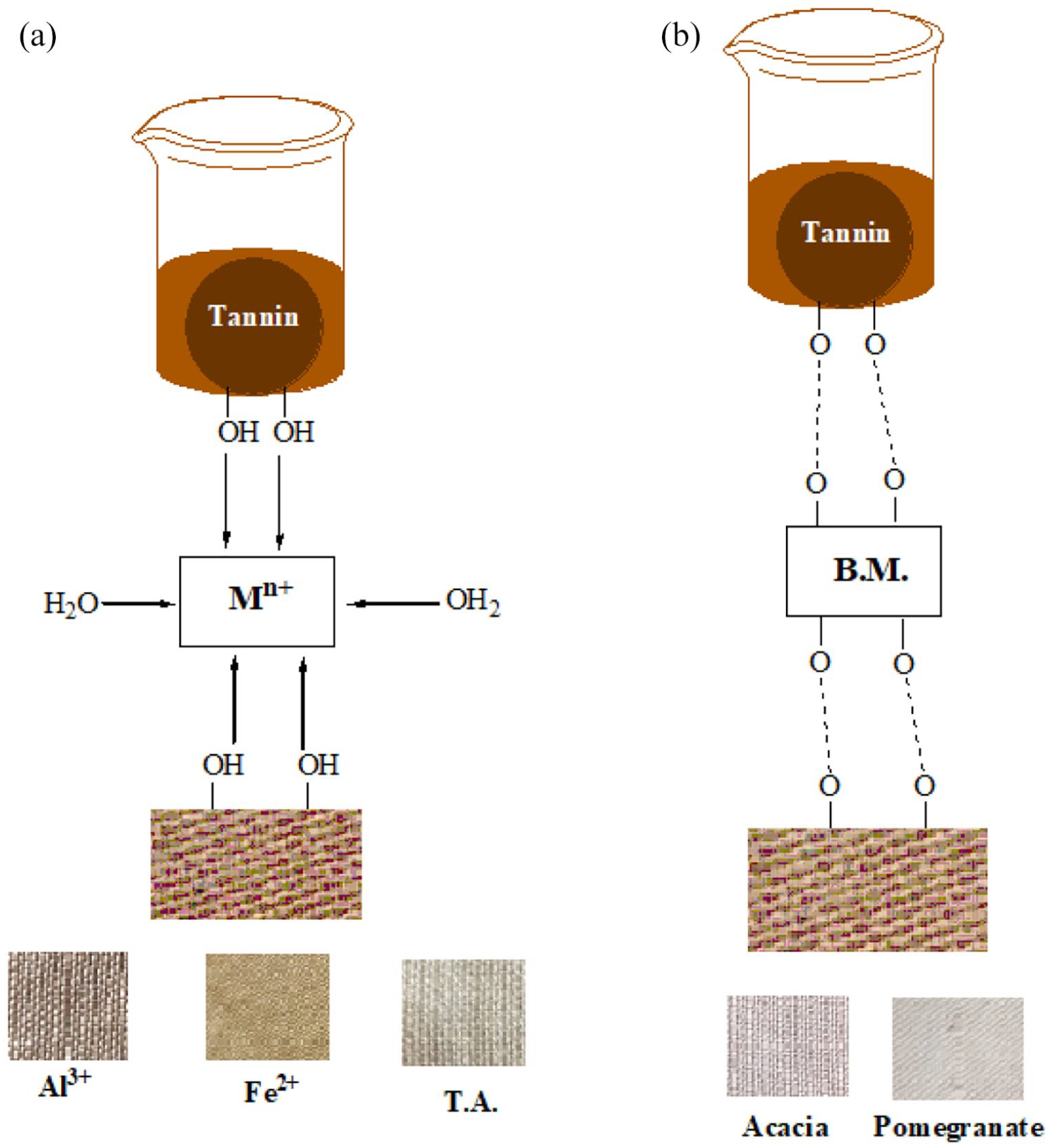
Proposed interaction of mordanted cotton (chemical = a; bio-mordant = b) with colourant.
Overall, on comparison for cotton, the mordanting with Iron before dyeing mordant and with tannic acid (T.A 2.0 g/100 mL) after dyeing (2.0 g/100 mL) is the most suitable to get colour fast shades. During Bio-mordants extract taken 4.0 g/100 mL of pomegranate before dyeing whereas extract taken from 2.0 g/100 mL of pomegranate after dyeing is recommended to get colour fast shades onto fabric using Peepal bark-based tannin natural colourant. The good colour strength using chemical mordant in due to formation of stable dye complex onto surface modified fabric. 40 Here isolation of the dye, the fabric nature of mordant are playing their role as Fe2+ has low reduction power so it gives darker shades while interacting with tannin and –OH of cellulosic unit, whereas case of tannic acid the additional H-bonding gives firm and colour fast shades.
During bio-mordanting the OH of bio-mordants as functional sites interacts with –OH of tannin and –OH of cellulosic unit to produce fast and strong colours.41,42 Here during bio-mordanting the additional conjugation extra H-bonding and fabric surface after tunning show promising role to give fast shades of high strength. 43 Hence overall the sustainable anchors are giving excellent results, where after M.W. treatment their amount not only has been reduced but also acceptable fastness ratings have been achieved at grey scale. The colourfastness properties given in Table 5 show that using selected amounts of bio and chemical anchors, the fastness to light washing and rubbing has been improved. The good to excellent fastness properties is due to stable complex formation by Al and Fe onto fabric with dye and extra H-bonding formed by –OH of tannic acid with –OH of colourant and –OH of cellulosic unit.27,42 Similarly, using plant molecules the phenolic unit of bio-anchor, –OH of cellulosic unit as well as –OH of tannin from Peepal bark via additional bonding furnish firm shade.44,45 Hence microwave rays for surface modification of fabric to enhance uptake-ability of colourant and taken low amount of mordant to furnish colour fast shade
Grey scale ratings for colourfastness of chemical and bio-mordanted cotton fabric dyed with Peepal bark extract.

Conclusion
The after effects of carcinogens have now forced the people shift towards given sustainable products. Ficus religiosa as the new dye yielding plant has been explored under M.W. treatment. It is observed that tannin extracted from leaves have good colour characteristics when employed on to cotton fabric through selected conditions of dyeing and mordants. It has been concluded the presence of bio-mordants and environmentally friendly chemical mordants has improved fastness ratings, whereas the application of M.W. rays’ treatment has enhanced the colour yield. The addition of clear processes for the extraction of bio-colours and the bio mordants for shade quality has made this act of cultural heritage more value added.
Supplemental Material
sj-docx-1-jef-10.1177_15589250221078927 – Supplemental material for Impact of MW rays on extraction and application of Ficus religiosa bark based natural colourant for cotton dyeing
Supplemental material, sj-docx-1-jef-10.1177_15589250221078927 for Impact of MW rays on extraction and application of Ficus religiosa bark based natural colourant for cotton dyeing by Waseem Akram, Shahid Adeel, Nimra Amin, Noman Habib, Asma Inayat and Somayeh Mirnezhad in Journal of Engineered Fibers and Fabrics
Footnotes
Declaration of conflicting interests
The author(s) declared no potential conflicts of interest with respect to the research, authorship, and/or publication of this article.
Funding
The author(s) received no financial support for the research, authorship, and/or publication of this article.

Supplemental material
Supplemental material for this article is available online.
References
Supplementary Material
Please find the following supplemental material available below.
For Open Access articles published under a Creative Commons License, all supplemental material carries the same license as the article it is associated with.
For non-Open Access articles published, all supplemental material carries a non-exclusive license, and permission requests for re-use of supplemental material or any part of supplemental material shall be sent directly to the copyright owner as specified in the copyright notice associated with the article.
