




Abstract
The demand for fashion, and for virtual fitting and personalized fashion among customers, is changing the design and consumption of fashion. To meet such challenges, fashion design models are being developed based on big data and digitization, in which fashion is designed based on data, virtual fitting, design-support systems, and recommendation systems. This paper reviews the fashion design models proposed in recent years and considers future development directions for fashion design. Using big data and digital processing technologies, fashion designers identify the characteristics of popular fashions in the market, predict fashion trends, and create designs accordingly. The virtual fitting of scanatar, parametric mannequin, or even real human bodies, enables customers to quickly and easily find fashion that best meets their tastes and requirements. On consumer design-support platforms, consumers can freely select styles, colors, materials, and other fashion aspects and view the design output. Furthermore, fashion recommendation systems, guided by fashion design experts, have greatly improved consumer satisfaction with fashion design. Yet, current fashion design systems do not fully consider the performance of textile materials and do not involve functional fashion design, let alone comfort. Such limitations provide directions future research in fashion design.
Keywords
Introduction
Improved living standards and changes in aesthetic concepts have created a shift in consumption from popular styles to personalized demand.1,2 People use fashion to express who they are and who they hope to become. 3 Consumers’ fashion requirements have also changed, from basic protection, concealment, and beautification to higher-level functions, such as moisture absorption,4,5 flame retardation,6–8 and bacterial resistance.9–11 Consumers’ personalized demands have prompted the fashion industry to shift from a model based on tailoring, mass production, and mass personalized customization12–14 to one of “one person, one style,” involving advanced customization. Personalized fashion demands are expressed via advanced customization, semicustomization, ready-to-wear customization, Internet customization, Internet-celebrity customization, and original-designer customization, among other models.
Today, the world is undergoing major changes driven by big data, analytics, and new technologies.15–17 To meet changes in consumer fashion demands, the management modes, production processes, product designs, and marketing methods of textile and fashion enterprises have also undergone significant changes. 18 Relying on the Internet, enterprises build cloud platforms by collecting and mining big data to develop precise marketing and design solutions oriented toward customer needs to improve user experience and maximize marketing and operational efficiency.19,20
This paper elaborates on fashion design models based on big data and digitization. It analyzes and summarizes the characteristics of each model and discusses the current status and development direction of fashion design.
Fashion design based on big data
Today, various kinds of data are being collected all the time. Fashion enterprises use large amounts of data to obtain insight, qualitatively analyzing consumer behaviors and preferences to find solutions that are matched with the real needs of contexts of real consumers.21,22
Fashion enterprises collect data on fashion sales from websites, stores, and mobile phone apps, among other sources. 23 They intelligently analyze the data and select diverse fashion-attribute data to identify preferences for colors, styles, fabrics, sizes, brands, and so on, among consumers according to age, gender, region, and other characteristics. 24 This approach provides a guide for fashion design and for fashion production managers. In this way, fashion design can better meet market demands and brand characteristics while greatly improving the efficiency and quality of fashion design.
When using big data, fashion designers must apply the data-mining results for a certain fashion to a specific type of design and judge whether it meets consumer needs based on the data. This can overcome the overemphasis in traditional design on the subjective aesthetics of fashion designers. For example, in designing men’s T-shirts, fashion designers can analyze the characteristics, styles, patterns, fabrics, and production processes of currently popular men’s T-shirts. In this way, they use big data platforms to identify the factors consumers pay the most attention to when buying men’s T-shirts and then use them as a design focus.
Quan et al. 24 proposed a product innovation framework that combined Kansei engineering and the deep learning, which could transfer pattern, color, etc. of a style image to products’ shapes automatically. Consumers’ preferences are obtained and the BP mapping between semantics and product properties is established at first. Then, a style transfer model is constructed to transfer the style image to the content image, and to generate new products. The semantics of the product before and after transfer are compared at last. The results indicate that the new product image can not only retain the shape of the target product but also have the characteristics of the style image. Taking the female coat as example (Figure 1), Figure 1(a) are content images, Figure 1(b) are style images and Figure 1(c) are the result images. They input (a, b) into the style transfer model, after processing, to achieve the results (c). The results reserve the shape of (a), while having details such as color and pattern similar to (b). Although this framework can automatically get new products without manual intervention, the evaluation of style image is based on questionnaires rather than objective models, which injects a certain degree of subjectivity into their framework. In addition, when the framework is used for designing fashion, the fashion style cannot be changed, and some design elements of the old fashion cannot be combined to produce a new pattern, which is a big shortcoming of this framework.

Product designs based on neural style transfer: 24 (a) content image, (b) style image, and (c) result image.
Singh et al. 23 studied a model system that can take the clothes bought by consumers and the latest fashion trends as input to generate new fashion. This system can design personalized clothes for consumers, which helping garment enterprises to come up with the fashion for target customers. The main limitation of this system is that the clothes in the two domains do not belong to a specific category, that is, these different types of clothes are not segregated and there is also no limit to the number of images of each type of cloth, which may affect the end results of fashion design.
In all, big data–based fashion design can clarify research and development directions for design, prioritize consumer demand, and thus help designers match design with demand. Fashion design based on big data is now a widely used approach that greatly improves the success of design. 25
Virtual customer fitting
Societies have evolved from agrarian economies to industrial economies and then to service economies. Today, we have entered the “experience economy” as evidenced by changes in consumer demand. It is well known that services and experiences are distinct economic offerings for consumers. Accordingly, virtual customer fitting systems have entered the fashion industry.
With virtual customer fitting systems, consumers can conveniently try out various styles or fashions to better identify a fashion that suits their tastes and requirements.26,27 A better fit between product and preference increases customer satisfaction, which may in turn increase willingness to pay. 28 Virtual customer fitting can be subdivided into customer mannequin virtual fitting and real-human-body virtual fitting.
Customer mannequin virtual fitting
In customer mannequin virtual fitting, a mannequin of a customer based on 3D anthropometry tries on garments virtually. 29 Customer mannequins can be created by two methods: (1) a manual avatar based on body measurement and (2) a direct avatar based on a 3D body scan. Customer mannequin virtual-fitting systems have considerable benefits for both fashion enterprises and customers. They enable fitting to a specific body, as well as designing fashion while just monitoring the fit to the model of a specific person without his or her physical presence. 30 Therefore, customer mannequin virtual fitting not only helps decrease physical samples for fashion before production, which saves money for manufacturers, but also saves time and recommends fashion well-suited to the customer. 31
Song and Ashdown 31 made 61 custom pants for volunteers and virtually tried each on a personalized 3D body-scan avatar. The overall accuracy of the virtual-fitting technology was found to be sufficiently good for use. The technology, however, was not perfect for visualizing fit; in particular, the 3D virtual model could not reflect the silhouette of the pants.
In ski jumping, success depends on not only technique but also the suit the skier wears. Simona et al. 30 developed ski-jump suits in a virtual environment based on two virtual body models (parametric and scanned) and compared them with real ones. Optitex software was used for the virtual prototyping of ski-jump suits (Figure 2). The differences in appearance among them were found to be attributable to the mechanical properties of the fabrics and the seam properties in the virtual environment. Further, parametric 3D body models could not precisely simulate real human bodies, which have complex structures that could not be fully reflected by parametric 3D body modeling.
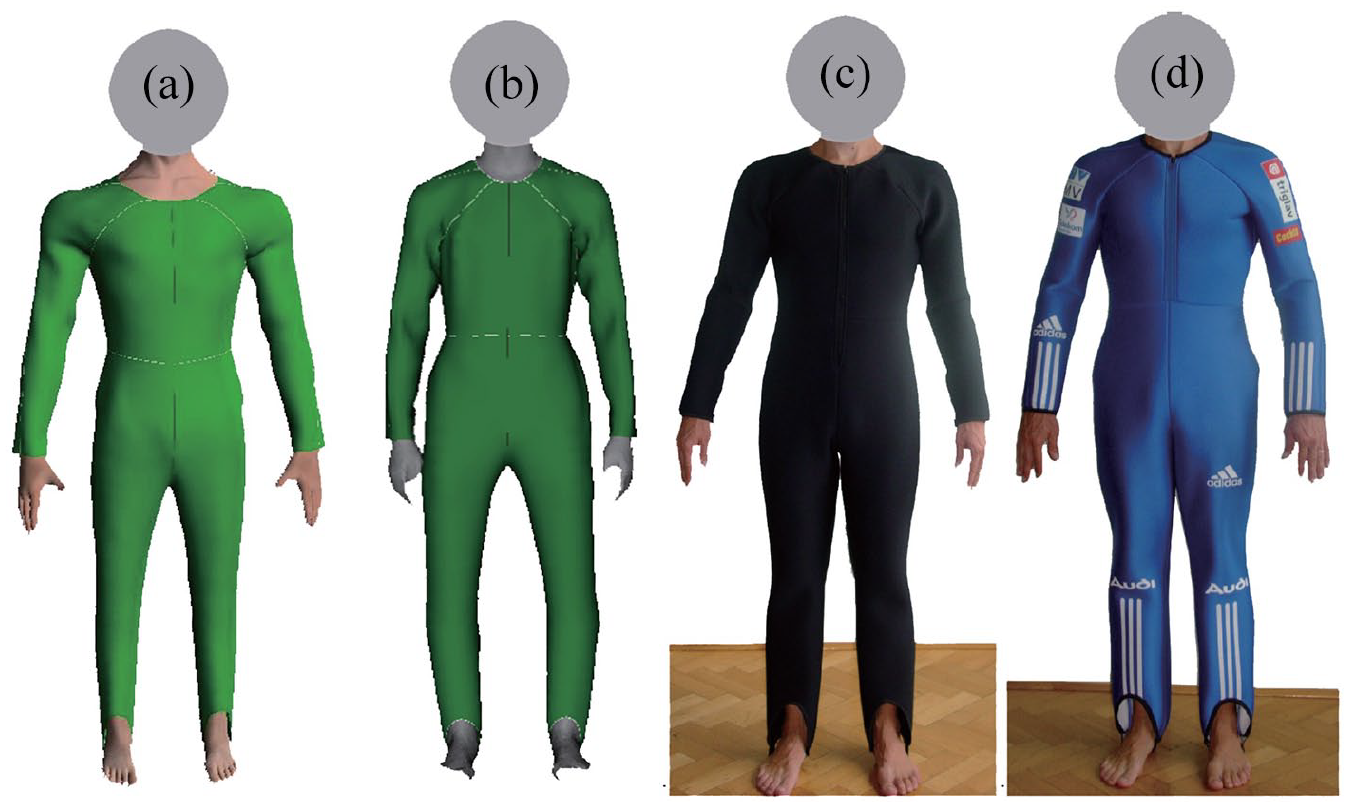
Ski-jump suits:39 (a) virtual prototype on parametric 3D body model, (b) virtual prototype on scanned 3D body model, (c) prototype of a ski-jump suit, and (d) professional ski-jump suit.
Fashion fit is one of the main factors affecting consumers’ purchasing decisions.32,33 Therefore, no matter how excellent the fabric or how beautiful the garment, a customer will not buy it if it does not fit well. In online shopping, consumers cannot physically try on garments; therefore, estimating garment fit is a problem to be solved. Liu et al. 34 proposed a machine learning–based model to predict fashion fit. In this model, for a specific customer, a parametric human model is used to adjust to the real dimensions of the body (Figure 3(a) and (b)). Next, fashion patterns from a company database are searched (Figure 3(c)). Then, to evaluate garment pressure at key points on the human body, several red points are marked on the selected patterns (Figure 3(d)). After that, a fashion is built based on the adjusted digital human model (Figure 3(e)) and then assembled to form a 3D virtual fashion (Figure 3(f)). Finally, garment pressures are simulated on the predefined positions (Figure 3(g)). After these steps, the simulated garment pressures are introduced in the fashion-fit evaluation model to automatically predict fit. This proposed model can predict fashion fit automatically and quickly without real try-on and can be used to evaluate remote fashion fit in online shopping. However, this model is limited in that it is not suitab:le for certain loose fashions that do not directly contact the body and therefore have near-zero garment pressure.

3D human model adjustment and virtual try-on:34 (a) parametric human model, (b) adjusted human model, (c) search for patterns, (d) set measuring points, (e) arrange patterns, (f) virtual try-on, and (g) measure digital pressure.
Using depth sensor data, Gültepe and Gueduekbay 35 developed a virtual fitting room framework that could provide a realistic fitting experience with customized motion filters, body measurement, and physical simulation. This model prepares a collision mesh and a physical simulation, with only 1 s of preprocessing time. Figure 4 presents six apparel meshes – three for a male avatar and three for a female avatar. A limitation of this approach is that it is insufficiently customizable since it only provides a realistic fitting experience for a standard human body type. The female avatar in Figure 4(b), for example, has a very well-defined waist; in reality, however, a woman might have a greater overall body width.

Designed apparel meshes for male and female avatars:35 (a), (b) and (c) are a female avatar with three different apparels, respectively; (d), (e) and (f) are a male avatar with three different apparels, respectively.
Real-human-body virtual fitting
Customer mannequin virtual fitting solves the problem of fitting without going to a brick-and-mortar store. However, some consumers complain that the faces of mannequins are not their own; their virtual-fitting experience is therefore unsatisfactory and lacks a sense of really trying on the clothes. To address this problem, some studies36–39 have aimed to develop real-human-body virtual-fitting systems.
Yamada et al. 36 developed an image-based real-human-body virtual-fitting system to reproduce the appearance of fitting when shopping online for garments. Figure 5 shows an overview of the system. The system’s inputs are whole-body images of a garment model and the customer. First, the body-contour models of both input images are estimated. Then, it is determined how the garment should be reshaped from the body-contour model of the garment model and the customer. The customer adjusts his or her position in the garment image, which is composited, and then a virtual-fitting image is output. Finally, a virtual-fitting result is obtained by adjusting the brightness of the customer image and retouching protrusions. The advantages of this model are as follows: (1) the garment image is reshaped based on the customer’s body shape, (2) brightness differences between the customer image and the garment image are adjusted automatically based on facial color, and (3) protrusions in the customer’s cloth behind the garment are automatically retouched. A limitation is that only a 2D image of the garment is input in this virtual-fitting system, and the customer cannot therefore view more realistic 3D fitting effects.

Overview of image-based real-human-body virtual fitting.36
Bansidhar et al. 39 proposed a virtual dressing room using Kinect. They introduced a real-human-body virtual fitting room framework that can provide a realistic fitting experience via physical simulation, size adjustment, and customized motion filters. Figure 6 shows the dressing room. This model adjusts the avatar and calculates standardized garment sizes according to measurements of the user’s body. It prepares the collision mesh and conducts human-body virtual fitting, requiring only one second of preprocessing. This virtual fitting room does not require visual tags, and it can make shopping for fashion faster, easier, and more accessible. It reduces floor space and fitting rooms and can thereby lower costs for store owners. Moreover, it shortens the time spent trying on different combinations and facilitates making good purchase decisions. However, the Kinect has difficulty reading small parts and, as a system with general 3D applications, it lacks easy-to-use tools for the fashion design industry.

Virtual dressing room.39
Design-support systems for fashion
While fashion designers can professionally design garments for consumers, and virtual-fitting systems facilitate trying on garments, some customers’ demands are still not being met. 40 Fashion can be considered a metaphor for identity by which individuals express who they are and who they hope to become. 23 Customers, therefore, want fashion to express their individuality and ideas by way of design elements such as images and colors.41,42 Hence, there is a need for fashion design systems that help ordinary people design fashions that appeal to them.3,43 Such customer-design systems have been developed in recent years. Furthermore, e-garment shops should be designed that can interact intelligently with consumers by considering the perceptive and cognitive elements of classical shopping. 44
Saakes et al. 45 developed a “Mirror Mirror” system that not only supports mixing and matching existing fashion items but also allows users to design a new fashion in front of a mirror and export design drawings to a printer. Brodsky et al. 46 aimed to eliminate laborious manual or computerized fashion conceptualization, pattern drafting, and 3D garment simulation, regardless of design complexity or user skill level. Using a cloud-based integrated environment (e.g. on a computer or mobile device), their approach allows for the custom design of products, individual customized virtual fitting, and final garment preview on a figure.
Zhu et al. 47 developed an interactive, personalized fashion design virtual-display system that uses the customer’s own face and can therefore meet the requirement of personalized fashion customization. Customers can choose fashion design elements to realize personalized design (Figure 7). The options include body type, collar type, front placket styles, and sleeve fork, among others. The garment can be seen in a 360° view by clicking a rotation button. This model not only allows customers to design style elements and choose colors, fabrics, and accessories, thereby realizing their own personalized style, but also presents a personalized 3D virtual display using the user’s own face. However, this system could create personal information risks since 3D face models and fashion preferences are recorded and saved by the system. As such, there might be a need for increased network security measures.

Interface for an interactive garment design and display.47
Mok et al. 48 developed a customized fashion design system to help customers create their preferred fashion in a user-friendly way. The system consists of an interactive design model, a sketch representation, a composing method, and a user-friendly interface. Figure 8 shows the system’s user interface design. All of the design elements are integrated into the design-support system, by which customers can easily design their preferred fashions. However, designs in this system are presented as 2D sketches (Figure 8), which might look not as attractive on 2D avatars as on 3D avatars.

User interface design of the design-support system.48
Fashion recommendation system
Customers have their own unique aesthetics but often lack professional fashion knowledge or tastes; thus, their demands for personalized clothing can be qualitative or ambiguous. Therefore, the problem with fashion design-support systems is that customers might not fully understand their needs and are not sure how to realize their design concepts. As such, fashion customization generally cannot meet customers’ expectations, resulting in dissatisfaction. There is a need, therefore, for fashion design recommendation systems with personal style advisors; this could help customers design fashion that satisfies their needs. 49 One type of recommendation system studies customers’ preferences for styles, colors, patterns, and other aspects based on customers’ online evaluations, search keywords, browsing behaviors, and purchase records on e-commerce platforms. It then makes intelligent fashion recommendations suited to customer preferences.44,50 With fashion design recommendation systems, customers not only want them to recommend fashions similar to their current dress style, but they also hope to get personalized style advice to develop a better understanding of their personal style. 51 Figure 9 shows an overview of the recommendation system. Intelligent recommendation vitally important for fashion companies to increase their influence and profits.

Overview of a recommendation system. 16
Previous fashion recommender systems mainly concern about the technologies development of virtual fashion assembling, permitting designed fashion to be fitted to specific model of the human body. 52 However, these systems rarely deal with consumers’ personal temperament and designers’ professional design knowledge, as a result, the designed fashion may not satisfactory.
In reality, experienced designers may use their knowledge of design and previously successful design cases, combined with an understanding of the consumers’ personal temperament. Therefore, it is extremely significant to develop designers’ knowledge-based, personalized fashion recommendation systems because they can effectively help consumers design fashion freely according to their own needs, under the guidance of professional designers, which is conductive to promoting the success rate of fashion design. Dong et al. 53 developed an intelligent recommendation system to help apparel retailers provide systematic expert recommendations (Figure 10). The system proposes a type of object-oriented blackboard and sets up expert rules based on apparel-characteristic elements. The system makes personal recommendations based on a positive rule reasoning mechanism engine. Consequently, from the perspective of a fashion expert, an apparel-matching solution is provided to the customer through a human–machine interface. The experimental results indicated that this system could recommend suitable fashions for customers and improve customers’ shopping experiences.
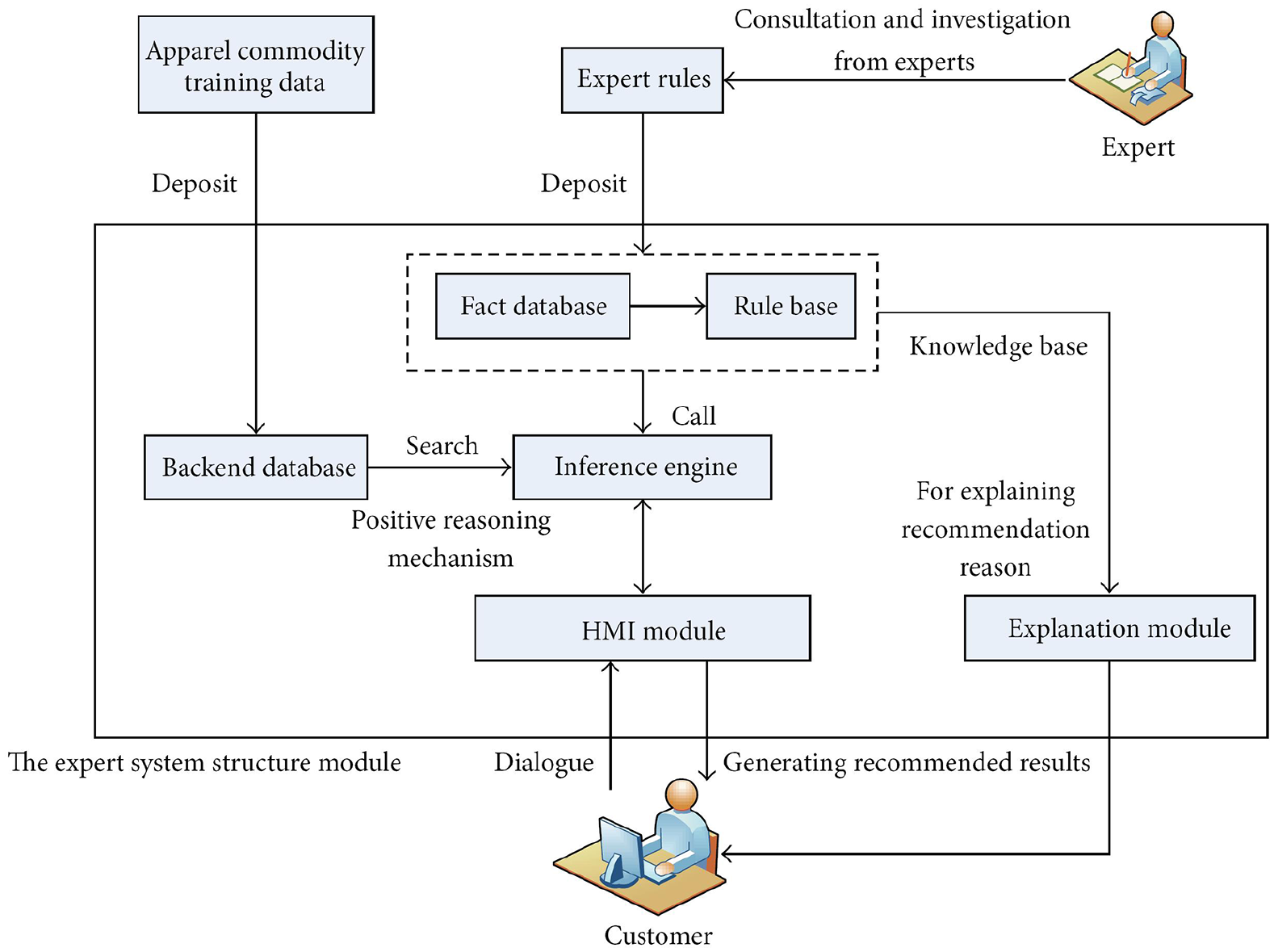
Structure of an intelligent apparel-expert recommendation system.53
Li and Chen 50 proposed an e-customized codesigned system for fashion design that enables customers to codesign garments and communicate with experts, designers, and manufacturers. The main characteristics of this system include communicating, evaluating, and sharing design knowledge and recommending styles to consumers. This e-customized codesigned system improves upon existing e-customized systems and can help consumers by way of fashion design recommendations, professional suggestions, and expert evaluation.
Conclusion and perspective
The innovative use of big data and digital models in fashion design has attracted the attention of researchers, technology developers, retailers, and customers. Many types of fashion design models have emerged in recent years. At present, market-oriented fashion design models based on big data are predominant. These obtain consumers’ fashion requirements, match tastes using various methods (e.g. via shopping websites, shopping apps, or market surveys), predict fashion trends, and then design fashion using professional knowledge.
With the rapid development of big data, the digital economy, and e-commerce, many companies have adopted virtual customer fitting and design-support systems on e-commerce platforms. However, the functions of current virtual-fitting platforms are relatively simple, and the styles and quantity of clothes that can be tried on virtually are limited, making it difficult to meet consumers’ diverse demands. The main process of a design-support system is that a customer inputs body size, selects fashion information (e.g. styles, colors, self-designed fashion), and then enters the virtual apparel display link. This type of model enables customers to design fashion by themselves and realize personalized design. However, design-support systems may cause problems in that customers lack professional knowledge and cannot always achieve the desired fashion effect, leading to design failure. Expert recommendation systems have been introduced to address this issue, enabling fashion designers and even garment production departments to participate in consumer fashion design. Such systems can provide accurate recommendations that suit consumers’ personalized needs and greatly improve the success rate of fashion design. However, they might also increase the cost and time investment of customized design.
It is easy to see that current fashion design models based on big data and digitization do not involve the performance of textile materials or functionality and only focus on the appearance of the design (e.g. style and color). Good fashion should not only look beautiful but also be comfortable (e.g. heat/humidity, 54 pressure, 55 and contact comfort 56 ). Key aspects influencing human body-wear comfort are the garment, the human body itself, the environment, and activity. 57 To facilitate comfort, therefore, lifestyle, target activity, environment (e.g. temperature, relative humidity, wind velocity), human body (physical and physiological properties), and garment characteristics (e.g. fitting style, fabric properties) need to be considered.58–60 Li et al.61–63 developed an online CAD system, called e-Thermal, to satisfy designers’ and manufacturers’ requirements for thermal functional design. This system considers all key aspects affecting human body-wear comfort. With e-Thermal, fashion can be designed in a virtual environment based on assigned activities, and the thermal status of both the human body and fashion can be predicted. This system is currently being perfected and supplemented, and it is expected to be rolled out in the near future.
In the future, fashion design platforms can be developed that fully consider not only appearance but also comfort and functionality. Consumers can perform fashion design and virtual try-ons under the guidance of experts while also viewing comfort parameters after trying on the apparel in real time to achieve the best dressing experience.
Footnotes
Declaration of conflicting interests
The author(s) declared no potential conflicts of interest with respect to the research, authorship, and/or publication of this article.
Funding
The author(s) disclosed receipt of the following financial support for the research, authorship, and/or publication of this article: We would like to thank the China Scholarship Council for funding this research (No. 201809345023).
