




Abstract
Advanced triboelectric nanogenerator techniques provide a massive opportunity for the development of new generation wearable electronics, which toward multi-function and self-powering. Textiles have been refreshed with the requirement of flexible electronics in recent decades. In particular, knitted-textiles have exhibited enormous and prominent potential possibilities for smart wearable devices, which are based on the merits of high stretchability, excellent elasticity, comfortability as well as compatibility. Combined knitted textiles with nanogenerator techniques will promote the knitted textile triboelectric nanogenerators (KNGs) emerging, endowing conventional textiles with biomechanical energy harvesting and sensing energy supplied abilities. However, the design of KNGs and the construction of KNGs are based on features of human motions symbolizing considerable challenges in both high efficiency and excellent comfort. Currently, this review is concerned with KNGs construction account of triboelectric effects referring to knitted-textile classifications, structural features, human motion energy traits, working mechanisms, and practical applications. Moreover, the remaining challenges of industrial production and the future prospects of knitted-textile triboelectric nanogenerators of harvesting biomechanical energy are presented.
Keywords
Introduction
Wearable electronics devices that are integrated with garments have been extensively applied in monitoring physiological and biomechanical signals for human healthcare and dynamic attitude, 1 especially in an era of national fitness. In order to avoid injury occasions, abnormal physiological states, and incorrect movement postures should be discovered and rectified instantly. Currently, wearable devices have provided an appealing lifestyle for humans and quite an amount of commercial products have accessed the market for meeting the demands of people, for example, Amazfit GTR, Fitbit, 2 apple watch, sensoria socks. 3 There are significant data transmissions that are reliant on the technology of the internet of things (loT) 4 in every second, which needs a large number of wearable devices that are set on the human body or regular clothing, such as informal apparels, fitness garments. Therefore, miniaturization, portability, multi-functionality, and flexibility are the trends of wearable devices that are contacted with human body-friendly in recent years. 5 Owing to that smart devices wear without comfortable and no work without electricity, the wearable devices depended on the stretchable textiles and power supplement system that can solve the mentioned limitations and provide a creative and innovative development for further researches. As we all know, textiles with incredible flexibility and comfort are prevalently used in our life. Thus far, quite lots of textile-based sensors6,7 and supercapacitors8,9 have entered the mass visions and have been developed by many research groups, for example, knitted-based washable chest band for monitoring breath signal, 10 textile-based supercapacitors 11 for powering a smart wearable clothing. Compared to woven textile, 12 knitted fabric is more likely to achieve stretchable deformations. More importantly, it can generate significant electrical signals under small scale strain, which can monitor a variety of micro biomechanical energy. In 2012, a novel energy harvest technique was proposed that it can scavenge wasted biomechanical converting into electrical, which was a triboelectric nanogenerator (TENG). With the excellent advantages of green, easy fabrication, low cost, comprehensive materials, TENG is far more fit than other approaches to power smart wearable electronics. In the near future, the perfect wearable devices will be designed as a comfortable electronic with a self-power system integrated into the garment, converting human biomechanical into electrical energy efficiently.
The energy solutions are contained in the power source and energy supply for intelligent wearable devices. On the one hand, it is common to apply heavy power supplements based on traditional energy structures for keeping electronic wearables working regularly, such as conventional electrochemical supercapacitors 13 and lithium-ion batteries.14,15 One typical characteristic of these power sources is that they are the absence of flexibility, eco-unfriendly, 16 as well as short life. 17 Furthermore, these inherent shortcomings have limited the wearable electronics going toward micro and portable types in further. On the other hand, it is impossible to perfectly track and recycle 18 enormous numbers of power electronics that are equipped on textiles. In the end, environmental situations, especially soil pollution, will become worse because batteries are replaced frequently and littered. All current circumstances present an innovative approach of power acquisition is the necessities, which is required to satisfy the requirements of long term, convenience, and economy.
Various environmental energy forms are existing on earth, including solar,19,20 water, 21 thermal,22,23 and biochemical energy, 24 which are the main renewable power for supplying in the one decade 25 which has been reported. However, it is notoriously difficult to obtain solar and water energy consistently and continuously, due to the timeliness and environmental limitations, such as a sunny day without rain, dessert lack of water. The thermal energy can be generated through the apparent difference in temperature, however, the human temperature maintains constant at 37°C, making a relatively lower difference between skin and surrounding. All above the energies have a capacity to supply power, it is not suitable for wearable devices applications due to they are affected by too many external considerations. Therefore, mechanical energy 26 stands out among the various energy sources, which owns excellent environmental adaptability. However, as one of the frequent and abundant forms in our daily life, mechanical energy is usually ignored and wasted. In particular, as the core of energy, the human body is rich in substantial low-frequency biomechanical energy (in 1–5 Hz), which exist in numerous ways such as joint movements, breathing, heartbeats. As long as the human keeps constantly moving, the energy will never stop. Previous works indicated that the triboelectric nanogenerators have a wonderful output performance in 0.1 to 3 Hz. 27
The combination of knitted textiles and nanogenerator working mechanisms can give an appealing future of harvesting human motion energy. The most significant issue is how to combine different human movements with the structure of nanogenerator perfectly, obtaining the maximum output performance. Although many research teams have been dedicated to promoting transfer charge and energy storage, there remains no identify overview in terms of how to make full use of textile performances, such as structure design, materials option, and combination progression for Knitted-textile triboelectric nanogenerators (KNGs).
Herein, the review purposes of giving a comprehensive depiction of KNGs, referring to recent advanced progress of harvesting human motion energy and monitoring physical signals. Then depended on the characteristics of human movements, KNGs’ structural design has been discussed both knitted textiles and different working modes that can convert biomechanical power sources into electricity, respectively. This paper also comes up with future challenges of KNGs and self-powering wearable electronic devices. Moreover, the most important consideration is how can KNGs be extensively applied to every research kingdom and raise fundamental instructions on how to integrate knitted textiles with biomechanical energy harvest for other researchers who are not familiar with textiles, endorsing creative developments.
Knitted smart textile
Knitting is a prospect branch of traditional textile industrial with plentiful materials, short procedure, full range of products, as well as highly efficient, which have occupied a prominent status. Due to the intermeshing loops of yarns, knitted structures exhibit outstanding stretchable and deformable ability. Shown in Figure 1, the space existing in a single loop that can result in large deformations and good tensile recovery, providing high comfort. Herein, the greatly improved elasticity, enhanced broad strain range, and provided comfortable and wearable of knitting textiles are unique characteristics, which can be distinguished from woven and nonwoven fabric-types.
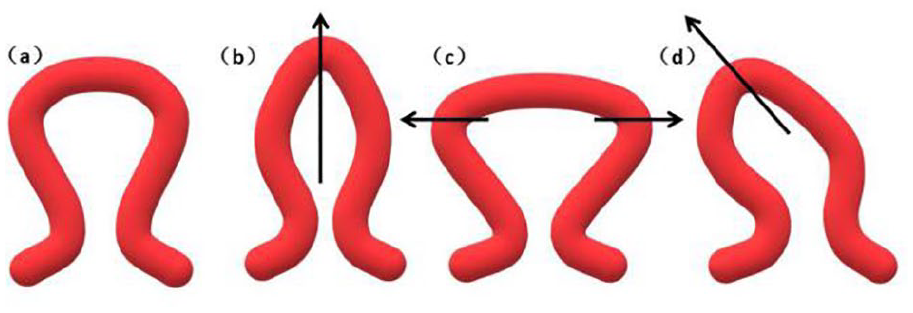
Deformations of knitted textile during stretching. (a) Original loop. (b) Transverse direction. (c) Longitudinal direction. (d) Slant direction.
As for the porous and non-planar surfaces of knitted textile, it is essential to take attention to the interconnected loops that are the basic unit. The structural fitness and fabric distortion are noticeably influenced in the loop structure and affect thermal comfort and tactile comfort when wearing. It is well known that loops patterns also can affect visual comfort, enhancing the textures and graphic sense of clothing. Furthermore, the used knitting materials can be made from multiple types, such as natural fibers, chemical filaments, modified threads, conduct fibers as well as treated yarns. During the processing, the knitting producing speed is the third superiority for intelligent applications, with decreasing the labor cost. The last is about the knitted technique that is the forming knitting as the representative clothing technique, which can provide a possibility for realizing sensing-area location knitting and improving the compatibility between intelligent devices and the garment. From the overall outstanding preponderance, the knitted textiles are highly desirable for flexible sensors and wearable devices.
Knitted textile classification
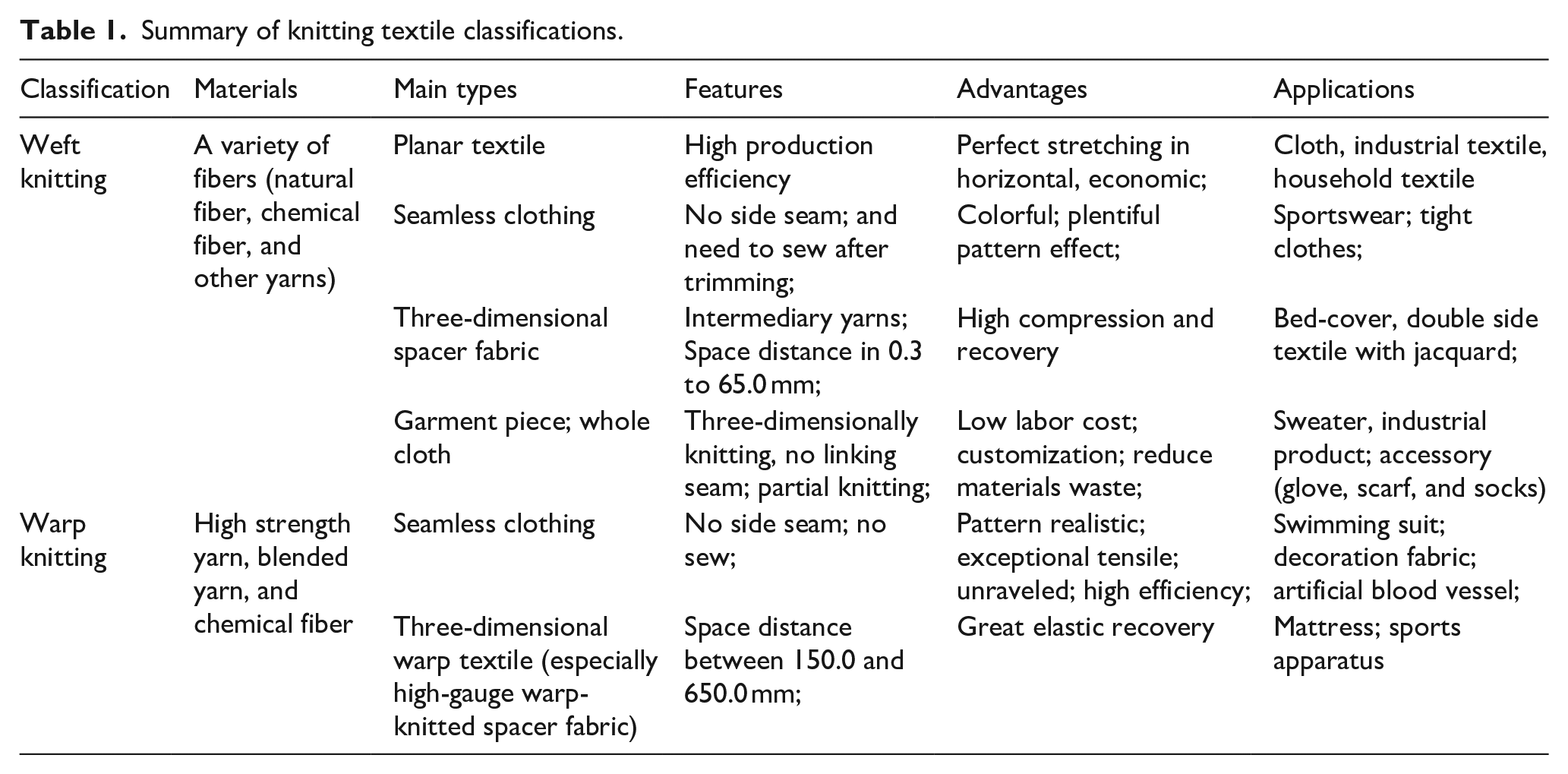
Knitted textiles are comprehensively divided into two categories due to the direction of interloping, including weft knitting and warp knitting. Weft knitted fabric is formed through several yarns which are fed into needles successively along the weft direction. A large number of yarns can simultaneously be fed into a machine that symbolizes high production efficiency. Generally, a circular knitting machine offers considerable scope for knitting specialty fabrics (such as plus, double-sided plus, and patterned plush). It provides more possibilities for developing wearable devices suitable for specific applications, endowing different sensing performances. Another remarkable characteristic of weft knitted textile is the performance of higher extensibility in the horizontal direction, which can be stretched more twice than the original. However, all weft knitted fabric will often occur unraveled immediately from the course knitted last. As wearables increase in washing and using, the drawback of unraveling gradually exacerbates, which is not fit for wearable usages requiring stability. Flat knitting is one of the weft-knitting techniques, that is good at fabricating forming textiles through coordinating between needle beds. And it is easy to knit textiles in a short time. The flat knitting technique enables cost-effective knitted various knitted fabrics that has been applied for the human-oriented flexible electronics.
Compared to weft knitted textiles, warp knitted textiles have little risk of unraveling along the course knitting direction. Because the threads are usually fed into along the warp and then forming some wale of loops. The characteristic of warp-knitting provides textiles some benefits of longitudinal extensibility and dimensional stability. As the warp knitted textiles, the simplest structure is a pillar stitch that the lapping movement is completed on the same needle. Thus, there is no connected wales that makes it difficult to form one piece of fabric. The number of needles overlapped is the essential factor for establishing a whole fabric, which needs two guide bars at least. The mesh structure is a useful application that increases the breathability of fabric under the arm and on the back. Spacer textile is typically used for pressure sensors that can be set in the shoes, with good compression performance. With the help of the multi guide bar machine, conductive threads can be simply integrated into clothing, which is similar to embroidery. Unlike embroidery, the multi guide fabrics are soft. However, with the disadvantage of the complex and long-time warping process, it seems that the warp knitting textiles are not suitable for the short cycle process and small orders.
Except for ordinary textile structures, 28 knitted textiles with distinctive structures present potential applications in the artificial intelligence area. We may use appropriate knit structures for obtaining prominent transfer charge and wearable performances. There are three typical knitting textiles, including seamless clothing, three-dimensional spacer fabrics 29 and forming fabrics. First of all, the technique of seamless can be frequently utilized in sportswear, medical dressing and skintight clothing, and the feature of no side seam that can forbid uneven pressure on the body, causing uncomfortable. Seamless fabrics have been improved on the materials selections and knitting methods, providing a large brilliant outlook on body signals detection and motions energy harvest. As for production efficiency, seamless clothing can save a third time than a common one. 30 Furthermore, three-dimensional spacer fabric consists of two face layers (top and bottom) and intermediary yarns connecting and bracing separated two layers that can achieve two layers contacted after stressing and separated after releasing. Particularly,the thickness of high-gauge warp-knitted spacer fabric is increased to more than 150 cm, owning the properties of elastic resilience, compression resistance as well as sound-absorbing. This unique structure can be widely used KNGs, providing an approach to separating electronics quickly. Thirdly, forming is the rapid development technique in decent years, improving product efficiency, reducing cost and increasing aesthetic. In particular, a four-needles bed computerized flat knitting machine is one of the primary forming equipment that enables one thread is fed into the needle and a whole apparel is completed. Combined with characteristics of high speed and material saving, the design method of applying partial knitting technology that uses the intarsia technique in the smart garment is put forward. It makes simple to knit various shapes and size regions in the designed position of textile, realizing the customization of intelligent products. This kind of knitting technique has been attracted to some concerned in all of the textile industries. When the technique is used in the smart wearable devices, a whole knitted garment with KNGs can be obtained without the need for sewing or embroidering.
The knitted textile classifications and main representative fabrics have been summarized in Table 1, wherein it can provide some information about knitting techniques. According to an overview of knitting fabric, the design of KNGs can be guided and integrated novel nano techniques with knitting techniques for fostering advanced KNGs with outstanding output performance, durability, and comfort.
Summary of knitting textile classifications.
Knitted conductive textile
Knitted conductive textiles own performances of both the ordinary knitting fabric flexible, extension and conductive functionary, making an opportunity of utilizing extensively in the smart cloth field. As for KNGs, conductive textiles are treated as electrode materials, which need to be used for transferring electrons quickly with low resistance and reducing electronic loss. It is the primary component of KNGs that is also the critical factor of influencing in output performance. Herein, improving knowledge about the kind of knitted conductive textiles and preparation methods is necessary to be considered and this is a building foundation for the KNGs system.
Conductive materials
When talking about conductive materials, it is common to use metals that own high conductivity. Stainless steel fibers are produced by Brunswick Company through drawing, which is the earliest metal fiber. Based on the merit of conductive resistance change sensibly and the temperature variation obviously for detecting thermal change, stainless steel fibers are extensively applied in hi-tech wearable industrialization. With the similar drawing method, metal fibers31,32 are made of various materials (silver (Ag), gold (Au), copper (Cu), nickel (Ni), 33 and aluminum (Al)) that exist on nature with abounding sources, and filaments of ~0.25 mm can be achieved. With the conductivity ranging from 10−4 to 10−5 Ω m−1, metal fibers are usually regarded as alternative pure metals, which will attract considerable research interests in knitting wearable devices. However, with the innate performance of rigid, it is complicated to manufacture a conductive thread because the conductive yarns are incorporated with a large number of single metal fibers, causing uneven twists and difficulty in knitting. As the processing techniques of metal materials increase in sophistication, metallic nanomaterials prepared by plating way will become a highly suitable solution for the above-mentioned problems, considering the merits of outstanding bonding with textile and knitting performance. However, plating silver threads that have been widely used in the knitted textile electronics are easy to oxidize if exposed in the air for the long term, decreasing the conductivity. So the plating silver conductive textile needs to be prevented from the air when storage. Considering the principle of knitting textile conductive, the equivalent resistance of textiles have been broken due to the large deformation of loops during stretching, resulting in the large electrical conductivity fluctuation. Moreover, the great humid effecting and washability of metal fibers are also rigorous challenges in flexible electronics.
As for the issue of rigidity and durability, the novel carbon materials with chemical durability, prominent mechanical property, high conductivity have been imposed on the researches, which are mainly included carbon nanotubes (CNT) fibers, 34 graphene fibers,35 –37 graphene composite conductive fiber, 38 carbon black fibers. 39 But there is no apparent improvements in terms of the above issues. According to the proportion of carbon, carbon-based materials are divided into carbon fibers (above 90%) and graphene (over 99%). This kind of conductive material has been appealed to the quality of researchers, with diversity fabrications and large surface area. Compared to carbon blacks, graphene and carbon nanotubes are the most popular materials in the wearable field which have better conductive performance and richer color, such as in the area of supercapacitor and stretchable sensors, in particularly wearable intelligent clothing. Due to the oxygen-containing group existence and difference, graphene has been classified into oxygen graphene with great hydrophilic and reduced oxygen graphene with better conductivity. Oxygen graphene tends to be treated by the approach to heating and chemical, endowing it conductivity. However, the poor dispersion and uniformity of solvent is one problem in spinning carbon fiber and dipping on textiles, inducing discontinuous conduction path and then reducing the conductivity and application times. The influence of carbon percentage is shown in Table 2. The number of carbon percentage is commonly set at 5% to 25%, which can keep excellent electrical properties and improve surface uniformity. In addition, when designed for marketing wearable garments, it is a complex process to obtain colorful carbon-based fibers which original color is black.
Influence of carbon percentage.

Organic polymer conductive materials are the third type of conductive materials, with advantages of outstanding electrical performance, corrosion resistance, film formation and easily combined with textiles, exhibiting high potential applications in the wearable electronics and the KNGs field. If accounting for the conductivity, the spinning is the fabulous approach that can keep original textile performance and improve the conductivity. However, with the necessity for electronic transmission increasing, the fine diameter of the fabricated thread is so difficult to control which is a complex fabricating process. Diverse strategies have been attempted to integrate organic polymer conductive materials with a piece of fabric, particularly in the reduced chemical method. Due to the short-time processes, large-scale production, inexpensive method and eligible electrical conductivity, conductive polymer textiles have been used as promising flexible substrate electrodes. Based on requirements of applications in flexible wearable devices, more and more conductive polymers have been appealed, such as polypyrrole (PPy),40,41 polyaniline (PAIN),42,43 polythiophene (PTh),44,45 and poly(3,4-ethylene dioxythiophene)-poly-(styrene sulfonate) (PEDOT: PSS). 46 Conductive polymers have been developed by covering or dipping on the textile, forming an inter-connection conductive network on the fiber surface. However, due to most of the conductive materials covered surface, the conductivity decreases after several times of frictions and washing during knitting and applying, causing a short circuit between adjacent conductive fibers. This is a significant issue limiting the widespread utilization. Besides, the coatings used will affect the comfort, breathability, stability as well as washability. Therefore, in order to combine tightly and enhance stability, it is necessary to use cross-linking agents to improve working durability. Furthermore, most conductive polymers and cross-linking agents are poisonous, which can indicate serious environmental problems and endanger human health when wearing. To integrate conductive polymers with knitting textiles well, exploring a method that can combination perfectly, washability, and stabilities is of important.
As above-mentioned conductive materials, there are different benefits and drawbacks in electronic devices utilizations. To gain maximum the advantages of various conductive materials, associating two elements together is a good choice that has been reported in some research works. To construction a continuous conductive path, graphene nanoplatelets/PEDOT: PSS, 47 graphene/PPy 48 have been reported through the coating on the fabric. Treated textiles have been demonstrated strong resistance against bending and stretching several times. It offers a promising preparation of enhancing textile performances and conductive ability in using of KNGs.
Conductive thread structure
Conductive threads are knitted into the textile for endowing conductivity that is a direct technique available. The structures of conductive thread have an enormous influence on the properties of the fabric, such as density, thickness, electrical performance, mechanism, and comfortable. Numerous structures have been designed and accepted to generate conductive threads, such as the type of monofilament, wrapping structure, core-shell structure, and wrinkle structure. Herein, it is necessary to summarize structures of conductive fibers for the textile-based electrode in KNGs in Table 3.
Summary of structures of conductive fibers.
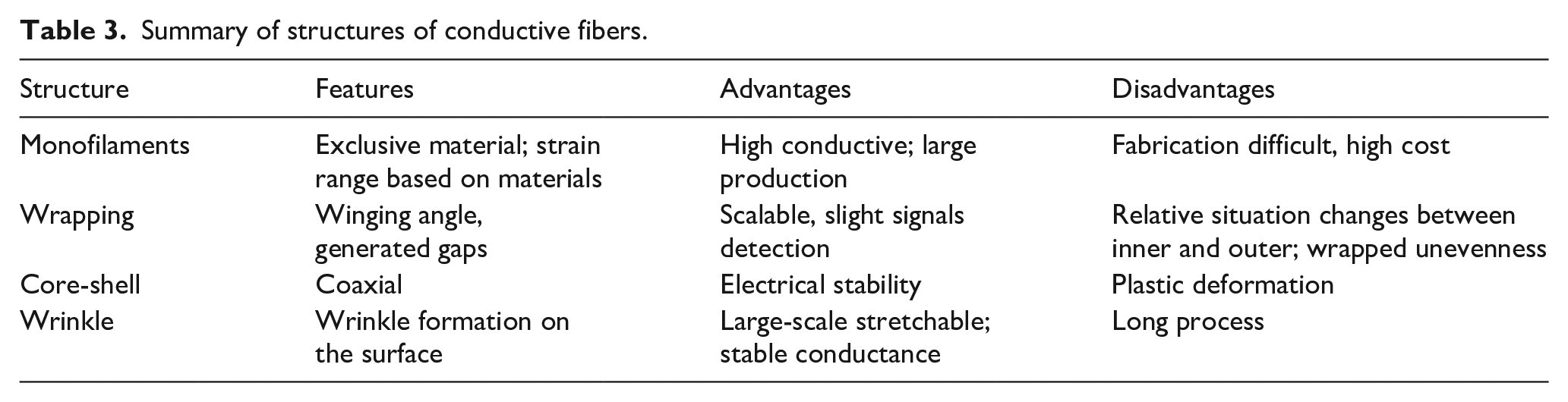
Conductive monofilaments are the uniform type conductive threads that can be spun directly. As for conductive monofilament, that is rarely utilization because of its heavy weight and interference between fibers if it is knitted into textiles. Monofilaments’ fabrication is an elaborate procession, especially for preparing small diameter fibers, wasting a lot of time. Furthermore, the performance of poor stretchability limits practical applications in flexible electronics. To compensate shortcomings of flexibility and knitting, wrapped structure has been designed for conductive threads, which is also the most straightforward method for enhancing strain range.
Wrapping constructed fibers 49 a simple structure available which is commonly composed of an elastic yarn as trunk and conductive fibers wrapping around “the trunk,” exhibiting “Z” or “S” styles. Either one layer or multilayer is wrapped on the surface that provides some benefits to prepare a large-scale stretchability and controllable torsional actuation mechanism.50,51 Fiber stretchability is the most significant improvement, which can enhance the conductive cloth comfort and application areas. The contact area, thickness, and tightness can be changed through the deformation of stretching induced by the human motions. However, the increase in winding angle and generated gaps between layers during stretching can reduce the efficient contact area, 52 resulting in electrical resistance enhancement, the time of using and washing, the deformation of the thread has obviously loosened, which changes the relative location and the contact area between inner and outer, decreasing the conductivity. These are the great challenges to wrap-structural conductive yarns.
As an improvement structure, core-shell structure49,53 –55 has been employed in the design of conductive threads, which is also named the coaxial structure. Both elastomer (including silicone rubber and polyurethane (PU), fibers and so on) as shell and conductive fibers as the core 56 and the opposite structure, 55 both are ordinary methods to constructing one core or multiple cores of flexible conductive fibers. With the merits of stretchability, core-shell fibers can be adopted in large scale movements for several cycles, hindering crack and break appearances. The high ratio of conductive materials with the number of cores increasing owns great conductivity ability. The common core-shell threads include plating Ag/nylon, PDMS covered nylon, PU covered stain steel yarn and so on. Currently, plating Ag/nylon yarn is one of the popular core-shell conductive threads with advantages of quickly knitting and high strain-scale, but limitations are the poor anti-oxidation and washability which cause a short-time operation. A team did a oxidation experiment and then tested the change of yarns resistance. The resistance of one yarn decreases by 8.3% after 30 times laundering. 57 In the research paper, 58 the resistance of threads exposed to the air has increased by 20% after 35 days. However, there is no apparent change in the outward and resistance of yarns stored in bags that do not contact air.
Wrinkle structure inspired by the creeping worms has been designed for a sensor of tracking human motions (strains > 100%), obtaining ideal stretchability. However, stable conductance is an essential factor that should be discussed during stretching. Coating worm-shaped graphene on the surface of PU fiber enables be strained to 1010% with the long-term durability of up to 4000 times. 59 For applying in wearable devices, conductive threads need to require the demand of washing in full water conditions. The stretchable conductive fibers can be improved through the prestrained water resistance elastic fibers which are covered on the surface. It is not only keeping good conductivity but also is fit into the underwater for a long-time 60 that is the promising application of conductive fiber under large-scale strain and underwater wearable electronics.
Conductive textile structure
Knitting conductive thread is a different kind of feasible approach to form conductive fabrics, however, it is hard to knit through commercial machines due to the rigid mechanics. Herein, the development of intelligent devices has witnessed the emergence and growth of conductive textiles. To realize the facile fabrication and commercialization, conventional textiles are served as flexible substrates treating with conductive materials. Multiple layer structures are the most attractive due to diversity materials, simple preparation, low cost and high electrical, which is the result of stacking many layers in the method of coating, dipping, printing, spraying, paste, and so on. A substantial number of materials can be available for these methods, no matter in what forms, including particles, solvents, and powders. However, most of the conductive materials covering the fabric surface forms a continuous conductive film. When knitting, wearing and washing, the conductive elements on the textile are accessible to exfoliation or cracks generation, resulting in the conductivity path broken and reducing electrical ability. To enhance the combination of conductive materials and fabrics, chemical cross-linking agents are commonly used, but that is toxic and un-friendly. In particular, chemicals added on the surface of conductive textile can cause skin irritation and threaten human safety when directly contacting with skin. Besides, if the multilayers structure is sewed or knitted in the cloth, with the features of thickness and large weight increasing, the ability of air-permeable and thermal and moisture comfort will be decreased.
Human motion energy
The human body is the core of energy that is rich in substantial mechanical energy. Human biomechanical energy can be generated by numerous forms motions and continuously as long as users keep moving, including elbows, knees, legs, feet, necks, arm, and waist. They show outstanding motion abilities and good flexibility. Herein, triboelectric nanogenerators have improved the energy supplement system of wearable devices through converting biomechanical energy 61 which is generated on the biomechanical energy into electricity, with the merits of facile, clean, sustainable and high. The type of harvesting human movements is served as an energy source has attracted much attention on constructing a perfect wearable system. Herein, the features of human motion and the amount of human energy should be considered for understanding the source of biomechanical power.
The features of human movements
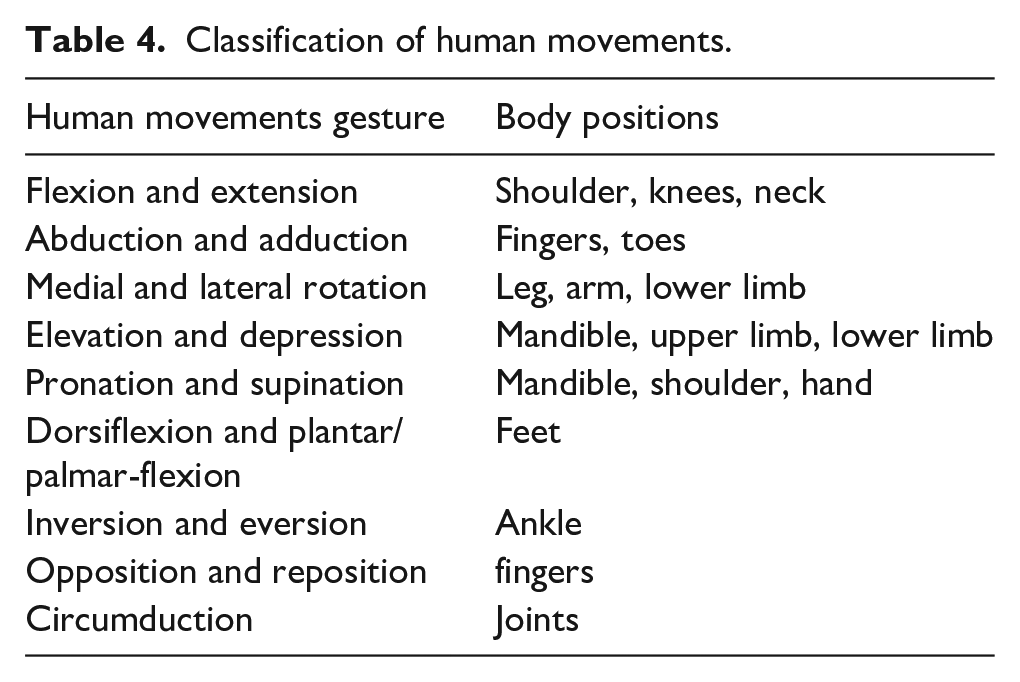
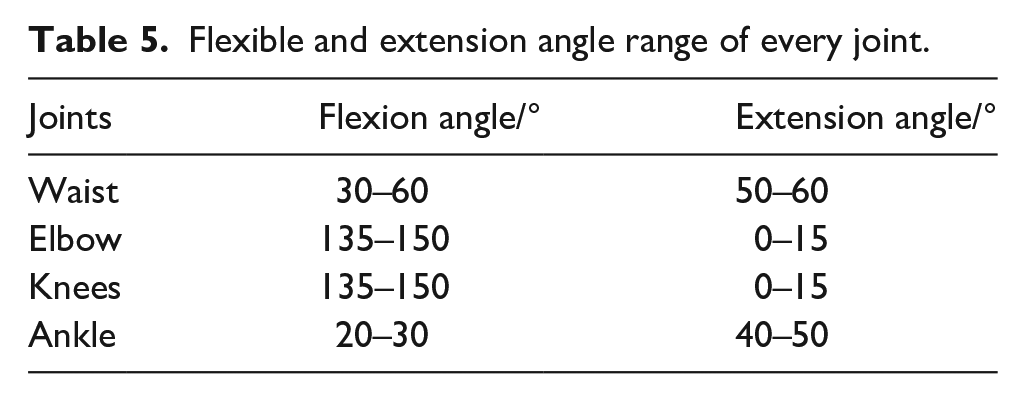
Human motions mainly include large-scale movements and subtle motions, which are generated by both muscles and joints cooperation. Generally, there are nine kinds of classifications about human movements shown in Table 4. Based on a variety of body movements and the characteristics of human motions, the mechanical deformation of different body parts can be the design rule of KNGs for harvesting maximum energy. Except for the slide friction and contact movements under the arm, the stretchable motions of the joints are the main human motion mode, wherein the maximum swing angle range should be concerned. Table 5 shows the flexion and extension angle range of the main joint during movement is tested through a joint protractor. 62 In addition to the above noticeable movements, there are some small-scale motions on the different positions of the body, such as pulse, respiration, and throat motions. These micro-variations have been rarely used for harvesting energy due to low production and slightly change, while most of them are just detected as personal health signals.
Classification of human movements.
Flexible and extension angle range of every joint.
Human energy
Human energy is generated by primary metabolism and exercises, which provides thermal to protect organs working regularly. But most of the body mechanism energy has been wasted due to people have no unconscious of harvesting and utilization. Starner 63 calculated the kinetic energy output of a 68 kilogram male in diversity motions, which exhibited in Table 6. 64 Especially, limb motions are described as the most energy generation, including walking, running, shaking, swinging and movement of joints. It has been estimated that 1% to 5% of harvesting body energy can satisfy for running wearable electronics. 63 Shown in Table 7, 65 the most electrical miniaturization applications consume power that can be fully supported by human movements. For example, transmitting data via Bluetooth needs 1 to 10 mW power. 66 In principle, all of the biomechanical energy can be harvested through KNGs.
Energy output of a male.

Energy consumption of sensor for 1 min.

Knitted-textile triboelectric nanogenerators
The triboelectric nanogenerator (TENG) was invented in the Georgia Institute of Technology, 67 coupling with the effect of triboelectrification and electrostatic induction. 25 This is a common phenomenon in our daily life. TENG is an energy harvest equipment capable of converting mechanical energy into electricity, which is not only utilized for supplying power, but also can be treated as self-power sensors. Since the applications are applied on harvesting biomechanical energy, it is necessary to consider materials, constructions as well as sensing sensitivity. In previous studies, TENGs are usually designed in the type of rigid, influencing flexible and wearable comfort, which are not suitable for integrating into the garment. With the merits of slightness, transparent and nanostructures, most of the film structural TENGs have been developed at present,68 –72 which can obtain high output performance. However, as a result of the low stretchability of film structures, 73 the performance of electrical stability and durability have restricted potential applications for harvesting full-range human motions. Cracks may be appeared 74 when the membrane structure is applied in large-scale motions, such as knees, elbows and other joints motions. After stretching for several times, the continuous film-based generator will lose elastic recovery, and thus reducing charge output performance, stability and durability. Knitted-textile exhibits benefits of a lightweight, flexible and multiple bending, wearing comfort and low-cost, large charge transfer, so that this kind of generator 75 can be applied to attach to daily clothing, which has no limit on human movements and easy to reach industrialization. These advantages have provided an excellent opportunity to innovate self-power wearable devices.
Working modes and working mechanism of KNGs
Depended on the circuit and load connection, KNGs can be divided into four working modes, including vertical contact separation mode, lateral sliding mode, single electrode mode, and freestanding triboelectric layer mode. 76 Every method has its structural feature, which proposes in knit structure for harvesting human biomechanics energy, which has been compared in Table 8. It is promising that it can be provided design guidance for future applications in the human body.
The summary of four working modes of KNGs.
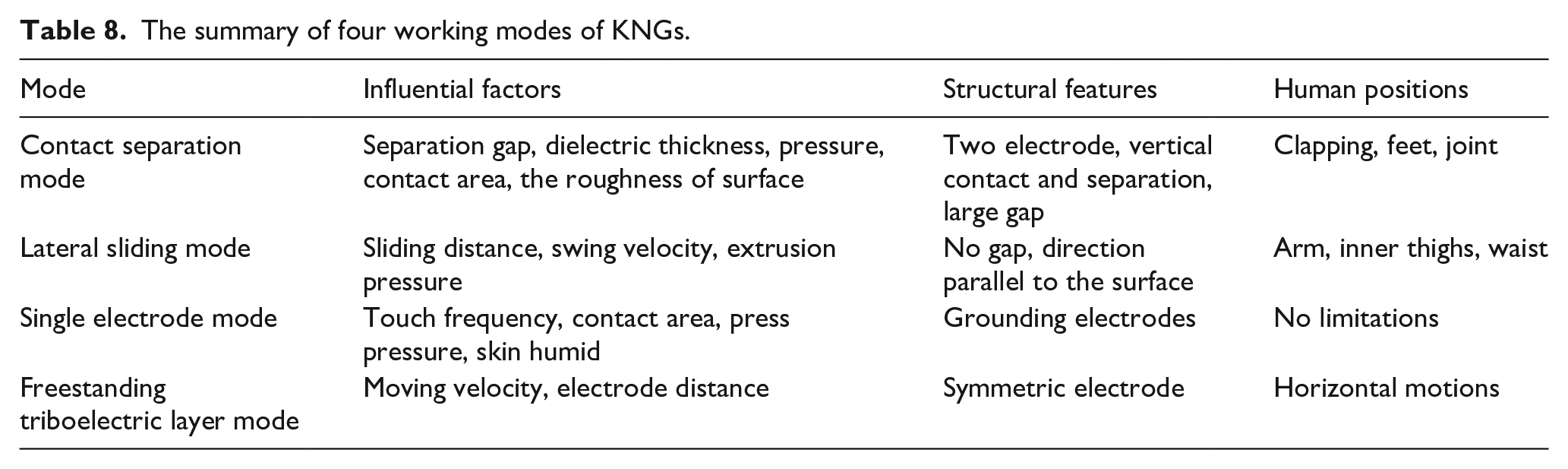
Vertical contact separation mode is universal in harvesting human energy with a simple structure which is caused by two materials relative motion in vertical direction imposed external force. Though contacting and separating between two dielectric materials, the electrical potential exists on the surface of materials wherein one element is charged with positive and the other is a negative charge. When they are separating from each, an external circuit is necessary for transmitting charge, achieving at neutralization. Based on the features of human movements, this working model has wide applications, which is suitable for harvesting energy of walking, running, and patting hand in ordinary life. Similar to vertical contact separation mode, lateral sliding mode is operated in the horizontal direction for a period of time not vertical motions. Through lateral-sliding mode, both knitted textiles can be continuously rubbed and this mode is mainly constructed for planar harvesting movements, which contains motions of inside thighs and under the arms. Freestanding triboelectric layer mode is one of the most significant working modes that consists of a moving item and a couple of unconnected electrodes, and the size of dielectric materials is the same as the electrode. As the moving distance changing, freestanding height and distance between two electrodes should be considered, which play essential roles in the output performance. Above all mentioned working modes, the number of electrodes is two, which is often set on the back of dielectric materials. When applying on the garment, the fixed electrode has an impact on the efficiency of these working modes and thus limits human motions. With the merits of a single electrode, moving freely, the single electrode mode has been designed for suiting versatile applications, which owns a grounding electrode. Skin tends to be the earth electrode due to the skin is an electrical conductor with the positive charge. The advantages of simple assembly and one unfixable electrode allow KNGs to carry and integrate easily.
No matter what kinds of mode operating, the working mechanism is the same that is coupling with triboelectrification and electrostatic induction. The working mechanism can be introduced in detail by contact-separation working mode, as shown in Figure 2. Initially, both friction systems completely contact without a potential difference. When external forced on the textile, the potential charge can increase with the distance away which leads to current flow in the external circuit. But the distance is getting more far, the charge difference vanished and every part shows the electric neutrality. Until contact again under the pressure, the opposite current is generated for balancing the induced charge on the electrode. That is a cycle that can convert human motions into electrical through contacting and separating repeated, generating self-power currently.

Working mechanism based on contact-separation working mode.
Dielectric substances
It is widely known that the triboelectric effect occurs in two materials with various charged intensity during contacting progress, such as metal, wood, natural fibers, polymers, and so on. The same material is influenced by different temperature and humid that have different abilities to gain or lose electrons.18,77 Owing to the different triboelectric polarities of materials, the ability of electrical generation is different and the output performance of KNGs also has been effected. 78 Therefore, there are extensive materials that can be applied in KNGs79,80 which have been quantified by the triboelectric series. 81 This series rank reveals the capability of various materials to obtain or lose electrons after contact electrification, which is regarded as the intrinsic characteristic. Referring to the charged sequence, 82 the longer distance between two substances is set on the series with opposite triboelectric polarities, the more charge-transfer has been obtained. The triboelectric series has a long development that contains ten ordinary materials in the order of polarity as the first one. Then the series has been gradually perfected, adding some natural and synthetic materials. Until the year of 2019, Zou et al. 81 have introduced a triboelectric series for abounding materials and it is crucial to enhance output performance through material selection in the development of KNGs.
The integration of dielectric materials with conventional knitted textiles bring more possibilities for wearable devices. The textile-based dielectric layer is expected to own the properties of facile knitting, high stretchability and compatible into clothing. Therefore, based on the ability of charge transfer, common textile materials are treated as dielectric substances that allow some novel researches in the progress of KNGs, such as polyethylene terephthalate (PET),83 –85 polyamide, 86 polytetrafluoroethylene (PTFE), 12 Poly(vinylidene fluoride) (PVDF). 49
But the charge potential of the two dielectric materials keep constant under the same situation, and it is challenging to increase charge output only through changing materials, limiting the development of triboelectric generators. Consequently, some researchers have focused on methods on how to modify fibers and fabrics through chemical and nano techniques for enhancing large contact area and increasing roughness of the surface, which is the most significant factor for increasing the charge transfer and ability of harvesting. Through summarize many works, three major ways have been introduced. The first is micro-nano fiber and fabric fabrication. The surface morphology of contacting textiles can be modified through micro-machining, which is required to achieve a large contact area and improve electrostatic induction for highly effective KNGs. Typically, preparations of the micro-nano structure referred to several deformations that are in the shape of an arch, pyramid, rectangle, and semi-circle. The second is chemical treatment due to nano-structures adhering to the surface of textiles for increasing their roughness, such as various molecules, nanotube, nano-wires, and nano-particles. The last one is the surface functionalization. Although nano techniques have the advantages of high efficiency, it is hard to integrate into wearable devices due to high cost, complicated process and un-friendly. According to the features of textiles, the structure is another research direction for enhancing the contact area and the roughness that it’s critical. Kwak et al. 12 investigated the impact of the basic textile structure (including plain-, double-, and rib-fabric structures) as the key factor influencing the performance of transfer charge. The rib-fabric structure can be stretched up to 30% and the contact area can be enlarged to 180 cm2, because of the middle region existence. As a result, the KNG can generate the highest current and power of 1.05 μA and 60 μW, respectively. Herein, KNGs will bring new vitality and more possibilities for the wearable functional devices, and change the way of power supply through biomechanical energy harvest.
Design of KNGs for the harvesting of energy produced by human motions
KNGs are highly desirable for the novation of the self-powering wearable electronics that own the properties of flexible, high stretchability, large deformation, comfortable, and washability. More importantly, loops are the basic unit of knitted fabrics that influence on the electrical performance. Through the change of the position in each loop contacting, different electrical signals can be generated. The knitted textiles have been used in a strain sensor for recognition human motions which cause electrical resistance change, 87 due to the large deformation of structures. It can be believed that the knitted textile have potential applications on biomechanical signals. The development of KNGs can give satisfactory output performance for harvesting different human movements, especially for nonplanar shapes. Based on the different characteristics of human motions, divided into stretchable-type and contact-type, KNGs have been designed in diversity formations for requiring the demand for harvesting biomechanical energy. Herein, the structural, working modes, electrical performance, and wearability regard to the textile-based TENGs are developed that can provide some supports for designing KNGs. The main discussions are about the two categories, stretchable-type KNGs and contacting-type KNGs.
Stretchable-type KNGs
When it comes to harvest joints energy, the features of stretchability in elbows, knees, wrist, and fingers, should be concerned for designing the structure of KNGs. By stretching, compression, bending, and twisting of joints and muscles, large-scale deformation of textiles is easy to be obtained. Due to the deformation of textiles, electrons can be separated so quickly for generating charge transfer. Herein, the stretchable-type is the typical adopted structure in the design of KNGs for harvesting joints energy. Based on human joints movements, contact-separation mode and single-electrode mode are usually used in the stretchable-type KNGs. In order to realize working modes, fibers and textiles are designed in unique structures for harvesting biomechanics energy.
Fiber is the smallest element of knitted textile and the simplest unit of harvesting, which can be fabricated in core-sheath structure33,88 and coaxial structure89,90 for harvesting kinematic energy. The contact-separation mode fibers are commonly designed as core-sheath which shows an inner hollow or gaps between layers.33,88 The space between inner and outer allows two materials with different triboelectric polarities easily contact, inducing charge transfer. Once remove the external force, the charge can be separated quickly due to the shape recovery. The potential difference can be balanced through the external circuit.
In the beginning, one gap has been developed between the core and the sheath, in which the inner materials as elastomer and cover with conductive materials as electrode 91 (Figure 3(a)). Then the outer is fabricated as a spiral structure which can enhance stretchable 92 (Figure 3(b)). The structure of the spiral also has been developed as an inner layer, endowing excellent stretchability, which provides a good opportunity for harvesting pressing, bending, twisting, and lengthening human movements 93 (Figure 3(c)). With the improvement of fiber preparation, fiber-based KNGs are incorporated into cloth, which have excellent abilities to be tailored and sewn 94 (Figure 3(d)). Two or more gaps between the inner tube, middle tube as well as out tube forming the hollow structure have been designed for converting energy from varied enforcing directions into electrical energy54,95 (Figure 3(e) and (f)). However, there is a big issue that is electric leakage, which should be improved during application. Herein, increasing a layer is made of flexible insulating materials, which lies outside of the whole fiber, such as PDMS 88 (Figure 3(g)), silicone rubber96,97 (Figure 3(h) and (i)). In previous researches, these stretchable triboelectric materials have been reported also can strain up to 70% in wire-convolving fibers. 92 In addition, it is difficult to knit because of these fibers are in big diameter, which is not common fiber materials and not suitable for textile industrial production. Currently, the wrinkled structure is a novel construction improvement of the core-sheath structure fibers, which are often used as the main structure of stretchable conductive fibers. The commonly used shell elastomer pre-tension and then release the stretch, producing wrinkle type. Wrinkle-structural is a high efficiency way when it is desirable to apply on the body part of high strain, arriving at 100% to 300% stretchability and enhancing the stability for using several times. For example, the wrinkled structure was designed with silver-coated nylon/PU fiber and polyvinylidene fluoride-co-trifluoroethylene (PVDF-TrFE)/CNT as the negative material 49 (Figure 3(j)). Its large stretchable (about 50%) was obtained by strained fiber was released due to the different Poisson’s ratio, monitoring kinematic movements. However, the wrinkle structure is hard to get large deformations when stretching in small strain, resulting in the ability to transfer electrical signals decline, which is not suitable for sensing small-scale human motions. Combing nanogenerator techniques with wrinkle fibers provides some novel developments of KNGs, which can withstand washability and bending times for ten thousand applying on the joints and can capture subtle signals. This kind of fibers with micro diameter dimensions has provided a possibility to apply in knitting.
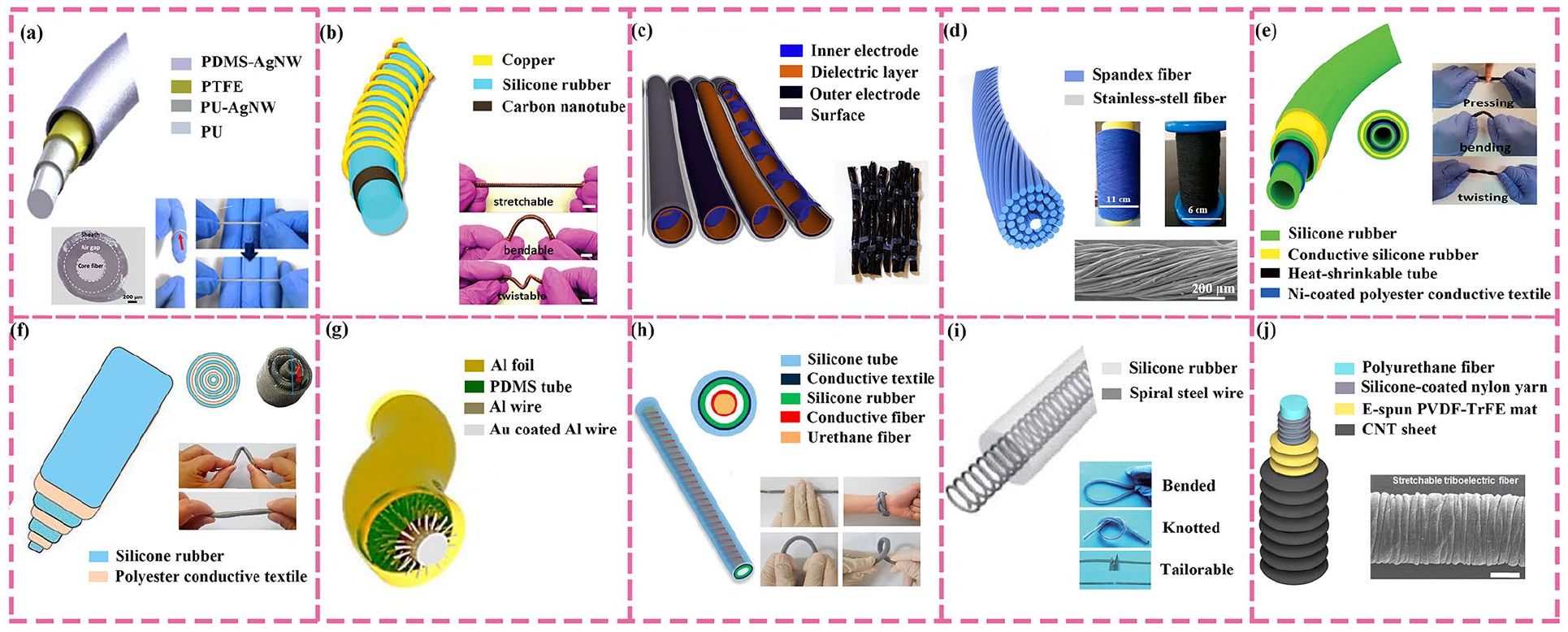
Core sheath structural fiber-based triboelectric nanogenerator. (a) PU as inner and covered with conductive as electrode. Reproduced with permission. 91 Copyright 2017, Elsevier. (b) Spiral structure as outer layer. Reproduced with permission. 92 Copyright 2017, Wiley-VCH. (c) Spiral structure as inner layer. Reproduced under the terms of the Creative Commons Attribution 4.0 International License (http://creativecommons.org/licenses/by/4.0/). 93 Copyright 2016. The Authors, published by Springer Nature. (d) The real fiber with core-sheath structure. Reproduced with permission. 94 Copyright 2017, American Chemical Society. (e) Two gaps in fiber. Reproduced with permission. 59 Copyright 2018, Royal Society of Chemistry. (f) More than two gaps. Reproduced with permission. Copyright 2019, (http://creativecommons.org/licenses/by/4.0/). 98 Copyright 2019, The Authors, published by MDPI. (g) Electrode protected by PDMS. Reproduced with permission. 88 Copyright 2019, American Chemical Society. (h and i) Electrode protected by silicone rubber. Reproduced with permission.96,97 Copyright 2019, American Chemical Society. (j) Wrinkled structure fiber. Reproduced under the terms of the CC-BY Creative Commons Attribution 4.0 International License (http://creativecommons.org/licenses/by/4.0/) 49 Copyright 2016, The Authors, Published by Springer Nature.
Although the core-sheath structural fibers are facile to harvest energy power and have better flexibility, the fabrication of hollow structural is a complex process that takes some time, costs much and difficult to control the fiber strength. To obtain wide applications in knitted textiles, coaxial structural fibers in single electrode mode are usually designed. It is a conventional method to wrap conductive fiber for achieving the coaxial structure, and there are many yarns used such as stainless steel fibers 98 (Figure 4(a)), polyamide fiber coated by Ag 99 (Figure 4(b)). Then the double helix structure is also the common combination approach of coaxial yarns. The single-electrode yarn-based TENGs can be prepared by two coaxial yarns in a double helix structure. For example, a double helix structure yarn consists of two threads which includes a cotton thread coated CNT as an electrode and the other is CNT yarn coated PDMS 89 (Figure 4(c)). However, the CNT electrode is inelastic that is hard to adapt to large-scale human motions, leading to appear cracks and broke the conductive path within stretching. In order to endow single electrode fibers stretchability, wrapped fibers are designed for the improvement. Instead of coating conductive materials on the core yarn, compress structure or spiral conductive materials have been developed. Stretchable fibers tend to coil around the elastic rubber and then dip-coated silicone on the whole surface 100 (Figure 4(d)), which can be strained over 30%. Finally, the twisted conductive yarns are covered on the silicone rubber as the other electrode. Due to the different electron affinity of silicone rubber and conductive fiber, charge movement is lead through stretching. To simplify the fabrication process, the outmost layer is coated silicon rubber without twisting conductive yarns 55 (Figure 4(e)). The energy is obtained by contacting skin, which is convenient to wear and fabricate. As a wearable self-power system, the fiber-based triboelectric nanogenerator needs to be working when contacting sweating skin. Herein, a highly stretchable, continuous and amphibious energy yarns have been manufactured, which consists of built-in helical structure stainless steel yarn and silicone rubber coverage 56 (Figure 4(f)). It facilitates the fabricating of large-scale self-power textiles and has broad application prospects in harvesting biomechanism energy.

Coaxial structural fiber-based triboelectric nanogenerator. (a) Stainless steel yarn coaxial fiber. Reproduced with permission. 98 Copyright 2017, Wiley-VCH. (b) Polyamide yarn coaxial fiber. Reproduced with permission. 99 Copyright 2019, Elsevier. (c) Double helix structure coaxial fiber. Reproduced with permission. 89 Copyright 2017, American Chemical Society. (d) Conductive fibers are coiled on the surface of silicone rubber. Reproduced with permission. 100 Copyright 2017, IEEE. (e) Working through contacting with skin. Reproduced with permission. 55 Copyright 2017, The Royal Society of Chemistry. (f) A water-resistant modified coaxial fiber. Reproduced under the terms of the CC-BY Creative Commons Attribution 4.0 International License (http://creativecommons.org/licenses/by/4.0/) 56 Copyright 2019, The Authors, published by Springer Nature.
Considering the limited stretching of single electrode fibers, the textiles knitted by stretchable yarns are reported. The textile structure is an effective method that can improve the stretchability of KNGs, especially in knitting structures. Imitating the loop stitch, the serpentine shape was sewed in both sides of the elastic textile, using silicone-rubber-coated stainless-steel thread 98 (Figure 5(a)). The higher stretchable can be achieved than ever reported in coaxial yarn. But the silicone rubber directly contacts with the skin that may cause allergic which is a necessary issue that should be solved at present. Therefore, real knitted textiles are a crucial point to solve the problem. The KNGs are fabricated based on the knitted textile substrate with the merits of not only fitting for the body but also breathable. Electrode and dielectric materials are selected from common cloth fibers, which are accessible to knitting. Most importantly, the whole KNGs are knitted by commercial textile machines, and the KNGs are comfortable, washable and tailorable. These features were further illustrated that the KNGs have an increasing attraction in wearable devices.

Textile-based stretchable-type KNGs. (a) Serpentine shape textile. Reproduced with permission. 98 Copyright 2017, Wiley-VCH. (b) Interlock structure knitted structure. Reproduced with permission. 99 Copyright 2019, Elsevier. (c) Double arch shape textile. Reproduced with permission. 12 Copyright 2017, American Chemical Society. (d) Single arch structure formed by sewn. Reproduced with permission. 101 Copyright 2019, American Chemical Society. (e) PEDOT: PSS coated knitted textile with single arch structure. Reproduced with permission. 102 Copyright 2019, Elsevier. (f) Multi-arch structure. Reproduced with permission. 46 Copyright 2019, Elsevier. (g) Middle wavy layer. Reproduced with permission. 83 Copyright 2017, Wiley-VCH. (h) Corrugated structural textile. Reproduced under the terms of the CC-BY Creative Commons Attribution 4.0 International License (http://creativecommons.org/licenses/by/4.0/). 78 Copyright 2017, The Authors, Published by Springer Nature.
In order to obtain large-scale stretchability, veritable knitted fabrics have also been studied in terms of the structural design. Through varied knitted techniques, KNGs based on the different structures can be prepared to optimize stretchable, breathable and fitting bodies, as well as industrialization. As the development of KNGs, the relationship between textile structures and output performance has been discussed in many research works. Plain is an ordinary knitted structure with high elasticity, due to loops can be stretched easily in any directions. With the advantages of high flexibility, the plain structure of KNGs 94 has been proposed for harvesting human biomechanism energy. But the feature of the plain structure is not stable and is facile to deformation, causing the instability of power output. To optimize the performance of transfer charge, interlock structure knitted fabric 99 (Figure 5(b)) used in coaxial yarn has been introduced. Both high stretchability and double-face structure, it has provided to bring continuous current outputs and is convince to be utilized in daily life (walking and running et al.).
Compared to standard planar fabrics, three-dimensional textiles process substantial movement space in the thickness direction, providing more possibilities for enhancing output performance and strain scale. The double arch shape has been designed for KNGs, wherein the number of the gap is attributed to the number of arch structures. In previous work, the top and bottom textile were knitted in the same (rib-, double-, and plain structure), which combined inner knitted PTFE fibers with outer knitted Ag fibers 12 (Figure 5(c)). And an Ag knitted textile lies in the middle between the top and bottom layers, which is the inner electrode. To simplify the circuit connection, a single arch structure has been applied. A stitched arch is commonly used in the design of KNGs. PDMS microrod array was grown on the surface of spandex fabric as a part of TENG, and then was sewed onto the elbow for harvest human elbow energy 101 (Figure 5(d)). When the elbow is bent, the TENG is dominated for completing energy harvest by both parts contacting with each other. Another TENG with a similar structure as above consisted of PEDOT: PSS coated textile, which was set on the glove-based interface for sensing fingers bending gestures (Figure 5(e)). 102 However, flexibility is both an advantage and a disadvantage in the arch structure design. Therefore, in order to improve the issue of weak sustenance of textile-based double-arch shape, there is an innovative method utilized through stitching textiles with designed spaces, forming varied sizes arch structure. Poly (3,4-ethylene dioxythiophene): poly (styrene sulfonate) (PEDOT: PSS) functional textile with the conductive and positive charge was designed as an arch part, allowing relative simple process and more extensive strain range shown in the Figure 5(f), including consistent-height multi-arch and height-varying multi-arch structure. 46 In order to promote the output, a counter arch-shape was also investigated, but seldom was used in the textile-based. This is because of ordinary textile own high flexible without hard enough, which is difficult to shape counter arch structures and keep wearing comfortable. Instead of the arch structure in knitted textiles, a novel wavy-shape has been achieved by bending fabric continuously and fixing after finishing one wave. For instance, a wavy knitted textile was comprised of PET fabric as the middle layer, and a couple of cloths as an upper and lower layer 83 (Figure 5(g)). When compressing the KNGs, the structure change of the middle layer will induce the contact area change, resulting in a variety of electrical signals and making a convenient to be self-power pressure sensors. The wavy-shape is also named corrugated structural, which can be a sewn textile-based triboelectric nanogenerator 78 (Figure 5(h)). The power is generated by stretching, pressing as well as rubbing movements, reaching 28.13 V, 119.1 V, and 11.2 V, respectively.
The combination of traditional fibers and textiles and TENGs can provide some promising ideas for stretchable-type KNGs. Generally speaking, the fibers and textiles should be comparable in the advantage of stretching applications for harvest biomechanical energy of different stretching human motions. Herein, the summary of stretchable-type KNGs (including fiber-based and textile-based) are listed in Table 9.
The summary and comparison of stretchable-type KNGs (including fiber-based and textile-based).

Contact-type KNGs
Except for stretching and bending in joints, swing underarms and thighs are also the primary postures on daily motions. About two phases have been divided during walking or running, named stance phase and swing phase, which are based on the angle of foot landing and knee bending. In order to keep balance, it is crucial to swinging arms in the period of terminal swing. Cloths on the inside of thighs are rubbed frequently due to two legs moving forth and back. Above mentioned movements, energy harvest is mainly from the planar structure and clothes in these locations are rarely bending and twisting. Herein, two pieces of fabric with different triboelectric polarities contacted with each other, which is a facilitating and direct fabrication to suit these features of movements for harvesting human motions. Considering the output performance of the triboelectric nanogenerator, textile-based energy harvest is definitely a better development than fiber structure, which owns much more contact area and short-time production. Among the four kinds of working modes, contact separation mode, lateral sliding mode and single electrode mode are the better selection for collecting human movements simply.
For fabricating easily, the weaving technique is the first selection and is the beginning of a textile-based triboelectric nanogenerator, which has been an extensive utilization in the handicraft stage. Some strips are woven forming the whole fabric, in which conductive strips are pasted onto the surface of nylon and polyester strips as part of a textile-based triboelectric nanogenerator 86 (Figure 6(a)). In order to enhance the charge transfer and stability, both materials selection and the circuit connection are discussed and improved. From Ni-based84,103 (Figure 6(b) and (c)) to Cu-based 104 (Figure 6(d)), metal strips are treated as the electrode, showing a lower resistance and reducing electrons waste. The same point in those researches is the plain fabric structure. The plain structure has been attracted some interests from the merits of facilitating fabrication, which is woven through each weft wire over and under the warp wires at 90° angles. Due to the large deformations of human motions, the stability of triboelectric nanogenerator and textile structures may be damaged in traditional weaving structures. The woven-based TENGs are usually hand-woven due to the limitation of yarn diameter. Herein, the manual technique wastes much time and has low production efficiency. Weaving structures are not an excellent textile structure for harvesting swing energy, when it comes to the performance of bad flexible and fitting. Compared to the weaving technique, knit fabrics are more and more popular with excellent flexibility, obtaining some developments in harvesting biomechanics energy. To meet the demand of knitting techniques, the thread needs to be kept the certain diameters for suiting different types of knitting machines. The strip is hard to be used in the industrial production of knitting, while it has been provided as a general fabrication for preparing KNGs. To complete the contact separation convenient and improve the output performance, three-dimension knitted textiles have been prepared with the same working mechanism, which have the merits of high porosity, great elastic resilience and enough contact and separation space in the thickness direction. A textile with a 3D orthogonal woven structure is a successful development that can be applied for harvesting biomechanical energy and tracking motion signals 105 (Figure 6(e)). However, this is a long-time process for braiding yarns. Herein, a kind of three-dimensional textile forming technique needs to be paid much attention. As exhibited in Figure 6(f), PET-based warp spacer fabric is immersed into PDMS, which endows the elastic in the thickness direction, accomplishing the process of dielectric materials fabrication. 29 A similar three-dimensional fabric structure also can be fabricated by a flat knitting machine 106 (Figure 6(g)), which tries to obtain the real cloth texture. The 3D weft-knitted textile-based triboelectric nanogenerator consists of the top layer of Ag-coated nylon fibers, the bottom layer of PAN fibers as well as middle link fiber of cotton. Above all mentioned, these characteristics of the structure are designed in a three-dimensional direction for boosting the capability of output performance and satisfying individual exercise requirements. However, they are not suitable for integrating into smart devices with portable and comfortable due to enlarged space dimensional structure in the vertical direction.

Contact-type fabric-based triboelectric nanogenerators. (a) Textile structure woven by nylon/Ag strips and PET/Ag strips. Reproduced with permission. 86 Copyright 2016, American Chemical Society. (b) Textile structure woven by Ni-coated PET strips and then covered parylene film. Reproduced with permission. 12 Copyright 2015, Wiley-VCH. (c) Textile structure woven by Ni-coated PET strips and silicone rubber covered Ni-coated PET. Reproduced with permission 103 Copyright 2017, Elsevier. (d) Washable textile woven by PTFE/Cu strips. Reproduced with permission. 104 Copyright 2018, Royal Society of Chemistry. (e) A 3D orthogonal woven textile. Reproduced with permission. 105 Copyright 2018, Wiley-VCH. (f) A PET-based warp spacer fabric. Reproduced with permission. 29 Copyright 2016, Royal Society of Chemistry. (g) An all-textile power devices. Reproduced with permission. 106 Copyright 2019, Elsevier.
Considering the features of swing forth and back of arm and legs, the lateral-sliding mode is commonly used which is beneficial for combining human motions with typical garments. To facilitating preparation and enhancing the output performance in the horizontal direction, a whole textile consists of either different triboelectric polarities fabrics or interlaced structures with grating, which can be prepared by pasting and sewing. For example, PA and PET cloth strips can be pasted on the cotton substrate with an interdigitating structure 107 (Figure 7(a)). The generator is able to be folded, kneaded, and washed and after washing, the generator has little influence on the output performance, keeping 0.2 mA and 2 kV. However, the method of pasting on the garment reduces the operational lifetime of the generator after utilizing several times, with peeling off the pasted part. With the advanced developments of chemical and physical techniques, this issue has been improved. In order to alternate the cloth strips, approaches of printing 108 and laser 109 have been invested in recent researches. For example, the textile is composed of the upper substrate of nylon fabric and PVC HTV with gratings and lower substrate with conductive Ag on a PVC coated fabric 108 shown in Figure 7(b). As shown in Figure 7(c), the Ni electroless deposition textile and then parylene coating on the Ni-textile by chemical vapor deposition (CVD). 109 The laser route has been designed for drawing predetermined patterns, which have no damage to the natural textile. When people swing the arm, both of the fabrics are rubbed with each other generating charge transfer continually. In the process of fabrication, the number of the grating (including size, the spacing between two gratings) should be paid much attentions, influencing the performance of output. Compared to the textile without gratings, in terms of open-circuit voltage and short-circuit current, the generator with gratings has obtained a higher output performance during movements. And the result shows that the number of segments has a linear increase with the amount of voltage and current peaks. Moreover, the coating is also a good method to form a grating structure. 110 In Figure 7(d), the triboelectric nanogenerator is made up of two types of carbon fabric as the flexible substrate. One is coated PI and PU, while the other is coated PDMS and Al foils. Although the grating structure is an efficient way to construct lateral-sliding mode energy harvest by cloth strips and chemical treatments, these procedures have the shortcomings of time-consuming, much cost, unable-industrialization as well as poor ventilate. Due to simplify the preparation process, the whole textile grating structure can be achieved through for knitted forming techniques. As illustrated in Figure 7(e), instead of strips, the knit structures with outstanding flexibility and commercial production have been knitted in silver-plated nylon and cotton yarns. 111 The free-standing mode KNGs are designed in alternative distribution, in which cotton threads lie between conductive knitted fabrics. The peak voltage and current can reach at 800 V and 15 μA, respectively. And the result demonstrates the number of accumulated charges is enhanced by increasing the number of gratings again. Meanwhile, the impact of fabric structures has been studied aiming at gaining more output properties, obtaining a higher voltage of 900 V and current of 19 μA. The main factors include contact area and stitch density which have a positive correlation with output performance.

Textiles with grating structure. (a) Nylon\Cu strips and PET\Cu strips pasted on the cotton fabric. Reproduced with permission. 107 Copyright 2015, American Chemical Society. (b) Grating structure fabricated by printing. Reproduced with permission. 108 Copyright 2019. Elsevier. (c) Grating structure fabricated by laser. Reproduced with permission. 109 Copyright 2016, Wiley-VCH. (d) Grating structure fabricated by coating. Reproduced with permission. 110 Copyright 2014, Wiley-VCH. (e) Knitted fabric with grating structure. Reproduced with permission. 111 Copyright 2019, Elsevier.
Although the contact separation mode and the lateral sliding mode are easy to be established and achieve relatively high charge transfer, the complex connection is the primary element influencing the application in harvesting energy from human movements. Herein, the single electrode mode KNGs have been constructed for satisfying the human freedom movements, which need several steps for building structure and forming micro texture on the surface. Based on the working mode of the single electrode, textile tends to be coated on the surface, including electrode materials and sealed substance. As shown in Figure 8(a), the single electrode KNGs is knitted in Ag textile that is encapsulated by PDMS. 112 The obtained KNGs can be touched by the skin for completing the whole cycle, generating charge transmission in an external circuit. Through utilizing the different roughness of sandpapers, microstructures of textiles can be fabricated. The highest power density of 613 mW m−2 can be achieved. In addition, organic polymer conductive materials coated textile as a flexible electrode is also sealed by PDMS or silicone rubber. In Figure 8(b), the PPy-coated TENG with a similar structure has been developed. 41 In order to protect the electrode in humid conditions, the waterproof triboelectric nanogenerators have been developed with the same working mode. It is common to use chemical treatment and screen-printing techniques for constructing. For example, the whole textile-based has been designed by coating BP (black phosphorus) and HCOENPs (cellulose-derived hydrophobic nanoparticles) on the cotton textile 90 (Figure 8(c)). The obtained power device was applied in energy harvesting from body motions. Moreover, screen-printing is an excellent way that can make electric ink printed on the nylon fabric, realizing good washability 113 (Figure 8(d)). However, the obtained single-electrode KNGs reduce the capacity of breathability, which is not fit for wearing a long time. Based on the features of human motions, underneath arm is not the mainly sweating position with little impact on body comfortable. It is worth designing KNGs that KNGs are fabricated in the mentioned method, owns higher output performance for harvesting movements.
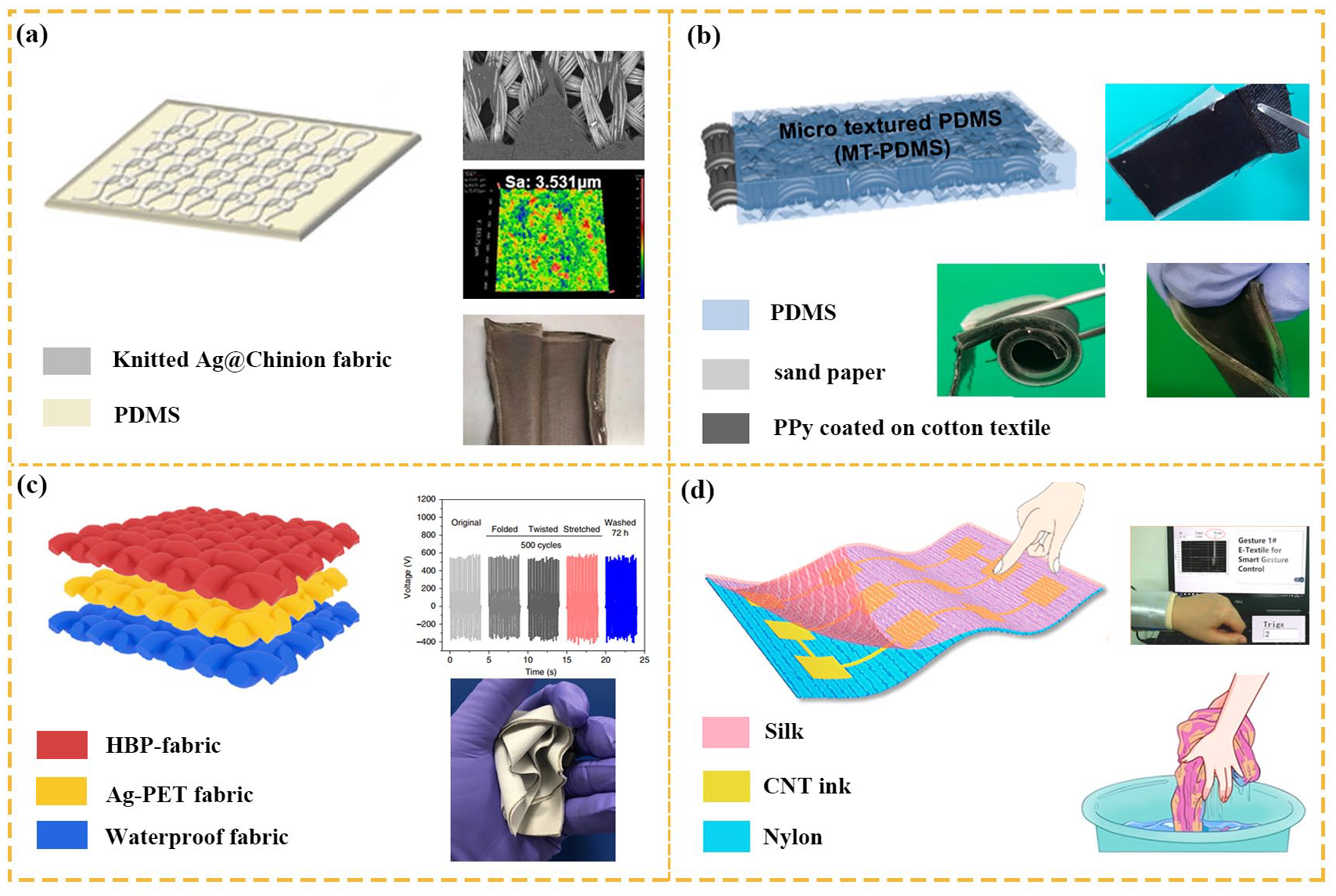
Single-electrode textile-based. (a) Coating nanostructured PDMS on knitted Ag textile. Reproduced under the terms of the CC-BY 4.0 Creative Commons Attribution license (http://creativecommons.org/licenses/by/4.0/). 112 Copyright 2018. The Authors, Published by MDPI. (b) Nanostructured PDMS on PPy coated cotton textile. Reproduced with permission. 41 Copyright 2019. American Chemical Society. (c) A washable textile contact with skin. Reproduced under the terms of the Creative Commons Attribution 4.0 International License (http://creativecommons.org/licenses/by/4.0/). 90 Copyright 2018. The Authors, Published by Springer Nature. (d) Washable textile printed by ink. Reproduced with permission. 113 Copyright 2018, American Chemical Society.
The structures and output performance of contact-type triboelectric nanogenerators are compared in Table 10. Based on the features of human motions (under the arm and thigh), the contact-type KNGs can be designed through varied textile structures changing. And this is also effective and useful information that provides principles of contact-type KNGs designing for future researchers.
The structure and electrical output of contact-type triboelectric nanogenerator.

Combined fiber-based supercapacitor with KNGs
KNGs are designed in stretchable-type and contact-type for harvesting a variety of human movements, which is an attractive energy research area for wearable devices. However, there is still one attention issue that is how to construct an energy-storing system for collecting and storing biomechanical energy. Due to the uncontrollable, instantaneous and instable of output performance, therefore, the collaboration of the storage system from the power supply system needs to meet the practical demand of converting biomechanical energy into electricity. With regard to energy storage and conversion, supercapacitors (SC) exhibit the merits of the long-time cycle, good stability and high power for future wearable devices. In order to integrate into clothing and collect biomechanical energy, fiber-based supercapacitors have been designed. Besides proper capacitance and regular cycles, the fiber-based SC also requires high flexibility and tunable adaptability. As presented in Figure 9(a), 33 an all-solid-state fiber SC with polyester as flexible substrate coating rGO-Ni was estimated to achieve an energy density of 1.60 μWhcm−2. Meanwhile, the performance of lightweight and proper bending is still retained by the assembled fiber supercapacitor. To construct a self-charging powering textile, fiber-based SC is usually woven 11 (Figure 9(b)) or braided 116 (Figure 9(c)) into the textile within parallel or series connection. With the woven structure design, the textile-based TENG and a fiber SC can combine the merits of facile energy management and power continually. However, the weaving self-power device and storage system are an elaborate procession that often run horizontally and vertically, limiting the feature of high stretchability. Therefore, the KNGs with flexible SC have been developed, showing large space between each loop. The SC is prepared by dip-coating carbon nanofiber and PEDOT: PSS on a carbon fiber bundle and then knitted into the one piece of textile with KNGs 79 (Figure 9(d)). The designed knitted self-powering system provides an excellent direction for modern wearable electronics. As shown in Table 11, the performances of fiber-based SC are compared and summarized. A severe issue arising in the triboelectric nanogenerator with SC is electrodes connection that is not stable, due to poor mechanical deformation of textiles. Moreover, it is a difficult way for mass production, which needs long working time and a high level of fabricating technique.

SC-triboelectric nanogenerator. (a) Polyester as flexible substrate coating rGO-Ni. Reproduced with permission. 33 Copyright 2016. WILEY-VCH. (b) Woven fiber-based SC. Reproduced with permission. 11 Copyright 2018. Elsevier. (c) Braided fiber-based SC. Reproduced with permission. 116 Copyright 2019. WILEY-VCH. (d) KNGs with fiber-based SC. Reproduced with permission. 79 Copyright 2017. American Chemical Society.
The summary of SC-triboelectric nanogenerator.

Conclusion
With the rapid development of nano techniques and textile, integrating textile with nanogenerator can foster a self-power textile which can harvest biomechanical energy. In summary, we have a brief introduction of TENGs based on textiles for harvesting human movement’s power in ordinary life, which can provide some advices for constructing KNGs with the merits of high output performance and excellent wearable. Since characteristics of textiles provide notable flexibility for current intelligent wearable clothing, it is necessary to support a summarization to guide practical utilization. To meet the need for portable and sustained electronics, self-power wearable devices have shown enormous advantages for further life, which can solve the issue of charged and recharged battery perfectly. Generally speaking, the TENGs have no danger to the human body and have no pollution to the environment based on the varied triboelectric polarities materials rubbed with each other, which owns a large space for prospects of wearable devices. The electrical signals deliver some information which can reflect the state of the body, connection between the human and external condition and power up microelectronics.
Knitted textiles have wide applications on cloth and industrialization that provide colorful and flexible textiles and various knit structures, from which we can find the opportunity to enhance output performance of KNGs. Wearable devices are one part of intelligent life in the current family, which can give a convenient and effective lifestyle. The biomechanical energy system is the energy supply of wearable devices that is the essential component for working successfully. KNGs are developed based on the knitted textile as a substrate, endowing stretchability and wearable. Thus, it provides a portable and compatible energy supplement, including large-scale strain motions. Integration with conventional cloth, human motions can be collected unawareness and tracked, when moving. The biomechanical energy system can be constructed in a fast and accurate situation through sophisticated knitted techniques (such as forming technique and intarsia), thus providing a textile-based circuit path for the whole system. A complete energy system integrated into cloth is an essential aspect of improving special garments into functional and intelligent. The biomechanical energy system worn on the people will power smart devices, even though the workers in severe conditions without battery. It also can be confirmed that KNG is a good point for the development of wearable devices and the realization of multiple wearable devices.
In terms of lightweight, flexibility, breathability, comfortability and low-cost, textile-based substrates in the form of fibers and textiles are most suit for diversity modern micro-style wearable electronic devices. Especially for knitted textile, it has exhibited excellent stretchable, ventilation as well as commercial production than other textile types, which has rapid growth. Based on the ubiquitous triboelectric effect, the structure design has been provided with many possibilities. In terms of features of human movements, the design KNGs have been classified into a stretchable type and contact type. Considering the energy storage, hybrid electronics consist of KNGs and textile-based supercapacitors, which can supply wearable devices if necessary. To date, the progress of textile-based TENGs has been discussed passionately and has made significant strides reported in many researches. For KNGs design, a large number of works need to be summarized and confirmed, which can make a simple direction for manufacturing KNGs for harvesting human motions energy. When it comes to industrialization and commercialization products, there is a considerable distance in the applications of KNGs, lacking excellent reliability and washability. Though the enormous progress in the practical applications, KNGs develop toward to human-orient style, which has still a disparity exists when comparing to textile-based wearable devices. It is always a long path, as further work is yet required. The challenges of KNGs are introduced as the following aspects:
(1) Washability
Since the KNGs are constructed for harvesting human biomechanics energy, they need to obey the rules of ordinary cloth, especially washability. However, the whole conductive path will short circuit when dipping into the water or contacting with high humidity environment. And the performance of the triboelectric nanogenerator is suppressed by this condition. For example, a large number of KNGs in a single electrode working mechanism generate energy through contact with skin. If the wearer gets sweat in hand or under the arm and thigh, the performance of KNGs may be restrained and cannot supply wearable devices. Most researchers have devoted to making progress for underwater working textile-based TENGs, but the property of flexible and wearability has been abandoned.90,117 –121 At present, a washable electronic textile has been constructed by screen-printed textiles for a self-powering gesture sensor, which still has disadvantages on high cost and long-time procession. 113 From the perspective of raw fibers, the humidity is rather difficult to solve. If some waterproof materials coating on the surface of fibers or textile, 122 the formed film may have affected the air- permeability. Even if the films are slim, they will susceptible destruction in the large-scale joint movements, indicating the open circuit happens. From the view of textile structures, it is hard to design a kind of structure that owns both well breathable and excellent waterproof ability. Therefore, the performance of washability should be paid much attention to many points.
(2) Output
As an electrical supply device, the textile-based triboelectric nanogenerator is not only harvest human motions efficient, but also need to provide excellent output performance. However, compared to film-based triboelectric nanogenerators, the output of textile-based TENGs is still instability. This is disappointing to notice that most of the textile-based TENGs are challenging to use in the practical consumer market. On the one hand, the contact area is an important factor for enhancing harvest efficiency, which often should be improved through nano-micro structure treatments. However, this is a long time and expensive process that restrict the effectiveness of KNGs and reduce the sense of use. As we all know, different textile structures can show varied patterns which establish efficient contact area, improving the ability of harvesting human motions. Currently, this method has been discussed by many researches, such as weaving, knitting, and unwoven. Knitting is a mature production technique that can realize both large numbers of convex-concave structures and softness. Furthermore, the nanoscale surface energy 123 may be considered into the design of KNGs by a combined electrospinning process with knitting for enhancing charge output performance. By combining the bionics method with the knitted technique, the KNGs may be skillfully designed with a large contact area.
On the other hand, textile-based flexible substrates as electrodes are easily interfered with by stretching motions. Although knitted-based resistance models have been reported widely, few conclusions can explain the procession of conductivity clearly and give improvement methods for enhancing electrical. Herein, the route of KNGs researching is still a long term that the output ability can be improved by some researchers’ co-efforts.
(3) Structure
As we all know, the textile structure is a crucial factor affecting the elasticity and performance mechanism. There are a number of knitted structures that can be used in the construction of KNGs based on the different working modes. Since KNGs are used in the self-power wearable devices, the knitted structures should be meted with human motion features, including large bending angles, high stretchability, good cycle, facile fabrication, and aesthetic. However, most papers are only concerned with simple and common structures, which are either low output or too ordinary textiles. This issue is so complex and threatens the KNGs applications in the commercial market due to structure selections. Thus, it is essential to establish a relationship between structures and energy generation and give quantitative information for KNGs design. Loop is a fundamental unit in knitted textiles, which includes many parameters. For example, the loop length influenced the density of textiles and the number of contact points, inducing charge transfer and electronic loss. Moreover, knitted structures are prone to lose elastic under several stretchable cycles. Besides the output, the stability of structures is also essential for wearable performance, which is associated with the lifetime of the self-powering system. Structures selection also should be prepared easily, which also need to demand the wearable comfort and fashion. More importantly, the geometry of surface should be researched that affect the contact area and the roughness. As for the irregular surface morphology, the knitted structures can be analyzed by a fractal theory which can solve complex problems effectively by leading it into textile engineering.124 –127 Using mathematic is an efficient approach to comprehending the features of knitted fabrics and preparing a contacting model for KNGs. As the KNGs applied to the cloth, the designed structures must be beautiful and be a decoration of garment. With the tendency of cloth fashion, the smart wearable cloth can be responded to the trend, obtaining the consume market welcome. In the future, amounts of textile structures are selected and can be employed as a real wearable device.
(4) Knitted textile industrialization
With the benefits of the large-scale and high speed of production, the knitted techniques can realize industrial production. And this is one of the important factors for KNGs commercial applications, which can power wearable electronics and detect signals, entering thousands of families for establishing the healthcare system and providing life convenience. However, previous works presented triboelectric nanogenerators and circuit connections are fabricated by humans made, which occupy some time and high production cost. With some efforts done, but the KNGs are still not realized industrialization. From the prospect of materials, traditional textile materials are the best choice for large-scale production, but it is hard to own any particular functions as the electrode and dielectric materials. It is necessary to endow functionality and intelligent through physics and chemical methods, however, it may cause the textile pollution and poor wearability. In addition, considering the demands of KNGs structure and comfort, knitted textiles become a future tendency that own the fast forming ability and high flexibility. For example, three-dimensional textiles with high output performance and customized sensor areas with a jacquard technique can be successfully produced. However, how to utilize knitting techniques well is a significant issue for fabricating KNGs to harvest biomechanical energy efficiently.
Although lots of challenges are necessary to be accepted, there is still some promising in future development. Herein, the potential applications based on the KNGs are still the mainstream of future wearable devices and smart cloth, which can provide much more possibilities and innovations.
Footnotes
Declaration of conflicting interests
The author(s) declared no potential conflicts of interest with respect to the research, authorship, and/or publication of this article.
Funding
The author(s) disclosed receipt of the following financial support for the research, authorship, and/or publication of this article: This work was financially supported by “the Fundamental Research Funds for the Central Universities (JUSRP52013B),” and the “National Science Foundation of China (61772238)” and “Postgraduate Research & Practice Innovation Program of Jiangsu Province” (grant no. KYCX20_1805).
