




Abstract
This paper proposes a design method for personalized 3D modeling and a rapid style recommendation of polo shirts based on interactive genetic algorithms. Through the research on the parametric multi-style design method of polo shirts, this paper proposes 3D design methods such as the conversion of 3D models, component splicing, and stripes matching mapping rules. In addition, we establish a coded component library of style parts and striped designs to realize the component modeling of tailor-made styles for polo shirts. Besides, the Interactive Genetic Algorithm (IGA) is introduced in the article. Through the algorithm coding, initial population generation, selection, using the scoring mechanism to obtain the user’s suitability evaluation of the program, crossover, and mutation, etc., gradually generating a user-satisfied polo shirt style model design plan, a personalized rapid style recommendation of the user-oriented polo shirt is established. This system can present tailored polo shirt style for customers, and WYSIWYG, to find the most favorite clothing styles for customers and lower the threshold of clothing design expertise.
Introduction
In recent years, personalized clothing customization has become a new way of producing and selling garments. It is also guided by differences in body figure and consumption needs of different consumers. Based on building a modular and diverse clothing parts library, clothing customization combined with free design can quickly modify and generate virtual design solutions suitable for consumers, and realize the integration of anthropometry, clothing pattern design, modeling, and production.
In the virtual design of clothing, the component-based modeling method can facilitate users to quickly obtain a variety of clothing virtual simulation models from different patterns, to carry out different forms of combination. Zhou Haimei divided the clothing module into two types: optional and fixed, and classified the deformation of components, and introduced binary decision variables to select clothing components. The constraints and mathematical models of the connection parts of each module were established.1,2 WANG Qian considered the basic model of module configuration from customer demand function, clothing design factors, environmental demand factors, and summarized the main design methods involved in the module construction process. 3 Li proposed a clothing modeling method based on examples, which “assembled” a new clothing model on the designed three-dimensional human body model directly, making clothing modeling as easy as building blocks. 4 Liu Li proposed a customer-driven rapid 3D clothing modeling method. 5 This method inputs the designed clothing component model and classifies the components through shape and style analysis, which builds a virtual clothing component library.
The genetic evolution algorithm is a global optimization problem-solving algorithm derived from the principle of survival of the fittest in biology, it produces more optimized individuals through behaviors such as selection, reorganization. However, the interactive genetic algorithm introduces human-computer interaction scoring instead of the adaptive function, which is an emerging algorithm that optimizes the original genetic algorithm. Kwok used genetic algorithms and knowledge of clothing technology to arbitrarily combine the effects of clothing sketch lines. 6 In Dou Runliang’s research, a multi-stage interactive genetic algorithm (MS-IGA) is proposed, which divides the large population of the traditional interactive genetic algorithm (TIGA) into several stages according to different functional requirements. 7 Jian Lv introduced a novel design method based on an interactive genetic algorithm with individual fuzzy interval fitness (IGA-BPFIF), which has the error back propagation neural network user cognitive surrogate model. 8 By analyzing and combining the jacket model components, Ogata provided customers with alternative solutions, obtained fitness by interactive scoring by customers, and forms customer satisfaction solutions through genetic operations. 9 Hsiao proposed a clothing consulting and simulation system based on the interactive genetic algorithm to help designers obtain the best matching scheme of product components and decorative patterns. 10 Kim found out a new coding scheme that can integrate apparel domain expertise into genotypes and developed a more practical women’s design assistant system. 11 The “Which scheme is the customer’s favorite polo shirt design” problem in this article is in line with the resolution range of this algorithm, which can fully meet the customers’ independent design of clothing, perform a global search on the entire database, and obtain the optimal solution that meets the user’s preferences.
Polo shirts are made of knitted fabrics. From sportswear, they have gradually become one of the styles of daily wear, such as business casual, summer school uniforms for students, corporate collective clothing, and so on. Polo shirts’ basic form is relatively fixed and the details of each component can be extended, so the polo shirt is selected for research. The research of the senior scholars provided new ideas for this research. The article hopes to establish a virtual model library of polo shirt components through parametric multi-style template design methods and three-dimensional modeling so that various combinations can be used to quickly generate virtual models of different styles of polo shirts. And we combine with the Interactive Genetic Algorithm to make a rapid polo shirt style recommendation system based on customer interaction scoring.
Partial modeling of polo shirts
Multi-style polo shirt pattern design
At present, the parameterized pattern design method is very efficient. It can quickly design fixed patterns based on the customers’ body data, but the style is relatively simple, and it is difficult to integrate the parts generated after three-dimensional modeling of different polo shirts’ patterns. Therefore, this paper proposes a new parametric paper pattern drawing method. The basic pattern is designed according to the input human body parameters, and then the stitching sewing thread between the parts is fixed. Finally, the control points and curves are set and freely deformed. The pattern design conforms to the personalized body of different users and enriches the style design, which is convenient for subsequent splicing. The scheme is shown in Figure 1.
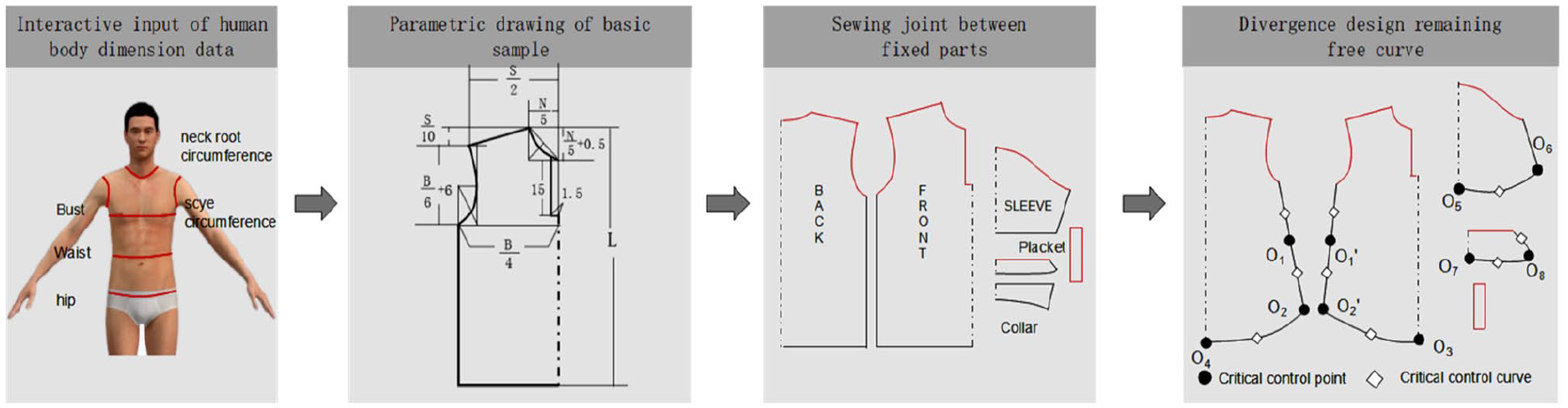
Multi-style parameterized pattern design method.
This article divides the stitching position (shoulder seam, neckline seam, top fly seam, armhole line, etc.) into a ‘sewing joint’ part. It has a weak relationship with the design appearance and a strong relationship with body size. The users interactively input body dimension data such as neck root circumference, scye circumference, bust, etc., and generate a basic polo shirt pattern according to the computer simulation algorithm of the basic pattern drawing method, and thereby fix the curve of the stitching joint as a basis for free design.
Secondly, we divide the remaining non-splicing positions of each component into free design ends. By changing the critical control curve, we can control its bending arc. The critical control points include waist control point O1, bottom hem(hem circumference, clothing length) control point O2, center front, and center back length control points O3, O4, sleeve (sleeve length, cuff width) control points O5, O6, Collar (collar stand width, collar edge) control points O5, O6. The free design method includes unit drag mode and points drag mode. The coordinate position changes according to the drag path. The style design has greater freedom. Under the condition of fixed sewing joints, the designer can design the design ends freely and save it multiple times for the selection of subsequent component combinations. This method can increase the number of styles in the design library while meeting the personalized body shape of the customer, generate multi-style polo shirt patterns, and prepare for the customer’s componentized design.
Three-dimensional design of polo shirt components
Components modeling and splicing
To realize the modeling of the polo shirt, we first perform triangular meshes on the patterns. The 3D transformation of the patterns can be abstracted into the transformation of the spatial position and shape of all triangle meshes in the patterns, that is, scaling, shearing, rotating, move, and other operations. We assign physical properties to the particles and establish a spring-mass model. The 2D clothing patterns are at rest at the initial moment. The conversion process from 2D patterns to 3D models can be regarded as a dynamic iterative system of a time-varying motion system that complies with Newton’s second law,

Where X is the solution target and represents the position vector of the particle, X ∈ R3, m is the mass of the particle, and the force of the particle is the sum of the external force and internal force.
To define the stitching and splicing relationship between the components, we define that a surface {S} consists of a set of vertices represented by {Pi}, a set of triangles represented by {Ti}, and a set of meshes represented by {Ek}. Before splicing, it is necessary to set the seam connection between the parts. Take the stitching of collar and body parts as an example. The stitching line of the neckline is Fneck. After finding the stitching boundary between the collar and body, the stitching points are searched out, then the collar boundary and the garment boundary are sutured according to the principle of maximizing the minimum inner angle of the triangle. That is, when Pa1, Pa2, Pb1, Pb2 are stitched together, ∠Pa1Pb1Pa2 which is formed by Bonding Pa1 and Pb1 is bigger than ∠Pa1Pb2Pa2 which is formed by Bonding Pa1 and Pb2, so we sew Pa1 onto Pb1. The schematic diagram and the effect are shown in Figure 2(a) and (b). When the distance between all the corresponding sewing points is less than the given distance and the difference of the system elastic change energy between the last two iterations is less than the given error value, the iterative system finishes the operation.

Components splicing schematic diagram. (a) Determine the stitching point. (b) The stitching of the collar and the body. (c) The grid of the connection when the parts are replaced.
In our polo shirt models, the storage of the points are presented in the form of coordinates, and the relative coordinate data of all the points are not changed when the 3D garments are uploaded, so the data in each part file is reorganized to display the entire garment completely, and the parts are spliced. The splicing between parts belongs to the splicing of stitched integrable parts. This kind of splicing requires not only the continuity of geometry but also the continuity of topology. That is, after splicing, the boundary grid vertices are coincident and spliced together, they are topologically merged into an entity but without the fusion of models. Take the splicing of the sleeve and the body as an example. Because patterns were designed to keep the seam of the sleeve cage consistent, there is no need to display the page multiple times of triangulation to occupy the computer memory. The grid at the connection remains the same when different components at the same position are replaced. When different sleeve parts are replaced, multiple triangulation and simulation operations can be reduced, as shown in Figure 2(c).
Component texture mapping
Clothing parts need to increase the appearance texture of the fabric to enhance the reality of the model. In this paper, the three-dimensional matching of the texture is optimized by calibrating the position of the clothing plate in the 2D mapping coordinate system. Texture mapping is the conversion of a textured pattern from a 2D plane to a 3D model through the UV coordinate system (U and V refer to the horizontal and vertical axes of the 2D mapping space because X, Y, and Z have been used in 3D space in the previous article). There is a one-to-one correspondence between the points of 2D texture and the points of the 3D model. After the stripe texture map is imported into the plate, as shown in Figure 3(a) and (b), through the conversion of the UV coordinate system, each point in the texture map can be assigned to the corresponding spatial points of the three-dimensional model to achieve the texture in the clothing, as shown in Figure 3(c) and (d).

Texture mapping for virtual clothing. (a) Striped texture map. (b) Texture map import plate. (c) UV coordinate system. (d) Texture mapping effect.
When the clothing parts are mapped with textures, the placement of the patterns in 2D coordinates determines the relative position displayed on the 3D parts. According to the habit of aligning fabric patterns such as stripes or patterns, the rules for placing the pattern position can be formulated to reduce the process of adjusting the alignment of the pattern after mapping, which can be closer to the real clothing, and reduce the deviation of the position of the map.
The alignment of the stripe position of each component in the polo shirt also has its customary alignment method. Usually, the stripe alignment is set at the chest between the sleeve and the body, the front and back pieces, the top fly parts, and the body position.
In order to solve the problem that the stripes are easily disordered after UV mapping, this article proposes that the layout position rule based on the strip should be set in the two-dimensional layout, and the position of the strip should be marked. Identify benchmark key points such as such as the lowest point of the armhole curve and the lowest point of the cap arc line, and establish benchmark alignment lines, which can calibrate the relative position of the plate for correct alignment of the striped texture after modeling, as shown in Figure 4.

Clothing pattern position calibration in UV mapping.
Polo shirt compoments library establishment
For a long time, polo shirts, as people’s favorite clothing style, can be suitable for sports, shopping, travel, and suits or other outerwear. This article makes a detailed analysis of its style, and establishes the collar model library, the body model library, the sleeve model library, the top fly model library, and the texture component library. At the same time, the article carries out the modeling of some styles and the numbering of the library and establishes a part database for subsequent style recommendations.
Model library
In the model library of collar components, the line at the joint between the collar and the body does not change, and divergence design is performed at the remaining positions. The collar style can be divided into the flat knit collar, shirt collar, rounded collar, and so on. It can make changes at the collar width and shape. The collar needs to be revealed when it is worn in a suit. So the collar height is usually about 2.5 cm and the lapel width is about 3–6 cm. This article saves the model according to parts, not limited to the traditional obj file, the part model file and pattern information are packaged in the file. The content is more abundant, and it is more convenient for subsequent secondary editing and docking production procedures. The sample and number of the changed style model examples are shown in Figure 5.

Polo shirt collar style components library.
Other parts and collar parts are similarly operated. The style changes are as follows. In the body parts model library, according to the waist to hip ratio (WHR), the body style can be changed to close-fitting style, fitting style, loose style, and so on. Body piece length can be changed in short, medium, and long styles, and the hem in front can be the same with the back or shorter. It can also be designed with a split line. All of these are changes in style when the sewing stitching line is fixed. In the sleeve parts model library, the looseness, sleeve length, whether to sew rib-knit cuff and its width and shape, can be changed when the shape of the sleeve cap curve is fixed. In the model library of top fly parts, there are style changes such as neckline placket and French front. The depth of the top fly can be changed together with the body, two buttons or three buttons are more common.
Texture components library
The stripe design in the polo shirt is simple but orderly, with a sense of movement and change, and has a unique expression. Striping includes the division of regular stripes and positioned stripes. Different stripe designs can convey a completely different design intents. The wide stripes of the regular stripes are solemn and generous, the fine stripes are delicate and meticulous. The positioned stripes can be set on the chest, waist, sleeves. It can improve the monotonous sense of regular stripes and make them more lively and dynamic.
Combining different colors and stripes with different heights can form a texture part library for polo shirt design. After the total number of color libraries is determined and coded, each number represents a color, and the height of the stripes is divided finely. Limit the minimum and maximum heights, and set a code every 0.5 cm. A group number contains its color code and the height of the color stripes. The type of color determines the number of code groups. The collar of the polo shirt is made of solid colors in common colors or one of stripe colors in the body, which can be stored separately. The storage of each stripe pattern in the texture library includes all the color selection numbers of the stripe design, its corresponding stripe width, a single cycle of BMP maps, and MTL material files.
Rapid style recommendation system
System design concept
Interactive Genetic Algorithm (IGA) evolved from the survival of the fittest mechanism in nature, and it through the algorithm coding, initial population generation, selection, using the scoring mechanism to obtain the user’s suitability evaluation of the program, hybridization and mutation, etc., gradually generate better individuals, which are closer to the designated elimination and evolution rules.
This article proposes to generate an initial group by combining the polo shirt components to form a style design and a striped appearance design, obtain individual fitness through interactive evaluation, hybridize and mutate design solutions that do not meet customer needs, and evolve to produce better offspring. Repeat this process until the user obtains a satisfactory plan, complete the personalized rapid style recommendation of the polo shirt, as shown in Figure 6.
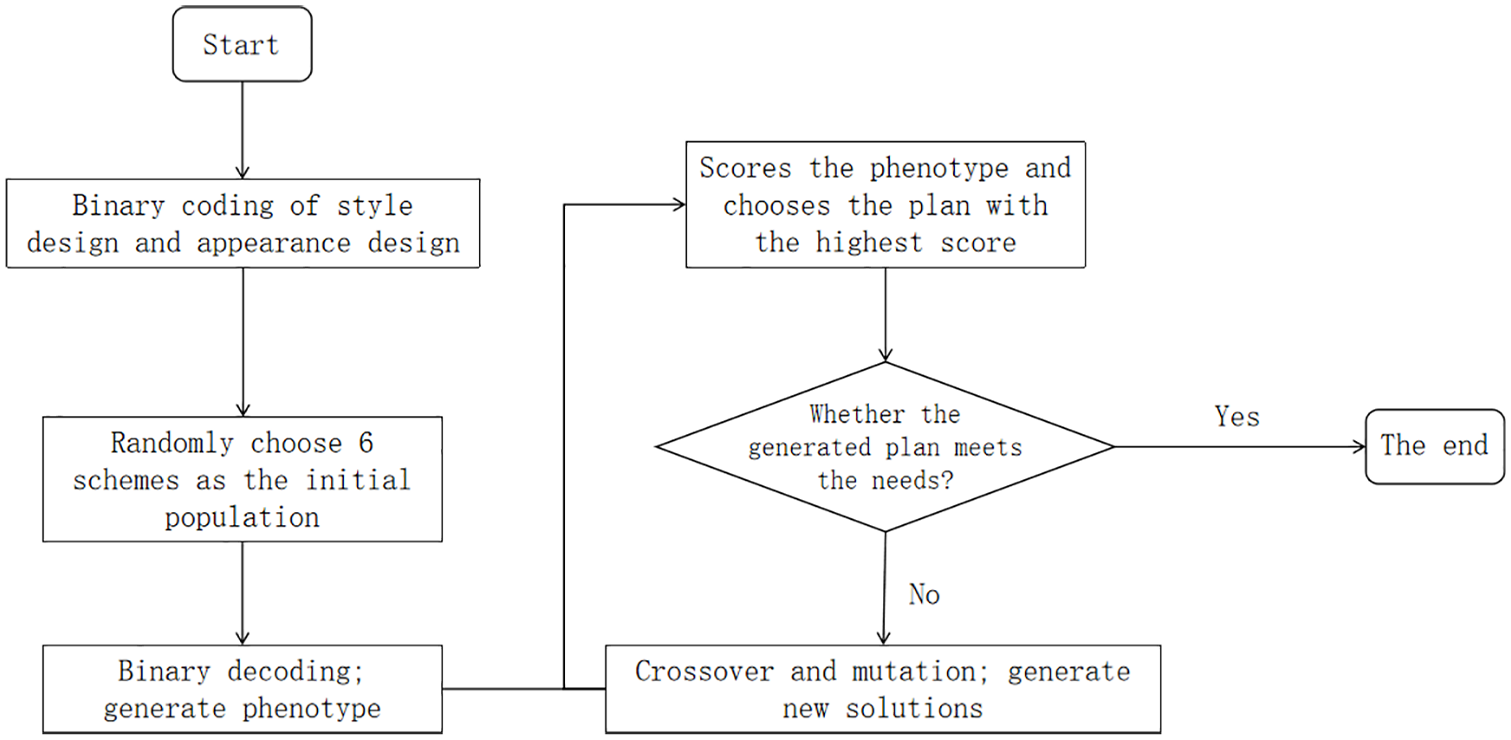
Flow chart of interactive genetic algorithm.
Coding and initial scheme generation
As a chromosome in the evolution process, a design scheme of the polo shirt can be divided into two parts: style design and appearance design. The coding methods in the genetic evolution algorithm include binary coding, tree structure coding, real number coding. We choose the binary encoding method, which is more simple and clear, widely used, and can accommodate large-capacity samples. Different combinations of “0” and “1” are used to indicate different contents of the sample.
The coding format of component splicing is shown in Figure 7, A indicates a collar component, B indicates a body component, C indicates a sleeve component, and D indicates a placket component. The length of the code depends on the number of model parts in each part. Each component stores eight component models this time, that is, each component needs to be represented by a 3-bit binary code, and a total of 12 coding groups are required to represent a component splicing scheme.

Binary coding scheme of polo shirt personalized design scheme.
In order to limit the number of samples, this article selects a two-color circular jacquard stripe design with a total of eight spare colors. The design scheme includes color choice E and stripe width F for color one, color choice G and stripe width H for color two, and collar texture design I (common colors, such as white, black, or color one or color two). The stripe width is divided into a total of 16 values of 0.5 cm, 1 cm, 1.5 cm . . . 8 cm, then the coding length of the design scheme is L = 16, that is, a coding group with a length of 16 is required to represent a design plan.
It can be seen that a complete polo shirt design in this article will be represented by a 28-bit code, as shown in Figures 7 and 6 schemes are randomly selected as the initial population. If there are more parts storage requirements, the number of coding bits can be increased to 8bit according to this method, or even greater to represent a part model, then large-capacity storage and recall of the parts library can be realized.
Selection and adaptability evaluation
After decoding the character strings of the selected six schemes, the phenotype of the design scheme can be obtained. We introduce a scoring mechanism for user interaction. Setting the scoring of each program on the interactive interface can simplify the acquisition of individual fitness. The score can be assigned from 1 to 10 for customer evaluation. The higher the score after the scoring, the higher the fitness. Using the proportional selection method and the optimal preservation strategy, the probability of being selected among the individuals in the population is proportional to their fitness, and the two individuals with the highest fitness are retained as parents, retaining their excellent genes, and performing subsequent evolution operations. The style recommendation interface design is shown in Figure 8.

Polo shirt style recommendation evaluation interface.
Crossover and mutation
In this paper, as shown in Figure 9 the two-point crossover method is used to carry out the hybridization process. The crossover positions of the genes are randomly determined in the two selected parents, replaced and recombined. The new coding scheme generated, the new design scheme unlocked, and the two-part scheme The part that meets user approval is passed on to the next generation of individuals. In order to prevent the output result from falling into the local optimal solution when the population is too large, the mutation process will swap the 0 and 1 of the randomly selected position in the coding. The new code will change some of the model parts, further promote the generation of new styles, and maintain global search, to ensure that the output results are more in line with customer aesthetics, the steps are as follows:
(1) After adaptability evaluation, select the parental polo shirt design scheme Oa, Ob with the highest score;
(2) Randomly determine the cross position X1, mutation position X2, X3 in the program code;
(3) Double-point cross the X1 positions of the parents Oa and Ob, and the remaining positions remain unchanged to form new offspring Oc and Od;
(4) Single-point mutation of the X2 and X3 positions of the parents Oa, Ob, and the remaining positions unchanged, forming new offspring Oe, Of;
(5) Unlock the Oc, Od, Oe, Of codes of the new individual to reveal the phenotype, together with Oa, Ob for users to re-evaluate, looking for the polo shirt design scheme with the highest score.

Crossover and mutation.
System implementation
We invited ten people of different ages as subjects, and found that after 10 to 15 iterations, they could find their favorite design styles within 10 min. Compared with personalization based on choosing one-by-one seven parameters (style design A, B, C, D, appearance design E, F, G, H, I), although the speed of obtaining styles may be slightly slower, for some users with weaker clothing design expertise, the overall comparison of design styles can more accurately obtain their favorite solutions.
Through several iterations of evolution, the search space gradually decreases, and the new polo shirt design scheme gradually meets the needs of users. When the adaptation value of the scheme reaches the preset value or the user thinks that it is satisfied, the evolution process can be ended and the final design scheme can be generated.The final scheme includes the overall effect model of the final polo shirt simulation, the design scheme of splicing and matching of each part model, the polo shirt pattern design, the texture appearance design plan, and so on.
Conclusion
This article described the 3D modeling method of polo shirts and establishes a rapid style recommendation system by combining with interactive genetic algorithm. First, this article describes the pattern design of polo shirts with diversified styles and the 3D modeling design method of component splicing, personalized and multi-style design of polo shirts. In order to match the texture in three dimensions, we set the position calibration rule of the clothing patterns in the 2D mapping coordinate system according to the stripe alignment rule of the polo shirt.
Secondly, based on the principle of component modeling, the article establishes a polo shirt model splicing part library and texture appearance part library according to the style changes of each part, and encodes it for subsequent design calls.
At the same time, we introduced an interactive genetic evolution algorithm based on user evaluation, established a polo shirt style rapid recommendation system through algorithm coding, initial population generation, selection, adaptability evaluation, crossover, mutation and so on, to achieve the formation of a user-oriented polo shirt design plan, which is more convenient and intuitive than the original customer-oriented selection design method. It not only maintains the intuitive advantages of 3D design, but also combines the intelligence and convenience of interactive genetic algorithms, shortening the entire process from style design to user recommendation.
Future investigations are necessary to validate the kinds of conclusions that can be drawn from this study. And further research could continue to explore the application of IGA in other clothing style and industrial supplies recommendation fields, to get closer to user preferences faster and meet individual customization needs.
Footnotes
Declaration of Conflicting Interests
The author(s) declared no potential conflicts of interest with respect to the research, authorship, and/or publication of this article.
Funding
The author(s) disclosed receipt of the following financial support for the research, authorship, and/or publication of this article: The authors are grateful for the support of the National Science Foundation of China (61772238), Taishan Industry Leading Talents (tscy20180224), and the Fundamental Research Funds for the Central Universities (JUSRP52013B).
