



Abstract
Recently, many efforts have been dedicated to achieve lightweight, stretchable, and flexible heat device. Here, the Polyester Cleanroom Wiper coated with poly(pyrrole) as flexible material showing electrothermal properties are reported. Poly(pyrrole) particles are synthesized on the cloth via a simple in situ polymerization method with different Py/FeCl3 concentration ratios. A highly conductive cloth with surface resistance of 23 Ω/sq can be produced by changing the Py/FeCl3 concentration. The flexible composites showed sensitive electrothermal performance, and a steady-state temperature of 89.1°C could be reached at 6 V. In addition, temperature, voltage, and time-dependent temperature results showed that the heating performance was strongly dependent on the resistance and external voltage. Herein, as-prepared composites were further analyzed as ultra-fast responding electrothermal heaters, indicating their great potential in application value as wearable electronic textiles.
Introduction
Flexible wearable technology has aroused a tide in modern life, making many possible portable devices available for treating joint injuries, monitoring sport activities, or energy crisis.1–3 These devices, supercapacitors,4–6 batteries,7,8 Joule heaters,9,10 among others, 11 can provide the combined beneficial advantages of conductive fabrics, such as breathability, flexibility, and lightweight. Great attention has been devoted to flexible heaters in particular because they are important in various applications, such as heating textiles, flexible deicing units, defrosting device, and thermotherapy12–15 in industry and daily life. However, conventional conductive devices, such as heating package, have limited real-world applications because they usually cannot provide the continuous temperature and are too bulk. Based on that premise, the development of new advanced materials on flexible substrates has been an important trend in the last years.
Recently, tremendous attempts have been made in textile devices based on conducting polymers.16–18 Conducting polymers, such as poly(pyrrole) (PPy), poly(aniline) (PANI), and poly(thiophene) (PTP), have gathered extensive attention on conductive coating materials because of their perfect properties of facile preparation, lightweight, and biocompatibility. 19 In recent years, PPy is the most promising conducting polymer because of its high conductivity in the range of 1–1000 S cm−1,20 good adhesion to the modified fabric, 21 and ease of synthesis for in situ polymerization method. 22 Nonetheless, PPy suffers from poor mechanical stability. Therefore, it is essential to develop methods which deposit highly conductive PPy on flexible substrate making wearable smart devices to simplify the process and reduce the cost. Wang et al. 23 reported that polypyrrole/poly(vinyl alcohol-co-ethylene) nanofiber composite on polyethylene terephthalate substrates as electric heating element exhibited a rapid temperature response, long retaining behavior, and thermal and operational stability. In this article, PPy coated on Polyester Cleanroom Wiper (PCW) substrates by a simple one-step synthesis as wearable smart device were reported.
PCW cloth is made of microfiber, the main components of which are polyurethane and polyamide. 24 The yarn of the PCW cloth is a bundle structure, which imparts more fine pores on the fabric. These fine pores are much smaller than the micropores on the ordinary polyester fabric, so in this aspect, the microfiber can show better ability to adsorb tiny particles. Many academics and industrial researchers are dedicated to study the use of PCW clothes for various applications as early as a few years ago; for example, Humphreys et al. 25 studied the cleaning efficiency of microfiber clothes processed through an ozonated laundry system. Diabelschahawi et al. 26 studied the decontamination efficacy of new and reprocessed microfiber cleaning cloth in the hospital. Therefore, combining a conductive polymer particle with the cloth can have unexpected results. Of course, there is no detailed attempt reported till date on the use of combination of PPy and PCW for making wearable heater textiles.
In this work, the fabrication of a flexible wearable heater device based on the highly conductive PPy/PCW fabric was reported. The device was prepared via in situ polymerization method. 27 The PPy/PCW fabrics exhibited low resistance of 23 Ω/sq. The temperature of the PPy/PCW fabric is well controlled by adjusting the input voltage. More importantly, PPy/PCW fabric could reach to a certain temperature of 89.1°C under 6 V in 66 s and meanwhile cooled down sharply when the output power was turned off. Therefore, these results indicate that the PPy/PCW fabrics are greatly promising in the development and application of the wearable smart device.
Experimental
Material
PCW cloth composed of composite 75% polyester/25% polyamide fibers with the size of (16 cm × 16 cm) was purchased from Shenzhen Xinkexiang purification technology (China). Pyrrole sealed in the dark storage containers was purchased from Sinopharm Chemical Reagent Co., Ltd (China), and the storage temperature was below 0°C. Iron (III) chloride hexahydrate (99%, FeCl3 6H2O) used as oxidant was purchased from Dezhou Runyu Experimental Instrument Co., Ltd. (China). Deionized water was used in the preparation of all solutions used in this work.
Preparation of PPy coated on PCW
Pyrrole (Py, 3.36 mL, 50 mmol) was added to 50 mL of distilled water and PCW (40 × 40 mm2) that were placed in the solution and stewing for 1 h before the addition of 0.5 M FeCl3 solution (50 mL) at 0°C–5°C. The stirring was done for another 2 h. The reaction concentration of Py/FeCl3 6H2O was 0.1 M/0.05 M, 0.2 M/0.1 M, 0.25 M/0.125 M, 0.5 M/0.25 M, 0.75 M/0.375 M, and 1 M/0.5 M, respectively, which can be regarded as Py-1, Py-2, Py-3, Py-4, Py-5, and Py-6. Black layers were evident on the surface of these clothes. After this treatment, the cloth samples were washed with distilled water and ethanol until all uncoated PPy were completely removed, followed by drying in oven at 70°C for 1 h. The specific synthesis process of PPy/PCW is shown in Figure 1.

Schematic illustration of the preparation of PPy/Polyester Cleanroom Wiper.
Characterization and measurements
The characteristic groups of as-prepared PPy/PCW were examined by Fourier transform infrared spectrometer (FT-IR, Nicolet210) in the wavenumber range from 4000 to 400 cm−1. The surface morphology of the samples was characterized through scanning electronic microscope (SEM, JSM-6510L) with the accelerating voltage of 5 kV. X-ray diffraction (XRD, UItima Ⅳ) patterns of the composites were recorded via Philips X’pert diffractometer by monitoring the diffraction angle from 5° to 75° (2θ) using Cu-Kα radiation (λ = 1.5406 Å). The warp (weft) tensile strength and warp (weft) elongation at break were obtained using universal testing machine (WEW-300D, China) employing a crosshead speed of 100 mm min−1, and the samples used for the mechanical tests were cut into strips of 0.5 cm width and 6 cm length. The thermal behavior of the samples was carried out using a thermogravimetric analyzer (TGA, SDT Q600), and the temperature was raised from 50°C to 600°C with an increase rate of 20°C/min under N2 atmosphere condition. Test the relative resistance change with a digital multimeter (VC890C+, Victor).
Heat behavior of PPy coated on PCW
The electrothermal properties of fabric were tested by a rectangle sample (2 × 1 cm2) powered by a direct-current source meter (HM-WL-2001, China), and the temperature of the fabric was evaluated by a Handheld Thermal Imaging Camera (Tis60, Fluke). Measuring accuracy: +2°C.
Results and discussion
Electrical properties
Table 1 shows surface resistance and deposit weight changes of PPy/PCW fabrics with different Py/FeCl3 concentration ratios. The surface resistance of fabrics decreased steeply from about 1800 to 23 Ω/sq, after which it gradually increased to 28.3 Ω/sq. It is obvious that PPy/PCW fabric of Py-5 obtained resulted in the lowest surface resistance among all the fabrics used for this study. The reduced surface resistance is mainly due to the adhesion of PPy to the PCW fabrics with the increased amount of PPy produced. Simultaneously, with the increase in Py/FeCl3 concentration ratio, the number of polymerized polypyrrole particles increased, so the deposition weight of the fabrics increases notably. The results are coordination with mentioned above on the electrical property. Naturally, it can also be concluded that increasing the concentration of Py/FeCl3 leads to a significant improvement in the load amount of PPy and reduces the surface resistance of the PPy/PCW fabrics, thus improving a higher electrical conductivity on fabrics.
Surface resistance and deposit weight of PPy-coated PCW fabrics with different Py/FeCl3 concentration ratio.

SEM images
Surface morphologies of (a) PCW fabric, (b) Py-1, (c) Py-2, (d) Py-3, (e) Py-4, (f) Py-5, and (g) Py-6 are depicted in Figure 2. The surface of the raw PCW fabric is very clean and smooth as shown in Figure 2(a). After in situ polymerization and Py/FeCl3 reaction concentration of 0.1/0.05, a relatively thin and even layer of uniform polymer is coated (Figure 2(b)). The surface of the PPy-coated PCW fabric is less clean and smooth than that of the raw fabric, when Py/FeCl3 reaction concentration increases. The surface of PCW fabric has become rough with a large amount of PPy than Py-1 (Figure 2(b) to (g)), while the excess PPy particles will randomly aggregate together forming spherical structure, PPy spherical structure formed by the aggregation of the particles, then distributing on the surface of the PPy/PCW fabric as shown in Figure 2 (b) to (g). However, as can be seen in Figure 2(e) and (g), the PPy particles cannot be evenly deposited on the fabric when the amount of PPy is large, so it is noticeable that Py-5 is the optimum blending concentration in combination with the electrical conductivity of the fabric.

SEM images of (a) PCW fabric, (b) Py-1, (c) Py-2, (d) Py-3, (e) Py-4, (f) Py-5, and (g) Py-6 and its corresponding magnification.
IR spectra
The FTIR spectra of PCW, PPy/PCW composite of Py-5, and PPy are presented in Figure 3. The spectrum of the raw PCW fabric shows a strong absorption band, namely, the peak of N–H stretching vibration indicative at 3430 and 1640 cm−1, the peak at 1720 cm−1 indicative C=O stretching vibration, and peak at 1100 cm−1 indicative the C–O stretching vibration. The wide band at 966 cm−1 is attributed to the C–N stretching vibrations of the pyrrole ring. The broad bands at 1541 cm−1 and 1452 cm−1 are attributed to the C–C and C–N stretching vibrations of the PPy ring, respectively. The spectrum of the Py-5 fabric is featured by the typical characteristics of PPy.28,29 The peaks at 3430–2030 cm−1 of the PPy/PCW composite and PPy increase compared with the PCW fabric, which can be eventuated by the increasing water bound in polymerization process. Therefore, it could be confirmed that there is the existence of PPy coated onto PCW fabric.

FTIR spectra of (a) PPy, (b) PCW, and (c) PPy/PCW composite of Py-5.
XRD spectra
The XRD patterns of PCW and PPy/PCW composite with different Py/FeCl3 concentration ratios are shown in Figure 4. The XRD spectra of the raw PCW present typical peaks around 17.56°, 20.16°, 23.58°, and 25.22°. The diffraction peaks of Py-1 and Py-2 are similar to raw PCW, no obvious diffraction peaks of PPy appear, and the fact that the content of PPy in the composite is very small. However, with the increase of the concentration, raw PCW typical peaks gradually weakened as shown in Py-3, Py-4, Py-5, and Py-6, contributing to the amorphous behavior of PPy, the broad peak can be ascribed to the scattering of X-rays from PPy chain. 30 In all, the diffraction peak intensity of PPy/PCW composite reduces due to PPy evenly dispersed in the PCW surface.
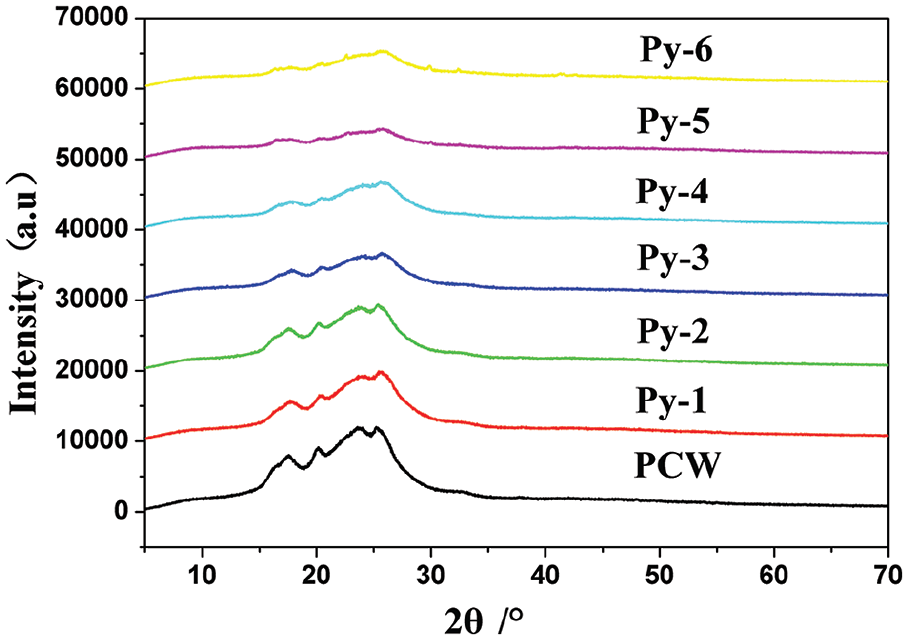
X-ray diffraction patterns of PCW, Py-1, Py-2, Py-3, Py-4, Py-5, and Py-6.
Thermogravimetric analysis of PPy/PCW fabric
Evaluating the thermal stability of the fabrics is an important aspect of the electric heating. In order to avoid thermal degradation and sharp increase in resistance, the heating temperature should be well below the limit temperature of the thermally stable composite material. Thermal stability of the PCW and PPy/PCW composite of Py-5 is shown in Figure 5. The raw PCW of TG curve exhibits substantial weight loss in three stages, which is in the temperature range up to 360°C (I stage), 360°C–480°C (II stage), and above 480°C (III stage), respectively. For the first stage, a weight loss up to 3 wt% is observed, corresponding to the evaporation of water entrapped in fabric structure. For the second stage, the weight loss is indeed increasing due to the degradation of polyester and polyamide fibers. For PPy/PCW composite, it shows a similar decomposition stage. However, the residue of PPy/PCW composite material obviously increased a lot due to the existence of PPy, this is consistent with the scanning electron microscopy. As can be seen from the DTG diagram, compared with PCW cloth, the maximum thermal degradation temperature of composites at 428°C remained unchanged, but the corresponding degradation rate decreased. Therefore, it is safe to use as a heater within these degradation temperature ranges.

Thermogravimetric analysis of PCW and PPy/PCW composite of Py-5.
Electrothermal property
Carbon-based materials with low electrical resistance can be used as electrothermal devices because they can convert electric energy into heat energy via Joule effect. 31 The raw cloth is an electrical insulator, and its surface resistance is too high, which is beyond the measuring range of our test equipment. In Figure 6(a), the LED lamp can be lit under low pressure with PPy/PCW fabric as the conductive connection wire. As shown in Figure 6(b), PPy/PCW fabric has high flexibility, such as torsion and bending, and is expected to be a candidate material for flexible wearable heater. To evaluate the heating performance of the PPy/PCW fabric, the temperature was captured in real time with the aid of a handheld thermal imaging camera at a certain input voltage. For a specific PPy/PCW fabrics sample, when a constant voltage was applied, as shown in Figure 6(c) and (d). Figure 6(c) shows the temperature–time profiles for the PPy/PCW fabric, which had a resistance of 23 Ω/sq. When a voltage (2, 3, 4, 5, and 6 V) was input, the temperature of the fabric heater rise within 66 s and saturated to a certain temperature, we can conclude that higher voltage applied result in higher saturation temperature. Saturation temperature could be as high as 53.3°C under a low voltage of 4 V. Figure 6(d) shows the cloth can be raised to the saturated temperature of 90°C within 70 s when 12 V was applied. It is obvious that the PPy/PCW fabric with lower electrical resistance can reach a stable value in a short period of time, and the temperature is also high. Therefore, the PPy/PCW conductive cloth used as a wearable heater could obtain desirable temperatures, fast thermal response, and uniform heating.

(a) A red LED lamp was lit by applying a voltage of 5 V. (b) Digital image of PPy coated on PCW substrates in twisting and bending. Temperature–time dependence curves of (c) Py-5 and (d) Py-3 with application of different voltages.
Fast thermal response and uniform heating can be recognized by infrared thermal image as shown in Figure 7. When the voltage power is on, the infrared image becomes more and more clear, and a certain temperature can be reached in 60 s. When the voltage power is off, the infrared image becomes more and more blurred and recovers to near room temperature in 60 s. Simultaneously, the infrared image color of PPy/PCW fabric is divided into three layers, from outside to inside is blue, red, and yellow, respectively. Infrared image of composite exhibited uniform heating temperature distribution when the saturation temperature of heart-shaped shows 65.7°C, which demonstrates the well-distributed PPy coated on PCW fabric. More importantly, the safe voltage of human body is lower, that is, 36 V; PPy-coated PCW fabric can be used as a heater to reach the required temperature of the human body at low pressure. So there is no worry of safety threat to human; in this way, PPy/PCW fabric act as a wearable heating device under working voltage, providing warm to the human body in a cold environment. In conclusion, compared to the most traditional used heat devices, the as-prepared PPy/PCW cloth has the advantages of lightweight, high flexibility, controllable temperature, and safety.
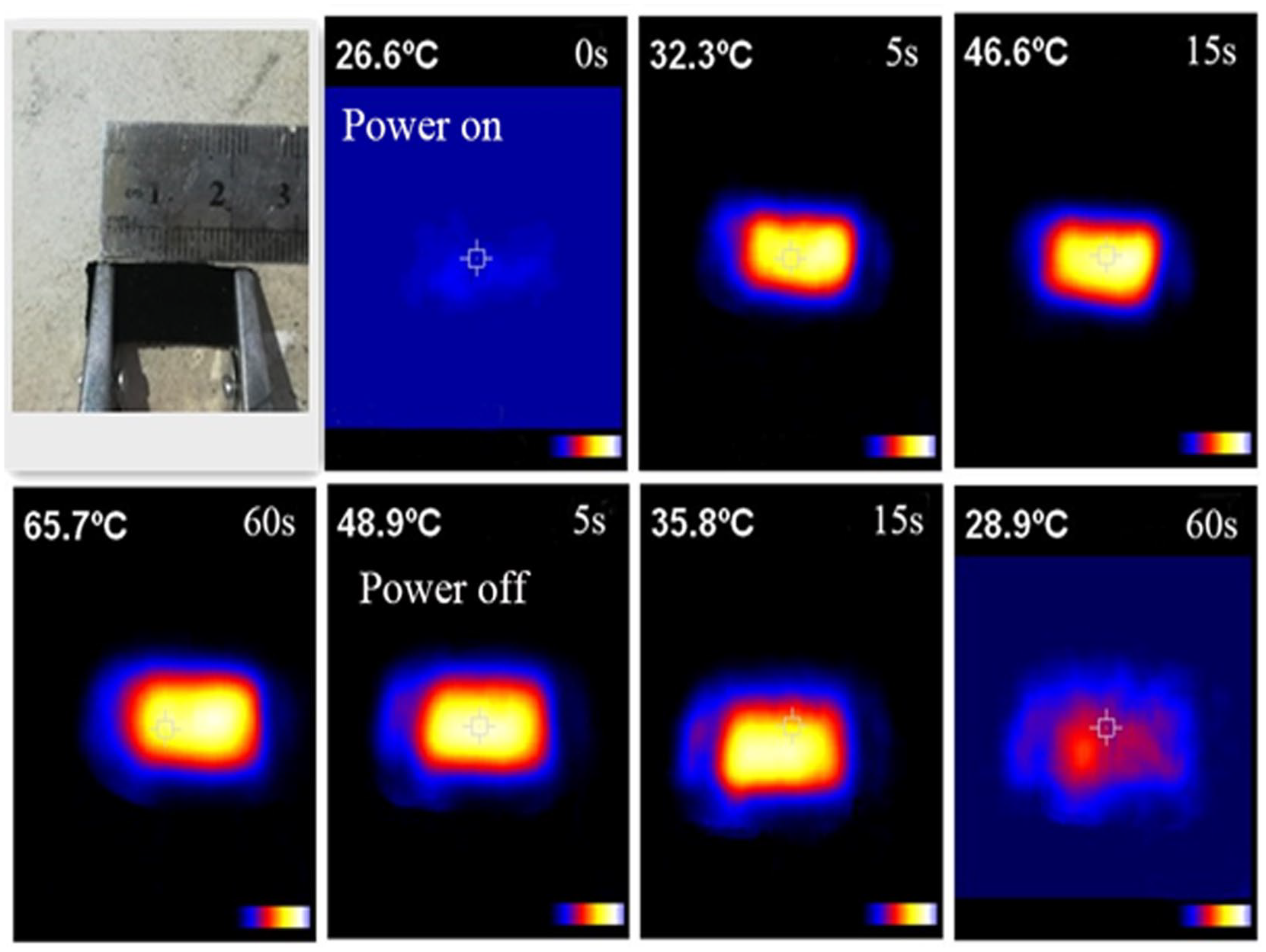
Infrared thermal images of Py-5 for different time power on and power off when applying 5 V.
Conclusion
In a word, a freestanding flexible PPy/ PCW fabric with high conductivity and electrothermal property was prepared. The loading PPy amounts were controlled by the ratio of Py/FeCl3 concentrations. The outstanding characteristics of the PPy/PCW cloth allowed their use as a joule heater. The PPy/PCW fabric obtained could reach up to a high temperature of 89.1°C with a voltage of 6 V in 66 s and when the power was turned off it cooled down quickly. For all of the above, this fabric is positioned as a key role in new wearable textiles for heater devices.
Footnotes
Declaration of conflicting interests
The author(s) declared no potential conflicts of interest with respect to the research, authorship, and/or publication of this article.
Funding
The author(s) disclosed receipt of the following financial support for the research, authorship, and/or publication of this article: This work is supported by key research Program of Higher Education of Henan Province (19A540005).
