




Abstract
To prepare flame-retardant epoxy resin, phosphorus compound containing di-hydroxyl group (10-(2,5-dihydroxyphenyl)-9,10-dihydro-9-oxa-10-phospha phenanthrene-10-oxide, DOPO-HQ) was reacted with uncured epoxy resin (diglycidyl ether of bisphenol A, YD-128) and then cured using a curing agent (dicyandiamide, DICY). This study focused on the effect of phosphorus compound/phosphorus content on physical properties and flame retardancy of cured epoxy resin. The thermal decomposition temperature of the cured epoxy resins (samples: P0, P1.5, P2.0, and P2.5, the number represents the wt% of phosphorus) increased with increasing the content of phosphorus compound/phosphorus (0/0, 19.8/1.5, 27.8/2.0, and 36.8/2.5 wt%) based on epoxy resin. The impact strength of the cured epoxy resin increased significantly with increasing phosphorus compound content. As the phosphorus compound/phosphorus content increased from 0/0 to 36.8/2.5 wt%, the glass transition temperature (the peak temperature of loss modulus curve) increased from 135.2°C to 142.0°C. In addition, as the content of phosphorous compound increased, the storage modulus remained almost constant up to higher temperature. The limiting oxygen index value of cured epoxy resin increased from 21.1% to 30.0% with increasing phosphorus compound/phosphorus content from 0/0 to 36.8/2.5 wt%. The UL 94 V test result showed that no rating for phosphorus compounds less than 19.8 wt% and V-1 for 27.8 wt%. However, when the phosphorus compound was 36.8 wt%, the V-0 level indicating complete flame retardancy was obtained. In conclusion, the incorporation of phosphorus compounds into the epoxy chain resulted in improved properties such as impact strength and heat resistance, as well as a significant increase in flame retardancy.
Introduction
Epoxy resins are most widely used as matrices in advanced composites because of their high tensile strength/modulus, low shrinkage on cure, high adhesive strength, good chemical/corrosion resistance, and excellent dimensional stability. However, since conventional epoxy resins are flammable, they cannot be used for materials requiring high flame resistance.1–4
There are various methods of making the epoxy resin more flame retardant. Examples of the flame retardant include inorganic flame retardants, halogen flame retardants, organic phosphorus flame retardants, and combinations thereof. Considering avoiding the occurrence of environmental pollution a long time ago, the tendency was to use a halogen-free flame retardant.5–7
Epoxy resins modified with phosphorus-containing flame retardants have received much attention because they are more environmentally friendly. When the phosphorus-containing compound is used as a flame retardant in a polymer, it is simply blended or reacted with the polymer. Generally, reactive flame retardants are of more interest because reactive flame retardants can sustain flame retardancy longer and reduce the impact on the intrinsic properties of the polymer.8–15
Studies on various phosphorus-containing reactive flame retardants such as bis(4(or 3)-aminophenoxy)phenyl(or methyl) phosphine oxide (BAPP)/di(tri)glycidyl[or phenyl (or methyl)] phosphonate (or phosphate, or phosphite), 9,10-dihydro-9-oxa-10-phosphaphenanthrene-10-oxide (DOPO)-N-(4-hydroxyphenyl) maleimide (HPM), and 1,3-benzenediphosphoro tetrachloridate (DCP)-amine have been published.
In this study, the phosphorus-containing flame-retardant component (10-(2,5-dihydroxyphenyl)-9,10-dihydro-9-oxa-10-phospha phenanthrene-10-oxide, DOPO-HQ) was reacted with an epoxy resin (diglycidyl ether of bisphenol A, YD-128) and then cured using a curing agent (dicyandiamide, DICY) to prepare a cured phosphorus-contained epoxy resin. The effects of phosphorus compound content on the thermal decomposition behavior, impact strength, storage modulus/glass transition temperature, and flame retardancy of cured epoxy resin sheets were investigated in this study.
Experimental section
Materials and method
Materials
The pure epoxy resin (diglycidyl ether of bisphenol A with an epoxide equivalent weight (EEW) of 187 g/eq, YD-128) was supplied by KUKDO Chemical Co., Ltd, Korea. Phosphorus compound (10-(2,5-dihydroxyphenyl)-9,10-dihydro-9-oxa-10-phospha phenanthrene-10-oxide (DOPO-HQ)) was supplied by Pharmicell Co., Korea. Hardener (dicyandiamide, DICY, AlzChem, Germany, EEW = 21 g/eq), accelerator (DYHARD UR500, AlzChem), and catalyst (benzyltrimethylammonium chloride, BTMLC; Tokyo Chemical Industry Co., Japan) were used as received.
Preparation of epoxy resins containing phosphorus
The synthesis process of cured phosphorus-containing epoxy resin is shown in Scheme 1. A fixed amount of bisphenol A epoxy resin (YD-128) was mixed with the required amount of phosphorus compound (DOPO-HQ) and catalyst (BTMLC) in a 500-mL round bottom flask. The catalyst BTMLC was used in an amount of 1 wt% based on DOPO-HQ. The reaction mixture were heated to 170°C using oil bath and stirred for about 2 h. After, the reaction mixture becomes transparent, which means that DOPO-HQ is dissolved in epoxy resin melt and reacted with the epoxy resin. This reaction was confirmed by Fourier-transform infrared spectroscopy (FTIR) analysis. The reaction mixture was cooled down to 120°C and then hardener DICY/accelerator UR500 is added so that the molar ratio of hardener to epoxy resin is 1:0.7. Here, the accelerator UR500 is 1 wt% for the hardener. The reaction mixture was stirred under vacuum at 300 r/min until a transparent phase was formed. Then, the reaction mixture was put into a closed mold, and the volatile matter and air bubbles were completely removed from the vacuum oven at room temperature. Then, the mixture was cured at 150°C for 1 h. The sample designation and composition of epoxy resins containing various contents of phosphorus are given in Table 1.

Synthesis process of the cured epoxy resin containing phosphorus.
Sample designation, composition, and contents of epoxy resins (YD-128)/phosphorous (DOPO-HQ)/hardener (DICY)/accelerator (UR500) in epoxy resins.

Characterizations
FTIR analysis
The FTIR spectra of the epoxy resin were recorded in the range of 4000–650 cm−1 at a 4 cm−1 resolution over 32 scans using a Nicolet™ iS5 FTIR Spectrometer (Thermo Scientific, USA).
Thermal analysis measurement
Differential scanning calorimetry (DSC) thermograms were obtained using DSC Q 25 (TA Instruments, USA). In order to drive the curing temperature, the mixture (3 mg) of epoxy resin and hardener (DICY) was heated from room temperature to 350°C with various heating rates (1°C/min, 3°C/min, 5°C/min, 7°C/min, and 10°C/min) under nitrogen atmosphere. In addition, dynamic DSC kinetics test (ASTM E 698-16: Standard test method for kinetic parameters for thermally unstable materials using differential scanning calorimetry and Flynn/Wall/Ozawa method) was performed at various heating rates of 1°C/min, 3°C/min, 5°C/min, 7°C/min, and 10°C/min.
The thermal stability of the cured epoxy resin samples was examined by thermogravimetric analysis (TGA; TGA Q500, TA Instruments). Samples (about 15 mg) were heated in Pt pans, from 30°C to 900°C at heating rate of 10°C/min under nitrogen atmosphere.
The dynamic mechanical properties of the cured epoxy resin samples were examined by dynamic mechanical analysis (DMA; DMA Q800, TA Instruments) at 1 Hz, 0.03% strain, and a heating rate of 5°C/min over a temperature range from 30°C to 180°C.
Impact strength
The impact strength was measured at room temperature using an impact test instrument (Toyoseiki, Japan) according to ASTM D256-10 (Standard test methods for determining the Izod pendulum impact resistance of plastics, Method A). The following measurement conditions were used; hammer capacity: 3 J, destruction type: C (complete fracture), temperature: 23°C ± 2°C, and notch depth: 2 mm. The values quoted are the average of three measurements.
Flame-retardant properties measurement
Limiting oxygen index (LOI) was measured according to ISO 4589 (Plastics—determination of burning behavior by oxygen index). The apparatus used was LOI tester (FTT, UK) with a mixture of oxygen and nitrogen to obtain the percentage concentration of oxygen in supporting combustion of the sample as the LOI. And, five samples were carried out in the LOI test.
The vertical burning tests (UL 94; Underwriters Laboratory, USA) of cured epoxy resins were conducted by UL 94 AVH chamber (Korea). The L/W/D of specimens was 125/13/3.5 (mm) according to the UL 94 tests (ASTM D3801: Standard test method for measuring the comparative burning characteristics of solid plastics in a vertical position). The flame retardancy in the UL 94 test was determined by taking into account the residual flame time after the first flame pouring, the flame residue/time remaining after the second flame pouring, and the ignition of the cotton flake by burning and dropping to the clamp (125 mm).
Results and discussion
Identification of phosphorus-containing epoxy resin
Figure 1 shows the FTIR spectra of (a) epoxy prepolymer: diglycidyl ether of bisphenol A (YD-128), (b) DOPO-HQ, (c) the reaction product of YD-128 and DOPO-HQ, and (d) the cured epoxy resin containing DOPO-HQ. The structure of YD-128 was confirmed from characteristic peaks of epoxy groups of 914 and 827 cm−1 (914 cm−1 (C–O of ether) and 827 cm−1 (C–O–C of oxirane) (see Figure 1(a))). The structure of DOPO-HQ was confirmed from characteristic peaks of 3650–3140 cm−1 (O–H), 1477 cm−1 (P–C), and 1184 cm−1 (P=O/P–O–C) (see Figure 1(b)). The structure of the reaction products of YD-128 and DOPO-HQ can be confirmed by the appearance of mixed characteristic peak of YD-128 and DOPO-HQ (see Figure 1(c)). The curing reaction of the epoxy resin (P2.5) containing DOPO-HQ can be confirmed by the disappearance of the characteristic peaks of the epoxy groups appearing at 914 and 827 cm−1, and the increase in the hydroxyl group peak in the range of 3650–3140 cm−1; in addition, the appearance of the stretching peak of the N–H group, which is a hardener component appeared in the range of 3500–3300 cm−1 and 1460 cm−1 (see Figure 1(d)).16–18

FTIR spectra of (a) uncured pure epoxy resin: diglycidyl ether of bisphenol A (YD-128), (b) DOPO-HQ, (c) the reaction product of YD-128 and DOPO-HQ, and (d) the cured epoxy resin (P2.5) containing 2.5 wt% DOPO-HQ.
Curing reaction of epoxy resin YD-128 and hardener DICY
The curing reaction of the epoxy system is an exothermic reaction. Thus, a convenient way to track the hardening of the epoxy is to record the thermal effects of the curing process using a DSC apparatus. The dynamic DSC measurement at the constant heating rate shows the temperature range at which the curing reaction takes place and the temperature of the exothermic peak at curing. The DSC curves of the curing of the epoxy system (sample P0) at various heating rates (1°C/min, 3°C/min, 5°C/min, 7°C/min, and 10°C/min) are shown in Figure 2. As the heating rate increased from 1°C/min to 10°C/min, the exothermic peak temperature increased from 112.5°C to 145.5°C. Also, as the heating rate increased, the temperature range at which the curing reaction takes place was widened and the range was shifted to higher temperature.

Dynamic DSC curves at various heating rates (1°C/min, 3°C/min, 5°C/min, 7°C/min, and 10°C/min) under nitrogen atmosphere for epoxy sample (P0).
Isothermal measurements, however, show the reaction heat (enthalpy) of epoxy system at each curing time and also provide information about the conversion at each curing time at a given temperature. Figure 3 shows conversion of curing reaction at a given temperature (80°C, 100°C, 120°C, 150°C, and 180°C) with curing time. From these results, it can be seen that the curing reaction rate increases sharply at the beginning of the curing reaction and then the rate of the curing increases slowly or reaches 100%. The higher the curing temperature, the higher the reaction rate at the initial stage of the curing reaction. These data are essential for determining the proper curing time and temperature to achieve the desired degree of cure. It was found that the conversion reaches 100% at about 7 min of curing at 150°C. Therefore, in this study, the curing conditions of all samples were taken at 150°C for 1 h, which is sufficient curing.

Percent conversion—curing time relationship for epoxy sample (P0) at 80°C, 100°C, 120°C, 150°C, and 180°C.
TGA analysis
Figure 4 shows (a) TGA and (b) derivative thermogravimetry (DTG) curves for cured epoxy resin samples containing various phosphorus contents. The TGA and DTG results are shown in Table 2. The temperature of 10 wt% weight loss (T10%) and the temperature of max weight loss (Tmax) increased with increasing phosphorus content. As the phosphorus content increased, the area of first peak at about 385°C of DTG curve decreased; however, the area of second peak at about 425°C increased, indicating that the fraction of the non-crystalline region that is decomposed at a higher temperature is greater than the fraction of the non-crystalline region that is decomposed at a lower temperature.

(a) TGA and (b) DTG curves of the cured epoxy resins containing various contents (0/0 wt%, 19.8/1.5 wt%, 27.8/2.0 wt%, and 36.8/2.5 wt%) of phosphorous compound/phosphorus.
TGA, DTG, and DMA results of the cured epoxy resins (P0, P1.5, P2.0, and P2.5).

TGA: thermogravimetric analysis; DTG: derivative thermogravimetry; DMA: dynamic mechanical analysis; T10%: temperature at 10% weight loss; Tmax: temperature at maximum weight loss rate.
The measurements were carried out in a nitrogen atmosphere.
DMA analysis
From the DMA results, the information on the glass transition temperature and microstructure of the cured epoxy resin can be obtained. Figure 5 shows the DMA curves of cured epoxy resin samples containing various phosphorus contents. The glass transition temperatures of cured epoxy resin containing various phosphorus contents are summarized in Table 2. The value of Tg of the neat epoxy is 135.2°C. As the content of phosphorous compound/phosphorus increased from 0/0 to 36.8/2.5 wt%, the glass transition temperature (the peak temperature of loss modulus curve) increased from 135.2°C to 142.0°C. In addition, as the content of phosphorous increased, the storage modulus remained almost constant up to higher temperature. These increases are thought to be due to the rigid ring structure including phosphorous and the linked rigid aromatic ring.

(a) Storage modulus and (b) loss modulus of the cured epoxy resins (P0, P1.5, P2.0, and P2.5).
Impact strength of epoxy resin containing various phosphorus contents
The impact strength of cured epoxy resin containing various phosphorus contents is shown in Figure 6. The impact strength corresponds to the energy required for a specimen subjected to a sudden load to be destroyed. The magnitude of the impact strength reflects the ability of the material to withstand impact. The impact strength increased with increasing the phosphorus compound content. The structure of phosphorus compound (DOPO-HQ) is composed of side chains in which rigid aromatic rings are connected. It is believed that the increase in impact strength with increasing phosphorus content is due to this rigid side chain structure.
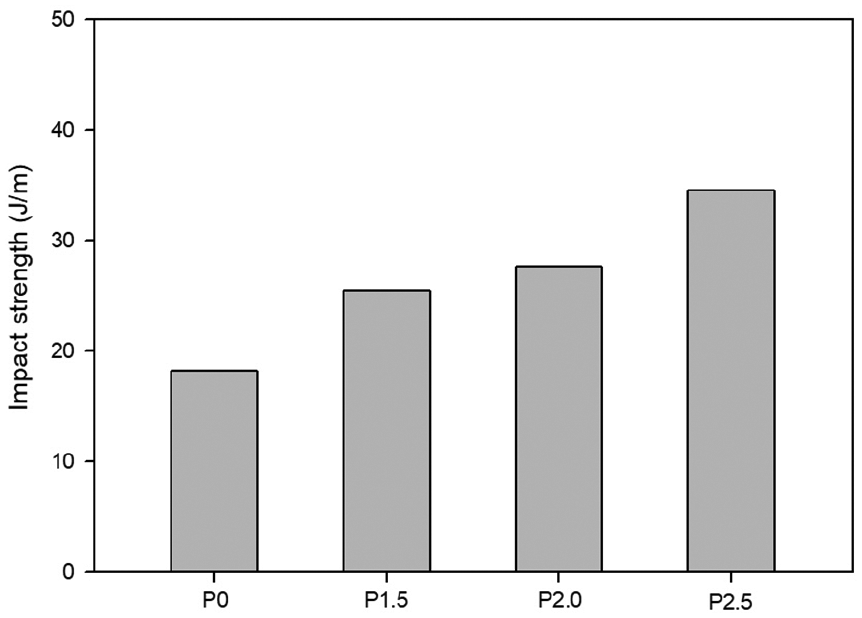
Impact strength of the cured epoxy resins (P0, P1.5, P2.0, and P2.5).
LOI and UL 94 V test results of cured epoxy resin containing various phosphorus contents
The LOI is the minimum concentration of oxygen that can support the combustion of a polymer. 19 The UL 94 V test 20 evaluates the combustion pattern of the plastic product and the degree of flame propagation around it when the flame is applied in the vertical direction of the product. In order to be evaluated as a flammable material, UL 94 V test results should indicate V-0 rating. 21
The LOI and UL 94 of cured epoxy resins containing 0, 1.5, 2.0, and 2.5 wt% of phosphorus are shown in Figure 7. The LOI value of cured epoxy resin increased from 21.1% to 30.0% with increase in phosphorus content from 0 to 2.5 wt%. The sample P2.0 showed the V-1 level of the UL 94 V test, while the sample P2.5 showed the V-0 level. However, P0 and P1.5 samples showed no rating level. When phosphorus content is 2.5 wt%, LOI value reaches 30.0% and UL 94 shows V-0 rating. Therefore, the sample P2.5 containing 2.5 wt% of phosphorous can be evaluated as a flame-retardant material.
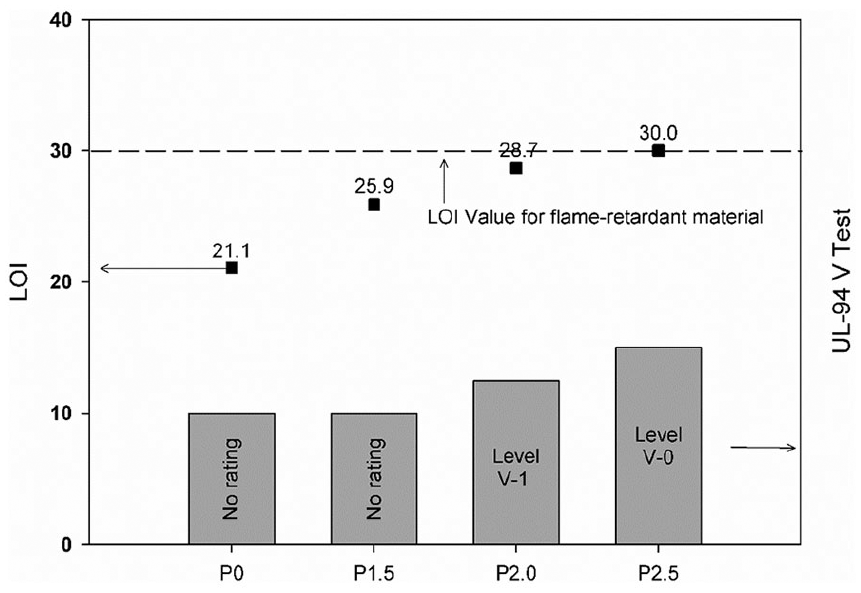
LOI and UL 94 test results of the cured epoxy resins (P0, P1.5, P2.0, and P2.5).
Conclusion
In this study, the component of phosphorus-containing compound was incorporated into the epoxy main chain to provide continuous flame retardancy. Various amounts of phosphorus compound containing di-hydroxyl group (10-(2,5-dihydroxyphenyl)-9,10-dihydro-9-oxa-10-phospha phenanthrene-10-oxide, DOPO-HQ) were reacted with uncured epoxy prepolymer containing epoxy end group (diglycidyl ether of bisphenol A, DGEBA) in a molten state and then cured using a curing agent (dicyandiamide, DICY). In this study, the effect of phosphorus content on the properties of cured epoxy resin was investigated. The thermal decomposition temperature, glass transition temperature, impact strength, and LOI value of the cured epoxy resin increased significantly with increase in the content of phosphorus compound/phosphorus. The LOI value of the phosphorus-free cured epoxy resin was 21.1%, while the LOI value of the flame-retardant cured epoxy resin containing phosphorus of 2.5 wt% was 30.0%. The cause of this increase is believed to be due to rigid aromatic rings containing phosphorus. The UL 94 V test result showed that the cured epoxy resin containing less than 1.5 wt% phosphorus had a no rating level. However, when phosphorus was 2.0 wt%, it showed V-1, and when phosphorus was 2.5 wt%, it showed V-0 which means complete flame retardancy.
Footnotes
Declaration of conflicting interests
The author(s) declared no potential conflicts of interest with respect to the research, authorship, and/or publication of this article.
Funding
The author(s) disclosed receipt of the following financial support for the research, authorship, and/or publication of this article: This work was supported by a grant from the Fundamental R&D program for Mari-time hybrid composite industrialization project (10053826, Development of core material technology based marine composites) funded by the Ministry of Trade, Industry and Energy (MOTIE, Korea).
