



Abstract
Tires might be the first technically significant composite out of rubber and play a vital role in the overall performance of a car. The essential functions of a tire rely to a great extent on the properties of tire cords. Polyester and nylon cords make up the majority of synthetic fibers used in tires. A new kind of polyester cord has been developed combining the performance characteristics of both polyester and nylon cords. This article examines the dynamic mechanical properties of this nylon-like polyester tire cord by adopting dynamic mechanical analysis, Instron, and DISC fatigue experiments, as well as its dynamic adhesion property using flex fatigue experiment. It demonstrated that the dynamic complex modulus of the nylon-like polyester cord was higher than that of nylon 6 cord but lower than that of standard polyester cord, which was a favorable characteristic when it came to replacing nylon 6 cord with nylon-like polyester cord in tires. Under cyclic loading, hysteresis loss of nylon 6 cord > nylon 66 cord > nylon-like polyester cord > standard polyester cord was observed. In the DISC experiment, nylon-like polyester had a similar compression resistance property to that of nylon 6 cord. At a temperature below 85°C, nylon-like polyester cord maintained roughly the same level of residual ratio of dynamic adhesion, but beyond this temperature point, nylon 6 exhibited a better performance.
Keywords
Introduction
Textile fiber–reinforced rubber composites have been available in many applications, such as hoses, transmission belts, conveyor belts, and pneumatic tires. Among these mechanical rubber goods, tires are the most common, which can be viewed as an organic object with a structural skeleton of tire cords fleshed with rubber compounds. 1 As a skeleton component, tire cords bear a large share of the structural load exerted on the tire and are also responsible in maintaining its contour. The essence of tire performance is largely determined by properties of tire cords.1–4 Polyester and nylon fibers are currently the two predominant synthetic reinforcement materials used as tire cords. Polyester tire cord has good attributes such as high modulus and low thermal shrinkage, but poor adhesion and shock absorbance. However, nylon cord has favorable adhesion and good shock absorbance, but poor dimensional stability. Given the distinctive characteristics of polyester and nylon cords, a new nylon-like polyester tire cord was invented by optimizing the twist-level design and dipping parameters in our previous paper. 3 Nylon-like polyester tire cord integrates the favorable characteristics of these two dominant tire cords. It had a typical high modulus of polyester tire cord and a high breaking elongation of up to 21.7%, creating a hybrid effect. In actual service, tire cords are subjected to cyclic mechanical loading, during which they undergo a combination of tension, compression, shearing, and bending. 5 The static mechanical properties of a tire cord, such as tenacity, modulus, and thermal stability, are essential to maintaining the functions of a tire. However, the dynamic properties of tire cords are best demonstrated during actual servicing conditions. 1 EM Winkler 6 introduced the Goodrich block fatigue test to evaluate the compression property of tire cords. This same protocol was used in evaluating the fatigue mechanism of the nylon-like polyester cord. G Orjela et al. 7 introduced a dynamometer (Pirelli Pure Moment Dynamometer (PPMD)) to evaluate the compression property of tire cord, as well as establish the effects of process variables on the experiment. K Barun et al. 8 studied the hysteresis characteristics and dynamic property of the polyester tire cord, revealing that there was a good correlation between specific work loss of the hysteresis test and tan δ of the dynamic test. L Christophe et al. 9 studied the fatigue mechanism of fiber bundles embedded in the rubber compound matrix. They indicated that the initiation of cracks was observed all across the fiber section instead of being limited to the near-surface region, which was more complicated than a single fiber situation. M Kerr et al. 10 reviewed the cyclic loading fatigue mechanisms of several types of fibers, revealing that, in nylon and polyester fibers, the compressive stress was an important factor leading to the initiation of cracks, which resulted in the final fatigue failure.
As to the whole composite, the adhesion of tire cords to the rubber compound matrix is another critical elements. The rubber compound matrix binds the composite together, transferring the force from the exterior rubber to the cords, determining the performance of the whole system. 11 Several studies introduced methods to evaluate the adhesion properties of tire cords to rubber compounds, such as strap peel test, H-adhesion test method, and flex fatigue experiment.3,5,11,12 R Soghra 12 used the H-adhesion method to study the effect of moisture on the adhesion strength of nylon6/66 cords to rubber compound. M Jamshidi and T Afshar 11 studied both static and dynamic adhesion properties of the polyethylene terephthalate (PET) cord to rubber matrix at a range of temperatures and proposed an equation to estimate dynamic adhesion from H-Pull static test results. P Van Bogaert 5 introduced the bend-over-sheave test to evaluate the fatigue interply delamination as well as the dynamic adhesion degradation. In this study, the dynamic behavior and fatigue properties of this nylon-like polyester tire cord were investigated; its dynamic adhesion to rubber compound was also studied.
Experimental
Materials
Preparations of the nylon-like polyester tire cord were conducted in Performance Fibers (Kaiping) Company Limited. PA6 and PA6.6 tire cords used as reference in this article were supplied from Formosa Taffeta Co., Ltd. Standard high-modulus low-shrinkage (HMLS) polyester tire cord was obtained from Performance Fibers (Kaiping) Company Limited. The specimens used in this experiment were two-ply yarns twisted together and coated with a layer of resorcinol formaldehyde latex (RFL) solution.
Characterizations
Mechanical measurement
Tensile measurements were carried out, according to ASTM D885, in an Instron tensile tester 3367 at a room temperature of 25°C, with cross head moving at a speed of 254 mm/min and with a gauge length of 254 mm. Specimens were conditioned at a temperature of 20°C with a relative humidity of 65% for 24 h before testing. The value shown in the article is an average of 10 experiment runs.
Thermal shrinkage measurement
Thermal shrinkage test was conducted according to ASTM D4974, using a Testrite tester. The test condition was set at 177°C for 2 min with a pre-load of 0.05 g/D during the test. The value shown in this article is an average of three experiment runs.
Twist-level measurement
Twist-level test of dipped tire cord was measured using the Uster Zweigle Twist Tester according to ASTM D885. The unit of twist-level measurement is turns per meter (TPM). Results compiled in this work are an average of three test runs.
Dynamic mechanical analysis (DMA)
The dynamic properties of tire cords were measured using the BOSE 3230 SERIES Ⅱ tester in tensile mode (Figure 1). The sinusoidal wave load (static load of 13 N and dynamic load of 2.5 N) were applied to the tire cord specimen at a frequency of 12 Hz, with a gauge length of 30 mm and a temperature range of 30°C–200°C.

Schematic of dynamic mechanical analysis (DMA) instrument.
Cyclic loading test
Tire cords are viscoelastic materials; therefore, its loading and unloading curves do not exactly coincide in each cycle (Figure 2). As the tire cord experiences repeated loading and unloading in a running tire, the energy of loading becomes greater than that of unloading, and the area within the hysteresis loop represents the amount of energy dissipated as heat. 13 The Instron tensile tester 3367 with an environmental chamber was adopted to measure hysteresis loss at different temperatures. Cyclic loading of 10–30 N was applied to the specimen, with a gauge length of 343 mm, at a speed of 100 mm/min. The value compiled in this experiment is the average of three test runs.

Hysteresis loop under cyclic loading of synthetic tire cord.
DISC fatigue tests
Since the synthetic fiber tire cord is soft, it is difficult to directly evaluate its compression properties. Hence, it was usually measured through cord/rubber composite.5,6 The block samples of the cord/rubber composite, with a size of 76 mm × 12.7 mm × 11.2 mm, were prepared in a stainless steel die by placing a piece of rubber compound at the bottom of the mold, and the tire cord was placed on the top of the rubber compound and then covered with another piece of rubber compound in a similar manner to the sample preparation for H-adhesion. 11 The curing condition was set at 168°C under 11 ton pressure for 15 min with a plate vulcanizer. Furthermore, the prepared composite samples were mounted in a B.F. Goodrich Disc Fatigue tester running for 8 h at a rotational speed of 2000 r/min at ambient temperature. During the running process, the samples were subjected to compression and extension as well, and the compression ratio can be adjusted. 14 A set of untreated samples were selected as the control. After the test, extra rubber compound was cautiously cut off using a knife mold, and then a thin cord/rubber composite specimen of 76 mm × 2.5 mm × 2.5 mm in size was obtained. All the block samples, including both treated and untreated ones, were cut into thin-sliced specimens and placed in the Instron tensile tester to measure the breaking strength (BS). The ratio of residual BS and the percentage of BS of treated to untreated samples were calculated to measure the property of DISC fatigue. The test protocol followed ASTM D6588. The value compiled in this article is the average of four test runs.
Flex fatigue measurement (shoeshine)
Flex (also known as shoeshine) fatigue test was carried out using the Ueshima Flex Fatigue instrument. The specimen was a two-ply cord fabric–reinforced rubber belt (Figure 3), which was then subjected to a constant tensile load (80 kgf) while dynamically flexed around a mobilizing sheave (Figure 4). The ambient temperature of the chamber can be heated and the specimen was conditioned for 30 min before running this test, and surface temperature of the specimen was recorded with a remote temperature detector mounted inside the chamber. Curing condition for the specimen was set at 171°C under 5.4 ton pressure for 12 min. There were five specimens, with size of 5.3 mm × 25.4 mm × 400 mm, cut out of each curing batch. Four specimens were run simultaneously from each batch, for 36,000 cycles during a period of 3 h, and one served as control. The peeling adhesion of all the two-ply specimens was measured in the Instron tensile tester. The ratio of residual peeling adhesion and the percentage of peeling adhesion of four treated specimens to one untreated sample were used to evaluate the dynamic adhesion of the specimen.

Schematic of two-ply flex fatigue specimen preparation.

Schematic of specimen mounted on the sheave in the chamber.
Results and discussion
Static mechanical properties
Representative stress–strain curves are depicted in Figure 5, and data/CV (coefficient of variation) derived from the stress–strain curves along with representative thermal shrinkage are summarized in Table 1. As tire cords were continuously strained to 2%–5%, 15 load at a specified elongation of 5% (LASE-5) was adopted as a way to evaluate the modulus of tire cords 16 Higher values of LASE-5 indicate a higher modulus, which in turn is a desirable characteristic of tire cords. As indicated in Figure 5 and Table 1, the nylon-like polyester tire cord possesses a high modulus typical for the standard polyester cord, thus enhancing tire dimensional stability and handling performance, and a high breaking elongation up to 21.7%. This favorable characteristic of the newly designed nylon-like polyester tire cord resulted from the combination of distinctive mechanical properties of both nylon and polyester cords. 3 Thermoplastic polymers, such as nylon and polyester, are supposed to experience shrinkage under high temperature; 16 thermal shrinkage measures the thermal stability of tire cords; hence, lower shrinkage means better thermal stability. Nylon-like polyester only has a value of 0.1% in terms of thermal shrinkage, indicating excellent temperature resistance.
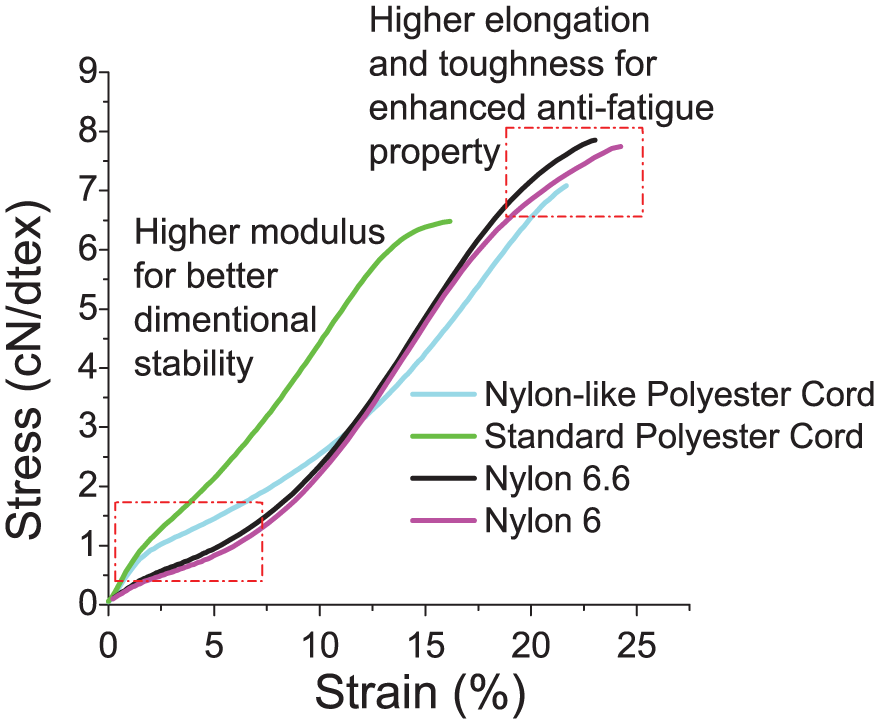
Stress–strain curves of the nylon-like polyester cord and reference cords.
Static mechanical properties of the nylon-like polyester cord and reference cords.

CV: coefficient of variation; LASE-5: load at a specified elongation of 5%.
Dynamic mechanical property (DMA)
Under actual driving conditions, there is a considerable amount of heat generated during running, and the temperature of the tire could easily reach up to 100°C or even higher. 2 In view of that, the dynamic mechanical properties of tire cords along with a temperature sweep were studied by applying DMA, while tan δ peak was used to measure the glass transition temperature (Tg) of tire cords. 17 As indicated in Figure 6, with an increase in temperature, the modulus decreased. This is not a favorable characteristic for tire cords. There was a dramatic drop of modulus at the glass transition temperature (Tg), and the polyester cord had a higher Tg than that of nylon cord, which was the main reason for the replacement of nylon cords with polyester cords in recent years.3,18 Nylon-like polyester cord had a higher dynamic modulus than nylon 6 and nylon 66 cords, but lower than that of standard polyester cord. This was in accordance with its static modulus shown in the stress–strain curve. Higher modulus means a better dimensional stability and a better handling performance while driving.

Dynamic mechanical property of the nylon-like polyester cord and reference cords.
Resultantly, nylon-like polyester cord had an advantage when it came to replacing nylon 6 tire cord in motor cycle or all-terrain vehicle (ATV) tires.
Cyclic loading result
The tire cord in this study was composed of multiple filaments twisted together and coated with a layer of RFL solution. 3 When a load is applied, adhesion damage and slippage between filaments were revealed. This process was irreversible under unloading because of the friction. 19 With a few loading–unloading cycles, the hysteresis loop tended to be stable, while the 100th cycle was used to characterize hysteresis loss.8,19 Results of this experiment in Figure 7 showed hysteresis loss of nylon 6 cord > nylon 66 cord > nylon-like polyester cord > standard polyester cord, which could be explained by the modulus of each specimen. At the same level of cyclic loading, the higher the modulus of the sample, the smaller the displacement. Nylon 6 cord exhibited the highest hysteresis loss. Prior to the temperature of 80°C, hysteresis loss remained roughly at the same level. There was an evident increment of hysteresis loss beyond this temperature point. The mobility of molecular chains increases at elevated temperature, and the modulus of specimen decreases. Hysteresis loss tends to increase at high temperature. The hysteresis effect of rubber/cord composite was the reason for rolling resistance. 13 Thus, based on energy consumption and environmental concerns, nylon-like polyester cords compare favorably to nylon 6 cords.
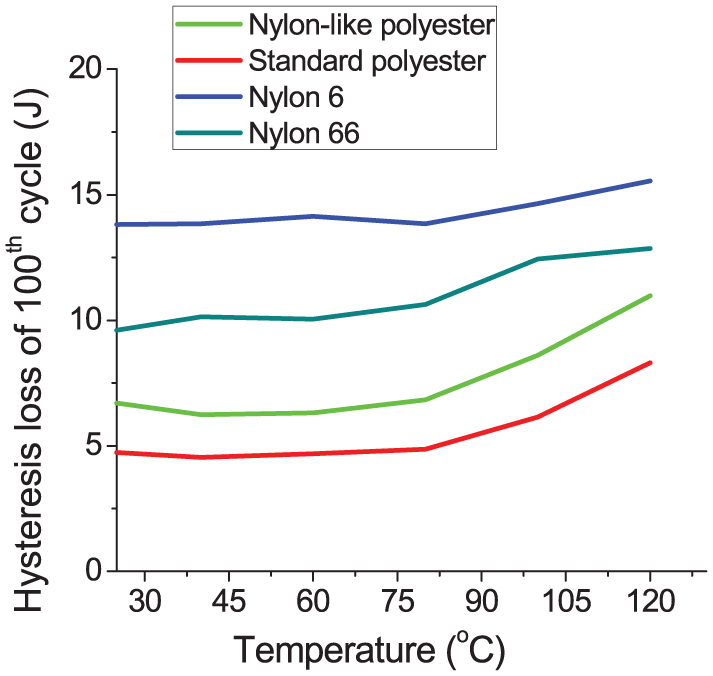
Hysteretic energy loss of the nylon-like polyester cord and reference cords.
DISC fatigue experiment result
Under actual driving conditions, the tire cord withstands constant tension/compression process under operation and impact load. Therefore, it is very important for a cord to have optimum fatigue resistance, particularly compression fatigue resistance. 7 In the DISC fatigue experiment, the samples endured compression and extension in each cycle, and the compression ratio can be manipulated. It was observed from Figure 8 that prior to the compression ratio of 25%, all four cords had roughly the same level of residual BS ratio. However, beyond this point, there was a sharp drop for standard polyester cord, which led to the failure of the tire. A higher breaking elongation and a high breaking toughness (calculated as area under the stress–strain curve) were believed to be the factors attributing to this favorable fatigue resistance property. The compression fatigue property of both the nylon-like polyester and nylon reference cords was considered to be at the same level during a range of compression ratios. Compression fatigue resilience was a good attribute of nylon cord; thus, nylon-like polyester had a similar anti-fatigue property to that of nylon cord. Figure 8 also reveals that higher twist level of 470 TPM could improve the fatigue property of a cord, which was in accordance with a previous study. 20
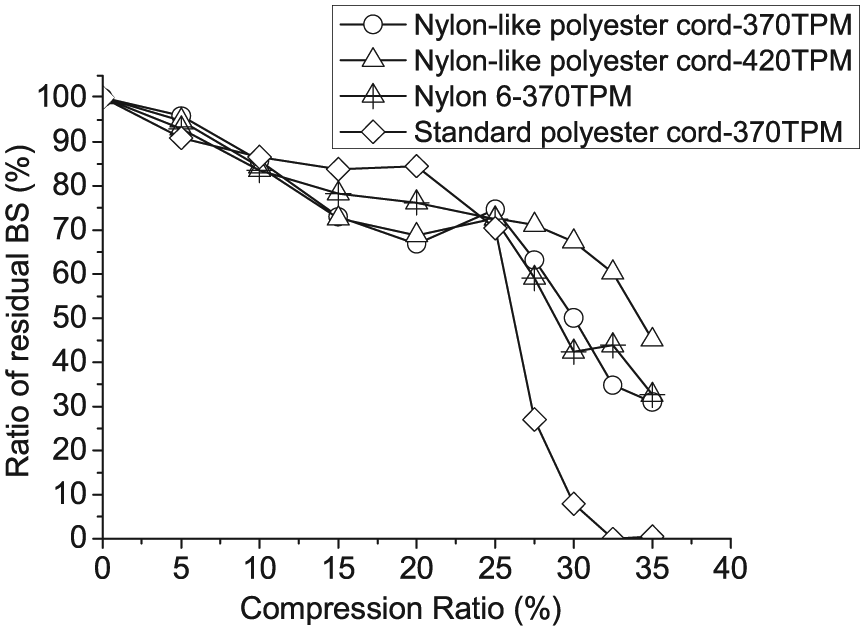
Compression property of the nylon-like polyester cord and reference cords.
Flex fatigue experiment result
Apart from the mechanical properties of a tire cord, adhesion of tire cord to the rubber compound is another critical component to a composite. There are several methods to evaluate the adhesion property, and many of them are used by measuring its static adhesion property.3,5,11,12 Flex fatigue is believed to be an efficient method for evaluating the dynamic adhesion of tire cord to rubber compound as well as adhesion degradation. 5 As discussed earlier, the temperature of a running tire could easily reach 100°C or above; thus, it was meaningful to study the effect of temperature on dynamic adhesion in the flex fatigue experiment. Ambient temperature of the specimen in the instrument chamber was set at 35°C, 40°C, 45°C, 50°C, 55°C, 60°C, and 65°C. The specimens were mounted on the sheave and conditioned for 30 min before running. At the end of the test, the corresponding surface temperatures of the specimen were 65°C, 70°C, 75°C, 85°C, 95°C 105°C, and 115°C, respectively. Table 2 shows that dynamic adhesion was a function of temperature, and the residual peel adhesion ratio decreased rapidly as the surface temperature of specimens increased. Temperature was a significant factor in accelerating the peel adhesion degradation process. Higher values of ratio indicate a better adhesion within the composite, which is a favorite characteristic for tire cords. Prior to the temperature of 85°C, the residual ratio of both nylon-like polyester cord and nylon 6 cord was roughly at the same level, but nylon 6 cord maintained a higher residual ratio than that of nylon-like polyester beyond this temperature point, which was determined by the nature of material and was in accordance with their static adhesion result. 3
Effect of temperature on dynamic flex adhesion of nylon-like polyester and nylon 6 cords.

Conclusion
The dynamic mechanical properties of nylon-like polyester tire cords were evaluated. It was confirmed that nylon-like polyester tire cord exhibited a high modulus, a favorable compression resistance property, and low hysteresis loss, combining the distinctive characteristics of both standard polyester and nylon cords. HMLS of this nylon-like polyester could enhance tire handling performance, and high elongation contributed to its fatigue properties and shock absorbance. These favorable characteristics enable nylon-like polyester cord to provide a better or equivalent tire performance when it comes to replacing the nylon 6 cord in motor cycle or ATV tires. Our next work will validate the tire performance of this polyester tire cord.
Footnotes
Declaration of conflicting interests
The author(s) declared no potential conflicts of interest with respect to the research, authorship, and/or publication of this article.
Funding
The author(s) disclosed receipt of the following financial support for the research, authorship, and/or publication of this article: This work was financially supported by the 111 Project (B17021), National First-Class Discipline Program of Light Industry Technology and Engineering (LITE2018-21), and the program of China Scholarship Council ([2017] 7751-201706790089).