



Abstract
This study examined the superiority of the strength of compact-Siro spun yarn. First, the strength properties of four types of yarn—ring, compact, Siro, and compact-Siro spun yarn—were compared based on an experiment with 9.7 tex and 14.6 tex polyester yarns. Yarn unevenness and compactness were analyzed in terms of their influence on yarn strength. It was determined that compact spinning enhanced the strength distribution by improving the overall yarn compactness. Siro spinning significantly increased the minimum yarn strength by reducing unevenness. Furthermore, compact-Siro spun yarn, which incorporates the advantages of both compact and Siro, remarkably improved the yarn strength distribution. These results were verified in the first part of the experiment. Finally, the four types of yarn were applied in the same weaving process. The results indicated that the efficiency of weaving with compact-Siro pure polyester yarn was higher than that of other methods by 3%–6%, thereby confirming the superior productivity of the method.
Introduction
The strength and strength distribution of staple fiber yarn are important indicators of yarn quality and have a significant influence on the subsequent weaving process. A weak point in the yarn can lead to yarn breakage during weaving, which in turn, can interrupt production and undermine fabric quality. The mean or minimum breaking strength of yarn is a determining factor of weaving efficiency.
Yarn strength has been an important subject of research in the textile industry.1–3 The factors influencing yarn strength, such as fiber properties,4,5 yarn structure, 6 and testing parameters, 7 have been systematically investigated. Previously, scholars attempted to predict the overall yarn strength by analyzing the basic yarn parameters, in order to guide the processing of related products. Zurek et al. 8 used the basic parameters of fiber and yarn to predict the yarn strength and compared the predicted strengths with experimental data. Hasler and Honegger 9 analyzed the relationship between ring-spinning strength and irregular strength distributions. They found that yarn strength increased with decreased irregularity. Rengasamy et al. 10 studied the strength changes of ring, rotor, jet, and friction-spun yarns in different measured lengths, in order to examine the influence of the measuring parameters on the yarn strength.
In recent years, the yarn structure has undergone considerable changes with the advent of advanced spinning technologies such as compact, Siro, and compact-Siro spinning.11,12 To further improve traditional ring spinning, compact spinning includes a condenser behind the drafting field, such that the spinning triangle is reduced or substantially eliminated.13–15 Siro spinning, invented by the Commonwealth Scientific and Industrial Research Organization (CSIRO) for wool spinning in 1975–1976, has become renowned in common fiber spinning. 16 Compact-Siro spinning is a relatively recent technology that integrates compact and Siro spinning, in which two rovings are separately fed into the drafting assembly in parallel. 11 They are then slightly twisted after agglomeration in the suction area, after which they converge at the junction point.
Owing to notable changes in the yarn structure that have emerged from advancements in spinning technology, considerable research has been conducted on factors that influence the yarn strength.17,18 Huh et al. 19 studied how the yarn structures of different spinning methods affected yarn physical properties. By comparing the physical properties of ring, rotor, and friction-spun yarn, they found that yarn breaking strength was positively related to yarn fiber migration. Basal and Oxenham 20 showed that the rate and amplitude of fiber migration in compact yarns were higher than those in ring-spun yarns, which, in turn, contributed to the higher breaking strength and extension in compact yarns. In addition, the superiority of compact yarns in improving the breaking strength was more noticeable at lower twist levels. Soltani and Johari 21 further studied the tenacity of Siro-spun yarn in terms of strand spacing. They determined that Siro-spun yarn had a higher tenacity, hairiness, and migration fiber rate when the strand distance was 8 mm.
Although the physical properties of ring, compact, and Siro-spun yarn have been thoroughly investigated, no literature exists on the strength characteristics of compact-Siro spun yarn. Therefore, the objective of this study was to examine the strength distribution characteristics of ring, compact, Siro, and compact-Siro spun yarns and to verify the advantages of compact-Siro spun yarn in the weaving process through theoretical analysis and subsequent experimental measurements.
Compact-Siro spun yarn combines the advantages of the compact and Siro spinning processes. Compact-Siro spinning improves the compactness and strength of yarn, while reducing its unevenness. Yarn compactness refers to the tightness of the fiber arrangement, and can be expressed by the longitudinal shape of the yarn. Unevenness is related to the yarn linear density diversity, and the CV% value is the main parameter. The compactness and unevenness of the four types of yarn are compared in the following experiment to analyze their strength distribution characteristics.
Experiment
Sample selection
To test the yarn strength distribution laws of the above four spinning methods, a staple polyester fiber with high consistency was selected for processing in order to obtain the corresponding yarn with 38 mm length. A Toyota RX300 ring-spinning frame was utilized to spin 14.6 tex and 9.7 tex ring, compact, Siro, and compact-Siro spun yarn, using the same processing parameters and twist factor (330). Other factors are shown in Table 1.
Main parameters of the spinning process.

An increase in the draft ratio weakens the yarn quality and requires greater stability in the spinning frame. While spinning Siro and compact-Siro yarn, the draft ratio of the spinning frame was twice that of the other two methods. Thus, the roving quantum of the ring-spun and compact-spun yarn was twice that of the yarn produced by Siro and compact-Siro spinning. Moreover, the stability of the adopted Toyota RX300, which is one of the best compact-Siro spun spinning frames, provided higher pressure for the larger draft ratio to preserve the yarn quality.
Yarn compactness property
The images in Figure 1, which depict the longitudinal structures of the four yarns, were obtained using a Hitachi SU1510 scanning electronic microscope with 50× magnification. It is readily apparent in the figure that the yarn compactness order from high to low is compact-Siro, compact, Siro, and ring-spun yarn. A higher yarn compactness could result in more fibers being involved in the yarn tensile load, which could accordingly improve the yarn tension.

Longitudinal structure of yarn: (a) ring-spun yarn, (b) compact yarn, (c) Siro-spun yarn, and (d) compact-Siro spun yarn.
When spinning compact and compact-Siro yarn, negative pressure is incurred through the suction device. With our device, the alignment of fibers was optimized, thereby promoting its compactness. Despite the ply structure in Siro having a certain impact on compactness, the results show that the other two methods produced tighter yarns.
Yarn unevenness property
The yarn unevenness of 14.6 tex and 9.7 tex yarn changed according to the different spinning methods, as shown in Table 2. Using the Uster Evenness Tester, the yarn unevenness and yarn diameter were simultaneously tested under a measuring time of 1 min and a speed of 400 m/min.
Yarn unevenness of 14.6 tex and 9.7 tex yarn.

Yarn strength property
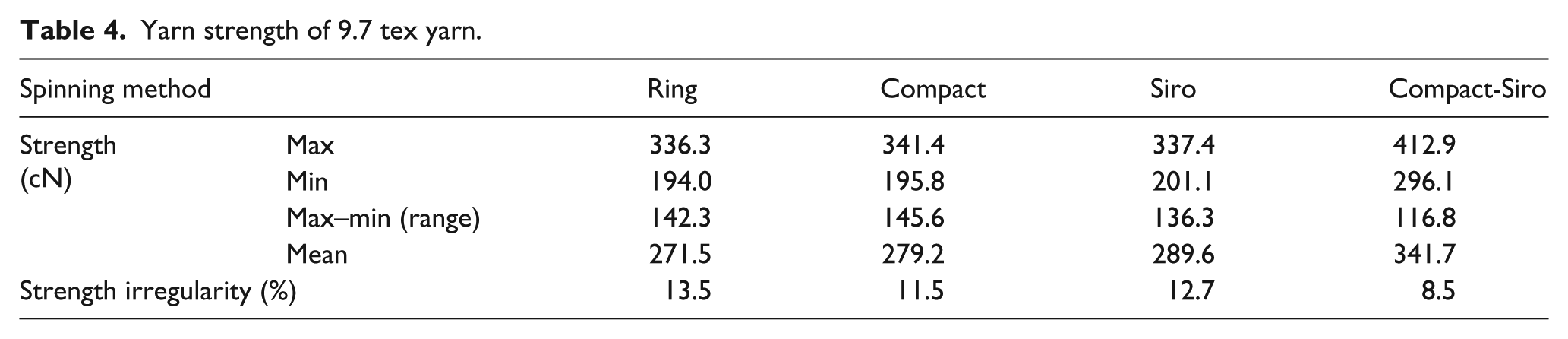
A test on the breaking strength was conducted on a YG063T automatic yarn strength machine in accordance with the national standard listed in “GB/ T3916-2013 Measurements on Breaking Strength and Elongation of Textiles—Curl Yarn and Single Yarn,” at a frequency of 05 tub/10 times. 22 For each type of yarn, 50 samples were tested. The yarn was placed in an environment with a relative humidity of 60% and a temperature of 20°C for 24 h prior to the breaking strength test. The test parameters consisted of a pre-tension coefficient of 0.5 cN/tex and a tensile speed of 500 mm/min. The strength distribution characteristics are shown in Figures 2 and 3. The specific strength indicators are shown in Tables 3 and 4.

Strength distribution of 14.6 tex yarn: (a) ring-spun yarn, (b) compact-spun yarn, (c) Siro-spun yarn, and (d) compact-Siro spun yarn.

Strength distribution of 9.7 tex yarn: (a) ring-spun yarn, (b) compact-spun yarn, (c) Siro-spun yarn, and (d) compact-Siro spun yarn.
Yarn strength of 14.6 tex yarn.

Yarn strength of 9.7 tex yarn.
Data analysis
From the previous analysis, the compact-Siro spun yarn combines the respective advantages of the compact and Siro spinning processes. The former enhances yarn compactness and improves fiber straightness; the latter forms a structure similar to plied yarn and reduces yarn unevenness.
The experimental results proved that the compact-Siro spun yarn showed greater tension characteristics than the other three yarns. The enhanced compactness and reduced unevenness were the primary contributing factors in this result.
Effect of compactness on yarn strength
As shown in Figure 1, the compactness of compact- and compact-Siro spun yarn is higher than that of the other two yarns. The fibers were condensed by the negative pressure from the suction device. The yarns produced by this device had significantly increased compactness. To compare the compactness of the compact and compact-Siro spun yarn under the same agglomeration effect, the two rovings were separately fed into the condenser in the compact-Siro spinning system. Therefore, fewer fibers were involved in the condensing process under negative pressure, and the efficiency of agglomeration was improved. Thus, the compact-Siro spun yarn was tighter than the compact-spun yarn.
Compactness has a significant influence on yarn strength. Compactness refers to the bulk proportion of fiber in yarn, which can be expressed by the yarn packing factor. A greater compactness represents a higher yarn density and a higher yarn packing factor. Compactness has certain effects on the yarn strength: when compactness is high, the cohesive force between fibers, as well as the friction between them, will substantially increase. It is thus unlikely for them to slide up with the increase in friction. The yarn strength will increase. The following is a yarn strength prediction equation proposed by Frydrych 23
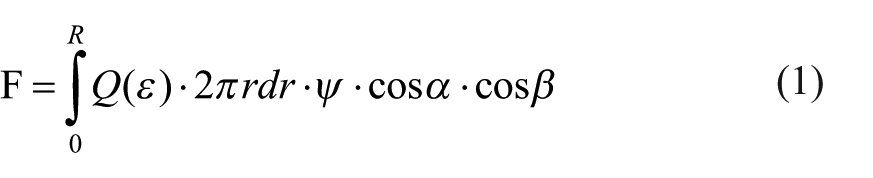
where F represents the total force, Q(ε) is the stress in a differential cross-sectional area normal to the fiber axis, and R is the yarn radius. In addition, r is the internal radius, ψ is the yam packing factor (compactness), and α is the helical angle (i.e. the angle between the tangent to the fiber axis and the direction of the yarn axis prior to extension). Furthermore, β is the angle between the tangent to the fiber axis and the direction of the yam axis subsequent to extension.
In equation (1), the stress component Q(ε) is enhanced with increases in yarn compactness and packing factor ψ. Thus, yarn strength is positively correlated with compactness according to this equation. The increase in yarn compactness should improve the overall yarn strength according to this equation. This improvement is shown in Figures 2 and 3.
In the compact spinning system, yarn strength is enhanced with an increase in yarn compactness. However, the strength fluctuation caused by yarn unevenness, especially the unevenness of earlier products, will not notably change. Consequently, the yarn strength diversity of compact spinning is similar to that of ring spinning, and the difference between the maximum and minimum strengths should be at the same level.
Effect of unevenness on yarn strength
In viewing the data in Table 2, it is evident that, to some extent, the yarn evenness improves in Siro and compact-Siro spinning methods, whereas the evenness of compact-spun yarn is at the same level as that of ring-spun yarn.
It should be noted that two primary factors affect yarn evenness. First, feeding two rovings causes the yarn to form a structure similar to that of plying yarn. 11 Thus, yarn unevenness is reduced according to a combination principle. Second, to meet the requirements of yarn fineness, a greater draft ratio is used in Siro and compact-Siro spinning systems, which may lead to increased yarn unevenness. The influence that the plying process has on yarn unevenness is more remarkable than that of a higher draft ratio. Thus, in our experiment, the Siro and compact-Siro spun yarn showed greater evenness. The high stability of the drafting process of the employed spinning machine was the basis for this improvement.
Compared with the Siro spinning process, the hairiness of the compact-Siro spun strand was smoother and more uniform when the negative pressure suction technology was applied before combination. As a result, the unevenness of the compact-Siro yarn was reduced.
As shown in Table 2, the CV% value of the compact-Siro spun yarn is superior to those of the other three yarns. The approximate plying process played an important role in the improvement. Yarn unevenness is mainly composed of three parts: (1) the unevenness of the fibers, which is related to fiber length, fineness, structure, and morphology, (2) the unevenness due to the product of the preceding process; that is, the unevenness of the rovers according to the four types of yarn, and (3) the unevenness that emerges in the drafting process of the spinning operation.
Yarn unevenness caused by rover unevenness can be reduced by plying strands, after which thick and thin parts in strands can be randomly combined, thereby increasing yarn evenness. Moreover, the mutual contact between two strands is conducive to increased yarn strength. The result of the unevenness after plying two strands is

where C represents the yarn unevenness after plying, and C0 is the unevenness of each strand before plying.
The strength of yarn 500 mm long (Q) can be calculated according to a modified Peirce’s equation as 23

where Q1 is the strength of the fracture zone, vy is the coefficient of irregularity of the yarn linear density, and q is the ratio of the specimen length to the length of the fracture zone. As shown in equation (3), when the unevenness of the linear density is reduced, the yarn strength increases.
For Siro and compact-Siro spun yarns, the plying of two strands made their uniformity higher than that of ring-spun yarn; that is, they had a high strength. In the Siro spinning system, yarn strength was improved by promoting strand unevenness. However, the fiber structure involved in the strength distribution of the yarn structure incurred minimal change. Thus, minimal change was expected in the maximum strength of Siro. Nevertheless, the minimum strength was indeed promoted because of the reduction in unevenness.
Strength distribution characteristics
From Figures 2 and 3, and Tables 3 and 4, it is evident that the mean strength of compact, Siro, and compact-Siro spun yarn is higher than that of ring-spun yarn. For compact-Siro spun yarn, improvements are apparent in terms of both compactness and unevenness. Hence, its strength is remarkably enhanced, especially with a lower linear density (14.6 tex, 6.9%, 9.7 tex, 25.9%).
A decrease in the linear density of yarns will increase the agglomeration effects of compact and compact-Siro spinning. Outer fibers will be efficiently condensed and arranged by the suction area in those spinning processes. The well-arranged and condensed fibers can improve fiber–fiber friction and increase tension uniformity, and the yarn tension in this portion of the fibers can be improved simultaneously. An increase in the linear density of yarns will decrease the ratio of the fibers affected by the suction equipment; as a result, the improvement in strength for thicker yarns will be less than that for thinner yarns.
The maximum strength of compact and compact-Siro spun yarns was significantly improved compared with that of ring-spun yarns, while the maximum strength of Siro was similar to that of ring spinning. In the compact and compact-Siro spinning systems, the suction device produced an agglomeration effect on the yarn and more fibers were integrated in the strength distribution. Thus, the yarn strength was greatly enhanced, especially the maximum strength. However, the Siro spinning system improved yarn strength by reducing yarn unevenness. The number of fibers integrated in the strength distribution did not significantly increase; thus, the maximum strength of the Siro-spun yarn was similar to that of the ring-spun yarn.
With respect to the discrepancy between the maximum and minimum strengths, the absolute difference between Siro and compact-Siro spun yarns significantly decreased, while that of compact yarn showed no obvious change compared with ring spinning. In the Siro and compact-Siro spinning systems, yarn unevenness improved by feeding two strands; in addition, yarn strength increased and the difference between the maximum and minimum strengths decreased. In the compact-Siro spinning methods, more fibers were fed to agglomerate in a strand, and yarn strength improved. Therefore, compact-Siro spun yarn had the highest minimum strength.
Regarding the unevenness of breaking strength, significant improvements were made in Siro and compact-Siro spun yarns. The strength unevenness of compact-Siro was notably reduced, especially with a lower linear density (9.7 tex increase by 5%). This is because the contribution rate of fiber to yarn strength further increased as the thread density decreased. Consequently, notable improvements were made in the yarn unevenness and fiber uniformity. These improvements would have been more significant in thinner yarn.
In the compact-Siro spinning system, both yarn compactness and unevenness improved, and the average strength dramatically increased. The discrepancy between the maximum and minimum strengths significantly decreased. Owing to the condenser agglomeration effect, most fibers were twisted into the yarn because the strand was thinner. Therefore, its compactness was greater than that of the ring-spun and Siro yarn.
In terms of the overall distribution, the mean yarn strength of compact-Siro spun yarn was fundamentally improved, the strength distribution interval was more highly concentrated, and strength unevenness was greatly reduced. The improvement in the strength distribution should significantly enhance the loom efficiency in the subsequent process. Thus, the four 9.7 tex polyester staple fiber yarns underwent the same weaving process to verify this deduction.
Comparative test on loom efficiency
To highlight the influence of the yarn strength distribution on loom efficiency, four 9.7 tex yarns were selected for weft weaving on the same loom. A 50D polyester filament was chosen as the warp yarn (to avoid warp yarn breaking). The twist of the latter was 10 turns/m with a fabric weave of 4/1 satin and a fabric density of 68 × 36 cm2. A Toyota JAT710 was chosen as the loom, with a speed controlled at 650 r/min and a fabric width of 176 cm. The loom was operated for more than 12 h to enable us to observe the efficiency deviations caused by different weft yarns.
The loom efficiency results with the respective use of the four yarns are shown in Table 5. For 9.7 tex yarn, the loom efficiency of the compact-Siro pure polyester yarn reached as high as 96%, which is 6% higher than that of ring-spun yarn. The loom efficiencies of compact and Siro yarns were almost the same and were higher than that of ring-spun yarn by 2%–3%.
Loom efficiency using the four yarns.

Because a fabric specification polyester filament was used for the warp direction, the loom efficiency was largely affected by weft yarn issues. During the air-jet weft insertion process, the yarn, forced by airflow traction, entered into the fell. If the weft yarn strength was less than the traction force, broken picks would have occurred. The yarn breaking strength, therefore, had a significant influence on loom efficiency for the 9.7 tex yarn.
It should be noted that, loom efficiency is crucial to productivity and directly affects the product quality and productivity. If this yarn type is woven from a warp direction, higher requirements are set for indicators, such as yarn strength and abrasive resistance, because it repeatedly undergoes abrasion during the looming process. Based on the findings of this study, the strength distribution of compact-Siro spun yarn would present a greater advantage in preventing warp breaking.
Conclusion
Ring, compact, Siro, and compact-Siro spun yarn technologies are the most widely used spinning methods in the modern textile industry. However, despite several related research efforts, no report on the strength properties of compact-Siro spun yarn exists to date. To bridge this gap, these four spinning methods were comprehensively compared and analyzed.
Tests on yarn breaking strength indicated that the compact-Siro spun yarn had the highest strength with a small fluctuation range, which can greatly improve the overall yarn quality. The compact-Siro spun yarn incorporated the advantages of compact and Siro yarns. The compact-Siro spinning system could agglomerate slivers through the negative pressure suction machine in a stable process. Without a spinning triangle, the yarn exhibited less hairiness. Moreover, the combination of two single yarn strands fed into a drafting zone could reduce the irregularity of yarn in this system. Therefore, the yarn was superior in terms of the breaking strength distribution and could uniformly bear external force when drafting.
The superiority of the compact-Siro spun yarn in terms of strength distribution was beneficial to the weaving process. The weaving efficiency could be significantly improved by using compact-Siro spun yarn, which represents an effective method for weaving mills to achieve higher productivity.
Footnotes
Declaration of conflicting interests
The author(s) declared no potential conflicts of interest with respect to the research, authorship, and/or publication of this article.
Funding
The author(s) disclosed receipt of the following financial support for the research, authorship, and/or publication of this article: This study was funded by the National Key R&D Program of China (2017YFB0309200) and the Enterprise University Research Prospective Program of Jiangsu Province (No. BY2016022-16).