



Abstract
Knitted fabrics and products are subjected to a variety of stresses and loads/deformation during their usage. The loads are different by value, by direction, and by duration. The alternations of loading and unloading or resting processes affect the knitted structure and could bring about changes in the linear dimensions of the fabric or result in the deformation of the knitted items and ultimately the loss of product appearance or its functional properties. A wide range of textile materials resistant to multiply loads was produced by using elastomeric yarn that has an elongation of more than 95% and is able to attain full recovery after relaxation due to its chemical composition. This case study examines two existing test methods for evaluating the stretch properties of textile materials produced with the elastomeric yarns with emphasis on warp knitted abdominal binder-type fabrics. It was found that the linear density of the weft in-laying threads and the preliminary tension of the ground yarn which formed pillar stitch affect stretch properties of elastic warp knitted fabric: the full deformation and its constituent parts. The change in the preliminary elongation of the bare spandex in the 210%–270% range does not have a significant effect.
Keywords
Introduction
Among textiles, a knitted material is characterized by the most unstable structure in which parameters change due to various efforts, including stretching. Insignificant loads that alternate with unloading and rest affect a knit structure: an item is deformed with changing a size and a shape. 1 There are a number of scientific works conducted on the deformation behavior of textile generally 2 and focused on the knitted fabrics. 3 Various authors have investigated the tensile properties4–6 and modeled the load-extension behavior7–10 of knitted fabric. Most of these investigations were based on plain weft-knitted structure and a single loop was used as a unit cell for analysis. 11 Yanagawa and colleagues12,13 developed the analytical method for calculation of the tensile properties of single tricot warp knitted fabrics, but it is limited to biaxial stress of knitted fabric from conventional yarn.
Full deformation and its components are characteristics that are the most used in single-cycle studies to assess the mechanical properties of textile materials. The full deformation consists of the following components: elastic deformation, which disappears immediately after unload; plastic deformation with an additional relaxation period, which occurs in time with low velocities; and residual deformation, which does not disappear after unloading the sample.
Shalov, 14 who studied the deformation of knitted material, considered the stretching as a process of breaking the internal equilibrium of the loops system and transitioning it to a new equilibrium state.
At the same time, Shalov researched three phases of changing the knit structure during its stretching. At the initial phase of stretching (elastic deformation), the degree of orientation of the elementary units increases due to the elimination of the telescopic setting and the collision of the loops’ skeletons in the direction normal to the load. At this stretching stage, the mutual position of the elementary parts (loops) of the knitted structure is fully restored to the initial after removing of the external forces.
At the second phase of the stretching (plastic deformation), there are significant changes in the filaments’ curvature in the loops, which are accompanied by stretching and compression strain. Together with uneven tension of threads in the different loop parts, it leads to dragging the thread from one, less loaded areas, to other, more loaded.
At the third phase of the stretching (residual deformation), the oriented segments of the thread are strongly stretched, and the segments of the threads at the contact areas are subjected to large bending and compression. As a result of uneven tension, the fiber in yarn and the elemental threads in the complex thread are moving relative to each other.
Thus, Kobliakov 15 concluded that, at the first period of the stretching of the knitted material, changes occur mainly in its rough loop structure—at macro level. The thread elongation begins only with considerable fabric elongation at load that is close to breaking load.
The relaxation is a reverse process after unloading the textile material. During relaxation, due to elastic forces, the stretched knitted structure returns to its original position until such forces become equal to the frictional forces between loops. There is a conditional equilibrium that is characteristic of certain specific conditions. 15 Therefore, the great curiosity in designing a knitted fabric for different purposes is to study the characteristics of mechanical properties that can be obtained from the stretching cycle: loading–unloading–rest. 16
Stretch fabrics are widely used today for different applications,17–19 most of them made from core spun yarn with elastane core. It has been observed that tensile and low-stress mechanical characteristics of such fabric are significantly influenced by the process parameters: elastane stretch, proportion of elastane core, and twist multiplier. 20 The investigation of the relaxation phenomena for the fabrics containing elastane yarns 21 indicates that the stress relaxation under constant deformation depends on the content of elastane and the fabric with the highest content of elastane need the longest relaxation time. Based on the study of the influence of the structural and viscoelastic properties of fabric with elastane yarn on elastic recovery, 22 it is concluded that the elastane content in the yarn has the significant influence on elastic recovery of fabric.
As for knitted elasticized fabric, only few published papers report on their elastic properties. Cooke and Assimakopoulas23,24 studied twill warp structure and concluded that the total elongation related to two factors: the degree of relaxation between the machine state and the finished state and the mechanism of yarn transfer between the underlap and the loop. In the work by Stolyarov et al., 25 the tensile and stress relaxation properties of high-stretch knitted fabrics made of different yarns were investigated. It was shown that the mechanical behavior of weft-knitted fabric is a non-linear and significantly dependent on time. In another paper, 26 an attempt was done to analyze the effect of cyclic loading on cotton/spandex knitted fabric subjected to the different levels of loading under different values of initial extensions. These investigations were based on knitted structure with loops formed from core spun yarn with elastane core too.
The main feature of medical fixing and compression devices is the use of elastic textile material, in particular knitted fabric. The product does not restrict the movement freedom and provides the required compression level. The relaxation ability is an advantage of elastic material for such end-use. 19 The bare spandex is the main element of the structure of elastic textile materials, which defines their functional properties and can be elongated by 500% depending on the type, with full recovery of the initial dimensions after unload.
Limited information about properties of elastic knitted fabric with bare spandex is available. Chattopadhyay et al. 27 studied effect of input tension of inlay yarn on the properties of knitted circular stretch fabric. It was found that there is no difference in the tensile behavior of fabrics up to 30% extension. At 100% extension, the tension is seen to decrease with the increase in yarn pre-tension.
The detail analyses of the constructions of the medical-preventive goods were carried out, and Melnyk and Kyzymchuk 28 considerate that an elastic warp knitted structure with pillar stitch is usually used for such purposes. The influence of inlaying variants of weft yarn on structure parameters of such stretch warp knitted fabric was found. 29 It should be noted that the pillar stitch is not widely used interloping. The tensile strength of fabric with the pillar stitch is smallest among three common types of warp knit stitches (tricot, cord, and pillar). 30
The purpose of this research work is to study and analyze the stretch properties of elasticized warp knitted fabric with pillar stitches and with longwise filling-in bare spandex and to determine their dependence on the technological parameters of knitting.
Test methods
There are many standards related to tensile testing of various types of textiles but only some of them we can use for the elastic textile material.
The test method according to ASTM D 3107-07:2015 31 is intended for use with woven fabrics exhibiting high stretch (greater than 12%) and good recovery properties from low tension (up to 360 g/cm of fabric width) but is not applicable to knitted fabric. The test method according to ASTM D 2594-04:2016 32 covers the measurement of fabric stretch and fabric growth of knitted fabrics intended for applications requiring low-power stretch properties: swimwear, anchored slacks, and other form-fitting apparel (also commonly known as semi-support apparel) applications, as well as loose-fitting apparel (also commonly known as comfort stretch apparel) applications. Frame, suitable for supporting the hanger assembly and tension forces applied during testing, and Tensioning Weights are special equipment for this test. An extension of the specimen loop depends on fabrics end-use and stretch direction: 30% walewise and 60% coursewise for form-fitting apparel. Duration of tensile force is 2 h and 5 min, and recovery time is 1 h. But this test method is not applicable to fabrics intended for support.
ASTM D 4964-96:2016 33 covers the measurement of tension and elongation of wide or narrow elastic fabrics made from natural or man-made elastomers, either alone or in combination with other textile yarns, when tested with a constant-rate-of-extension (CRE)-type tensile testing machine. As a result of test, the percent elongation at the specified loop tension (100 N or other) or the loop tension values corresponding to 30%, 50%, and 70% elongations are calculated.
Medical elastic products, as opposed to casual wear, should provide some specific functional properties: fixing the medical devices as well as the parts of the human body and creating or supporting compression effect. General technical requirements for such products and correlated test methods are regulated by RAL-GZ 387/1. 34 Accordingly, in this standard, an elastic elongation and a residual strain are determined on the tensile testing machines by stretching the sample of 50 mm width until the load reaches 5 kgf values. The distance between the machine clamps is set to 100 ± 1 mm, but it is allowed to be set to 50 ± 1 mm and even 25 ± 1 mm for high-stretch materials. The test cycle is 60 min only: 30 min loading and 30 min resting after unloading. That is, this standard regulates the load value of 5 kgf for practically the entire range of medical elastic products, regardless of the number and linear density of elastomeric yarn, except hosiery for which a restriction during stretching is imposed as 150% not on the load but on the elongation.
Senthilkumar et al. 17 notes that even though a number of methods are available to test elastic fabrics characteristics for a specific end use, the testing of its elastic properties with the existing methods may be unsuitable.
The elastic parts of the products may be stretched to different or set values during usage. That is why the Shcherbinina and Kostenko 35 proposed a new method for the determination of the deformation properties of the elastic fabric. In contrast to the standard test, the essence of proposed method is to determine the components of full deformation at different stages of fabric stretching. It is important to take into account the testing time as close as possible to the actual wear of the corset product: the loading for 8 h, after which elasticity is determined, and then resting for 16 h, after which the irreversible deformation is determined. The loads have been chosen to ensure that the fabric elongation is 20%, 30%, 40%, 50%, and 60%. This research methodology simulates the conditions of elastic knit products according to specific end uses, and its results can be used to design elastic details of corset, sportswear, and linen products.
The testing method of the stretching of textile and haberdashery products containing elastomeric yarns is given in GOST 16218.9-89, 36 whereby the elasticity and elongation are determined on a rack-relaxometer. The recommended load applied to the sample is determined, depending on the number and linear sizes of elastomeric yarns, and the loading time is only 3 min. Consequently, this standard is limited to narrow products that are stretched for a short period of time and can be used for medical bandages only.
The testing method of elasticity and residual deformation of the elastic warp knit fabric is determined by GOST 26435-85, 37 whereby the research is carried out on relaxometer too but at two possible load levels: low, equal to 7.8 N (0.8 ± 0.008 kg), and the average, which is determined by the linear density of polyurethane threads (1.2, 1.8, and 2.3 kg). This standard requires five cycles: load for 60 min and unloading for 60 min. Such a method is rather labor-intensive and takes a considerable time.
Sular et al. 38 used three different test methods to compare the stretching abilities of the knitted sportswear fabrics. It was found out that there is no systematic tendency observed among the fabric types for the different test methods.
Elastic knitted fabric with pillar stitches, which is the subject of this study, is mainly used as bands in medical binders. That is why two test methods were chosen: according to GOST 16218.9-8936 and RAL-GZ 387/1. 34 The stretching of fabrics samples was carried out walewise in the direction of the elastomeric thread laying during both tests. The typical graphical dependence of a specimen length on a cycle time can be obtained (Figure 1)
The following formulas are used for calculation:
Full deformation (%)

Elastic deformation (%)

Plastic deformation (%)

Residual deformation (%)

where L0 is an initial distance between clamps (initial length of specimen); L1 is a specimen’s length after loading; L2 is a specimen’s length after unloading; and L3 is a specimen’s length after rest.

Dependence of the specimen`s length on the cycling time.
In addition to the values of full deformation and its components, their contributions in full deformation are important characteristics of mechanical properties of knitted structure:
Elastic

Plastic

Residual

Experimental samples
The elastic warp knitted fabric of pillar stitch with filling yarns (Figure 2) is a subject of the study. All samples were produced on 15-gauge Crochet knitting machine. A chain with closed loop (L1) from 16.7 tex polyester thread (A) is used for ground interlooping. Spandex (B) with 0.8 mm diameter is laid longitudinally in each wale (L3). Weft threads from 33.4 tex polyester yarns (C) have been used on both sides (L2 and L4) to ensure the connection of chains in a fabric and the covering of polyurethane threads.

Lapping diagram.
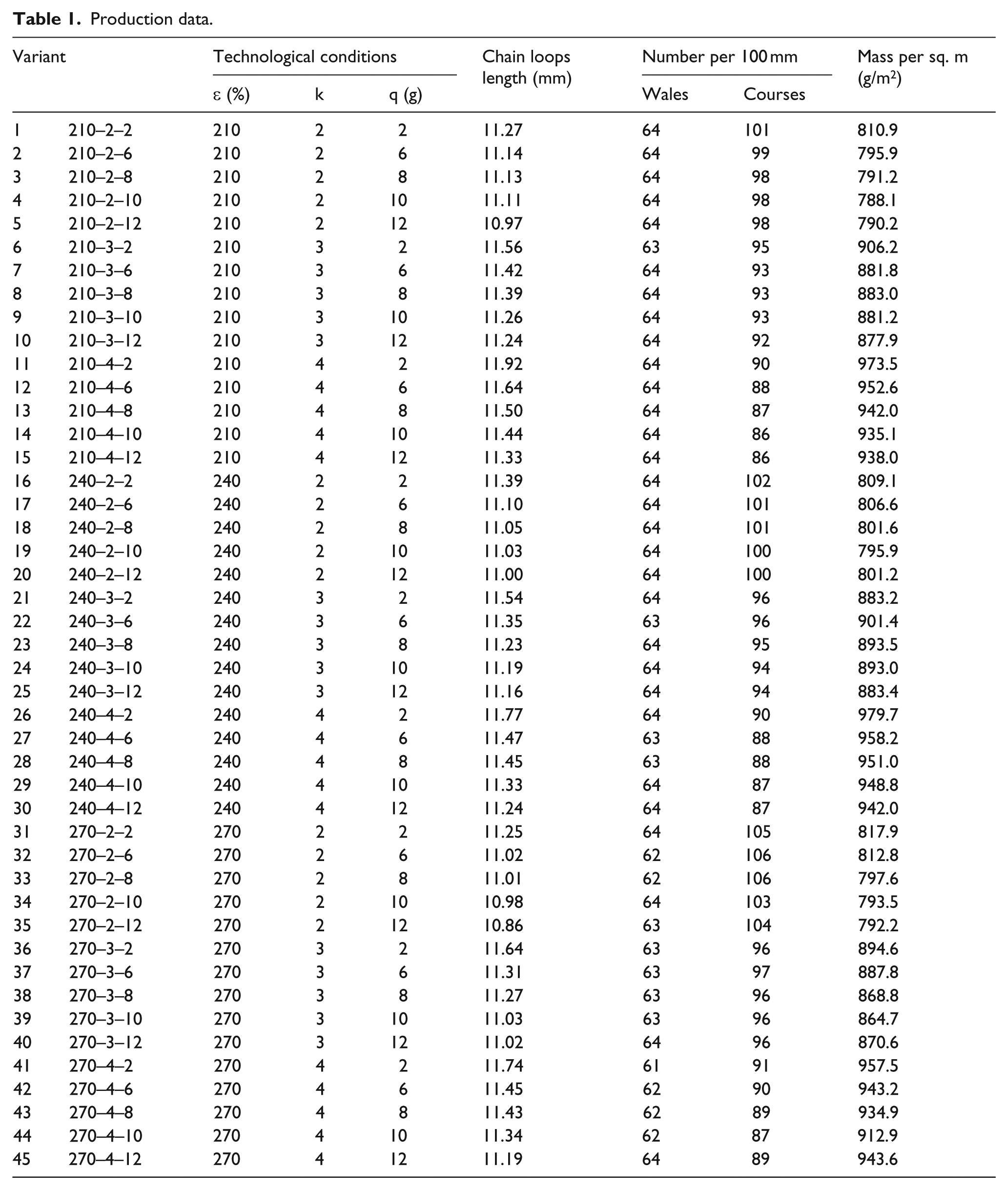
In order to determine the influence of knitting parameters on the stretch properties of knit fabric, the following three variable conditions have been chosen: 39
Three pre-elongation levels of an elastomeric (polyurethane) threads (ε): 210%, 240%, and 270 %;
Three variants of the linear density of the weft threads, which were changed due to number of yarn ends (k): 2, 3, or 4;
Five tension levels of the ground yarn, which was changed due to additional load (q): 2, 6, 8, 10, or 12 g at each aground thread.
Thus, a total of 45 variations (types) of elastic fabrics have been produced, the main characteristics of which are given in Table 1.
Production data.
Results and discussions
A rack-relaxometer (Figure 3) has been used for first test method. The research was carried out at the following conditions: 30 N (3 kgf) load, which was determined according to the number of elastomeric threads in specimen; the loading time—60 min; and the resting time after unloading—60 min also. The sample photos at initial state and under load for several variants of elastic fabrics are given in Table 2.

Testing set up.
Fabrics photos.

The six parallel measurements were made for each option, the average result of which has been used for calculation of the full deformation and its components as well as components contribution (Table 3). The regression dependences that adequately reflect the dependence of a full deformation on the variable process parameters were obtained as a result of mathematical processing of the experimental data (Table 4).
Stretch characteristics of elastic fabric.

Dependence of full deformation on the variable process parameters.

The graphical representations of dependences are shown in Figure 4. It is necessary to emphasize the similarity of dependencies for different levels of pre-elongation of elastomeric thread. It should be noted that changing value of pre-elongation from 210% to 270% does not affect the value of full deformation of fabric. It is found that the full deformation of the elastic warp knitted fabric mainly depends on the linear density of the weft inlaying threads and the preliminary tension of the ground yarn. Increasing the value of the input parameter g leads to a decrease in the full deformation of the fabric.

Dependence of full deformation on knitting parameters: (a) ε = 210%, (b) ε = 240%, and (c) ε = 270%.
When additional load on the ground yarn increases, the loop length of the chain decreases, which leads to an increase in the contact surface between the elastomeric and the ground threads, resulting in increased frictional forces between them, which reduce the strain. This effect is enhanced with increasing linear density of weft in-laying threads, which is also in contact with elastomeric yarn.
As a result of the study, it was found that elastic component is a significant part (contributing 0.94 ÷ 0.97) of full deformation of elastic warp knitted fabric. The dependence of elastic deformation on input technological factors is similar to full deformation dependence. At the same time, the dependence of the elastic contribution in full deformation on the pre-elongation of elastomeric yarn is established (Figure 5): the increase in elongation leads to the increase in elastic component. Obviously, increase of pre-elongation of elastomeric yarn leads to an increase in the yarn strain, and therefore the relaxation processes in the fabric structure are faster.

Dependence of elastic contribution in full deformation on pre-elongation of elastomeric yarn.
Simultaneously, these processes lead to reducing the value of the residual deformation of knitted structure. The residual deformation of the studied elastic warp knitted fabric varies within 1% ÷ 4%, its contribution in full deformation does not exceed 0.03 (Table 3).
CRE-type tensile testing machine RM-30 has been used for second test method. A length between clamps is set to100 mm, load is 50 N (5 kgf). The loading time and the resting time are 30 min each. Three parallel measurements were made for each option, the average results of which have been used for calculation of elongation εs and residual deformation ε3 (Table 3). It should be noted that fabric slippage is more for this test which affected the results,.
Comparison of the results of testing obtained by two methods shows that the extensibility of the knitted fabric (according to the second method) is 30%–40% higher than the full deformation (according to the first method). This is predictable, since the load applied to the specimens is significantly (by 70%) different: 50 and 30 N, respectively.
The regressions that adequately reflect the dependence of an extensibility on the variable process parameters have been obtained as a result of mathematical processing of the experimental data. For a fixed value of pre-elongation of the elastomeric threads, they are
Pre-elongation of an elastomeric thread ε = 210%

Pre-elongation of an elastomeric thread ε = 240%

Pre-elongation of an elastomeric thread ε = 270%

The graphical representations of dependences are shown in Figure 6. Comparison of the corresponding plots on Figures 4 and 6 shows the analogy of the dependencies of the parameters studied on the technological parameters of knitting. The extensibility of the warp knitted fabric at a load of 50 N depends mainly on the linear density of the weft in-laying threads and the preliminary tension of the ground yarn. The increasing value of the input parameter leads to a decrease in the fabric extensibility. At the same time, the change in the preliminary elongation of the elastomeric yarn in the 210%–270% range does not have a significant effect.

Dependence of extensibility under 50 N load on knitting parameters: (a) ε = 210%, (b) ε = 240%, and (c) ε = 270%.
The value of residual deformation of the studied elastic warp knitted fabric varies within 0% ÷ 2% and does not depend on input technological factors. That means that both methods produce relatively similar results.
Conclusion
Results of the studies indicate that the linear density of the weft in-laying threads and the preliminary tension of the ground yarn of elastic warp knitted fabric are the main technological parameters that affect its stretch properties: the full deformation and its constituent parts. Meanwhile, the change in the preliminary elongation of the elastomeric yarn in the 210%–270% range does not have a significant effect. An increase in the parameter leads to an increase in the elastic contribution/component from 0.94 to 0.96 only.
Comparison of two test methods shows the effect of the dependencies of the deformation properties on the technological knitting parameters. Thus, in choosing test method for specific research, the following considerations should be taken into account: method using rack-relaxometer is easier and faster since it involves in the use of the simplest equipment and the ability to test up to 10 specimens simultaneously. The fabric slippage is less for this test since the load value is smaller.
Footnotes
Declaration of conflicting interests
The author(s) declared no potential conflicts of interest with respect to the research, authorship, and/or publication of this article.
Funding
The author(s) received no financial support for the research, authorship, and/or publication of this article.
