



Abstract
This study examined how undergraduate students conceptualize campus recreation by analyzing open-ended responses from a campus-wide survey at a Canadian university. Drawing on social identity theory and self-categorization theory, we developed a typology of five recreation identity types (i.e., The Competitor, The Casual, The Health-Oriented, The Disengaged, and The Unaware) that reflect distinct symbolic orientations toward campus recreation. These identity types describe how students make sense of recreation offerings, and why some opt out due to symbolic disconnection rather than structural constraints. More specifically, findings suggest that campus recreation participation is shaped not only by access and logistics, but by alignment with students’ self-concept and group affiliations. Practical implications are offered for developing inclusive, resonant programming and outreach strategies tailored to diverse recreation identities.
University recreation programs are widely recognized for their role in enhancing student wellbeing, community connection, and academic persistence (Wilson, 2022). Participation in campus recreation activities ranging from fitness centre use and drop-in sports to intramural sports and wellness classes has been consistently linked to stress relief, improved mental health, and a stronger sense of campus belonging (Forrester, 2015; Vasold et al., 2019). Beyond these individual benefits, recent research has highlighted how informal recreation settings that are unstructured, student-directed, and socially flexible can play a unique role in fostering belonging and identity development among students (Eubank & DeVita, 2024). For instance, informal recreation spaces allow students to engage at their own pace, build peer networks organically, and experience a sense of inclusion without the pressure of formal competition or performance (Eubank & DeVita, 2024). These experiences are particularly valuable in early stages of the college transition, when feelings of isolation and uncertainty are common (Wood & Danylchuk, 2015).
Informal and low-barrier recreation opportunities have also been found to support cross-cultural interaction, reduce social anxiety, and provide marginalized students including international, racialized, or first-generation students with alternative avenues for connection (Eubank & DeVita, 2024). This suggests that campus recreation services and programs are not merely sites of physical activity but are integral to the emotional and social ecology of university life. Yet despite this broader significance, much of the empirical research in this area has concentrated on the constraints that hinder student participation.
Existing research has predominantly focused on identifying constraints to participation (e.g., Cho & Price, 2018; Hoang et al., 2016; Masmanidis et al., 2009; Selvaratnam et al., 2021; Snelgrove et al., 2022). For instance, Selvaratnam et al. (2021) found that different types of recreation participation such as intramural sports versus fitness centre use were associated with distinct constraint profiles. Students often cited lack of information as a constraint to intramural sport involvement, while social unfamiliarity and physical discomfort were more relevant to drop-in and fitness activities, respectively. These findings point to the complex, context-specific nature of recreation engagement.
However, as Wilson (2022) noted in a review of campus recreation and sport-based experience literature, most existing studies rely heavily on quantitative methods and treat students as homogenous groups. There is a lack of attention to how students themselves make sense of and relate to recreation, that is, how they conceptualize recreation's purpose, meaning, and relevance in their university experience. Wilson (2022) highlighted the need for more qualitative, interpretive, and student-centered approaches that attend to identity, symbolism, and perception. Without such insight, efforts to boost recreation participation may overlook critical mismatches between institutional messaging and student meaning-making.
This study addressed those gaps by analyzing open-ended responses from a campus-wide survey at a Canadian university. In particular, we examine how students respond to the prompt, “What comes to mind when you think of [campus] Athletics and Recreation?” Examining how students respond to this prompt is important because it reveals the underlying mental models and associations they hold about campus recreation. In other words, it reveals the cognitive perceptions that students use to understand, interpret, and navigate campus recreation opportunities and barriers. These initial, unfiltered reactions offer insight into what students think campus athletics and recreation represents, not just what it offers. These associations are important because they shape how students interpret invitations to participate, whether they feel recreation is “for people like me,” and ultimately whether they engage (Godwyll et al., 2024; Zou et al., 2019). In short, how students think about recreation precedes and predicts how they may choose to participate in it. By analyzing these perceptions, campus recreation departments can uncover mismatches between student understanding and intended messaging, allowing for more resonant outreach, branding, and program design.
Drawing on both deductive and inductive thematic analysis, we construct a typology of recreation identity types that reflect diverse student orientations to campus recreation. In doing so, this study contributes to a growing body of work that seeks to reframe recreation engagement not only as a behavioral or logistical issue, but as a matter of identity, interpretation, and voice. By bringing students’ own words into the foreground, we offer a nuanced understanding of the student-recreation relationship and provide actionable insights for more inclusive and effective programming.
Theoretical Framework
Understanding how students form and interpret their recreation-related identities can be enriched by drawing on social identity theory (SIT) (Tajfel et al., 1979) and its extension, self-categorization theory (SCT) (Turner & Reynolds, 2012). SIT posits that individuals define themselves in part through their membership in social groups, which shape their perceptions, attitudes, and behaviors (Tajfel et al., 1979). In the context of campus recreation, we argue that students may affiliate with particular types of recreation users such as “athletes,” “casual players,” or “non-participants” based on perceived group norms and symbolic cues. These affiliations influence how they interpret invitations to participate, what kinds of activities they view as relevant or “for people like me,” and how they evaluate their own place within the broader campus recreation system (Stevens et al., 2017).
Moreover, SCT adds an important cognitive dimension to this process (Stevens et al., 2017). According to SCT, individuals actively categorize themselves into social groups based on situational cues and comparative contexts and then internalize the prototypical attributes of those groups. For instance, a student who sees campus recreation as primarily serving varsity athletes may self-categorize as an outsider if they do not see themselves as competitive or highly skilled. This categorization process shapes not only how students view recreation offerings, but also how they interpret their own suitability or eligibility for participation. In this way, identity becomes both a lens and a gatekeeper through which recreation messaging is filtered.
By grounding the recreation identity typology in SIT and SCT, this study expands the conversation around recreation participation to include psychological and symbolic processes. These frameworks help explain what students associate with campus recreation and why those associations matter in shaping behavior and belonging. Incorporating identity theories into the analysis enhances the conceptual rigor of the typology and provides a foundation for future research that explores how these identities form, shift, and influence participation over time. The following research questions were explored in this study:
How do undergraduate students conceptualize campus recreation when prompted with an open-ended question? What distinct identity types emerge from students’ descriptions of campus recreation?
Method
A cross-sectional survey methodology was employed midway through the spring 2018 and fall 2018 academic terms to collect data at a large public university in Ontario, Canada. The institution houses two major athletics and recreation facilities that offer a wide range of programs, including intramural sports (i.e., semester-long, team-based sport competitions), drop-in sports (i.e., unstructured activities during designated facility times), and fitness centre access (i.e., free weights and cardio equipment). At this institution, campus recreation is managed under Waterloo Athletics. Recreational programs including intramurals, fitness classes, open recreation, and sport clubs are integrated under the same Athletics and Recreation umbrella rather than being organized through Student Affairs or a separate recreation office.
Data Collection and Sample
Undergraduate student participants were recruited from six courses including one lower-year and one upper-year course in each of the following faculties: arts, health, and science. Among the 298 students who provided valid open-ended responses after data cleaning, approximately 59% identified as female, 39% as male, and 2% as another gender identity or preferred not to say. Roughly 21% of respondents self-identified as international students, with the remaining 79% identifying as domestic students. The number of international students in this sample is consistent with the number of international students at all college and university enrolments in 2022/2023 at 21.20%. While the study's recruitment strategy aimed to ensure disciplinary and academic-level diversity, we acknowledge that certain groups such as students with disabilities, part-time students, or those not enrolled in the selected courses may be underrepresented. These demographic distributions provide important context for interpreting the themes of disengagement, unawareness, and inclusion, and future studies may benefit from targeted sampling to ensure even broader representation of marginalized student populations.
Students voluntarily completed a paper-based survey during class time. The survey included both structured and open-ended questions about their participation in campus recreation, perceived constraints, awareness, and suggestions for improvement. This study specifically focuses on responses to the following question: What comes to mind when you think of [campus] Athletics and Recreation? All responses were anonymized prior to analysis, and ethics clearance was granted by the university's research ethics board.
Data Analysis
To explore how students conceptualize campus recreation, we used a combination of deductive and inductive coding to develop a typology of recreation identity types based on responses to the prompt, “What comes to mind when you think of [campus] Athletics and Recreation?” Responses were first cleaned by removing punctuation, converting text to lowercase, and standardizing common terms (e.g., “rec” for recreation, “gym” for fitness centre). We then applied a rule-based keyword analysis to classify responses into distinct identity types.
Ambiguous or borderline responses were reviewed in context and conservatively categorized to avoid overinterpretation. Where responses overlapped multiple identity features, the dominant theme was used to guide classification. This process allowed for segmentation of the student body based not on demographics or behavior, but on how they framed the idea of campus recreation. The five identity categories emerged through an iterative process that combined deductive theory-informed reasoning with inductive insights from the data. This approach was chosen to capture the range of symbolic associations and experiential framings that students hold about campus recreation. Initial category development was informed by common programmatic distinctions in campus recreation literature (e.g., structured vs. unstructured activity; performance-based vs. health-based motivations) and prior research on recreation constraints and participation typologies (e.g., Hoang et al., 2016; Selvaratnam et al., 2021).
During coding, however, it became clear that a portion of students provided either vague responses with no specific reference to activities or facilities, or statements that explicitly expressed unfamiliarity or indifference (e.g., “I don’t know,” “nothing”). To meaningfully account for these students’ perspectives without forcing them into the primary categories, two additional identity types were developed: the disengaged and the unaware. These categories acknowledge varying levels of recognition and engagement and allowed for a more inclusive and accurate segmentation of the student body.
Inter-Coder Reliability
To enhance the trustworthiness of our findings, we employed several inter-coder reliability strategies (O’Connor & Joffe, 2020). First, coding rules for the identity typology were clearly documented and applied systematically across all responses to ensure consistency. A subset of responses was independently reviewed by a second researcher with expertise in campus recreation to validate the categorization process (O’Connor & Joffe, 2020). To further enhance the reliability of our typology development, we incorporated a secondary coding process involving another researcher with expertise in campus recreation and qualitative methods (O’Connor & Joffe, 2020). This second coder reviewed a randomly selected subset of 20% of the open-ended responses independently, using the same category definitions established during the primary coding phase. Intercoder agreement was calculated using percent agreement, which yielded an initial concordance rate of 87%.
Discrepancies were discussed collaboratively and resolved through consensus, leading to minor refinements in the category descriptions to improve clarity and consistency. This iterative review process ensured that the typology categories were applied systematically and that the resulting classifications reflected shared interpretive judgments, thereby strengthening the credibility and dependability of the analysis. Discrepancies were discussed collaboratively and resolved through consensus, enhancing inter-coder reliability (O’Connor & Joffe, 2020).
Results
Five identity types emerged from the analysis: The Competitor (n = 43), The Casual (n = 100), The Health-Oriented (n = 45), The Disengaged (n = 50), and The Unaware (n = 60). These categories reflect the dominant lens through which students in this study conceptualized campus recreation, shaped by personal identity, perceived relevance, and symbolic meaning rather than demographic characteristics or behavioral data alone. To illustrate these symbolic orientations and their relative degrees of engagement, we developed a visual model called the Symbolic Engagement Continuum (please see Figure 1 for a visual depiction of this continuum) that situates each identity type along a spectrum ranging from complete unawareness to strong identification with competitive. This model reflects how students psychologically position themselves in relation to recreation offerings, based on internalized group associations and self-perceptions. Table 1 provides a summary of each identity type with descriptive keywords and sample participant responses.
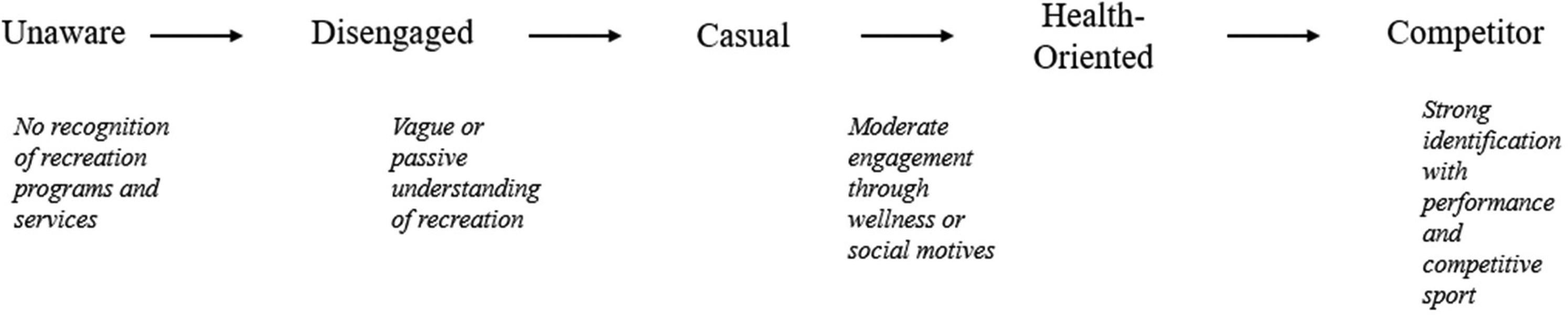
Symbolic Engagement Continuum of Student Recreation Identity Types.
Typology of Student Perceptions of Campus Recreation.
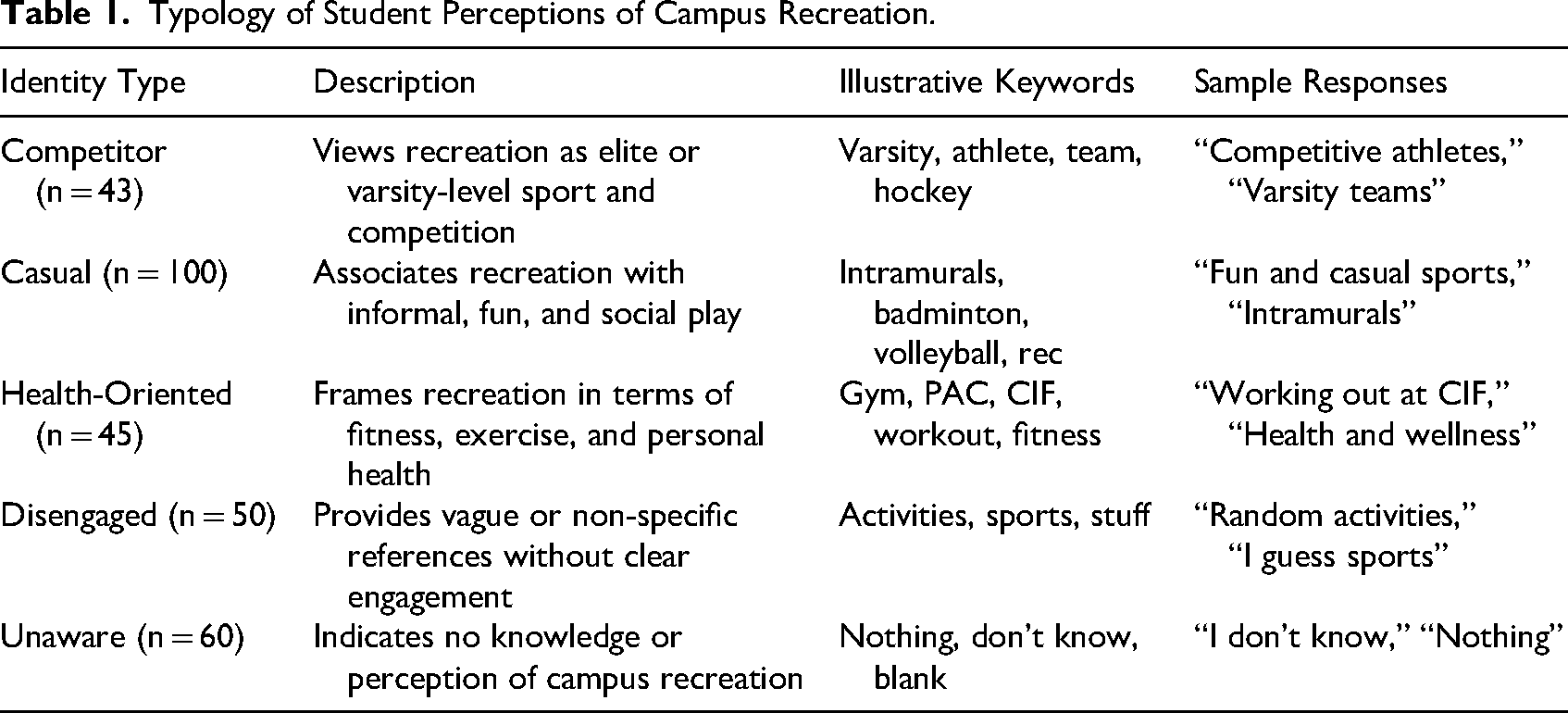
The casual identity type was the most prevalent, comprising 34% of the sample. These students framed recreation as informal, enjoyable, and socially oriented, frequently referencing intramural sports, drop-in sports, and fun-based activities. Their responses suggest that casual recreation is the dominant mental model among the student body, with an emphasis on flexibility, community, and low-pressure participation.
However, the combined total of disengaged (17%) and unaware (20%) students accounted for over one-third of all responses. These categories represent a significant portion of students who either lacked meaningful associations with campus recreation or held vague, non-committal understandings. Disengaged students referenced general or unclear terms such as “sports” or “stuff,” while unaware students often replied with “nothing” or “I don’t know.”
These responses indicate a symbolic or cognitive disconnect from the recreation system, raising questions about program visibility, institutional messaging, and perceived legitimacy.
The health-oriented group (15%) reflected students who associated recreation with fitness, wellness, and personal improvement. Their responses focused on gyms, workouts, and health maintenance, suggesting that these students approach recreation from a self-care or goal-oriented perspective. Finally, the competitor identity type (14%) described recreation as structured, elite, or performance-based, referencing varsity teams, training, and high-skill sport. Although less common, this group highlights that some students still associate recreation primarily with athleticism and competitive achievement.
Discussion
This study developed a typology of five symbolic identity types, namely the competitor, the casual, the health-oriented, the disengaged, and the unaware to examine how undergraduate students conceptualize campus recreation. This typology moves beyond traditional behavioral and constraint-based models by foregrounding students’ interpretive frameworks, self-perceptions, and symbolic associations with recreation offerings. The identity types are not merely descriptive but are situated along a broader continuum of psychological proximity to recreation culture, illustrated in the Symbolic Engagement Continuum (see Figure 1).
It is important to note that the Symbolic Engagement Continuum is not intended as a hierarchy in which movement toward the Competitor identity type represents a more advanced or desirable form of engagement. Rather, the continuum depicts varying degrees of symbolic proximity to campus recreation culture, where “proximity” refers to the strength of identification with any recreation-related identity. The competitor type aligns more closely with traditional sport norms emphasizing structured competition and performance, whereas the casual and health-oriented types often embody the inclusive, community-building, and wellness-focused principles many campus recreation professionals prioritize. Proximity in this model is therefore descriptive of identity alignment, not prescriptive of progression.
The main finding of this study is that undergraduate students’ engagement with campus recreation is shaped not simply by structural access or behavioral intention, but by how they symbolically identify with recreation as part of their self-concept. Through the five-category typology and continuum model, we demonstrate that students occupy distinct psychological positions ranging from complete unawareness to strong alignment with competitive. This spectrum reveals that a significant portion of students feel disconnected from campus recreation because they do not perceive it as relevant to “people like me.” This diverges from the literature that typically describes participation through a leisure constraints theory approach (e.g., Selvaratnam et al., 2021; Wood & Danylchuk, 2015). This symbolic misalignment, especially among the Disengaged and Unaware identity types represents a critical and often overlooked barrier to participation that calls for new theoretical approaches centered on identity, meaning, and belonging.
Theoretically, this study advances SIT and SCT by illustrating how students’ affiliations (or lack thereof) with recreational user groups shape their interpretation of campus programming. The findings demonstrate that students implicitly categorize themselves relative to perceived group norms associated with different types of recreation users. For instance, students in the Competitor category emphasized elite athleticism and structured team play, aligning themselves with a narrow, performance-oriented recreation identity. Conversely, students in the Casual and Health-Oriented groups reflected broader, more inclusive categorizations, associating recreation with flexibility, wellness, and social connection. This interpretation is consistent with recent research emphasizing the importance of identity fit and symbolic representation in promoting participation among underrepresented groups (Green, 2008; Hoang et al., 2016). As such, rather than viewing participation as a binary or solely behavioral outcome, this typology situates engagement within broader psychological, symbolic, and institutional contexts. In doing so, it responds to recent calls for interpretive, student-centered approaches to understanding recreation in higher education (Wilson, 2022) and moves beyond constraint-based theorizing (e.g., Selvaratnam et al., 2021; Wood & Danylchuk, 2015).
Moreover, students in the Disengaged and Unaware categories reveal something more theoretically complex: they lack meaningful symbolic alignment with any recreational identity. Drawing from organizational legitimacy theory (Suchman, 1995; Wigfield & Snelgrove, 2024), we interpret these patterns as evidence of a cognitive legitimacy gap whereby students may not see campus recreation as a meaningful, recognizable, or relevant part of their university experience. This suggests that non-participation may not always reflect lack of opportunity but rather lack of recognition. Even when accessible, recreational programs may fail to capture attention or resonate symbolically with large segments of the student body.
Moreover, by visualizing the identity types along the Symbolic Engagement Continuum, the study introduces a conceptual model that operationalizes degrees of psychological proximity to recreation. This continuum expands binary understandings of participation (e.g., active vs. inactive) and offers a framework for interpreting engagement as a gradational, identity-mediated process. It also provides a heuristic tool for future research to explore transitions between identity states and the situational or developmental factors that prompt shifts. For instance, under SCT, identity salience is context-dependent (Turner & Reynolds, 2012). A student may move from Unaware to Health-Oriented if exposed to wellness initiatives, or from Casual to Competitor through increased skill development and social reinforcement. This supports research on identity development and transition during the university years (Stevens et al., 2017) and invites longitudinal research to explore how and why students move between identity types over time.
Finally, the study opens theoretical space for integrating intersectionality into symbolic identity frameworks. Although SIT and SCT traditionally emphasize group-level processes, this study suggests that intersecting social identities such as race, gender, ability, and international status likely condition students’ symbolic alignment with recreation. Future research should examine how marginalized students may struggle to find meaningful identity anchors within dominant recreation narratives, and how identity accessibility is unevenly distributed across campus groups.
Practical Implications
The typology and Symbolic Engagement Continuum developed in this study offer actionable insights for recreation professionals seeking to broaden student engagement through identity-informed programming and communication strategies. For students in the Health-Oriented category, programming should emphasize individualized progress, stress relief, and well-being, offering opportunities such as fitness tracking, mindfulness workshops, and health challenges that reinforce a personal growth mindset. Casual users, who made up the largest proportion of the sample, may be most responsive to messaging that highlights social connection, fun, and low-pressure play. Flexible, drop-in formats and co-curricular collaborations (e.g., “recess breaks,” themed leagues, or faculty-based teams) may enhance their continued participation.
In contrast, Disengaged students who described vague or indifferent associations with recreation could benefit from entry points that frame recreation as exploratory, playful, or linked to campus life more broadly. Co-branding recreation opportunities with academic departments, student clubs, or residence life initiatives may create pathways that feel more relevant and less intimidating. For students in the Unaware category, efforts should begin by building basic recognition. Guided tours, “Recreation 101” sessions, or integration into first-year orientation could help reduce psychological distance and increase cognitive legitimacy.
Moreover, visual and verbal framing matter. Programs should be presented in ways that reflect a broad and inclusive definition of recreation featuring diverse student identities, body types, and activity types to ensure that students from various backgrounds can see themselves represented and invited. Language should avoid assuming prior knowledge or experience and instead frame recreation as flexible, identity-affirming, and open-ended.
Additionally, the Symbolic Engagement Continuum illustrates that students occupy different psychological distances from recreation based on interest and whether they recognize, value, and relate to it. Recognizing this symbolic dimension can help practitioners shift from one-size-fits-all marketing to more strategic, segment-specific approaches. Finally, institutions should consider disaggregating participation and awareness data by student demographics (e.g., race, gender, international status, first-generation) to identify which groups are overrepresented in the Unaware or Disengaged categories. These data can inform more culturally responsive outreach and inclusion efforts that ensure recreation serves as a tool for belonging, not a symbol of exclusion.
Limitations and Future Research
While this study offers meaningful insights, it is not without limitations. The identity typology was based on brief open-ended responses, which (while rich) may not fully capture the nuance of students’ conceptualizations. Future research could build on this typology using in-depth interviews or focus groups to better understand the motivations, emotions, and histories that underlie these identity types. Another limitation concerns the potential for sampling bias due to the recruitment method. Although the course-based sampling strategy was designed to capture a diverse cross-section of students across disciplines and academic levels, participation was voluntary and conducted during class time. This approach may have introduced self-selection bias, whereby students who chose to complete the survey may have held more pronounced opinions about campus recreation than those who opted out. As a result, certain perspectives may be underrepresented. Future studies could address this limitation by employing stratified random sampling across the broader student population or by using digital distribution methods that reach students outside of classroom settings. Finally, this study did not collect data on other potentially relevant demographics such as race, age, or prior experience with athletics or campus recreation. This was due to the survey's primary focus on eliciting open-ended perceptions of campus recreation rather than compiling a comprehensive demographic profile. We sought to minimize potentially sensitive questions that might reduce participation rates, particularly in a classroom-based recruitment setting. Future research could incorporate these variables to examine how intersecting social identities influence symbolic alignment with campus recreation.
Conclusion
This study contributes to a deeper understanding of how students conceptualize campus recreation by developing a typology of recreation identities. The five identity types highlight the varied lenses through which students relate to recreational programming, ranging from performance-based engagement to complete unfamiliarity. By centering students’ own words and perceptions, this research moves beyond traditional participation metrics and constraint frameworks to capture the symbolic and psychological dimensions of recreation on campus.
As institutions continue to prioritize student wellbeing, belonging, and retention, campus recreation must be viewed not simply as a site of physical activity but as a vital component of the broader university experience. By illuminating the meanings students assign to recreation, this study lays the groundwork for more inclusive, identity-informed approaches to designing and delivering campus recreation experiences.
Footnotes

Funding
The authors received no financial support for the research, authorship, and/or publication of this article.
Declaration of Conflicting Interests
The authors declared no potential conflicts of interest with respect to the research, authorship, and/or publication of this article.