




Abstract
Despite the known benefits of campus recreation participation, many students do not engage with the programs and services offered on college campuses. College students report factors that constrain leisure time physical activity within the context of campus recreation. Examining the constraints and negotiation strategies of college students specific to the use of campus recreation facilities and programs is understudied and lacks validated instruments. The purpose of this study was to develop and report initial validity and reliability of the Campus Recreation Constraints and Negotiation Questionnaire. Exploratory factor analysis and confirmatory factor analysis were used to evaluate two independent scales. Psychometric properties including construct validity, internal structure, and reliability are reported from two different samples of college students. Practical implications for campus recreation programming and marketing efforts are discussed.
Background
Recreation on campus provides students with physical, psychological, social, and academic benefits (Forrester, 2014). Higher retention rates are found among students who participate compared to those who do not participate (Forrester et al., 2018; Kampf & Teske, 2013; McElveen & Rossow, 2014). Campus recreation participation has been associated with increases in academic achievement (Mayers et al., 2017). Additionally, participation in campus recreation can lead to transferable skills and enhance career readiness (e.g., leadership and communication skills) (Lindsey, 2012). Despite these benefits, there are students who do not participate in leisure activities through campus recreation.
Leisure Constraints
Leisure constraints have evolved in the literature, most notably from the work of Crawford and Godbey (1987). Leisure constraints are factors that are assumed by researchers or perceived by individuals to prohibit or limit the formation of leisure preferences or engagement in leisure activities (Jackson, 2000). Crawford et al. (1991) proposed a hierarchical model consisting of three distinct types of constraints (see Figure 1).
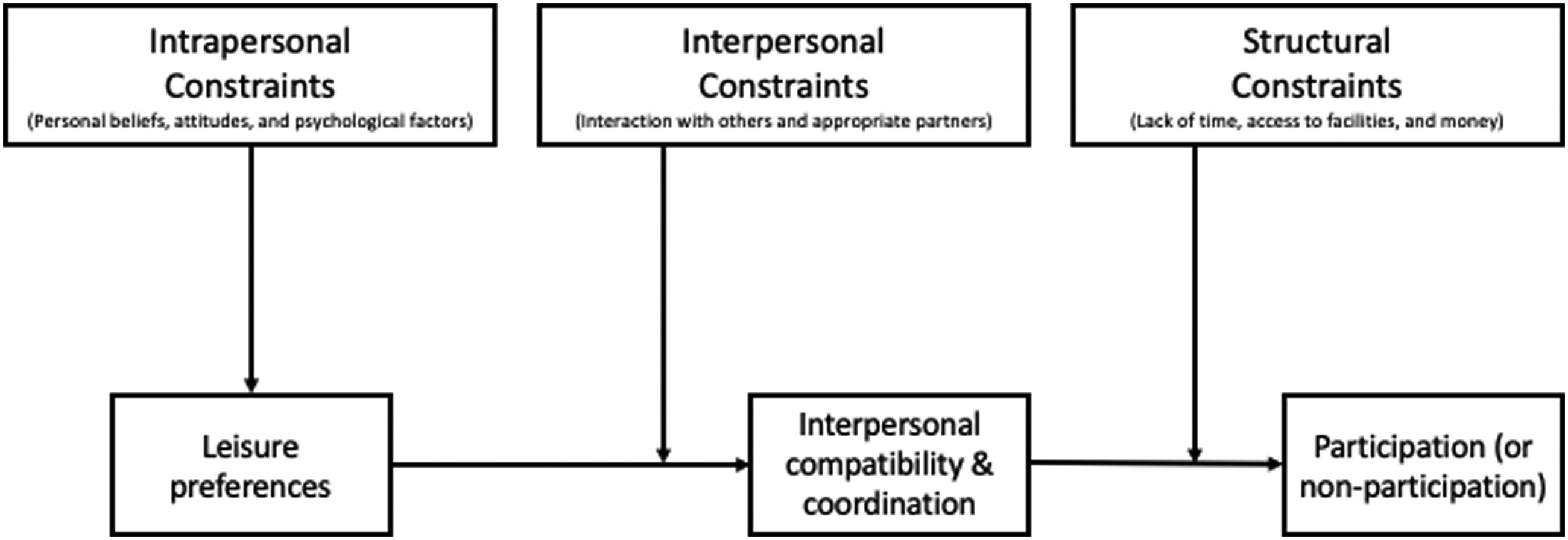
A hierarchical model of leisure constraints adapted from Crawford et al. (1991).
Studies have explored the constraints and facilitators of leisure time physical activity (LTPA) among college students. Lack of time (e.g., school workload and competing priorities) (Ebben & Brudzynski, 2008; Kulavic et al., 2013), lack of energy or willpower (Kulavic et al., 2013), and lack of support (Sukys et al., 2019) are commonly cited barriers. Studies examining facilitators to LTPA report a desire to achieve strength/endurance goals (Snyder et al., 2017), improved physical health (Sukys et al., 2019), and psychological benefits (Sukys et al., 2019).
In the context of campus recreation, constraints such as lack of time (Adam et al., 2015; Hiu-Lun Tsai & Coleman, 2007; Stankowski et al., 2017; Young et al., 2003), lack of knowledge/skill (Adam et al., 2015; Young et al., 2003), lack of access to facilities (Drakou et al., 2008) finding co-participants for activities (Hiu-Lun Tsai & Coleman, 2007; Stankowski et al., 2017), and academic conflicts (Adam et al., 2015) are often reported by college students. Prior studies have shown that some students employ constraint negotiation strategies to overcome constraints to participation. Interpersonal support for engagement is the most commonly reported strategy as students utilize their social network (i.e., friends and important others) to coordinate activity, and increase motivation and accountability (Beggs et al., 2005; Hoang et al., 2016; Wilson et al., 2019). Despite the positive findings regarding the effectiveness of negotiation strategies in addressing leisure constraints, negotiation strategies are largely understudied among college students.
Constraints to participation and negotiation strategies among college students are well established concerning LTPA, broadly. Yet, limited research has been conducted to examine the constraints and negotiation strategies of college students specific to the use of campus recreation facilities and programs. Furthermore, the studies that have examined the phenomenon utilize various methodologies and heterogeneous measurement instruments. There is limited work to establish a reliable and valid instrument for campus recreation constraints and negotiation strategies. Existing leisure constraint research has primarily focused on leisure tourism (i.e., traveling for the purpose of recreation and enjoyment). A Leisure Constraint Scale was empirically tested to support Crawford and Godbey (1987) (Raymore et al., 1993). This initial scale confirmed three categories generalizable to any new leisure activity, but not a specific activity such as LTPA within the campus recreation center. Subsequent studies have criticized the leisure constraints theory suggesting that constraints may be not be hierarchical in nature and could be interrelated (Gilbert & Hudson, 2000). In the case of constraints to leisure skiing, the data on constraints does not support the hierarchical nature of the leisure constraints theory. Still, the data supports that intrapersonal, interpersonal, and structural constraints exist in explaining differences in leisure participation (Gilbert & Hudson, 2000). It is plausible, however, that conceptually distinct constructs can be correlated in behavior theory (Godbey et al., 2010). Further, leisure constraints are unique to specific types of activities so there must be an intentional aim to examine, measure, and report leisure constraints as such (Raymore et al., 1993).
Two measures have been validated in the literature related to college students and are limited in two ways: validation contexts largely focus on sport participation and scales overemphasize structural constraint items. First, the Constraint Scale for Sport Participation (Alexandris & Carroll, 1997) refers to both team (e.g., basketball and volleyball) and individual (e.g., skiing and swimming) sports. The European Council's definition of sport used in the content validation process is narrow compared to the broader engagement aspects of campus recreation described by NIRSA. The language used in the University Sport Constraints Questionnaire (USCQ; Masmanidis et al., 2009) emphasizes participation in sports as opposed to participation in both formal and informal recreation activities. This may directly reflect cultural norms associated with Greek university students. Further, six of the nine latent constructs on the USCQ represent structural constraints. Lack of access, lack of knowledge, and facilities were the most significant constraints reported among Greek university students (Masmanidis et al., 2009). However, this could be attributed to an unbalanced inclusion of items that reflect intervening factors in comparison to intrapersonal and interpersonal factors.
Considering the established relationship between leisure constraints and negotiation strategies, it is critical to identify valid and reliable instruments to measure these items. Therefore, the purpose of this study was to develop and report initial validity and reliability of a scale that examines both recreation constraints and negotiation strategies. This scale, known as the Campus Recreation Constraints and Negotiation Questionnaire (CRCNQ) consists of two independent scales: the campus recreation constraints scale (CRCS) and the campus recreation negotiation scale (CRNS) used to examine college students’ engagement with campus recreation.
Methods
Item Generation and Scale Development
For the current study, campus recreation participation was defined as the individual use of campus recreation facilities, programs, and services for the purpose of engaging in formal and/or informal leisure, physical activity, exercise, sports, personal wellbeing, or social engagement. This definition is used to establish the domain of interest, enhance construct validity evidence, and provide a starting point for the initial item generation (Bandalos, 2018). Constraint and negotiation items are formatted as declarative statements for which students indicate their level of agreement as it pertains to participation or non-participation. Constraint items are rated on a 5-point scale ranging from strongly disagree (1) to strongly agree (5). Negotiation items are rated on a 4-point scale ranging from never (1) to always (4).
An initial item pool of 61 constraint items (e.g., “using the campus recreation center is too stressful”) and 43 negotiation items (e.g., “I encourage my friends to participate with me”) were generated based on a review of the existing literature and a series of semi-structured focus groups. Purposive sampling was used to recruit campus recreation and higher education student affairs experts (n = 14), college students that participate in campus recreation (n = 6), and college students that report no participation in campus recreation (n = 7) from three institutions in the southeast United States. Focus group participants described (a) factors that may prohibit some students from visiting the campus recreation center, (b) strategies that frequent users may employ to overcome barriers to participation, and (c) reasons that might increase the frequency of student visits. Student focus group non-participants were asked to reflect on the (a) reasons they do not use the recreation center and (b) factors that would encourage them to use the recreation center. An exhaustive list of items was submitted to a panel of subject matter experts (SMEs). SMEs were campus recreation professionals (n = 4) and research measurement experts (n = 2). SMEs rated each item in terms of (a) content clarity (i.e., easily read and interpreted by college students), (b) construct relevancy (i.e., related to measuring campus recreation constraints or negotiation strategies), and (c) specificity (i.e., ability to discriminate between participants and non-participants of campus recreation) using a 1 (poor) to 4 (excellent) point scale. The average interrater reliability was 0.78. Items with a mean score of 3.5 or greater were retained, resulting in a list of 57 constraint items and 41 negotiation items.
Study Design and Participants
A two-phased approach was used to establish validity and reliability evidence for the CRCNQ. A descriptive cross-sectional study design was used to evaluate the initial 98 items. Two independent samples of students (sample 1 n = 2,201; sample 2 n = 6,798) were recruited from universities in the Southeast United States. Universities were geographically homogeneous but represented large (>50,000), mid-size (25,000–49,000), and small (<5,000) student enrollment. Universities were predominantly white institutions (n = 2), a Hispanic Serving Institution (n = 1), and a Historically Black College (n = 1). These universities were selected due to accessibility of data for the primary author. The university registrar provided a random sample of students enrolled in degree-seeking programs stratified by class, gender identity, and race/ethnicity. Students were invited to complete an online questionnaire via Qualtrics® from January 2023 to April 2023. Participants were provided an explanation of the research, and consent was assumed if the participant clicked to continue with the survey. Recipients received two reminder emails within the 21-day period. Students who completed the questionnaire received a $10 electronic gift card as compensation. The study protocol was approved by the Institutional Review Board at the University of Central Florida.
Statistical Analysis
Preliminary descriptive analyses were used to describe the demographic characteristics of the samples. Data normality was examined. Items with extreme skewness or kurtosis values were removed. Principal axis factor extraction with promax rotation was used to determine the number of factors to extract. Kaiser–Meyer–Olkin (KMO) and Bartlett's test of sphericity were used to test whether the data were appropriate for factor analysis.
Exploratory Factor Analysis (EFA)
An EFA was conducted to obtain evidence of the hypothesized internal structure and dimensionality using factor analysis. A reflective measurement model with high internal consistency is hypothesized to result from the factor analysis. Multiple methods were considered for factor extraction including Kaiser's criterion (eigenvalues > 1.0), parallel analysis, and scree plot. Items with factor loadings greater than 0.40 on only one factor were retained. This process was repeated until a simple factor structure representative of the leisure constraints and negotiation theory remained. Each latent construct required a minimum of three variables to identify factors that were stable (Comrey, 1988). A total of 66 items were retained for the subsequent confirmatory factor analysis (CFA).
Confirmatory Factor Analysis (CFA)
Further construct validity was established by a CFA. Several fit indices were examined to evaluate model fit. The chi-square test alone has limitations (e.g., sensitive to sample size) as an indicator of model fit thus, additional indices were used that included a root mean square error of approximation (RMSEA) between 0.05 and 0.08 and its 90% confidence interval (90% CI), Tucker–Lewis index (TLI) greater than 0.90, comparative fit index (CFI) greater than 0.90, and the standardized root mean square residual (SRMR) less than 0.08 (Hu & Bentler, 1999). All items were estimated using maximum likelihood (ML) in both EFA and CFA. The internal consistency was established by calculating Cronbach's alpha coefficients. Statistical analyses were conducted using SPSS version 20 and MPLUS version 8.0.
Results
Participant Demographics
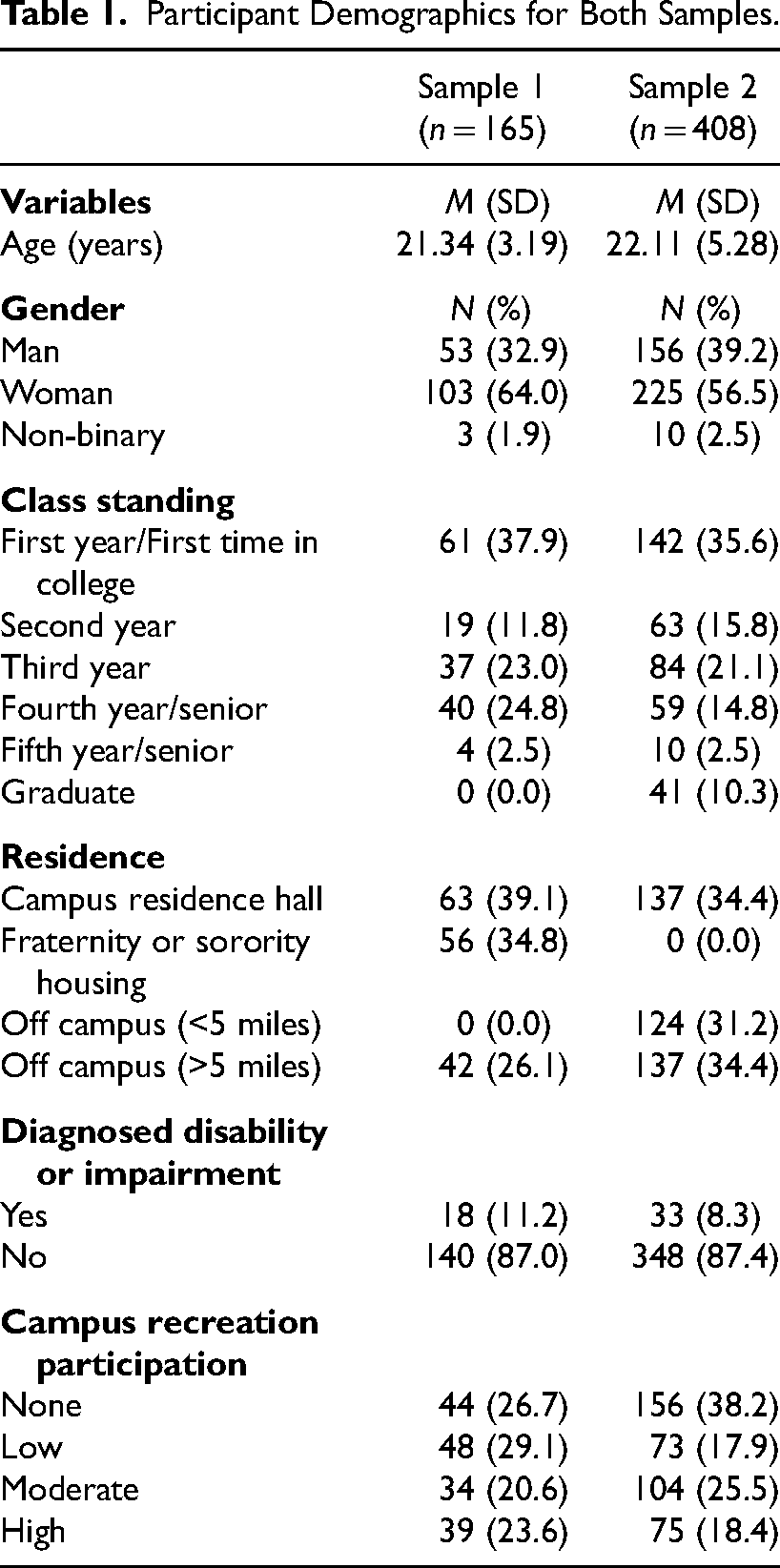
For sample 1, participants were 165 students with a mean age of 21.34 (SD = 3.19) enrolled full-time at a large university in the Southeast. Approximately 60% were women, and nearly 40% resided in on-campus housing. Twenty-six percent of respondents did not engage in campus recreation. For sample 2, participants were 408 students with a mean age of 22.11 (SD = 5.28) enrolled in programs at three universities in the Southeast. Of those that completed the questionnaire, 38% did not engage in campus recreation (see Table 1).
Participant Demographics for Both Samples.
Exploratory Factor Analysis
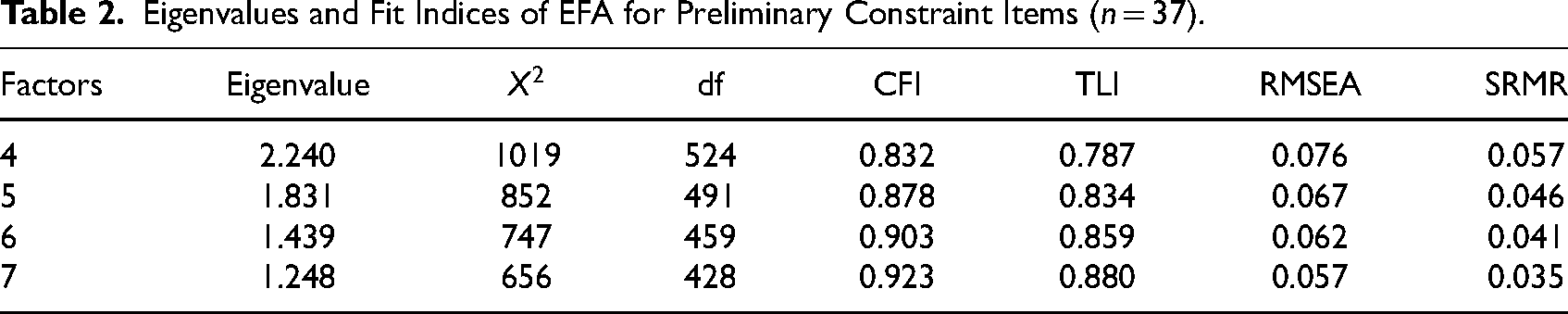
EFAs were conducted on sample 1 to estimate the number of factors and evaluate model fit. Table 2 summarizes the results of these factor analyses for constraint items. The KMO measure of .848 and the Bartlett's test of sphericity was statistically significant (p < .001) which indicates that the sample from which these data were collected was adequate. Both a six- and seven-factor solution were supported by fit indices. The decrease in eigenvalues leveled off after the seventh factor and the model did not converge for an eight-factor solution. The p-value for the RMSEA for a seven-factor constraint model failed to meet significance, but other fit indices indicate an acceptable close fit. It is recommended that multiple goodness of fit (GOF) indices be evaluated to determine model specification (Kline, 2016). Further, it is suggested that strict cutoff values should be used with caution for psychological models when evaluating GOF (Marsh et al., 2004). We selected the seven-solution model to ensure that the theoretical leisure constraints model was adequately represented. For negotiation items, fit indices supported a four- or five-factor solution (see Table 3). The KMO measure of .895 and the Bartlett's test of sphericity was statistically significant (p < .001) indicating that the sample from which these data were collected was adequate. The CFI approached 0.95, indicating an acceptable close fit. The RMSEA and its 90% CI were between 0.05 and 0.08. A five-factor solution was selected to effectively represent a combination of individual, interpersonal, and structural negotiation strategies.
Eigenvalues and Fit Indices of EFA for Preliminary Constraint Items (n = 37).
Eigenvalues and Fit Indices of EFA for Preliminary Negotiation Items (n = 29).

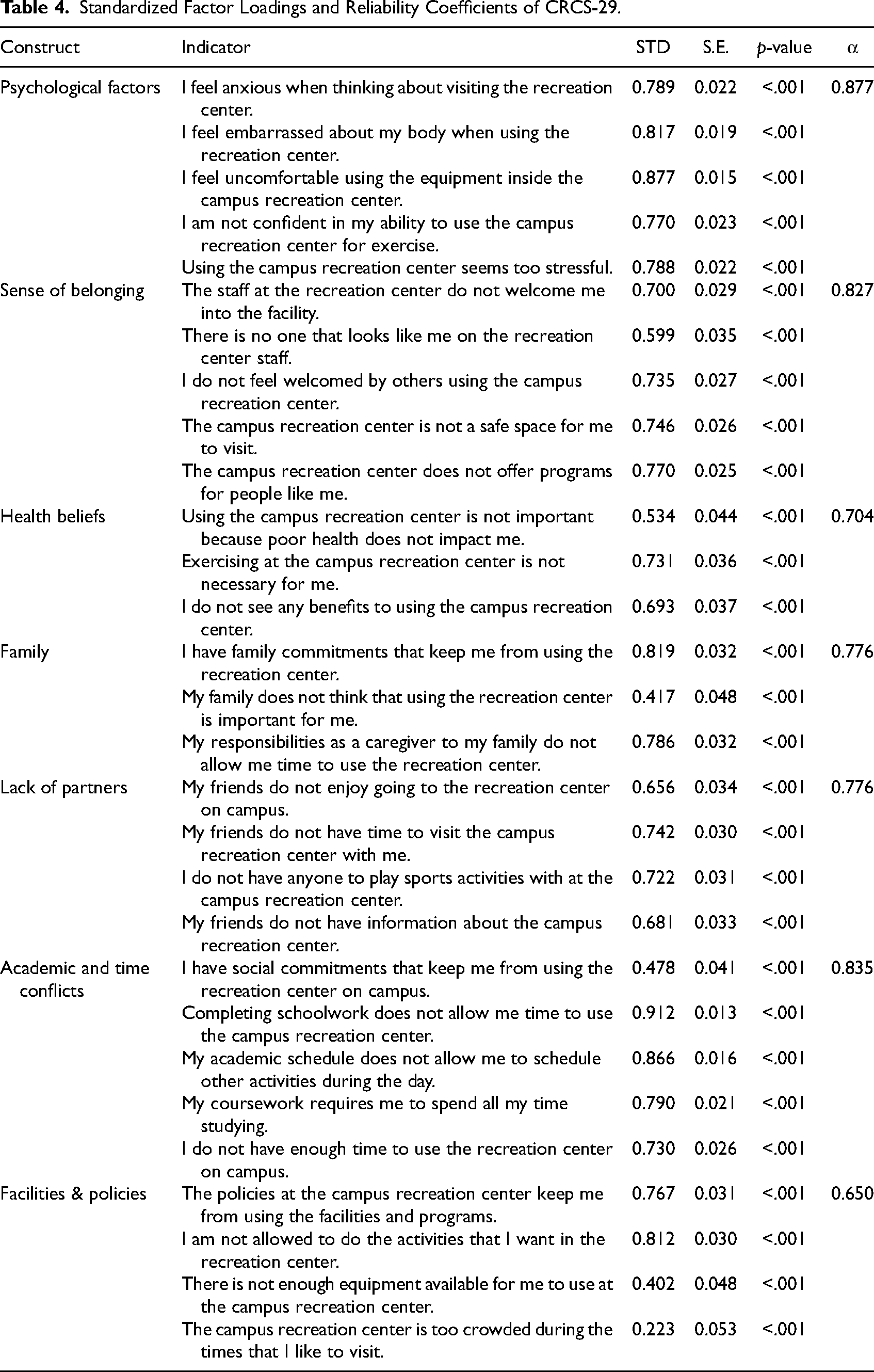
Based on the results of the EFAs, the item selection procedure included an evaluation of salient factor loadings and the theoretical fit of items. Items with factor loadings greater than 0.40 on at least one factor were retained. Items with multiple loadings were evaluated and retained if the difference between the factor loadings was at least 0.20. For constraint items, the seven factors consist of three intrapersonal, two interpersonal, and two structural types. The first factor refers to “Psychological factors” with items related to anxiousness and self-efficacy in using the campus recreation center. The second factor refers to “Sense of belonging” with items that measure students’ perception of acceptance within the campus culture. The third factor refers to “Health beliefs” with items related to the utility of campus recreation based on anticipated health outcomes. The fourth constraint factor refers to “Family” related to caregiving responsibilities and support from family to use the campus recreation center. The fifth factor refers to “Lack of partners” and includes items related to willing and capable others needed to participate. The sixth factor refers to “Academic and time conflicts” with items that measure competing time demands. The seventh factor refers to “Facilities and policies” related to engaging with campus recreation programs and services.
Items measuring negotiation strategies make up five latent factors. The first factor refers to “Self-determined motivation” and consists of intrinsic facilitators to campus recreation participation. The second factor refers to “Health and skill acquisition” and represents items related to physical behaviors that may improve successful participation. The third factor refers to “Social connection” and includes items related to friends and significant others. The fourth factor refers to “Time management” which consists of items related to planning and scheduling that facilitates participation. The fifth factor refers to “Perceived health benefits” and includes items related to the maintenance of good health now and in the future.
Confirmatory Factor Analysis
The CFA model for the 29-item constraints scale resulted in a seven-factor structure. Fit indices were χ2/df = 2.35, RMSEA = 0.058 (90% CI = 0.052–0.063), CFI = 0.915, TLI = 0.902, SRMR = 0.067 indicating an acceptable model fit. Most items had standardized factor loadings greater than 0.60 and all loading were significant (see Table 4). Modification indices suggested two covariances in the final measurement model. Two items in the “Academic and time conflicts” scale were set to covary. Similarly, two items in the “Facilities and policies” scale were set to covary.
Standardized Factor Loadings and Reliability Coefficients of CRCS-29.
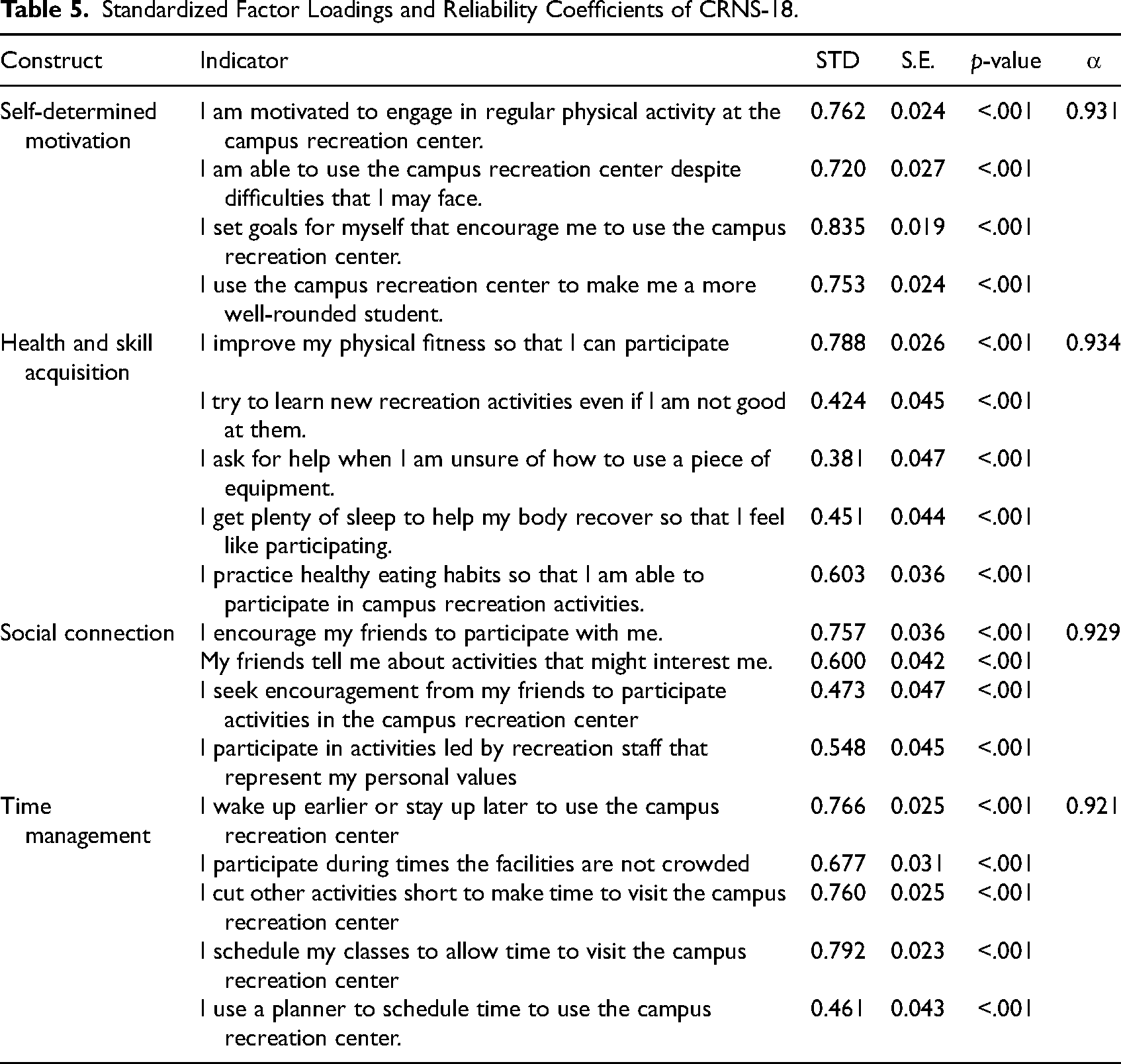
The CFA model for the 21-item negotiations scale did not support a five-factor solution. The “Perceived health benefits” variable shared a correlation greater than 1.0 with other latent variables in the model. This suggests that this variable may not be distinct enough from other latent variables being measured. Three items were removed from the scale resulting in an 18-item negotiation scale. The CFA model for this scale supported a four-factor structure. Fit indices include χ2/df = 2.63, RMSEA = 0.064 (90% CI = 0.055–0.072), CFI = 0.931, TLI = 0.917, SRMR = 0.051 indicating an acceptable model fit. Modification indices suggest a covariance between two indicators in the “Health and skill acquisition” scale. Table 5 shows the final standardized factor loadings for the final CRNS 18-item scale.
Standardized Factor Loadings and Reliability Coefficients of CRNS-18.
Internal Consistency Reliability
The Cronbach's alpha coefficient for the CRCS scale was 0.916 and the coefficients for the seven factors ranged from 0.650 to 0.877, indicating mostly acceptable internal reliability for the scale and individual factors. For the CRNS scale, the alpha coefficient was 0.976, and the four factors’ coefficients ranged from 0.921 to 0.934, indicating good internal reliability for the scale and in the individual factors (Cronbach, 1951).
Discussion
Measuring the constraints and negotiation strategies for campus recreation participation is of great importance to the physical, psychological, and social well-being of college students. The purpose of this study was to report the initial psychometric properties of two independent scales: the campus recreation constraints scale containing 29 items (CRCS-29) and the campus recreation negotiations scale containing 18 items (CRNS-18). The CRCNQ assesses the intrapersonal, interpersonal, and structural constraints that may prohibit campus recreation participation and the factors that may increase the negotiation of those constraints for college students. The items were generated from the expert judgment of key stakeholders and evaluated for representativeness of the domain of campus recreation participation. This strengthens the face and content validity of the questionnaire (Messick, 1995).
The psychometric properties of the two independent scales of the questionnaire support its content validity. An EFA of the CRCS-29 yielded a seven-factor solution that explained 60.63% of the variance in the study. The subsequent CFA indicated an acceptable fit to the seven-factor model based on a combination of fit indices (e.g., RMSEA, CFI, and SRMR). An EFA for the CRNS-18 supported both a four- or five-factor solution that explained 57.14% and 61.14% of the variance, respectively. The CFA indicated that the four-factor solution approached a better close-fitting model based on the aforementioned fit indices. Validity based on internal factor structure is supported for the questionnaire (Hu & Bentler, 1998; Messick, 1995).
The Cronbach's alpha for the CRCS-29 and CRNS-18 were both greater than 0.91, indicating good internal reliability in this sample. The subscales for the CRNS-18 each exceeded 0.90 also indicating good reliability for the measure. The alpha reliability for the subscales of CRCS-29 varied, ranging from 0.650 to 0.877, indicating fair to acceptable reliability. It should be noted that the “Facilities and policies” subscale showed less than adequate factor loadings on two items. It also demonstrated the lowest alpha coefficient. The factor was retained despite these findings because the theoretical underpinning of the structural constraint items is consistent with findings from previous studies (Selvaratnam et al., 2021; Van Niekerk, 2010) but may vary based on individual characteristics such as nationality (Selvaratnam et al., 2021). Based on the hierarchical nature of leisure constraints, it is plausible that students in the present sample possessed stronger intrapersonal and interpersonal constraints and thus have not formulated leisure preferences or determined the appropriateness of activities within the campus recreation center. These data were derived from a diverse sample population that included both users and non-users from a wide demographic of college students at different types of universities. University characteristics were similar regarding geographic location but varied regarding student enrollment and minority serving institution status. This heterogeneity increases the generalizability of the findings and enhances the utility of the CRCNQ across institutions. However, future studies should examine how these dimensions vary based on individual student characteristics such as age, race/ethnicity, and gender identity.
It should be noted that dimension reduction during the factor analysis process results in some items being removed from the final questionnaire. In this study, constraint items related to access and transportation were not retained. Inadequate factor loadings and poor internal reliability of the subscale called into question its relationship to other variables on the questionnaire. Additionally, it is less likely that campus administrators and program managers can modify programs to account for students that do not to live near campus or those who do not have adequate transportation rendering those findings less useful for program and policy development. Similarly, negotiation strategies related to the latent variable “perceived health benefits” (e.g., use campus recreation to maintain good health) were highly correlated with the latent variable “Self-determined motivation.” The correlation between the two latent variables was greater than 1.0, indicating that these items measure the same construct. According to the Health Belief Model, health behaviors depend on a combination of factors including perceived benefits and health motivation (Rosenstock, 2000). Leisure constraints and negotiation strategies may be conceptually distinct but materially related which would result in correlated variables. It is likely that students with high engagement may possess more self-determined motivation because of the perceived positive health benefits associated with using the campus recreation center. Further data analysis would be needed to determine the extent to which constructs in this model are correlated.
The CRCS-29 integrates the tenets of the leisure constraints model as applied to college students’ engagement in campus recreation programs. Intrapersonal (i.e., psychological), interpersonal (i.e., lack of partners), and structural (i.e., academic and time conflict) constraints emerged as salient factors among college students for this questionnaire. This supports findings from previous studies (Adam et al., 2015; Selvaratnam et al., 2021; Stankowski et al., 2017). Leisure constraints do not necessarily result in non-participation (Crawford et al., 1991). Instead, examining leisure constraints can assist researchers in understanding the motivations, preferences, and programming needs of college students. Similarly, factors that emerged on the CRNS-18 support previous literature examining negotiation strategies (Hoang et al., 2016; Wilson et al., 2019). These negotiation strategies are leveraged to increase participation in campus recreation.
Practical Implications
Given these findings, the CRCNQ may be used for measuring constraints and negotiation strategies that influence campus recreation participation among college students. The use of a validated questionnaire is encouraged when assessing participation in campus recreation. Program managers should measure how constraints vary across individual characteristics and the academic journey to develop campus recreation offerings that support a diverse student demographic. Findings can be used to develop and deliver more intentional initiatives to increase engagement and participation among user groups.
Social marketing is an approach to design activities to change or maintain the behaviors of individuals or groups. Social marketing is a public health principle that could enhance marketing and promotion efforts within campus recreation. Using the CRCNQ to understand the needs of college students who do not engage with campus recreation to inform marketing strategies may enhance the effectiveness of campaigns and increase the return on investment of valuable resources to impact behavior change.
Limitations and Future Research
Sample size for SEM is an important consideration. In general, larger sample sizes are preferred to adequately detect power. However, it is argued that when all outcome variables are continuous and normally distributed smaller sample sizes may be acceptable (Kline, 2016). For CFA, current measurement literature suggests that factor loadings of .7 require a sample size of at least 300 with larger samples needed for lower loadings (Bandalos, 2018). The present study sample size warrants some caution in interpreting results.
This study reports an initial step in the development and validation process for the CRCNQ. Limitations of the instrument include unclear relationships with other variables. Further testing is required to understand how these factors vary based on other individual characteristics, affinity groups, and participation. Another limitation is the lack of meaningful participation data collected in this self-report study design. Students were asked if they “did” or “did not” engage with campus recreation. Thus, the participation variable in this study is a categorical variable which renders predictive variance difficult. Future research should consider a continuous dependent variable such as total MET minutes of participation or average minutes per week.
Constraints and negotiation strategies may vary based on institutional characteristics (i.e., size, geographic location, private vs. public). Previous studies suggest that constraints and negotiation strategies may vary based on individual characteristics such as race and ethnicity (Hoang et al., 2016), and gender identity (Lauderdale et al., 2015). It is also plausible that college students with physical, neurodevelopmental, or intellectual disabilities may report unique constraints and negotiation strategies. Future research should be conducted with more diverse samples of college students.
Conclusion
The purpose of this study was to offer a valid and reliable tool to examine constraints and negotiation strategies among college students. The CRCNQ can be used to examine the unique prevalence of constraints and negotiation of subsets of a given population on campus to design programs and facilities. Campus recreation administrators are encouraged to use this questionnaire to understand the needs of their student population. The use of a validated measure also allows for multi-institutional comparisons and benchmarking. The results can also assist in the evaluation of policies or procedures that may prohibit or reduce the utilization of particular access points for students. The benefits of campus recreation participation are well-documented. Increasing the quantity and frequency of student participation is important to improve the well-being of college students.
Footnotes
Declaration of Conflicting Interests
The authors declared no potential conflicts of interest with respect to the research, authorship, and/or publication of this article.
Funding
The authors disclosed receipt of the following financial support for the research, authorship, and/or publication of this article: This work was supported by the NIRSA Foundation.
