



Abstract
There are limited studies on the application of exploratory sequential design as a mixed methods approach to intervention development. Accordingly, the methodological purpose of this paper, using an agricultural education example, is to illustrate how the mixed methods exploratory sequential design can be used in the development of a continuous professional development framework. The paper incorporates 35 semi-structured interviews, 70 survey responses, an additional qualitative-plus-quantitative step (including two focus groups), and a transnational perspective to the exploratory sequential design process. The paper signifies a novel methodological contribution to the traditional exploratory sequential design process as it is widely understood. The approach applied in this paper can be used by other researchers/educators/training providers/interest holders/etc., to inform future intervention development.
Introduction
There are limited studies on the application of mixed methods exploratory sequential design for intervention development (Durham et al., 2011; Kong et al., 2018; Munce et al., 2021). Additionally, opportunities for continuous professional development (CPD), particularly with respect to pedagogical skills and strategies, within the agricultural context is lacking (Flannery et al., 2019; Requena et al., 2025). Accordingly, the methodological purpose of this paper is to illustrate how the mixed methods exploratory sequential design can be used in the development of a CPD framework. Within the agricultural sphere, there is a tendency to place emphasis on technical and scientific value, over pedagogical expertise. This accentuates the need to conceptualize a professional development framework which is focused on developing educator competence in pedagogical knowledge in parallel to technical expertise. Nastasi et al. (2007) and Panda et al. (2015) indicate exploratory approaches such as exploratory sequential design should be used for intervention development, such as is the case here in the development of a professional development framework. The professional development framework detailed in this paper is referred to as a “Pedagogical Competency Framework” (PCF) developed for agricultural educators within the VET (Vocational Education and Training) sector. The PCF is defined as a conceptual structure which incorporates pedagogical knowledge, skills, and dispositions required by educators to support the delivery of quality teaching and learning within the agri-food VET sector (Alexander, 2013; MindTools, 2022).
Mixed methods research is increasingly used by social and health science researchers (Borrego et al., 2009; Hidalgo et al., 2020; Jackson & Otaki, 2023; Kilroy et al., 2025; Munce et al., 2021; Squires & Rigby, 2024). The rationale for utilizing a mixed methods approach is grounded in the trustworthiness of the results obtained, and the conclusions and recommendations made (Creswell & Plano Clark, 2018; O’Cathain et al., 2010). Traditionally, exploratory sequential design (in general and when applied to intervention development) commences with the generation of qualitative data to explore a phenomenon followed by a quantitative instrument developed based on the qualitative phase. Finally, the extent to which the instrument developed generalizes or broadens the initial qualitative findings is explored (Creswell & Plano Clark, 2018). However, for this paper, the researchers developed a participative mixed methods approach which incorporated an additional qualitative-plus-quantitative step as well as a transnational perspective to the traditional exploratory sequential design. This step (i.e., additional qualitative-plus-quantitative step) has not been previously witnessed by the authors in other studies but was a significant step in refining the PCF developed. This signifies a novel methodological contribution of this paper to the exploratory sequential design process as it is widely understood.
The purpose of the PCF developed using the exploratory sequential design is to provide a roadmap of pedagogical competencies agricultural educators should strive to achieve throughout their career as educators and extension agents. The additional qualitative-plus-quantitative step provided a universal lens through which the pedagogical competencies were identified, increasing the practical relevance of the framework developed. Depth was achieved through the introduction of the additional qualitative-plus-quantitative step while breadth was achieved through the inclusion of the transnational perspective with elements of the research carried out in both Ireland and the Netherlands. Thus, this paper contributes uniquely to methodological discussion concerning mixed methods exploratory sequential design, with the development of the novel methodological approach and the resultant framework being inextricably linked. The paper also serves as a reference for other researchers, educators, training providers, interest holders, etc., in using the exploratory sequential design to develop a CPD framework for practitioners.
Paper Structure
Given the complexity of the PCF developed and the transnational, participative mixed methodological approach used in establishing the framework, the paper is specifically structured to reflect the research phases. The paper consists of four sections. First, an overview of the traditional exploratory sequential design in mixed methods research alongside the introduction of a fourth, novel step to the exploratory sequential design applied in this study is discussed. Second, the research design and specific phases of data generation are presented, including the results from each phase given the methodological approach and resultant framework are inextricably linked. This section illustrates how the mixed methods exploratory sequential design was applied to the development of a CPD framework for practitioners (including the application of the additional qualitative-plus-quantitative step and transnational element). Third, a discussion of the procedural issues encountered in the study and the contribution of this paper to the field of mixed methods is presented, alongside the strengths and limitations of the study. Finally, key findings and contributions are summarized in the conclusion.
Exploratory Sequential Design in Mixed Methods Research
New developments in mixed methods research offer great potential for addressing complex problems which are context-specific and multidisciplinary in nature. Mixed methods exploratory sequential design comprises three phases which commences with qualitative data generation and analysis subsequently followed by the development of a quantitative instrument/tool (Creswell & Plano Clark, 2018; Dawadi, 2021). The instrument developed is grounded in the views and opinions of the participants given it is developed based on the qualitative phase of data generation. The quantitative instrument/tool developed is then tested to explore the extent to which the instrument developed generalizes or broadens the initial qualitative findings. In this study, in-depth exploratory semi-structured interviews were used in the initial qualitative phase for data generation. A first draft of the PCF was developed following analysis of the qualitative data collected which identified competencies specific to pedagogy in education. The draft PCF was then tested using a quantitative survey instrument, an online survey, to test the importance of each pedagogical competency identified. A fourth additional qualitative-plus-quantitative phase was added to the exploratory sequential design to amend and finalize the PCF developed. This step was crucial in terms of ensuring the applicability and relevance of the PCF developed to the population of educators within the agri-food VET sector. The development of the framework also included an extensive review of academic literature within the scholarly field of pedagogy as pedagogical knowledge and expertise was required to develop the PCF applicable to agricultural educator needs. Therefore, in summary, the mixed methods exploratory sequential design employed in this study consisted of four distinct phases (as opposed to three) which are discussed in detail below. All stages in the data generation process were integrated with each phase informing the other to ensure the PCF developed met the needs of the sample population (Creswell & Plano Clark, 2018).
This study was conducted with the national population of agricultural educators within the VET sector in Ireland, a sample of pedagogically trained agricultural educators in the Netherlands, and a sample of pedagogical experts and senior agricultural education managers both in Ireland and the Netherlands. The Netherlands was selected due to their extensive research in the area of competence studies and the development of competency frameworks for other education sectors beyond agriculture alone (Biemans et al., 2004; Demssie et al., 2022; Mulder, 2012; van Dam et al., 2010; Wesselink & Wals, 2011). The Netherlands are also leaders in sustainable agriculture and highly innovative while also being the second largest exporters of agriculture globally (WUR, 2022). The incorporation of this transnational element to the mixed methods exploratory sequential design process introduced an international perspective and universal lens to the development of the PCF. It supported a shift in focus, from just the Irish case, to include the Netherlands given their extensive research in the area of competence studies and competency framework development. Ultimately, the transnational element was incorporated as an opportunity to generate data from more experienced counterparts, on a similar level to those recruited in Ireland, in another country. This provided greater context to what could be a narrower sectoral study, given that CPD for agricultural educators with regard to pedagogy in education within the agri-food VET sector in Ireland is a relatively new space. Regarding research ethics, in all stages, written, informed participant consent was obtained while participants were informed there was no obligation on them to participate, with them being free to withdraw from the study at any point. Confidentiality and anonymity were guaranteed throughout the study.
Application of Mixed Methods Exploratory Sequential Design to the Development of a CPD Framework
Phase 1: Theoretical Foundation for Development of CPD Framework
A theoretical framework to support the development of the PCF was established following an extensive review of academic literature within the scholarly field of pedagogy in education. This involved secondary analysis of published information in peer-reviewed academic journals (Sarantakos, 2013) to develop the theoretical framework pertinent to the development of the PCF within this study. Google Scholar was the primary search engine utilized to discover academic publications concerning pedagogy in education. The purpose of this phase in the exploratory sequential design process was to establish an expert knowledge of pedagogy, particularly with regard to the VET sector. This supported the development of the PCF which addresses agricultural educator training needs. Findings from this phase in the data generation process also supported the development of the interview guide for research phase 2 as well as informing the development of the draft PCF in phase 3.
The development of pedagogical competence requires three types of knowledge: (i) know-why; (ii) know-how; and (iii) know-what (Madhavaram & Laverie, 2010; Sousa & Mangas, 2024). Know-why provides a theoretical understanding to the achievement of a task as reflection supports the educator in learning new things and new ways of doing things. Know-how is supported through learning-by-doing, the hands-on, practical knowledge attained by executing a task. Finally, know-what occurs following the creation of new knowledge and ideas as a result of the application of pedagogical instructional innovations which support more efficient, effective knowledge exchange (Madhavaram & Laverie, 2010; Sousa & Mangas, 2024). Each of these three types of knowledge was considered in the development of the PCF. Additionally, educator professional learning can occur in various ways with the PCF developed acknowledging four specific dimensions of educators’ learning: (i) personal/professional; (ii) individual/collaborative; (iii) formal/informal; and (iv) school-based/external (Gallimore et al., 2009; Greany et al., 2025; Jones & Dexter, 2014; Korthagen, 2017; Richter et al., 2014). However, it is important to note that these four dimensions intertwine and interchange, they are not mutually exclusive, which presents opportunities for a variety of different learning experiences. A considerable amount of educator learning occurs in the “third space” often associated with the in-between places of learning (Greany et al., 2025; Kilpatrick & Falk, 2003; Oldenburg, 2001; Timm-Bottos & Reilly, 2015). This supports and promotes collaborative sharing of new ideas, methodologies, and resources within the community of educators through shared informal conversations and applied on-the-job learning for instance (AITSL, 2014; Greany et al., 2025; Jones & Dexter, 2014; Owen, 2014). An educator’s professional identity can also be a contributing factor to the educators teaching approach, engagement with professional development, and their attitude toward educational change (Schepens et al., 2009; Simon, 2024). Accordingly, the PCF developed is based on the assumption the educator will have the academic qualification and subject matter knowledge required for the role at point of employment (Flannery et al., 2019). However, a CPD framework which supports and guides the educator toward pedagogical competence over the course of their career is required. Subsequently, the PCF was developed as a tool to support this motion.
Phase 2: Qualitative Exploration of Pedagogical Competencies
The purpose of this phase was to explore the pedagogical competencies, relevant to agricultural educators specifically, for inclusion in the PCF being developed. Face-to-face semi-structured exploratory interviews (n = 35) were conducted by the first author with a sample of agricultural educators (pedagogically trained and untrained) within the VET sector in Ireland (n = 8), a sample of pedagogically trained agricultural educators in the Netherlands (n = 9), and a sample of pedagogical experts and senior agricultural education managers both in Ireland (n = 15) and the Netherlands (n = 3). Key interest holders beyond the agri-food VET field were identified and chosen for inclusion in this phase of the study given their extensive knowledge and expertise in relation to pedagogy in education and their position within the VET sector. These parameters were deemed significantly important to the purpose of this phase in the data generation process. The semi-structured interviews involved preparation of an interview guide which focused on the broad topic of agricultural educator professional development needs, specifically pedagogical needs. The core questions (n = 3) were standardized as follows: (i) Do you think a PCF would be beneficial or useful for training VET agricultural educators in pedagogical knowledge, skills, and competencies?; (ii) What pedagogical competencies: knowledge, skills, and attitudes, do you think all agricultural educators should possess?; and (iii) What is the best way of providing CPD to agricultural educators to ensure these pedagogical competencies are acquired? The interview guide was piloted with a sample of educators not associated with the study. Semi-structured interviews were conducted primarily in Ireland (n = 23) with the Netherlands included as a secondary case study to provide a transnational lens through which pedagogical competencies could be identified. Specifically, Wageningen University was chosen as a partner university because of their leadership in the field of agriculture and a department within the university exclusively focused on education and competence studies. The knowledge, experience, and expertise of scholars within this particular department in the university were deemed significantly important and valuable to the study objectives and development of the PCF within this study. The approach supported depth and breadth of the data.
Purposive recruitment was used to identify participants for this phase of the study. This approach supported the recruitment of participants with the appropriate knowledge, skills, expertise, and experience relevant to the study objective being addressed. Snowball recruitment was used in tandem with purposive recruitment to increase accessibility to suitable personnel within the VET and higher education sectors while also ensuring trustworthiness. Initially, Irish participants were selected based on the possession of a Level 9 teaching qualification on the National Framework of Qualifications (NFQ). 1 At the time of conducting this research, only five educators within the agri-food VET sector in Ireland possessed such a qualification. As a consequence, these five educators were purposively recruited for inclusion in the study. The purposively recruited educators were then asked to snowball three other educators relevant to the study. This resulted in the identification of eight educators for inclusion in this phase of the study. Senior agricultural education managers were purposively recruited based on their senior roles within agri-food colleges or their involvement at agri-food educational policy level in Ireland. This resulted in the identification of 11 senior agricultural education managers in Ireland for inclusion in the study. Four of the 11 senior agricultural education managers recruited were involved at the agri-food educational policy level in Ireland (i.e., n = 4 pedagogical experts) and were asked to nominate a key stakeholder each within the higher education sector relevant to the study. This resulted in eight pedagogical experts overall being included in the study. In the case of the Netherlands, the same approach was applied for participant recruitment. Initial participants were purposively recruited under the guidance of a professor within Wageningen University with purposively recruited participants used to snowball further participants relevant to the study. Subsequently, participants in the Netherlands included nine pedagogically trained educators within the agri-food VET sector and three pedagogical experts, all within the VET and higher education sectors in the Netherlands. In summary, a total of 35 in-depth semi-structured interviews were conducted with agricultural educators (n = 8 Ireland, n = 9 Netherlands), and senior agricultural education managers and pedagogical experts (n = 15 Ireland, n = 3 Netherlands) primarily in Ireland but also including the Netherlands as a secondary case study.
Qualitative data collected in the form of face-to-face in-depth semi-structured exploratory interviews were audio-recorded and subsequently transcribed by the first author prior to reflexive thematic analysis (TA). The first author read and re-read the transcripts, noting initial analytical observations on the transcripts and then in relation to the entire dataset. Following this, codes were created in line with the research question, with the entire dataset being coded twice. Each pedagogical knowledge, skill, and/or disposition mentioned at least once across all 35 interviews was identified and recorded. Codes were then examined and collated to begin developing candidate themes. Therefore, the knowledge, skills, and dispositions identified and recorded were then collated to generate related pedagogical competencies (candidate themes) (e.g., assessment, student engagement, and scaffolding). Each candidate theme (i.e., related pedagogical competency) was checked against the coded data and entire dataset to further develop the themes and construct individual pedagogical competencies for inclusion on the framework. During this phase, candidate themes and themes were split, combined, and even discarded prior to refining, defining, and naming the themes. This resulted in the construction of nine pedagogical competencies (themes) for inclusion on the PCF. Reflexive TA was chosen because it offered an ability to develop rich, detailed, and nuanced analysis based on the research question (Braun & Clarke, 2021; Byrne, 2022; Terry & Hayfield, 2025). While the process is sequential with each phase building on the next, analysis was a recursive process with movement back and forth between phases. Qualitative data collected in Ireland and the Netherlands were integrated in the data analysis phase given the ultimate objective was to develop a PCF which addresses the professional development needs of agricultural educators within the VET sector. Agricultural educator training with respect to pedagogy in education in Ireland is behind the curve when compared to international best practice. This is not the case in the Netherlands where they are well advanced in educator training and development of competency frameworks for many sectors. Therefore, the knowledge and expertise gathered during the field visit to the Netherlands was significant to the development of the PCF and a key component of the exploratory sequential design process employed. Consequently, a comprehensive analysis of the dataset as a whole provided greater contribution to the PCF developed compared to analyzing each single case alone.
Phase 3: Quantitative Survey Instrument: Inclusion/Exclusion Test of Pedagogical Competencies
The purpose of this phase was to conduct an inclusion-exclusion test on the related pedagogical competencies identified in phase 2. A quantitative survey instrument was developed based on the findings from phase 2 and the pedagogical competencies constructed in order to achieve this (i.e., determine which pedagogical competencies constructed in phase 2 are to be included on the PCF developed). The online survey was self-developed and piloted prior to dissemination to the study participants. The quantitative survey instrument comprised primarily of closed-ended questions (n = 26) and some open-ended questions (n = 2) presenting participants with the opportunity to identify gaps in pedagogical competencies constructed by suggesting further pedagogical competencies participants believe should be included in the framework developed. Closed-ended questions investigated demographic information, teaching career, and teaching qualifications at the outset of the survey. 5-point Likert scales comprised the main body of the survey, inviting participants to rate the importance of each pedagogical competency (identified in phase 2); from 1 = not at all important to 5 = very important, to their role as an agricultural educator. Subsequently, the quantitative survey instrument tested each related pedagogical competency identified in phase 2 for inclusion/exclusion on the PCF. The survey also determined the extent to which the findings in phase 2 generalize to the agricultural educator population.
Purposive recruitment was employed to identify participants in this phase. The purpose of the PCF developed was to increase agricultural VET educators’ pedagogical competence throughout their career as an educator/extension agent. Consequently, the national population of agricultural educators in Ireland (n = 72), the national population of senior agricultural education managers (n = 7), and pedagogical experts (n = 8) within the Irish agri-food VET sector were recruited for inclusion in research phase 3. Therefore, the survey was conducted with a total of 87 participants, achieving a response rate of 80% (n = 70 respondents). This surpassed the expected response rate for an online survey of approximately 50% (Kumar, 2014). The three purposively recruited categories of participants were recruited given their roles and responsibilities with regard to agricultural education program delivery and their impact at managerial and policy level. In summary, all Irish participants included in phase 2 were included in this phase, phase 3, together with an increased sample population of agricultural educators, senior agricultural education managers, and pedagogical experts within the agricultural VET sector.
Results of Quantitative Survey Instrument Used in Phase 3 to Identify Pedagogical Competencies for Inclusion/Exclusion on the Framework (Total n = 70)
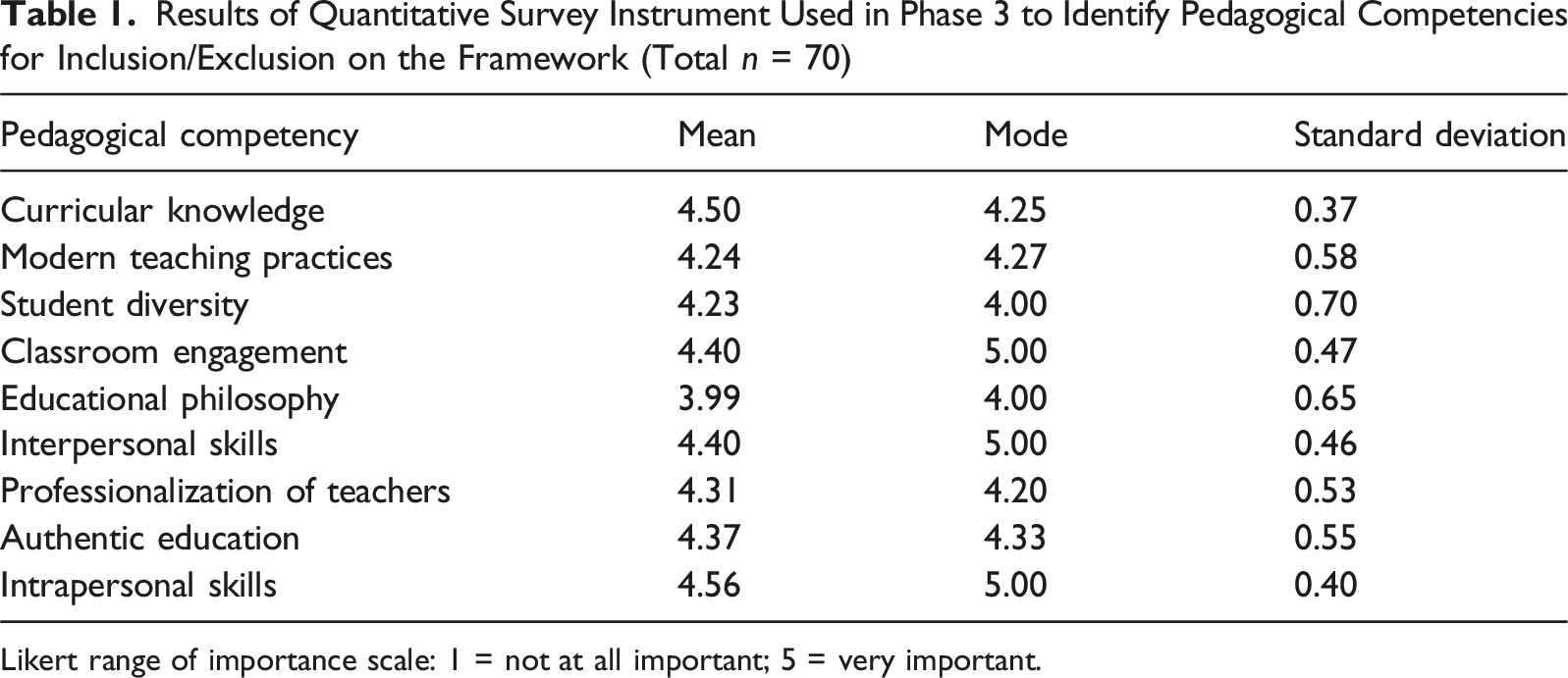
Likert range of importance scale: 1 = not at all important; 5 = very important.
Phase 4: Additional Qualitative-Plus-Quantitative Step: Finalizing Pedagogical Competency Framework Developed
The purpose of this research phase was to conduct a comprehensive review of the draft PCF developed at the end of phase 3 in an effort to refine the pedagogical competencies included on the final framework developed. To achieve this, two methodologies were employed: first, a qualitative stage involving two focus group discussions; and second, a quantitative stage entailing a Factor Analysis of the key competencies identified to establish relationships. The first focus group included interest holders involved in educational policy reform at the national level (n = 4) and the second focus group was conducted with the national population of senior agricultural education managers in Ireland (n = 7). Similar to phase 3, participants involved in this phase, phase 4, had previously been involved in phases 2 and 3 of the data generation process. This illustrates the importance of integration and its application throughout the study in achieving the overall research objective. The focus groups involved preparation of a focus group guide which focused on four core questions: (i) If we were to develop a teaching qualification for agricultural educators based on the framework as it stands what do you think it should look like?; (ii) What do you think the final framework should contain?; (iii) How would you rank each competency?; and (iv) What do you think is the biggest risk to agricultural VET providers if we do not provide adequate pedagogical training to educators within the sector? These core questions ensured the draft PCF developed at the end of phase 2 and amended slightly at the end of phase 3 was discussed, amended, and redesigned within the two focus group discussions. Both focus group discussions were underpinned by potential opportunities to design and develop a formalized teaching qualification for agricultural VET educators based on the PCF developed. Similar to the other research phases described in this paper, participants for this phase were recruited using purposive recruitment. Personnel operating at the managerial and policy level with regard to VET agricultural education were recruited due to their involvement with curricular reform and professional development of agricultural educators. As mentioned previously, both cohorts involved in the focus group discussions during this phase were also involved in the previous three primary data generation phases. This approach was employed to increase the trustworthiness (i.e., credibility, transferability, dependability, and confirmability) of the PCF developed.
Qualitative data collected in the form of focus group discussions (n = 2) was audio-recorded and subsequently transcribed by the first author prior to coding reliability TA. As described previously in phase 2, reflexive TA was used to construct pedagogical competencies, whereas in this phase (phase 4), the researchers were seeking to review the drafted framework based on the pedagogical competencies (themes) already constructed at the end of phase 2. Accordingly, coding reliability TA was used as it enhanced the trustworthiness and rigor of the qualitative research findings. Additionally, a quantitative step was incorporated to this phase, phase 4, in the form of a factor analysis to determine the extent of the relationships between each pedagogical competency constructed, determining where each pedagogical competency should be positioned on the PCF. Applying factor analysis helped identify relationships between competencies which may not have been obvious. This helped enhance the trustworthiness of the final framework developed with regard to competency positioning on the framework.
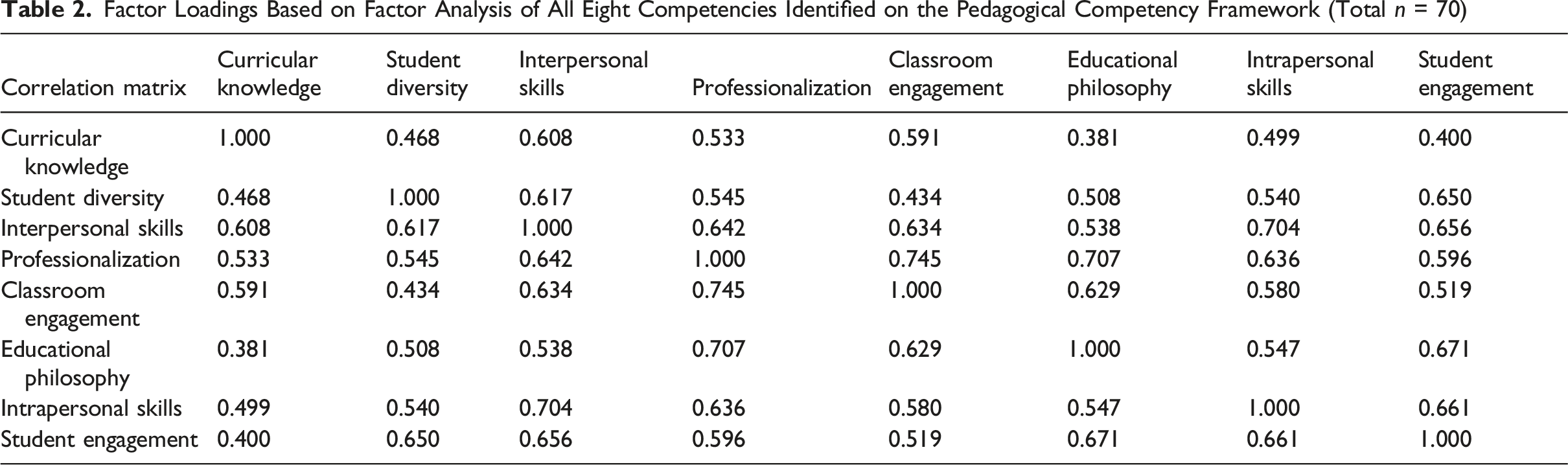
Progression through each study-specific mixed methodology described up to this point resulted in the construction of a final eight-part framework. Synthesizing the findings from the literature, semi-structured exploratory interviews, quantitative survey instrument, focus group discussions, and the factor analysis resulted in the framework being formed around the four pillars of the individual, the institutional, the technical, and the instructional (see Figure 1). Layered upon each of the pillars is the teacher–student perspective which forms an anchor to each of the refined eight pedagogical competencies which form the PCF. The theoretical framework for the PCF developed was only applied after all primary data collected had been analyzed. At the end of phase 3, nine pedagogical competencies were constructed for inclusion on the framework. However, this phase, phase 4, resulted in the pedagogical competencies included on the framework being refined to eight. This was due to results from both the focus group discussions and the completed factor analysis. The term “Authentic Education” as a pedagogical competency included at the end of phase 3 was changed to “Student Engagement” based on findings from the focus group discussions which illustrated difficulty in understanding the educational jargon. Additionally, “Modern Teaching Practices” as a pedagogical competency included at the end of phase 3 had a strong emphasis on technology in the classroom and during this research phase, phase 4, has been incorporated into the pedagogical competency “Student Engagement.” Again, this was based on findings evident in the focus group discussions. On completion of the focus groups analysis, a factor analysis was conducted to determine the extent of the relationships between the competencies identified. This determined the position of each pedagogical competency on the final framework developed. It was observed that all eight pedagogical competencies identified at the end of the focus group analysis correlated 0.4 or greater with at least one other competency, suggesting factorability exists. Second, the Kaiser–Meyer–Olkin measure of sampling adequacy was 0.897 and Bartlett’s test of sphericity was significant (p < .05). Consequently, the pedagogical competencies constructed were categorized on the framework as per Figure 1 based on the results of the factor analysis (Table 2). Each competency categorized within the teacher–student axis on the framework was then positioned under each of the four pillars identified (Figure 1).
The four pillars identified on the PCF developed acknowledge that teaching and learning does not take place in a vacuum and are driven by a number of factors: (i) Individual, which encompasses Student Diversity and Intrapersonal Skills; (ii) Institutional, which encompasses Interpersonal Skills and Classroom Engagement; (iii) Technical, which encompasses Curricular Knowledge and Professionalization; and (iv) Instructional, which encompasses Educational Philosophy and Student Engagement. Developed pedagogical competency framework for VET educators within agriculture Factor Loadings Based on Factor Analysis of All Eight Competencies Identified on the Pedagogical Competency Framework (Total n = 70)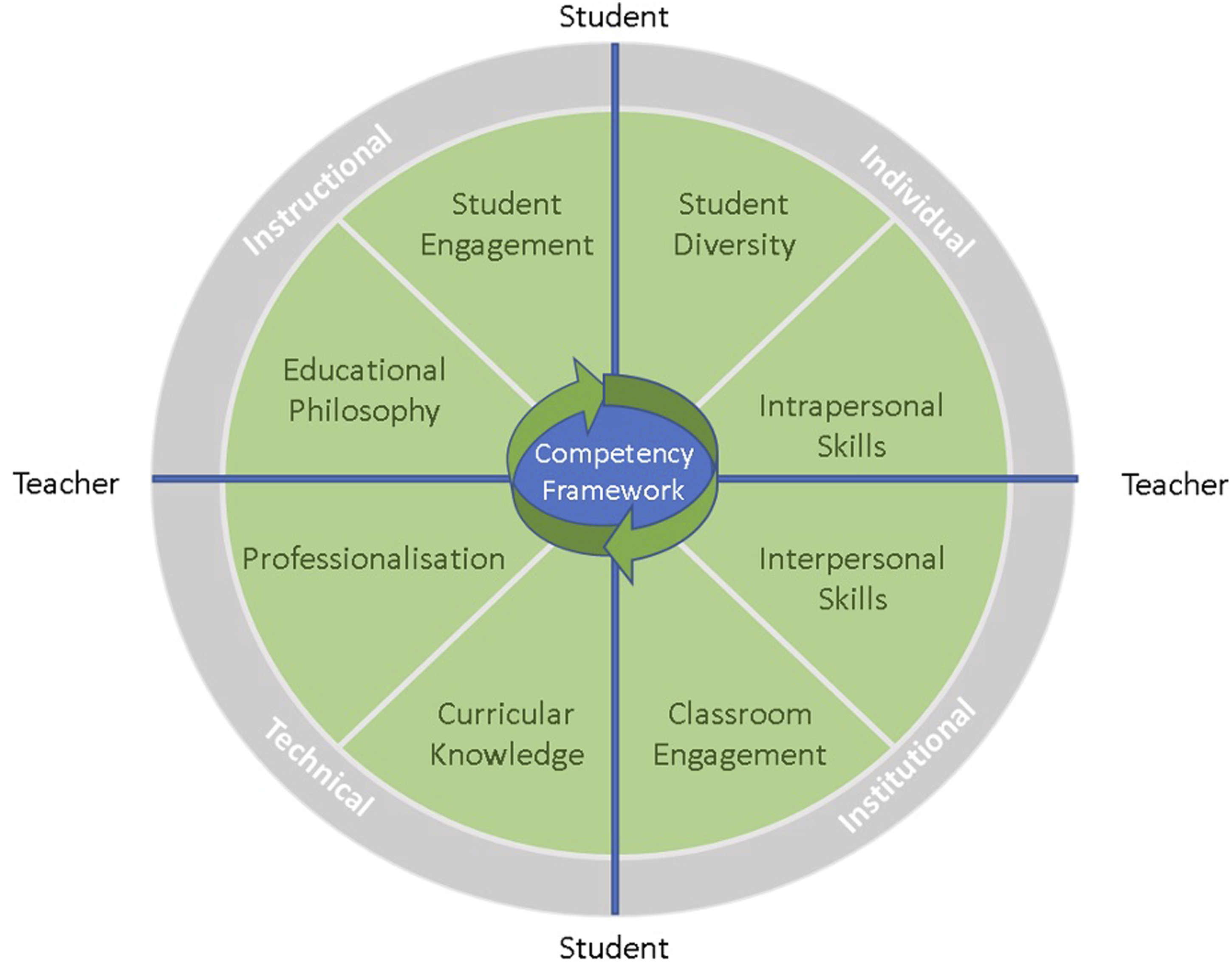
In summary, this additional qualitative-plus-quantitative step signifies a novel methodological contribution of this study to the exploratory sequential design process as it is widely understood. This step has not been previously witnessed by the authors in other studies; however, this additional step was of significant importance in this study to the development of the resultant framework, offering the only opportunity throughout the research process to refine the PCF developed. This approach can serve as a reference for other researchers, educators, training provides, interest holders, etc., in using the mixed methods exploratory sequential design in the development of professional development frameworks and interventions for practitioners.
Exploratory Sequential Design in Mixed Methods Research Procedural Issues
The issues of priority, implementation, and integration of the qualitative and quantitative approaches employed are common challenges faced when using any mixed methods approach (Akerblad et al., 2021; Dawadi, 2021; Ivankova et al., 2006). Within this study, consideration was given to which approach, that is, qualitative or quantitative, would receive more emphasis within the study design. The sequence of data generation and analysis also had to be determined as well as identifying integration of both qualitative and quantitative approaches. Each of these decisions was made based on the purpose of the study and its research objective. A visual representation of the nuances of the study design employed in this study is illustrated in Figure 2, which clearly outlines the priority/weighting given to the qualitative or quantitative data generation procedure and the point of integration within the methodology. Within this illustrative study, priority was given to the qualitative approach with several points of integration evident throughout the study. Giving priority to the qualitative approach is consistent with the recommendation of Nastasi et al. (2007) and Panda et al. (2015) in using exploratory approaches in intervention development. Procedures of the mixed methods exploratory sequential design employed in this study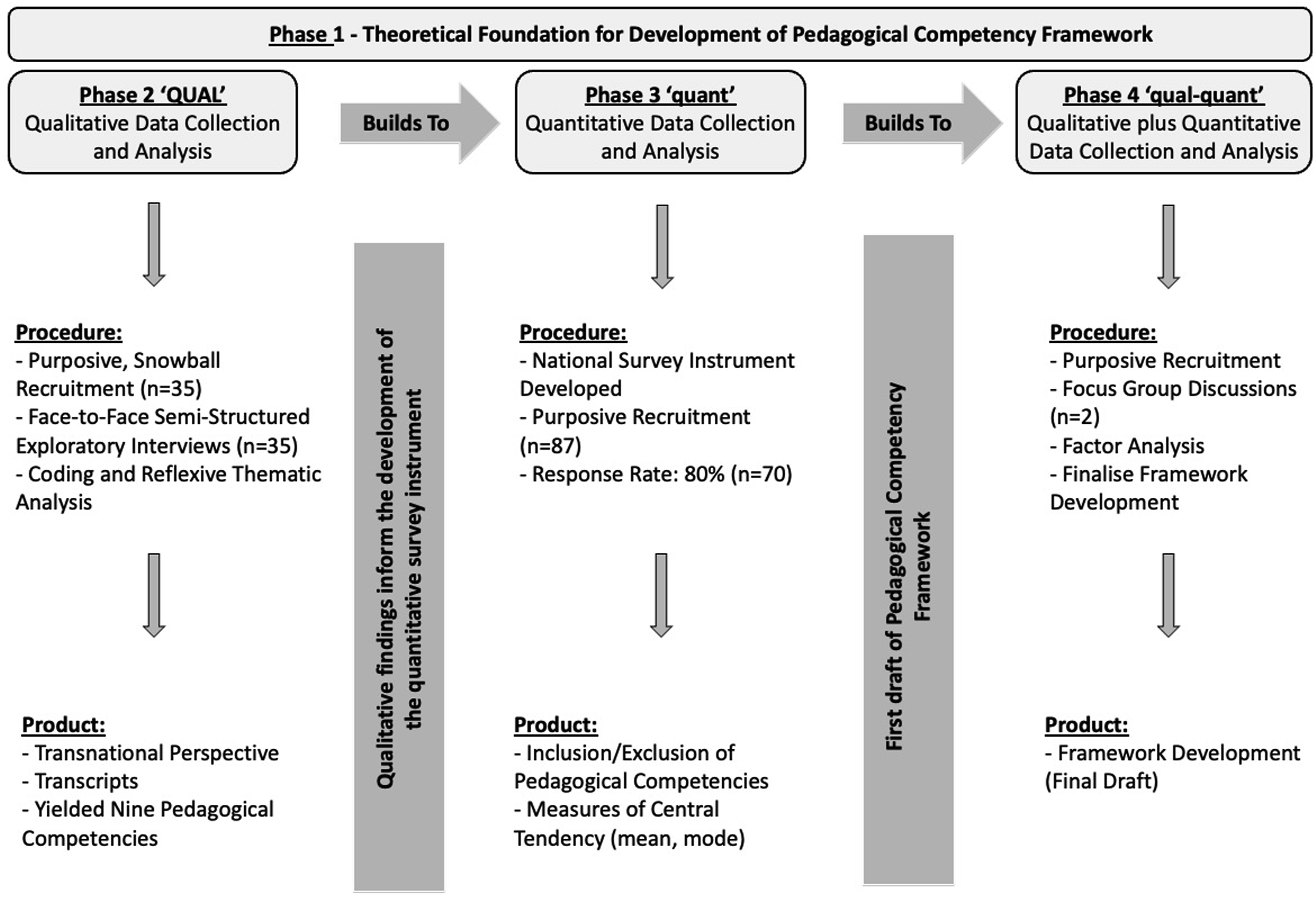
Priority
Within this illustrative study, priority was given to qualitative data generation (Dawadi, 2021; Ivankova et al., 2006; Tashakkori & Teddlie, 2003) given the primary objective was to establish a professional development framework which meets the pedagogical needs of agricultural educators. This approach supported an in-depth exploration of the pedagogical competencies for inclusion on the PCF developed. The quantitative approach was used to ensure the pedagogical competencies constructed in the qualitative phase meet the professional development needs of the sample population. An additional qualitative-plus-quantitative step was incorporated to the traditional exploratory sequential design in this study to ensure a comprehensive review of the PCF developed was conducted while also offering the only opportunity throughout the research process to refine the PCF developed. Thus, it was a crucial step in the mixed methods exploratory sequential design process for this study. Generating data across four phases (as illustrated previously) helped confirm and enrich the analysis, resulting in the development of a more comprehensive CPD framework for practitioners.
Implementation
Within this illustrative study, the traditional approach to exploratory sequential design was employed (Creswell & Plano Clark, 2018), however with an additional phase, phase 4. The purpose of the initial qualitative phase was to construct the pedagogical competencies for inclusion on the framework. The second quantitative phase involved the development of a quantitative survey instrument to conduct an inclusion–exclusion test on the pedagogical competencies identified, following analysis of the data collected in the initial qualitative phase. A final, additional qualitative-plus-quantitative step was introduced to this study to amend and refine the PCF developed. This phase supported the identification of relationships between pedagogical competencies identified as well as determining the position of the pedagogical competencies on the resultant framework. Progression through each of the exploratory sequential design phases employed in this study resulted in the establishment of PCF for VET educators within the agricultural sector. The inclusion of the final, additional qualitative-plus-quantitative step was crucial in the development of the resultant framework as it was the only opportunity throughout the research process to refine the framework developed.
Integration
Integration in the study was greater than the union of qualitative and quantitative components at different phases of the study (Creswell & Plano Clark, 2018; Tashakkori & Teddlie, 2003). It involved the entire research process and a variety of relations and interrelations which Akerblad et al. (2021) acknowledge as integrative strategy. Within this illustrative study, there are several points of integration throughout each phase. As expected, the initial qualitative phase is connected to the subsequent quantitative phase as it informs the development of the quantitative survey instrument (Dawadi, 2021). However, the subsequent quantitative phase is also connected to the additional qualitative-plus-quantitative phase employed in this study given the first draft of the PCF is based on findings from the intermediate quantitative phase. Additionally, the theoretical foundation phase informed the initial qualitative phase, informing the development of the interview guide for this qualitative phase, with study participants integrated at each phase also. Finally, all phases in the research design, that is, Qual + quant + qual-quant, are integrated in the final framework developed as the results from all phases inform the outcome of the entire study. A combination of qualitative and quantitative questions was asked throughout to ensure the framework developed meets the professional development needs of the sample population and the larger population of agricultural VET educators. Integration in this study resulted in more holistic, comprehensive, and robust analysis of the research problem (Creswell & Plano Clark, 2018; Johnson et al., 2007), giving the researchers greater confidence in the trustworthiness of the study findings and resultant framework developed (Creswell & Plano Clark, 2018; O’Cathain et al., 2010).
Contribution to the Field of Mixed Methods
This paper contributes to methodological discussion concerning mixed methods exploratory sequential design. Combining qualitative and quantitative methods is a long-standing research practice (Pluye et al., 2009); however, mixed methods as a conceptual framework for this approach is a relatively new occurrence (Tashakkori & Teddlie, 2003). Mixed methods research continues to grow as a discipline so it is important for researchers to advance their understanding in how this methodological approach is applied. As mentioned previously, Nastasi et al. (2007) and Panda et al. (2015) indicate exploratory approaches should be used for intervention development but there are limited studies which illustrate mixed methods application in intervention development. This paper advances the discipline of mixed methods research by illustrating (i) the development of a CPD framework using mixed methods exploratory sequential design and (ii) a participative mixed methods which incorporated an additional qualitative-plus-quantitative step as well as a transnational perspective to the traditional exploratory sequential design as it is widely understood. This resulted in a qualitative dominant mixed methods research approach: QUAL + quant + qual-quant, being applied. Application of this methodological approach enabled the findings to be grounded in the views of participants ensuring significant depth and breadth was achieved (Creswell & Plano Clark, 2018; Dawadi, 2021; Harrison & Creswell, 2020). Depth was achieved through the introduction of the additional “+qual-quant” step to the research design as it supported a more in-depth exploration of the study phenomenon. Breadth was achieved through the incorporation of the transnational element, that is, the Netherlands, which supported the provision of greater context to what could have been a narrow sectoral study. The transnational element provided a universal lens through which the pedagogical competencies were constructed. Subsequently, this paper signifies a novel methodological contribution of this paper to the traditional exploratory sequential design process as it is widely understood. The paper also serves as a reference for other researchers, educators, training providers, interest holders, etc., in using the mixed methods exploratory sequential design in the development of an intervention or continuous professional development framework for practitioners. The paper advances discussion of discipline-specific influences which can affect the development of a research method over time.
Methodological Strengths and Limitations
The use of multiple perspectives including agricultural educators, agricultural education managers, and pedagogical experts provided the opportunity to develop a CPD framework which is scientifically and practically relevant within the scholarly field. This iterative process as well as the incorporation of a transnational element has enhanced the utility, relevance, and trustworthiness of the findings and subsequent framework developed. However, there are some limitations which need to be acknowledged. The procedural steps in this paper may not be applicable to other mixed methods designs that are not largely qualitative to quantitative in sequence and do not require an additional qualitative-plus-quantitative step to ensure the intervention being developed meets end users’ needs. However, the paper complements recent work (Bhuyan & Zhang, 2020; Meera et al., 2024; Munce et al., 2021) by illustrating how mixed methods exploratory sequential design can be used in the development of a CPD framework for practitioners. Additionally, other mixed methods researchers may benefit from a conceptual and practical level in understanding how an additional qualitative-plus-quantitative step can be used in refining and defining an intervention and increasing its applicability to the larger target population. Significant time and effort are required for data generation and analysis, particularly given the additional “+qual-quant” step and transnational element applied to this study. Furthermore, the dominant qualitative phase can bias the researcher when designing and conducting the quantitative phase as the researcher only looks for results in the quantitative phase(s) which confirm and/or build on the qualitative findings, limiting the attention given to divergent findings. This signifies the potential added value of the additional “+qual-qaunt” step in the study, particularly the factor analysis. Despite these limitations, the significant contribution of this paper is the application of a mixed methods approach to the development of frameworks and interventions for practitioners. On a methodological level, as the mixed methods literature develops, there is a growing need for journal editors to be more open to mixed methods, providing opportunities for researchers to expand on their methodological approach (which is often quite restricted due to journal word/page limits). Additionally, greater understanding of the diversity of mixed methods, and more specifically thematic analysis, and how these are applied may be required. Academic conferences and workshops on mixed methods research can help advance necessary debate regarding rigorous research methods (Harrison & Creswell, 2020).
Conclusion
This paper signifies a novel methodological contribution to the traditional mixed methods exploratory sequential design as it is widely understood. The methodological approach presents opportunities for greater conceptualization of the research problem, enhancing trustworthiness of the study findings. The participative mixed methods approach also presents opportunities for the introduction of a universal lens and transnational perspective to the research approach. Common challenges faced in all mixed methods studies, that is, priority/weighting, implementation, and integration, were encountered within this study; however, they contributed to the success of the novel methodological approach employed. An additional layer of implementation and integration was incorporated in the study in the form of the added “+qual-quant” step in research phase 4, with this phase being of significant importance to the final PCF developed. Specifically, researchers and practitioners will benefit from the methodological purpose of this paper in illustrating how the mixed methods exploratory sequential design can be used in the development of continuous professional development frameworks. The prioritization of the qualitative and quantitative methods, convergence of the mixed methods designs, integration of the qualitative and quantitative methods, specific forms of data analysis, and establishment of the trustworthiness of the mixed methods employed contribute to methodological discussions concerning mixed methods research while also supporting practitioners. The paper illustrates how the exploratory sequential design is applied within a study in developing a framework which is substantially relevant and culturally sensitive. The application of the exploratory sequential design in the development of pertinent and sustainable interventions should be accentuated and applied more broadly.
Footnotes

Ethical Considerations
In all stages of the research, written, informed participant consent was obtained. There was no obligation to participate in the research. Participation was entirely voluntary with participants being free to withdraw from the study at any point. Confidentiality and anonymity were guaranteed.
Funding
The authors disclosed receipt of the following financial support for the research, authorship, and/or publication of this article: This work was supported by the Teagasc Walsh Scholarship Programme (Grant Number 2015304).
Declaration of Conflicting Interests
The authors declared no potential conflicts of interest with respect to the research, authorship, and/or publication of this article.