



Abstract
This study was aimed to investigate the prevalence of domestic violence against men and its effect on marital satisfaction during the Covid-19 pandemic. This cross-sectional study was conducted in the period 2019 to 2020 on 233 men of Estahban city, Iran, who were selected using the convenient sampling method. Data collection instruments were the Demographic Characteristics Checklist, the Domestic Violence Against Men Questionnaire, and the Enrich Marital Satisfaction Questionnaire. Pearson’s correlation analysis and multiple linear regression analysis were used for data analysis. The mean scores of the violence and marital satisfaction were 321.08 ± 25.9 and 235 ± 0.13, respectively, and these two variables were significantly correlated (r = .215; p < .001). In addition, the regression analysis showed that the mean score of violence significantly predicted marital satisfaction (p < .05). The study finding showed that the Iranian men faced with a moderate level of domestic violence during the Covid-19 pandemic; therefore, the study concludes that various institutions should design and implement effective strategies to prevent the occurrence of domestic violence and reduce its negative effects on the family.
Introduction
The emergence of the Covid-19 pandemic caused international surprise in the new era when the spread of an epidemic was unimaginable (Seyyedzadeh & Jangi, 2022). The unpreparedness of the governments and the lack of sufficient science in dealing with and controlling the disease practically turned this epidemic into the most serious global health problem since the beginning of the century. To reduce the effects of this disease, the governments implemented medical and social measures. They put a quick and almost similar agenda. Among the solutions used was nationwide quarantine (de Lima et al., 2020); however, this strategy resulted in domestic violence and caused unwanted negative consequences for families. (Bouillon-Minois et al., 2020; Sacco et al., 2020).
After strict restrictions were imposed, schools and universities went online, and many businesses closed down or continued to work remotely. This caused couples to be with each other all day, and there was no privacy. The fear and anxiety of contracting Covid-19 on the one hand and the economic pressures and unemployment on the other hand gradually led to widespread domestic violence between couples (Bagheri Sheykhangafshe & Fathi-Ashtiani, 2021).
Although some studies have shown that overall crime rates have decreased following the imposition of restrictions related to Covid-19, there is also evidence that the impact of the Covid-19 pandemic on crime has not been uniform across crime types and communities. Data from 27 cities around the world show an increase in domestic violence as a result of staying at home for a long time (Campedelli et al., 2020; Nivette et al., 2021; Stickle & Felson, 2020). Recently, in a meta-analysis of 18 studies from 12 U.S. states and 6 other countries around the world, researchers found that domestic violence incidents have increased after the implementation of quarantine orders and staying at home (Piquero et al., 2021). Aragbuwa (2021) also showed that in Nigeria, violence against men has increased by 14% during the Corona epidemic.
Men constitute a large proportion of the population who are perpetrators or victims of violence. The most common type of violence against men is domestic violence, and the most common type of violence among the types of domestic violence is psychological violence (insult and humiliation). Because men who are victims of this type of violence are not willing to report it due to the feeling of shame and confusion (Aragbuwa, 2021 #32).
In the field of domestic violence of women against men in Iran, despite its relatively high prevalence, there are no accurate statistics and few studies have been conducted on its prevalence; therefore, this research study examined the prevalence of domestic violence against men and its relationships with marital satisfaction during the Covid-19 pandemic in Iran.
Methods
Design and Participants
This cross-sectional study was conducted in the period 2019 to 2020 in Estahban city, Iran. To begin with, from among the people who referred to counseling centers in Estahban city, 233 men were selected using the convenient sampling method. The inclusion criteria were as follows: not having applied for divorce through online registration or in person; not suffering from mental illness; and no history of significant life events during the past 6 months (such as road accidents or significant losses). The only exclusion criterion was unwillingness to stay in the study.
The sample size was calculated based on previous studies, which reported that the prevalence of domestic violence against men was 30%. Accordingly, with a confidence level of 95%, and using the sample size formula, a sample of 233 men was identified needful for the study.
Instruments
Data collection instruments were the Domestic Violence Against Men Questionnaire, the Enrich Marital Satisfaction Questionnaire, and a Demographic Characteristics Checklist.
The Domestic Violence Against Men Questionnaire has been designed and psychometrically evaluated by the research team based on literature review. This tool has 95 items on a 5-point Likert scale ranging from completely agree (1) to completely disagree (5). The tool measures violence against men in the areas of personal violence (27 items); legal violence (3 items); physical violence (8 items); social violence (11 items); economic violence (13 items); verbal violence (15 items); psychological violence (10 items); and sexual violence (8 items). The possible total score of the scale varies in the range of 95 to 475. In this questionnaire, higher scores indicate less violence in each subscale. The psychometric properties of this instrument were confirmed with a Cronbach’s alpha of .74 in the present study.
The 47-item Enrich Marital Satisfaction Questionnaire assesses marital satisfaction in 11 dimensions, namely idealistic distortion; marital satisfaction; personality issues; communication; conflict resolution; financial management; leisure activities; sexual relationship; children and parenting; family and friends; and religious orientation. Each item is scored from completely agree (1) to completely disagree (5), resulting in a possible total score of 47 to 235. The score obtained from this questionnaire is converted into a t score after alignment. A score higher than 60 indicates complete marital satisfaction; scores between 40 and 60 indicate relative marital satisfaction; and scores below 40 indicate dissatisfaction with the marital relationship. This scale has acceptable validity for marital satisfaction and a Cronbach’s alpha of .94 (Soliemanian et al., 2016).
After familiarizing with the samples and conducting an interview with them, if they met the requirements for the study, the purpose of the study was explained to them. If they met the conditions to enter the study, they were given the study questionnaire and instructed to complete it.
Data Analysis
The SPSS version 22 software and descriptive and inferential methods were used to analyze the data IBM Corp (2013). To examine the relationship between domestic violence and marital satisfaction, Pearson’s correlation coefficient and regression analysis were used. All analyses were performed at a significance level of <.05.
Ethical Considerations
The ethics code for this study (IR.SUMS.NUMIMG.REC.1400.046) was obtained from the Ethics Committee of Shiraz University of Medical Sciences, Shiraz, Iran. All the questionnaires were unnamed. The objectives of the study were explained to participants, and they were informed of their rights to voluntarily participate in or withdraw from the study. All participants signed written informed consent for participation.
Results
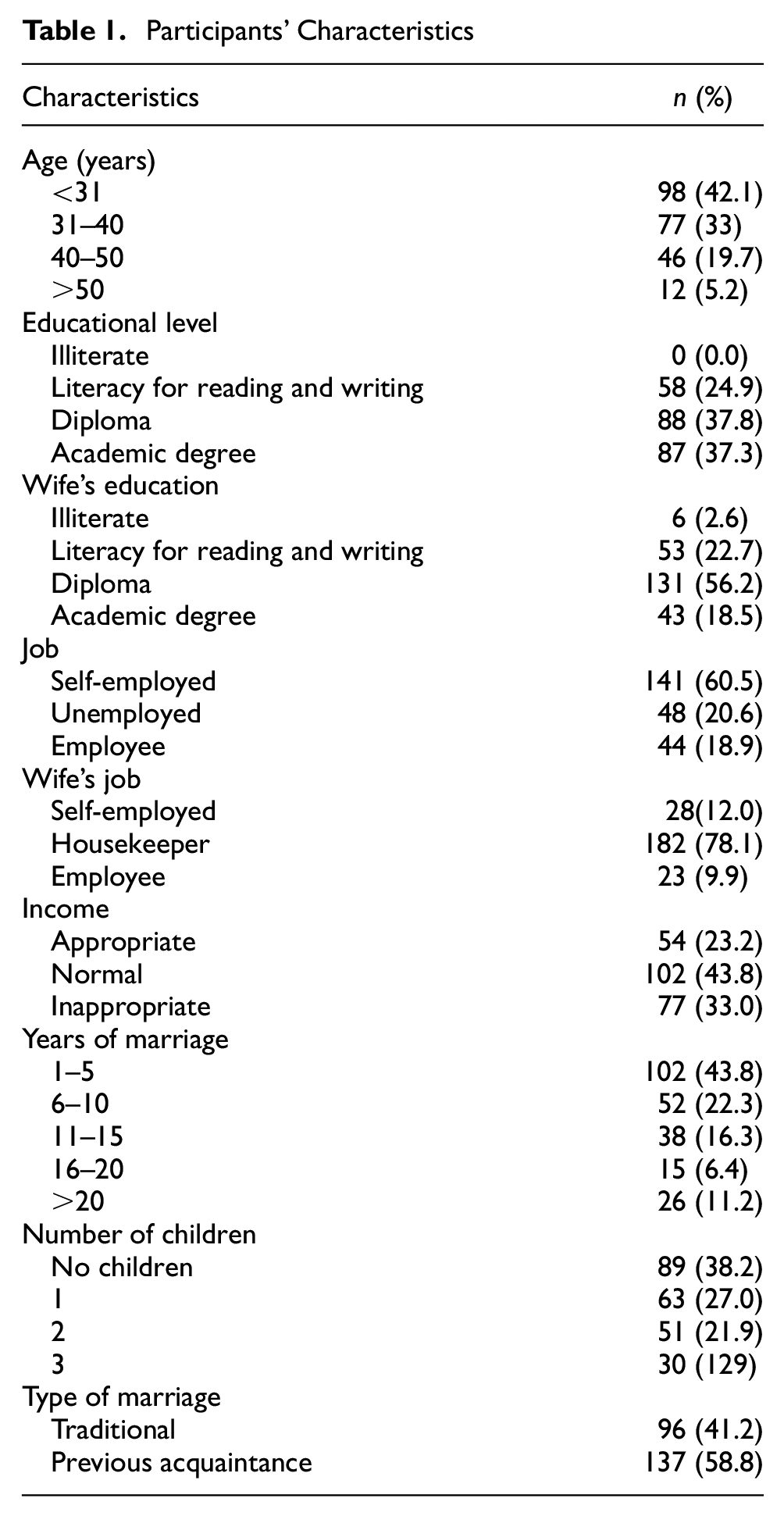
In total, 233 men participated in the present study. As shown in Table 1, most of the participants were 26 to 35 years old (42.1%), held a diploma educational degree (37.8%), had no children (38.2%), were not employees (60.5%), had average income (43.8%), and were married through previous acquaintances (58.8%).
Participants’ Characteristics
Nearly 28% (n = 3,293) of men reported having experienced physical violence from their intimate partner. The mean score of domestic violence was 321.08 ± 25.93 from the obtainable range of 95 to 475. Besides, based on the normalized average, the lowest and highest scores were related to the areas of personal violence (3.24 out of 5) and sexual violence (4.14 out of 5), respectively. In other words, the highest level of violence in the individual level and the lowest level of violence was in the area of sexual violence (Table 2). It should be noted that in this tool, a lower score indicated more violence. Based on the obtained data, the mean score of marital satisfaction was 130.0 ± 20.91 from the attainable range of 47 to 235. Besides, based on the normalized average, the lowest and highest scores were, respectively, related to the dimensions of idealistic distortion (2.56 out of 5) and conflict resolution (3.04 out of 5; Table 2). Additionally, the results showed that the majority of the participants in this research were fully satisfied (52; 4%).
The Mean Scores of Domestic Violence, Marital Satisfaction, and Their Dimensions

Note. SD = standard deviation.
The total score of marital satisfaction had significant correlations with the scores of domestic violence and its social violence (r = .413, p < .001); economic violence (r = .173, p = .009); verbal violence (r = .293, p > .001); psychological violence (r = .254, p > .001); and sexual violence (r = .184, p = .005) dimensions (Table 3).
Pearson’s Correlation Coefficients of the Correlations of Marital Satisfaction with Domestic Violence and Its Dimensions

The results of regression analysis showed that violence (p = .045) and age (p > .000) were significant predictors of marital satisfaction, and for one unit increase in the independent variables of violence and age, the dependent variable of marital satisfaction increases by 1.08 and 1.96 units, respectively (Table 4).
The Results of Regression Analysis for the Prediction of Marital Satisfaction

Note. SE = standard error.
Discussion
Study findings revealed that about 28% of the participants experienced physical violence during the Covid-19 pandemic. Domestic violence comprises all types of misbehavior in different ways and abuses of the body and mind of men and women in the family, which includes different areas of violence such as psychological, legal, physical, sexual, and social violence (Janabadi, 2016). Contrary to our findings, in Janabadi’s study (2016), which aimed to investigate the type and amount of domestic violence experienced by married men and women in Zabol city, Iran, a lower percentage of participating men experienced domestic violence (Janabadi, 2016). In addition, in the study conducted by Malik and Nadda (2019) in the rural area of Haryana, India, in the period of 2012 to 2013, a smaller percentage of the participants have faced domestic violence. In explaining this difference, it can be pointed out that the current study, unlike the aforementioned studies, was conducted during the restrictions caused during the Covid-19 pandemic.
In line with our results, the study of Gosangi et al. (2021) showed that the amount of domestic violence and sexual violence increased almost twice during the Covid-19 pandemic. Moreira and Da Costa (2020) in a review study reported that the amount of verbal, physical, and psychological violence increased significantly during the Covid-19 outbreak. The results of the current study and the mentioned studies indicate an increase in domestic violence during the Covid-19 pandemic. In explaining this finding, it can be noted that the Covid-19 pandemic, in addition to the wide health consequences it had in the world, has caused many problems in families. It has led to the closure of schools, universities, and many businesses, besides enforcing social distancing and strict restrictions; and the creation of corona restrictions has increased the reported cases of domestic violence. On the other hand, couples who had disagreements and problems with each other before the epidemic experienced very severe conflicts during the outbreak of Covid-19 due to the closure and interruption of counseling and treatment sessions. This issue caused the statistics related to verbal, physical, and sexual violence to increase.
Study findings showed that the average marital satisfaction score of the research samples was moderate. In the study of Ramezani et al. (2015), which was conducted with the aim of investigating the relationship between marital satisfaction and violence against women, the mean score of marital satisfaction was higher than the obtained values reported in the current research. To justify this difference, it can be pointed out that the study was conducted before the Covid-19 pandemic.
In addition, our results showed that there is a statistically significant relationship between the overall score of marital satisfaction and the overall score of violence and some of its dimensions, including the areas of social, economic, verbal, psychological, and sexual violence. The higher the domestic violence, the lower the marital satisfaction. In this regard, Alimoradi et al. (2023) investigated the mediating role of mental distress and domestic violence in the relationship between fear of Covid-19 and marital satisfaction and the quality of sexual life of Iranian women of reproductive age. The results showed that the fear of Covid-19 during the epidemic indirectly reduces marital satisfaction and the quality of women’s sexual life through increasing psychological distress and domestic violence (Alimoradi et al., 2023). The Aponte et al. (2020) study showed that between the variable of marital satisfaction and the risk domestic violence has a negative and significant correlation (Aponte et al., 2020), which is in line with the results of our study. Ghorbani et al. (2022) also reported that marital satisfaction has a significant effect on domestic violence against infertile women. The higher the level of marital satisfaction, the lower the domestic violence against infertile women (Ghorbani et al., 2022), which is in line with our results.
Conclusion
The results of the current study indicate the fact that the men participating in the present study faced a moderate level of domestic violence during the Covid-19 pandemic. In addition, the results of the study showed that there is a statistically significant relationship between domestic violence against men and marital satisfaction, so that with the increase of domestic violence against men, their marital satisfaction decreases. Therefore, considering the negative consequences of domestic violence on the mental and physical health of the victims as well as the family structure, the coordination and cooperation of various institutions to design and implement effective intervention and support strategies to prevent the occurrence of domestic violence and reduce its negative effects is recommended.
Footnotes
Acknowledgements
This article was derived from a master thesis of Zahra Kazemi Asl with project number IR. SUMS.VCR.REC.1400.046, Shiraz University of Medical Sciences, Shiraz, Iran. The authors would like to acknowledge the research deputy at Shiraz University of Medical Sciences for their support. The authors are thankful for all participants in this study.
Declaration of Conflicting Interests
The author(s) declared no potential conflicts of interest with respect to the research, authorship, and/or publication of this article.
Funding
The author(s) disclosed receipt of the following financial support for the research, authorship, and/or publication of this article: This study was financially supported by research deputy at Shiraz University of Medical Sciences (Ethics code: IR.SUMS.NUMIMG.REC.1400.046). This article was derived from a thesis research project.
Ethical Approval
Ethical approval (IR.SUMS.NUMIMG.REC.1400.046) was obtained from the Ethics Committee of Shiraz University of Medical Sciences, Shiraz, Iran. All participants signed written informed consent for participation.
