



Abstract
Military operations subject soldiers to intense stress, which can adversely affect both their emotional regulation and physical balance. This study examines the effectiveness of Reich’s vegetotherapy (VGT), an alternative non-pharmacological intervention, in improving these critical areas among military personnel. A total of 29 soldiers, with an average age of 30, were randomly assigned to either an experimental group (EG; 15 soldiers) or a control group (CG; 14 soldiers). Over a period of 6 weeks, the EG participated in twice-weekly VGT sessions, while the CG received no intervention. The intervention group showed a significant reduction in anxiety levels, with scores improving from the beginning to the end of the test (p = .001) and a significant time × group interaction (p = .003). The EG experienced a greater improvement (-68%) compared to the CG (−9%) (p = .036). In the open-eyes postural balance test, the EG showed a significant improvement (p = .029), with a time × group interaction effect (p = .04), although no significant difference was found between the groups (p > .05). The EG improved more (−36%) compared to the CG (24%). In addition, anger levels significantly improved post-intervention (p = .001), with a significant time × group interaction (p = .001). These findings suggest that Reich’s VGT may serve as an effective method for mitigating stress-related impairments in military personnel. Further research with larger sample sizes is necessary to validate these results and explore its broader applications.
Introduction
Military operations and combat exposure are well-known stressors that trigger both acute and chronic stress responses in soldiers, significantly impacting their health and performance (Bustamante-Sánchez et al., 2020). Research highlights that combat scenarios, including symmetrical, asymmetrical, and especially close-quarter combat, elevate sympathetic nervous system activity, with the most pronounced effects observed in close-quarter situations (Norman et al., 2018). Emotional regulation and static postural balance, critical to soldiers’ performance, are influenced by the complex relationship between emotional states and postural control (Adkin & Carpenter, 2018).
Difficulties in emotional regulation have been linked to adverse psychological outcomes in military personnel, including depression, dissociation, substance abuse, and interpersonal issues (Meehan et al., 2019). Soldiers with post-traumatic stress disorder (PTSD) often report elevated levels of depression, trauma-related dissociation, alcohol misuse, and social adjustment problems, many of which are exacerbated by emotional regulation difficulties. Emotional responses to threats, such as arousal, anxiety, and fear of falling, further disrupt postural control by impairing standing balance, anticipatory adjustments, and reactive responses (Meehan et al., 2019). Understanding the interplay between these emotional and physical responses is essential for improving the diagnosis and treatment of postural deficits.
Body psychotherapy, stemming from Wilhelm Reich’s psychoanalytic work, has become a recognized approach in Europe, where 88% of German psychosomatic clinics incorporate body-oriented therapies into their treatments (Young, 2008). Chief physicians have emphasized the critical role of these therapies, although their scientific evaluation remains limited (Geuter, 2004; Röhricht, 2009). The absence of robust evidence restricts the full understanding and application of body-oriented psychotherapeutic techniques in line with evidence-based medicine.
Despite the limited research, body psychotherapy shows promise in improving both emotional regulation and postural balance in soldiers. The use of body psychotherapy has been explored as an adjunct therapy for veterans with PTSD, where benefits such as enhanced body perception and awareness have been reported (Ahlmark et al., 2020). Additional studies have shown that external factors, like wearing body armor, can significantly affect postural stability during physical tasks, underscoring the importance of interventions targeting balance and postural control (Sell et al., 2016). Psychotherapeutic interventions have been found to normalize postural behavior in patients with somatoform vertigo and dizziness, suggesting the potential for similar improvements in soldiers (Best et al., 2015).
Vegetotherapy (VGT), a nature-based therapeutic approach developed by Wilhelm Reich, is a therapeutic approach that integrates physical and emotional dimensions to address psychosomatic issues. The approach is particularly noted for its focus on deep breathing, emotional expression, and relaxation of specific muscle groups associated with emotional blockages. By addressing the interplay between body and mind, VGT aims to restore emotional balance and improve physical functionality, making it a valuable non-pharmacological intervention in stress-related conditions. Research showed benefits in treating PTSD in military populations with VGT. For example, veterans who participated in a 10-week nature-based intervention reported enhanced life insight, improved control, and better coping mechanisms for handling daily challenges (Poulsen et al., 2016). The specific benefits of VGT in treating PTSD and its effects on emotional regulation and postural balance in soldiers remain underexplored and warrant further research.
The majority of the literature on Wilhelm Reich’s VGT is published in Norwegian, limiting its accessibility and global impact. This language barrier may prevent wider dissemination of his techniques and insights. Although the effects of VGT on soldiers’ emotional regulation and postural stability have not been extensively documented, further investigation could offer valuable insights into its potential therapeutic benefits.
Population and Methods
Study Design
Our study was a multicenter randomized controlled trial, where participants were assigned using a simple randomization method to either an experimental group (EG) or a control group (CG). The CG continued their regular daily routines and completed assessments both before and after the study. The EG, on the contrary, took part in a 6-week VGT program, consisting of two sessions per week.
Participants
Twenty-nine male students (average age: 22 ± 0.8 years) from the “Ecole Militaire du Sport” joined the study. To be included, participants must be from the military center, free from chronic diseases or mental health issues, older than 18 years, and have a minimum of 4 years of training experience. The participants were split into two groups: the EG of 15 soldiers (age: 22 ± 0.7 years; height: 1.77 ± 0.8 m; body mass: 73 ± 0.3 kg; body mass index (BMI): 23 ± 0.15; training history: 7 ± 1.2 years) and the CG of 14 soldiers (age: 22 ± 0.9 years; height: 1.76 ± 0.6 m; body mass: 77 ± 0.7 kg; BMI: 24 ± 0.19; training history: 7 ± 1.2 years). All participants gave their informed consent to take part in the study. The research was approved by a local Ethics Committee in line with the standards set in the Declaration of Helsinki.
Procedure
Anthropometric Measurements
We took body measurements including body weight (BW), fat mass (FM), and water mass (WM) using a TANITA BC 601 impedance meter. Height was measured with a stadiometer, with the participants standing barefoot, feet together, arms at their sides, and looking straight ahead.
Mood Assessment
Mood was evaluated using the French version of the Profile of Mood States (POMS-F), which measures six moods: Anxiety, Anger, Confusion, Depression, Fatigue, and Interpersonal Relationships. Participants rated their mood on a five-point Likert-type scale from 0 (not at all) to 4 (extremely). The POMS-F has good internal reliability, with the Cronbach alpha scores ranging from 0.73 to 0.88 for the subscales.
Postural Balance Tests
We used the WinPosture platform to assess static postural balance. Participants stood barefoot on the platform in a reference position, facing a target at eye level. Two tests were conducted: eyes open (YO) and eyes closed (YF) for 51 s each. The platform measured key postural parameters, such as the ellipse surface area (S), the center of pressure on both axes (x), Romberg quotient (QRBG), length-to-surface ratio (LAS), and the variance in center-of-pressure speed.
Training Program
The EG followed a twice-weekly, 30-min VGT program designed to stimulate the vagus nerve through breathing and movement exercises aimed at lowering stress and improving both mental and physical well-being.
Session Structure (30 min)
Constructive Rest Position (CRP): Participants lay on their backs in CRP.
Breathing Technique: Focus on belly breathing, inhaling through the mouth and exhaling through the nose, with the exhale lasting four times longer than the inhale.
Relaxation: Eyes closed or covered, focusing on reducing stress and tension.
The training also included exercises targeting different joints (scapular, cervical, hip, and knee), incorporating neuromodulation techniques (Brain Trinity). Each session aimed to improve relaxation, mobility, and self-awareness through targeted breathing and movement practices, including the use of a “war cry” to release tension (More details can be found in Table 1).
Standardized Basic-Level Vegetotherapy Exercises Were Applied as Shown

This protocol aimed to enhance both physical and mental performance by promoting relaxation and balance.
Statistical Analyses
The data were visually inspected for potential outliers, and normality was assessed using the Shapiro–Wilk test due to the small sample size. Since the data followed a normal distribution, parametric tests were applied. Repeated-measures analysis of variance (ANOVA) with Bonferroni’s post hoc test was conducted to examine the effects of group (control and intervention) and time (pre- and post-training). Descriptive statistics were calculated for all outcome measures. Effect size was calculated using Cohen’s d, with values of 0.20 < d < 0.30 indicating a small effect, 0.40 < d < 0.70 indicating a medium effect, and d≥ 0.80 representing a large effect. All statistical analyses were performed using the IBM SPSS Statistics 29 software, and the alpha level was set at p < .05.
Results
Change in Mood States
Table 2 presents the comparison within and between groups at baseline and post-intervention for all mood states.
Age and Anthropometric Data of the Participants
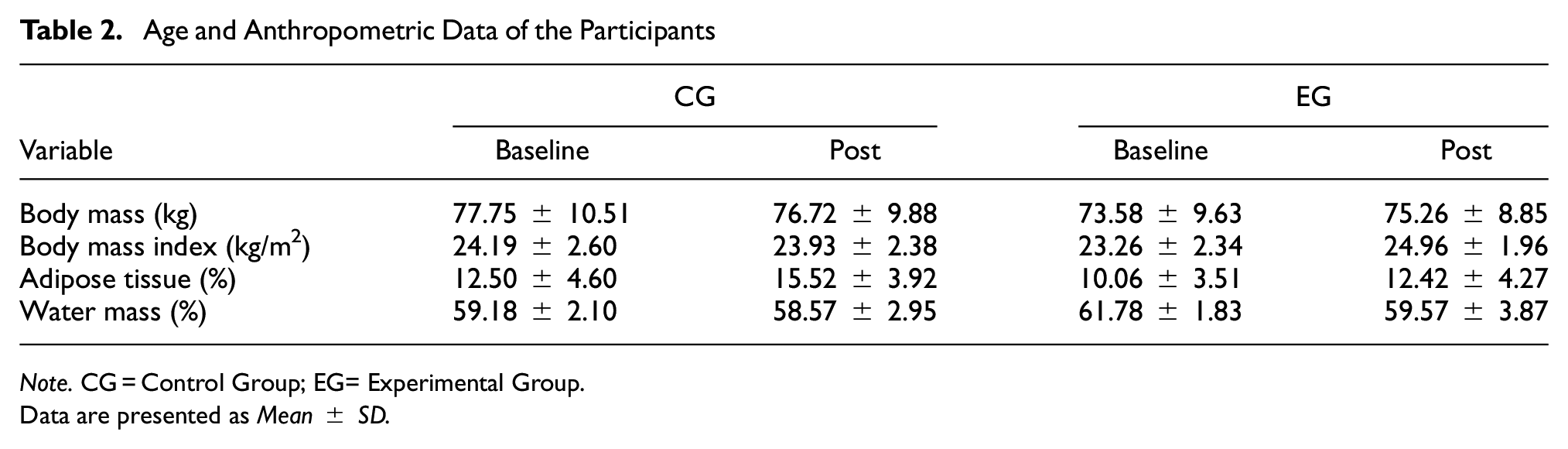
Note. CG = Control Group; EG= Experimental Group.
Data are presented as Mean±SD.
Participants' baseline measures are presented in Table 2. Initially, there was no difference between the groups. However, the EG improved their mood after 12 sessions of VGT. In contrast, after the workout, the EG performed significantly better.
A beneficial impact of VGT was observed in the intervention group, with significant results on the anxiety variable; scores improved from the beginning to the end of the test (p = .001), and the interaction (time × group) was significant (p = .003), as well as for the group effect (p = .036). The EG improved more than the CG, with effect sizes of EG = −68% and CG = −9% (More details can be found in Table 3 and Figure 1).
Mood states Parameters in a Control and Intervention Group Pre-and Post-Intervention


Anxiety Comparisons Within and Between Groups at Pre- and Post-Intervention
Scores for anger significantly improved after the protocol intervention (p = .001), as did the interaction effect (time × group) (p = .001). However, no significant difference was observed between the groups (p > .05). Improvements in the anger variable were particularly evident in the elderly, with better results in the EG: EG = −58% and CG = −5% (Figure 2).

Anger Comparisons Within and Between Groups at Pre- and Post-Intervention
After the intervention period, our results showed no significant main effect of time (p = .059). However, the interaction effect (group × time) was significant (p = .041), and there was a significant main effect of group (p = .028) for the confusion variable (Figure 3).
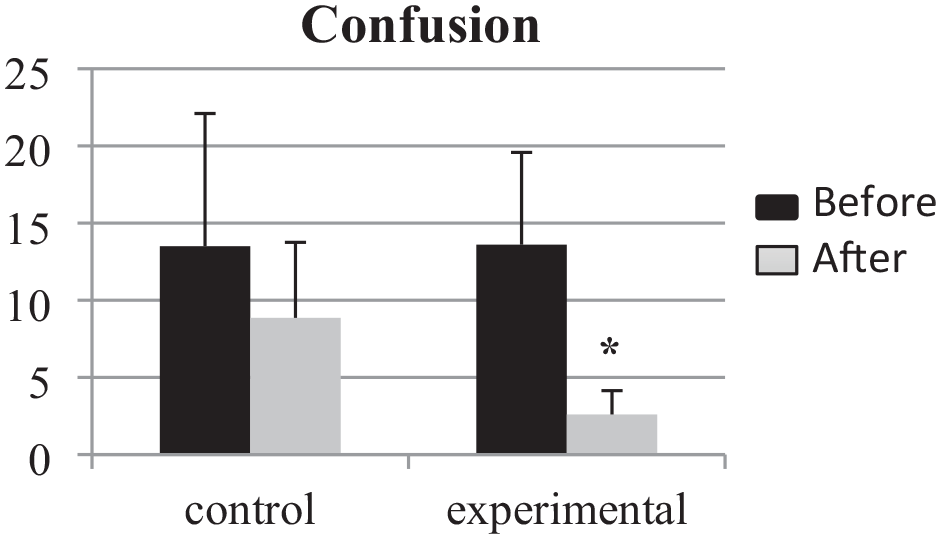
Confusion Comparisons Within and Between Groups at Pre- and Post-Intervention
In the depression variable, patients in the EG covered a longer distance compared to their baseline measure, showing a significant improvement in scores (p < .001). The interaction effect (group × time; p = .033) also reached statistical significance. However, no significant difference was observed between the groups (p > .05). The intervention group showed greater improvement than the CG, which performed worse on the test (EG = −70%; CG = −22%) (Figure 4).

Depression Comparisons Within and Between Groups at Pre- and Post-Intervention
For fatigue, there was an effect of group, time, and interaction (p < .01); the patients in the EG achieved better performance in fatigue measures than the CG (EG = −75%; CG = −21%) (Figure 5).

Fatigue Comparisons Within and Between Groups at Pre- and Post-Intervention
Static Stability
Initially, there was no difference between the groups. In addition, the EG improved in static stability tests after 12 sessions of VGT. However, after the workout, the EG performed significantly better.
A beneficial impact of VGT was observed in the intervention group, with significant results in the open-eyes test; the scores between the beginning and the end of the test improved (p = .29), and the interaction (time × group) was significant (p = .04). On the contrary, no significant difference was observed between the groups (p > .05). The EG showed a greater improvement than the CG (EG = −36% and CG = 24%) (Figure 6).

Eyes Open Comparisons Within and Between Groups at Pre- and-Post Intervention
After the intervention period, our results indicated significant differences in the EG before and after the intervention (p = .001), with lower values observed after the intervention, and the interaction (group × time; p = .008). However, no significant difference was observed between the groups (p > .05).
Improvements in the static stability score (eyes closed) were noted, with better results in the EG than in the CG (EG = 46%; CG = −48%) (More details can be found in Table 4 and Figure 7).
Static stability Parameters in a Control and Intervention Group Pre-and Post-Intervention

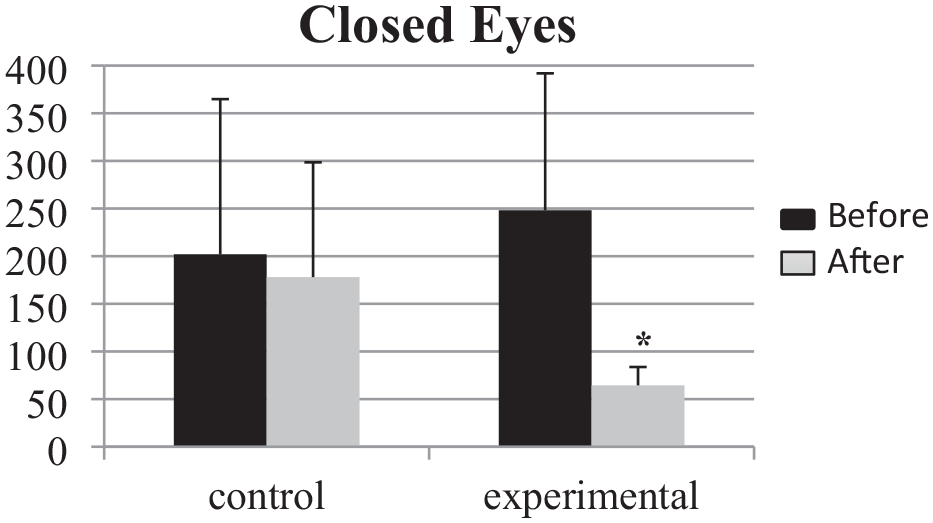
Eyes Closed Comparisons Within and Between Groups at Pre- and Post-Intervention
Discussion
Although the specific benefits of VGT therapy on military anxiety have not been explicitly discussed in the scientific literature, our study suggests that it may have potential benefits for anxious soldiers. In this study, the effects of VGT on mood and anxiety were investigated by comparing two groups: an EG that underwent VGT sessions and an EG. The primary aim was to determine if these interventions had different impacts on mood and anxiety. Initially, no significant differences were observed between the two groups, indicating that both groups started with similar levels of mood and anxiety. However, after 12 sessions of VGT, the EG demonstrated a noticeable improvement in mood, suggesting that VGT had a positive effect on emotional well-being.
Interestingly, the EG exhibited enhanced performance following physical workouts, reinforcing the well-established benefits of exercise on physical and psychological performance. Despite this, the most notable findings were related to anxiety in the EG. Anxiety levels significantly decreased after participating in VGT (p = .001), with a marked interaction effect between time and group (p = .003). This indicates that the impact of VGT on anxiety developed over time. In addition, a significant main effect for the group (p = .036) was found, confirming a difference in anxiety outcomes between the two groups. The EG showed a significantly greater reduction in anxiety compared to the CG, with a −68% improvement in anxiety scores for the EG, while the CG only showed a −9% improvement. These findings suggest that VGT contributes positively to psychological well-being, each with its unique effects.
Anxiety can have a negative impact on the health and performance of soldiers. Soldiers’ shooting accuracy, decision-making, and mathematical skills were found to decrease significantly under anxiety (Nibbeling et al., 2014). In addition, anxiety can lead to psychosocial and psychophysiological adversity, affecting soldiers’ performance and health (Nibbeling et al., 2014). However, the effects of anxiety on performance can be influenced by other factors. For example, exercise-induced fatigue may either improve or deteriorate performance depending on the nature of the task (Bustamante-Sánchez et al., 2020). The experience and specific training can modulate autonomic and cardiovascular chronic stress in military populations (Bustamante-Sánchez et al., 2020).
Body Psychotherapy and Anxiety
Body psychotherapy has been shown to have a positive impact on anxiety. It can help address the traumatic impact of oppression and support individuals in developing increased capacity for regulation, self-love, and empowerment in the face of ongoing oppression (Holohan, 2022). Affect-focused body psychotherapy (ABP) has been found to be a viable treatment alternative for patients with generalized anxiety disorder (GAD). Patients who received ABP showed significant improvement in symptoms compared to those who received psychiatric treatment as usual (TAU) (Levy et al., 2009). Movement therapy and relaxation techniques have also been found to reduce anxiety in psychiatric patients (Peterson et al., 1978). ABP has been shown to increase affect consciousness, which may contribute to improved outcomes for patients with GAD (Berg, 2009). In contrast to traditional anxiolytic drugs, body psychotherapy offers a potentially effective treatment for anxiety with minimal unwanted side effects (Feighner, 1987).
The results of VGT on anxiety in soldiers have not been specifically addressed in the abstracts provided. However, the abstracts do mention the effectiveness of other body–mind therapies for anxiety. Mind–body therapies such as hypnotherapy, relaxation therapy, meditation, and mindfulness-based stress reduction have shown positive results in reducing anxiety (Ligabue &Tenconi, 2021). These therapies have been supported by strong evidence and have been found to be effective for anxiety and related symptoms. It is important to note that the evidence supporting the efficacy of mind–body therapies for anxiety disorders has been mixed, and further research is needed to establish their effectiveness (Bandealy et al., 2021).
This research explored the effects of a specific intervention on anger levels in soldiers, aiming to assess changes over time, differences between groups, and the overall impact of the intervention on anger scores. The findings revealed a significant improvement in soldiers’ anger scores following the intervention (p = .001), demonstrating that the intervention effectively reduced anger. In addition, there was a significant interaction effect between time and group (time × group, p = .001), suggesting that the intervention’s impact on anger levels evolved over time, highlighting a dynamic relationship between the intervention and its effects. Despite these improvements, no significant difference was found between the two groups when directly compared (p > .05), indicating that both groups experienced similar changes in anger levels overall. Anger can have a significant impact on the health and performance of soldiers. Soldiers who perceive anger as helpful in performing their duties may experience worse mental health symptoms (Adler et al., 2017). Anger management education based on the Health Promotion Model has been shown to be effective in reducing risky behaviors, such as fighting, among soldiers (Asadzandi et al., 2015).
Anger and Static Postural Balance
Anger affects static postural balance in soldiers through changes in emotions and arousal levels, which in turn influence postural control (Adler et al., 2017). Height-induced threat, which increases the perceived consequences of instability, has been used as a model to study the effects of emotions on postural control (Adler et al., 2017). Threat-related changes in arousal, anxiety, and fear of falling have been found to directly influence all aspects of postural control, including standing, anticipatory, and reactive balance (Adler et al., 2017). These threat-related postural changes promote a greater physical safety margin while maintaining an upright stance (Adler et al., 2017). The underlying neurophysiological and cognitive mechanisms that contribute to the relationship between emotions and postural control are still being investigated (Adler et al., 2017) Furthermore, it is important to note that understanding the effects of anger on static postural balance in soldiers has significant implications for diagnosing and treating postural control deficits in this population.
Conclusion
In conclusion, addressing the historical concerns surrounding Reich’s VGT requires a nuanced approach. Acknowledging ethical considerations, questioning scientific validity, and promoting rigorous research within modern ethical frameworks can foster a more balanced and scientific discussion about the potential use of VGT in contemporary psychotherapeutic research. Future research on VGT for the treatment of PTSD in soldiers should explore the effectiveness of intensive outpatient formats for delivering evidence-based psychotherapy. Studies have shown that intensive outpatient formats can improve retention rates and yield outcomes comparable to traditional outpatient settings. In addition, research should investigate the use of nature-based therapy for veterans with PTSD, as this approach has shown promise in improving insight, symptom control, and social participation. Furthermore, high-quality studies are needed to assess the efficacy of various interventions, such as exposure therapy and cognitive processing therapy, in addressing PTSD in soldiers and veterans. The impact of group therapy combined with trauma-focused therapy on treatment outcomes for this population should also be explored. Overall, future research should focus on enhancing the effectiveness and engagement of PTSD treatments for soldiers through innovative approaches and comprehensive evaluations of treatment modalities.
Footnotes
Declaration of Conflicting Interests
The author(s) declared no potential conflicts of interest with respect to the research, authorship, and/or publication of this article.
Funding
The author(s) received no financial support for the research, authorship, and/or publication of this article.
