



Abstract
Screening for depression in males is important because their symptoms differ from those of females, ranging from indications of aggression to attempts at suicide. Men and women differ in their responses to job stress. There are no tools that have been verified, developed, or translated for screening male depression in Korea. Our team translated the Gotland Male Depression Scale (GMDS) into Korean. The Korean version of GMDS (K-GMDS) and Maslach Burnout Inventory-General Survey (MBI-GS) were administered to 277 office workers in one public institution. Gender differences in each scale score were measured along with the correlation between the K-GMDS and the MBI-GS. There was no significant difference in the K-GMDS score between males and females, whereas females scored significantly higher on the MBI-GS (p < .001). The correlation between the K-GMDS total score and the MBI total score (male: r = .702, p < .001, female: r = .375, p < .001) and MBI subscale scores were higher in males than females. Gender moderated the relationship between total K-GMDS and total MBI scores (p < .001). The Korean version of the GMDS is suitable for screening male depression symptoms in the workplace. The results of the K-GMDS demonstrated a strong correlation between depressive symptoms and work-related burnout among men. This study can be used as a basis for studying male depression symptoms in Korea, which has not been studied extensively. This will prove beneficial for work environments.
Keywords
Introduction
The prevalence of depression is increasing worldwide, with it being 1.5 times higher among females than males (World Health Organization [WHO], 2017). Lower rates of depression in males reflect lower detection in males rather than actual gendered differences. Depressive symptoms may stay unrecognized in men due to a lack of communication. Men abstain from seeking help owing to societal ideals of masculinity such as self-sufficiency, strength, and invulnerability (Call & Shafer, 2018). Furthermore, although there is evidence that symptoms of depression in males are different from those in females, this is not considered in traditional diagnostic criteria. Rutz et al. have argued that gender-specific factors do not affect depressive illness if an aggressive component in male depression is taken into consideration (Rutz et al., 1995). Previous studies have highlighted gendered differences in the symptoms of depression. Increased appetite or weight, increased interpersonal sensitivity, mood reactivity, and somatic symptoms are common in women, whereas low stress tolerance, impulsivity, risky behavior, anger, irritability, alcoholism, suicide attempts, overfocus on work or school, a sense of emptiness, and burnout are more common in men (Haug et al., 2004; Magovcevic & Addis, 2008; Marcus et al., 2005; Martin et al., 2013; Stewart, 2020). Male depression, which is characterized by externalizing symptoms, has been explained by gender role and gender role socialization. At the time of industrialization, men worked in the public sphere and were encouraged to be dominant, independent, assertive, and competitive. In this regard, men were also expected to hide weakness. Thus, externalizing symptoms are not only affected by masculine norms but also used to cover the internalizing symptoms, which can be considered weak (Smith et al., 2018).
Suicide is strongly associated with mental disorders, particularly major depressive disorders (De Leo & San Too, 2014). Interestingly, although higher rates of depression are detected among females, the suicide rate is more than 1.5 times as high among males (WHO, 2017). This contradictory tendency between the prevalence of depression and the suicide rate is similar in Korea. The prevalence of depression was twice as high among women (6.9%) as compared with men (3.0%), although the suicide rate has been consistently twice as high in men over the past 5 years until 2020; (Cho & Joo, 2020; Hong, 2016; Korea Foundation for Suicide Prevention, 2020). A systematic review conducted by Sørensen et al. reported that overconsumption of harmful substances, a trend observed in cases of depression in men, may indeed increase the risk of suicide or suicide attempts (Sørensen et al., 2020). Lack of understanding of characteristic male depression symptoms may cause poor detection of depression in males and missed or delayed treatment, which may result in more serious consequences, such as suicide.
The Diagnostic and Statistical Manual of Mental Disorders (5th ed.; text rev.; DSM-5-TR), in the major depressive disorder section, has now added a section on sex and gender considerations and men’s engagement in externalizing coping and problem-solving. (American Psychiatric Association, 2022). This is indeed evidence that gender differences in depressive symptoms are being accepted. But currently employed depression scales, such as Beck’s Depression Inventory, Center for Epidemiologic Studies Depression Scale (CES-D), and Zung Self-Rated Depression Scale do not include many depressive symptoms characteristic in men (Beck et al., 1996; Radloff, 1977; Zung, 1986). These scales encompass typical depressive symptoms, such as low mood, anhedonia, fatigue, and feelings of guilt, but not the externalizing depressive symptoms mentioned earlier. A scale that can encompass these characteristics would be better suited to screen male depression, provide a better understanding of the symptoms that require treatment, and promote follow-up. Rutz et al. constructed the Gotland Male Depression Scale (GMDS), which includes irritability, anger, alcohol use, and burnout as diagnostic criteria. These are characteristic depressive symptoms in men (Wålinder & Rutz, 2001). This scale has been translated into various languages, including English, Icelandic, Italian, Chinese, and German, and has been used as a screening tool in research and primary care (Chu et al., 2014; Innamorati et al., 2011; Möller-Leimkuhler & Yucel, 2010; Sigurdsson et al., 2015; Watkins et al., 2020). Previous studies have shown that the scale is reliable and valid in various settings, such as alcohol use clinics, male health clinics, and communities (Chu et al., 2014; Sigurdsson et al., 2015; Zierau et al., 2002). Using the GMDS, Winkler et al. reported that men score higher than women in terms of irritability, and a large inpatient study by Möller-Leimkuhler et al. reported that irritability, aggression, and antisocial behavior were more strongly correlated with depression in men than in women (Möller-Leimkühler et al., 2004; Winkler et al., 2005). However, tools that screen for male depression have not been developed, verified, or translated in Korea.
Burnout is a term that refers to the condition of being extremely tired and lethargic that a person experiences post being engrossed in work. It is akin to the phenomenon of fuel being burned out. Previous studies have repeatedly shown a high correlation between burnout and depression (Bianchi et al., 2015). Depression and burnout appear as overlapping symptoms, but they are distinct as “burnout is specific to the work context, in contrast to depression, which tends to pervade every domain of a person’s life” (Maslach et al., 2001). Burnout and depression display interdependence. For example, burnout may appear as a stressor of depression; at the same time, burnout may appear as a symptom due to lethargy and decreased function caused by depression (Bianchi et al., 2015). Burnout also has been suggested as one of the characteristic symptoms of depression in males (Stewart, 2020; Wålinder & Rutz, 2001). In Western societies, professional success and social status are key elements of traditional male gender roles (David & Brannon, 1976). Studies on occupational mental health have reported that high work-role orientation is an intrinsic risk factor that increases the negative impact of occupational stress on mental health (Siegrist & Li, 2016). Previous research reported that among depressive male patients, the high work-role oriented group is less able to cope with emotional tension and failure and is easily negatively influenced by work (Kilian et al., 2020). In particular, Korean society lays heavy emphasis on social roles, and thus, men are greatly influenced by gender roles as they grow up, educate themselves, and live in the patriarchal and collective Korean culture. The domestic role of women and the socioeconomic role of men are still considered important. This results in gendered differences in depressive symptoms and work-related mental health, such as burnout. A qualitative study on the experiences of Korean male depression highlighted a decrease in work function due to lethargy as a key experience rather than aggression or alcohol use (Cho & Joo, 2020). However, the correlation between job burnout and gender has been inconsistent in studies, and to the best of our knowledge, no studies have revealed a correlation between burnout and depressive symptoms according to gender using a male depression-related scale (Bianchi et al., 2015).
In this study, the GMDS was translated into Korean, and a questionnaire including the K-GMDS and Maslach Burnout Inventory-General Survey (MBI-GS) was administered to 277 workers from one public institution. This study aimed to investigate the correlation between depressive symptoms, which are particularly regarded to be specific for men (male depression symptoms) as assessed by K-GMDS and burnout as assessed by MBI-GS according to gender at workplaces.
Method
This task was carried out as part of stress management and healing program to relieve the stress of office workers belonging to the Korea Fire Institute who were fatigued due to civil complaints owing to the COVID-19 pandemic. We collected the results of the scales and demographic information of the participants, including age, sex, job status, and working duration.
Participants
This study was conducted on 277 people working at one public institution who voluntarily participated in the program in 2020. All full-time and part-time workers were invited to participate. Data were collected online, except for that of 19 workers, whose data were collected face-to-face because they found it difficult to use online surveys. Before participating in the program, all participants provided written consent for the use of their results in the study. No other incentives were provided. The study complied with the Declaration of Helsinki and was approved by the Institutional Review Board of Daegu Catholic University Medical Center. (Approval number: CR-20-231).
Materials
Korean Version of the Gotland Male Depression Scale (K-GMDS)
The GMDS is a 13-item self-report screening instrument designed to evaluate the symptoms of depression in men. Each item is rated on a 4-point Likert-type scale (0–3 points), with a total score ranging from 0 to 39. Rutz et al. defined a score of 13 to 26 points as probable depression and 27 to 39 points as definite depression (Zierau et al., 2002). In this study, we defined the subjects who scored higher than the cut-off score suggested by Rutz et al. as the male depression group. To compare the frequency at which participants experienced a symptom according to gender, answering with a score of 1 or more for that item was counted as one in the frequency count (Möller-Leimkuhler & Yucel, 2010).
Regarding translation, our team received permission from Rutz to translate the English version of the GMDS into Korean (Zierau et al., 2002). The scale was translated into Korean by three psychiatrists, then counter-translated by a psychiatrist who spoke English as their native language and who did not participate in the translation, and a test–retest was conducted (see the appendix). In terms of reliability of the GMDS, Cronbach’s α was .86 in the study conducted by Zierau et al., while it was .91 in the present study (Zierau et al., 2002).
Maslach Burnout Inventory–General Survey (MBI-GS)
The Maslach Burnout Inventory-General Survey (MBI-GS) is a 15-item self-administered questionnaire developed in 1997. It consists of 3 subscales, including 5 items under exhaustion, 4 items under cynicism, and 6 items under professional efficacy. In the MBI-GS, burnout is described as having three subdomains: (a) Exhaustion, which is a state of overload due to the depletion of emotional resources; (b) Cynicism, which refers to a negative and insensitive response to others; and (c) Reduced professional efficacy, which refers to a state of being unproductive and ineffective. The score ranges from 0 to 90, with higher scores indicating a higher tendency for burnout (Maslach et al., 1997). A valid and reliable Korean version of the MBI-GS was developed in 2003 (Shin, 2003). In the present study, Cronbach’s α for the total scale was 0. 927, and Cronbach’s α for each subscale was 0.911 (exhaustion), 0.851 (cynicism), and 0.897 (professional efficacy).
Statistical Analysis
All statistical data were analyzed using SPSS version 25 for Windows, and the significance level (p value) for determining statistical significance was set at .05. An independent t test was performed to compare the participants’ demographic characteristics and mean GMDS scores by gender. Chi-square test and Fischer’s exact test were performed to compare the proportion of nonregular workers, the proportion of depressed workers, and the frequencies of GMDS symptoms by gender. A principal component factor analysis with a varimax rotation was conducted.
We used Pearson’s correlation analysis to investigate and explain interscale correlations according to gender. The moderating effect of gender on the relationship between GMDS and MBI-GS was also analyzed. For this reason, males were treated as the reference variable (assigned a score of 0), while females were treated as a dummy variable (assigned a score of 1), and hierarchical regression analyses were performed (Baron & Kenny, 1986).
Results
Sample Characteristics
The demographic characteristics of the sample are summarized in Table 1. There were significantly more men in the sample (n = 222, 80.14%) as compared with women (n = 55, 19.16%). The mean age of the respondents was 39.45 years, and there was no significant difference between men and women. The average working duration was 119.52 months among males and 72.96 months among females, indicating that the males had significantly longer working duration (p < .001; Table 1). The ratio of non-regular workers was 4.1% for males and 23.6% for females, with a significantly higher proportion of non-regular workers among females (p < .05).
Comparison of Demographic Characteristics of Males and Females.

Note. MBI-GS = Maslach Burnout Inventory-General Survey; K-GMDS = Korean version of the Gotland male depression scale.
p < .05. **p < .01. ***p < .001.
We compared the mean total MBI-GS score and each subscale score according to gender. The MBI-GS total score (t = -3.294, p = .001) and subscale scores for exhaustion (t = -2.977, p = .008), cynicism (t = -2.990, p = .003), and decreased occupational efficacy (t = -2.716, p = .007) were significantly higher in females than in males. The comparison of the mean total K-GMDS score according to gender indicated no significant difference (p = .240). In addition, there was no significant difference in the total K-GMDS score between the males and the females when controlling for the effects of age, number of months worked, and nonregular employment using covariance analysis (F = 2.037, p = .155).
Factor Structure
Principal component analysis of the symptoms was conducted for the whole sample and separately for the male and female groups. For the whole sample, two factors resulted in an eigenvalue N>1 explaining 61.18% of the variance in response to individual symptoms. The dominant first factor included 7 items and explained already 51.05% of the variance. The factor structure of the factor analysis for male and female groups was almost similar except for Item 6 “Difficulty making decisions” shown in Table 2.
Factor Structure of the Korean Version of the Gotland Male Depression Scale (K-GMDS).

Prevalence of Male Depression as Measured by the Korean Version of Gotland Male Depression Scale
Following the scale suggested by Rutz et al., probable depression was identified in 33 males (18.21%) and 11 females (20.00%), while definite depression was identified in one male (Table 3). There was no significant difference in the prevalence of depression between the genders (p = .503).
Prevalence of Depression as Measured by the Korean Version of the Gotland Male Depression Scale (K-GMDS).

Symptoms Corresponding to the Korean Version of the Gotland Male Depression Scale
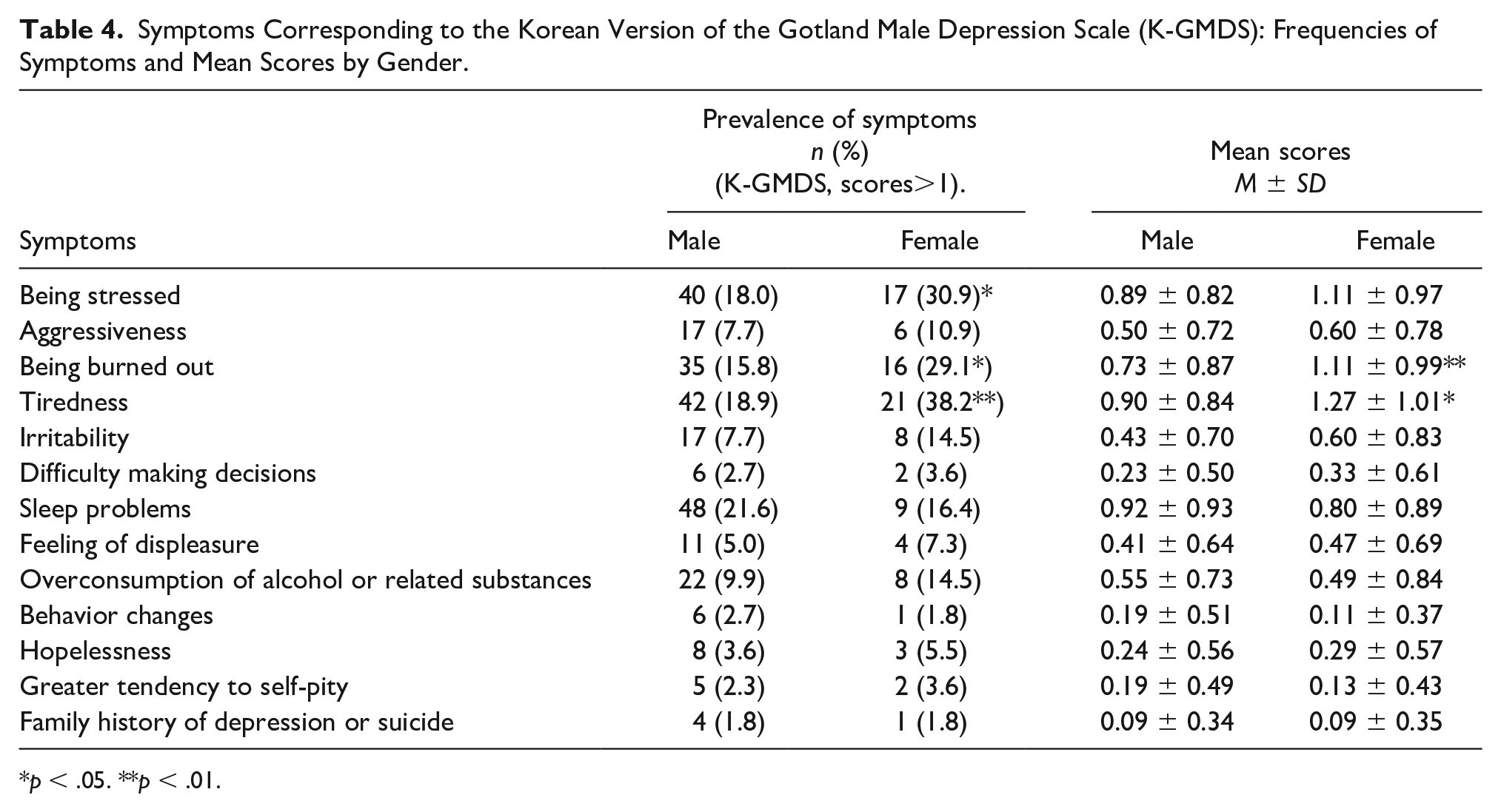
The frequencies and mean scores of most items, which were devised to describe the male depression symptoms, did not differ between males and females (Table 4). “Being stressed,” “being burned out,” “tiredness,” and “sleep problems” were the most common characteristics reported while “family history of depression or suicide,” “behavior changes,” “difficulty making decisions,” and “greater tendency to self-pity” were rarely reported, independent of gender. None of the symptoms was reported significantly more often in males, whereas “being stressed” (male = 18.0 % vs. female = 30.9%, χ2 = 4.48, p = .041), “being burned out” (male = 15.8% vs. female 29.1%, χ2 = 5.21, p=.032), and “tiredness” (male = 18.9% vs. female = 38.2%, χ2 = 9.31, p = .002) were more prevalent among females. At the same time, about severity, “being burned out” (male = 0.73 vs. female = 1.11, p = .006), and “tiredness” (male = 0.90 vs. female = 1.27, p = .014) were reported as higher scores among females which means more severe. None of the symptoms were more severe among males.
Symptoms Corresponding to the Korean Version of the Gotland Male Depression Scale (K-GMDS): Frequencies of Symptoms and Mean Scores by Gender.
p < .05. **p < .01.
Correlation Between the Korean Version of Gotland Male Depression Scale Total Score and Maslach Burnout Scale Total Score
There was a positive correlation between the total K-GMDS score and the total MBI-GS score (r = .649, p < .001). The correlation between the two variables was strongly positive for men (r = .702, p < .001) and weakly positive for women (r = .375, p < .001) according to the Rule of Thumb for Interpreting the Size of a Correlation (Figure 1) (Hinkle et al., 2003; Mukaka, 2012).

Correlation Between the Korean Version of the Gotland Male Depression Scale (K-GMDS) Total Score and the Maslach Burnout Inventory–General Survey (MBI-GS) Total Score in Males and Females
Correlation Between the Korean Version of the Gotland Male Depression Scale Total Score and the Maslach Burnout Inventory–General Survey Scale Subscale Scores
The total K-GMDS score displayed significant positive correlation with all subscale scores of the MBI-GS subscale. The results are detailed as follows: exhaustion (r = .664, p < .001), cynicism (r = 0.508, p < .001), and reduced professional efficacy (r = 0.450, p < .001; Table 5).
Pearson Correlation Coefficient Between the Korean Version of the Gotland Male Depression Scale (K-GMDS) Total Score and the Maslach Burnout Inventory–General Survey (MBI-GS) Subscale Score.

p < .05.
When the correlations were analyzed again by gender, the total K-GMDS score had a significant positive correlation with all three MBI-GS subscale scores among males, specifically: exhaustion (r = .702, p < .001), cynicism (r = .568, p < .001), and reduced professional efficacy (r = .507, p < .001). Among females, there was a weaker correlation between the total K-GMDS score and exhaustion (r = .467, p < .001), and it had no statistically significant correlation with cynicism (r = .218, p = .109) and reduced professional efficacy (r = .154, p =.261).
Gender as a Moderator of the Relationship between the Korean Version of the Gotland Male Depression Scale Total Score and the Maslach Burnout Scale Total Score
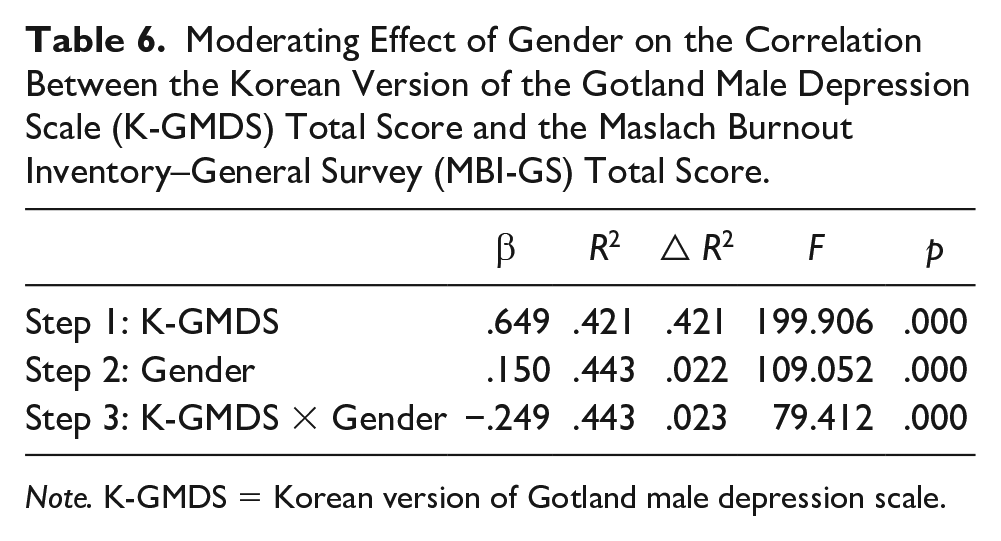
To test the moderating effect of gender on the correlation between male depression symptoms and burnout, a series of hierarchical regression analyses were performed. In this procedure, the K-GMDS was entered in Step 1, followed by gender (male = 0, female = 1) in Step 2, and then the interaction term (K-GMDS × gender) in Step 3. The results of the analysis of the moderating effect of gender on the correlation between the K-GMDS and MBI-GS are presented in Table 6. In the first step, the K-GMDS total score predicted MBI-GS (β = .649, p<.001). When gender was coded as a dummy variable (male = 0, female = 1), the estimated coefficient indicated that gender was a predictor of male depression symptom (β = .150; p < .001). As predicted, in Step 3, the interaction term of standardized male depression symptom, and dummy-coded gender displayed a negative correlation with a burnout at a significance level of 0.00. The data, therefore, support the hypothesis that gender moderates the relationship between K-GMDS and MBI-GS (Figure 2).
Moderating Effect of Gender on the Correlation Between the Korean Version of the Gotland Male Depression Scale (K-GMDS) Total Score and the Maslach Burnout Inventory–General Survey (MBI-GS) Total Score.
Note. K-GMDS = Korean version of Gotland male depression scale.

Moderation Effect of Gender on the Relationship Between the Korean Version of the Gotland Male Depression Scale (K-GMDS) Total Score and the Maslach Burnout Inventory–General Survey (MBI-GS) Total Score
Discussion
We assessed male depression symptoms and work-related burnout of workers belonging to one public office using the K-GMDS and MBI-GS. To the best of our knowledge, this is the first study to translate and use the GMDS in Korea. Previous studies have employed the GMDS, but there has never been a study on the difference in the correlation between depressive symptoms and burnout symptoms according to gender, wherein both the male depression symptom scale and the job burnout scale were used. Although burnout has been mentioned as a male depression symptom, this study is, to the best of our knowledge, the first to specifically examine this relationship. In this study, there was no statistically significant difference in the mean of the total K-GMDS score and the prevalence of depression according to gender. We conducted a factor analysis to understand the factor structure of the K-GMDS, and the factor structure was almost similar in men and women except for Item 6 “Difficulty making decisions.” Females had a significantly higher MBI-GS score. There were significantly stronger correlations between the total K-GMDS score and the total and subscale MBI-GS scores among males as compared with females. Additional analysis revealed that gender has a moderating effect on the correlation between the K-GMDS and the MBI-GS scores.
The results of previous studies that used GMDS on both sexes are consistent with the results of the current study, which reported no significant gender differences in depression prevalence (Möller-Leimkühler et al., 2004; Möller-Leimkuhler & Yucel, 2010; Pompili et al., 2014; Yao & Chen, 2009). Most studies of male depression used GMDS or other male depression scales only on men, and several studies using male depression scales for both males and females expected that males should have a higher number of corresponding symptoms on these scales than females. The similar prevalence of depression among both genders may contradict this expectation. However, considering that in the general population, depression is twice as prevalent in women, GMDS can be advantageous in screening for depressive symptoms in men as was suggested by previous study findings (Stromberg et al., 2010). As per the Mental Health Survey of 2016, the prevalence of major depressive disorders was twice as high among women (6.9%) than men (3.0%) in Korea (Hong, 2016). In addition, another national survey in 2016, using the Korean version of the CES-D, reported that women had higher levels of depression than men (Jeon, 2014). The results of this study do not report intersexual significant differences in depressive prevalence. This suggests that GMDS is superior in screening for depression in men.
The mean total score of GMDS was not significantly different between males and females in the current study. Previous studies have had heterogeneous results. Some studies reported no gendered differences, which is consistent with our results (Innamorati et al., 2011; Möller-Leimkühler et al., 2004; Pompili et al., 2014; Rice et al., 2017). However, other studies reported higher GMDS scores among females than males despite no difference in the prevalence of depression (Grace et al., 2014; Möller-Leimkuhler & Yucel, 2010; Yao & Chen, 2009). None of the studies reported a higher GMDS score among men. With regard to symptom patterns, the frequency and mean scores of most GMDS items did not differ between males and females in the current study. Men did not report any of the symptoms significantly more frequently than females. In contrast, “being stressed,” “being burned out,” and “tiredness” were more prevalent among females, who also reported more severe levels of these symptoms. Irritability, aggressiveness, and alcohol abuse, which were expected to be more prevalent in males, were equivalent between the two groups in our study. This was similar to previous studies wherein most symptoms were equivalent between the males and the females in terms of prevalence and severity, and where externalizing symptoms were not more prevalent or severe in males (Marcus et al., 2005; Möller-Leimkuhler & Yucel, 2010; Möller-Leimkühler et al., 2004; Rice et al., 2017). A large inpatient study displayed a stronger correlation between irritability, aggression, and antisocial behavior with depression in men than in women (Möller-Leimkühler et al., 2004).
It is possible that male depression symptoms, which conclude externalizing symptoms such as aggressiveness, irritability, and abusive and risky behavior as core symptoms, can be regarded as a masculine variant of depression and does not specifically differentiate male depressive patients from female patients. (Innamorati et al., 2011). In studies investigating masculine traits and depressive symptoms together, women with more masculine traits experienced more externalizing symptoms and reported lower levels of typical depressive symptoms (Price et al., 2018). Similarly, a study conducted among German university students reported that the average GMDS total score was significantly higher in females than in males with no significant difference in the items related to anger and problematic drinking, which was explained by the change in gender roles (Möller-Leimkuhler & Yucel, 2010). They measured gender-role orientation and reported that the risk of male depression is significantly associated with differing levels of aspects of masculine and feminine traits.
No significant gender difference in externalizing symptoms in recent studies may reflect the changes in gender roles and gender-related self-concept of women in modern society. Characteristics of subjects in specific studies can also affect the results. Gender roles have been reported to be related to occupational state and studies conducted within similar socioeconomic states, such as in the same workspace or the same university reduce the difference in gender roles between men and women (Alewell, 2013; Lipińska-Grobelny & Wasiak, 2010). The current study was performed in a male-dominated public institution and female workers may have more masculine traits than the general population. As another study suggests, the potential for aggression is equal for both sexes but the expression of aggression differs due to socialization and gender norms (Straus, 1997). Young females may respond to feelings of helplessness not only with the normative prototypic symptom of depression but also with more aggressive behavior since aggression (even physical aggression) is becoming more socially tolerable among females (Möller-Leimkuhler & Yucel, 2010). Irrespective of gender, depressive symptoms in individuals with masculine traits are not easily recognizable. This results in delayed treatment (Price et al., 2018). Therefore, measures should be taken to establish a comprehensive depression evaluation and effective tools for detecting depressive people with masculine traits.
The MBI-GS total scores significantly correlated with those of the K-GMDS in this study. Total MBI-GS score and subscale scores were significantly higher in women than in men. Consistent with the results of our study, previous studies (including meta-analysis) have reported a significant correlation between burnout and depressive symptoms, although these studies differ in their interpretations of causality between these two variables (Bianchi et al., 2015; Koutsimani et al., 2019). Higher burnout symptoms in females are consistent with the findings of previous studies (Maslach et al., 2001; Purvanova & Muros, 2010), although some recent studies do not agree with these results (Bianchi et al., 2015; Y. S. Kim et al., 2013). Owing to the following factors, working women may experience job burnout: A range of micro-inequities, such as slower promotion, lower salaries and a higher risk of sexual harassment, lack of role models and role strain, and overload owing to domestic and workplace duties (Robinson, 2003). In the present study, the office was a male-dominated space, and female participants might have felt as “token hires,” “who were included in a group to make people believe that a group is trying to be fair and include all types of people when this is not really true” (Macmillan dictionary, 2021). They might have experienced inferiority owing to the constant ordeal of having to prove themselves and being expected to fail (Purvanova & Muros, 2010). Recently, owing to the COVID-19 pandemic, schools in Korea had to opt for the online mode of education which increased the domestic workload on women (J. Kim & Choi, 2021).
Despite the higher burnout symptoms in females, there was a stronger correlation of the MBI-GS total score with K-GMDS among men, and gender had significantly moderated the effect of the K-GMDS total score on the MBI-GS total score. A possible explanation for our result regarding the moderating effect of gender on the correlation of GMDS and MBI is that women can easily express burnout symptoms regardless of their severity of depression, whereas men can express burnout only when they are depressed. The gender role theory explains that women are more likely to express feelings because they learn to display their emotions related to exhaustion while men are more likely to shut off and withdraw under stress because they learn to conceal their emotions, which is related to cynicism (Purvanova & Muros, 2010). However, such an interpretation may lead to the misunderstanding that “women overreact.” Gender differences in terms of responses to job-related burnout and stress may differ qualitatively rather than quantitatively. The meta-analysis suggested that women experience emotional exhaustion slightly more than men, while men are more depersonalized than women (Purvanova & Muros, 2010). And the GMDS would reflect male burnout-related psychological responses more specifically.
In addition, a previous study about burnout and depressive symptoms and their relationship with electroencephalogram analyses among college students reported that depression was strongly related to an individual alpha frequency, whereas burnout was related to the power of alpha waves. Regression analysis revealed that the moderating effect of gender and the relationship between alpha power and burnout was found only among males (Tement et al., 2016). Although the preceding studies cannot fully explain the results of this study, they suggest that the role of gender in the relationship between burnout and depression can be explained not only culturally but also biologically.
The characteristics of Korean culture may have also affected the result of this study. According to a qualitative study on depression among men in Korea, the structural aspect of Korean society which places importance on the socioeconomic role of men characteristically affected male depression (Cho & Joo, 2020). According to the results of an analysis on employment trends for dual-income parents in 2017, 60% of parents in Organization for Economic Cooperation and Development countries with children (0–14 years old) work as dual-income earners, whereas in Korea, only 30% of such cases were reported. Therefore, it can be inferred that men view economic ability as a more important value than women do. Even if they work in the same workplace, men may have greater pressure to maintain their jobs and economic activities (Ministry of Employment and Labor, 2021). The work-related burnout can affect the overall mood of men. This could be the reason for the stronger correlation between burnout and mood in men. Gender roles in Korea bear some similarities to the West, but they consist of some completely different factors. Domestic responsibility is a conventional attribute of masculinity for Korean men (Park & Jo, 2002). Unlike in the West, alcohol use, anger, and irritability were not salient features in Korean depressive men. In the West, depressive men expressed alcohol dependence or negative emotions through irritability or anger, but Korean depressive men were mostly non-drinkers, and as a result, they lost opportunities to socialize and express their feelings of anger (Cho & Joo, 2020; Magovcevic & Addis, 2008). This could be why mean scores and prevalence of externalizing symptoms were not higher in males in the current study.
Social backgrounds, measurement issues, and biological differences account for gender differences in the prevalence and definition of depression. Symptoms mentioned as male characteristics should be examined with a gendered lens. In our study, the differences in the reactions to burnout between males and females can be accounted for through cultural differences. According to our findings, the GMDS seems to reflect male burnout-related psychological responses more specifically than female burnout-related psychological responses.
This study had some limitations. The study sample was limited to a specific group and the number of participants was small. There was a statistically significant difference in the presence of non-regular workers and the average number of working months, although the GMDS total score was still equivalent in terms of gender after controlling for age, working months, and the ratio of non-regular workers. Compared with the general population, there was a lower gender gap in terms of the ratio of temporary workers or average tenure in this study sample (Ministry of Employment and Labor, 2020; Kwon, 2018). If a more diverse population is included in the follow-up study, the ratio of non-regular workers or the number of months worked can possibly contribute to gender differences in depressive symptoms and burnout. The cut-off scores and external validity of the K-GMDS were not confirmed using other depression scales or a structured diagnostic interview, although foreign studies confirmed the validity of the GMDS. Furthermore, there are limitations to the GMDS itself used in this study. Research findings from the GMDS have been inconsistent, and cut-off scores are not well validated. For example, the factor structure of K-GMDS was not consistent with the originally proposed factor structure as well as any of the previous studies. Previous studies evaluating the factor structure of the GMDS have reported discrepant findings (Chu et al., 2014; Rice et al., 2017; Zierau et al., 2002). Gendered comparison of mean total scores has also been inconsistent, and it was difficult to see that sensitivity was significantly superior in screening male depression compared with other depression scales (Rice et al., 2017; Stromberg et al., 2010). MDRS, developed later than GMDS, is a male depression scale, and like GMDS, it has been translated into multiple cultures. And Some current studies suggested that the Male Depression Risk Scale (MDRS) was more effective in screening depression in men than GMDS. However, unlike GMDS, MDRS has not been studied in Asian cultures until now (Herreen et al., 2022; Rice et al., 2013, 2019). To develop a Korean male depression screening tool, MDRS should also be translated and validated in Korea. Follow-up studies should prioritize evaluating the external validity of the K-GMDS and confirm the cut-off point using other depression screening scales.
Conclusion
This is the first study to translate and use male depressive symptom scale in Korea. The K-GMDS demonstrated a strong correlation between male depression symptoms and work-related burnout among men. This study can be used as a basis for studying male depressive symptoms in Korea, which has not been studied extensively. Further studies should also develop a depression screening scale suitable for the Korean context using the GMDS and other depression scales, diagnostic interviews, and biomarkers, as well as contribute to enhancing the cultural and biological understanding of male depression.
Footnotes
Appendix
The Korean version of Gotland Male Depression Scale.
◆ 고틀랜드 남성 우울증 척도.

|
|
|
|
|
||
|---|---|---|---|---|---|
| 1. 스트레스 역치가 낮아졌다/평소보다 스트레스를 많이 받았다. | |||||
| 2. 더 공격적이 되고, 외부로 감정을 표출하며, 자제력을 유지하기가 어려웠다. | |||||
| 3. 매우 지치고 공허한 느낌이 들었다. | |||||
| 4. 별다른 이유 없이 계속 피곤했다. | |||||
| 5. 더 짜증스럽고, 안절부절 못하며, 좌절감을 느꼈다. | |||||
| 6. 평범한 일상적인 결정도 내리기가 어렵다 | |||||
| 7. 수면 문제: 잠을 너무 많이 잔다/잠을 너무 적게 잔다/잠을 설친다, 잠들기가 어렵다/잠에서 일찍 깬다. | |||||
| 8. 특히 아침에 심리적인 동요/불안감/불쾌감을 느낀다. | |||||
| 9. 진정 및 이완 효과를 얻기 위해 술과 약물을 과다 복용한다. 과하게 활동하거나 쉼 없이 열심히 일하기, 달리기나 다른 운동하기, 식사 제한이나 과식하기를 통해 화나 스트레스를 풀었다. | |||||
| 10. 당신 스스로나 주변 사람들이 당신을 못 알아보거나 대하기 어려울 정도로, 당신의 행동이 변했다고 느낀다. | |||||
| 11. 당신 스스로나 주변 사람들이 당신을 우울하고, 부정적이고, 모든 것이 암울하게 보이는 절망적인 상태라고 인식한 적이 있다. | |||||
| 12. 당신이나 주변 사람들이, 당신이 자기 연민적이고, 불평을 하거나, 한심해 보인다고 여기는 경향이 크다는 것을 알아 차린 적이 있다 | |||||
| 13. 당신의 생물학적 가족들에서 학대, 우울함/낙담, 자살 시도 또는 위험을 초래하는 행동에 대한 경향성이 있다. | |||||
|
|
|||||
|
|
|
||||
|
|
|
||||
|
|
|||||
| 평가자 기록란: 총점 ________________ 평가 _________________ | |||||
Acknowledgements
We would like to thank Professor Wolfgang Rutz for precious advice and permission to translate and use of Gotland Male Depression scale.
Declaration of Conflicting Interests
The author(s) declared no potential conflicts of interest with respect to the research, authorship, and/or publication of this article.
Funding
The author(s) disclosed receipt of the following financial support for the research, authorship, and/or publication of this article: This work was supported by research grants from Daegu Catholic University in 2018.
