



Abstract
Negative body image, which often results from social-evaluative body image threats, is common in young men and related to many harmful outcomes. Using social self-preservation theory (SSPT), the present study investigated the psychobiological (i.e., shame and cortisol) and behavioral (e.g., submission) response-recovery profile to a social-evaluative body image threat in university men. Participants (N = 69; Mage = 20.80 years, SD = 1.84) were randomly assigned to a high-threat (n = 34) or low-threat condition (n = 35). Men in the high-threat condition reported greater post-threat body shame, had greater post-threat cortisol levels, and exhibited more shame-relevant behaviors than men in the low-threat condition. There were no significant differences between conditions for body shame or cortisol at the final post-threat time point (after resting for 30 min). These findings are consistent with SSPT and suggest that men respond to, and recover from, body image threats relatively efficiently.
Keywords
Increasing evidence indicates that men suffer from negative body image including dissatisfaction with various aspects of their appearance, especially with regard to muscularity (McCreary, 2011; Parent, 2013). This is particularly true in North American society where the male ideal is characterized by a tall, lean, and muscular build. Research suggests that men experience negative body image to almost the same extent as women, but are less likely to voice their concerns for fear of being perceived as less masculine (Lamarche et al., 2018). In college men, body image concerns are associated with several harmful psychological (e.g., depression; Parent, 2013) and behavioral (e.g., eating disorders, steroid abuse; Parent & Moradi, 2011) outcomes. Within the past decade, research applying social self-preservation theory (SSPT; Dickerson et al., 2004) to body image has identified physiological outcomes such as increased cortisol levels that are associated with poor body image (Cloudt et al., 2014; Lamarche et al., 2017; Martin Ginis et al., 2012) and implicated in a number of harmful outcomes including heart disease, diabetes, and depression (Dickerson, 2008; Dickerson et al., 2009). The application of SSPT to body image research is useful for investigating the psychological, behavioral, and physiological responses to negative body image situations.
SSPT is founded on the belief that humans have a fundamental need to belong and be accepted by others. People therefore monitor their environments for threats to their social selves (Dickerson, 2008). Social-evaluative threats occur when there is a real or potential loss of social acceptance from others and they elicit a specific psychobiological response, including increases in shame and cortisol, which lead to appeasement, disengagement, and/or submissive behaviors to prevent further loss of social acceptance (Dickerson et al., 2004). While the psychobiological responses to social-evaluative threats themselves are thought to be functional (i.e., they warn the individual that there is a threat to his or her social status), prolonged or repeated exposure to high levels of shame and cortisol can be detrimental to one’s health (Dickerson et al., 2004, 2009).
Initial findings have demonstrated support for psychological and cortisol responses to actual exposure to, or anticipation of, a social-evaluative body image threat in women (Cloudt et al., 2014; Lamarche et al., 2014, 2016; Martin Ginis et al., 2012). Only one experimental study has been conducted with men. Lamarche et al. (2017) manipulated a social-evaluative body image threat using a variety of factors hypothesized to increase social evaluation in general (e.g., an evaluative audience, permanent recording such as a video tape, potential for negative social comparisons; Dickerson & Kemeny, 2004) and related specifically to men’s body image (e.g., wearing less clothing, being in the presence of an attractive female and a muscular, ideal male; Lamarche et al., 2018; Marquez & McAuley, 2001). Results indicated that participants’ responses in the high-threat condition were consistent with SSPT; that is, participants in the high-threat condition had significantly greater levels of cortisol and body shame compared to participants in the low-threat condition.
While informative, the findings of Lamarche et al. (2017) provide only part of the picture. Researchers have yet to investigate recovery from social-evaluative body image threats in men. While the relationship between cortisol levels and long-term health outcomes is highly complex (and a comprehensive description is beyond the scope of this article), cortisol levels have been implicated in a variety of negative health outcomes ranging from depression to coronary heart disease (Miller et al., 2007). These negative health outcomes may occur as a result of uncoordinated or excessive activation of the cortisol response, failure to habituate to repeated threats, and/or failure to shut down the cortisol response after the termination of a threat (i.e., protracted recovery). Exaggerated and prolonged cortisol responses contribute to allostatic load (McEwan, 1998b), the “wear and tear” on the body that occurs as a consequence of chronic stress, which is linked to the onset and progression of numerous health conditions including cancer, cardiovascular disease, diabetes, and hypertension (Dickerson & Kemeny, 2004; McEwen, 1998a).
It is critical to investigate both responses to, and recovery from, social-evaluative threats (Brosschot, 2010). In fact, researchers have suggested that examining patterns of cortisol recovery after stressful events is more important for understanding health consequences (than investigating immediate responses only) since pathology results when recovery is delayed (Sapolsky et al., 2000). Conversely, failing to investigate recovery may lead to erroneous conclusions about the distress experienced, and the potential for downstream negative health outcomes to occur, among those who demonstrate an efficient response-recovery profile (Juster et al., 2012).
In the context of social-evaluative body image threats, only one study has investigated recovery. Lamarche et al. (2016) investigated women’s responses to, and recovery from, actual exposure to a social-evaluative body image threat and reported that women responded to but also recovered from the threat within 50 min of its onset (Lamarche et al., 2016). The researchers suggested that this response-recovery profile might be considered relatively efficient. An efficient psychobiological response is thought to be adaptive (Gruenewald et al., 2007). Previous research that investigated only responses to (but not recovery from) a social-evaluative body image threat may have overestimated the distress experienced by participants as well as their disease vulnerabilities (Lamarche et al., 2016).
Given that men exhibit a psychobiological response (Lamarche et al., 2017) that is similar to that of women (Lamarche et al., 2016), it is possible that men exhibit a similar recovery profile as well. Developing a better understanding of men’s response-recovery profile will help to clarify whether previous research has overestimated the distress that men experience in response to social-evaluative body image threats (Juster et al., 2012), as well as the potential for downstream negative health outcomes.
Another gap in the literature involves behavioral responses to social-evaluative body image threats. According to SSPT, psychobiological responses to social-evaluative threats lead to behavioral responses to protect one’s social standing. Researchers have yet to investigate these behaviors. Behavioral responses to a social-evaluative threat may include those that reflect the motivational states associated with shame (i.e., submission, withdrawal, disengagement) such as a head tilted downward and a slumped posture. Investigating behavioral responses can provide corroborating evidence of psychological responses, and more fully test SSPT, providing a deeper understanding of men’s responses.
The present study investigated men’s psychobiological (i.e., shame and cortisol) and behavioral (with particular focus on indicators of shame) responses to, and recovery from, a social-evaluative body image threat. It was hypothesized that men in a high-threat condition would report greater post-threat body shame and have a greater increase in cortisol after the threat compared to men in a low-threat condition (H1) and that there would be no significant differences between conditions for body shame and cortisol levels at the final post-threat time point (approximately 50 min after the onset of the threat; H2), consistent with findings in women (Lamarche et al., 2016). It was hypothesized that men in the high-threat condition would exhibit behavioral displays of shame to a greater extent than men in the low-threat condition (H3).
Methods
Participants
The sample size for the present study was determined using previous research that investigated men’s responses to a social-evaluative body image threat and reported medium effect sizes (body shame ηp 2 = .10; cortisol ηp 2 = .11; Lamarche et al., 2017). Based on these effect sizes with power = .80, α = .05, approximately 25 men per condition were required. Participants included 73 men from a Southern Ontario university, between the ages of 17 and 25 years, who were recruited for a study examining hormones, physical characteristics, and self-beliefs. The majority of the participants were Caucasian (64%; n = 47) and came from kinesiology programs (49%; n = 36). Participants were excluded if they had a history of a clinical eating disorder or were varsity athletes, as athletes generally have more positive body image and greater levels of physical activity compared to the general public (Hausenblas & Symons Downs, 2001). Chronic smokers, individuals on medications (e.g., corticosteroids), and those with medical conditions that affect cortisol (e.g., Cushing’s disease; Gold & Chrousos, 1985) were also excluded.
Measures
Demographic questionnaire
Participants self-reported age, university major, ethnicity, and sexual orientation. They were also asked questions to reconfirm study eligibility. Finally, they were asked if they ate or drank anything, participated in any physical activity within 1 hr of testing, or experienced any stressful events prior to arriving at the lab, since these factors can affect cortisol.
Primary Outcomes
Weight- and Body-Related Shame Scale
The shame subscale of the Weight- and Body-Related Shame Scale (WBRSS; Conradt et al., 2007) was used to assess body shame related to the body and weight control. It consists of six items rated on a 5-point scale ranging from 0 = strongly disagree to 4 = strongly agree. The WBRSS has been reported to be a psychometrically sound, reliable, and valid instrument for measuring feelings of body shame in men and women with concerns related to weight (Conradt et al., 2007). In the present study, an adapted version used in previous research (Cloudt et al., 2014; Lamarche et al., 2014, 2017) was used to investigate state body shame. Items were reworded to reflect feelings of shame in the current moment, rather than more generally (i.e., state versus trait). Internal consistency was deemed adequate for all time points (α ranged from .84 to .86).
Salivary cortisol
Each participant was asked to provide a saliva sample on five separate occasions over the course of the testing session since examining multiple saliva samples allows for a more nuanced understanding of cortisol reactivity (Engert et al., 2013). Saliva samples were collected using Salivettes specific for cortisol measurement, using standard procedures. Saliva samples were stored in a −20°C freezer until analysis. This method for saliva collection is commonly used in psychological stress research (Dickerson & Kemeny, 2004); it is hygienic and poses minimal risk to the participant and researcher. Standard procedures for salivary cortisol were used, as described in Lamarche et al. (2017).
While numerous cortisol indices have been used in previous research (see Khoury et al., 2015), given that changes in cortisol from pre- to post-threat were of interest (and pre-threat levels could impact subsequent levels), the present research investigated percent change in cortisol. Khoury et al. (2015) differentiated between two core cortisol indices—total cortisol production and changes in cortisol over time and reported percent change in cortisol as an effective method for investigating changes in cortisol. This method has been used to investigate cortisol reactivity in previous research (Luby et al., 2003; van Anders et al., 2007). Percent change in cortisol was calculated by subtracting participants’ pre-threat cortisol from post-threat cortisol and dividing this change in cortisol by pre-threat cortisol (and then multiplying by 100). This provided a measure of the percent change in cortisol referenced to pre-threat cortisol levels.
Secondary Outcome
Pride Coding System
The pride coding system (Tracy & Robins, 2007), which includes codes for both pride- and shame-relevant behaviors, was used to analyze participants’ voluntary, nonverbal behaviors throughout the duration of the study. Participants in each condition were videotaped so that their behaviors could be coded after the completion of data collection. The pride coding system includes six shame-relevant codes and 10 pride-relevant codes. Only shame-relevant codes were investigated. Each code was rated on a scale from 0 = not at all visible to 5 = extreme intensity. Intensity was determined by both the frequency and duration of a behavior. For the present study, each video recording lasted approximately 75 min. As recommended to increase accuracy of behavioral coding, sessions were divided into five time intervals: pre-threat, anticipation, post-threat 1 (immediately following the onset of the threat), post-threat 2 (immediately following the termination of the threat), and post-threat 3 (10 min after the termination of the threat; Bakeman & Quera, 2011). Time intervals ranged from 10 to 20 min in duration. Each code was rated for each of the five time intervals and then a mean was calculated for the duration of the study. A total score for shame-relevant behaviors was calculated by summing the means for all six shame-relevant codes.
To ensure trustworthiness of the findings, the first author and a trained research assistant coded the video recordings independently. Initially, they each coded 20 videos (10 from each condition) randomly chosen from across the data collection period. Once the researchers watched and coded each recording, they met to discuss any discrepancies. Discussion continued until the two researchers reached consensus on all ratings for each time point. Interrater reliability was deemed adequate, and the first author coded the rest of the videos.
Potential Covariates
The International Physical Activity Questionnaire (short [IPAQ-S]; Craig et al., 2003) was used to assess self-reported levels of physical activity. Participants reported the number of days they participated in vigorous, moderate, and mild activity over the past 7 days and the average amount of time spent engaged in each type of activity per day. A total score for amount of moderate and vigorous physical activity was calculated. The short version of the IPAQ has been reported to be reliable and valid (Craig et al., 2003).
Male Body Attitudes Scale
The muscularity subscale of the Male Body Attitudes Scale (MBAS; Tylka et al., 2005) was used to assess participants’ dissatisfaction and preoccupation with their muscularity, both globally and in discrete areas. Participants were asked to read and rate the extent to which each of 10 statements applied to them on a 6-point scale, ranging from 1 = never to 6 = always. Internal consistency was deemed adequate in the present study (α = .88). The MBAS has been reported to be reliable and valid in a sample of college men (Tylka et al., 2005).
Anthropometric and strength measures
Anthropometric measurements were taken primarily to increase the intensity of the threat used during the manipulation; however, certain measurements (e.g., height, weight, skinfold measures) were used to calculate body composition values and investigated as potential covariates. To enhance the intensity of the threat, measurements emphasized upper body muscularity and leanness, consistent with the North American muscular ideal (Cafri & Thompson, 2004). Flexed biceps (for each arm), chest, and waist circumferences were each taken three times using a measuring tape. Body fat percentage was estimated using standard protocol for a two-site skinfold test (Sloan, 1967). Measurement sites were the subscapula and thigh. Each measurement was taken three times and the mean values were used to calculate body density using a standard formula, which was then used to calculate body fat percentage using the Siri equation (Siri, 1961). Height and weight were also measured using standard laboratory equipment.
Strength was assessed primarily to increase the intensity of the threat (since strength is another characteristic of the male ideal); however, it was also investigated as a potential covariate of the outcome variables. Handgrip strength was assessed using a handgrip dynamometer, using standard laboratory procedures (Mathiowetz et al., 1984). This method for measuring strength has been reported to be reliable and valid (Bellace et al., 2000).
Manipulation Checks
Perceived evaluative threat (PET; Focht & Hausenblas, 2004) was measured with one item on a 5-point scale, ranging from 0 = not at all threatening to 4 = extremely threatening (i.e., “Using the scale below, please circle the number that best corresponds to how threatening you think the situation was in terms of having your body evaluated”). Participants in the high-threat condition also completed a second manipulation check to ensure that specific features of the manipulation were valid. Since previous research has reported that men find wearing less clothing in the presence of an attractive female and/or a muscular male to be an uncomfortable body image situation, participants rated the build of the other participant (male confederate) on a 5-point scale, ranging from 0 = not at all my perception of the muscular ideal to 4 = my exact perceptions of the muscular ideal (i.e., “How close was the other male participant to your perceptions of the muscular ideal?). Participants indicated how attractive they perceived the female confederate to be on a 5-point scale, ranging from 0 = not at all attractive to 4 = very attractive (i.e., “How attractive do you perceive the female research assistant who took your measurements?”).
Procedures
After clearance was granted from the Brock University Research Ethics Board (File #: 15-013), participants were recruited to participate in a study on hormones, physical characteristics, and self-beliefs, via announcements made in classes, posters placed around campus, and from the university psychology research participant pool website. Interested participants contacted the research team and eligibility was confirmed via email. Participants were then randomly assigned into either the high-threat or low-threat condition without their knowledge. It is important to note that the manipulation used was appropriate for a North American context.
All testing procedures took place in a private laboratory on campus between 2:30 p.m. and 7:00 p.m. when cortisol levels are relatively stable, to account for the diurnal variations in cortisol (Dickerson et al., 2009; Dickerson & Kemeny, 2004). Two walls in the lab had floor-to-ceiling mirrors. Upon arrival at the lab, participants were asked to sit and provide written informed consent as well as a baseline saliva sample. Next, participants completed the demographic questionnaire and measures of physical activity and muscularity concerns. These procedures served as a rest period prior to the pre-threat saliva sample. Participants then completed the pre-threat state shame measure and provided a pre-threat saliva sample before undergoing their conditions (see the following text for conditions). Consistent with previous research (Lamarche et al., 2017), a high- versus low-threat model was used because it is difficult to design a valid control condition without any threatening elements. Immediately following their conditions, participants were asked to provide their first post-threat saliva sample (taken approximately 20 min after the onset of the threat) and complete the post-threat state shame measure as well as the PET question.
Participants were then asked to rest quietly for 10 min before providing a second post-threat saliva sample, which was taken approximately 30 min after the onset of the threat. Since cortisol responses can peak anywhere from 20 to 40 min after the onset of a threat (Dickerson & Kemeny, 2004), multiple post-threat saliva samples were taken to track the nature of the cortisol response-recovery profile. After resting for another 20 min, participants provided a final post-threat saliva sample (50 min after the onset of the threat) and completed the second post-threat state body shame measure. Participants in the high-threat condition completed the second manipulation check about perceptions of the confederates. Finally, participants were debriefed about the true purpose of the study, asked to provide final consent, and offered $10.00 or 1 hr research credit as compensation for their time. Participants were also asked to refrain from discussing the study with other students while the study was ongoing. Anthropometric and strength results were available for participants at the end of their sessions.
High-threat condition
The elements of the manipulation in the high-threat condition are consistent with past research (Lamarche et al., 2017) and SSPT (Dickerson & Kemeny, 2004). All procedures in the high-threat condition took place in front of the two walls with mirrors. Participants underwent testing with a researcher (male), a research assistant, a male confederate (described as another research participant), and a female confederate (described as a research assistant). Thus, there were four people present in addition to the participant. Confederates were chosen based on physical characteristics that were consistent with cultural ideals and the confederates used in Lamarche et al. (2017). That is, the male confederate was tall, lean, and muscular, consistent with the North American ideal for the male body. The female confederate represented the thin female ideal. Both confederates were Caucasian; the male confederate was 24 years old and the female was 22 years old. The same confederates were present for all sessions.
The researcher informed the participants that they would undergo a number of anthropometric measurements and a strength test. Participants were told that all measures would be taken with their shirts off to ensure accuracy and that they would be videotaped during these measurements to ensure all procedures were performed correctly. The video camera was salient in the environment. Participants were also told that they would be provided with normative feedback so that they could see how their results compared with other men their age. In reality, the aforementioned elements were incorporated primarily to increase the intensity of the threat.
In each session, the male confederate was tested first, in front of the participant. All physical measures were taken and read aloud by the female confederate to the researcher, who recorded the results. Once all measurements were taken, the researcher passed the recorded values to the other research assistant who left the lab for approximately 2 min to “calculate” his results. When the research assistant returned, the female confederate read them out loud so that everyone could hear. The male confederate’s results indicated that he tested in the healthiest range for body mass index (BMI) based on norms for men his age, had 8% body fat, indicating optimal levels comparable to elite athletes, and scored in the 90th percentile for strength.
Next, the participant underwent the same anthropometric and strength measurements using identical procedures. After all measurements were completed, a research assistant left to calculate the participant’s results, while the researcher moved forward with the procedures (under the guise that this would save time).
Low-threat condition
All procedures in the low-threat condition took place in the same lab; however, a number of steps were taken to decrease the intensity of the threat. For example, participants were located away from the mirrors, facing in the opposite direction, and only one researcher and one research assistant were present (i.e., no confederates). The researcher explained in detail to the participant that he would undergo a number of measurements following a 10-min rest period. This rest period accounted for the time it took for the confederate to be tested in the high-threat condition and ensured that all questionnaires and saliva samples were completed at approximately the same time in each condition. The participant underwent the same anthropometric and strength measurements as those performed in the high-threat condition using the same standardized protocols. All measurements were taken with the participant’s shirt on. Measurements were not read aloud but, instead, were recorded quietly by the research assistant, and no normative feedback was provided. Participants were videotaped; however, the video camera was set up in the corner obscured from view and not mentioned until participants were debriefed.
Results
Data were screened to ensure that they met the assumptions for each analysis. All assumptions were met except for the assumption of independent random sampling since participation was voluntary. One participant from the high-threat condition withdrew from the study and was removed from analysis. Two participants from the low-threat condition were removed for having abnormally high pre-threat shame scores prior to undergoing the manipulation. One participant was removed because he was not representative of the sample. His body fat percentage (40%) and BMI (38.7) classified him as morbidly obese, which can impact both body image and health. The final data set consisted of 35 participants in the low-threat condition and 34 in the high-threat condition.
A series of independent sample t tests were conducted for demographic and anthropometric information to examine any between-group differences (see Table 1). Significant differences between conditions existed for age (which was considered not meaningful), body fat percentage, BMI, and height. BMI, which can be influenced by both body fat and muscle mass for both conditions was close to the “normal” cutoff and typical for active samples of young men. Body fat percentages for both conditions were classified as “good” (Jeukendrup & Gleeson, 2010). Nonetheless, body fat percentage was entered as a covariate in each analysis to account for the group differences in body composition (since body fat percentage is considered a more accurate measure of body composition than BMI). There were no significant differences between conditions for pre-threat body shame or baseline cortisol.
Descriptive Statistics by Condition.

Note. BMI = body mass index (18.5–24.9 is considered normal); PA = moderate and vigorous physical activity; MET = measured in metabolic equivalent of task minutes per week; MBAS Muscularity = Male Body Attitudes Scale, muscularity subscale, ranges from 1 to 6; body shame ranges from 0 to 4.
p < .05.
Participants in the high-threat condition reported their condition as significantly more threatening (M = 1.21, SD = 0.91) than participants in the low-threat condition did (M = 0.26, SD = 0.56), t(67) = −5.22, p < .001, d = 1.26). Participants in the high-threat condition rated the male confederate M = 3.17 (SD = .80) out of 4 for resemblance to the muscular ideal and the female confederate M = 3.07 (SD = .88) out of 4 for attractiveness. Both confederates represented the cultural ideals. On the demographics questionnaire, all participants reported following instructions (e.g., did not eat or drink anything for 1 hr before participating) and no participants reported experiencing any stressful situations immediately before participating.
Given that variables such as body composition (Milhausen et al., 2015) and levels of physical activity (Hausenblas & Fallon, 2006) are related to body image outcomes, prior to hypothesis testing, correlations were conducted to see whether there were any relationships between outcome variables and potential covariates. It was decided a priori that significant correlates would be included as covariates in their respective analyses.
Descriptive statistics were calculated for both the high-threat and low-threat condition for body shame and cortisol at all time points (see Table 2). Bivariate Pearson correlations between outcome variables and potential covariates were conducted (see Table 4 in the supplemental materials). The muscularity concerns subscale of the MBAS was positively correlated with both the first (r = .28, p = .02) and second (r = .35, p < .01) measures of post-threat body shame. Strength was positively correlated with cortisol at all three post-threat time points (all rs > .29, ps < .05). Physical activity was negatively correlated with both post-threat body shame measures (all rs > .30, ps < .05). Given the aforementioned correlations, the muscularity concerns subscale of the MBAS, physical activity, body fat percentage, and pre-threat body shame were used as covariates in the body shame analyses. The muscularity concerns subscale of the MBAS, body fat percentage, and strength were used as covariates in the cortisol analyses. All analyses were also conducted without covariates; results remained unchanged unless otherwise noted (see supplemental materials).
ANCOVAs and Descriptive Statistics for Body Shame and Cortisol by Condition.

Note. In the body shame analyses, analyses of covariance (ANCOVAs) controlled for trait muscularity concerns, physical activity, body fat percentage, and pre-threat body shame. In the cortisol analyses, ANCOVAs controlled for trait muscularity concerns, body fat percentage, and strength. EMM = estimated marginal mean; BS = body shame, ranges 0–4; cortisol measured in ng/ml; S# = sample number; % change = the percent change in cortisol from pre-threat (S2) levels.
p < .05.
To examine differences between conditions for the two post-threat body shame measures, a repeated measures analysis of covariance (ANCOVA) was conducted. Pre-threat body shame, muscularity concerns, physical activity, and percent body fat were entered as covariates. There was a significant time by condition effect, F (1,64) = 4.46, p = .039, ηp2 = .07. Two follow-up ANCOVAs were conducted to investigate differences between conditions in body shame at each post-threat time point 1 . Similar approaches have been used in previous body image research examining group differences in shame and cortisol (Cloudt et al., 2014; Lamarche et al., 2017; Martin Ginis et al., 2012). For the first post-threat body shame measure, pre-threat body shame was the only significant covariate (p < .001). There was a significant effect of condition on body shame, F (1,64) = 6.80, p = .011, ηp2 = .10. Participants in the high-threat condition reported significantly greater levels of post-threat body shame immediately after the threat compared to those in the low-threat condition (see Table 2 and Figure 1). There was no significant effect of condition on the second measure of post-threat body shame, F (1,64) = 2.29, p = .135, ηp2 = .04, indicating no difference in body shame between conditions approximately 50 min after the onset of the threat.

Body shame by condition over time. This figure shows self-reported levels of body shame for the low-threat (red) and the high-threat (blue) conditions measured on a scale from 0 (low body shame) to 4 (high body shame) at the pre-threat, post-threat, and 30-min post-threat time points.
Three separate ANCOVAs were conducted to examine differences between conditions for percent change in cortisol (i.e., cortisol reactivity) from pre-threat levels to each of the three post-threat time points. Muscularity, percent body fat, and strength were entered as covariates in each analysis. For the first post-threat time point, there were no significant covariates. There was a significant effect of condition on percent change in cortisol at the first post-threat time point, F (1,63) = 6.41, p = .014, ηp2 = .092. Participants in the high-threat condition exhibited a significantly greater percent increase in cortisol from pre-threat to immediately post-threat (i.e., 20 min after the onset of the threat) compared to those in the low-threat condition (see Table 2 and Figures 2a and b). There was a significant effect of condition on percent change in cortisol at the second post-threat time point, F (1,63) = 4.41, p = .040, ηp2 = .063. Participants in the high-threat condition had a significantly greater percent increase in cortisol from pre-threat to the second post-threat time point (i.e., approximately 30 min after the onset of the threat) compared to those in the low-threat condition. There was no significant effect of condition on percent change in cortisol at the third post-threat time point (i.e., approximately 50 min after the onset of the threat), F (1,63) = 2.49, p = .119, ηp2 = .044.

Cortisol by condition across time. This figure shows cortisol values for the low-threat (red) and high-threat (blue) conditions measured in ng/ml for all five saliva samples. S# = sample number.

Percent change in cortisol by condition. This figure shows the percent change in cortisol from pre-threat to the first post-threat, second post-threat, and third post-threat time points for the low-threat (red) and high-threat (blue) conditions. S# = sample number.
To examine differences in shame-relevant behaviors, the first author and a trained research assistant initially coded 20 video recordings independently. Interrater reliability was .80 and deemed adequate; thus, the first author coded the rest of the videos after the two researchers met and discussed coding discrepancies. To determine whether participants in the high-threat condition generally displayed shame-relevant behaviors to a greater extent than men in the low-threat condition did, first, all mean scores (taken across all five time intervals) from the six shame codes were summed together and an independent samples t test was conducted (see Table 3 for descriptive statistics). Overall, participants in the high-threat condition exhibited shame-relevant behaviors to a greater extent than participants in the low-threat condition did, t (61) = −2.52, p = .014, d = .65. Next, a series of independent samples t tests was conducted, one for each shame code (using the mean from all five time intervals). Participants in the high-threat condition displayed greater amounts of specific shame-relevant behaviors including head tilted forward/down, t (61) = −2.26, p = .027, d = .58, and shoulders slumped forward, t (61) = −2.58, p = .012, d = .66. No significant differences were reported for “moving hands to cover face or part of face,” “hiding face by moving face or head,” “one or both arms limp at sides,” and “chest narrowed inward.”
t-tests and Descriptive Statistics for Shame Codes by Condition.
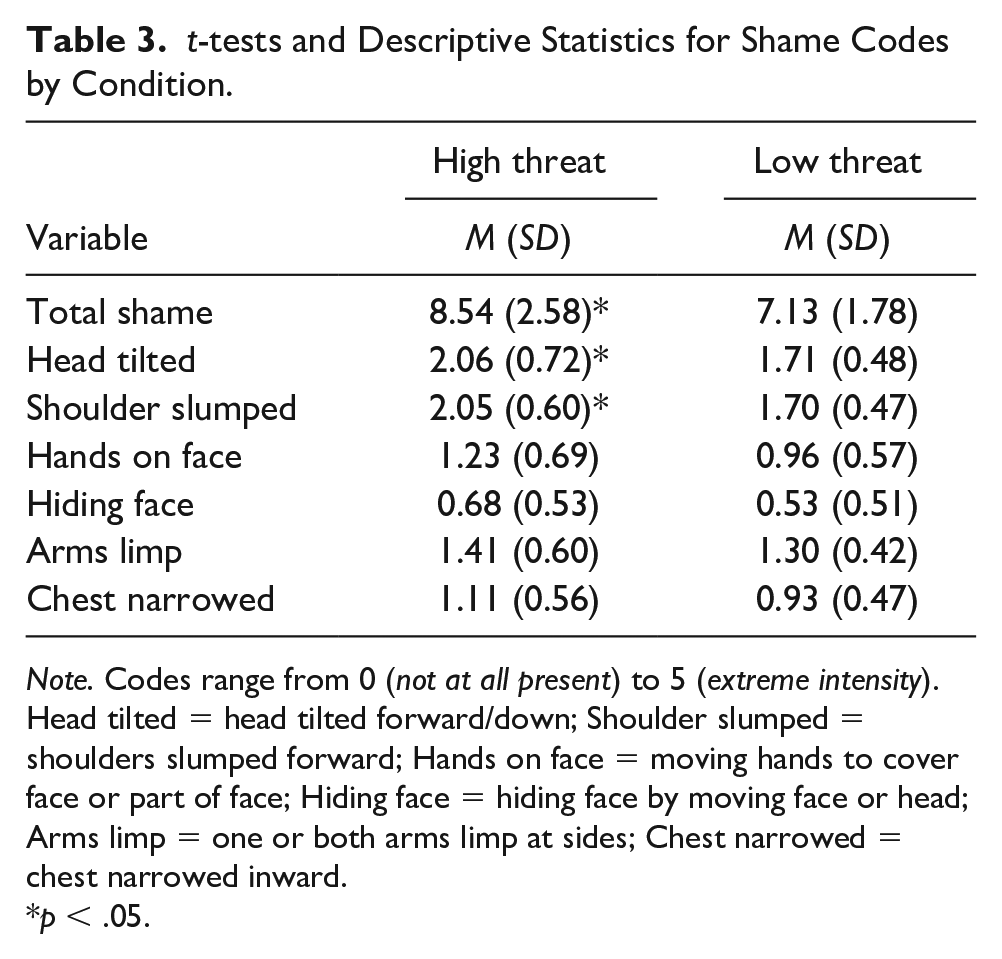
Note. Codes range from 0 (not at all present) to 5 (extreme intensity). Head tilted = head tilted forward/down; Shoulder slumped = shoulders slumped forward; Hands on face = moving hands to cover face or part of face; Hiding face = hiding face by moving face or head; Arms limp = one or both arms limp at sides; Chest narrowed = chest narrowed inward.
p < .05.
Discussion
The present study is the first to investigate men’s psychobiological and behavioral response-recovery profile to a social-evaluative body image threat. Consistent with the first hypothesis and SSPT, results indicated that participants in the high-threat condition reported greater levels of post-threat body shame and greater changes (i.e., increases) in cortisol post-threat, compared to participants in the low-threat condition. These findings are consistent with previous research investigating men; Lamarche et al. (2017) reported that men who experienced a social-evaluative body image threat reported significantly greater levels of body shame and had higher cortisol levels post-threat compared to men in a low-threat condition. Further, the present findings contribute to the literature with respect to recovery—consistent with the second hypothesis, there were no differences between conditions for body shame or cortisol at the final time point, 30 min after the termination of the threat (50 min following the onset of the threat). This finding is consistent with previous research on women and recovery from actual threat exposure (Lamarche et al., 2016).
Taken together, the response-recovery profile exhibited in the present study may be interpreted as relatively efficient. As predicted, there were no significant differences between conditions for body shame or percent change in cortisol at the final post-threat time point, suggesting shame and cortisol returned to pre-threat levels. These findings are consistent with Lamarche et al.’s (2016) finding that women who were exposed to a social-evaluative body image threat experienced significant increases in social physique anxiety and cortisol post-threat; however, at the recovery time point (approximately 50 min after the onset of the threat), women’s levels returned to baseline.
The contribution with respect to recovery is important as previous research has investigated only responses to social-evaluative body image threats, but neglected the recovery phase, perhaps overestimating the negative effects associated with these types of threats, especially in the short term. The response-recovery profile identified in the present study may be viewed in a positive light from a health perspective. Previous research suggests that chronic activation of the hypothalamic–pituitary–adrenal (HPA) axis could contribute to allostatic load and ultimately lead to a variety of negative health outcomes (e.g., cancer, cardiovascular disease; Dickerson & Kemeny, 2004; McEwen, 1998a). The response-recovery profile identified in the present study suggests that men may not be at risk of chronic activation of the HPA axis or the associated health consequences since pathology is thought to result when one fails to efficiently recover from a stressful event or repeated stressors (Sapolsky et al., 2000). Nevertheless, no research exists on the effects of chronic exposure to social-evaluative body image threats. Appearance concerns can be chronic (Kanner et al., 1981), and while the experience of a single social-evaluative body image threat may not compromise health, chronic or repeated exposure to these types of threats could be problematic (Dickerson & Kemeny, 2004). The relationship between acute cortisol responses and health consequences is highly complex and beyond the scope of this article (Miller et al., 2007). While the cortisol response-recovery profile followed the hypothesized pattern in the high-threat condition (see Figure 2a), caution must be taken when interpreting the present findings with regards to men’s cortisol response-recovery profile and its relation to long-term health outcomes.
In the low-threat condition, there was a slight decrease in cortisol from pre-threat to the first post-threat time point. This decrease likely reflects the 10-min “rest period” that participants in the low-threat condition underwent prior to having their measurements taken. (This rest period was implemented to ensure measurements were taken at roughly equal time points between conditions.) Participants in the high-threat condition watched the confederate get tested during this time period. Although participants in the low-threat condition were informed beforehand that they would have their measurements taken following this rest period, this information may not have elicited any anticipatory threat and therefore participants may not have experienced any perceived threat until their measurements were actually taken. This might explain the cortisol pattern in the low-threat condition (see Figure 2a).
The results of the present study suggest that although men respond to social-evaluate body image threats, they recover within approximately 50 min. It appears, however, that this type of response-recovery profile cannot generalize to other types of psychosocial stressors. For example, in a study conducted in the field, Rohleder et al. (2007) reported that ballroom dancers had significantly greater cortisol levels on competition days compared to control days (no competition or training) and that cortisol levels took up to 6 hr to return to baseline after the competition. In laboratory research, cortisol levels have been reported to remain elevated for up to 1 hr following the Trier Social Stress Test, a performance-based social-evaluative threat (Dickerson & Kemeny, 2004; Kirschbaum et al., 1993), and some researchers suggest that cortisol typically takes 60–90 min to return to normal levels after a stressor (De Kloet et al., 2005). In examining recovery from body image threats, shame and cortisol levels returned to baseline approximately 30 min after the termination of the threat (50 min after its onset), suggesting psychobiological recovery from a social-evaluative body image threat may require less time in comparison to other performance-based social-evaluative threats. Nonetheless, methodological differences make these comparisons difficult. It is possible that among relatively fit and active young men, social-evaluative body image threats are less threatening or shorter lived than other types of stressors. The response-recovery profile in the present study may also suggest that relatively fit and active men have become accustomed to uncomfortable body image situations in their daily lives or that they have developed coping strategies to deal with them.
A secondary aim of this study was to investigate men’s behavioral responses to a social-evaluative body image threat. Consistent with the third hypothesis and SSPT, men in the high-threat condition exhibited behavioral expressions of shame to a greater extent than men in the low-threat condition did. Shame behaviors, including downward head tilt and slumped shoulders represent submissive postures, which may serve to maintain social position by adhering to social norms (Tracy & Matsumoto, 2008). Participants in the high-threat condition may have exhibited shame-relevant behaviors to appease the evaluators who observed the participants’ “failure” to meet the ideal during the threat (Keltner, 1995). These behaviors may help individuals to cope with body image threats, which may, in turn, facilitate recovery. Shame-relevant behaviors may have reflected social physique anxiety (Frederick & Morrison, 1996) and/or avoidance coping strategies for dealing with negative body image situations, which include trying to ignore, hide from, or escape threatening body image situations (Lamarche et al., 2018). Avoidance coping strategies are closely linked to the experience of shame and in many cases may be indistinguishable from behavioral expressions of shame. For example, participants in the high-threat condition often had their heads tilted down during the threat, which may have been a strategy for ignoring the situation at hand (i.e., cognitive avoidance).
Although there were no significant differences between conditions for several shame-relevant codes (“moving hands to cover face or part of face,” “hiding face by moving face or head,” “one or both arms limp at sides,” and “chest narrowed inward”), these behaviors are more ambiguous than the prototypical shame-relevant gestures (i.e., slumped shoulders, downward tilted head) and their significance may only be accurately assessed by simultaneously considering other facial or postural expressions. This was the first study to investigate the behavioral responses to a social-evaluative body image threat in the context of SSPT. The behavioral responses observed in the present study complemented the self-report shame responses and were consistent with previous research on SSPT and body image coping.
Limitations
While the findings of the present study contribute to the literature on men’s body image, there are some limitations that should be addressed. First, the findings of the present study can only be generalized to a relatively fit and active sample of university men (within a North American context). Second, while the true purpose of the study was concealed, the ethics board required that posters included information about the measurements that participants would have to undergo. Given the voluntary nature of participation, it is likely that the men who volunteered to participate in a study in which physical characteristics would be measured were more comfortable with their bodies than those who chose not to participate. This point should also be taken into account when generalizing the present findings. Clinical populations (e.g., individuals with eating disorders or body dysmorphic disorder) may not exhibit the same response-recovery profile. Third, the present research was conducted in a laboratory setting and may not generalize to the type of body image threats encountered in everyday life.
There were limitations with regard to analysis of shame-related behaviors. The shame-relevant behaviors in the present study were only observed at a mild intensity. While this may have been due to cultural norms in North America, where displaying the full expression of shame is discouraged (Tracy & Matsumoto, 2008), it could have to do with the way that participants’ behaviors were analyzed. Each participant’s session and video recording was approximately 75 min. Shame-relevant behaviors were usually only expressed for a short amount of time; therefore, behaviors were often coded with a low intensity. The pride coding system only includes shame- and pride-relevant behaviors. There may be other behaviors that are important to analyze with regard to the way men react to, and cope with, uncomfortable body image situations such as verbal communication or eye contact. Despite these limitations, this study is a starting point to examining the behavioral responses to social-evaluative threats.
Future Directions
There are a number of future directions that should be explored in order to better understand how men can effectively cope with uncomfortable body image situations. First, future research should explore potential moderators of the psychobiological responses such as positive body image constructs (e.g., body acceptance). Future research should investigate which aspects of the manipulation participants perceived as the most threatening. Experience sampling methods (i.e., ecological momentary assessment) would yield rich data for determining the type and intensity of body image threats that occur in real life as well as men’s psychobiological response-recovery profiles to them. This approach may be particularly fruitful for investigating whether the response-recovery profile observed in the present study is considered adaptive or maladaptive, particularly from a health perspective (Gruenewald, et al., 2007; Lamarche et al., 2016). Experience sampling methods would permit the investigation of repeated exposure to body image threats and could examine links to potential downstream health outcomes (e.g., depression; Olivardia et al., 2004; Parent, 2013), which are thought to result from excessive shame experiences or cortisol responses (Dickerson, 2008; Dickerson et al., 2009). Finally, future researchers should consider the development of a measure that includes shame-relevant behaviors and other body image coping strategies (i.e., avoidance strategies) that is designed for video analysis and can be used to investigate men’s behavioral responses to body image threats.
Conclusion
Using SSPT, the present study examined men’s psychobiological and behavioral responses to, and recovery from, a social-evaluative body image threat. The findings demonstrate that while men are susceptible to uncomfortable body image situations that elicit psychobiological and behavioral responses consistent with SSPT, they recover from these threats within 30 min after the termination of the threat. Ultimately, this study provides a more complete picture of men’s uncomfortable body image situations and how they cope with them.
Supplemental Material
Analyses_without_Covariates – Supplemental material for Examining University Men’s Psychobiological and Behavioral Response-Recovery Profile From a Social-Evaluative Body Image Threat
Supplemental material, Analyses_without_Covariates for Examining University Men’s Psychobiological and Behavioral Response-Recovery Profile From a Social-Evaluative Body Image Threat by Aidan P. J. Smyth, Kimberley L. Gammage, Larkin Lamarche and Cameron Muir in American Journal of Men’s Health
Supplemental Material
Table_4_-_Supplemental_Materials – Supplemental material for Examining University Men’s Psychobiological and Behavioral Response-Recovery Profile From a Social-Evaluative Body Image Threat
Supplemental material, Table_4_-_Supplemental_Materials for Examining University Men’s Psychobiological and Behavioral Response-Recovery Profile From a Social-Evaluative Body Image Threat by Aidan P. J. Smyth, Kimberley L. Gammage, Larkin Lamarche and Cameron Muir in American Journal of Men’s Health
Footnotes
Acknowledgements
We acknowledge the support of the Natural Sciences and Engineering Research Council of Canada (NSERC). A. Smyth was supported by a grant from the Social Sciences and Humanities Research Council of Canada (SSHRC). We would also like to thank Damon Currie, Jonathon Vaantaja, Amanda Branco, Demi Toms, and Helen Qin for their help with data collection.
Declaration of Conflicting Interests
The author(s) declared no potential conflicts of interest with respect to the research, authorship, and/or publication of this article.
Funding
The author(s) disclosed receipt of the following financial support for the research, authorship, and/or publication of this article: This research was supported by the Natural Sciences and Engineering Research Council of Canada (NSERC). A. Smyth was supported by a grant from the Social Sciences and Humanities Research Council of Canada (SSHRC).

Data Accessibility Statement
Upon acceptance, data used for this manuscript will be archived so as to be publicly available. The link will be provided at that time.
Supplemental Material
Supplemental material for this article is available online.
Notes
References
Supplementary Material
Please find the following supplemental material available below.
For Open Access articles published under a Creative Commons License, all supplemental material carries the same license as the article it is associated with.
For non-Open Access articles published, all supplemental material carries a non-exclusive license, and permission requests for re-use of supplemental material or any part of supplemental material shall be sent directly to the copyright owner as specified in the copyright notice associated with the article.
