




Abstract
A growing body of research has tied religion to problematic sexual behavior in both positive and negative ways. On the one hand, religious belief and engagement buffer against incidence and severity of problematic sexual behavior, but on the other hand religiously affiliated individuals who engage in such behavior tend to experience spiritual struggles (negative religious coping) and poor psychosocial outcomes. No published empirical studies have examined these variables among adult Jewish males. In the present study, 94 adult Jewish males completed measures of religious belief/practice, positive religious coping, spiritual struggles, and problematic sexual behavior. General and positive aspects of Jewish religiosity were unrelated to problematic sexual behavior. By contrast, spiritual struggles were tied to higher levels of problematic sexual behavior, but only for individuals who were raised as Orthodox Jews. Surprisingly, this latter finding was independent of current Orthodox affiliation. These results suggest that a religious Jewish upbringing, irrespective of current religious identity, can moderate ties between sexual behavior and spirituals struggles.
The past decade has witnessed a proliferation of research on problematic sexual behavior, which has been defined as (nonparaphilic) sexual acts that result in significant psychological distress and/or psychosocial impairment (Derbyshire & Grant, 2015). Problematic sexual behavior is thus a broad category of sexual acts that may be subjectively concerning to the individual who practices them, objectively debilitating in some way, or both.
One consistent finding in this area of study is that religious belief and practice is generally associated with lower prevalence and severity of problematic sexual behavior. Religious involvement predicts substantially lower rates of risky sexual behavior among both adolescents (Hubbard-McCree, Wingood, DiClemente, Davies, & Harrington, 2003) and young adults (Smith, 2015), decreased engagement with cybersex (Ghoroghi, Hassan, & Mohd Ayub, 2017), and less relational hypersexuality including fewer lifetime and past-year sexual partners (Reid, Carpenter, & Hook, 2016). Religious affiliation and involvement further predict lower levels of high-frequency masturbation (Das, 2007), and buffer against use of ego-dystonic (value-incongruent) Internet pornography (Baltazar, Helm, McBride, Hopkins, & Stevens, 2010; Perry, 2017; Ross, Mansson, & Daneback, 2012). Interestingly, a recent study among Jewish adolescents in Israel found that religious status was unrelated to compulsive sexual behavior (Efrati, 2018). Nevertheless, these findings on the whole are consistent with a larger body of research linking religion to greater self-regulation, more self-control, and lower levels of impulsivity (McCullough & Willoughby, 2009).
However, relative to secular individuals, social-emotional outcomes tend to be worse when religious individuals engage in problematic sexual behavior. For example, lower quality of parent–child relationships is only associated with pornography use among individuals who regularly attend religious services (Perry & Snawder, 2017), and religious but not secular individuals who use pornography are statistically less happy than the average American (Patterson & Price, 2012). While religious beliefs and practices are typically associated with lower levels of depression (Smith, McCullough, & Poll, 2003), greater levels of religiosity predict higher depression among hypersexual individuals (Reid et al., 2016). One compelling explanation of these trends, put forth by Grubbs and colleagues (2015), is that problematic sexual behavior among religious individuals tends to lead to the development of spiritual struggles (Grubbs, Exline, Pargament, Volk, & Lindberg, 2017), which involve conflicts and distress centered around spiritual matters (Exline & Rose, 2005). An even broader perspective, also put forth by Grubbs and coauthors, suggests that problematic sexual behavior can be defined in terms of moral incongruence; that is, sexual acts are psychologically problematic when engagement patterns exceed an individual’s personal or moral values (Grubbs, Perry, Wilt, & Reid, 2018). Religious individuals tend to morally disapprove of problematic sexual behavior since such behaviors are generally proscribed by religious traditions. It is therefore not surprising that religious individuals tend to experience significant guilt, shame, and general distress when engaged in these activities, leading to poor psychosocial outcomes. These effects are compounded by the fact that religious individuals are more likely to perceive low levels of problematic sexual behavior as a bona fide addiction (Grubbs, Exline, Pargament, Hook, & Carlisle, 2015). Spiritual struggles are commonly referred to in the literature by the moniker “negative religious coping,” since they are thought to reflect an effort to conserve spirituality in times of distress (Pargament, 1997). Spiritual struggles are known to increase risk for a host of mental and physical health concerns (McConnell, Pargament, Ellison, & Flannelly, 2006; Pargament & Ano, 2006; Pargament, Murray-Swank, Magyar, & Ano, 2005).
Research has yet to explore problematic sexual behavior and religion among Jewish adult males. In fact, there have been no published empirical reports in this population, though both positive and negative effects of Jewish religiosity on sexual attitudes were reported in a recent conference abstract, along the lines above: Among Orthodox Jewish adults, religious involvement was correlated with lower fear of intimacy overall, but engaging in a priming task involving reading punitive Biblical quotations regarding masturbation led to increased links between avoidant attachment and fear of intimacy (Shapiro-Halberstam & Josephs, 2017). Other research in the Jewish community has identified both positive and negative effects of religious identity, belief, and practice on a range of psychosocial factors (e.g., Pirutinsky, Rosmarin, & Holt, 2012; Rosmarin, Pargament, & Mahoney, 2009). While there have been divergent findings in the past (e.g., Rosmarin, Pargament, & Flannelly, 2009; Rosmarin, Pirutinsky, Pargament, & Krumrei, 2009), recent research indicates that relationships between various religious factors and mental health are largely equivalent for Orthodox Jews, who believe in the perpetuity of the Torah and Oral Tradition and adhere to their directives (Schnall, 2006), and non-Orthodox Jews, who have a Jewish ancestry, heritage, and identity, but do not view scriptural or foundational commandments as legally binding (Meyer, 1988). That is, for both Orthodox and non-Orthodox Jews, higher levels of religious belief, greater religious practice, and positive religious coping tend to predict better psychological functioning, whereas spiritual struggles (negative religious coping) are associated with greater distress (Rosmarin, Pirutinsky, Carp, Appel, & Kor, 2017).
There are fundamental differences between Orthodox and non-Orthodox Jewish religious culture in attitudes towards gender and sexuality. Among Orthodox Jews, single-gender education from K-12 and beyond is the norm, and traditional gender roles and dress are emphasized from a young age throughout the lifespan (Cohen, 2005; Ringel, 2007). Regarding sexuality, irrespective of procreation considerations, Orthodox Judaism values and in fact religiously mandates that males provide for the sexual needs of females, but only within the sanctified union of marriage. Further, even within the marital context, there are numerous restrictions including abstention of sexual activity during menstruation and for an additional 7-day waiting period each month (Petok, 2001). By contrast, none of these attitudes and practices are common among non-Orthodox Jews; rather gender roles and sexual practices closely resemble that of the general population, with the notable exception that non-Orthodox Jews are more likely to get married and have children than non-Jewish individuals (Pew Research Center, 2013). However, in recent years it has been common for individuals raised non-Orthodox to convert to Orthodoxy, and vice versa (Pew Research Center, 2013). Research has yet to fully examine whether being raised Orthodox moderates links between religion and mental health in a manner that is independent of current Orthodox affiliation. For example, it is possible that being raised Orthodox has more pronounced effects on sexual attitudes and behaviors, relative to being presently Orthodox.
The present study therefore examined religion and problematic sexual behavior in a community sample of adult Jewish males. Given that religious-moral disapproval of problematic sexual engagement tends to exacerbate its effects on psychogenic/spiritual distress (as discussed above), problematic sexual behavior was expected to correlate with spiritual struggles among Orthodox Jews, but not among the non-Orthodox. Regarding general religious involvement (e.g., being presently Orthodox, being raised Orthodox, religious practice, intrinsic religiosity) and positive religious coping, it was expected that these factors would predict lower levels of problematic sexual behavior across the entire sample (Orthodox and non-Orthodox Jews). Given the dearth of previous literature, no hypotheses were proposed as to whether being raised Orthodox would have specific effects on these variables, and whether such effects would be independent on present affiliation with Orthodoxy.
Method
Participants and Procedure
Participants were recruited to a 3-year, six-wave, longitudinal study on a range of topics relevant to Judaism and mental health. Recruitment was conducted in collaboration with Jewish organizations across the gamut of Jewish religiosity, including the Agudath Israel of America (ultra-Orthodox), Orthodox Union and Yeshiva University (centrist Orthodox), United Synagogue of Conservative Judaism and Union of Reform Judaism (non-Orthodox), organizations supporting individuals who converted to Orthodoxy (e.g., Aish HaTorah, Ohr Somayach), and organizations devoted to supporting individuals who once but no longer affiliate with Orthodoxy (e.g., Footsteps). Recruitment was also carried out through emails and advertisements on Jewish community listservs, social media outlets, websites, and by word-of-mouth. Participants were eligible to receive up to a total of $45 in Visa gift cards over the course of the entire study period, and no other remuneration, compensation, or reward was provided. The institutional review board of McLean Hospital/Harvard Medical School provided review and approval for this study (Protocol # 2012P001882/PHS), and all participants provided written informed consent prior to completing study instruments.
Given the sensitive nature of the topic under study, no mention of sexual health, sexuality, or problematic sexual behavior was made in any recruitment materials. Rather, participants were recruited for a study on “Judaism and Mental Health,” and items assessing for problematic sexual behavior were administered alongside items assessing various other aspects of psychological functioning. Further, assessment of problematic sexual behavior was included in the fourth wave of the study, which was carried out after 2 years of participant involvement. This unique approach was seen as integral to the validity of the present study, as it allowed us to develop a trusting relationship with participants prior to administration of items related to sexuality. Notably, 100% of participants who completed the fourth wave of the parent study completed the measure of problematic sexual behavior.
Participant demographic and religious characteristics are reported in Table 1. The sample consisted of 94 adult Jewish males. Mean age was 40.15 years (SD = 16.11), and the sample was highly educated (69% had a college degree, n = 65) and predominantly married (60.6%, n = 57). Approximately half the sample (51.1%, n = 48) reported Orthodox affiliation, whereas 45.7% (n = 43) reported non-Orthodox affiliation. 1 Conversion from Orthodoxy to non-Orthodoxy or vice versa was common (38.5% overall, n = 35), but the majority of individuals raised Orthodox remained as such (70.8% of Orthodox Jews in the sample, n = 34/48), and the majority of individuals raised non-Orthodox were non-Orthodox at the time of the study (51.2% of non-Orthodox Jews in the sample, n = 22/43).
Demographic and Religious Characteristics of the Sample (n = 94).

Note. Problematic sexual behavior (n/%) refers to 1×/week or greater engagement. Information about current and/or past affiliation was missing for a small number of participants (n = 3) and pairwise deletion was used for all analyses.
Measures
Religious affiliation was assessed with two items: “What is your current religious affiliation?” and “What was the religious affiliation of the home in which you were raised?” Response choices included 12 common Jewish religious affiliations, which were subsequently collapsed into either Orthodox (Hassidic, Chabad/Lubavitch, Yeshiva Orthodox, modern Orthodox, Sephardic-Religious, or Sephardic-Traditional), or non-Orthodox (Conservative, Reform, Humanistic, Reconstructionist, Sephardic-Secular, Jewish Renewal, and Other). To facilitate secondary analyses, these categories were further divided into ultra-Orthodox (Hassidic, Chabad/Lubavitch, Yeshiva Orthodox, Sephardic-Religious) and modern Orthodox (modern Orthodox, Sephardic-Traditional) groups.
Religious practice was measured by a three-item composite measure that has been previously used and validated within the Jewish community (Pirutinsky & Rosmarin, 2018). It included the following questions: (a) “How often do you speak to God or pray?” (b) “How often do you attend religious services?” (c) “How often do you read religious literature or attend a religious sermon or lecture?” Response anchors ranged from Several times a day to Never on a 9-point scale. This measure demonstrated a high level of internal reliability in the present sample (α = .89) and an exploratory factor analysis suggested that all items loaded on a single factor (eigenvalue = 2.45) accounting for 81.5% of the variance.
Intrinsic religiosity represents the degree to which individuals value faith as a core value, rather than an instrumental aspect of identify (e.g., social), and was measured with a brief, well-utilized, and valid three-item measure taken from the Duke Religion Index (Koenig, Parkerson Jr, & Meador, 1997). Reliability in the present sample was high (α = .90).
Religious coping and spiritual struggles were measured using the 16-item Jewish Religious Coping Scale (JCOPE; Rosmarin, Pargament, Krumrei, & Flannelly, 2009), which has previously been reported to be a reliable and valid measure of positive and negative religious coping among Jews. Unlike secular coping, religious coping is a spiritual construct that specifically centers around the use of faith to cope with distress. Like other measures of religious coping, the JCOPE breaks into two subscales, measuring the degree to which individuals draw on religion in positive ways (i.e., positive religious coping) and negative ways (i.e., spiritual struggles), when faced with life stressors. Participants were asked about how they cope with challenges in life and then rated items such as “I ask G-d to forgive me for things I did wrong,” (positive) and “I get mad at G-d” (negative) on a 5-point scale. Internal consistency in the present study was high (positive subscale α = .94; negative subscale α = .82).
Problematic sexual behavior was assessed with the screening items from the clinical interview for Hypersexual Disorder (Reid et al., 2012). Items assessed for six potential forms of problematic sexual behavior: masturbation, telephone sex, cybersex (defined for participants as “Internet-related sexual talk or behavior”), pornography, visiting strip clubs, and sexual engagement with consenting adults (defined as “direct contact”). In order to ensure that items assessed for problematic aspects of sexual behavior (as opposed to diverse sexual practices), the scale specifically assessed for subjectively distressing or objectively impairing levels of engagement with these behaviors. Items were thus prefaced by the following instructions: “We request that you provide the following information, although these questions may be uncomfortable to answer. Please note that your responses are anonymous. How often did you engage in any of the following activities in a manner that caused you problems, or in an excessive manner in order to cope with difficult feelings/stress?” Response anchors assessed for frequency of engagement with each item on a 7-point scale, ranging from 0 (not at all) to 6 (more than 9 times per week). Responses to the items were summed to create composite measure with moderate internal consistency (α = .71).
Results
Problematic engagement with masturbation and pornography use were reported by approximately half the sample overall (51.1%, n = 48; see Table 1). Problematic cybersex and direct sexual contact were each reported by 7.4% of participants (n = 7). Problematic telephone sex and visiting of strip clubs were reported by very few participants (2.2%, n = 2, and 1.1%, n = 1, respectively). Compared to their non-Orthodox counterparts, Orthodox participants reported higher mean levels of religious practice (F[1, 89] = 61.58, p < .001), intrinsic religiosity (F[1, 89] = 17.58, p < .001), and positive religious coping (F[1, 88] = 19.39, p < .001), but equivalent levels of spiritual struggles (negative religious coping; F[1, 87] = .15, p = .70). Participants currently identifying as Orthodox also reported somewhat lower levels of problematic sexual behavior overall (M = 9.83, SD = 4.89) compared to the non-Orthodox (M = 11.37, SD = 4.64, Cohen’s d = .32), but this difference did not reach statistical significance (F[1, 89] = 2.35, p = .13). Individuals who were raised Orthodox reported lower levels of problematic sexual behavior (M = 9.8, SD = 4.58) compared to individuals raised non-Orthodox (M = 11.72, SD = 4.99); however, this difference also fell short of significance (F[1, 89] = 3.57, p = .06). There were no significant differences on problematic sexual behavior between those currently identifying with ultra-Orthodox versus modern Orthodox groups (F[1, 38] = .40, p = .53) and no differences between those raised ultra-Orthodox versus modern Orthodox (F[1, 53] = 1.24, p = .27), although power was low for both of these analyses. In terms of specific sexual behaviors, Mann–Whitney U tests comparing groups on individual items were similarly nonsignificant (although trending toward lower problematic sexual behavior among those currently Orthodox and those raised Orthodox), with the exception that currently Orthodox participants reported significantly less frequent pornography use than those currently non-Orthodox (U = 772.50, Z = 2.00, p = .046).
Contrary to expectations, levels of religious practice, intrinsic religiosity, and positive religious coping were not associated with lower levels of problematic sexual behavior (r ranging from –.03 to –.01 and p ranging from .79 to .90 for all variables). To further explore these findings, a Bayesian analytic method was utilized (Wagenmakers, Verhagen, & Ly, 2016) to quantify the evidence in favor of the null hypothesis of no linear relationship. Results indicated moderate likelihood that problematic sexual behavior is not related to intrinsic religiosity (BF01 = 7.58) and religious practice (BF01 = 7.58), and mild evidence for a null relationship to positive religious coping (BF01 = .93). By contrast, spiritual struggles were associated with greater levels of problematic sexual behavior overall (r = .38, p < .001). Upon closer examination, however, this relationship was specific to individuals who were raised Orthodox, irrespective of whether they were presently Orthodox (see Table 2). This relationship also appeared to be stronger among those raised ultra-Orthodox (r = .61, p < .001) versus those raised modern Orthodox (r = .43, p = .04), although this difference was not statistically significant (Z = .84, p = .20). As such, problematic sexual behavior was associated with substantially greater spiritual struggles among individuals who were raised Orthodox, irrespective of their current affiliation with Orthodoxy. Among those who were not raised Orthodox, however, no such associations were identified, even among individuals who reported present Orthodox affiliation.
Correlations Between Religion and Problematic Sexual Behavior.

Note. *p < .05, **p < .01. IR = intrinsic religiosity; RP = religious practice; P-JCOPE = positive Jewish religious coping; spiritual struggles are commonly referred to in the literature as “negative Jewish religious coping” (see text for explanation). The four groups in this table are mutually exclusive; information about current and/or past affiliation was missing for a small number of participants (n = 3) and pairwise deletion was used for all analyses.
In order to formally test for moderation effects, a multiple regression analysis was conducted predicting spiritual struggles from the affiliation in which participants were raised (Orthodox vs. non-Orthodox), problematic sexual behavior (mean-centered), and their interaction. To provide for a more conservative test, current religious affiliation (Orthodox vs. non-Orthodox) was entered as a control variable. Overall model fit was significant with a moderate effect (r2 = .19, F[4, 84] = 4.89, p = .001), and coefficients for this model are reported in Table 3. Results confirmed a significant moderation effect and Figure 1 displays a plot of the resulting interaction, which indicates that for individuals raised Orthodox, higher levels of problematic sexual behavior were associated with significantly greater negative religious coping (b = .41, SE = .10, t = 3.98, p < .001), but among individuals raised non-Orthodox there was no such relationship between these variables (b = .06, SE = .12, t = .08, p = .59).
Problematic Sexual Behavior and Orthodox Affiliation (Current/Raised) as Predictors of Spiritual Struggles.
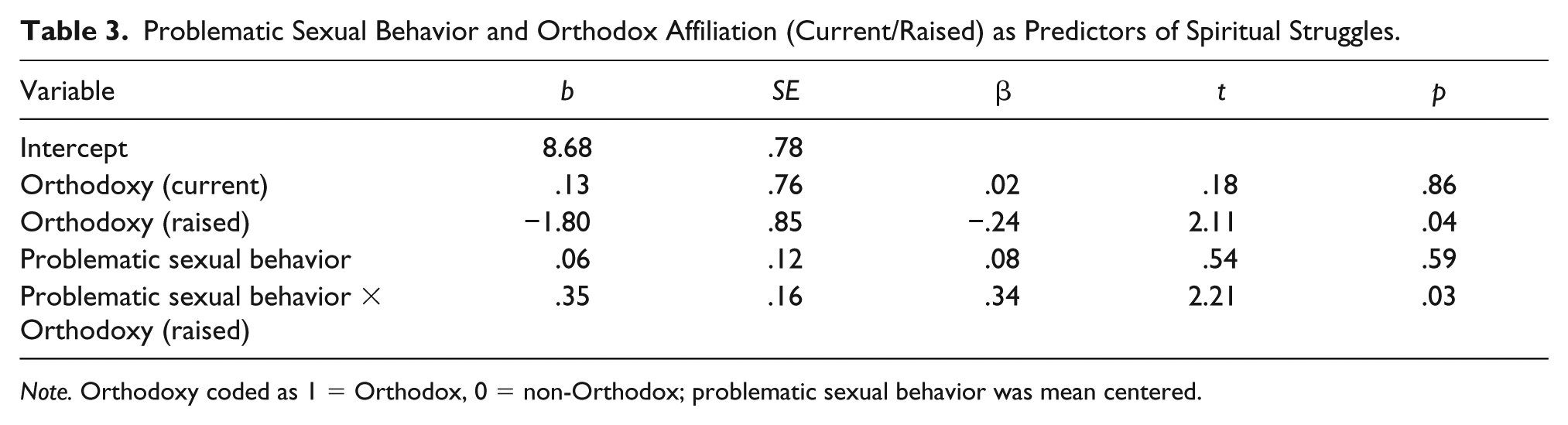
Note. Orthodoxy coded as 1 = Orthodox, 0 = non-Orthodox; problematic sexual behavior was mean centered.

Relationship between problematic sexual behavior and spiritual struggles (negative religious coping).
Finally, additional analyses were performed to further understand these results. First, a second formal moderation test was conducted to test if the relationship between problematic sexual behavior and spiritual struggles differed between participants raised in ultra-Orthodox versus modern Orthodox families. Results indicated that there were no significant differences between these groups (r2 = .03, F[1, 49] = 1.90, p = .18). Second, given the possibility of demographic confounds, an additional regression model was estimated, statistically controlling for all demographic variables (i.e., age, marital status, education, and income, and household size). Results indicated that the addition of demographic significantly improved model fit (Δr2 = . 27, F[18, 67] = 1.80, p = .04), but only household size reached significance such that those with larger households reported less frequent problematic sexual behavior (b = −.62, SE = .26, t = 2.57, p = .02). The interaction between problematic sexual behavior and being raised Orthodox remained significant in this model (b = .35, SE = .16, t = 2.25, p = .03).
Discussion
In contrast with previous findings in the general population and other religious groups, and despite using numerous valid and reliable measures of spiritual/religious life in the present study, our results did not show evidence for positive or protective effects of Jewish religious involvement on problematic sexual behavior. Specifically, religious identity, belief, and practice were not inversely correlated with problematic sexual behavior, and while current Orthodox affiliation and being raised Orthodox were both associated with lower levels of problematic sexual behavior, these associations were beneath the threshold of statistical significance. What may explain these null findings? One possibility, as noted above, is that traditional Jewish culture highly values sexual engagement within marriage. It therefore could be that sexuality is not as foreign or stigmatized to religious Jews as it may be to individuals from other religious cultures; problematic sexual behavior may thus not be as much of an anathema. A second possibility stems from Judaism’s focus on behavioral engagement. Some have characterized Judaism as a religion of Orthopraxy (Grossberg, 2010), given its value of doctrinal adherence even in the absence of faith. While a rich Jewish religious tradition for developing belief and internal connection goes back well over a millennium (e.g., Ibn Pakuda, 1957), it is nevertheless religiously and culturally possible to maintain Jewish religious lifestyle without an inner sense of spiritual connection. Jewish religious observance may thus be doctrinally orthogonal to religious-morality in the sexual realm. However, it is possible that other aspects of Jewish religious life that were not evaluated by our study might buffer against engagement with problematic sexual behavior, or that the small sample size in the present study limited the detection of significant effects. It is further possible that complex interactions between different facets of Jewish religious life may yield effects on problematic sexual behavior (see Pirutinsky & Rosmarin, 2018, as a recent example in relation to depression).
Consistent with expectations, problematic sexual behavior predicted greater spiritual struggles, but a formal moderation analysis revealed that these associations were only identified among individuals who were raised as Orthodox Jews. Interestingly, these findings were independent of current affiliation with Orthodoxy. That is, individuals who grew up in Orthodox homes had strong relationships between problematic sexual behavior and spiritual struggles whether they were currently Orthodox (r = .58, p < .001) or currently non-Orthodox (r = .47, p < .05). By contrast, problematic sexual behavior and spiritual struggles were not correlated among individuals from non-Orthodox backgrounds, whether they remained non-Orthodox (r = −.01, ns [nonsignificant]), or had converted to Orthodoxy (r = .10, ns). Why might being raised Orthodox (irrespective of current Orthodoxy) facilitate a connection between problematic sexual behavior and spiritual struggles? It is possible that one’s religious identity during critical stages of sexual development (i.e., during and shortly after puberty) could have a more formative impact on sexual attitudes than one’s current religious identity. It is known that exposure to sexually explicit material during early adolescence is associated with more permissive attitudes toward sexuality, a tendency to view women as sex objects, a higher number of (casual) sexual partners, and lower sexual and relationship satisfaction (Brown & L’Engle, 2009; Morgan, 2011; Peter & Valkenburg, 2007). It is therefore possible that participants raised Orthodox were less likely to view pornography as teenagers by virtue of growing up in more religiously cloistered and traditional environments, which may have rendered problematic sexual behavior during adulthood as a context for development of spiritual struggles. Regretfully adolescent sexuality was not assessed in this study and cannot formally evaluate these possibilities. Future research should examine whether being raised in a religious environment (independent of current religiosity) may impact or moderate links between religion and problematic sexual behavior. Future research should also try to replicate the findings of the present study among other religious groups and explore these and other potential mediating mechanisms.
This study was limited by use of a cross-sectional design, and directions of effect between the variables under study cannot be determined. It is therefore possible that problematic sexual behavior leads to spiritual struggles (among individuals who were raised Orthodox), or that spiritual struggles lead to problematic sexual behavior, or that these difficulties simply co-occur. Our sample was also relatively small and limited to adult Jewish males, and results cannot speak to potential links between religion and problematic sexual behavior among Jewish females. Sampling methods were not epidemiological, nor was a representative sample of the Jewish community recruited. As well, hypersexuality was not formally assessed, since this study was initiated in 2011 prior to the development of most of the current research and theory described in this article. 2 It also must be clarified that in accordance with current clinical definitions of problematic sexual behavior, our findings do not relate to the prevalence of various sexual behaviors, but rather to engagement that leads to emotional distress and/or psychosocial impairment. Further research with broader and more assessment tools is warranted to better understand the relationships between religion and sexuality among Jewish men. Nevertheless, this is the first published empirical study of religion and problematic sexual behavior among adult Jewish males, and the novel sampling method utilized avoided many of the common response and recruitment biases that can easily arise in studying this sensitive subject matter. To these ends, these findings complement the growing literature on religion and sexuality and suggest that these areas of human life are interconnected in many ways.
Footnotes
Authors’ Note
David H. Rosmarin, PhD, ABPP, affirms that this manuscript is an honest, accurate, and transparent account of the study being reported; that no important aspects of the study have been omitted; and that any discrepancies from the study as planned have been explained.
Declaration of Conflicting Interests
The author(s) declared no potential conflicts of interest with respect to the research, authorship, and/or publication of this article.
Funding
The author(s) disclosed receipt of the following financial support for the research, authorship, and/or publication of this article: Financial support was received from McLean Hospital development fund #041537.