



Abstract
Tanned skin has been associated with perceptions of fitness and social desirability. Portrayal of models in magazines may reflect and perpetuate these perceptions. Limited research has investigated tanning shade gradations of models in men’s versus women’s fitness and muscle enthusiast magazines. Such findings are relevant in light of increased incidence and prevalence of melanoma in the United States. This study evaluated and compared tanning shade gradations of adult Caucasian male and female model images in mainstream fitness and muscle enthusiast magazines. Sixty-nine U.S. magazine issues (spring and summer, 2013) were utilized. Two independent reviewers rated tanning shade gradations of adult Caucasian male and female model images on magazines’ covers, advertisements, and feature articles. Shade gradations were assessed using stock photographs of Caucasian models with varying levels of tanned skin on an 8-shade scale. A total of 4,683 images were evaluated. Darkest tanning shades were found among males in muscle enthusiast magazines and lightest among females in women’s mainstream fitness magazines. By gender, male model images were 54% more likely to portray a darker tanning shade. In this study, images in men’s (vs. women’s) fitness and muscle enthusiast magazines portrayed Caucasian models with darker skin shades. Despite these magazines’ fitness-related messages, protanning images may promote attitudes and behaviors associated with higher skin cancer risk. To date, this is the first study to explore tanning shades in men’s magazines of these genres. Further research is necessary to identify effects of exposure to these images among male readers.
Background
In the United States, skin cancer is the most common form of cancer (Centers for Disease Control and Prevention [CDC], 2014a). Incidence and prevalence of melanoma has recently increased among both Caucasian males and females (CDC, 2014b, 2014c). In Caucasian men specifically, melanoma mortality rates have increased significantly (CDC, 2014c). A primary risk factor for developing skin cancer is exposure to ultraviolet radiation from sun exposure or artificial tanning devices (Boniol, Autier, Boyle, & Gandini, 2012). Portrayal of models in popular magazines may both reflect and perpetuate perceptions about the social desirability being tan (Gamble et al., 2011).
Magazines are one form of media that can be used for relaying health promotion messages (CDC, 2011). Mainstream fitness and muscle enthusiast magazines, for instance, are information channels that readers may use to make health-related decisions. In addition to text-based articles, editorials, and advertisements, these magazines, contain images that contribute to a context, which promotes both health and risk behaviors (Basch, Ethan, Hillyer, & Berdnik, 2014; Cho, Hall, Kosmoski, Fox, & Mastin, 2010). The impact of magazine images on the formation of body-related perceptions and behaviors, particularly among female readers, has been considerably documented (Hawkins, Richards, Granley, & Stein, 2004; Grabe, Ward, & Hyde, 2008).
Research on the impact of media images on male readers’ perceptions and behaviors is less extensive, but growing. A review of 15 experimental studies that exposed males to idealized physical images of men in advertisements found a small but significant negative impact on the subjects’ body dissatisfaction (Blond, 2008). In a recent study of college students, male subjects’ drive for muscularity was correlated with reading men’s health magazines (Cramblitt & Pritchard, 2013).
In the area of skin cancer prevention, magazines geared toward a younger versus older audience have been found to depict Caucasian models with significantly less sun-protective clothing (Cafri et al., 2006; Dixon, Dobbinson, Wakefield, Jamsen, McLeod, 2008) and younger models were more likely than older models to be portrayed with darker tans (Dixon et al., 2008). Magazines targeting female readers have been found to include content more likely to reflect benefits than consequences of tanning (Cho et al., 2010). Fashion and fitness magazine readers have reported that tanned women appear to be more fit (Cho, Lee, & Wilson, 2010). Citing theories in communications, Grabe et al. (2008) note that viewers may interpret what they see as representations of reality after repeated exposure to media content. Portrayal of tanned models in popular fitness magazines may therefore reinforce males’ and females’ perceptions and actions related to the desire to be tan. There is a paucity of skin health research on magazines that focus on males despite the higher rate of melanoma in this group (Fisher & Geller, 2013). The purpose of this study was, therefore, to evaluate and compare the tanned skin gradations of images of adult Caucasian male and female models in mainstream fitness and muscle enthusiast magazines.
Methods
We reviewed 69 issues across 14 U.S. fitness and muscle enthusiast magazines to evaluate the tanning shade of images of adult Caucasian male and female models presented on the cover of each magazine, in advertisements, in feature articles, and associated with other aspects of the magazine. Magazines in the sample were categorized as women’s mainstream fitness, men’s mainstream fitness, and muscle enthusiast magazines and were considered a comprehensive sample of these magazine genres available during this time frame. The combined readership for the 14 magazines was more than 65 million (American Media, 2014a, 2014b, Audit Bureau of Circulations, 2011, Echo Media, n.d.).
Images in all 2013 spring and summer issues (April through September) were rated by two independent reviewers. Models with 50% or more of the body exposed were included. Duplicate images of a model were counted only once. Black and white images or images in which skin tone was altered in any way, and images of models that were too far away, too small, or were included in scenes of crowds that precluded clear determination of race and skin tone were excluded. Images that were displayed on at least one-half of a page were included. Tanning shade was assessed using stock photographs of Caucasian models with tanned skin coloration graded as no tan (Shade 1), lightest tan (Shade 2), light tan (Shade 4), moderate tan (Shade 6), and darkest tan (Shade 8). Shading between reference photographs was allowed, yielding a scale of “1” through “8,” an established method (Chapman, Marks, & King, 1992; Dixon, Borland, & Hill, 1999; Dixon et al., 2008).
High interrater reliability using Cohen’s kappa (Landis & Koch, 1977) was demonstrated (κ = .97). Discrepancies in rating were resolved to yield complete consensus prior to analysis. Comparisons of the variation in tanning shade by gender and image type by magazine category and individual magazine were performed using chi-square analysis. Mean tanning shade was calculated, and differences by gender and photograph type were derived using analysis of variance. Associations between higher tanning shade and model gender, image type, and magazine category (women’s mainstream fitness, men’s mainstream fitness, and muscle enthusiast), were assessed using generalized linear regression and expressed as odds ratios and 95% confidence intervals. Statistical significance was considered when p values were less than .05. All analyses were conducted using IBM SPSS, version 21. The study was deemed exempt from human subject’s review.
Results
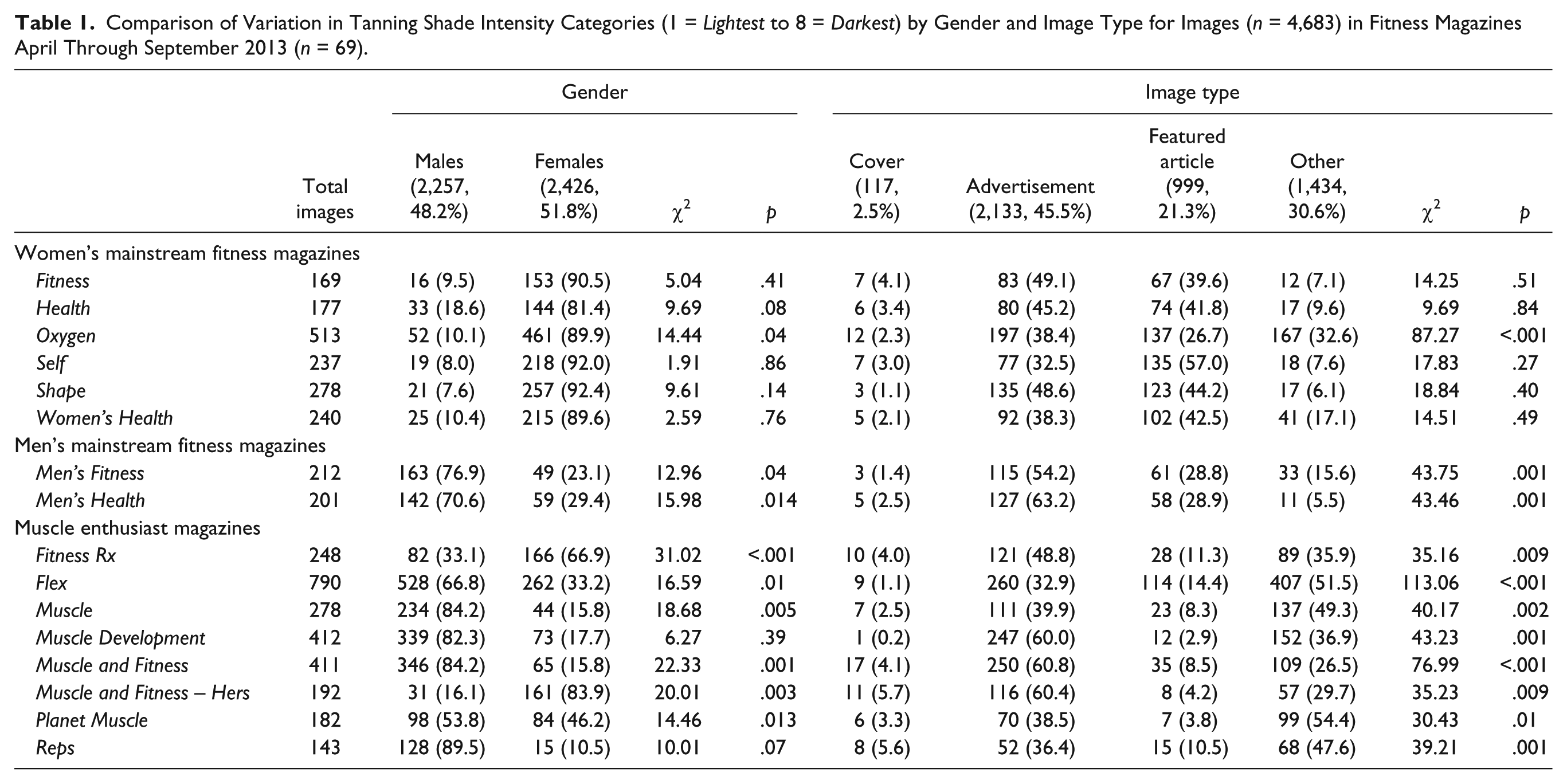
A total of 4,683 images were evaluated. Of these, 1,614 (34.5%) were in women’s mainstream fitness magazines, 413 (8.8%) were in men’s mainstream fitness magazines, and 2656 (56.7%) were in muscle enthusiast magazines. Male and female images were nearly equally represented (48.2% and 51.8%, respectively) but images of females were more predominant in the women’s mainstream fitness magazines and male images predominated in the men’s mainstream fitness magazines and muscle enthusiast magazines (Table 1). Almost half (45.5%) were in advertisements and sources other than on the cover, with more than 20% in featured articles. Among women’s mainstream fitness magazines, tanning shade varied significantly by the gender of the model (χ2 = 14.44, p = .04) and the type of image in only one magazine, Oxygen ( χ2 = 87.27, p < .001). However, in the men’s mainstream fitness and muscle enthusiast magazines, type of image was associated with intensity of the tanning shade in all magazines and gender associated for nearly all (excluding muscle development). Table 2 shows the mean tanning shade intensity by gender and image type. Overall, images in all magazines spanned the spectrum of tanning shades. Women’s mainstream fitness magazines tended to present models with lighter tanning shades ranging from a mean of 3.6 (SD 1.0) to 4.5 (SD 1.3), corresponding to light tan; whereas muscle enthusiast magazines shades depicted models with darker shades, ranging from a mean of 5.2 (SD 1.2) to 6.1 (SD 1.3), corresponding to a moderate tan. Male models in men’s fitness magazines and several of the muscle enthusiast magazines were significantly darker than female models. Of the women’s mainstream fitness magazines, Oxygen and Shape displayed significantly darker models on the cover as did Muscle and Muscle and Fitness in the muscle enthusiast magazine group. Others (Men’s Fitness, Fitness Rx, Planet Muscle, and Reps) displayed darker tanning shades in advertisement images. Generalized linear regression models demonstrated that images of male models were 54% more likely to portray a darker tanning shade compared to images of female models (odds ratio [OR] 1.54, 95% confidence interval [CI] 1.41-1.69). Compared with magazine cover images, those in featured articles and other sources were less likely to portray darker tanning shades (OR 0.80, 95% CI 0.73-0.89) as were women’s (OR 0.28, 95% CI 0.25-0.31) and men’s (OR 0.40, 95% CI 0.35-0.46) mainstream fitness magazines compared to muscle enthusiast magazines (data not shown).
Comparison of Variation in Tanning Shade Intensity Categories (1 = Lightest to 8 = Darkest) by Gender and Image Type for Images (n = 4,683) in Fitness Magazines April Through September 2013 (n = 69).
Mean Tanning Shade Intensity (1 = Lightest Through 8 = Darkest) by Gender and Image Type for Images (n = 4,683) in Fitness Magazines by Type, April Through September 2013 (n = 69).

Conclusions
We did not identify any published studies that evaluated the tanning gradations of images of adult Caucasian male and female models in mainstream fitness and muscle enthusiast magazines. The findings of this study are novel for several reasons. First, the cover images of muscle enthusiast magazines portrayed the darkest tanning shades. While the purpose of these magazines is to deliver information about fitness to the reader, protanning images promote behaviors that are directly associated with a higher risk of developing skin cancer. A recent study addressing magazine exposure and tanning attitudes found that study participants positively associated “fitness” with tanned images of models (Cho, Lee, & Wilson, 2010). Continued exposure to these images presented through this medium may reinforce these attitudes.
Mean tanning shades were darker in men’s versus women’s mainstream fitness magazines. As mentioned previously, the majority of research to date has focused on women. This study offers insight into the tanning-related images that male readers of mainstream fitness and muscle enthusiast magazines may be exposed to. This is of particular importance given that, compared with females, males have a higher mortality risk from malignant melanoma (Fisher & Geller, 2013).
Tanning gradation was darker for images found in muscle enthusiast versus mainstream fitness magazines. While these magazines may cater to a particular audience, the excessive levels of tanning portrayed may contribute to the social desirability of tanned skin and skin cancer risk among readers. Further research is necessary to assess and compare exposure to such images and perceptions of tanning among readers of these magazine genres.
Recent data indicate that American adults are engaging in high-risk behaviors associated with ultraviolet exposure and skin cancer (Buller et al., 2011, CDC, 2012). Indoor tanning, for instance, is prevalent among both males and females with 40% and 58%, respectively, reporting use of a tanning bed 10 or more times in 2009 (Mahler, Beckerley, & Vogel, 2010). These findings suggest specific motivating factors for such behaviors. These motivations, in turn, may be influenced by the desire to be tan (Hillhouse, Thompson, Jacobsen, & Hillhouse, 2009), which has been associated with the belief that being tan enhances appearance (Dennis, Lowe, & Snetselaar, 2009; Lamanna, 2004; Peacey, Steptoe, Sanderman, & Wardle, 2006). Given their collectively high readership, fitness and muscle enthusiast magazines can potentially aid in shifting such beliefs and attitudes by presenting images of Caucasian models with lighter skin shades that project a message of sun protection on covers, feature articles, and advertisements.
Magazine content can reinforce these messages with articles, editorials and other messaging that promote skin cancer prevention and sun-protective behaviors. Media plays an important role in both reflecting and influencing the social desirability of various health related perceptions and behaviors. While the causal role of media in shaping these behaviors has not been established, the media in general and popular magazines in particular have an opportunity to contribute to public health by explicitly addressing issues through featured articles and implicitly contributing to readers perceptions in the way that models are portrayed. Given the increased rates of melanoma morbidity and mortality, this is an opportune time for examination of the tan levels of images portrayed in magazines.
Footnotes
Declaration of Conflicting Interests
The author(s) declared no potential conflicts of interest with respect to the research, authorship, and/or publication of this article.
Funding
The author(s) received no financial support for the research, authorship, and/or publication of this article.