




Abstract
This study investigated how dissatisfaction with particular aspects of the body was associated with overall body dissatisfaction among male adolescents in Western and Asian cultures. One hundred and six Malaysian Malays, 55 Malaysian Chinese, 195 Chinese from China, and 45 non-Asian Australians aged 12 to 19 years completed a questionnaire assessing dissatisfaction with their overall body and dissatisfaction with varying aspects of their body. Dissatisfaction with the face, height, and hair was positively correlated with overall body dissatisfaction among Malaysian Malays after body mass index, age and dissatisfaction with body areas typically included in measures (weight/shape, upper, middle, and lower body, and muscles) had been controlled for. Dissatisfaction with the face was positively correlated with overall body dissatisfaction among Malaysian Chinese. These findings demonstrate the differences in body focus for males from different cultures and the importance of using assessment measures that address all possible areas of body focus.
Introduction
Adolescence is a particularly vulnerable life stage for the emergence of body image concerns (Grogan, 2008; Levine & Smolak, 2002; Murray & Lewis, 2012; Ricciardelli, 2012), and studies of body dissatisfaction among adolescents have reported it to be associated with low self-esteem (Siegel, Yancey, Aneshensel, & Schuler, 1999; Thompson & Hammond, 2003), depression (Paxton, Neumark-Sztainer, Hannan, & Eisenberg, 2006; Stice, Hayward, Cameron, Killen, & Barr Taylor, 2000), and anxiety (e.g., Psujek, Martz, Curtin, Michael, & Aeschleman, 2004). A recent longitudinal study by Quick, Wall, Larson, Haines, and Neumark-Sztainer (2013) also suggests that among adolescents, increases in the level of body dissatisfaction over the 10-year study period predicted the incidence of overweight in early adulthood.
The majority of research into body dissatisfaction at this development period has focused on females. However, since the late 1990s, there has been an increasing interest in male body image (Ricciardelli, 2012), and research suggests that many adolescent males are also dissatisfied with their bodies and engage in a range of unhealthy body change strategies such as excessive exercising and training, and even steroid use (McCabe & Ricciardelli, 2004; Murray & Lewis, 2012; Ricciardelli, 2012). Such research indicates that there are clear gender differences in body concerns, with males focusing on ideals of muscularity, power, and strength (McCabe & Ricciardelli, 2004; Mintz & Kashubeck, 1999; Murray & Lewis, 2012; Ricciardelli, 2012), as opposed to females, for whom modelesque thinness is ideal (Barnett, Keel, & Conoscenti, 2002; Murnen, Smolak, Mills, & Good, 2003; Wertheim, Paxton, Schutz, & Muir, 1997).
To help us understand the nature of body dissatisfaction in adolescent males, cultural factors as well as these gender differences must be taken into consideration. As will be outlined below, different cultures place different importance on particular body features, and this suggests that attempts to assess body dissatisfaction need to include a focus on all relevant body features, especially if researchers wish to compare adolescents from different cultural contexts, or are seeking information to inform intervention and prevention programs. The current study focuses on male adolescent body dissatisfaction in one Western and two Asian contexts, the body features associated with body dissatisfaction, and the role that cultural context may play in determining overall body dissatisfaction.
Male Body Dissatisfaction Across Western and Asian Cultures
Of the limited research focusing on male body dissatisfaction, the majority of research has sampled boys in Western cultures (Jung, Forbes, & Lee, 2009; Ricciardelli, 2012). In these Western samples, body dissatisfaction tends to center on the desire for a lean muscular physique (McCabe & Ricciardelli, 2004; Mintz & Kashubeck, 1999; Murray & Lewis, 2012; Ricciardelli, 2012). In addition, dissatisfaction related to height is also common (Mintz & Kashubeck, 1999; Murray & Lewis, 2012). While some studies (Furnham & Calnan, 1998; Middleman, Vazquez, & Durant, 1998) have also found a proportion of boys wanting to lose weight, it is likely that this is related to a desire for lean muscle mass rather than a desire to be thin per se (McCabe & Ricciardelli, 2004).
More recent research has demonstrated that body image concerns are no longer confined to Western populations, with numerous studies showing the emergence of body dissatisfaction among male and female adolescents in Asia (e.g., Grammas & Schwartz, 2009; Jung et al., 2009; Leone et al., 2011; Mellor et al., 2013; Wardle, Haase, & Steptoe, 2006), and an increase in eating disorders and other body change strategies across a number of Asian cultures (Jung et al., 2009; Jung & Forbes, 2006, 2007; Wardle et al., 2006; Xu et al., 2010). In addition, there is growing evidence Asian adolescent males are concerned about lean muscularity (Mintz & Kashubeck, 1999; Thianthai, 2008; Watt & Ricciardelli, 2012; Xu et al., 2010).
Such literature has suggested that Asian males are “catching up” to Western levels of body dissatisfaction (Altabe, 1998; Mintz & Kashubeck, 1999; Ricciardelli, McCabe, Williams, & Thompson, 2007), whereas other recent research suggests that Asian males are experiencing higher levels of body dissatisfaction than their counterparts in Western cultures (Holmqvist & Frisén, 2010; Jung et al., 2009; Kennedy, Templeton, Gandhi, & Gorzalka, 2004; Kowner, 2002; Neumark-Sztainer et al., 2002; Ricciardelli et al., 2007; Wardle et al., 2006; Xu et al., 2010). For example, in a study comparing levels of overall body dissatisfaction in male and female adolescents from Korea and the United States, Jung et al. (2009) found that Korean boys and girls reported significantly greater body dissatisfaction than their U.S. counterparts. However, as Swami and Chamorro-Premuzic (2008) argued, there may be cross-cultural differences in the variables contributing to body image and body dissatisfaction. They suggested that members of different cultures may relate to their own bodies in particular ways and have divergent body ideals that are associated with body dissatisfaction. As an example, they suggested that Malaysian women in the capital city of Kuala Lumpur may be conflicted between Western notions of individual control over the body and more traditional Eastern self-abasement. In addition, religion, family values, and historical factors may play a role.
Body Features Associated With Body Dissatisfaction Across Cultures
Despite Swami and Chamorro-Premuzic’s (2008) argument, beyond an understanding of differing levels of overall body dissatisfaction in Western and Asian cultures, there is currently a lack of research investigating specific body features that are concerning for adolescents in Asian cultures, and how these relate to overall body dissatisfaction (Mellor et al., 2013). Although there is evidence that both Western and Asian adolescent males report body concerns related to body shape (e.g., muscularity), simply focusing on this aspect of body image may not sufficiently represent the importance of specific body features that differ between cultures because of ethnic variations in physical appearance and cultural variations in appearance ideals (Hall, 1995; Jackson & Chen, 2008; Jung & Forbes, 2006; Kawamura & Rice, 2009; Mellor et al., 2013; Watt & Ricciardelli, 2012).
Research suggests that Asian adolescents may be particularly vulnerable to height-related dissatisfaction (Arkoff & Weaver, 1966; Kennedy et al., 2004; Mellor et al., 2013; Mintz & Kashubeck, 1999; Park, Kang, & Kim, 2003; Thianthai, 2008; Watt & Ricciardelli, 2012). For example, Watt and Ricciardelli (2012) found that Chinese men in Australia were most dissatisfied with their height, and both Arkoff and Weaver (1966) and Thianthai (2008) found that Asian boys had significantly greater dissatisfaction with their height than Caucasian boys.
Dissatisfaction with the face has also been identified as a body feature of significant concern for Asian individuals because of facial features, such as the single eye-fold and thicker nose bridge, unique to Asian appearance (Hall, 1995; Kawamura & Rice, 2009; Mellor et al., 2013; Mintz & Kashubeck, 1999). Evidence of dissatisfaction with facial attractiveness has been reported for young adult Asian males in one study conducted in Canada by Kennedy et al. (2004). In this study, male and female Chinese undergraduate students both reported lower satisfaction with facial attractiveness than with other parts of the body as measured by the body image subscale of the Derogatis Sexual Functioning Inventory (Derogatis, 1978). Kennedy et al. stated that this was supportive of previous assertions that Eastern Asian and Chinese cultures place heavy emphasis on facial features (Lee, Leung, Lee, Yu, & Leung, 1996). Dissatisfaction with eye-shape has also been reported among adolescent Thai males (Thianthai, 2008). This literature is also consistent with reports of Asian media placing higher importance on the face than the body (Jackson & Chen, 2008; Xu et al., 2010).
Another body feature that may hold significance for Asian adolescent males, although it has received very little research attention, is dissatisfaction with hair. Research suggests that hair dissatisfaction may be an important feature of body dissatisfaction among Asian women (Mellor et al., 2013; Rongmuang et al., 2011; Tewari, 2009), and results from recent qualitative research suggests that this may also be the case for young adult Asian males (Watt & Ricciardelli, 2012). Watt and Ricciardelli (2012) reported that hair-change strategies, such as styling and coloring, emerged as a theme in discussions about body image with male Chinese participants, and intracultural variations were also reported, with Japan, Korea, and Hong Kong being identified as the “harbingers of hair fashion” for Asian men (p. 121).
In summary, the notion of significant cross-cultural variations in the body features associated with overall body dissatisfaction is supported by the literature. However, the vast majority of current body dissatisfaction measures has been developed in Western contexts, and may therefore have limited applicability in Asian contexts, because they may overlook significant body dissatisfaction contributors within Asian cultures, such as dissatisfaction with height, face, and hair. It is therefore important to establish whether these body features need to be included in measures of body dissatisfaction in order to ensure that such measures are inclusive of all relevant body parts, and can be used with confidence in cross-cultural studies.
The current study aimed to assess overall body dissatisfaction across one Western and two Asian cultures, as well as dissatisfaction with specific body features. In addition to the more commonly measured body features (e.g., weight and muscles), this study aimed to assess the relative importance of height, face, and hair to overall body dissatisfaction among adolescent male high school students in each cultural context. The study was conducted in Australia, Malaysia, and China. Australia was chosen because it is a developed Western nation with similar body dissatisfaction trends as other Western countries (Abbott & Barber, 2010; Paxton et al., 1991). Malaysia and China were chosen to represent Asian countries that have seen rapid economic development and social change over recent decades (Jung & Forbes, 2007; Swami, Kannan, & Furnham, 2012), with increasing liberalizations and exposure to Western values via various media.
Based on the reviewed literature and the recent results from Mellor et al. (2013) for female adolescents across the same cultural contexts, the following were hypothesized:
Chinese and Malaysian male adolescents would report greater overall body dissatisfaction than their Caucasian Australian counterparts
Chinese and Malaysian male adolescents would be more dissatisfied with their height, face and hair, than Caucasian Australian adolescent males
Dissatisfaction with height, face, and hair would be significantly associated with overall body dissatisfaction among Chinese and Malaysian male adolescents but not among Caucasian Australian adolescent males
Method
Participants
An initial sample of 516 adolescent male participants was recruited from secondary schools in large urban settings in Australia (N = 106), China (N = 215) and Malaysia (N = 195).
Prior to analyses, the initial sample of 516 was reduced due to missing data and small subsample sizes. First, as a measure of body mass index (BMI) was required, all participants who failed to provide a measure of either weight or height (9 Malaysian Malays, 11 Chinese, and 12 Australians) were excluded. Furthermore, 22 cases (10 Malaysians, 9 Chinese, and 3 Australians) with a BMI more than one standard deviation from other participants (<15 or >40) were also excluded from the data file due to the likelihood that they were reporting errors. After these exclusions, the sample consisted of 462 male students, 176 from Malaysia, 195 from China, and 91 from Australia. Then, in order to ensure that the samples from each location were not of mixed ethnicity, and to reduce the potentially confounding effect of acculturation processes, each data set was examined for respondents’ self-reported ethnicity. The Chinese sample consisted of only Han Chinese and all 195 participants were retained. Within the Australian sample, 28 participants who identified as Malaysian, Chinese, or “other-Asian,” and 18 participants who identified as “other non-Asian” were excluded from the sample, leaving 45 who identified themselves as Australian, and whose parents were born in Australia. No participant identified as being Indigenous Australian. Finally, 15 Indian participants were excluded from the Malaysian sample as they did not constitute a group of sufficient size for analysis. This left 106 Malaysian Malays and 55 Malaysian Chinese in the sample.
Measures
Demographic information requested included date of birth, sex, year level at school, ethnicity, country of birth, each parent’s country of birth, and height and weight. Self-reported height and weight were used to calculate BMI for each participant and have been found in previous studies (Lim, Seubsman, & Sleigh, 2009; McAdams, Van Dam, & Hu, 2007; Mintz & Kashubeck, 1999; Stunkard & Albaum, 1981; Xu et al., 2010) to have good concordance with objectively measures weight and height.
Body dissatisfaction was assessed using an extended version of the 6-item Body Image Dissatisfaction subscale taken from the Body Image and Body Change Inventory (McCabe & Ricciardelli, 2001). Item 1 assesses respondents’ overall dissatisfaction with their body. Items 2 and 3 assess level of dissatisfaction with weight/shape and muscles. Three further items assess dissatisfaction with the lower body (e.g., thighs and legs), middle body (e.g., waist and stomach), and upper body (e.g., chest and arms). A 5-point response format ranging from 1 (very happy) to 5 (very unhappy) is used. Three additional items assessing dissatisfaction with hair, height, and face were added to this measure, bringing the full questionnaire to nine items. In Malaysia and China, national language versions of the 6-item scale, as translated for previous studies (Mellor et al., 2009; Xu et al., 2010), were used. The three additional items were translated and back-translated by Malay and Chinese academics.
The six-item version of the scale has been shown to have high levels of internal consistency when used with adolescent males (Cronbach’s α > .92), and has demonstrated concurrent and discriminant validity (McCabe & Ricciardelli, 2003). In this study, across the four groups, Cronbach’s αs ranged from .87 to .94 for the six-item scale and from .88 to .95 for the nine-item scale.
Procedure
Approval to undertake this project was obtained from the relevant university ethics committees in Australia, Malaysia, and China. In addition, approvals to conduct the research in schools were obtained from the relevant education authorities in each location before schools were approached. Two of four schools in the eastern suburbs of Melbourne, Australia, four of five schools in Selangor, Malaysia, and the one school approached in Chengdu, China, agreed to participate. These schools were provided with plain language descriptions of the project to be sent home with students. All students whose parents had consented to their involvement also completed a consent form, and then under the supervision of their teachers, they completed the anonymous questionnaire in groups of six to eight students. The response rate in Australia was 35%, in Malaysia 58%, and in China 95%. The questionnaire took approximately 5 minutes to complete.
Statistical Analyses
A multivariate analysis of variance (MANOVA) investigated group differences in height and weight. An analysis of variance (ANOVA) investigated group differences in age and BMI. These analyses were conducted to determine if these variables needed to be controlled for in the remaining analyses. Subsequently, differences in overall body dissatisfaction were investigated by analysis of covariance (ANCOVA), and differences between groups in level of dissatisfaction with the various areas of the body were investigated using multivariate analysis of covariance (MANCOVA) in which BMI and age were controlled. Finally, given that there were insufficient participants in three of the groups to support regression analyses, the associations between overall body dissatisfaction and dissatisfaction with the areas of the body were investigated using partial correlations. We used an α level of .05 for all statistical tests.
Results
Participants included in the analyses were aged between 11 and 19 years, with a mean age of 15.53 years (SD = 2.05). Descriptive summaries of the demographic data and the body dissatisfaction data for each participant group are presented in Table 1.
Mean Age, Weight and Height of the Sample, and Mean Level of Dissatisfaction With Body Areas (Standard Deviations in Parentheses) by Ethnicity.
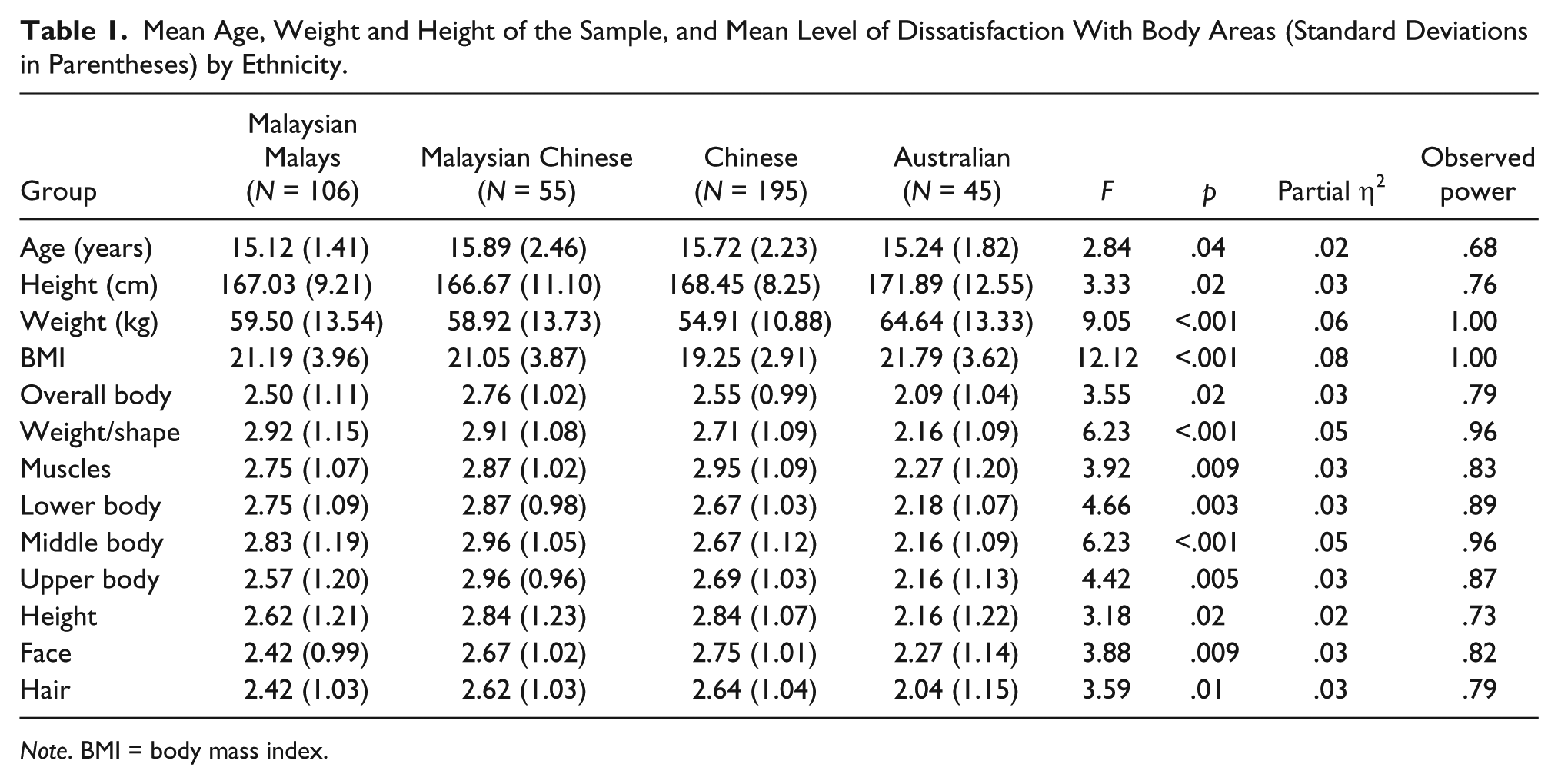
Note. BMI = body mass index.
A MANOVA was conducted to determine group differences in height and weight. Using Pillai’s trace, the model was significant, F(6, 794) = 7.89, p < .001, Partial η2 = .10, observed power = 1.00. There were significant effects for both height, F(3, 397) = 3.33, p = .02, partial η2 = .03, observed power = .76, and weight, F(3, 397) = 9.05, p < .001, partial η2 = .06, observed power = 1.00. Tukey’s post hoc tests revealed that Australian participants were significantly taller than Malaysian Malays and Malaysian Chinese (p < .05 in each case). Australians and Malaysian Malays were significantly heavier than Chinese participants (p < .001 and p < .05, respectively).
Two ANOVAs were conducted to determine group differences in age and BMI. The results revealed significant differences on BMI, F(3, 397) = 12.12, p < .001, partial η2 = .08, observed power = 1.00, and age, F(3, 397) = 2.84, p = .04, partial η2 = .02, observed power = .68. Tukey’s post hoc tests revealed that the Chinese participants had significantly lower BMI than Australian (p < .001, d = .77), Malaysian Malay (p < .001, d = .56), and Malaysian Chinese (p < .01, d = .53) participants. Although the ANOVA result for group differences in age was significant, no significant age differences were apparent in the post hoc comparisons (see Table 1).
Controlling for age and BMI, an ANCOVA was conducted to determine differences on overall body dissatisfaction among the four groups. There were significant group differences, F(3, 395) = 3.55, p = .02, partial η2 = .03, observed power = .79. Malaysian Chinese and Chinese participants had significantly higher levels of overall body dissatisfaction compared with the Australians (p < .05 in each case, d = .65 and .45, respectively).
A MANCOVA was conducted to test for group differences across the dimensions of body dissatisfaction assessed by the extended scale. As the previous analyses found significant group effects for age and BMI, these two variables were entered as covariates in the MANCOVA. Using Pillai’s trace, the model was significant, F(24, 1,170) = 2.15, p = .001, partial η2 = .04, observed power = 1.00. There were significant differences between groups for level of dissatisfaction with all dimensions of body dissatisfaction. Tukey’s post hoc analyses indicated the following significant differences, all with medium-high effect sizes.
Australian participants were significantly less dissatisfied with their
Weight/shape than Malaysian Malay (p < .001, d = .68), Malaysian Chinese (p < .01, d = .69), and Chinese participants (p < .01, d = .50)
Muscles than the Chinese participants (p < .01, d = .59)
Lower bodies than Malaysian Chinese (p < .01, d = .67), Malaysian Malay (p < .01, d = .53), and Chinese (p < .01, d = .47) participants
Their middle bodies than Malaysian Chinese (p < .01, d = 75), Malaysian Malay (p < .01, d = .59), and Chinese (p < .01, d = .46) participants
Upper bodies than Malaysian Chinese (p < .01, d = .76) and Chinese (p < .05, d = .49) participants
Height (p < .05, d = .59), face (p < .05, d = .45), and hair (p < .05, d = .55) than Chinese participants
Partial correlations were conducted to determine the associations between overall body dissatisfaction and dissatisfaction with the five body features assessed by the original Body Image Dissatisfaction scale for each of the four groups, controlling for BMI and age. All associations were significant (see Table 2).
Correlations Between Dissatisfaction With Aspects of the Body and Dissatisfaction With the Overall Body, for Different Group.

Note. BMI = body mass index.
p < .05. **p < .01. ***p < .001.
To determine if height, face, and hair dissatisfaction were associated with overall body dissatisfaction for each of the groups, further partial correlations were conducted, controlling for BMI, age, and dissatisfaction with the five body features mentioned above (see Table 2). Dissatisfaction with height was significantly correlated with overall body dissatisfaction for Malaysian Malays (r = .30, p = .003). Dissatisfaction with the face was significantly correlated with overall body dissatisfaction for Malaysian Malay (r = .28, p = .005) and Malaysian Chinese participants (r = .34, p = .017). Dissatisfaction with hair was also significantly correlated with overall body dissatisfaction for Malaysian Malays (r = .28, p = .006).
Discussion
The aim of the current study was to assess overall body dissatisfaction across Western and Asian male adolescents and to evaluate the specific body features associated with body dissatisfaction across these cultural contexts. In addition to the contribution of more commonly measured body features (weight/shape, muscles, lower, middle, and upper body), this study aimed to assess the relative importance of height, face, and hair to overall body dissatisfaction after BMI, age, and dissatisfaction with the other five body features were controlled for.
The hypothesis that Asian adolescent males would report greater overall body dissatisfaction than their Australian counterparts was partially confirmed, with Malaysian Chinese and Chinese participants reporting significantly higher levels of overall body dissatisfaction compared with the Australians. However, there was no significant difference between body dissatisfaction levels of Australian and Malaysian Malay adolescent males. Although these findings only partially support the hypothesis, these results are consistent with prior research that has suggested that overall body dissatisfaction among males is higher in Asian cultures than Western cultures (Holmqvist & Frisén, 2010; Jung et al., 2009; Kennedy et al., 2004; Kowner, 2002; Neumark-Sztainer et al., 2002; Ricciardelli et al., 2007; Wardle et al., 2006; Xu et al., 2010), or at a similar level (Altabe, 1998; Arkoff & Weaver, 1966; Mintz & Kashubeck, 1999; Ricciardelli et al., 2007).
Interestingly, while Malaysian Malay adolescents did not differ significantly from Australian adolescent males in overall body dissatisfaction, they also did not differ significantly in overall body dissatisfaction levels from Malaysian Chinese and Chinese adolescent males. This finding of no significant cultural differences in overall body dissatisfaction between the three Asian groups differs from a recent evaluation of adolescent girls across the same Asian cultures (Mellor et al., 2013), in which Malaysian Chinese girls reported significantly higher overall body dissatisfaction than Malaysian Malay and Chinese participants. It may be that cultural differences in adolescent male body dissatisfaction across Asian contexts are more subtle. However, further research is necessary to support this interpretation. Nonetheless, the fact that adolescent males from two Asian cultures reported significantly greater overall body dissatisfaction than their Australian counterparts, while adolescent males from another Asian culture did not, is consistent with sociocultural and theories of body image (Jung et al., 2009; Thompson, Heinberg, Altabe, & Tantleff-Dunn, 1999), which suggest that a range of sociocultural factors may affect body dissatisfaction and that seemingly similar cultural contexts may differ in their degree of overall body dissatisfaction (Holmqvist & Frisén, 2010; Jackson & Chen, 2008; Jung et al., 2009; Mellor et al., 2013; Swami et al., 2010; Xu et al., 2010).
Increasing affluence has been consistently identified as a social factor that may predict body dissatisfaction (Chen & Jackson, 2005; Holmqvist & Frisén, 2010; Jung & Forbes, 2007; Swami et al., 2010) and may help explain the finding that Malaysian Chinese participants’ overall body dissatisfaction was significantly higher than Australian participants’, whereas this was not the case for Malaysian Malays. While both Malaysian groups have high exposure to Western media, Malaysian Chinese are generally considered to be more affluent than Malaysian Malays, as noted by Mellor et al. (2013), and this may explain why Malaysian Chinese participants’ overall body dissatisfaction was significantly higher than Australian participants, whereas Malaysian Malay participants’ overall body dissatisfaction was not. These sociocultural factors were not directly measured in this study and are therefore tentative explanatory hypotheses, and it is likely that other sociocultural factors also played a role in the results.
Further investigation of the five more commonly measured body features, after controlling for age and BMI, revealed that Chinese participants were more dissatisfied with all five body features (weight/shape, muscles, lower body, middle body, upper body) than Australians. In addition, both Malaysian Chinese and Malaysian Malay participants were significantly more dissatisfied with their weight/shape, lower body, and middle body than Australian participants, and Malaysian Chinese participants were significantly more dissatisfied with their upper body than Australians. There were no significant differences between the three Asian cultures on these five body features. These results suggest that differences may exist between Western and Asian adolescent males on commonly measured body features. These analyses suggest that all five of these body features are relevant aspects of body dissatisfaction to be measured within Asian male adolescent samples.
The analyses related to the other three body areas assessed—height, face, and hair—suggest that Chinese adolescent males are significantly more dissatisfied with each of these than their Australian counterparts. No significant differences were found between Malaysian Chinese or Malaysian Malay participants and the Australian participants, nor were any significant differences detected between the three Asian groups. While the two Malaysian groups and Chinese group all came from urban Asian contexts, one possible explanation for these results is the portrayal of ideal male appearance in local media. For example, Watt and Ricciardelli’s (2012) male participants reported that some Asian cultures have a greater focus on male hair fashion than others. Certain Asian cultures (e.g., China) have also been noted as having a greater focus on the face in local media (Jackson & Chen, 2008). Further investigation is necessary to determine the importance of height, face, and hair in relation to overall body dissatisfaction in differing Asian contexts, but these results provide preliminary evidence that these body areas may be salient to body image for male adolescents in some Asian contexts.
To investigate these results further, the correlational analyses demonstrated that all of the five more commonly measured body features (weight/shape, muscles, lower bodies, middle bodies, upper bodies) were significantly associated with overall body dissatisfaction across all groups, after controlling for age and BMI. In addition, when dissatisfaction with these five body features was also controlled for, dissatisfaction with height, face, and hair was significantly correlated with overall body dissatisfaction for Malaysian Malays. Dissatisfaction with the face was also significantly correlated with overall body dissatisfaction for Malaysian Chinese participants. These results add further support for the importance of the more commonly measured body features across Western and Asian contexts and also the additional importance of height, face, and hair in Asian cultures.
One point to consider in relation to these findings is that the assessment of body dissatisfaction in this study assumes that body dissatisfaction is relatively stable. This may be the case in relation to certain features of the body, such as height, which are not readily changeable or modifiable. However, other body image experiences may be temporally determined. For example, an adolescent might not be satisfied with their face if they currently have acne, but they may be more satisfied when the acne resolves. Similarly, a hair styling may be associated with dissatisfaction, but once the style grows out, satisfaction may rise. Body satisfaction may also be contextually influenced. Tiggermann (2001), for example, has shown that both global body dissatisfaction and body esteem change according to situations in which adolescents find themselves, and Fuller-Tyszkiewicz, Skouteris, and McCabe (2013) have shown that body dissatisfaction increases after engagement in exercise. While this raises the issue of how body dissatisfaction should be conceptualized (stable or situation/context dependent) and therefore measured, the results of the current study demonstrate the need to develop more culture-specific measures that include aspects such as height, face, and hair dissatisfaction for use among males in Asian cultures. The inclusion of both culturally specific features and salient cross-cultural body features may enable both comparison consistency and cultural appropriateness and increase the validity of the assessment of body image measures in future research.
This study had several limitations. First, body dissatisfaction was assessed in a nonspecific manner. That is, each of the body features measured could be defined by a wide variety of physical attributes, but only one global question was asked for each body feature. For example, hair attributes may include color, texture, length, and so on, whereas this study asked one nonspecific question about satisfaction with hair. This nonspecific manner of measurement therefore did not elucidate from participants the particular attributes of each body feature that dissatisfied them, or look at cultural differences in these attributes. Measurement of body dissatisfaction was also nondirectional. For example, participants were asked how dissatisfied they were in general with their weight/shape rather than whether they were dissatisfied with being too heavy or too light. Furthermore, while we added three items to the original body dissatisfaction scale we used based on the literature on Asian males, it is possible that other body features may also be important. For example, skin tone and texture may be important determinants of body dissatisfaction among Asian populations (Rongmuang et al., 2011). Future assessments of the determinants of body dissatisfaction among adolescent males could include assessment of other such potentially relevant traits.
A second limitation is that the study did not assess participants’ pubertal stage. Since male body image is likely to be associated with muscle build, the experience of puberty and growth spurt are of potential importance. Malaysian Chinese and Chinese participants may have expressed higher body dissatisfaction because they have delayed onset of puberty relative to their Australian counterparts. Participants in this study ranged from 11 to 19 years, and there were significant differences in mean ages across groups. It is likely that there were also differences in the proportions of adolescent males in the postpubertal stage across groups. Although BMI was statistically controlled for in the analyses, the relationship between puberty-associated weight gain and body dissatisfaction may have been a source of bias. This may be particularly the case if age of pubertal onset varies across contexts. Although some studies have attempted to identify the age of pubertal onset in different countries, and have identified a range of factors associated with it, there are difficulties related to the identification of pubertal stage among males, and other methodological issues in such studies (e.g., Herman-Giddens et al., 2012; Parent et al., 2003).
A third limitation of the study is that while all participants were recruited from large urban environments areas, we did not include a specific measure of socioeconomic status of the participants. Previous studies have established that locality and rurality have an effect on body image and aesthetic judgments in Malaysia (Swami et al., 2012; Swami & Tovée, 2005), and the differences found may be confounded by socioeconomic status. Finally, the results are limited by the small final sample size of two of the groups: Malaysian Chinese (n = 55) and Australian (n = 45). With a response rate before exclusions of 35% in Australia, and a large number of participants excluded due to race or BMI issues, there may have a level of self-bias present within this subsample. It is therefore important that the study is replicated with larger samples to verify the findings before they can be generalized.
In summary, the current study identified dissatisfaction with some body features such as weight/shape, muscles, upper, middle, and lower body that is shared across Western and Asian adolescent males. It also identified specific body features related to overall body dissatisfaction that differ across cultures, with height, face, and hair being more strongly related to overall body dissatisfaction in some Asian cultures. As well as the differences in salient body features between Western and Asian cultures, differences between the different Asian groups were also identified. These findings highlight the importance of understanding both the influence of globalization on body dissatisfaction in Asian cultures, as well as other sociocultural factors that influence body dissatisfaction. A broader understanding of cultural differences in body dissatisfaction will allow a better understanding of the factors that contribute to body dissatisfaction among male adolescents from different cultures and should inform future development of assessment and intervention/prevention strategies to address all possible body features related to body dissatisfaction for different cultural groups. The aim of such interventions need not be to change unchangeable body features but to change cognitions and emotions about the features that contribute most strongly to body dissatisfaction.
Footnotes
Declaration of Conflicting Interests
The author(s) declared no potential conflicts of interest with respect to the research, authorship, and/or publication of this article.
Funding
The author(s) received no financial support for the research, authorship, and/or publication of this article.