




Abstract
Unintentional injuries are a leading public health problem for children, particularly among those living at lower socioeconomic levels. Parents play an important preventive role, and the aim of this study was to examine fathers’ views on the role of their family financial situation in preventing children’s injuries. In-depth interviews were conducted with 15 fathers of children 2 to 7 years living in western Canada. Questions solicited fathers’ views about their financial situation and their child injury prevention efforts. Data analysis was underpinned by masculinity theory and guided by constant comparative grounded theory methods. Findings included that fathers living with fewer financial limitations emphasized use of safety equipment and aligned themselves with provider and protector masculine ideals. Fathers with moderate financial constraint described more child-centered safety efforts and efforts to manage finances. Those facing greatest constraint demonstrated aspects of marginalized masculinities, whereby they acknowledged their economic provider limitations while strongly aligning with the protector role. These findings hold relevance for development of interventions aimed at reducing child injury risk inequities. Taking into account how masculinities may shape their beliefs and practices can inform design of father-centered interventions for men living at different points on the socioeconomic spectrum.
Introduction
Unintentional childhood injuries are a leading public health problem for which parents play important preventive roles (Morrongiello & Schell, 2010). Research indicates that substantial socioeconomic disparities exist for all major causes of unintentional injuries among children (Laflamme, Burrows, & Hasselberg, 2009). A Canadian study reported that children in the lowest income quintile had 2.15 greater risk of injury death than the highest income quintiles (Birken, Parkin, To, & Macarthur, 2006). Popay and others have studied differences in lay understandings of health inequalities among people living in advantaged and disadvantaged areas (Davison, Mitchell, & Hunt, 2008; Popay, Bennett, et al., 2003; Popay, Thomas, et al., 2003), however, gender has not been a main focus and only a small number of studies of lay health perspectives have explicitly addressed masculinities (Robertson, 2007).
The majority of research on children’s injuries has been conducted with mothers; however, there is a need for better understanding of fathers’ roles since research suggests fathers’ behaviors are related to children’s injury rates. For example, one study reported that higher levels of paternal involvement were associated with fewer child injuries (Fujiwara, Okuyama, & Takahashi, 2010). In another study by Schwebel and Brezausek (2010), it was found that fathers who reported their work to be benefitting their family life had children with higher levels of injury. Therefore, it is important to learn more about the practices and perspectives of fathers related to child injury prevention as well as how those living across a range of financial situations may experience child safety issues. Researchers have identified challenges of addressing increased risk of injury among low-income populations and the lack of understanding about the underlying mechanisms and potentially effective solutions (Birken & MacArthur, 2004; Laflamme et al., 2009). Understandings of fathers’ views and the gendered contexts influencing these views may help elucidate reasons why children living in different socioeconomic locales experience different injury risks. Such understandings may offer ideas for developing prevention messaging relevant to those living in different financial situations.
Masculinities, Men’s Health, and Fathering
Connell’s theoretical work on masculinities (2005) posits that different “configurations of gender practice” (p. 29) act in contemporary Western society to form a gender order that affects health practices and health status. Hegemonic masculinity is the dominant form of masculinity and reflects ideals of strength, robustness, displaying aggressive behavior, and physical dominance. In the context of men’s health practices, this is seen to garner “emotional and physical control” and “denial of weakness or vulnerability” (Courtenay, 2011, p. 145). In contrast with the hegemonic ideal, less powerful configurations include subordinated masculinities (e.g., gay masculinities) and marginalized masculinities (e.g., marginalization associated with social class, race, or disability). Connell also refers to complicit and protest masculinities. The first acknowledges that most men do not meet the standards of hegemonic ideals, but rather benefit in the overall effect of hegemony on the subordination of women and some men. The latter describes actions enacted by men through exaggerated displays of masculine conventions (e.g., the use of violent behavior) as a response to a sense of powerlessness. Overall, these configurations of masculinities are seen to operate at structural and individual levels, influencing how men think and act (Connell, 2005; Williams, 2009).
Literature on men’s health and masculinities has grown in past years addressing a wide range of health issues (Garfield, Isacco, & Rogers, 2008) such as men’s depression, cancers, dietary behavior, tobacco use, and help-seeking behavior (Bottorff, Oliffe, Robinson, & Carey, 2011). Research on masculinity and fathering has addressed experiences of caregiving with few studies pertaining to fathering in relation to children’s health issues. One study focused on child health has included study of fathers’ experiences of smoking in the postpartum period (Oliffe, Bottorff, Johnson, Kelly, & LeBeau, 2010). To date, research has not addressed fathering and masculinity in connection with child safety and economic issues.
It has been argued that through fatherhood, men experience changes in their thinking about health and in their health practices (Backett & Davison, 1995). Furthermore, fatherhood has been described as helpful in providing men with an alternative to unhealthy behavior (Mullen, 1993). Changes in the lifecourse, including the anticipation of fatherhood, may lead men to shift their masculine practices from excesses and desire for release toward controlling hedonistic behaviors. This has been described by Robertson (2007) as moving toward “ideals of taking control and being the provider” (p. 56). Some fathering research has also focused on the intersections between fathering, masculinity, and economic status. For example, Catlett and McKenry (2004) examined masculinity, gender, and social class in the context of postdivorce relationships, whereas Plantin, Mansson, and Kearney (2003) compared involved fathering experiences of men across different social classes, arguing that fathering practices are shifting toward greater involvement. According to Wall and Arnold (2007), involved fathering includes spending more time with children, being more nurturing and emotionally involved, and sharing care giving with mothers. Other researchers have focused on aspects of “good fathering,” for example, Palkovitz (2002) argues “good fathering” is characterized by engagement, accessibility, and responsibility for children. Researchers have also addressed myths about fathering among low-income men. Tamis-LeMonda and McFadden (2010) reported that low-income fathers struggled to provide for their children, challenging prevailing myths about low-income fathers as nonessential or “dead-beat” dads.
However, little is known about how men within particular economic spheres view fathering practices in relation to their children’s safety. Moreover, although studies have examined fathers’ child safety perceptions and roles both quantitatively (Morrongiello, Walpole, & McArthur, 2009; Schwebel & Brezausek, 2010) and qualitatively (Brussoni, Creighton, Olsen, & Oliffe, 2013; Brussoni & Olsen, 2011), a gendered connection to masculinities (as it intersects with economic factors) has not been previously studied. Masculinity theory as an analytic lens can uncover gendered patterns in men’s perspectives about their fathering and child injury prevention efforts. How men adhere to and resist dominant masculine ideals can illuminate gendered fathering practices that may be protective for children or place them at increased risk of injury. For example, fathers’ practices associated with risk taking may increase injury exposures for children whereas those aligned with a protector role may reduce risks. This analytic approach can suggest avenues for messaging to reach fathers in ways congruent with their held meanings related to child safety, their financial situation, and their fathering roles. Thus, the purpose of this study was to examine fathers’ views on the role of their financial situation in preventing their children’s injuries and how their views reflected different expressions of masculinity.
Method
A social constructionist gender analysis was used to explore fathers’ views about how their financial situation influenced their orientation toward injury prevention for their children and how dominant ideals of masculinity shaped their understandings. Sociocultural theory on masculinity in the context of fathering (Connell, 2005; Courtenay, 2011; Robertson, 2007) provided the theoretical framework for analysis. Analysis was also informed by sociological theories on health inequalities and the role of lay knowledge (Blaxter, 1997; Popay & Williams, 1996). The steps of analysis were guided by grounded theory methodology (Charmaz, 2006; Strauss & Corbin, 1998).
Procedures
Data were collected from fathers participating in a study exploring the attitudes and practices of parents toward unintentional injury prevention for young children. Fifteen fathers ranging in age from 28 to 60 years with children 2 to 7 years old, living in urban and rural centers in British Columbia, Canada, were recruited. Participants were recruited via fathering program networks, community centers, and online forums. Purposive sampling (Morse, 1994) was used to ensure diversity within the sample, for example, through inclusion of fathers with varying levels of income.
Ethics approval was obtained from the university and health center ethics review board. Two in-person interviews were conducted with fathers. These lasted from between 1 and 2 hours and were audio-recorded. Field notes were completed following each interview. Fathers were interviewed by trained female researchers. Interview questions related to parents’ child safety attitudes and practices and specific questions addressed fathers’ views about their own household financial situations. Interview questions included the following: (a) How does your family’s current financial situation allow you to do the kinds of things you want to do with your children? (b) In what ways do you feel that your current household financial circumstances help or hinder your efforts to keep your child safe from injuries? Participant demographic data were collected and field notes augmented interview data. Participants received a CAD$ 50 honorarium.
Sample and Settings
The mean age of the 15 participants was 38.4 years, and all participants were White. A summary of key demographic characteristics are outlined in Table 1. Five of the 15 participants lived in a medium-sized city in British Columbia with a population of 71,000 (Statistics Canada, 2007) and with incomes dependent largely on forestry and the public sector (BC Stats, 2009). Among these fathers, two earned more than $80,000; one between $60,000 and 79,000; and two between $30,000 and $59,000. In comparison, the median income among couple households with children this city was $89,400 (2005 figures; Statistics Canada, 2007).
Sample Demographics (N = 15).
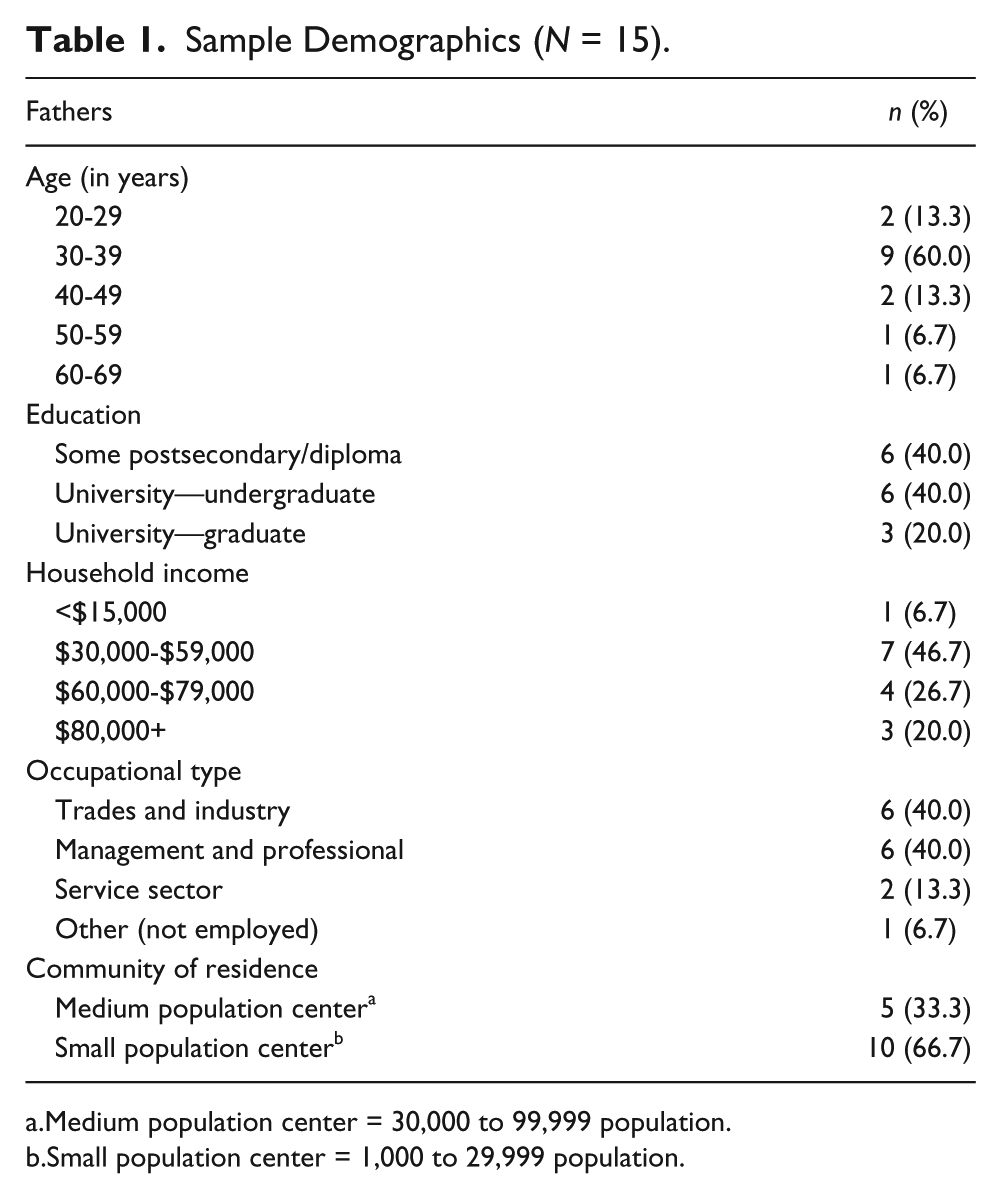
Medium population center = 30,000 to 99,999 population.
Small population center = 1,000 to 29,999 population.
Ten fathers lived in three smaller rural centers in British Columbia. Six were from a center with a population of 1,500, two from a center with a population of 7,200, and two from a center of 2,100 residents. Incomes in these centers depend mainly on forestry, public sector, and mining, with median household incomes ranging from $67,900 to $77,500 (BC Stats, 2009; Statistics Canada, 2007). Among the 10 fathers, one reported an income of more than $80,000; three reported incomes between $60,000 and 79,000; five between $30,000 and $59,000; and one reported income less than $15,000. In addition to self-reported levels of family income, fathers also self-identified whether their current financial situations caused constraint in terms of affecting the kinds of activities they were able to do with their children.
All four communities were rich in recreational and outdoor opportunities for families. Housing and other costs were lower than in large, urban metropolitan areas of province and median incomes were close to the provincial average, allowing many living in these communities to afford to engage in active recreational lifestyles. Likewise, families’ abilities to live on one income were enhanced because of lower costs of housing in these areas.
In terms of their family relationships, 11 of the 15 fathers were living with their partners, either married or common-law. Of the four single fathers, three were separated or divorced and one had never been married. Among the 15 fathers, 13 reported working full-time, one part-time, and one was at home full-time. In terms of family income, only one of the 15 fathers reported living on dual-incomes. Of the 11 fathers living with partners, 10 had female partners who were at home full-time, and their yearly household incomes ranged from $30,000 to $59,000 to more than $80,000.
Six of the fathers were employed in trade and industry related work. Fathers’ occupations in these sectors included truck driver, firefighter, construction/contracting, and railway transport. Another six were working in professional or management occupations that included teachers, health care professionals, manager, and private consultant. Two were employed in the service sector and one father was not employed, but receiving government income assistance.
Data Analysis
Digitally recorded interviews were transcribed verbatim, and NVivo 10™ was used to code and organize data. In the initial stage of analysis, codes were developed using constant comparative techniques (Strauss & Corbin, 1998) that reflected the main study concepts related to gender and socioeconomic conditions. Three of the authors coded the first five interviews. To ensure consistency, at least two authors coded every fifth interview and any discrepancies were discussed until consensus was reached. As analysis proceeded, group discussion advanced the development and modification of the codes, categories, and concepts. The interview guide was also modified accordingly to fully explore and test emerging concepts.
As analysis and writing proceeded, fathers’ views were explored regarding the role played by their financial situation in preventing injuries among their children and how their views reflected different expressions of masculinity. Fathers’ descriptions of their experiences of differing levels of constraint were grouped and counted, an approach supported by Seale and Silverman (1997). Data coded as relevant to economic factors were examined in relation to the following research question: What are the connections between masculinities (as it intersects with economic factors) and unintentional child injury prevention from the perspectives of fathers?
Results
Fathers expressed a range of experiences of financial constraint related to activities they did with their children. Comparing participant descriptions of their family’s financial circumstances and whether it affected the kinds of things they did with their children yielded a general division between those who agreed they were experiencing constraints and those who were not. Comparing fathers’ descriptions of constraint with their reported yearly household income levels indicated that these data components were closely linked. Those reporting a family income of less than $60,000 tended to describe their financial situations as being constrained, whereas those with incomes more than $60,000 described their situations as nonconstrained. Experiences of fathers expressing few financial limitations, as well as those describing moderate and more severe constraints are outlined below.
Varied Experiences of Financial Constraint and Gendered Fathering Practices
In considering whether their current financial situation allowed them to do the kinds of things they would like to with their children, fathers’ answers reflected their perceptions of varying levels of financial constraint. This first theme highlights fathers’ varied economic experiences and explores links with gendered aspects of fathering. The second theme presents findings on how gendered fathering amid varied experiences of constraint was related to fathers’ explanations about keeping children safe from injury.
Finances Not Limiting
Eight participants suggested that their finances did not pose concern and these men generally felt they could afford to do what they wanted with their children. Seven of the fathers reported an annual household income level of more than CAD$60,000, and one between $30,000 and $59,000. One 43-year-old, self-employed, married father of three children expressed feeling fortunate that he had the means to do the things he wanted with his children:
Yes, it’s great . . . we’re very lucky. . . . I have a business that allows me to take time off when I need to. . . . I can go and get the kids . . . take them to skating or . . . do this . . . do that, it’s no issue, we’re very lucky that way. . . . I mean they could do anything they want . . . it’s just kind of exposing them to stuff and seeing what they like to do.
This excerpt highlights his financial resources and flexible work schedule that he mobilized toward his ideals of contemporary fathering, prioritizing being involved with his children and providing them with opportunities. Evident were also traditional masculine ideals of autonomy and self-reliance. Yet masculine hierarchies are implicit here by virtue of the participant’s concession that he (relative to other men and families) is able to share his good fortune to afford his children choice.
Similarly, a 50-year-old self-employed consultant in the resource sector who was married with three children, expressed how finances were not problematic for him: “in terms of basic needs or whatever, if we need it then we just go get it . . . it’s not that big of an issue.” In both these examples, fathers were self-employed, and emphasized their capacity to be the sole family breadwinner and the purchasing power that afforded them. Within the context of involved fathering was evident the men’s comfort at being able to fulfill more traditional breadwinner and provider roles.
A divorced 31-year-old father had primary custody of his two children; his ex-partner lived in another city, regularly visiting the children. He felt fortunate to have significant assistance from his ex-partner’s family, including child care that coincided with his irregular work schedule. This outside help along with full-time employment in the transportation sector allowed him, despite being a single father, to be an effective financial provider to his children:
I mean just with the divorce, it’s been a little tougher trying to manage . . . but because it’s at the tail end of [the divorce], no it’s not an issue. I find that the first thing they want to do, we just go and do it.
These examples indicate that for a number of the fathers, income issues were not seen as constraining despite holding the position of sole financial provider. Their professional and resource sector occupations provided them with stable income and allowed them to engage with their children in financially nonconstrained ways.
Financial Constraint Framed as Parenting Choice
Some fathers described how their finances posed moderate constraints. The household income levels reported by the three fathers in this group were in the range of CAD$30,000 to $59,000. Although these fathers described some financial hardship, they tended not to speak directly of a lack of resources preventing them from being able to do things with their children. Rather, they framed their financial status in terms of choice and control over making the necessary adjustments to their children’s activities. For example, one 34-year-old divorced father with three children working as a clerk in a small, rural center affirmed that his current financial situation was “definitely an issue. No doubt, in everything. . . . So, I don’t think its necessarily sacrificing activities, we’re just changing them.” Men also framed their financial limitations as deliberate choices based on philosophies about parenting, for example, their desire to have one parent stay at home with their children. As one 28-year-old carpenter with three children and a wife who stayed at home mentioned:
We’re not people motivated by the dollar, we think it’s worth it in these first few years; it’s worth a million dollars to have a stay-at-home parent for the first five years.
Drawing on similar philosophies another couple, both teachers with boys aged 1 and 3 years old had decided that the mother would not work but rather stay home with their children. Their reduced income was framed by the 32-year-old father as a deliberate choice that reflected their priorities:
So we’re making ends meet with me just going to work and my wife being here at home and that’s what we feel our priority is and we’re glad we have that ability . . . we’re happy with our choice and we know it limits us in other things but we’re okay with that.
Thus, fathers living with moderate financial difficulty framed their situations in terms of parental choices about childrearing as serving the best interest of the child and worthwhile in terms of sacrificing the higher levels of family income. For some, this reflected an adherence to a more traditional pattern of the father in a breadwinner role, with an acknowledgement of the financial challenges associated with having only one financial provider for the family.
Experiences of More Severe Constraint
Four fathers expressed living in situations with more severe levels of financial constraint. These fathers reported having annual household incomes ranging from less than CAD$15,000 to between CAD$30,000 to $59,000. One father reported that he was living on income assistance, while the occupations of two others included modest paid jobs in the automotive and transportation sectors, and one participant who was waiting to begin a new out-of-town resource sector job. The hardship experienced by these fathers was expressed in different ways. One single 48-year-old father who was the main caregiver to six children described how his limited capacity to earn a full-time wage affected the things he was able to do with his children:
I’m in a bit of a special boat. I can’t work full-time, sometimes I can’t work even part-time. . . . Most things that I want to do I can’t do.
His ex-partner had a severe mental illness and was able to visit the children but unable to help care for them. His primary caregiver role allowed him only part-time, irregular work in the transportation sector. He expressed both financial and time-related constraints on the kinds of activities that his children were able to do.
A 32-year-old, married father of two children who worked two jobs while his wife also worked part-time noted that his financial situation “somewhat” curtailed the things he would like to do with his children. He described his efforts to make ends meet and how time limitations also came into play:
The fact that I have to work a second part-time job, actually almost sometimes almost full-time. Then, in order to make ends meet means that we may have less time for shuttling them around to their activities.
This father also spoke of how accessing financial assistance, despite its limitations, helped make some of his children’s activities more affordable:
When there is something the kids do like dance or figure skating, those things all cost money. Now there are subsidies, for some of those things you can get grants and whatnot. So that kind of alleviates that, but definitely, like ‘hey, there’s a soccer camp coming to town, oh, it’s a hundred and fifty bucks per kid,′ well, you know.
Another 34-year-old, married father of four children who was a single income earner spoke of currently waiting to start a new job out of town in the resource sector. This change came about because of a lack of local work to keep his contractor business viable. In considering whether his financial situation allowed him to do the kinds of things he would like with his kids, he responded that “typically it does, but at this point it doesn’t because our work is so depressed.” He saw his current year as “atypical” and described how it affected his family’s activities:
I’d like to get out skiing a little bit more and I’d like to start snow shoeing with at least [daughter] because she’s old enough, but as of right now, we can’t do those things . . . we’re kind of taking care of what we need to take care of . . . everything is getting kind of pushed back for activities, but in a typical year, we try and get out and do more.
While their actual income levels were comparable to those fathers expressing more moderate constraint, these fathers described more severe constraint amid the challenges of having to work multiple jobs, or relocate because of a lack of work—situations that limited or entirely halted any “extras” such family activities or recreational pursuits. As a group, they did not position their reduced income in terms of choices but rather due to changes imposed from external forces such as economic downturns, which reduced their paid work opportunities. For men whose primary role was strongly aligned with breadwinner status and having economic power to purchase goods such as children’s activities, these external challenges could affect their ability to adhere to both masculine and contemporary fathering ideals.
Linking Gendered Fathering Injury Prevention Practices and Financial Situations
The subthemes below address how fathers perceived their own level of financial constraint and how they saw this as connected to keeping their children safe from injury. These explanations reflected diverse masculinities within the context of fathering that were also embedded within broader structural contexts of their occupational and employment status.
Purchasing Power to Optimize Childhood Safety
Among fathers who saw themselves as unconstrained, some described the importance of supervising their young children. However, most placed emphasis on how safety equipment and material goods were useful to help prevent injuries. For example, a 43-year-old, self-employed father, who ran a local business, described how he and his family enjoyed nearby recreational activities such as skiing in winter and boating in summer. He described his ability to purchase needed safety equipment for his children’s recreational pursuits while recognizing that it might not be so easy for other families to do so:
For ski racing, now they want the full things (helmets). We had another helmet that didn’t have the hard shell ears, but we just went out and bought one . . . it’s expensive for those . . .
Helmets kind of add up?
Yeah, you know, their gear, we’re sharing it all down, but it’s not that expensive . . . but, I’m sure it might be for some families, right? Lots of families, yeah.
So, you feel like you’re in a position to (buy) what you need to buy?
I would say yeah . . . make sure you’ve got the right life jackets that fit and are comfortable. . . . Hats, sun protection, all that stuff, we don’t really spare any expense when it comes to the kids. Not that they’re spoilt or anything, but they just have the stuff they need I would say. (Father, 43 years, three children, 2, 4, and 5 years old)
His account emphasized aspects of quality, comfort, and aesthetics of the safety equipment he purchased for his children. This aspect was also mentioned by a 31-year-old single father of two boys (aged 3 and 4 years), who enjoyed cycling with his children. He mentioned the importance of buying high-quality equipment that he saw as more effective in preventing injury amid reflecting on how his well-paid job allowed him to do so:
I make a good enough wage that when I bought them helmets, I shop at [name of store], that’s where I buy all my bike stuff and it’s not cheap, right? . . . Instead of buying the 15 dollar one, I might have spent 28 dollars on a helmet, but then I know its adjusted perfectly. . . . I would never cheap out on that kind of stuff, it just doesn’t make sense . . . especially safety equipment, a lot of it is designed to take that impact and you’d want something that hasn’t been beat up because they have a shelf life, right? . . . It’s not worth a brain injury, so why wouldn’t I do everything that I can, having the economics to do that is quite helpful. . . . I’m thankful that I just don’t have to question it, I just do it.
These fathers conveyed how they associated keeping their children safe from injury with being able to provide for them through the purchase of high-quality consumer products perceived as functional and appealing. The fathers’ interviews reflected their alignment to ideals of hegemonic masculinity related to being a good provider and protector amid signaling a more affluent, middle-class lifestyle. The provider role was reflected in fathers’ descriptions of purchasing high-quality goods and taking advantage of recreational opportunities in the community. Thus, in these dad’s accounts of how their financial situations related to injury prevention strategies, hegemonic masculine ideals were reflected in how they portrayed themselves and their children (both boys and girls) as action-oriented, recreation seekers. While in more rural settings such recreational opportunities could be seen as typical and affordable activities, the descriptions of well-resourced fathers reflected a focus on not just the functional aspects of equipment but also on comfort and aesthetic appeal. These extensions reflected linkages between consumerism and the male provider role with purchases of higher end consumer products allowing fathers to express alignment to hegemonic masculine ideals.
Practices reflecting the protector role were also evident in the fathers’ description of being able to provide gear and safety equipment as part of recreational pursuits. Participants talked about qualities of safety-related equipment that related to the effectiveness of equipment to prevent children’s injuries such as the need for a helmet to be able to take an impact and prevent head injuries. Furthermore, these fathers’ could afford the time to engage in the protector role during recreational activities, for example, being “out on the boat all day” or bike riding. In spending this time with their children, fathers also had opportunities to engage in other safety-related interactions with children such as teaching or supervision.
Therefore, those fathers with better resourced financial situations reflected hegemonic masculine ideals of both provider and protector. Engaging in safety practices such as purchasing high-quality safety equipment for the pursuit of high-end recreational activities with their children afforded them opportunities to express their protective practices. At the same time, fathers also drew purchase on masculine provider ideals through their safety related consumer preferences and buying power.
Safety Practices as a Means to Display Resourcefulness and Accept Economic Vulnerabilities
For some fathers with moderate financial constraints, the need to manage limited household finances influenced their strategies for preventing children’s injuries. One father positioned his constrained finances as affecting other aspects of his family’s life, but not the children’s safety. He explained that although they were “making ends meet,” they did experience limitations in the things they could do as a family, but he also emphasized how he managed his finances such that the purchase of safety related material items held priority:
I wouldn’t say it [financial circumstances] would hinder it because I think the safety things would be more priority than other things . . . for example, my wife wanted me to get one of those chain locks for our front door because our oldest son has figured out how to unlock it and open the door . . . so something like that we don’t feel the pressure of finances to hinder us from buying that . . . and we’re going out to the lake this afternoon and we don’t have a life jacket for our older one so we’re going to stop at [store] and pick one up for him before we go . . . so I wouldn’t say finances is a hindrance to getting the safety things we need for our boys. (Father, 32 years old, two children)
Evident in this father’s response to financial constraints is his alignment with masculine ideals of provider and protector. He positions himself as the sole income earner, an active seeker of recreational opportunities for his children (a signifier of dominant masculinity in this cultural context), and as action oriented in his explanations of setting priorities and strategizing to manage the family financial situation amid protecting his boys’ well-being. Thus, he understands himself as being in control of the situation and emphasizes the role of personal choice in being able to manage finances in a strategic way.
Other fathers also positioned themselves as actively taking charge of their situations and placing priority on their children’s needs. For example, one father focused on the benefits of having a stay at home parent for their children and emphasized the value of spending time coaching or teaching his children about safety:
I don’t think my economic situation at all hinders their danger level. If I was working all the time I wouldn’t be able to spend time coaching them then that would be a hindrance. We have been able to offer the kids at least one stay at home parent all these years and that’s been a huge priority. . . . I don’t care how much money I put in their college fund, its more worth it for their betterment as people in society to have somebody at home. So, I think that relates to their safety in every facet of their exercise and activities. (Father, 28 years, three children)
He also noted how he and his wife were “very much open to used goods or hand me downs.” While he maintained that he would “use judgment” and never “buy junk,” he also acknowledged that these items could “potentially have a fault in them”’ or have “something that’s totally unsafe and has been recalled and I don’t know about it.” His fathering and child safety practices in the context of constrained finances revealed implicit resistance to the values assigned to money versus human connection. His focus on child-centered safety strategies that included teaching and coaching was also evident. He also favored used sports and safety equipment, despite the possibility they might be less than perfect condition and expressed his willingness to use extended family resources and hand-me downs. These orientations with a focus on teaching and coaching, a disregard for materialism, and a willingness to acknowledge and work with financial constraints reflected adherence to some dominant masculine ideals but not others. This father’s explanations showed a resistance to dominant discourses around affluence and consumerism, evident through his explicit assertions that child safety was achievable through diligent fathering rather than limitless financial resources.
Resisting and Accepting Marginalized Economic Situations
Several fathers spoke of experiencing severe levels of financial constraint; however, they asserted that these challenges did not encumber their strategies to promote their children’s safety. In fact, some viewed having a low income level as protective and keeping their children safer. As a single, 48-year-old father of six children suggested “where we live, it’s safer to be broke,” explaining,
Because you can’t afford going somewhere or doing something that may present a danger . . . or you don’t join the skidoo club . . . you just don’t have those machines.
One 32-year-old father of a 2-year-old child, who was living in the home of one of his parents, also objected to the idea of child injuries being linked to low income levels:
I’ve been on income assistance now since [son] was born . . . and I don’t think that has anything to do with it at all. . . . I mean the economics, it’s up to the individual parent, I think keeping your child safe is, yeah, it doesn’t have nothing to do with money for sure . . . it’s about the actual parent.
While these participants acknowledged their marginalized breadwinner status, they refuted the idea that their fathering abilities might be compromised. This positioning can be understood as demonstrating the plurality of masculinities whereby specific characteristics of hegemonic masculinity are triaged while others are explicitly contested. In other words, participants aligned with fathering protector roles while distancing themselves from salary man ideals—especially as a means to an ends for keeping their children safe.
In contrast, two fathers described ways that they thought their significant financial constraints could affect their efforts to prevent children’s injuries. For one 34-year-old father of four children who due to job relocation would soon be away from his family for several weeks at a time considered the possible impacts on his children:
It might affect safety issues a little bit because it’s going to be more of a burden on my wife as to taking care of kids. Yeah, because she’s not going to be able to have her eyes on them as much just because she’ll be spread thinner.
A 32-year-old father of two children described the potential safety impacts of being financially constrained in his “ability to customize your living environment.” He felt that with more money “you could go out and buy whatever house and fit it up exactly the way you want.” He described how the last house that he and his partner had rented had a yard that ‘was not kid safe at all.” He explained how this then affected his safety efforts with his children:
So, we had to extensively have discussions about areas that “you can’t play in, that’s not safe” . . . whereas if we had the money just, you know, pick a house and build a fence.
While reflecting a more marginalized masculinity in their admissions of the influence of the constraints on child safety, linkages to masculine ideals were also made in the participants’ steadfast commitment to overcome these barriers. For example, both fathers emphasized the central importance of teaching children and discussing safety issues with them, tactics that can be understood as adhering to the protector role but in a manner reflecting a more interpersonal and involved fathering approach.
Discussion
This analysis of fathers’ views on their financial situation and how these shaped their child injury prevention behaviors reveals an intriguing array of masculine practices. In all their accounts, there was evidence of some alignment with hegemonic ideals, most strongly in their desire to diligently protect their children from harm because of injury. While mothers are also seen as protectors of children, the idea of protection from fathers can be argued as broader in its conceptualization and linked to hegemonic masculinity. Ruddick (1997) describes the “good father” as a primary protector of children and the home with a historical context of men valued for bravery and strength in protecting their country in times of war (Ruddick, 1997).
For fathers who saw themselves as well-off (and who were in occupations that could support their desired lifestyles), dominant provider ideals were demonstrated through their accounts of being able to afford to have their children safely and actively engage with expensive recreational activities. Bundled within these men’s purchasing power were alignments to provider and protector ideals, which shaped their fathering identities. Moreover, affluent, consumer-oriented lifestyles were understood by these men as affording children important opportunities to learn through “doing,” which in turn was positioned as ensuring the child’s growth and development (as distinct from the potential for injury).
Martens, Southerton, and Scott (2004) discuss how consumption plays a critical role in the formation of adult identities, with individual consumption marking class-based social distinctions and boundaries. The current findings illustrate how features of consumption can be embodied or refuted by fathers in how they align or distance themselves philosophically and/or practically from those dominant ideals of masculinity. The working lives or roles of fathers in processes of production were linked to their abilities or choices to consume. Those earning higher wages spoke of their ability to purchase safety goods, whereas those who were more constrained financially spoke of making choices about their roles in production so they could be more directly involved in protecting their children.
Within the context of public health child safety promotion, Lupton (1994) has cautioned that health promotion messaging can be linked to consumer values but that this may only be effective among those who are more well off and who respond to “lifestyle messaging.” Lupton’s assertion resonates with the current findings and holds implications for how messages are targeted to subgroups of fathers based on their consumer capacity and constraints.
For participants who described themselves as less well off, a variety of factors, some of which resided outside the men’s direct control, were put forward to contextualize resistance and alignment to dominant masculine ideals. In contrast to Wall and Arnold (2007), who have argued that involved fathering maintains hegemonic ideals rather than providing an alternative masculine practice, our findings indicate the men with fewer financial resources routinely break and align with characteristics that might be understood as hegemonic. This is consistent with other fathering research, for example, Dolan and Coe (2011), who describe how fathers experienced marginalization in the context of childbirth but still drew on different forms of dominant masculinities. Likewise, Williams (2009) used Connell’s framework to analyze experiences of African Caribbean and White working-class fathers and reported how masculinities included both marginalized and hegemonic forms and were contradictory and dynamic in nature.
For fathers in the current study, it can be argued that some embody what Andersson, Cockcroft, and Shea (2008) refer to as “choice disability” or an “inability to implement prevention choices” (p. S74), which may demand that their fathering practices draw, at least in part, on alternative and less idealized and socially dominant performances of gender in response to structural constraints such as lack of secure, well-paying jobs. For example, reduced household incomes led fathers to adopt strategies for child safety such as utilizing used equipment and accepting assistance from extended family. Use of these alternative strategies allowed them a pragmatic way to address child safety needs, demonstrate personal agency, and maintain alignment with certain masculine norms such as resourcefulness and being a rationale, problem-solver.
However, for participants experiencing severe financial constraints, a compromised ability to deliver on their desire to ensure their children’s safety was present. These fathers distanced themselves from provider ideals and aligned more closely with protector roles. One question for further research is whether fathers’ stronger reliance on child teaching is consistent with more hegemonic practices related to control and authority (Ruddick, 1997) or whether it reflects more contemporary forms of fathering that encourage greater levels of interaction and involvement with children (Marsiglio, Day, & Lamb, 2000). Such work could help contextualize the connection between lower socioeconomic status and higher rates of childhood injury. But perhaps more important, the details shared by fathers who experienced severe financial hardship reveal how structural constraints and resulting choice disability can emerge to such an extent that some elements of child safety may be forgone as a by-product of focusing on providing for basic needs such as food and shelter. It is perhaps among this most vulnerable group that injury prevention messages should aim to assist fathers’ child safety efforts rather than further stress recipients about their existing competing demands. The need for strengths-based approaches to messaging has been addressed within men’s health promotion (Oliffe, Bottorff, & Sarbit, 2012). Such approaches, which include positive messages, a fostering of connections between masculine ideals and health, and privileging men’s testimonials, can be garnered in the context of father-centered child injury prevention programs.
A study limitation that might be addressed by future research includes our sampling of economically diverse participants. Perhaps by focusing on the most vulnerable, economically disadvantaged groups, insights can be gleaned about how best to support this subgroup of fathers. Including perspectives of partners and children, and detailing gender relations (among fathers and mothers, and among parents and children), may also shed light on family dynamics that can influence the potential for childhood injury.
In conclusion, the novel findings shared here advance the masculinities and men’s health literature by locating lay perspectives in terms of anchoring income and fathering in the context of child safety. Provided also are much needed insights into the lived experiences of men with diverse economic resources, which serve to highlight health disparities and disadvantage among poorer men. A masculinities framework has allowed for further understanding of the complexities of varied and shifting ways that fathers align with and distance themselves from masculinities related to protecting children from injury. These insights can help build much needed gendered, nuanced understandings about cause–effect relationships underlying the gradients in child injury rates.
Footnotes
Declaration of Conflicting Interests
The author(s) declared no potential conflicts of interest with respect to the research, authorship, and/or publication of this article.
Funding
The authors received the following financial support for the research, authorship, and/or publication of this article:
This work was supported by the Canadian Institutes of Health Research, Institute of Gender and Health (grant numbers IGO-103694 and MOP-111027).
Lise Olsen was supported by a Child and Family Research Institute (CFRI) posdoctoral fellowship. Career support for Mariana Brussoni was provided by a Michael Smith Foundation for Health Research (MSFHR) scholar award and a CFRI salary award. Career support for John Oliffe was provided by an MSFHR scholar award.