




Abstract
Though theoretical perspectives suggest experiences of stigma and discrimination after release may be one pathway through which incarceration leads to poor mental health, little research considers the relationship between discrimination and mental health among former inmates. In this article, data from a sample of men recently released from prison to Oakland or San Francisco, California (N = 172), are used to consider how criminal record discrimination and racial/ethnic discrimination are independently and cumulatively associated with psychological distress. Results indicate that (a) the frequency of criminal record discrimination and racial/ethnic discrimination are similar; (b) both forms of discrimination are independently, negatively associated with psychological distress; and (c) the level of racial/ethnic discrimination does not alter the association between criminal record discrimination and psychological distress. The results highlight that criminal record discrimination is an important social stressor with negative implications for the mental health of previously incarcerated individuals.
The American incarceration rate has increased dramatically since the mid-1970s. In 2010, 2.2 million U.S. residents were incarcerated in prisons or jails, and an additional 4.9 million adults were on probation or parole (Glaze, 2011). The rising incarceration rate has especially transformed the life course of poorly educated, minority men (Wakefield & Uggen, 2010). For example, among African American men born between 1965 and 1969, nearly 60% of those without a high school degree spent some time in prison by their early 30s, compared to only 11% of White men without a high school degree (Pettit & Western, 2004).
In response to the dramatic increases in incarceration, a burgeoning literature considers the physical and mental health consequences of imprisonment. Some evidence suggests that incarceration improves health while incarcerated or soon after incarceration, mostly resulting from increased access to health care in prison relative to on the outside (Binswanger et al., 2007; Curtis, 2011; Hammett, 2006; Rich et al., 2001; Spaulding et al., 2011; Vlahov & Putnam, 2006). But the majority of research suggests that, after release, former inmates, compared to their never-incarcerated counterparts, experience an increased likelihood of hypertension, infectious diseases, mortality, functional limitations, poor self-rated health, depression, and other psychiatric disorders (Binswanger et al., 2007; London & Myers, 2006; Massoglia, 2008a, 2008b; Merten, Bishop, & Williams, 2012; Rosen, Wohl, & Schoenbach, 2011; Schnittker & John, 2007; Schnittker, Massoglia, & Uggen, 2011; Spaulding et al., 2011; Turney, Wildeman, & Schnittker, 2012; Wang et al., 2009). Though it is possible that the negative association between incarceration and health results from selection into incarceration and not incarceration itself, as incarcerated men face disadvantages prior to incarceration (Turney et al., 2012), many of these research designs take steps to minimize such selection (Curtis, 2011; Massoglia, 2008a, 2008b; Schnittker & John, 2007; Schnittker, Massoglia, & Uggen, 2012; Turney et al., 2012). Therefore, the preponderance of research suggests that incarceration has deleterious consequences for men’s health.
The stigma and discrimination associated with having a criminal record is often invoked as one pathway linking incarceration to negative, enduring mental health outcomes. Indeed, much research on current and former inmates highlights their experiences with stigma and discrimination (Braman, 2004; Clemmer, 1940; Goffman, 1961; Haney, 2003; Sykes, 1958/2007). Incarceration is a life-defining stressor that can be stigmatizing for individuals long after release. Ethnographic research highlights that, even years after release, men report incarceration-based discrimination in multiple social settings (Braman, 2004). Stigma also underlies the discrimination that former inmates experience in the labor market (Pager, 2003), in voting rights (Uggen & Manza, 2002), and in family life (Massoglia, Remster, & King, 2011).
Despite the suggestion that discrimination resulting from a criminal record is one pathway linking incarceration to poor mental health (e.g., Schnittker & John, 2007; Turney et al., 2012), little existing literature examines the direct relationship between criminal record discrimination and mental health among inmates or former inmates. Only two previous studies have considered the association between criminal record discrimination and health. The first study reported no robust association between incarceration-related discrimination and high-risk social ties among illicit drug users in New York City (Crawford, Ford, et al., 2013; also see Crawford, Borrell, et al., 2013). The second study also used a sample of illicit drug users in New York City to examine how discrimination based on previous incarceration is associated with multiple indicators of health (Young, Stuber, Ahern, & Galea, 2005). The study reported that, in statistical models including relevant demographic controls, incarceration-related perceived discrimination was associated with chronic health conditions but not with mental health.
Though relatively little research considers the direct association between criminal record-related discrimination and mental health, there is a large literature linking personal experiences with discrimination attributed to multiple social statuses (e.g., race/ethnicity, gender, age, sexual orientation) to poor mental health, including increased depression, anxiety, hostility, and loneliness (Lee & Turney, 2012; Paradies, 2006; Pascoe & Smart Richman, 2009; Williams, 1999; Williams & Mohammed, 2009). Perceived discrimination based on race has been the most widely studied form of discrimination in the United States and has been cited as an important factor in explaining racial disparities in multiple health outcomes (Williams, 1999; Williams & Mohammed, 2009). However, despite the high rates of incarceration and recidivism, particularly among minority men, the effect of criminal-record discrimination, a distinct form of discrimination, on mental health is understudied (Frank, Wang, Nunez-Smith, & Comfort, 2012; Pager, Western, & Bonikowski, 2009).
Given the important consequences of racial discrimination for mental health, the minority men who have been disproportionately affected by the rise in mass incarceration may be an especially vulnerable population, as they may experience discrimination based on both their criminal record history and their race. Incarceration is also unique because the racial and social class disproportionality in incarceration rates provides evidence of structural forms of discrimination (Krieger, 2012). It has been argued that incarceration might help explain racial differences in health in ways that other, more broadly distributed risk factors, such as discrimination, do not (Iguchi, Bell, Ramchand, & Fain, 2005; Schnittker & John, 2007). Therefore, it is important to understand how both criminal record discrimination and racial discrimination function independently and cumulatively to influence the lives of previously incarcerated men.
To explore these associations, a new data set of men recently released from prison to the cities of Oakland or San Francisco, California, is used to make three contributions to the literature. First, this analysis documents the prevalence and frequency of perceived discrimination attributed to a criminal record and to race/ethnicity among a sample of recently released men. Second, this analysis provides one of the first examinations of the independent effect of criminal record discrimination and racial/ethnic discrimination on psychological distress among recently released men. Finally, this analysis considers how the association between criminal record discrimination and psychological distress varies by level of racial discrimination.
These data are particularly useful for examining associations between discrimination and psychological distress because they include an extensive series of questions regarding perceived discrimination resulting from a criminal record and from race/ethnicity and also include an established and valid measure of psychological distress. Considering that mental health problems are associated with a host of disadvantages—including financial hardship, difficulty in personal relationships, desistance from crime, and child well-being—it is especially important to understand the antecedents of mental health, including psychological distress (Coyne, 1976; Miech & Shanahan, 2000; Sampson & Laub, 2003; Turney, 2011). Additionally, this analysis allows for a consideration of the salience of two different forms of discrimination for mental health among an already vulnerable population. Overall, this work is an important contribution to the discrimination literature that has largely overlooked criminal record discrimination, both independently and in its intersection with racial discrimination.
Data and Methods
Data
Data for the Relate Project (HIV Risk Among Male Parolees and Their Female Partners, R01MH078743) were collected between January 2009 and February 2011 in Oakland and San Francisco, California. A cross-sectional quantitative interview was conducted with 172 male–female couples (N = 344 participants) in which the male partner was released from state or federal prison in the prior 12 months. Participants were recruited using street outreach methods, venue-based presentations, and flyer postings. Potential participants were screened for eligibility by phone. Eligibility criteria included both parties being 18 years of age or older, being in a relationship with each other during the male partner’s most recent incarceration and being in a relationship at the time of eligibility screening, and providing documentation of the male partner’s release from prison at least 3 and no more than 12 months prior to screening.
Of the 448 potential callers who were screened for eligibility, 257 were deemed eligible. Staff members made every effort to schedule all eligible callers for interview appointments and completed interviews with 172 of the eligible callers (for a response rate of 67%). From the information received during the screening process, there were no detectable differences between those who were and were not interviewed. The average age for interviewed and noninterviewed callers was 40.1 and 41.0, respectively, and the differences were not statistically significant. The relationship length between interviewed and noninterviewed callers was also not statistically different from one another (6.4 years, compared to 5.8 years). Couples came to the study appointment together and were consented and interviewed separately in private rooms at community-based organizations. Interviews were administered using a combination of computer-assisted personal interviewing and audio computer-assisted self-interviewing, the latter of which was used for questions about substance use and sexual behaviors. Each individual interview lasted between 90 and 180 minutes, and participants were remunerated $50 each in cash ($100 per couple). All study procedures were reviewed and approved by the University of California, San Francisco Committee on Human Research and the RTI International Institutional Review Board. For this analysis, survey data come from the 172 recently released men.
Importantly, the sample includes only men in romantic relationships, and this sample restriction may have implications for results. Though it is not known if criminal record discrimination varies by relationship status, it is likely that men in relationships experience less criminal record discrimination than their counterparts. Their partnership may be a positive signal to outsiders, their partners may provide them with connections to jobs through social or family networks, or they may receive financial support from partners and thus interact less with potential employers. Furthermore, other research shows that married men report less racial/ethnic discrimination than unmarried men (Kessler, Mickelson, & Williams, 1999), and it stands to reason that similar associations hold for criminal record discrimination. Married men also report better health than their unmarried counterparts (Meadows, 2009). The implications of the sample are discussed below.
Measures
Psychological distress was measured with the Brief Symptom Inventory (BSI-18), a commonly used measure of assessing psychological distress in community populations (Derogatis, 2001). Respondents were asked to indicate how often in the past week they were bothered by things such as feeling lonely, feeling hopeless about the future, and nervousness or shakiness inside (0 = not at all, 1 = a little bit, 2 = a moderate amount, 3 = quite a bit, 4 = extremely). Responses to the 18 questions were summed, with higher values indicating greater psychological distress (α = .89). The BSI-18 also included subscales for depression (α = .81), anxiety (α = .79), and somatization (α = .69). Though results estimating each of these subscales were not presented, supplemental analyses using these subscales revealed substantively similar results as those presented (available on request). Similarly, the summed BSI measure was used for ease of interpretation, but supplemental analyses using a logged measure revealed substantively similar results (available on request).
The two indicators of perceived discrimination included criminal record discrimination and racial/ethnic discrimination. These questions were based on a racial/ethnic discrimination scale that has been validated in previous research (Klonoff & Landrine, 1999; Landrine, Klonoff, Corral, Fernandez, & Roesch, 2006). With respect to criminal record discrimination, respondents were asked a series of 15 questions about how often they experienced things such as being treated unfairly by employers because of their criminal record and having their intentions misunderstood because of their criminal record (0 = never, 1 = once in a while, 2 = sometimes, 3 = a lot, 4 = most of the time, 5 = all of the time). Respondents were asked an identical series of questions about discrimination related to their racial/ethnic group. Responses to the questions were summed, with higher values indicating more criminal record discrimination (α = .89) and racial/ethnic discrimination (α = .88). See the appendix for all individual questions comprising these measures.
The multivariate analyses also controlled for a host of background characteristics that may be associated with perceived discrimination and psychological distress and, thus, render the relationship spurious. Given that Blacks are more likely than Whites to report any form of discrimination (Kessler et al., 1999), and report lower levels of psychological distress compared to Whites (Breslau, Kendler, Su, Gaxiola-Aguilar, & Kessler, 2005; Kessler & Neighbors, 1986), a dummy variable indicated the respondent identified as Black. Men were allowed to report more than one race, but only eight who identified as Black also identified as another race, and results were robust to coding these men as non-Black. Age, also associated with both discrimination (Kessler et al., 1999) and mental health (Mirowsky & Ross, 1992), was represented with a continuous variable. Some research suggests a nonlinear association between age and psychological distress (Mirowsky & Ross, 1992), and auxiliary analyses included a squared term in the regression model. Because results remained substantially unchanged to this alternative specification, the tables presented here do not include this squared term. The multivariate analyses also controlled for two indicators of socioeconomic status, educational attainment and household income, as low socioeconomic status is a known correlate of discrimination (Kessler et al., 1999) and mental health (Kessler et al., 2003). Household income was logged to account for the nonlinear nature of the measure. Family characteristics, including relationship status (married, cohabiting, nonresidential relationship) and number of biological children, were included as controls, as they are related to both discrimination (Kessler et al., 1999) and mental health (Kessler et al., 2003). Finally, a dummy variable indicated health insurance coverage, as coverage may facilitate treatment of mental health problems, and a logged variable indicated the number of times a respondent spent in jail, state prison, or federal prison. This is included as a control because incarceration churning may be a form of both acute and chronic stress and greater discriminatory experiences. Additionally, some research suggests a dose-response relationship between incarceration and health (Patterson, in press).
Analytic Plan
The analysis proceeded in three stages. The first analytic stage estimated the means and standard deviations of criminal record discrimination, racial/ethnic discrimination, and psychological distress. The second analytic stage considered the means of psychological distress by tertiles of criminal record discrimination and tertiles of racial/ethnic discrimination. Mean differences across groups were considered with ANOVA tests. In the third analytic stage, ordinary least squares regression models estimated psychological distress as a function of criminal record discrimination and racial/ethnic discrimination. Three sets of models were considered: one including only criminal record discrimination, one including only racial/ethnic discrimination, and one including both criminal record and racial/ethnic discrimination. Two models existed within each set: an unadjusted model and one that adjusted for background characteristics. In a final model in the third set, an interaction term between criminal record and racial/ethnic discrimination was used. Five respondents were missing data about household income, and one respondent was missing data about the number of biological children. These missing observations were replaced with the sample mean, and the multivariate analyses included flags indicating missing data. Results were robust to removing all observations missing covariates from the analytic sample.
Results
Sample Description
Descriptive statistics for all variables are presented in Table 1. The mean frequency of criminal record discrimination (the average across all 15 forms of discrimination) was 1.30, and the mean frequency of racial/ethnic discrimination was 1.27. The means were nearly one third of the way between the “once in a while” and “sometimes” responses. Virtually all (98%; n = 169) men reported experiencing at least one form of criminal record discrimination (once in a while, sometimes, a lot, most of the time, or all of the time) and 97% (n = 167) reported at least one form of racial/ethnic discrimination. More than three quarters (78%; n = 134) identified their race as Black. Men were, on average, 40 years old. The majority of men did not have education beyond high school, with 33% (n = 56) reporting less than a high school diploma and 49% (n = 85) reporting a high school diploma or GED. About 17% were married (n = 30), 56% were cohabiting (n = 96), and 27% (n = 46) were in a nonresidential relationship with their romantic partner.
Descriptive Statistics of All Variables.

Note. BSI = Brief Symptom Inventory.
Psychological Distress, by Tertiles of Criminal Record Discrimination and Racial/Ethnic Discrimination
The means of psychological distress by tertiles of criminal record discrimination and tertiles of racial/ethnic discrimination are presented in Table 2. Turning first to criminal record discrimination, men who reported low levels of criminal record discrimination had scores of 3.92 on the measure of psychological distress. This is compared to scores of 8.51 and 9.55 for men who, respectively, reported medium and high levels of criminal record discrimination. ANOVA tests revealed that these group differences were statistically significant (F = 8.90, p = .000). The patterns of psychological distress were similar by tertiles of racial/ethnic discrimination. Men with low levels of racial/ethnic discrimination had scores of 4.39 on the measure of psychological distress. Men with medium and high levels of racial/ethnic discrimination reported scores of 7.87 and 9.79, respectively. These group differences were also statistically significant (F = 7.40, p = .000).
Means of Total BSI, by Criminal Record Discrimination and Racial/Ethnic Discrimination.
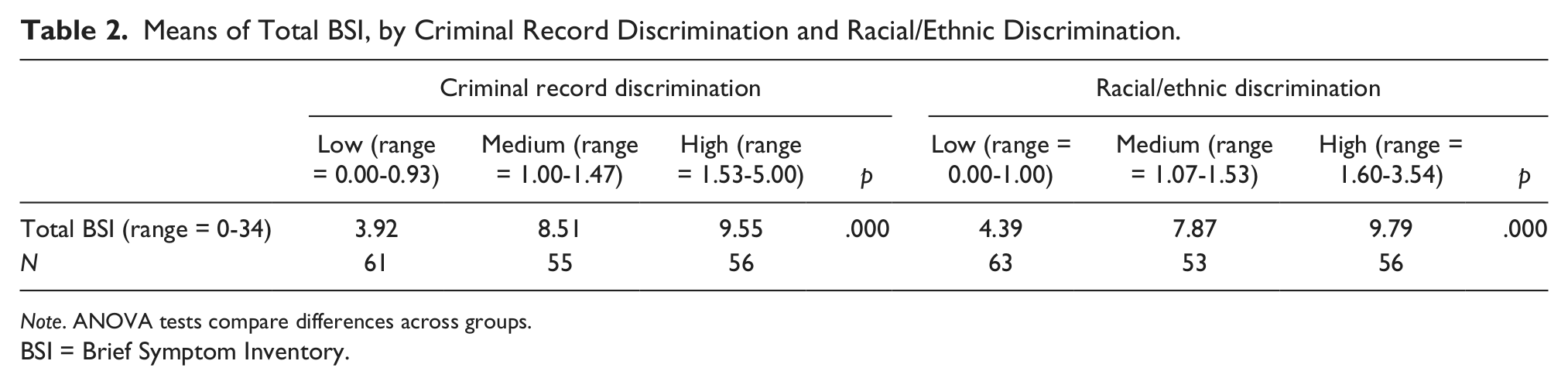
Note. ANOVA tests compare differences across groups.
BSI = Brief Symptom Inventory.
Psychological Distress as a Function of Criminal Record Discrimination and Racial/Ethnic Discrimination
The multivariate relationship between the two forms of perceived discrimination and psychological distress is presented in Table 3. The first set of models (Models 1 and 2) considered criminal record discrimination. Model 1, which presented the unadjusted association between criminal record discrimination and psychological distress, showed that a one-point increase in criminal record discrimination was associated with a 3.82-point increase in psychological distress (95% confidence interval [CI] = 2.46, 5.18). This coefficient translated into nearly half of a standard deviation in psychological distress. When control variables were included in Model 2, the association between criminal record discrimination and psychological distress was reduced by a small amount (5%) but persisted. A one-point increase in criminal record discrimination was associated with a 3.61-point increase in psychological distress (95% CI = 2.23, 4.99), which translated into about a half of a standard deviation increase in psychological distress. Importantly, in this full model, only one other variable was significantly associated with psychological distress. Black men had less psychological distress than non-Black men (β = −5.74, 95% CI = −8.45, −3.04). An interaction term (not presented) between criminal record discrimination and race was not statistically significant.
OLS Regression Models Estimating Total BSI as a Function of Criminal Record Discrimination and Racial/Ethnic Discrimination (N = 172).

Note. OLS = ordinary least squares; BSI = Brief Symptom Inventory; CI = confidence interval.
The second set of models in Table 3 (Models 3 and 4) considered the relationship between racial/ethnic discrimination and psychological distress. Model 3 documented a statistically significant association between racial/ethnic discrimination and psychological distress (β = 3.93, 95% CI = 2.40, 5.46), and the magnitude of this association increased slightly with the inclusion of control variables in Model 4 (β = 4.61, 95% CI = 3.15, 6.07). The coefficient for racial/ethnic discrimination translated into nearly three fifths of a standard deviation increase in psychological distress. Again, with respect to the background characteristics included in the model, only race was significantly associated with psychological distress, and an interaction term (not presented) between racial/ethnic discrimination and race was not statistically significant.
The final set of models in Table 3 (Models 5 through 7) included both criminal record discrimination and racial/ethnic discrimination, which allowed for an estimation of the independent effects of both measures of perceived discrimination. In Model 5, the unadjusted model, both criminal record and racial/ethnic discrimination were independently associated with increased psychological distress. As indicated by the overlapping confidence intervals, these coefficients were not statistically different from one another (p = .779). In Model 6, which included all control variables, both criminal record (β = 1.68, 95% CI = 0.03, 3.33) and racial/ethnic discrimination (β = 3.51, 95% CI = 1.70, 5.31) remained statistically significant predictors of psychological distress. The coefficient for criminal record discrimination translated to about one fifth of a standard deviation, and the coefficient for racial/ethnic discrimination translated to about two fifths of a standard deviation increase in psychological distress. Again, these coefficients were not statistically different from one another (p = .246) as indicated by the overlapping confidence intervals. Note that criminal record and racial/ethnic discrimination were highly correlated (r = .59), but diagnostic tests suggest that collinearity did not bias the results. For example, the mean variance inflation factor in Model 6 is 1.27, which is well below the threshold of 10 usually considered problematic in ordinary least squares models. Finally, Model 7 included an interaction term between criminal justice and racial/ethnic discrimination. This association was small in magnitude and statistically insignificant (β = −0.10, 95% CI = −1.61, 1.41), indicating that the association between criminal record discrimination and psychological distress did not vary by level of racial/ethnic discrimination.
Discussion
This article uses a sample of men recently released from prison to Oakland or San Francisco, California, to (a) examine the prevalence and frequency of perceived discrimination attributed to a criminal record and to race/ethnicity, (b) examine how criminal record discrimination and racial/ethnic discrimination are associated with psychological distress, and (c) examine how the association between criminal record discrimination and psychological distress varies by level of racial/ethnic discrimination.
In three important ways, the results contribute to existing literature about the collateral consequences of incarceration, perceived discrimination, and inequalities in men’s mental health. To begin with, the study is innovative in defining and providing frequency and prevalence estimates of criminal record discrimination among men recently released from prison. Two other studies, to our knowledge, consider the association between criminal record discrimination and health (Crawford, Ford, et al., 2013; Young et al., 2005; also see Crawford, Borrell, et al., 2013), but both these studies operationalize criminal record discrimination with a single-item dichotomous measure (i.e., “Have you ever been prevented from doing something, or been hassled or made to feel inferior because of being in jail or prison?”; Young et al., 2005). Our multi-item indicator is advantageous because it measures many different experiences with criminal record discrimination. Additionally, the results are innovative in that they show recently released men report amounts of criminal record discrimination that are similar to their reports of racial/ethnic discrimination. This is in contrast to the two studies that use a narrow measure of discrimination, as these studies find that criminal record discrimination is more prevalent than racial/ethnic discrimination (Crawford, Ford, et al., 2013; Young et al., 2005). Both measures of criminal record and racial/ethnic discrimination capture a variety of ways and settings in which these men may perceive discriminatory experiences.
Second, results show that both criminal record and racial/ethnic discrimination are independently associated with higher psychological distress. The results, which provide the first examination of the association between criminal record discrimination and psychological distress, contribute to the existing literature in several ways. Most obviously, they demonstrate the importance of criminal record discrimination for mental health. The fact that the association between criminal record discrimination and psychological distress remains statistically significant even after controlling for racial/ethnic discrimination suggests that criminal record discrimination has important implications for the mental health of previously incarcerated men that are unique from those based on racial/ethnic discrimination. These results diverge from research that finds no effect of criminal record discrimination on other aspects of health (i.e., high-risk social ties, general mental health), and it is possible that these divergent results stem from the uniqueness of the samples used to examine these relationships (i.e., illicit drug users in prior research), the heterogeneity in the timing of individuals’ prior incarceration (compared to this sample of recently released men), or the different measures of criminal record discrimination discussed above.
Third, the association between criminal record discrimination and psychological distress does not vary by level of racial/ethnic discrimination. This highlights that these two forms of discrimination operate independently to influence mental health. Experiencing one form of discrimination (i.e., criminal record discrimination) does not increase or decrease the deleterious consequences of another form of discrimination (i.e., racial discrimination). Despite this, previously incarcerated Black men may be more disadvantaged than previously incarcerated non-Black men because of their increased risk of perceiving discrimination based on both their criminal record and race/ethnicity (Kessler et al., 1999). The results extend previous research that indicates individuals who experience discrimination based on multiple attributes may have poorer health than those who only experience discrimination due to one attribute (Grollman, 2012; Krieger & Sidney, 1997; Landrine, Klonoff, Gibbs, Manning, & Lund, 1995; Young et al., 2005). However, this research only considers interactions between two attributes, and results may have differed if analyses considered other stigmatized statuses such as gender, sexual orientation, or drug use.
There are several implications of these results. First, results are consistent with a large body of research that considers the consequences of discrimination for health and may have implications for stress theory. Stress theory suggests that stressful life events often arise from the distinctive social contexts that characterize the lives of lower status groups such as racial/ethnic minorities, the economically disadvantaged, and the incarcerated, and perceived discrimination is often considered a unique stressor with implications for mental health (Pearlin, Schieman, Fazio, & Meersman, 2005; Thoits, 2010; Turner & Avison, 2003). Incarceration experiences are generally not considered in this framework (for an exception, see Turney et al., 2012), but future research would benefit from considering incarceration as a stressor that may affect health inequalities.
There are additional implications. Importantly, by documenting an association between criminal record discrimination and psychological distress, the results provide evidence that, as often speculated (e.g., Schnittker & John, 2007; Turney et al., 2012), stigma and discrimination may be one pathway linking incarceration to health inequalities. Future research should continue to investigate the stigma associated with a criminal record to understand how and under what conditions such stigma is most experienced and most consequential for mental and physical health. Future research should also formally test the extent to which stigma mediates the association between incarceration and health.
Finally, it is worth noting that these results imply there are clear intersections between criminal record and racial/ethnic discrimination. For example, some minorities report being treated as though they were a criminal as a form of racial discrimination (Sue et al., 2007). However, consistent with other work, the analyses suggest that both criminal record and racial/ethnic discrimination are separate forms of perceived discrimination (Crawford, Ford, et al., 2013; Pager, 2003; Young et al., 2005). Indeed, previous research suggests that employment discrimination based on race/ethnicity is more severe than employment discrimination based on a criminal record. Experimental studies show that Black men without a criminal record are less likely to be hired or called back for a job interview than White men with a criminal record, particularly in the low wage labor market (Pager, 2003; Pager et al., 2009).
Limitations
Several limitations should be kept in mind when interpreting the results. To begin with, the sample of recently released men includes men in romantic relationships with female partners of at least 3 months. Overall, men in romantic relationships report less discrimination than their counterparts (Kessler et al., 1999), and it stands to reason that recently incarcerated men in relationships also experience less discrimination than their recently incarcerated counterparts not in relationships. Social relationships are associated with better mental health (House, Landis, & Umberson, 1988; Kessler et al., 2003). This suggests that the sample of men in relationships is likely more advantaged than the overall prison population and, as such, results may be underestimated. However, it is especially important to consider psychological distress among men in romantic relationships, as this may be especially important to the well-being of the women and children attached to these men (Turney, 2011).
Additional limitations exist. For example, the data do not allow for a comparison of the consequences of criminal record discrimination between men recently released from prison and men who may have been arrested but not incarcerated. Also, the cross-sectional data make it difficult to discern causal ordering. Theoretical perspectives conceive of discrimination as a stressor that influences mental health, but it is also possible that individuals with impaired mental health are more likely than their counterparts to perceive events as discriminatory, to react negatively to events, or to elicit discriminatory treatment that results from negative affect and not from criminal records or race/ethnicity (Brondolo et al., 2008). Though much research about discrimination and mental health is cross-sectional, several longitudinal studies suggest that the relationship goes from discrimination to mental health, and there is no reason to expect that this would not apply to criminal record discrimination (Brown et al., 2000; Jackson et al., 1996; Pavalko, Mossakowski, & Hamilton, 2003; Schulz et al., 2006). Finally, men in our sample reported, on average, less psychological distress than those prison or clinical samples. Importantly, our sample includes men who were released from prison in the prior 12 months. It is possible that psychological distress is measured after a sharp (and likely temporary) drop in distress due to this release, particularly since these males are in a romantic relationship (and, therefore, are less likely to be homeless and more likely to have stress-buffering social support). Future research should examine trends in psychological distress over time among this population.
Conclusions
The results suggest the important role of criminal record discrimination for psychological distress among previously incarcerated individuals. Given the wide-ranging, negative effects of impaired mental health on earnings, romantic relationships, and other health outcomes, the consequences of criminal record discrimination may be even more wide-ranging (Coyne, 1976; Jayakody, Danziger, & Kessler, 1998; Penninx, Leveille, Ferrucci, van Eijk, & Guralnik, 1999). It is clear that recently incarcerated men face multiple forms of stigma and discrimination in many different social contexts (e.g., work, health care, and family settings) that may have implications for their health. Because of the disproportionately high rates of incarceration among minority men, the levels of stress faced by these men that contribute to their poor health may be underestimated (Frank et al., 2012; Grollman, 2012). Public health interventions aimed at improving the mental health of previously incarcerated men (or mitigating the mental health consequences of incarceration) must address social factors, such as discrimination, that directly affect and exacerbate psychological functioning. Future research should consider the multiple and independent forms of discrimination, beyond race-based discrimination, that is experienced by vulnerable populations to better understand the origin and persistence of health inequalities.
Footnotes
Appendix
Individual Items Comprising the Criminal Record Discrimination and Racial/Ethnic Discrimination Scales.
| 1. How often been treated unfairly by employers, bosses, and supervisors because of your [criminal record OR race/ethnic group]? |
| 2. How often been treated unfairly by coworkers because of your [criminal record OR race/ethnic group]? |
| 3. How often been treated unfairly by strangers because of your [criminal record OR race/ethnic group]? |
| 4. How often been treated unfairly by people in helping jobs (like doctors, nurses, psychiatrists, case workers, dentists, school counselors, or social workers) because of your [criminal record OR race/ethnic group]? |
| 5. How often been treated unfairly by neighbors because of your [criminal record OR race/ethnic group]? |
| 6. How often been treated unfairly by social institutions (like schools, the Department of Social Services, or the unemployment office) because of your [criminal record OR race/ethnic group]? |
| 7. How often been treated unfairly by criminal justice institutions (like the police and the courts) because of your [criminal record OR race/ethnic group]? |
| 8. How often been treated unfairly by people you thought were your friends because of your [criminal record OR race/ethnic group]? |
| 9. How often been accused or suspected of doing something wrong (such as stealing, cheating, not doing your share of the work, or breaking the law) because of your [criminal record OR race/ethnic group]? |
| 10. How often have people misunderstood your intentions and motives because of your [criminal record OR race/ethnic group]? |
| 11. How often have you been really angry about something that was done to you because of your [criminal record OR race/ethnic group]? |
| 12. How often have you been forced to take drastic steps (such as filing a grievance, quitting your job, or moving away) to deal with something that was done to you because of your [criminal record OR race/ethnic group]? |
| 13. How often have you been called an insulting name because of your [criminal record OR race/ethnic group]? |
| 14. How often have you gotten into argument about something because of your [criminal record OR race/ethnic group]? |
| 15. How often have you been made fun of, picked on, shoved, hit, or threatened with harm because of your [criminal record OR race/ethnic group]? |

Declaration of Conflicting Interests
The author(s) declared no potential conflicts of interest with respect to the research, authorship, and/or publication of this article.
Funding
The author(s) disclosed receipt of the following financial support for the research, authorship, and/or publication of this article: This research was funded by Grant R01MH078743 from the National Institutes of Health (PI: Megan Comfort).