




Abstract
Men of all ages in the United States experience disproportionately higher rates of morbidity and premature death than females. The reasons for this are complex and include biological, sociological, and health system–related issues, but this is also in part due to the fact that men and boys tend to lead more risky lifestyles and generally avoid preventive care when compared with women and girls. These disparities not only affect males but also their loved ones and can adversely affect their participation in the workforce and in their communities. Better understanding of the drivers of men’s health disparities is needed to enable health professionals to more effectively address this problem. One of the fundamental building blocks for changing health care delivery to males is to provide a core curricular framework for education and training of health professionals related to the specific health issues of men and boys. This article will present a study assessing what men’s health courses are available in the United States and identifying the content within such courses that will prepare health care professionals to deliver programs and care to this demographic. The study identified that as of 2012, there were only 21 courses in 18 institutions that address gender-appropriate health care for boys and men. The authors conclude that developing and incorporating an expert, consensus-based men’s health core curriculum in universities and colleges, particularly in health professional programs, is an extremely important cornerstone in advancing the science and practice of true and balanced gender-based care delivery.
Keywords
Introduction
Over the past two decades, there is a growing interest in men’s health and gendered approaches to health in the United States and other parts of the globe. This increased attention is critical considering that significant health disparities exist between men and women (S. T. Williams & Giorgianni, 2010). Men in the United States have poorer overall health status and health outcomes across a wide range of key indicators (Centers for Disease Control and Prevention [CDC], 2011a) than do U.S. women. D. Williams (2003) reports that, overall, U.S. men live less healthy lives than do women. For example, more men smoke (21.5% vs. 17.3%; CDC, 2011b) and more men are overweight (72.3% vs. 64.1%; National Institute of Diabetes and Digestive and Kidney Diseases, 2010) than women. In addition, men are less likely to receive routine preventive care or seek out care early in the disease process than women (Bonhomme, 2007). All these factors, and a myriad of others beyond the scope of this article, contribute to a life span for the U.S. male that is significantly shorter than that of the U.S. female—specifically, a difference of about 5 years (CDC, 2012). Despite these trends, there is still a lack of research on men’s perception of health and how beliefs about masculinity have influenced men’s health-seeking behaviors (Liburd, Namageyo-Funa, & Jack, 2007).
This is the first in a planned series of articles that will examine the state of men’s health academic studies, training programs, and practice standards and plan for the development of a formalized discipline for men’s health. The central hypothesis of this effort and this series is that to succeed in providing meaningful, gender-specific services to address the existing health disparities of American boys and men in an effort to continue toward a path of optimal health status for the male gender, a strategic, consensus-based approach to evolving a formalized discipline of men’s health is needed. This work must involve current experts in various aspects of health care, health policy, academics, and health research who have acknowledged expertise and experience in the area of men’s health (Stephens, 2006). These experts must begin a dialogue that eventually will lead to the development of acceptable practical skills and standards and core competencies in men’s health. Early on in the formative stages of the discipline, particular attention should be placed on the key areas of education and training of scientists and clinicians, research, public health, and health policy. Developing such a discipline is not only important from the academic and training perspective but is also a matter of importance to guide the public in selecting appropriately credentialized practitioners in male health care.
This first article in the series will examine the environment in health programs for providing formal academic training in men’s health. It presents the methodology, results, analysis, and commentary of research conducted from 2010 to 2012 by an ad hoc group convened by the American Journal of Men’s Health and the Men’s Health Network, to determine to what extent men’s health courses are taught in universities and colleges and what content is included within the framework of the courses. Subsequent planned articles by this group and others are intended to provide framework and scoping documents on the evolution of this practice area and the appropriateness of defining men’s health as a true specialty. These subsequent articles will also initiate the dialogue regarding initial and continued core competencies to appropriately identify a level of balanced expertise in male gender-based health and clinical care.
Background
The sociocultural aversion of boys and men to seeking preventive care results in men in the United States having higher death rates. Nine out of the top 10 causes of death include cardiovascular disease, cancer, diabetes, and unintentional injuries (Alzheimer’s disease, from which women die at a higher rate, is a notable exception; National Center for Health Statistics, 2010). According to the U.S. Preventative Services Task Force (as cited by Courtenay, 2003), at least half of men’s deaths each year could be prevented through changes in personal health behaviors. Zunzunegui, Alvarado, Be’land, and Vissandjee (2009) propose that “exposure to social factors during the life course is different for men and women, and that these differences result in different health outcomes” (p. 235). Factors such as socioeconomic status, access to health care, male acculturation to health issues, harmful perceptions about masculinity, and the lack of understanding of male health behaviors contribute to poor health outcomes for men. In addition, it has been widely documented that men who belong to racial and ethnic minority groups are at an even greater disadvantage with regard to health outcomes. D. Williams (2003) notes that, “the term ‘crisis’ has been used to characterize the markedly elevated rates of morbidity, disability, and mortality of minority men when compared with their white counterparts” (p. 724). This is due in part to the fact that minority males, especially African Americans, are exposed to a “broad range of social and environmental factors that adversely affect their health” (D. Williams, 2003, p. 724).
Although health care practitioners, institutions, and policymakers have generally acknowledged the need for gender appropriate interventions, the U.S. health infrastructure has not developed gender-based strategies, resources, or approaches that address the comprehensive needs and preferences of men and boys (S. T. Williams & Giorgianni, 2010). This is in part because historically there has been little research focused on how to structure, implement, and evaluate different approaches to meeting the lifelong health needs of men and boys. To address the unintended but remediable health status disparities for men, it is important to advance the critical study of men’s health, as this will lead to a better understanding of men’s health-seeking behaviors, unique needs, and social determinants of health. According to the American Assembly for Men in Nursing (2010), “The role of masculinity, socially imposed expectations regarding male behavior, and the associated and/or resultant impact on men’s physical and mental health states needs to be researched and addressed by academia.” Through the development of teaching, research, and clinical practice by academia on comprehensive men’s health advances can be made in policy and programming as well as health care delivery, which will ultimately lead to healthier males and benefit society as a whole.
A relatively small number of university faculty and public health officials teach men’s health courses at both the professional graduate and undergraduate levels. Although not a part of the formal data collection or analysis component of this article, the authors believe it is instructive to appreciate that in discussing this survey with faculty who have tried to develop and teach such courses, several have noted difficulty in obtaining consent from university and college curriculum committees to do so. Some faculty noted that requests to add such courses, even as elective courses, have been denied multiple times. Of the courses that are taught, these are often survey or stand-alone courses or courses in which men’s health issues are narrowly defined or are a small component of larger general course work or clinical practice training. Although such stand-alone survey courses attempt to provide fundamental precepts and competence in overall comprehensive men’s health matters, there is no professionally driven consensus on what core skills need to be taught in the psychosocial, policy, public health, or clinical domains. There is also lack of defined competency-based goals and objectives for the courses that are currently available. Furthermore, there is no guidance in the field of men’s health for professionals who create or credentialize postgraduates and medical professionals in developing broad-based skills in medical residencies. This is in no small measure because of the fact that there is no medical subspecialty identified in the United States that provides a core body of expertise in this area. This expertise has evolved for many other defined populations, including comprehensive women’s health, over the decades. A dialogue on establishing minimum core competencies for public health and clinical health care professionals in the area of men’s health is a critical first step to developing the cornerstones needed to build such expertise and guidance in addressing the health disparities apparent in the U.S. male population.
Method
Research was conducted from 2010 to 2012 to determine what courses related to men’s health were available among public health schools, medical schools, and other institutions of higher education. The following methods were used:
A general web-based search and internet review with the search engine being Google.
An Internet review of all public health schools that are accredited members of the Association of Schools of Public Health (ASPH), as listed on the ASPH website (2012). This list consisted of 49 schools (48 in the United States and 1 in Mexico).
An Internet review of all medical schools that are accredited members of the Association of American Medical Colleges (AAMC), as listed on the AAMC website (2012). This list consisted of 154 medical schools (137 in the United States and 17 in Canada).
For the Internet search using Google, the keywords entered into the search engine were “men’s health courses,” “men’s studies,” “masculinity courses,” and “masculinity studies.” Based on these search results, information posted on university and college home pages, course-offering catalogs, and specific department websites was reviewed for the inclusion of men’s health topics.
The same keywords/keyword terms listed above were used to search the websites of the public health and medical schools. Research of public health schools was supplemented with face-to-face interviews and phone calls with administrators and representatives of the schools. The face-to-face interviews took place at the American College Health Association (ACHA) and American Public Health Association (APHA) conferences in 2011. Interviews were held at the booths of the schools attending the conferences, and each school in attendance was approached for an interview. The following questions were asked:
Does your University/College offer a course in men’s health, men’s studies or masculinity?
If yes, would it be possible to obtain a copy of the class syllabus?
There were some schools that attended one or both of the conferences (APHA or ACHA) but were not listed as accredited members of the ASPH and they were included in the study as well. Likewise, not all accredited members of the ASPH attended one or both of these conferences. For those accredited ASPH members who were not present at the conferences and therefore not included in the face-to-face interviews, calls were placed to the administrative offices of the public health schools and the same questions listed above were asked. If the staff member answering the phone was not familiar with the course offerings of the school, they were requested to provide the name and contact information of the appropriate staff, who was then contacted. For those colleges and universities that had men’s health or related courses, the course instructors were either called or emailed to request the course syllabus.
Once courses were identified, these courses were categorized according to the Healthy People 2020 Determinants of Health (Healthypeople.gov, 2011). These are defined as the range of personal, social, economic, and environmental factors that influence health status. Healthy People 2020 recognizes the following determinants of health:
Social Determinants of health reflect social factors and the physical conditions in the environment in which people are born, live, learn, play, work, and age. Examples of social determinants include exposure to mass media and technology, availability of resources to meet daily needs, social norms and attitudes, and exposure to crime and violence.
Biology and genetics: Some biological and genetic factors affect specific populations more than others. For example, older adults are biologically prone to being in poorer health than adolescents because of the physical and cognitive effects of aging. Sex, race, inherited conditions, and family history of disease are other biological or genetic determinants of health.
Individual behavior plays a role in health outcomes. For example, if an individual quits smoking, his or her risk of developing heart disease is greatly reduced. Other behaviors that affect health include diet, physical activity, and hand washing.
Health services: Both access to health services and the quality of health services can affect health. Cost, service availability, insurance coverage, and language access are determinants included in this category.
Policymaking: Policies at the local, state, and federal levels affect individual and population health. Increasing taxes on tobacco sales, for example, can improve population health by reducing the number of people using tobacco products.
Classification was based on the information available about the course through the school websites, phone conversations, and/or in-person interviews, and, if available, the course syllabus. In the absence of a syllabus, provided course descriptions were analyzed. Some courses could conceivably be classified under more than one Healthy People 2020 determinant. In such cases, classification was based on the primary topics and objectives of the course as stated in the available descriptions or syllabus.
Results
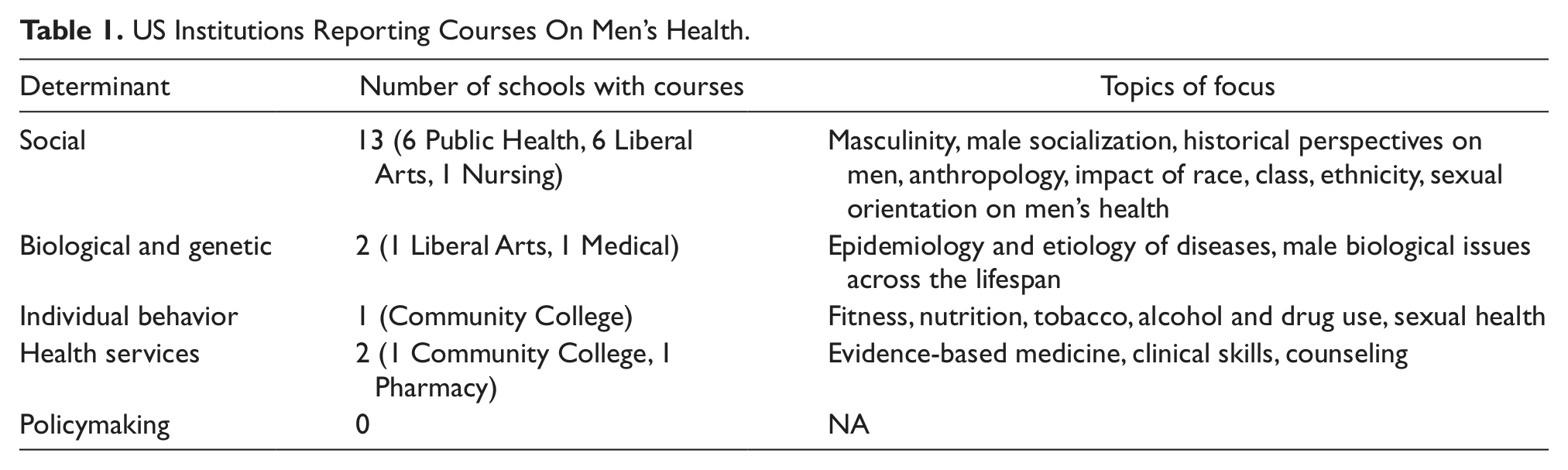
Only 18 U.S. institutions in all categories reported courses on men’s health. Three of the universities had two men’s health courses each, for a total of 21 courses. Two universities outside the United States were also found to have men’s health courses. Among the U.S. medical schools reviewed, only one had a course or program of study on men’s health (not including courses focusing strictly on urology). Six public health schools were identified to have a course in men’s health. The remaining men’s health courses found in the study were distributed among undergraduate liberal arts colleges and universities (7 schools), nursing schools (1), pharmacy schools (1), and community colleges (2).
The Healthy People 2020 Determinants of Health and their relation to the men’s health courses reported in this survey are as follows:
Social Determinants. The influence of social determinants on the health outcomes of men and boys was a common theme among the majority of the courses found in this study. Instructors for these classes encouraged students to analyze how masculinity has been defined and how this has influenced men’s health. For example, the idea that seeking help is not “manly” contributes to the number of men who delay or avoid seeing a doctor for a preventive visit or for an emerging health problem. Some of these courses also examined health disparities between men and women and discussed social factors that may cause these differences. Noting significant variance in health indicators between men of different racial backgrounds, ethnicity, economic, and cultural situations, some instructors focused their attention on understanding these disparities. Others compared ideas of masculinity and their impact on men’s health across several very different global contexts.
Biological and Genetic Determinants. Two of the courses identified in this study focused primarily on biological or genetic determinants of health for males. These determinants were also included as subtopics in other course descriptions. Instructors for these classes highlighted diseases and issues specific to males (including diseases of the prostate and testicular cancer), those that are more prevalent in males (such as heart disease, suicide, and colorectal cancers), and those for which risk factors are different for males when compared with females.
Individual Behavioral Determinants. One course focused primarily on understanding and addressing elements of individual behavior that affect men’s health. Analyzing topics such as substance abuse, risk taking, and involvement in preventive health activities, the instructor sought to engage students in reflection on their own health behaviors while stimulating debate on the best ways to promote healthy behaviors for men.
Policymaking Determinants. Although this determinant was not a central theme in the courses found through this survey, future discussions of men’s health courses should consider how health-related policies affect men and the kinds of policies that might be particularly useful in positively influencing the health of men.
Health Services Determinants. In two cases, the primary focus of the courses was to address the need for more targeted and effective health services for men. It is interesting to note that, among all the courses found in this study, course syllabi and descriptions universally included material on the need for health interventions tailored to men. Instructors covered material including the need for physicians to use different language and strategies for communicating with men and women. Some courses also discussed how public health workers can effectively target the larger male audience when designing programs by considering where and how men typically get health information, and what types of messaging they respond to best.
A brief summary of the content of the courses found in this survey can be found in Table 1.
US Institutions Reporting Courses On Men’s Health.
Instructors in many of these courses reported using creative pedagogies to engage students and encouraged them to think critically about issues related to men’s health. For example, one instructor required students to have a physical exam and then discuss and reflect on their experience with their classmates. Another unique assignment involved encouraging students to attend an open Alcoholics Anonymous meeting to better understand the impact of addiction as an important men’s (and general) health concern. These experiences enabled students to gain insight into the perspective of the patient. The majority of the classes involved regular reflection, often through journals, where students were advised to consider the implications of what they were learning on their own lives and perhaps their career goals. Some professors asked students to conduct surveys of their families, friends, or the general student population on topics such as what it means to be a man or their knowledge of important men’s health information.
It is important to note that the majority of the courses identified in this study are individual courses. Although rare, there were some broader programs that approached the model of an academic track that focused on men’s health or, more generally, men’s studies. However, the majority of these programs were identified at universities outside the United States. The only U.S.-based program focusing solely on the study of men was the Master of Science program in Men’s Studies and Fatherhood at Akamai University in Hawaii. This program used a multidisciplinary approach to better understand the range of issues and forces affecting today’s men and how these issues can be effectively addressed in fields ranging from psychology to public policy. The programs that were available globally included the Diploma in Men’s Health at the Chinese University of Hong Kong, with modules covering sexual and genitourinary health, mental health, and gender differential in utilization of health services. The Centre for Men’s Health at Leeds Metropolitan University, U.K., also offered diploma-, bachelor’s-, master’s-, and doctoral-level courses that explore gendered epidemiology, service use and provision, and experiences of illness and diagnosis related to men and boys.
Discussion
Men have poorer overall health status and health outcomes (S. T. Williams & Giorgianni, 2010). This survey demonstrates a distinct lack of formal academic and training programs in men’s health, including in health professional and public health programs. The Men’s Health Caucus of the American Public Health Association (2011) recognized this deficit in training, and as part of its policy agenda to advance the health of men, called for attention to be paid to the development of such programs. An essential step in advancing the health of men is the inclusion of a men’s health core curriculum in more universities and colleges than what currently exists, particularly in health professional and public health programs. Understanding men within the health professions is a strategic and thoughtful approach to developing a core knowledge base in the sociological and pathophysiological context. This approach is essential to address the existing health disparities and to better understand men’s health-seeking behaviors. It is imperative to help foster men’s health as a true discipline in population health care as one’s gender may determine the manifestation of chronic disease and health outcomes. If medical, nursing, and public health schools were to incorporate education about health disparities and other determinants of men’s health in their curricula, this could be optimally effective in capturing real-world implications of male patients and their clinical realities. This approach would enable students to understand men of all backgrounds, which could lead to culturally effective care that addresses these disparities, increases safety, decreases errors, and improves quality of health and care for all patients.
A review of The College Board (2010) reported that there are currently 317 higher education institutions that offer identified majors in women’s studies, which incorporate various elements of sociological and health studies in relation to women. However, aside from Akamai University in Hawaii, there are no programs that have been identified that have a major in any aspect of men’s studies in the United States. Offering women’s studies programs at universities has helped promote and transform women’s research outside of an academic setting. Students and professors have been involved in the implementation of programs and initiatives such as WISEWOMAN under CDC (2011c) and the Women’s Health Initiative under the National Heart, Lung and Blood Institute (2010). These programs and initiatives have prevented millions of unnecessary deaths, improved the lives of millions of women (“The role of HHS in improving women’s health,” 2002), and should serve as a roadmap toward achieving the same goal for men (Brott et al., 2011). If universities are encouraged to set up academic centers in the field of men’s health as they have done for women’s health, this can lead to increased funding for research on men and their health, with the long-term outcome being the millions of lives potentially saved (Brott et al., 2011).
As demonstrated by advances in women’s health, inclusion of course material on the pathophysiological progression of important medical conditions in boys and men is required to help promote better-targeted research and enhance quality of care delivered to men and boys. We propose that men’s health courses that encompass the physical, social, cultural, mental, and emotional aspects of the health of men and boys should be incorporated within the university system for medical, nursing, public health, and other health professional programs, particularly at the doctoral level. In addition, social work, psychology, social sciences, and other health care, biomedical, and health policy or administration programs should have some component or required course content on men’s health.
The cultural and social aspect entails looking at men’s health across the life span. This will serve as an opportunity to gain a deeper understanding of what affects men’s health, how men use available health resources, and how medical professionals can help men take a proactive approach to managing their own health. This also includes understanding the effects that policies have had on men’s health and how they can be changed to improve men’s health.
The physical aspect will allow better understanding of how various diseases progress in men, why they have a greater chance of premature death for nearly all the major disease states, and environmental factors that influence men’s health. In addition, research can be conducted to determine how men and those in their support circles, if these exist, can optimally cope with chronic and acute illnesses and healthful behaviors directed to prevention or early diagnosis and commitment to treatment.
The mental and emotional aspects will help uncover some mysteries behind how men perceive their health and the influences that can prevent them from seeking treatment.
One of the important conceptual frameworks or guiding documents to structure the development of a national men’s core curriculum strategy could be the Healthy People 2020 Determinants of Health, as it includes personal, social, economic, and environmental factors that influence one’s health status. Using this or a similar framework is important because the varied aspects of men’s health cannot be well represented by just one discipline, in either the health or social sciences, or the humanities. All are important and will enable health care workers to target men more effectively.
Defining ways to better understand socioeconomic, cultural, and educational predispositions to perceptions about health, wellness, and health care are skills that are likely to be needed by clinicians and policymakers. By doing this, health care professionals will have the proper skills and strategies which will enable them to provide individualized care to all patients. Delineating between the commonality of being a man and the difference or uniqueness of health issues of the individual man is key for physicians, nurses, and public health officials.
Study Limitations
The methods used to collect data comprise a highly representative sampling of the overall academic universe. The selected schools belonged to professional organizations such as the AASM and ASPH, and this introduces obvious elements of selection bias into the sample. However, as this study was unfunded by any entity and conducted strictly by volunteers, there were a number of constraints that were encountered during the research phase that made this sampling strategy the only practical approach at this time. First, there was scarcity of information and absence of data in some cases because some colleges and universities did not have updated websites and/or they have protected site sections to access their course catalogs. In those instances, the respective school departments where contacted via telephone in an attempt to obtain the needed information. However, during the discussions it appeared that some of the administrators were unaware of what courses where offered.
Second, courses within highly subspecialized medical areas, such as urology departments, were not a focal point of this review even though they were identified at various universities. The goal of this study was to identify courses that provided students with the opportunity to critically explore a broad array of men’s health concerns across the lifespan and those that approached the care of boys and men from a multidisciplinary perspective. This study was constructed to identify courses that include effects of the health care system, male socialization, and the impact of social and cultural factors on male health while covering topics such as reproductive health, violence, aging, chronic disease, depression, and sexuality.
Conclusion
Optimal health of boys and men will most appropriately be achieved with the guided and thoughtful development of the discipline of men’s health, or male health. The rationale for and developmental track of this discipline should follow that accepted and established for other medical disciplines, particularly those population-based disciplines. As with all health disciplines, men’s health must have as its mission to define and advance the health of boys and men through research and practice of gender-based biological, sociocultural, and other relevant parameters that affect the health of boys and men across their life span with the goal of optimizing health and wellness for boys and men. The discipline must evolve with particular attention to development of appropriate academic and training models as well as those for clinical practice. In addition, the discipline should encourage and build expertise in the analysis of research data for gender and ethnic differences as they apply to males and should inform and advise boys and men, health practitioners, and policymakers about the full range of contemporary issues that affect the health of boys and men across the life span.
Inclusion of a men’s health curriculum at higher education institutions is an extremely important component to building a formal discipline that has boys and men as its focus. Providing a curricular platform would facilitate society’s ability to intellectually comprehend male behavior, and men’s health perception, thus creating a better understanding of how to reach out to men and boys in all aspects of their lives in an effort to eliminate health disparities between males and females. This curricular platform also can serve as a catalyst to address social determinants of male health such as socioeconomic status, access to health care, and ethnicity, which will lead to better quality of life, quality of care, and ultimately create a constituency engaged in the mission of changing the overall landscape in men’s health. Incorporating men’s health studies in higher education will enhance knowledge, research, and policy issues related to men by creating an empowering space for men and acting as an important incubator for ideas and strategies that can be transferred to mainstream interventions in an effort to reduce health disparities among males. Finally, having male-specific curricula, universities can innovate, educate, advocate, and integrate by preparing tomorrow’s physicians, pharmacists, nurses, public health students, as well as all other disciplines for excellence in health care delivery and education to all men and boys across the life span.
To the best of our knowledge, this is the first in-depth analysis that has been conducted on men’s curricula in universities and colleges. More research needs to be done to assess what literature pertaining to men’s health is available for professors wishing to teach courses. The next step is to review and analyze the content in articles published in the different men’s health journals. This step is important to assess initiatives or research undergoing in the field of men’s studies and to determine the essential male health issues and phenomena of the specialty.
Footnotes
Declaration of Conflicting Interests
The author(s) declared no potential conflicts of interest with respect to the research, authorship, and/or publication of this article.
Funding
The author(s) received no financial support for the research, authorship, and/or publication of this article.