




Abstract
Injuries are a leading cause of death for children, and parental safety behaviors are fundamental to child injury prevention. Fathers’ perspectives are largely absent. Our novel research connects masculinities, fathering, and childhood injury. Sixteen fathers of children aged 2 to 7 years in two Canadian urban settings participated in photo-elicitation interviews detailing activities they enjoyed with their children and concerns regarding child safety. Participants described how elements of risk, protection, and emotional connection influenced their approach to fathering as it related to injury prevention. Most men considered engaging children in risk as key to facilitating development and described strategies for protecting their children while engaging in risk. Many men identified how the presence of an emotional connection to their children allowed them to gauge optimal levels of risk and protection. There exists a tremendous opportunity to work with fathers to assist in their efforts to keep their children safe.
Worldwide, approximately 950,000 children die every year as a result of unintentional injuries and a further tens of millions are hospitalized with injuries resulting in long-term disability (Peden et al., 2008). Unintentional injuries are those occurring without the intent of harm, such as burns and motor vehicle crashes, as opposed to intentional injuries, which include mechanisms such as abuse, neglect, or assaults. In developed countries, unintentional injuries account for approximately 40% of all child deaths (Peden et al., 2008). The limited data available regarding the costs of childhood unintentional injuries indicate that in the United States, injuries to children aged 0 to 14 years cost approximately US$50 billion (Doll, Bonzo, Mercy, & Sleet, 2007), whereas in Canada, the annual costs of injuries to Canadians are estimated at CDN$19.8 billion (SmartRisk, 2009). Not all children are at equal risk of injury: compared with girls, boys are consistently at greater risk of all types of injury (Spady, Saunders, Schopflocher, & Svenson, 2004; Towner, Dowswell, Errington, Burkes, & Towner, 2004). The World Health Organization estimates that boys experience approximately 24% more injury deaths than girls (Peden et al., 2008).
Parental safety behaviors and supervision are fundamental to childhood injury prevention, and parental attitudes leading to a lack of adequate caregiver supervision have been implicated in studies of childhood unintentional injuries (Larson-Bright et al., 2009; Morrongiello, 2005; Morrongiello & Corbett, 2006; Morrongiello, Corbett, & Brison, 2009; Morrongiello, Ondejko, & Littlejohn, 2004; Petrass, Blitvich, & Finch, 2009; Rosen & Peterson, 1990). However, most studies have been based on maternal samples, and notably absent are fathers’ perspectives about children’s injury prevention. One study found that infants with highly involved fathers had fewer injuries than did those with less involved fathers (Fujiwara, Okuyama, & Takahashi, 2010), and another study indicated that fathers reporting more positive relationships with their school-aged children had children with fewer injuries, particularly sons (Schwebel & Brezausek, 2010). Surprisingly, a similar association has not been found for the mother–child relationship (Damashek et al., 2005; Karazsia & Dulmen, 2008; Schwebel & Brezausek, 2010), suggesting a potentially unique and independent role for fathers in mitigating the risk of injuries to their children.
Research has highlighted the distinctiveness of the father–child relationship. It has been described as side-by-side in nature—often occurring in the context of doing things together, such as going for walks or playing (Brandth & Kvande, 1998). Independent of social class, ethnicity, occupation, and sexuality, fathers’ nurturing typically focuses on a physical and outdoors approach to caring, promoting independence, and encouraging risk taking (Brandth & Kvande, 1998; Doucet, 2004a; Grossmann et al., 2002; Plantin, Månsson, & Kearney, 2003).
Masculine Identities, Roles, and Relations
Fathers’ perceptions of their own masculine identities might hold important implications for how they engage with their young children. Socially constructed dominant ideals of masculinity are context dependent (Connell & Messerschmidt, 2005) and are key to the ways in which ideals about fatherhood are constructed in cultural, family, and work contexts (Brandth & Kvande, 1998). A shift from traditional models, wherein fathering was synonymous with provider and breadwinner roles, to contemporary ideals of fathering that encompasses nurturing and caregiving has pervaded recent literature (Aumann, Galinsky, & Matos, 2011; Gerson, 2009; Harrington, Deusen, & Ladge, 2010; Johansson & Klinth, 2008; Summers, Boller, Schiffman, & Raikes, 2006).
Masculinities also bear relevance to fathering in relation to child safety efforts. The notion, for instance, that fathers function as “protectors” is consistent with dominant masculine ideals of strength and control. Fathers who take on this gendered identity consider it their responsibility to defend their children from the dangers inherent in the outside world (Allen & Daly, 2005; Doucet, 2004b; Summers et al., 2006). That said, masculine ideals can also beget practices that run counter to avoiding injury. Risk taking behaviors that involve disregard for personal safety, such as reckless driving and substance overuse, have been associated with hypermasculine identities (Capraro, 2000; Mast, Sieverding, Esslen, Graber, & Jancke, 2008).
Unintentional injury prevention efforts, particularly those directed at fathers, might draw on understandings about how masculinities promote safety (e.g., protector role) amid considering those that risk health (e.g., risk-reliant identities). Connell and Messerschmidt (2005) discuss the impact of the local context on versions of masculinities, highlighting the importance of comparing and analyzing masculinities regionally and locally. Our research examines connections between masculine identities as they relate to fathers’ and unintentional childhood injury in Western Canada.
Method
In this study, we undertook a social constructionist approach to masculinities analysis from fathers’ perspectives (Connell, 1995). We were guided by grounded theory methods (Charmaz, 2006; Strauss & Corbin, 1998) and used photo-elicitation data gathering strategies.
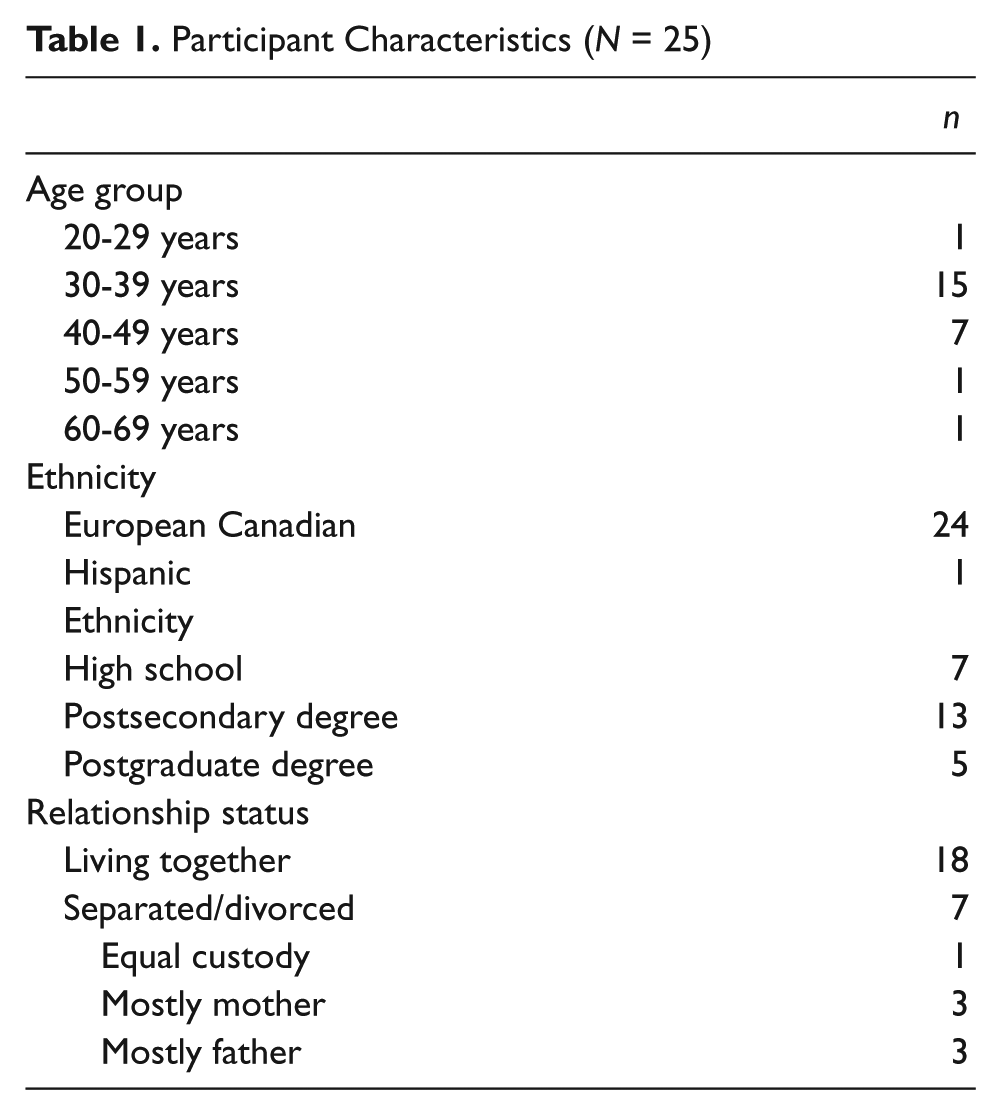
Following ethical approval from the university and health centre review board, fathers of children aged 2 to 7 years were recruited from across the province. Twenty-five participants from two urban and three rural settings participated in the study. The participants’ age ranged from 28 to 60 years (M=38.4 years), all identified as Canadian, and were in diverse relationship circumstances. Further demographic details are available in Table 1.
Participant Characteristics (N = 25)
Participants were interviewed twice. The first interview included questions related to their relationship to their child and the ways that they considered fathering, risk taking, and child injury prevention. At the end of the first interview, participants were provided with a camera and invited to take photographs of activities they enjoy doing with their children as well as things that concerned them regarding their child’s safety. Participants returned the camera to the researchers via mail, and a subsequent follow-up interview was scheduled to discuss their photographs. The photo-elicitation interviews focused on fathers’ responses to their photos in relation to their perceptions and practices for child risk engagement and safety. Interviews were digitally recorded and took between 1 and 2 hours, and participants received an honorarium for their contribution to the study.
Data Analysis
Interviews were transcribed, checked for accuracy, and uploaded to NVivo 9™ for coding. In the early stages of data analysis, we used constant comparative techniques to develop an initial set of codes that represent key gendered processes described in the interviews (Dey, 1999; Strauss & Corbin, 1998). As data collection and analysis continued, we described specific participant experiences to illustrate broad social processes paying specific attention to the ways in which gender influenced their fathering and relationships with their children.
We repeated the coding and analysis procedure several times over data collection, beginning with the first five interviews and continuing in groups of five interviews. This facilitated identification of new codes as data were collected, guided theoretical sampling of participants to help develop categories and concepts, and informed modification of the interview guide to explore emerging concepts. Three authors coded both interviews for the initial five participants. For subsequent interviews, at least two authors coded both interviews for every fifth participant to ensure consistency in coding. Throughout this process, we discussed any discrepancies until consensus was reached.
We analyzed photographs using a three-stage process (Oliffe, Bottorff, Kelly, & Halpin, 2008):
Preview: Consisted of viewing the photograph with the father’s narrative relating to that image. In this stage, the father’s perspective was highlighted to facilitate understanding of his representations.
Review: We considered the photograph from our perspective, focusing on details, characters depicted, possible inconsistencies between the father’s narrative and the photograph, as well as considering how the image linked to cultural practices and contexts. These data helped contextualize fathers’ accounts, challenge assumptions, and facilitate the inclusion of our interpretations.
Cross-photo comparison: We considered all photographs together to note overall impressions and interpretations. This allowed a higher level of abstraction and the development of categories reflecting the layers of meaning.
For this article, we chose one photograph to illustrate each of the inductively derived themes.
As the coding and writing proceeded, we examined in greater depth how masculine ideals influenced the ways men fathered and considered safety issues in the context of engaging their children. We also integrated published empirical findings to connect, contrast, and further examine our emergent thematic patterns.
Results
Our analyses revealed three themes that predominated in father’s interviews: (a) engaging risk, (b) affording protection, and (c) connecting emotionally. These themes reflected the different ways that men practiced various masculinities in the context of fatherhood.
Engaging Risk
Men placed importance on engaging their children with risk-related activities, feeling strongly that it promoted self-esteem and confidence. They involved their children in a variety of activities intended to build character and test physical abilities. The vast majority of examples shared by participants related to physical activities; and as Drummond (2002) and Sabo (2000) have highlighted, these performances were consistent with masculine ideals that privilege men’s action-orientated doing of gender. The participants’ masculine identities, as well as the philosophy underpinning their direct fathering activities, traded on ideals about the benefits of physical activity–based play and how it can garner personal growth. A 38-year-old man explained that hockey-related injuries had left him with “so much metal” amid highlighting how his experiences influenced the fathering of his 8-year-old son:
I feel that I was beat up extraordinarily bad. I suffered a lot more injuries than a lot of other people did so I kind of have a little bit of faith that he’s not going to get beat up as bad, you know doing Tae Kwon Do and playing different sports. He played soccer and he got kicked in the knees and stuff like that. I mean I think the benefits outweigh the risks that way. He learns teamwork, leadership and all of that kind of stuff from being part of that . . . there is far more to learn than there is danger involved. . . . If he does hurt himself we’ll just doctor him up as best you can and let him get back out there when he’s ready.
Evident here was the man’s desire to have his son gain experience and learn by doing within an environment wherein the occasional mishap is expected. Any potentially adverse outcomes were justified and perhaps welcomed as a necessary pathway to manhood, and character building in affording growth, self-reliance, and competitiveness. In discussing his son’s aspirations for fighting in the Ultimate Fighting Championship, the participant went on to matter-of-factly remark:
Yeah, he’ll get punched in the face and his nose will probably bleed and he’ll probably end up with a black eye but that’s minor, it builds character and he’ll live. You’ve got to do what you’ve got to do.
Masculinity, for this father, was primarily based in hegemonic ideals of stoicism, strength, and instrumentality. He wanted his sons to grow into men who do not cry when hurt, know how to be aggressive, defend themselves, and be resilient. In his opinion, injury and risk taking facilitate creating this kind of masculinity:
If you don’t let kids take risks, where do they get their self-confidence from . . . like in my case he’s a boy so where does he build his sense as a man growing up if he’s not allowed to take risks and decide for himself?
A 40-year-old with two sons, aged 3 and 5 years, asserted that because boys are naturally drawn to dangerous activities, they need to be taught about evaluating rather than avoiding risk. With this in mind he guided his sons toward accurately calculating risk in the hope that they would avoid being injured. In recognizing that his sons would ultimately decide what constituted risk for themselves, the father respected and perhaps expected manly virtues of autonomy and risk-seeking to preside. In addition, he appreciated the freedom and achievement that boys derive from potentially hazardous activities:
I think there’s going to be moments where to define themselves someone’s going to choose to take a risk. And I think I would support my child in saying that “Are you sure you’re going to do this knowing” and if the child said at whatever age, “I just need to prove to myself” or “I just need to feel that freedom” or “I just need to have that experience,” I’d say, “okay.”
Alignments to these masculine ideals were also evident among fathers who hoped that their sons might challenge themselves more. A 32-year-old father of two boys (aged 3 and 1 years) lamented his own overly cautious attitude as a child and hoped that his older son would “push those boundaries” to secure “those character building things”:
I see lot of my cautiousness in him and I don’t want that to be limiting for him because I know that I limited myself in so many ways when I was a kid. And as he grows up I don’t want that same limitation for himself [sic]. Like I’m okay with him still being cautious about it but I don’t want that to freeze him from trying new things and experiencing new things. So as he gets older I think it’s going to be a matter of encouraging him because, and helping him overcome some of that stuff. And wanting to push him a little bit to experience that . . .
The understanding that life should be fully experienced and enjoyed is ever present here, amid suggestions that the risk–reward payoff bodes well for a fuller and more vital life. Although varying degrees of alignment to hegemonic masculinity were present, the linkages between risk and reward were strongly represented. Though the men’s adherence to masculine ideals was most pronounced when they spoke about their sons, some participants were satisfied that their perspectives about risk also aided their daughter’s development. A 44-year-old father explained that his 6-year-old daughter has:
. . . got a lot of kind of boyish qualities when it comes to the physical side of things.
Are you surprised by that, having had a girl?
I’m not that surprised by it . . . [child’s mother] is reasonably physical, she does stuff and she likes to do stuff. And I am too, so I think it’s not that surprising. It’s pleasing though. It would be hard for me to have a totally princessy kind of kid, but I don’t think that’s something that comes by accident, so I think you have to be culpable if you wind up with a princess.
This example reveals the participant’s interest in transmitting and affirming the benefits of some masculine ideals being taken up by children regardless of their gender. Embedded here also is the positioning of masculinity as having utility and purchase in countering the potential to develop a hyperfeminine (princess) personality instead of being tough and physically active—much like her dad.
Pronounced among men’s various alignments to risk taking were tensions between ensuring safety and advancing their child’s development. This was evident in the parenting philosophy espoused by a 34-year-old father of a 7-year-old boy and 5- and 3-year-old girls. He practiced an active outdoor lifestyle that involved hiking, ice climbing, and more recently hunting. He included his children in these activities as soon as he felt they were physically able. With regard to Figure 1, he suggested:
For me that was a decision to let them climb something that is relatively safe where I can keep an eye on them and teach them about the limits of their bodies and help them. And there were certainly places that we didn’t let them climb but that we felt was safe enough. And so we talked to them about things to consider when you’re choosing this kind of route because in my experience it guaranteed they’re going to be doing this when they’re in their teens whether we teach them or not so teaching them appropriately now before they go off with a bunch of hooligans as teenagers. . . . I think we’re better off educating them than not and letting them have some exposure to risk and learning how to manage it rather than not.

Learning to manage risk
Evident is the participant’s confidence that through teaching his children to appropriately engage with risk at a young age, he can provide them with the tools to make sound decisions when they are older and more independent.
Affording Protection
Alongside an emphasis on the importance of their role as a father who supported an engagement with risk taking, the men also identified their presence as strong insurance against injury occurring. Implicit to these assertions is another masculine virtue—that of the “protective father.” A 36-year-old father of three (two girls aged 4 years and 5 months and a 2-year-old son) illustrated his protector role in providing a narrative to explain Figure 2:
[Daughter] definitely loved this. I let her try it last year. So this is an example where I’m okay with putting them at physical risk because what happens in order for them to get up there is that I follow them up the ladder and we have rules saying you cannot go any higher than that even though they want to. They can’t turn around unless I’m on the ladder behind them to turn around. And they can only get up the ladder if there’s another adult with them even though they would try like [son] is trying to do it right now. . . . So it’s a physical risk putting them up there and then once they’re up there I’m comfortable that they will listen to my warnings and I can walk backwards and they can enjoy the view and their independence. So it was a good example, I thought of physical risk that I’m okay with.

Rules for engaging risk
In this example, the participant outlines several rules of engagement amid assurances that his presence, authority, experience, and supervision will prevent any untoward event from occurring. Evident also is the conscious construction of an activity that enables the participant to embody a protector role as a core indicator of his fathering.
In some cases, the protector role was most salient for the fathers, overshadowing the child’s aforementioned risk-related rewards. For example, a 42-year-old father of a 4-year-old girl was strongly influenced by his own childhood experiences of danger in his steadfast commitment to ensuring his daughters safety:
To be honest I’m a very paranoid person. I get up in the middle of the night five times to make sure that the doors are locked and everything so that’s kind of where I come from. So I’m pretty sure that I worry about her ten time more than my wife and watch every side of the road for cars.
Similarly, a 60-year-old father of a 2-year-old girl spoke adamantly about his “zero tolerance” for risk in his daughter’s life, believing that activities with any potential for injury should be eschewed. He spoke at length about how, ideally, all potential hazards were removed from her environment. This father vehemently disagreed with other fathers who positioned risk as character building for children:
I don’t know what they’re thinking. That’s wrong to me; it doesn’t sit well with me . . . with dads around who are pushing their kids to do things that are not safe in the guise of teaching them what, responsibility or I don’t know.
Although many fathers aligned with masculine protector roles and described strategies for keeping their children safe while engaging them with potentially risky activities, a few participants viewed their protector role as reliant on excluding, wherever possible, risk taking with their children.
Connecting Emotionally
Entwined with fathers’ considerations of risk engagement and protection were participants’ commitment to building strong emotional connections with their children. The men worked toward understanding their child as a person with unique abilities and preferences within which a range of parental partnerships emerged.
For example, fathers detailed desires to be emotionally connected to their child and described ways of engaging that were not exclusively focused on physical activities but involved other forms of being with their children, such as reading and cooking. Central were expressions of affection, which a 41-year-old father of two boys aged 4 years and 8 months explained were key to his ideals about good parenting (and fathering):
My philosophy is that if your child knows that they are loved by both their parents boundlessly then their life is spent looking forward, not looking back over their shoulders saying “what do I need to do to get my parents’ love or approval?”
Revealed here, and in other participants’ narratives, were contemporary discourses that advocate joint parenting responsibilities for nurturing children. For many fathers, this contrasted to their childhood and they spoke about creating a relationship with their children that was markedly different from how they had been fathered. A 36-year-old father of three (two girls aged 4 years and 5 months and a 2-year-old boy) discussed his own experiences of growing up:
Well my father’s role when I grew up was very distant. . . . I am working to be more emotionally engaged with my children . . . rather than a stereotypical male role, which would be closed off or difficult to talk to at an emotional level.
As Connell (1995) has highlighted masculine ideals around fathering can differ across history, and evident were some men’s assurances that they were committed to embodying a distinctly different model to the way they had been fathered. In this regard, most men positioned the “absent provider” role as outdated amid strong desires to be physically and emotionally connected to their children. As a 41-year-old father of a 2-year old girl acknowledged performances embodying nurturing ran counter to traditional western stereotypes about fathering:
I think that a lot of fathers still, my age and younger, are still being raised with this model of, “I’m not the loving affectionate one, I’m the physical one, the one that runs out to the playground with them.” And I think that definitely still exists but I think we are moving away from that to a place where hopefully, the men are equally involved in the nurturing, giving affection and that sort of aspects of the relationship as they are with tossing them in the air and all that.
Fathers who valued an emotionally connected relationship with their children equated this with their child’s safety. This softer caring relationship allowed for waylaying risk, privileging the child’s needs, and opening up a menu of alternative activities for their time spent together that might not have been perceived as suitable under more traditional notions of masculinity. A 40-year-old father of 3- and 5-year-old boys who had recently separated from his wife reflected on how his views had shifted as a result of the relationship failing:
The mentality changes to being a primary caregiver. More thought process is put into the children and, with that heightened awareness. There is a higher awareness of risks and things like that for them as well. You spend more time thinking about the kids and more time interacting with the kids and more time experiencing situations with the kids. And as you do that they become a larger figure in your thoughts.
Apparent is a shift in his fathering from a focus on “doing” activities with his children toward “being” emotionally connected with his children. A 41-year-old man noted that his involvement and connection with his 2-year-old daughter facilitated his understanding of her safety needs:
I was thinking that if you’re not as involved with a child, if you’re not interacting with them a lot . . . then you’re not really tuned into their needs and what they’re able to do. You don’t know how well they’re able to eat; you don’t know how mobile they are necessarily. And you probably aren’t aware of what is actually a risk to them, what safety things.
A vivid representation came from his description of cooking with his daughter—a “beloved activity” for them both, as can be seen in Figure 3.
She’s very content she knows pretty much, she knows what all the ingredients that goes in muffins and we, you know, barely can I make dinner without her helping. So we have a great time in the kitchen together and she’s a very good helper she cracks the eggs and all that sort of stuff. However I’ve always been very aware that it’s, you know, there is some safety concerns.

Connecting in the kitchen
He went on to elaborate on the safety issues involved based on his knowledge of her abilities and skill level and the ways that he mitigated these to ensure their continued sharing in the cooking process and to facilitate her learning.
In sum, participants drew on contemporary fathering discourses that affirm emotional connectedness with children. They illustrated ways in which engaging their children in nontraditionally masculine environments served to broaden the boundaries of fathering. They took up roles of accompaniment and presence, “being” as opposed to solely “doing.” Fathers also described how these expanded connections with their children might have facilitated their abilities to keep them safe.
Discussion
The masculinities and men’s health literature that has focused on risk taking in a range of activities including substance overuse, dangerous driving, and injury-inducing competitive sports (Capraro, 2000; Mast et al., 2008; Messner & Sabo, 1994) has typically argued men’s alignments to hegemonic masculinity as contributing significantly to their poor health outcomes. Our findings, however, in a similar vein to Sloan, Gough, and Conner (2010), reveal Western masculine ideals as neither entirely good nor bad for the health of men and their families. Adding to work addressing masculinities, fathering, and smoking, which highlighted transitional masculinity in which hedonism gave way, at least in part, to family responsibilities and breadwinner roles for new dads (Oliffe, Bottorff, Johnson, Kelly, & LeBeau, 2010), our study findings offer nuanced accounts in the context of unintended childhood injury. This is important, because with few exceptions (see Bottorff, Radsma, Kelly, & Oliffe, 2009; Johnson, Oliffe, Kelly, Bottorff, & LeBeau, 2009), masculinities and fathering studies have been estranged from health, illness, and injury in ways that render peripheral or completely obscure considerations about the potential of father-centered health promotion programs. Our study, by connecting masculinities, fathering, and childhood injury, affords a much-needed empirical foundation on which to build toward interventions aimed at advancing the health and well-being of men and their children.
Considerable research has tracked changing gender relations as women have entered the workforce in increasing numbers, and expectations for fathers have extended beyond the breadwinner roles to engage in the nurturing and caregiving of children (Aumann et al., 2011; Harrington, Deusen, & Humberd, 2011; Summers et al., 2006). This has given rise to contemporary fathering discourses that, some research has found, is gaining widespread acceptance in redefining what it means to be a father (Aumann et al., 2011; Johansson & Klinth, 2008). However, within this emergent “new” father discourse connecting virtuous masculinities and active fathering, it is clear that men can align with risk and protector roles in varying configurations as important elements of fathering, while developing emotional connections with the child. In this respect, regardless of the relational practices around risk, protection, and emotional connection with their children, it was ever clear that participants were committed to ensuring childhood injury prevention. Within our findings both risk and protection most often emerged as lynchpins for fathers to create an emotional bond with their children. Moreover, for some men, both these discursive positions were framed by the value of this emotional connection, a quality generally associated with femininity and mothering. Such contemporary discourses of fathering might be argued as relying on as well as disrupting some masculine ideals. Participants described shielding their child from danger and drawing on masculine protector roles while simultaneously aligning to risk taking and action-oriented play.
The current study also extends findings reported by Brussoni and Olsen (2011) that proposed a conceptual model of fathers’ decision making as they seek to strike a balance between providing their children with opportunities for risk exposure and protecting their children from serious injury. Specifically, in connecting fathering and masculinities to unintended childhood injury, we made available rarely described insights to the intertwined nature of risk, protection, and emotional connectedness. The extent to which these tripartite factors featured was context dependent. Furthermore, although some contradictions arose, the entangled nature of these considerations often suggested their interdependence.
The men in our sample believed themselves capable of protecting their children from injury. Available research is unclear as to whether children experience different rates of injuries with their fathers when compared with other caregivers, after considering time spent together. It might be that, as suggested by many participants, the nature of the relationship and emotional connection might play an important role in fathers’ abilities to protect their children. Support for this comes from Schwebel and Brezausek’s (2010) study showing that positive father–child relationships were associated with fewer injuries among school-aged children.
Some research supports the belief, articulated by most men in our study, that risk experiences may serve to ultimately protect children from injuries (Sandseter & Kennair, 2011), but it is far from conclusive. Likewise, little is known regarding children’s internalization of these early lessons in risk and protection over the course of their development and the influence on their subsequent risk decision-making. There is indirect evidence for this via research supporting the importance of the father–child relationship on child injury risk (Fujiwara et al., 2010; Schwebel & Brezausek, 2010), but to our knowledge the mechanism of influence has not as yet been investigated.
Beyond the empirical findings, our study also affords valuable methodological insights. The use of innovative photo-elicitation methods to investigate fathering as it relates to child injury yielded several benefits. For example, the multiple points of contact with participants might have served to increase men’s willingness to reveal their perspectives and share insights about the picture-taking process as well as the content of their photographs and thoughts that occurred between points of contact. Furthermore, the photographic task provided a directive activity, and the photographs themselves acted as a focal point that facilitated conversation. The use of these methods might be particularly important with men as dominant masculine ideals of fortitude and silence can limit their willingness to share their perspectives, especially about health and child care issues. In examining men’s health concerns relating to their children, many participants were also introspective about what it meant to be a father. Although dominant discourses argue that men are reticent to engage in their own health, and little is known regarding their engagement in the health of others, including their children, routinely chronicled by participants was their enjoyment around fatherhood. Through our investigation, in this respect we interrogated the very ideals we sought to describe. Some of our data collection methods and findings appear to challenge these dominant discourses, illustrating men’s thoughtfulness regarding the health and well-being of their children, in addition to the interplay between hegemonic notions of risk protection with contemporary discourses regarding emotional connection.
In terms of limitations, the findings drawn from our study, although providing an in-depth look at father’s reflections on risk and injury in Western Canadian urban and rural settings, are limited in what they can say about fathers in other locales and circumstances. Indeed, the majority of our sample was living with the mother of their children and identified as White Canadian. Yet these limitations can guide future studies dedicated to understanding fathers with other family and sociodemographic circumstances in distilling differences as well as similarities around unintentional childhood injuries.
Conclusion
It is evident that fathers have a unique influence on their children’s lives (Essex et al., 2011; Pougnet, Serbin, Stack, & Schwartzman, 2011; Schwebel & Brezausek, 2010). Thus, there exists a tremendous opportunity to work with fathers to assist their efforts toward keeping their children safe. This necessitates understanding of their perspectives to appropriately target injury prevention initiatives.
The intersections between masculine and men’s fathering practices and “new” father discourse illuminated by our findings have the potential to inform health promotion and injury prevention strategies. Our results suggest that men are unlikely to identify with injury prevention messaging that encourages protection to the exclusion of risk engagement. Rather, it might be more appropriate to align with the positive aspects of the masculine risk taker and protector roles to highlight how injury prevention strategies can assist fathers in engaging their children to promote safe but exhilarating activities. Furthermore, the value that men placed on emotional connection with their children provided them with important insights to their children’s abilities and needs. Injury prevention efforts might benefit from tapping into such contemporary father–child relationships, both in terms of acknowledging fathers as experts on their children’s well-being (much as we currently do with mothers) and providing fathers with tools to select appropriate strategies for protection.
Footnotes
Acknowledgements
We thank the fathers whom participated in this study, and research team members Anne George, Pierre Maurice, David Sheftel, Sylvain Leduc and Sami Kruse.
Declaration of Conflicting Interests
The author(s) declared no potential conflicts of interest with respect to the research, authorship, and/or publication of this article.
Funding
The author(s) received following financial support for the research, authorship, and/or publication of this article. : This work was supported by grants from Canadian Institutes of Health Research (Institute of Gender and Health grant numbers IGO-103694, MOP-111027). Career support for Mariana Brussoni was provided by a Michael Smith Foundation for Health Research (MSFHR) scholar award and a British Columbia Child and Family Research Institute salary award. Career support for John Oliffe was provided by a MSFHR scholar award