



Abstract
The purpose of this study was to determine where men fall on the motivation continuum based on intuitive eating status and if motivation for physical activity and intuitive eating are correlated. Results indicate that being an intuitive eater was associated with a lower body mass index. In terms of demographic variables, as age increased, intuitive eating status decreased and body mass index increased. Men scored high on the antidieting and self-care subscales of the Intuitive Eating Scale. Men who were classified as intuitive eaters scored higher on the external and introjected regulation of the Behavioral Regulation in Exercise Questionnaire but no significant differences were reported by eating status and the identified and intrinsic motivation subscales. Intuitive eating holds promise as a weight management and weight loss tool for men. Intuitive eating may also influence initial motivation for physical activity for men.
Introduction
Intuitive Eating and Gender
Intuitive eating is an approach to weight management that stresses eating based on hunger cues and avoiding both restrictive and emotional eating (Gast & Hawks, 1998, 2000). The basic premise of the intuitive eating paradigm is that obesity is caused, in part, because individuals eat for nonphysiological reasons or what is often referred to as emotional, environmental, and/or social eating. Intuitive eaters, in contrast, pay attention to feelings of hunger and satiety, and individuals use these cues to determine when to begin and end eating. As opposed to dieting or restrictive eating, intuitive eaters do not limit food choices and are less likely to associate food with guilt or deprivation. It has been hypothesized that intuitive eaters may gravitate toward healthier food choices and avoid binge eating (Gast & Hawks, 2000) as compared with nonintuitive eaters. As a result, individuals who are intuitive eaters have body weight that remains relatively stable.
The research on intuitive eating holds promise for improved health and weight management. For example, Hawks, Madanat, Hawks, and Harris (2005) screened 205 college females for their level of intuitive eating. Of those, 15 scored high on the Intuitive Eating Scale (IES) and 17 scored low. The researchers examined various health indicators between the high and low scoring groups and reported that the intuitive eaters had significantly lower body mass index (BMI), lower cardiovascular risk, higher high-density lipoprotein, and lower triglyceride levels. Bacon, Stern, Van Loan, and Kiem (2005) identified similar health associations in a sample of obese women who had a history of chronic dieting. Bacon et al. split the sample into two groups by random assignment, with one receiving an intuitive eating–based intervention and the other a more traditional restrictive eating intervention. While there was no weight loss in the intuitive eating group, significant improvements were made in their health indicators including significant reductions in total cholesterol, triglycerides, and systolic blood pressure measures, which were maintained through the 24-month follow-up period. While the restrictive eating group did not have any significant changes in their total cholesterol, they had lost weight when compared with baseline. However, at the 24-month follow-up the weight loss and improvements in health indicators were no longer significant.
Most of the research on intuitive eating has been done with women, especially college women (see, e.g., Avalos & Tylka, 2006; Hawks et al., 2005). Women are more likely to suffer from poor body image (Forrest & Stuhldreher, 2007) and eating disorders (Streigal-Moore & Bulik, 2007; Streigal-Moore et al., 2009) when compared with men. Men are more likely to want to gain weight rather than lose weight and less likely to diet (Barnes & Tantleff-Dunn, 2010; Smith & Hawks, 2006). One can argue the social pressure for men to have a certain body type is less intense than for women. Men may also lack dieting role models when younger, whereas women who grow up in a household with a dieting mother are at increased risk to become dieters themselves (Snoek, van Strien, Janssens, & Engels, 2009). However, the rate of obesity among men and women is remarkably similar. As of 2008, the obesity rate for women in the United States was 35.5% and the rate for men was 32.2% (Flegal, Carroll, Ogden, & Curtin, 2010). So while men are at reduced risk for disordered eating behavior, they are at similar risk for obesity and the health consequences associated with obesity. Therefore, effective weight management methods are needed for both men and women.
The intuitive eating approach holds promise for men to achieve or maintain a healthy weight. Smith and Hawks (2006) examined gender differences with select variables and intuitive eating. The sample consisted of college students with 59.8% of the sample being males and used the IES to measure eating style. The IES contains four subscales: intrinsic eating (eating based on internal hunger cues), extrinsic eating (eating influenced by external factors), self-care (behaviors associated with health and fitness rather than fashion or social acceptance), and antidieting (avoiding dietary restraint behaviors). In this study, college males were more likely to be intuitive eaters and scored significantly higher on self-care orientation and the antidieting subscales of the IES as compared with females. Females in this study scored higher on health consciousness but lower than males on the pleasure of eating. Interestingly, there were no significant differences between genders and foods consumed/diet quality (e.g., junk food). Other research in community samples has reported that women have better overall diet quality as compared with men (Leibman et al., 2006). For both genders, a lower BMI, having a more diverse diet, and reporting eating breakfast was significantly associated with being categorized as an intuitive eater (Smith & Hawks, 2006). Intuitive eating interventions for men could build on their strengths to avoid unhealthy dieting behaviors and to engage in fitness behaviors. However, to date limited research has been conducted with male samples. This research seeks to close this gap.
Masculinity and Eating Behavior
Recent research has examined eating behavior as a gendered response. Researchers have reported that men’s relationship with food is often viewed from a masculine subtext. For example, men tend to define certain foods and food related behavior as masculine and in turn favor these food-related behaviors (e.g., meat consumption, alcohol consumption, and large portion sizes; Sellaeg & Chapman, 2008; Sobal, 2005). In a college sample, Levi, Chan, and Pence (2006) reported that men had less interest in food choices and healthful eating as compared with the women. Several studies have identified that men view healthy foods to be unappetizing and not filling (Gough & Conner, 2006; Levi et al., 2006). Since many men may view thinking about food and restriction of food as feminine behavior, an intuitive approach to eating where one does not restrict foods and eats when hungry and stops when full may hold appeal for men.
Self-Determination Theory
There are a variety of theories that seek to explain motivation related to health behaviors. However, self-determination theory (SDT) has several advantages over other models. First, motivation in SDT envisions extrinsic and intrinsic motivation along a continuum, illustrating that individuals may be motivated to varying degrees (Deci & Ryan, 1985). Second, previous models of motivation have typically defined motivation to be either intrinsic or extrinsic; however, Ryan and Deci (2000b) identified three psychological needs that must be met for intrinsic motivation to exist. These are competence, relatedness, and autonomy. Competence is the degree to which individuals feel they have mastered a needed skill related to the target behavior. Relatedness is defined as the degree to which people feel interconnected to others by doing a target behavior and how supportive they feel that others are engaging in that behavior. Finally, autonomy refers to degree of self-determination a person experiences related to the target behavior (Ryan & Deci, 2000b). When these needs are not met, individuals may lack motivation to engage in the target behavior (Ryan & Deci, 2000a).
Ryan and Deci (2000b) have indentified four constructs within the external motivation continuum: external regulation (engages in behavior for rewards or to avoid punishment), introjected regulation (partial internalization of accepted behavior), identified regulation (recognizes importance of behavior and has started to adopt behavior as part of self), and integrated regulation (inherently values the behavior and is part of self-image).
Previous research has not examined if intuitive eating is associated with an internal motivation to engage in physical activity. Instead, research has focused on physical activity engagement, physical activity dependence, behavior change, and psychological effects and SDT. For example, Wilson, Rodgers, Blanchard, and Gessell (2003) reported a significant relationship between self-determined motivation and increased physical activity and improved attitude toward physical activity (Wilson et al., 2003). Other research has identified a positive association between the SDT constructs of autonomy, relatedness, and competence and physical activity (Edmunds, Ntoumanis, & Duda, 2006). In addition, competence was the only psychological need to predict physical activity. However, past research with SDT has not examined both eating style and physical activity. The purpose of this study was to determine where college men fall on the motivation continuum based on intuitive eating status and if motivation for physical activity and intuitive eating are correlated.
Methods
Measures
The IES is a 27-item pen-and-paper survey developed to measure various levels of intuitive eating behaviors and cognitions present in an individual’s eating style and has established validity and reliability (Hawks, Madanat, & Merrill, 2004). The responses range from strongly agree to strongly disagree on a 5-point Likert-type scale. The IES consists of four different subscales—intrinsic eating, extrinsic eating, antidieting, and self-care—and a global score. For the current study, subscales and the global score was used in the data analysis. Cronbach’s alpha for the global IES for the present study was .843, indicating acceptable reliability. For the IES subscales, Cronbach’s alpha were the following: intrinsic eating .300, extrinsic eating .681, antidieting .866, and self-care .580, indicating poor to good reliability.
The Behavioral Regulation in Exercise Questionnaire (BREQ) was developed to test and evaluate the SDT (Mullan, Markland, & Ingledew, 1997). Past research has confirmed both validity and reliability of the instrument (Mullan et al., 1997). The BREQ is a 15-item self-report pen-and-paper survey that uses a 5-point Likert-type scale with response options that range from 0 = not true for me to 5 = very true for me. The purpose of the survey is to measure external motivation for physical activity on a continuum. The continuum is represented by the four subscales of the BREQ: external regulation, introjected regulation, identified regulation, and intrinsic regulation. Cronbach’s alphas for the current study were the following: external .820, introjected .815, identified .807, and intrinsic .912, indicating good reliability. These were consistent with past validation studies (Mullan et al., 1997).
Participants were asked to report their weight and height in order to calculate BMI. Other demographic items included gender, age, university major, and race/ethnicity. A question about current collegiate athletic involvement was included to control for intense training of participants. All university athletes were excluded from the final sample as were any students aged 17 years and younger.
Procedures and Analysis
Data were collected after university institutional review board approval was obtained for the study. Participants were college students enrolled in large general education courses at a large western university. Participants were provided a letter of information, the survey instruments, and an envelope for returning the completed surveys by the following class period. Participants had the option to enroll in a drawing for one of three $20 gift certificates for the university bookstore. Names for the drawing were not connected to the completed surveys, which were anonymous. Participation was voluntary; however, in certain courses students were provided extra credit or lab credit.
Data were analyzed using the Statistical Package for Social Sciences (SPSS) software for personal computers release 16.0. Descriptive statistics were used to describe the demographics of the respondents, their IES total and subscales scores, and BREQ subscale scores. To classify respondents into intuitive and nonintuitive eaters, we used the criterion previously reported by Hawks et al. (2004), which indicates that samples may be split into intuitive and nonintuitive eaters based on the median IES total score. In the current study, the median IES total score was 102. Thus, those scoring at or above 102 were considered intuitive eaters and those scoring below 102 were considered nonintuitive eaters.
Independent t tests were used to compare the mean BREQ subscale scores for intuitive and nonintuitive eaters. Linear regression analyses were performed controlling for demographic variables to understand the impact of intuitive eating on BMI and BREQ subscale and global scale scores. The level of significance was set at p < .05 for all tests of significance.
Results
Sample Demographics
A power analysis was conducted to determine an adequate sample size for the study, which indicated that an alpha of .05, an estimated power of .8, and a sample size of 114 would provide adequate power to determine a medium effect size. The demographic distribution of the sample is presented in Table 1. A total of 181 male college students participated in the study. The male college students were on average 21.4 years of age (SD = 3.66). The majority were non–Hispanic White (93.3%; n = 168) with small percentages of Hispanics (3.3%; n = 6), Asians (2.8%; n = 5), and Native Americans (0.6%; n = 1). The distribution of participants indicated that 30.2% (n = 54) of them were studying in the College of Business; 29.1% (n = 52) had undeclared majors; 11.2% (n = 20) were studying in the College of Engineering; 9.5% (n = 17) were studying in the College of Sciences; another 9.5% (n = 17) were in the College of Humanities, Arts and Social Sciences; 8.9% (n = 16) were in the College of Education; and 1.7% (n = 3) were in the College of Agriculture. In addition, most male college students fell in the normal BMI category (63.9%; n = 115), with relatively high levels of overweight (27.8%; n = 50) and relatively low levels of obesity (7.2%; n = 13) and underweight (1.1%; n = 2). The mean BMI for the sample was in the normal range at 24.4 (SD = 4.17).
Distribution of Select Demographic Characteristics of Participants
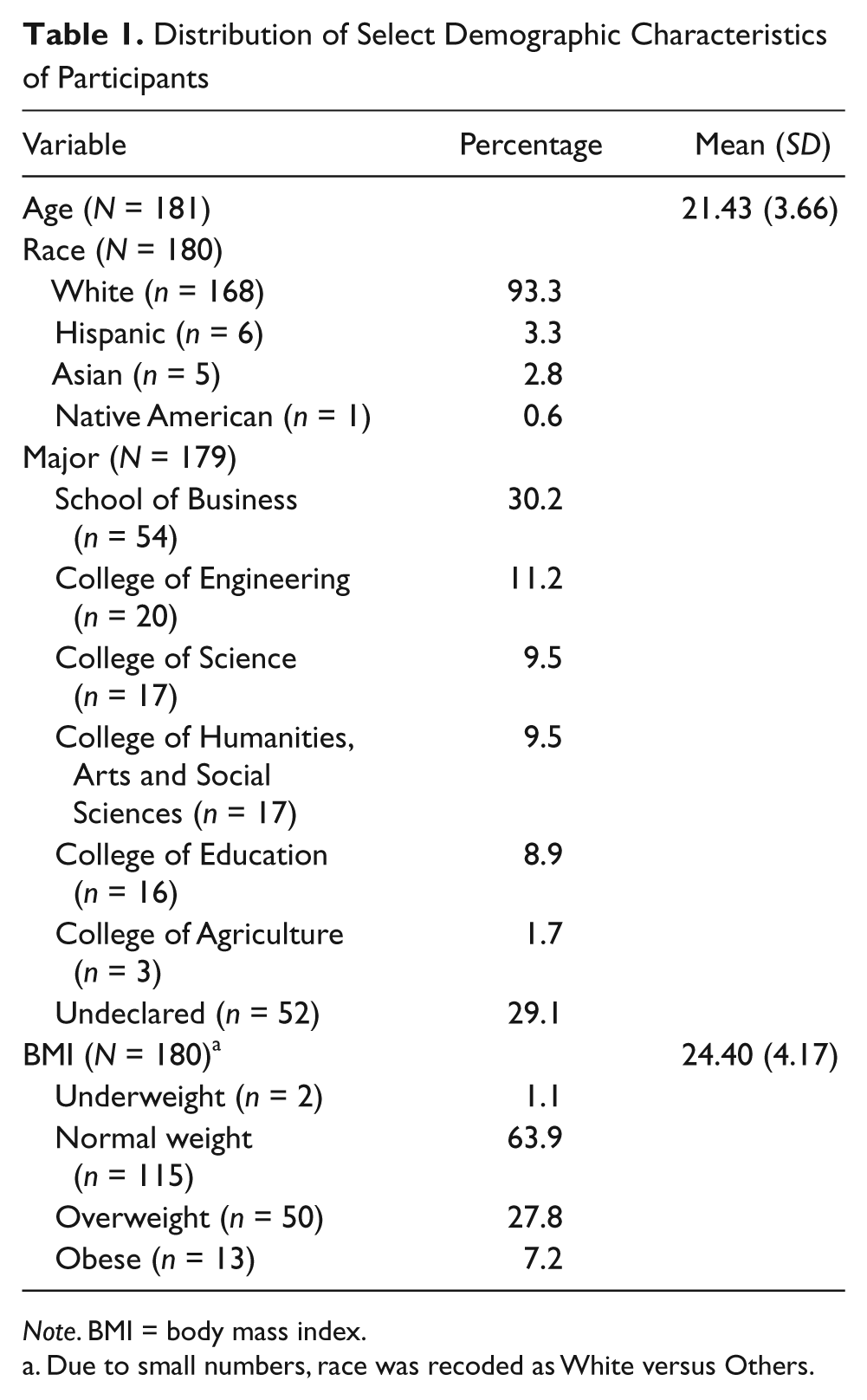
Note. BMI = body mass index.
Due to small numbers, race was recoded as White versus Others.
Summary Statistics for IES and BREQ Scores
The mean, standard deviation, and range for the IES and BREQ subscale scores are presented in Table 2. The highest mean scores for IES subscales were for the antidieting (mean = 4.03, SD = 0.74) and self-care (mean = 3.86, SD = 0.50) subscales. The mean total IES score was 3.66, indicating relatively high levels of intuitive eating in this sample. Interestingly, the lowest mean score was for the intrinsic eating subscale, with a mean score of 2.87 (SD = 0.62). The BREQ subscale scores reflected the continuum of external regulation to intrinsic regulation for physical activity with increases in mean scores across each level of the continuum. The mean score for external regulation was 0.83 (SD = 0.088), for introjected regulation 1.63 (SD = 1.10), for identified regulation 3.06 (SD = 0.83), and for intrinsic regulation 3.31 (SD = 0.83).
Summary Statistics for IES and BREQ Scores

Note. IES = Intuitive Eating Scale; BREQ = Behavioral Regulation in Exercise Questionnaire.
The results of the independent t-test comparisons of BREQ subscale scores for intuitive versus nonintuitive eaters are presented in Table 3. A significant difference (p < .001) was observed between the two groups on external and introjected regulation, with intuitive eaters scoring higher on both these subscales but no significant differences observed in mean scores for identified and intrinsic regulation scores.
Comparison of Mean Scores for BREQ Subscales for Intuitive Versus Nonintuitive Eaters

Note. BREQ = Behavioral Regulation in Exercise Questionnaire.
Body Mass Index and IES Score
Using linear regression analyses, results indicated that BMI decreased by 0.098 for every unit increase in total IES score (p < .001). The adjusted R2 indicates a moderately low predictive value for the model. Of the demographic variables, only age was associated with BMI. Specifically, BMI increased by 0.442 for every point increase in age (p < .001). The results of the final model, which only included IES total score and age, are presented in Table 4.
Unstandardized Coefficients for Intuitive Eating Scale Score and Age Predicting Body Mass Index

Note. BMI = body mass index; IES = Intuitive Eating Scale.
p < .01.
Unstandardized Coefficients for Independent Variables Regressed by BREQ Subscales
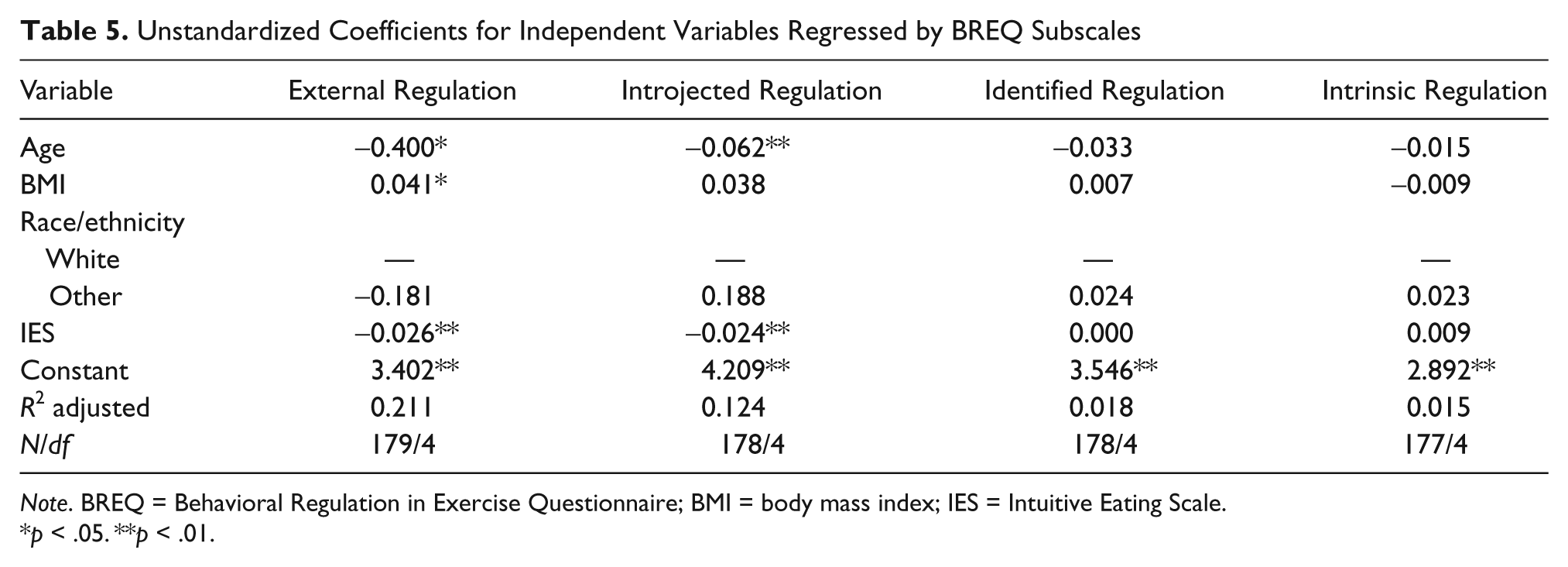
Note. BREQ = Behavioral Regulation in Exercise Questionnaire; BMI = body mass index; IES = Intuitive Eating Scale.
p < .05. **p < .01.
BREQ Subscale Scores and IES Score
To better understand the role of intuitive eating on physical activity motivation, we regressed IES total score on the four BREQ subscales. We also controlled for demographic variables to better understand the relationship between BREQ and IES independent of demographic variability. It was assumed that with age, race, and BMI there would be differences both with the BREQ subscale scores and IES total score. In all models, race/ethnicity was insignificant.
External Regulation Model
The first model, external regulation, revealed that IES total score was inversely related to external regulation, with 0.026-point decrease in external regulation for every unit increase in IES total score. In addition, two demographic variables were associated with external regulations. Specifically, for every point increase in age, there was a 0.400-point decrease in external regulation, and for every point increase in BMI, there was a 0.041-point decrease in external regulation.
Introjected Regulation Model
In this second model, IES total score was also inversely related to introjected regulation, with a 0.024-point decrease in introjected regulation for every point increase in IES. Of the demographic variables, only age was significantly associated with introjected regulation. For every point increase in age, there was a 0.062-point decrease in introjected regulation.
Identified and Intrinsic Regulation Models
For these final two models, no significant associations were identified between IES total score or any of the demographic variables and these two subscales. However, the direction of the IES relationship with these subscales was in the expected direction, reflecting the continuum of physical activity motivation.
Discussion
Little research has been conducted with men and intuitive eating. In addition, research has failed to examine how motivation for physically active and intuitive eating are related, if at all. Our research sought to close this gap.
In the present study, college men exhibited relatively high scores on the antidieting and self-care subscales of the IES. The antidieting findings are consistent with past research, which has reported that men do not identify as dieters and that dieting may be viewed as a feminine trait. For example, in a review by Jensen and Holm (1999), it was noted that men self-report dieting less than women and both men’s food quantities consumed at meals and food choices are consistent with antidieting behaviors. Diet foods (vegetables, salads) are considered inferior foods for many men. As noted by Jensen and Holmes, “Men tend to have an uncomplicated and direct relationship with food, eating meals that promise satiation, while women . . . seem to enjoy snacks and lighter meals that do not satiate the appetite” (p. 354). Men are less likely to be subjected to social control revolving around the amount and types of foods consumed as compared with women (Gough, 2007; Jensen & Holm, 1999) that allows for this direct relationship with food and avoidance of dieting behaviors. In past research using the IES scale, college men scored significantly higher on the antidieting subscale than the women in the sample (Smith & Hawks, 2006). Given that dieting behaviors are also associated with poor physical and mental health outcomes (Hawks & Gast, 1998; Hawks, Madanat, & Christley, 2008; Polivy & Herman, 2002), encouraging dieting behaviors in men should be avoided and effective alternatives to healthy weight management, such as intuitive eating, encouraged.
The present study’s findings that college men scored high on the self-care subscale of the IES is of interest and consistent with past research. Smith and Hawks (2009) reported a significant difference between female and male scores on the self-care subscale with men scoring higher than women. The four items of the IES self-care subscale focus on a concern with health and fitness over weight and fashion. For example, participants respond to the statements, “The health and strength of my body is more important to me than how much I weigh” and “I feel pressure from those around me to control my weight or watch what I eat.” As noted above, women have reported more pressure to regulate both the amounts and types of foods they eat (Jensen & Holm, 1999). Men in the current study placed more value on being physically fit and healthy than on an ideal weight. This is good news from a public health perspective as social pressure to look and eat a certain way have been reported to be precursors to disordered eating behaviors and attitudes (Hawks et al., 2008). However, research has also discovered that men, in particular heterosexual men, may engage in harmful behaviors to look fit and gain weight and muscle mass (McCreary, Hildebrandt, Heinberg, Boroughs, & Thompson, 2007). Therefore, more research is needed to determine if the self-care subscale of the IES used with male samples is truly measuring self-care or societal pressure unique to men. It is important to note that the intrinsic eating and self-care subscales have questionable reliability in the present sample (Cronbach’s α = .300). More research is needed with male samples to determine this IES subscale’s usefulness.
The college men in the study scored high on intrinsic regulation of physical activity. According to SDT, intrinsic motivation is the highest degree of motivation where an individual participates in physical activity for the pleasure and enjoyment of it. These results seem to validate the high self-care scores in the present study where college men report exercising because it makes them feel good. But as noted above, this subscale may lack validity in the present study.
Men in this study who were classified as intuitive eaters scored higher on both the external and introjected regulation of the BREQ. However, no significant differences were reported for the identified and intrinsic regulation scores. These differences in the BREQ subscales by intuitive eating status indicted that being an intuitive eater may be an important factor in moving men into the first few stages of motivation for physical activity, but not necessarily to more advanced stages of motivation. These results are somewhat unexpected as it was hypothesized that intuitive eaters would be more likely to score higher on intrinsic motivation. As is, the intuitive eaters were more likely to report that external factors (friends, family) and guilt or feelings of failure were more motivating to engage in physical activity. It appears that being an intuitive eater may only provide the initial motivation that is needed to engage in physical activity but not correlate with valuing and finding pleasure in physical activity.
Past research with obese women who participated in an intuitive eating intervention significantly increased their physical activity and maintained it at follow-up (Bacon et al., 2005). As participants learned intuitive eating skills in the intervention, they also significantly increased their time spent on moderate, hard, and very hard physical activity. Intuitive eaters are not only encouraged to engage in physical activity but also to enjoy it and focus on the pleasure that the activity provides rather than burning calories or decreasing body fat (Gast & Hawks, 1998). Avalos and Tylka (2006) tested a predictive model between intuitive eating, body function, and body appreciation. Body function is defined as having less preoccupation with outer appearance and more emphasis on the feel and function of the body. Body appreciation is defined as honoring the body by engaging in healthy behaviors such as eating healthy and/or physical activity. It was reported that intuitive eating was predictive of both body function and body appreciation. While these studies did not examine motivation for physical activity, they established a relationship between intuitive eating and physical activity.
Past research in female samples has reported that as IES scores increase, BMI decreases (Hawks et al., 2004; Smith & Hawks, 2006). Smith and Hawks (2006) also discovered this pattern with college male participants. This provides important information when thinking of weight management interventions with college men. While intuitive eating interventions with men have been limited, it may prove to be useful to test interventions with male samples that promote both intuitive eating skills and increased intrinsic motivation for physical activity, thus reducing BMI. In relation to BMI, this study replicated past research in that as participant’s age increased so did BMI (Smith & Hawks, 2006). Participants who were older not only reported heavier weight and less physical activity but also were more likely to report an eating style that was not intuitive. Intuitive eating interventions with men may stop or reverse this trend.
Intuitive eating seems an ideal intervention to be used with men since it builds on men’s antidieting views, does not encourage diet foods or dieting behaviors that may be viewed as feminine (e.g., counting calories or avoiding favorite foods), and builds on self-care beliefs that appear to be more likely held by men. There is also a relationship between initial motivation for physical activity and being an intuitive eater for men. Health psychologists and other health professionals working toward the prevention and treatment of obesity should consider intuitive eating methods with men.
While the study fills a gap in examining the eating style of college men and motivational factors for physical activity, there are some limitations to the study that should be addressed. The study is cross-sectional and therefore limits both causation and generalizability. In addition, a young college sample may be more motivated to engage in intuitive eating and physical activity. Past research has shown both physical activity and intuitive eating decline with age, so studies done with a more diverse sample is needed and in particular older and more ethnically diverse samples of men. Longitudinal studies that track men’s eating and physical activity patterns over the life course would be ideal and allow for better obesity prevention programs. It should be noted that we relied on self-report data for all aspects of the study, but a particular limitation is the self-report of height and weight. It is possible that a social desirability bias exists in the data. More objective measures of eating behaviors, height, and weight would improve the study.
Given that men and women have similar rates of obesity in the United States, obesity prevention programs should work within the psychosocial reality of men’s lives. For example, programs that build on masculine ideals of eating may be more successful than traditional approaches to weight loss (e.g., calorie restriction). Finally, intuitive eating interventions should be developed for men that also encourage physical activity.
Footnotes
The authors declared no potential conflicts of interest with respect to the research, authorship, and/or publication of this article.
The authors received no financial support for the research, authorship, and/or publication of this article.