




Abstract
Involvement by formal and informal social agents plays a major role in coping with the problem of partner violence. Based on data from the First National Israeli Survey of Family Violence, the present study attempted to answer whether the sex of the aggressor and the severity of his or her aggression affect formal and informal social involvement in partner violence. Data were obtained from a stratified probability sample of 2,544 women drawn from the general population in Israel. Findings show that the severity of aggression by both sexes affects informal social involvement similarly. But in regard to formal involvement, gender is of top importance, and only the severity of men’s aggression influences formal social involvement. The findings indicate society’s perceptions of partner violence and how it copes with the problem. These perceptions and their theoretical and practical implications are discussed. The discussion focuses on examining the factors that promote social construction of partner violence as identified in this study and the implications of this construction on dealing with the problem.
Involvement by formal and informal social agents plays a major role in coping with the problem of partner violence (PV). The factors promoting this involvement may indicate how the problem is perceived, therefore it is crucial to identify them in order to understand and efficiently address PV. It is reasonable to assume that social involvement in PV is based on risk assessment performed by formal social agents (police officers, medical doctors, social workers, etc.) and informal ones (relatives, neighbors, and friends). Risk assessment is a process of evaluating the probability of injury in PV (Kropp, 2008). The higher the risk of injury, the higher is the probability of social involvement. Risk of injury can be determined by two parameters: the severity of violence used by the aggressor and the resiliency of the victim to this aggression. The main question in this study is whether the sex of the aggressor and the severity of his or her aggression affect formal and informal social agents’ involvement.
Informal involvement and support in PV is most often provided by relatives and friends (Gondolf & Fisher, 1988; Horton & Johnson, 1993), and it includes advice, encouragement, financial assistance, accommodation, and child care (Goodkind, Gillum, Bybee, & Sullivan, 2003). Formal involvement and support are provided by a plethora of organizations and agencies, including law enforcement, welfare, health, women’s associations, and other bodies, specifically dedicated to helping battered women (Bowker, 1988; Donato & Bowker, 1984; Goodman, Dutton, Weinfurt, & Cook, 2003). These organizations offer a wide range of services, including legal information and counseling, direct or indirect financial support, and psychological advice and support.
Sex Differences in Partner Violence
There is a long-standing controversy as to how to identify, and accordingly also how to be involved, and cope with the problem of PV (Cook, & Swan, 2006; Eisikovits, Winstok, Grauwiler, & Mills, 2008; Frieze, 2005; M. P. Johnson, 2006; Winstok, 2011; Winstok & Eisikovits, 2011; Winstok & Straus, 2011). This controversy is led by two groups. One is dubbed “feminist scholars” (sometimes also domestic violence or violence against women researchers), who view the problem as asymmetric in terms of gender: They maintain that violence is used primarily by men against their female partner (e.g., R. E. Dobash & Dobash, 1979; R. P. Dobash, Dobash, Wilson, & Daly, 1992; Saunders, 1986; Tjaden & Thoennes, 2000; Vivian & Langhinrichsen-Rohling, 1994; Winstok, 2007). In this group, the term asymmetry reflects the notion that women, not men, are the victims of violence in intimate relationships. The second group is referred to as “family violence researchers” (sometimes also PV researchers), who view the problem as potentially symmetric in terms of gender. They maintain that a significant (but not necessarily equal) proportion of both sexes use violence in their intimate relationships (e.g., Madgol, Moffit, Caspi, Fagan, & Silva, 1997; Moffit & Caspi, 1999; Morse, 1995; O’Leary et al., 1989; Straus, Gelles, & Steinmetz, 1980/2006). Within this group, the term symmetry reflects the notion that sex is not a primary or significant factor in predicting violence in intimate relationships.
The cumulative empirical evidence unequivocally supports gender symmetry of violence in intimate relationships. Family violence surveys in the United States (the first was conducted in 1975 and the second in 1985; Gelles & Straus, 1988; Straus et al., 1980/2006) and other studies (e.g., Anderson, 2002; Kessler, Molnar, Feurer, Appelbaum, 2001; McCarroll, Ursano, Fan, & Newby, 2004; Williams & Frieze, 2005) demonstrated that approximately half the cases of PV were mutual, and the rest were divided equally between men and women. Findings indicate gender symmetry also from the etiological aspect. For instance, dominance by one partner (either man or woman) increases the probability of violence (Eisikovits, Winstok, & Gelles, 2002; Kim & Clifton, 2003; Straus, 2008; Sugihara & Warner, 2002; Winstok, Eisikovits, & Gelles, 2002). Moreover, it appears that only a small percentage of PV cases involve male dominance and female degradation (Gelles & Straus, 1988; Kantor & Straus, 1990; Straus, 1991). The assumption that female violence is associated with self-defense was found to be true only in a small number of incidents (Carrado, George, Loxam, Jones, & Templar, 1996; Cascardi & Vivian, 1995; DeKeseredy & MacLeod, 1997; Eisikovits & Buchbinder, 2000; Felson & Messner, 1998; Pearson, 1997).
The cumulative empirical knowledge consistently supports the idea of gender symmetry, from both the behavioral and etiological aspects. However, it is important to reemphasize that although both sexes exhibit similar rates of violence in their intimate relationships, most studies show that women suffer more injuries than men. These findings are somewhat inconsistent, some finding low injury rates whereas others finding high injury rates. An example of large sex differences can be found in the second survey on family violence in the general population in the United States performed in 1985. The survey (Stets & Straus, 1990) indicates considerable differences: 3% of women and 0.4% of men required medical attention as a result of a violent incident with their partner. Simpson and Christensen (2005), who studied this issue using a service population sample, found larger rates of injury but smaller sex differences: The rate of women who reported being injured in a conflict with their partner was 11.7%, the rate of women who reported that their partner was injured in a conflict with them was 17.9%, the rate of men who reported that their partner was injured in a conflict with them was 18.3%, and the rate of men who reported being injured in a conflict with their partner was 15.4%.
Winstok (2011) argued that the controversy over sex differences in PV perpetration and victimization stems from differing and competing paradigmatic outlooks, which disagree over the identification, definition, and understanding of PV. As such, the controversy cannot be mediated, resolved, or settled by empirical means. Moreover, it is suggested that the controversy cannot be resolved at all because of its paradigmatic nature. Terms, principles, and facts are created and sustained within a given paradigm, out of which they can be perceived and interpreted differently.
Risk Assessment in Partner Violence
Following the assumption that social involvement in PV is based on risk assessment, it is reasonable to hypothesize that the greater the severity of the aggression, the higher the probability of social involvement. In addition, since in PV the probability that women will be injured as a result of their male partner’s violence is higher than that of men being injured by their female partner’s violence, it is also reasonable to hypothesize that the probability of social involvement would be higher in the case of male aggression than in that of female aggression. Yet this assumption disregards a major female injury risk factor.
A recent work by Whitaker, Haileyesus, Swahn, and Saltzman (2007) may reemphasize how important it is to acknowledge the symmetrical etiological and behavioral aspects of the problem and their asymmetrical outcomes. It was based on data from a longitudinal national study of adolescent health in 2001. They analyzed the reports of 11,370 young adults aged 18 to 28 years on violence and injury in 18,761 heterosexual relationships. There was violence in 24% of the relationships; in almost half the cases (49.7%) violence was bilateral. In 70% of the unilateral violence cases, the women were those who used violence against their partners. However, men were more likely to injure their partners than women. The most interesting finding of this study was that mutual violence was associated with injury to a greater extent than unilateral violence, whether perpetrated by a man or a woman. Namely, the chances of injury were higher when both partners were violent than when only one partner was violent. This finding is consistent with those of Stith, Smith, Penn, Ward, and Tritt (2004), who analyzed 85 studies to identify the most significant risk factors for physical aggression and victimization among intimate partners. They found that women’s violence against their partners is the strongest risk factor for their victimization. Apparently, social involvement in PV, limited to instances of men-to-women violence, ignores a significant empirically established risk factor. Such inattention indicates that social involvement adheres to an asymmetric perspective and is ineffective in providing protection to women as well as to men.
Method
This study is based on data from the First National Israeli Survey of Family Violence and Children at Risk conducted in 2000-2001 (Eisikovits, Fishman, & Mesh, 2000). The survey was commissioned and funded by the Ministry of Social Affairs and was carried out by the Center for the Study of Society at the University of Haifa. The survey addressed a broad spectrum of personal, interpersonal, and social issues. This study will focus on aspects of the survey addressing social involvement in PV.
Sampling and Interview Procedures
A stratified probability sample drawn from the general population in Israel was used. In total, the survey encompassed 2,544 women who have been cohabiting with their partner for the past 12 months preceding data collection (Eisikovits et al., 2000; Eisikovits, Winstok, & Fishman, 2004). The sample was based on the size of the municipalities and the socioeconomic status of their inhabitants as calculated and presented by the Israeli Central Bureau of Statistics (2000). Assignment to a specific socioeconomic cluster was based on the following characteristics: financial means (work-related income), housing (crowdedness), household appliances (such as air conditioner and computer), transport (number and type of vehicles per household), education (years), work status (employment/unemployment), socioeconomic distress (such as unemployment), and demographic characteristics (number of family members per household). The dwelling units within each location were randomly selected (using a random number generator) from the telephone book in proportion to the population size of the municipality. Surveyors were dispatched to each selected address to administer structured interviews on domestic violence. They were instructed, however, to call on the adjacent address that was sampled, to overcome sample bias due to nonrepresentation of households without telephones.
The Research Ethics Committee at the University of Haifa approved the protocol for the interview and the consent procedures. Trained surveyors were required to ascertain that the address approached was inhabited by a woman with her partner or a woman who had lived there for at least one year with a partner during the preceding 5-year period. If these criteria were not met, the surveyors went to the next dwelling unit. If the criteria were met, the surveyors explained the purpose of the study and the type of information that was looked for. Once the participants gave their consent, they were interviewed at home by the surveyors. If a woman declined to participate, the surveyors continued to the next dwelling unit. The response rate among women who were available and met the criteria was 70%.
Participants
The average age of the women in the sample was 40 years (SD = 12.02). Their partner’s average age was 43 years (SD = 11.88). On average, the couples cohabited for 18 years (SD = 13.20) and had 3 children (SD = 2.07). The men and women in this sample had an average education of 12 years. The men had an average education of 12 years (SD = 3.52) similarly to the women (SD = 4.55). Below average income was reported by 59% of the couples.
Measures
This study used the items developed for a survey addressing social involvement and severity level of aggression (Eisikovits et al., 2004). The measurement instruments for this survey were developed based on U.S. and Canadian surveys, which were then adapted to the Israeli context (Gelles & Straus, 1988; A. G. Johnson, 1996; Straus et al.,1980/2006; Straus, Hamby, Boney-McCoy, & Sugarman, 1996). A pilot study was performed to examine item fit to a national broad-scope survey (Eisikovits et al., 2000).
Severity level of aggression
Women were asked to report their partner’s use of verbal aggression, threats of physical aggression, and actual physical aggression toward them and their own use of these behaviors toward their male partner during the preceding year. Based on a violence prevalence calculation, common in PV research (Straus et al., 1996), the composite scales (women’s and men’s severity level of aggression) were computed as follows: “0” in cases where any form of aggression was not in use, “1” if only verbal aggression was used, “2” if threats of physical aggression were made but no physical aggression was used, and “3” if physical aggression was used.
Social involvement
In this survey, women were asked to report the involvement of the following nine informal and formal agents in their conflicts with their partners in the preceding year: (a) family members, (b) friends, (c) neighbors, (d) welfare agencies, (e) courts of law, (f) legal assistants or counsels, (g) police, (h) psychotherapists, and (i) nurses or medical doctors. Social involvement could include just the awareness that a problem exists, an awareness that may not grow into any intervention, or may develop into various forms of formal or informal, direct or indirect intervention initiatives.
A principal components factor analysis was used to test the factorial structure of the nine items. The analysis extracted three expected factors (eigenvalue = 0.90, cumulative percentage = 64.82). The first factor was loaded by the items representing family members’, friends’, and neighbors’ involvement. The second was loaded with welfare agencies, courts of law, legal assistants or counsels, and police. The third was loaded with psychotherapists and nurses or medical doctors. In all cases, factor loadings were high (β > .65).
Based on the theoretical framework of this study and factor analysis results, three dichotomous variables were computed, representing noninvolvement (“0”) and involvement (“1”) of three social categories: (a) informal agents’ involvement (i.e., family members, friends, and neighbors); (b) welfare, judicial, and enforcement agents’ involvement (i.e., welfare agencies, courts of law, legal assistants or counsels, and police); (c) mental and physical health agents’ involvement (i.e., psychotherapists, nurses or medical doctors). For each dichotomous variable, noninvolvement (“0”) was determined when there was no involvement by any agent from the social category. Involvement (“1”) was determined for the rest of the cases, where one or more agents were involved.
Behavioral symmetry
Based on the differentiation between gender symmetry and asymmetry (Winstok, 2011), the composite scales of men’s and women’s severity of aggression (0 = not aggressive to 3 = physically aggressive) were also used to compute a dichotomous variable representing behavioral symmetry: “1” was encoded in cases where men’s and women’s severity levels of aggression were identical (i.e., symmetry). Cases with nonidentical severity levels were encoded as “0” (asymmetry).
Demographic variables such as women’s age, years of education, years of cohabitation, number of children, and family income were also addressed.
Data Analysis
To test research hypotheses, three logit regressions were used to predict informal agents’ involvement; welfare, judicial, and enforcement agents’ involvement; and mental and physical health agents’ involvement (using SPSS-17). In each model tested to predict a social support category, the other two categories were presented as predictors along with men’s and women’s severity levels of aggression and behavioral symmetry. The models tested were controlled for demographic variables, including family income, women’s age, education, years of cohabitation, and number of children.
Results
Descriptive Statistics
The rate of women who reported that there was violence in their intimate relationships was 72.3%. In 54.2% of these cases, women reported equivalent violence, that is, both partners used violence against each other at the same degree of severity. In 45.8% of these cases, women reported that the violence was not equivalent. In this group, 65.2% of women reported that the men were verbally violent whereas they (the women) were not violent at all; 8.5% reported that they were verbally violent whereas the men were not violent at all; 20.1% reported that the violence of men was more severe than their own; and 5.0% of the women in this group reported that their violence was more severe than that of the men.
The rate of women who reported violence in their intimate relationship and reported informal social involvement as well was 33.0%. Of the women who did not report violence in their intimate relationship, 13.2% did report informal social involvement. Of the women who reported PV, 6.1% also reported formal social involvement, including welfare, judicial, and enforcement agents. Of the women who did not report PV, 3.7% did report formal social involvement. Of the women who reported PV, 5.0% reported formal social involvement—including that of mental and physical health agents. Among women who did not report PV, 1.4% reported this kind of involvement.
Social Involvement Prediction
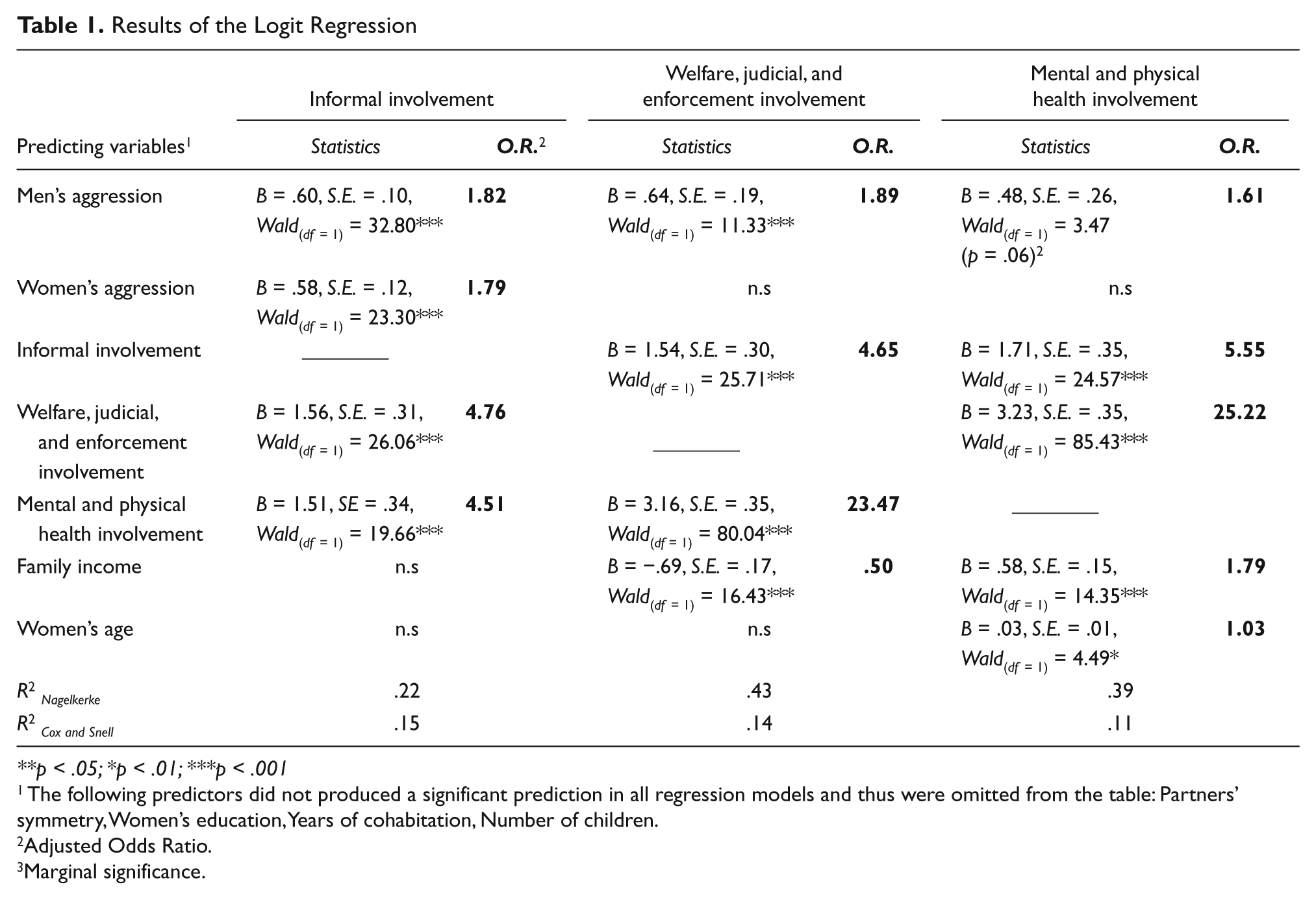
Figure 1 is a heuristic summary of the three logit regression analysis results (see also Table 1 for detailed statistics). For each analysis, one of three social involvement categories was predicted by the remaining variables. The analyses demonstrated that across all three models, the following variables had no significant effect: behavioral symmetry, women’s education, years of cohabitation, and number of children. Therefore, these variables appear on the upper right-hand side only as a reminder of their inclusion. The effects are given in values-of-odds ratios in the figure. Effects given in dotted lines are insignificant.

Heuristic presentation of the six logit regressions results
Results of the Logit Regression
p < .05; *p < .01; ***p < .001
The following predictors did not produced a significant prediction in all regression models and thus were omitted from the table: Partners’ symmetry, Women’s education, Years of cohabitation, Number of children.
Adjusted Odds Ratio.
Marginal significance.
Men’s severity of violence was found to predict involvement for all the social categories. The more severe the violence, the greater are the odds for social elements’ involvement. Women’s severity of violence was found to predict only informal involvement at similar levels to men’s. Each of the involvement elements predicted involvement by other elements. One element’s involvement increased the odds for involvement by other elements. For instance, involvement of family members, friends or neighbors increased the probability of involvement by welfare, law, and/or enforcement agents. Yet the association between informal social elements (i.e., family members, friends, or neighbors) and formal social elements (i.e., welfare, judicial, and enforcement agents on one hand and mental and physical health agents on the other hand) is weaker than the association between the two formal categories. Namely, when one category is involved, it is highly likely that other categories will be involved, especially when formal elements are concerned.
Findings also indicate that the higher the family income, higher the probability for involvement by mental and physical health agents, whereas lower the probability for involvement of welfare, judicial, and enforcement agents. Family income had no influence on the involvement of informal elements. Findings also demonstrate that the involvement of mental and physical health agents increases with the age of the women. Women’s age had no significant effect on the involvement of the remaining social elements categories.
Discussion
The present study attempted to answer whether the sex of the aggressor and the severity of his or her aggression affect formal and informal social involvement in PV. The severity of aggression by both sexes affects informal social involvement similarly. Gender has little effect in this case. But this is not so with formal involvement, where gender is of top importance. Only the severity of men’s aggression influenced formal social involvement. An examination of differences in formal and informal social involvement when the violence is perpetrated by men as opposed to that perpetrated by women may enhance our understanding of the social perception of the problem.
The first question to ask is why does gender have little importance for the informal involvement? This question may have several complementing answers. It is possible that informal social agents view the conflict itself, rather than the ensuing violence, as the problem to be dealt with. They may view violence only as an indication to the severity of the conflict. Their involvement is aimed mostly at resolving the conflict under the conjecture that once the conflict is resolved there will be no more violence. It is also possible that informal social agents intervene when the man hurts the woman, out of fear for her safety. They also worry for her when she hurts the man, perhaps because they assume that he may hurt her back at some point, or perhaps they take the woman’s violence as a legitimate attempt of self-protection from the man’s inappropriate attitude or his violence per se.
Informal involvement works along the lines of the perspective of family violence scholars, who argue gender symmetry in PV, since such involvement is affected by the severity of violence by both sexes. However, there is no reason to assume that informal involvement stems from such acknowledgment; it can only be assumed that informal involvement is consistent with such acknowledgment. Nevertheless, the explanations suggested for this finding are in keeping with the ideas of family violence scholars. The first explanation for the involvement of informal elements is that it is mainly geared to resolve the conflict. Many family violence scholars uphold this approach, whereas feminist scholars tend to reject it in general (Stith & McCollum, 2011; Winstok, 2011). According to the common approach that stems from feminist scholars’ paradigm of gender, when there is PV it is the violence that is to be focused on and be regarded as the problem that requires intervention and change. According to the family violence scholars’ paradigm of conflict, violence is the product of an interpersonal conflict that is an indication of a crisis between intimate partners. Consequently, in many cases when the violence is mild, the crisis that led one partner or both to violence can be addressed; hence resolving the crisis would resolve the problem of violence. The second explanation of informal involvement suggests that informal social elements get involved when violence is used by the woman, out of fear of the response of her male partner, and is consistent with the perspective of family violence scholars. Researchers such as Stith (see Stith et al., 2004) and Whitaker (see Whitaker et al., 2007) found that women’s violence against their partners is the strongest risk factor for their victimization.
Another question to be asked is why are formal social elements not involved in cases where women use violence against their male partners. The present study’s findings are insufficient to provide an answer to that question, but they can suggest explanations that require further examination. One possible explanation is that formal social agents do not get involved because these cases are not brought to their attention because of the common public perception (realistic or not) that formal social agents will only intervene when there is clear and present danger. Whereas the violence of men against women is regarded as clear and present danger, the violence of women against men is not taken as such. It is also possible that the violence of women against their male partners is reported to formal social agents, but they choose not to intervene, possibly because they may not regard it as dangerous.
This explanation is consistent with the argument that sex affects formal social agents’ response—including that of the police (Bittner, 1970; Black, 1980; Manning, 1997; Pattavina, Hirschel, Buzawa, Faggiani, & Bentley, 2007). For example, it is suggested that police officers’ response to female violence is more lenient than to male violence (Chesney-Lind, 1999; Chesney-Lind & Pasko, 2004). A complementing explanation can derive from sex differences in seeking help. Apparently in many areas women have greater willingness than men to seek out the help of support elements, and this is also true for the area of PV (Coker, Derrick, Lumpkin, Aldrich, & Oldendick, 2000; Mihorean, 2005; Walby & Allen, 2004). Women who are hurt by their male partners tend to involve formal and informal social elements more than men who are hurt by their female partners. Although there are several ways to explain formal involvement, clearly it is in keeping with the feminist outlook.
The various perspectives underlying formal and informal involvement have both advantages and disadvantages. The advantage of the perspective characterizing involvement by informal social agents is their familiarity with the couple and with the problem whether it is the crisis between the partners, the conflict, or the violence. They are available, are understanding, and more up to date than formal social agents as to what is happening in the couple’s lives and what it is they need. Therefore, informal social agents’ responses may be more in tune with the specific case at hand than the responses of formal social agents, who act to provide response to as many cases and situations as possible. More often than not they attempt to respond in a consistent, prescribed, and uniform manner, based on their extensive professional background and knowledge. Their approach in general is more objective than that of informal social elements. As already mentioned each approach has its advantages and disadvantages and one is not necessarily preferable over the other. Each is worth acknowledgment, and the benefit of a combined approach is especially worthy of attention in coping with PV (Winstok, 2011).
Findings also show that the higher the family income, the greater the probability of mental and physical health agents’ involvement, whereas the probability of welfare, judicial, and enforcement agents’ involvement decreases. Family income did not affect informal involvement. These findings may reveal additional aspects of social involvement, specifically the perceived costs associated with it. Family income is a proxy representation of socioeconomic status. Involvement by welfare, judicial, and enforcement agents can be considered an embarrassment and a threat to social status. The higher the status, the more serious the embarrassment can be perceived to be; hence an involvement by these elements is to be shunned by the victim as well as possibly family, friends, and neighbors who could also suffer the implications of such involvement. It would appear that the involvement of mental and physical health agents is a less “damaging” alternative for high income families in terms of status degradation.
The findings also demonstrate that the older the woman, the higher the probability of mental and physical health agents’ involvement. This effect may result from increased opportunities for such involvement over time, the negative cumulative effect of intimate conflicts and violence on the woman’s mental and physical health and a decrease in resilience to violence.
The findings also show that involvement by one social category increases the probability that other categories will become involved. The transition from informal to formal involvement is more moderate than the transition from one formal element to the next. This could be because of several reasons, for example, impediments accessing formal elements, fear of overinvolvement, disbelief in the ability of formal elements to provide a satisfactory response to the problem, and recognizing that costs are also associated with the benefits of the problem being revealed to formal agents. The transition from one formal category to another is much quicker, possibly because of a number of reasons such as protocol and policy, a perspective of the problem as requiring utilization of a variety of skills, and possible delegation of authority or rejection of accountability.
The practical implications of this study’s findings are not trivial and they rely on their guiding paradigm in their perspective on PV and on how to cope with it. Two major and competing paradigms exist (Winstok, 2011). One underlies the feminist perspective that the violence of men against their female partners is the problem. Gender is a factor of central importance in this paradigm for understanding and addressing PV (e.g., R. E. Dobash & Dobash, 1979; R. P. Dobash et al., 1992; Saunders, 1986; Tjaden & Thoennes, 2000; Vivian & Langhinrichsen-Rohling, 1994; Winstok, 2007). The second paradigm, based on a perspective of conflict, regards violence as the problem—when it is used by either men or women against their intimate partner. Gender in this case is a marginal factor (e.g., Madgol et al., 1997; Moffit & Caspi, 1999; Morse, 1995; O’Leary et al., 1989; Straus et al., 1980/2006). Nowadays, the predominant paradigm in dealing with PV is consistent with feminist thinking (Dutton & Corvo, 2006). The present findings concerning formal elements’ involvement in PV would probably provide encouragement to those guided by the feminist perspective. The practical implications of these findings could imply to them that the focus on male violence against their female partners should continue and be commanded on informal elements as well. As to those guided by the notion that sex plays a marginal role in the problem of PV, the present findings regarding informal elements’ involvement may be encouraging. However, the findings regarding formal agents’ involvement indicate that further educational effort is required if the violence of women and not only that of men is eventually to be addressed by the establishment.
The study at hand is limited in terms of theory, examining the involvement of a partial number of social elements and ignoring involvement characteristics altogether (how involvement comes into effect and is expressed). Methodologically, the study examined the general population, which can provide a standard overview, but is not representative of specific subsample populations. Statistically, the logit regression used in this study to analyze the data serves as a means to predict social involvement in PV, but it is limited in its ability to explain such involvement. The research is also limited in that it studied a dynamic experience at a single point in time. Most important, the assumptions and interpretation of findings in this study need further testing and support. Some questions remain, such as the following: Are social involvement and its predictors really representative of how the problem is socially constructed and perceived? If the man’s aggression alone is predicting the involvement, is this indicative of an asymmetrical approach? And if the woman’s aggression predicts involvement as well, does this indicate a symmetrical approach? Future research should address the limitations and questions mentioned above. Specifically, more studies are needed to expand the reference to additional social categories’ involvement, and broaden the scope of interest to the intervention method. This type of research should be performed across time periods so as to identify shifts in prevalent perspectives.
Appropriate social involvement by a variety of social elements can serve as an important protective factor in coping with the problem of PV and reducing its scope. This issue can be tackled in two ways: by research that identifies risk factors and, as in this study, by exploring elements that promote involvement among various social categories. The study of social involvement is also important because it helps our understanding of how social problems are constructed and responded to by societies.
It is important to remember that social problems are not just “out there” and are not independent of the perceptions of those who define them (Best, 1989). Social problems are a product of conceptualization and definition made by certain individuals who identify and label existing situations as socially harmful. They then provide frames of reference that include the causes of the problem and its consequences not only to explain how the problem was created and is affecting individuals and society but also to show how it should be addressed.
Footnotes
The author declared no potential conflicts of interest with respect to the research, authorship, and/or publication of this article.
The author received no financial support for the research, authorship, and/or publication of this article.