



Abstract
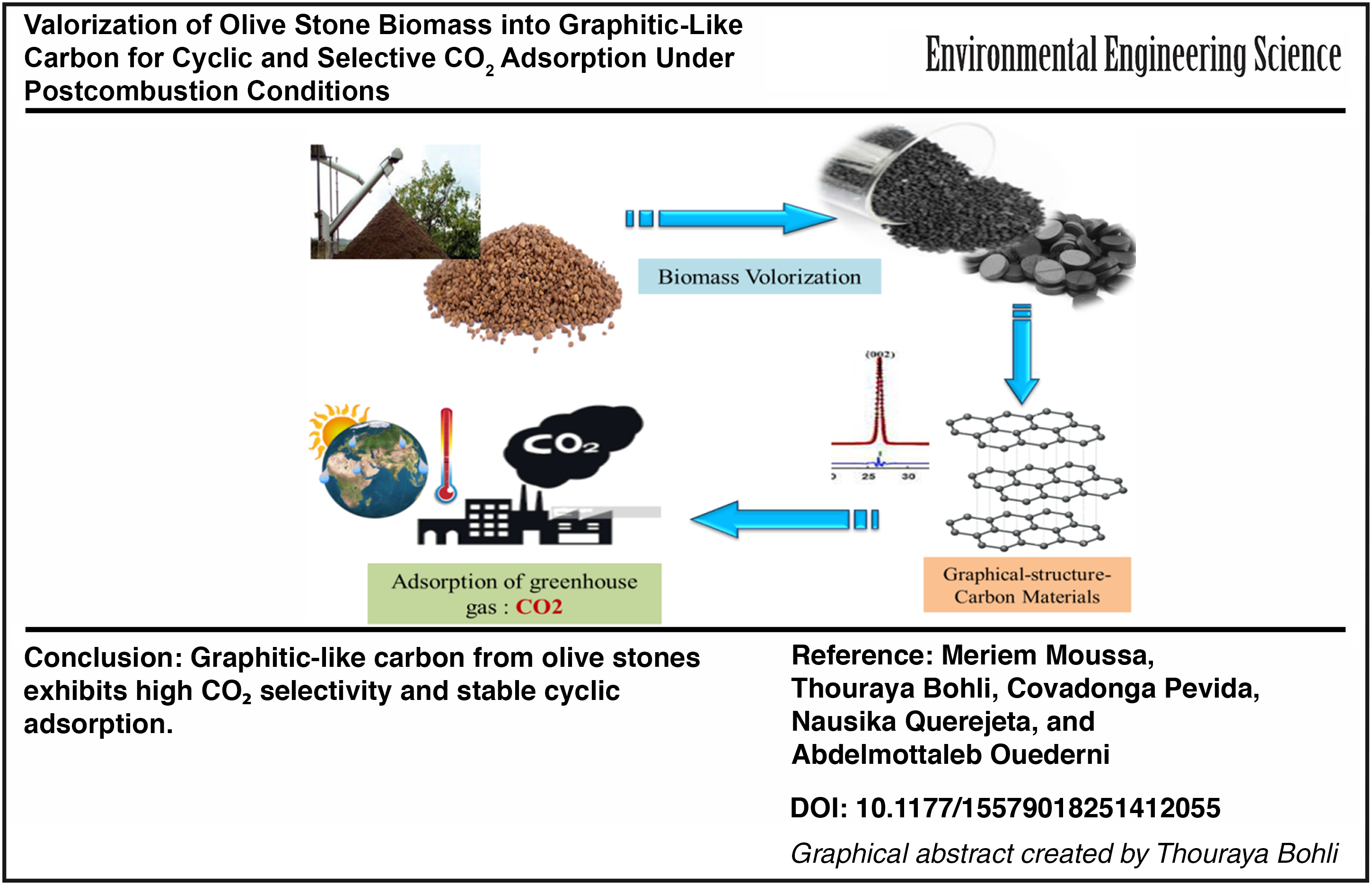
This work focuses on investigating the conversion of olive stone waste into porous, graphitic carbon materials using a sequence of thermal and catalytic treatments. Three distinct processing strategies were investigated: (i) chemical activation with potassium hydroxide (AC-OS-KOH), (ii) thermal pyrolysis in an inert atmosphere yielding biochar (C-OS), and (iii) catalytic graphitization using transition metals (Ni or Fe) either in combination with KOH activation (AC-OS-KOH-Ni, AC-OS-KOH-Fe) or applied directly to biochar (C-OS-Ni). The structural, morphological, and textural properties of the resulting carbon materials were characterized using X-ray diffraction, scanning electron microscopy, and carbon dioxide (CO2) physisorption at 0°C.
Among all synthesized materials, AC-OS-KOH and AC-OS-KOH-Fe displayed superior microporosity and well-developed pore architectures, leading to enhanced CO2 adsorption capacities compared with nonactivated and nickel-catalyzed samples. Notably, the dual strategy of chemical activation and nickel catalysis facilitated the transformation of olive stone precursors into graphitic-like porous carbon with a crystallinity index reaching 61%, indicating successful partial graphitization. CO2 adsorption–desorption experiments were conducted at 25°C and 50°C under two CO2 concentrations (90% and 10%, balanced with N2). The KOH-activated carbons, with or without metal doping, exhibited fast adsorption–desorption kinetics, in contrast to the sluggish performance of the C-OS-Ni sample. This behavior underscores the critical role of micropore size and volume in governing CO2 molecular diffusion and access to active sites. At elevated CO2 concentration (90%), AC-OS-KOH demonstrated the greatest adsorption capacity, achieving 13.64 wt.% at 25°C and 8.98 wt.% at 50°C. In contrast, under diluted CO2 conditions (10%), the AC-OS-KOH-Fe sample showed superior performance, indicating a strong link between pore size distribution and selective gas adsorption. Furthermore, the KOH-activated carbons maintained consistent adsorption performance across six consecutive adsorption–desorption cycles, confirming their stability and regeneration potential for practical CO2 capture applications.
Keywords
Get full access to this article
View all access options for this article.