



Abstract
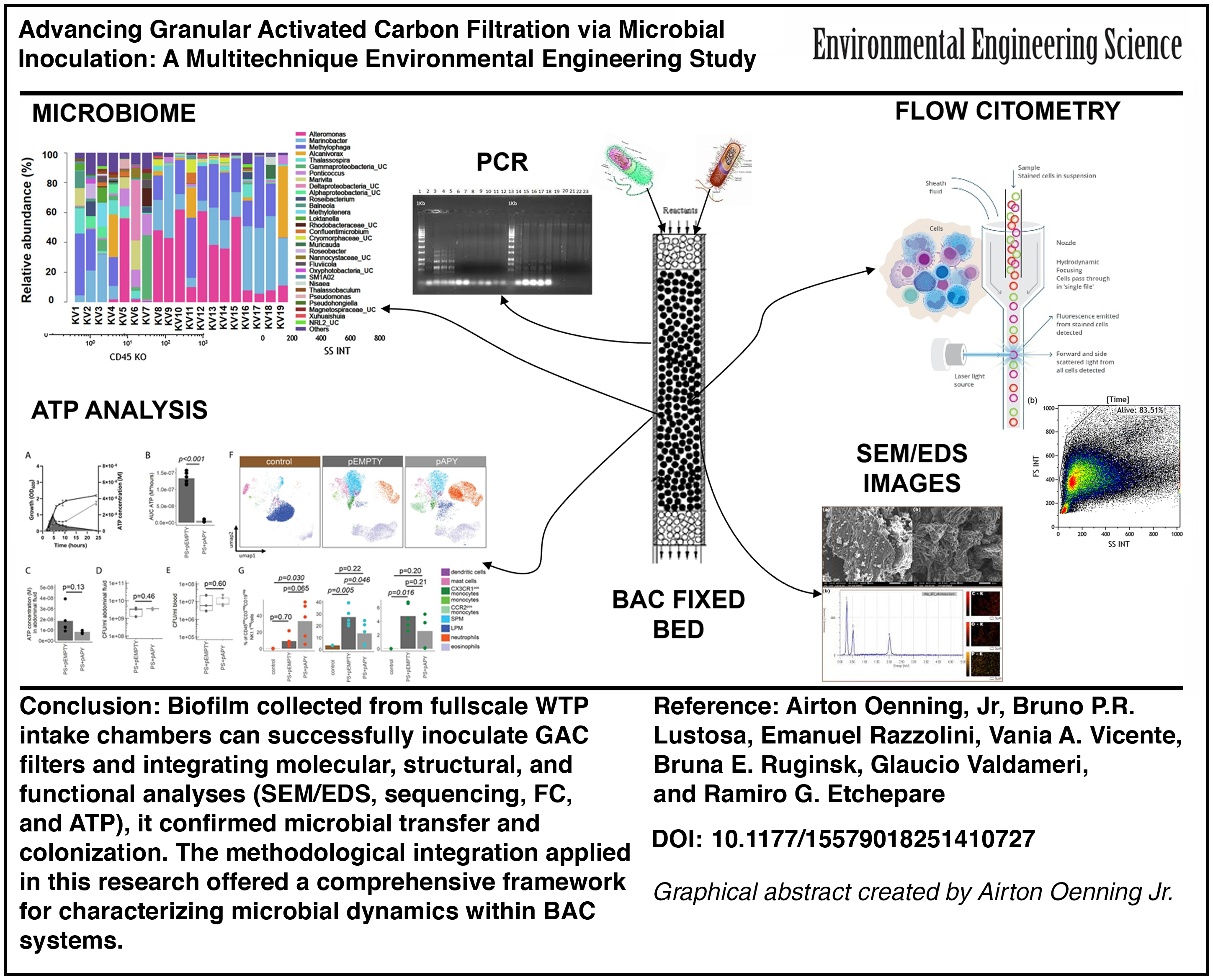
Biological activated carbon (BAC), an alternative water treatment, has emerged as an effective technology in water treatment plants (WTPs) for removing organic compounds and micropollutants. It integrates granular activated carbon (GAC) with biofiltration, improving taste and odor removal, prolonging carbon lifespan, and reducing chemical use. Microbial biofilms established on the carbon bed contribute to these processes, as characterizing their microbiota supports the optimization of contaminant removal. However, most studies employ a limited range of techniques, which constrains a comprehensive understanding of microbial colonization and functional roles within GAC filters. This study evaluated the ability of a WTP-derived microbiome to inoculate a GAC bed by applying, for the first time, a multimodal analytical framework. The approach combined scanning electron microscopy, energy-dispersive X-ray spectroscopy, metagenomic analyses (16S, 18S, and internal transcribed spacer [ITS]), flow cytometry, and adenosine triphosphate (ATP) quantification. Results confirmed successful microbial transfer from the inoculum to the GAC through imaging and genetic sequencing. Specifically, the inoculum microbiome yielded 116,526 sequences for 16S rRNA, 115,170 for 18S rRNA, and 432,578 for ITS. BAC samples produced 107,095 sequences for 16S rRNA and 267,057 for ITS, with no 18S sequences detected, indicating diminished eukaryotic presence. Flow cytometry detected nucleic acids in both samples, while ATP quantification showed higher ATP concentrations in the inoculum compared with BAC samples, suggesting reduced microbial viability postinoculation. This multitechnique engineering study advanced understanding of biofilm colonization dynamics on BAC filters by demonstrating microbial inoculation using raw water sources and established a methodological framework for optimizing BAC operation in drinking water treatment.
Graphical Abstract
Keywords
Get full access to this article
View all access options for this article.
References
Supplementary Material
Please find the following supplemental material available below.
For Open Access articles published under a Creative Commons License, all supplemental material carries the same license as the article it is associated with.
For non-Open Access articles published, all supplemental material carries a non-exclusive license, and permission requests for re-use of supplemental material or any part of supplemental material shall be sent directly to the copyright owner as specified in the copyright notice associated with the article.
