



Abstract
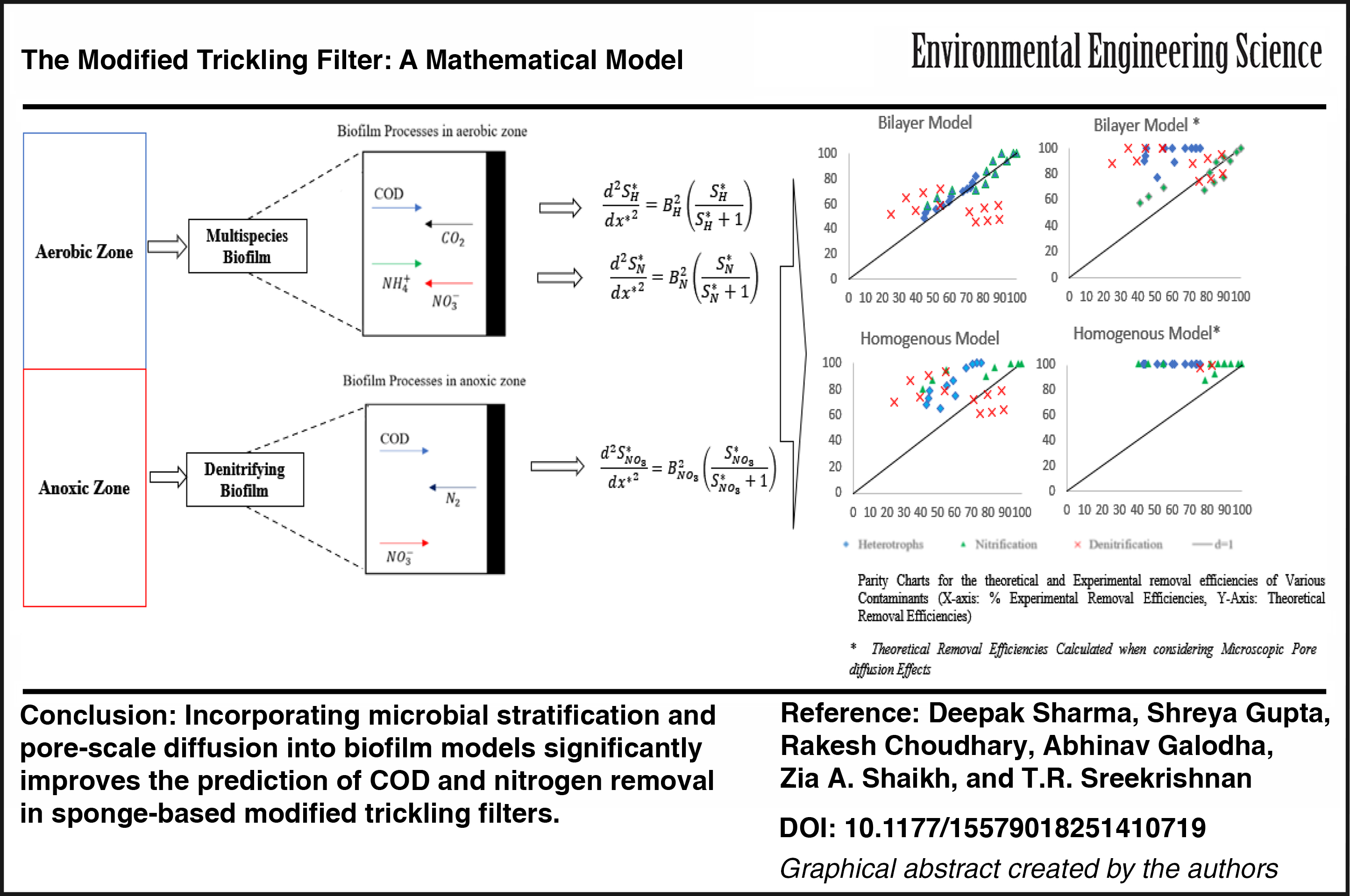
The primary objective of this study is to develop a modified trickling filter (MTF) mathematical model that addresses limitations of conventional biofilm models, including their inability to capture microbial stratification, simultaneous nitrification–denitrification, and diffusion effects in porous sponge media. Under fixed-bed circumstances, the MTF uses a polyurethane sponge medium to promote biomass adhesion and proliferation. The two main zones of the MTF are aerobic and anoxic. Heterotrophic organic carbon oxidation and nitrification are both carried out concurrently in the aerobic zone. The two main zones of the MTF are aerobic and anoxic: heterotrophic organic carbon oxidation and nitrification occur in the aerobic zone, whereas denitrification proceeds in the anoxic zone. The model integrates three components: a compartmental reactor flow model (axial plug-flow representation of completely mixed biofilm reactors), a biofilm kinetics module (substrate conversion by heterotrophs, nitrifiers, and denitrifiers), and a porous-media diffusion module (effective diffusion via the Millington–Quirk relationship). Within the biofilm, both bilayer distributions (heterotrophs outer, nitrifiers inner) and homogeneous distributions were evaluated. Model predictions were validated against experimental data (influent COD = 119–161 mg L−1, NH3-N = 29–35 mg L−1, hydraulic residence times = 2–4 h, with/without recycle) using parity charts and statistical indices. The bilayer biofilm with pore diffusion provided the most accurate results, with Willmott’s index of agreement (d) = 0.95 for COD, 0.95 for Ammoniacal Nitrogen (NH3-N), and 0.94 for Nitrate Nitrogen (NO3-N) and relative errors (RE) of 0.05–0.07, compared with d ≤ 0.47 and RE ≥ 0.24 for the homogeneous model. These findings confirm that incorporating stratification and pore diffusion significantly improves model performance. The framework not only clarifies COD, NH3, and NO3 removal mechanisms in sponge-based MTFs but also offers design guidance on recycle ratios and porosity thresholds for enhanced operation.
Graphical Abstract
Keywords
Get full access to this article
View all access options for this article.
References
Supplementary Material
Please find the following supplemental material available below.
For Open Access articles published under a Creative Commons License, all supplemental material carries the same license as the article it is associated with.
For non-Open Access articles published, all supplemental material carries a non-exclusive license, and permission requests for re-use of supplemental material or any part of supplemental material shall be sent directly to the copyright owner as specified in the copyright notice associated with the article.
