




Abstract
This study examines how rural women in Michoacán, Mexico understand and navigate intimate partner violence (IPV) amid poverty, limited state presence, and institutional promotion of legal intervention. Drawing on 64 qualitative interviews and embedded observation, the findings show a disconnect between institutional and community definitions of harm, strategic disengagement from legal systems, and reliance on relational, community-based responses often shaped by extended kin. Reframing the Dispute Pyramid through feminist criminology and decolonial feminist theory, the study highlights how survivors weigh competing harms and underscores the need for culturally grounded, non-carceral approaches aligned with local realities.
Keywords
Introduction
In the heat of a late August of 2022 afternoon, I stood outside the police station in Morelia, Michoacán—my last attempt after weeks of unanswered emails, unreturned calls, and failed in-person visits. I had come to speak with officers about intimate partner violence (IPV) in rural communities. Instead, I was met with silence, resistance, and thinly veiled dismissal. At one point, a young officer barely looked up from his paperwork as he told me no one was available, offering a generic promise that someone would call me back if I left my number. No one ever did. My inability to engage law enforcement echoed the experiences survivors and community members shared with me—stories in which police were not protectors, but symbols of indifference, obstruction, or even harm.
This study began with a central question: How do cultural norms, institutional distrust, and state messaging shape rural women’s decisions to forgo formal legal redress for IPV in Michoacán, Mexico? In Michoacán, as in many parts of Mexico, intimate partner violence is widespread: 44.8% of women in relationships report experiencing IPV, yet fewer than 22% report these incidents to authorities (Government of Mexico, 2016; INEGI, 2008). Law enforcement remains a cornerstone of the state’s gender-based violence response, promoted heavily through educational campaigns by SEIMUJER, the state’s gender equity agency. Yet interviews and observations in rural Michoacán reveal that these interventions often conflict with local realities. In communities marked by economic precarity, entrenched gender norms, and deep mistrust in institutions, survivors frequently seek resolution outside formal legal channels—if they seek it at all.
To understand this disconnect, I apply Miller and Sarat’s (1990) Dispute Pyramid, a framework that maps how injurious experiences are—or are not—translated into legal claims. I extend their model by incorporating feminist criminological critiques that examine how gender, race, and structural inequality shape legal consciousness and access to justice. In rural Michoacán, the pyramid often remains unascended not because harm is absent, but because the state is neither trusted nor viewed as capable of delivering meaningful justice. Survivors instead navigate violence through informal mechanisms—community mediation, familial negotiation, spiritual practice, or silence.
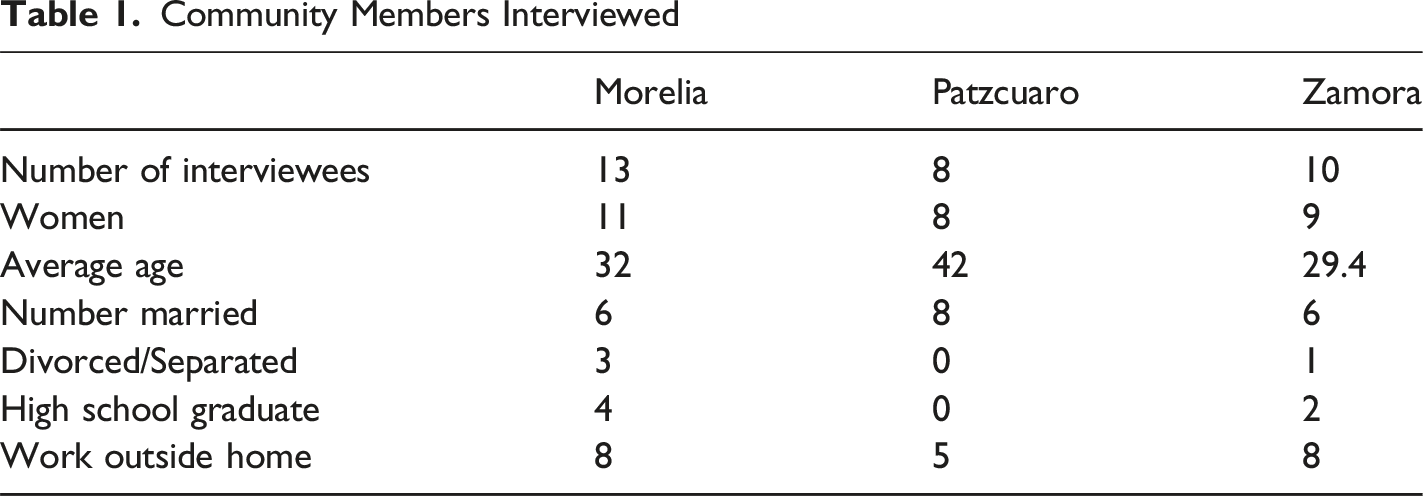
This article draws on 64 qualitative interviews, but centers on 31 in-depth interviews with rural community members (primarily women, many of whom identified direct experiences of intimate partner violence in their own relationships or households) to examine how they define violence, evaluate legal options, and ultimately decide whether to engage the state. In doing so, it centers the perspectives of survivors and marginalized communities, particularly Indigenous and trans women, whose experiences challenge carceral logics and call attention to the cultural limits of state-centered IPV responses. By foregrounding local narratives and epistemologies, this research contributes to feminist criminology by illustrating that legal disengagement is not rooted in misinformation or apathy, but is often a rational, gendered response to systemic neglect. Taken together, this study foregrounds how rural women in Michoacán interpret harm, assess institutional options, and navigate IPV through pathways that often exist outside the state.
Research on Latina survivors underscores how help-seeking decisions are shaped by structural and cultural barriers, including institutional mistrust, concerns about family unity, and limited access to services (Bui & Morash, 2008; Messing et al., 2017). Research also shows that survivors in marginalized communities often weigh potential retaliation, economic dependency, and social stigma when considering formal interventions, which helps explain why criminal-legal pathways may appear inaccessible or undesirable (Harper, 2017; Mendoza & Rochford, 2024). Although much of this scholarship focuses on Latina communities in the United States, its emphasis on constrained options and culturally embedded decision-making aligns with the patterns described by participants in rural Michoacán. This study extends these insights by examining how similar dynamics unfold in a rural Mexican context where geographic isolation, linguistic exclusion, and extended family authority further shape responses to IPV.
Theoretical Framework
This study draws from sociolegal theory, feminist criminology, and decolonial feminist thought to analyze how IPV is recognized, framed, and navigated in rural Michoacán, Mexico. Central to this approach is the concept of legal consciousness, which examines how people make sense of the law in everyday life, not only what they know about legal systems, but how they judge the usefulness, risks, and consequences of engaging them. In rural Michoacán, legal consciousness is shaped less by gaps in knowledge than by lived assessments of danger, institutional mistrust, and cultural expectations surrounding family authority and social harmony. This orientation provides the foundation for turning to Miller and Sarat’s (1990) Dispute Pyramid, which conceptualizes the transformation of injury into legal claims through the sequential stages of naming, blaming, and claiming. While foundational in access-to-justice research, the pyramid often assumes a linear and universal progression toward formal adjudication. Though its narrowing shape reflects attrition at each stage, it fails to account for the cultural, structural, and strategic reasons that lead individuals, particularly those in marginalized communities, to disengage from or bypass legal systems entirely. To address these limitations, Albiston et al.’s (2014) Dispute Tree offers a more dynamic alternative, conceptualizing legal mobilization as recursive and branching rather than linear. This model better captures the varied and context-specific pathways—often indirect or abandoned altogether—that characterize how rural and structurally disadvantaged populations engage with legal institutions.
Feminist criminology offers critical interventions into such models by examining how legal institutions reflect and reproduce broader structures of gendered, racialized, and classed power (Chesney-Lind & Morash, 2013; Richie, 2012). These perspectives emphasize that legal categories of harm do not emerge in a vacuum but are filtered through cultural norms, social hierarchies, and institutional gatekeeping. Legal consciousness, as feminist sociolegal scholars have argued, is shaped not merely by awareness of the law but by calculated assessments of its potential risks, costs, and perceived utility (Bumiller, 1988; Crenshaw, 1991; Ewick & Silbey, 1998).
Recent work by Mendoza and Rochford (2024) further complicates traditional help-seeking narratives, emphasizing that survivors often weigh the timing and feasibility of institutional help based on perceived risks and systemic responsiveness. Similarly, LeSuer (2020) offers cross-national evidence that structural gender inequality conditions not only the prevalence of IPV but also how it is defined and addressed. Harper (2017) and Bui and Morash (2008) highlight how marginalized women—especially immigrants and women of color—navigate masculinist expectations and institutional neglect, often under intense constraints. Lopez and Pasko (2017) call for Latina-centered frameworks in criminology that recognize cultural specificity and institutional mistrust, a call echoed throughout participants’ narratives.
This analysis is further enriched by decolonial and Global South feminist critiques of legal epistemology. These frameworks challenge the presumed universality of Western legal logics and instead emphasize how justice is shaped by colonial legacies, linguistic exclusion, and the uneven reach of the state (Levitt & Merry, 2009; Santos, 2012; Speed, 2006). Erwin (2006) critiques the exportation of U.S.-based domestic violence models that, when uncritically applied, fail to respond to local conditions and may even reinforce institutional disconnect. Cole and Phillips (2008) trace the evolution of Latin American feminist advocacy, demonstrating how grassroots actors have both collaborated with and resisted state systems to reshape gender violence discourse.
These critiques also raise concerns about epistemic injustice—the institutional failure to recognize culturally embedded experiences of harm or socially legitimate forms of justice (Fricker, 2007). Laidler and Mann (2008) emphasize how feminist-informed policy advances can be undermined by institutional backlash, mirroring participants’ own ambivalence toward SEIMUJER and the broader state apparatus.
This approach also clarifies what existing research has not yet addressed. Prior work has documented the limits of legal responses to IPV in Latin America, but has paid far less attention to three dynamics that shape help-seeking in rural Michoacán: coercive control exerted by in-laws and extended family; the use of community-based, non-carceral strategies as meaningful responses to harm; and the disconnect between institutional definitions of violence and local understandings of risk, obligation, and justice. This study brings these dynamics into focus, reframing legal disengagement not as inaction, but as a purposeful strategy grounded in cultural knowledge, survival, and community accountability.
Regional and Institutional Context
Michoacán, a predominantly agricultural state in western Mexico, is home to approximately 4.95 million residents (INEGI, 2022). Nearly 34% of the population works in agricultural labor, and many families rely on remittances from relatives in the United States, which totaled over US $5 billion in 2022 (Rodríguez-Sánchez, 2023). These economic patterns reflect long-standing transnational ties rooted in cycles of migration and labor precarity. While Michoacán is culturally rich—over 7% of the population identifies as Indigenous and approximately 147,000 people speak Purépecha (INEGI, 2020 Census)—the state faces acute social and economic challenges. More than 60% of residents lack a high school education, and approximately 7% are illiterate, with women disproportionately affected (CONEVAL, 2022). Poverty is pervasive: 12% of the population lives in extreme poverty, while an additional 45.2% lives in moderate poverty (CONEVAL, 2022).
In recent years, rising violence driven by organized crime, arms trafficking, and governmental instability has deepened community insecurity. The increasing use of firearms in femicides and the broader proliferation of weapons have heightened fears and displaced entire communities (Guerrero, 2023; Sánchez & Spagat, 2022). At the same time, trust in law enforcement remains alarmingly low: nationally, only 36.4% of Mexicans express confidence in federal police, 33% in state police, and 30.4% in local police—with even lower rates reported in Michoacán (INEGI, 2022). These conditions present significant obstacles for women seeking support after experiencing intimate partner violence (IPV).
The Secretaría de Igualdad Sustantiva y Desarrollo de las Mujeres Michoacanas (SEIMUJER) is the state agency tasked with advancing gender equity and addressing gender-based violence. SEIMUJER spearheads policies, educational campaigns, and interagency initiatives to address IPV, frequently emphasizing law enforcement as the primary avenue of institutional recourse (SEIMUJER, 2023). Public-facing outreach materials, including workshop handouts, printed graphics, presentation slides, and social media posts, consistently promote police reporting and formal legal intervention as the appropriate response to IPV. During this study, I served as a volunteer participant-observer at SEIMUJER, a role that allowed me to attend internal meetings, observe public trainings, and collect outreach materials. This embedded access offered key insights into the agency’s internal logic and external messaging—particularly its reliance on criminal-legal frameworks to frame and respond to IPV. These experiences, alongside fieldwork in rural communities, informed the multi-method qualitative approach described in the next section.
Methodology
This study employed a qualitative, multi-method research design to explore how rural community members in Michoacán understand and respond to IPV, and how institutional messaging—particularly from SEIMUJER—shapes those responses. Data were gathered through in-depth interviews, document collection, and participant observation. The approach was grounded in feminist research principles that emphasize contextual understanding, relational ethics, and attention to power dynamics in the research process (Hesse-Biber, 2014; Naples, 2013).
Fieldwork and Embedded Observation
From June 2022 to June 2023, I conducted fieldwork in rural communities surrounding Morelia, Pátzcuaro, and Zamora. I was embedded at SEIMUJER as a volunteer participant-observer (England, 1994; Speed, 2006), which enabled access to internal meetings, public trainings, campaign planning sessions, and interagency workshops. Observations focused on how SEIMUJER framed IPV in both internal discussions and public-facing materials, as well as how law enforcement was positioned in institutional discourse. These experiences offered critical insights into the agency’s operational logic and its reliance on criminal-legal frameworks.
In addition to institutional observation, I lived in Michoacán throughout the duration of the study, which allowed for deeper engagement with rural communities and strengthened trust-building with participants. I had longstanding relationships with several of the communities involved, having previously collaborated on community-based projects—including a recycling initiative, food gardens, and digital access for students during the COVID-19 pandemic. These relationships helped facilitate access and inform a culturally grounded, respectful research approach.
Researcher Positionality
My role in the field was informed by my background as a researcher of Mexican descent with longstanding cultural and linguistic familiarity, including fluency in Spanish. I first engaged with several of the participating communities through volunteer projects beginning in 2017, which helped establish ongoing relationships and trust prior to this study. This experience shaped access to both community participants and institutional settings, including SEIMUJER, and informed rapport during interviews and observations. I also recognize that my position as a university-affiliated researcher based in the United States may have influenced how participants understood the study and what they chose to share. Throughout the research process, I emphasized voluntary participation, confidentiality, and participant-led pacing, and I remained attentive to how my social location shaped interpretation and analysis.
Interview Recruitment and Participants
Community Members Interviewed
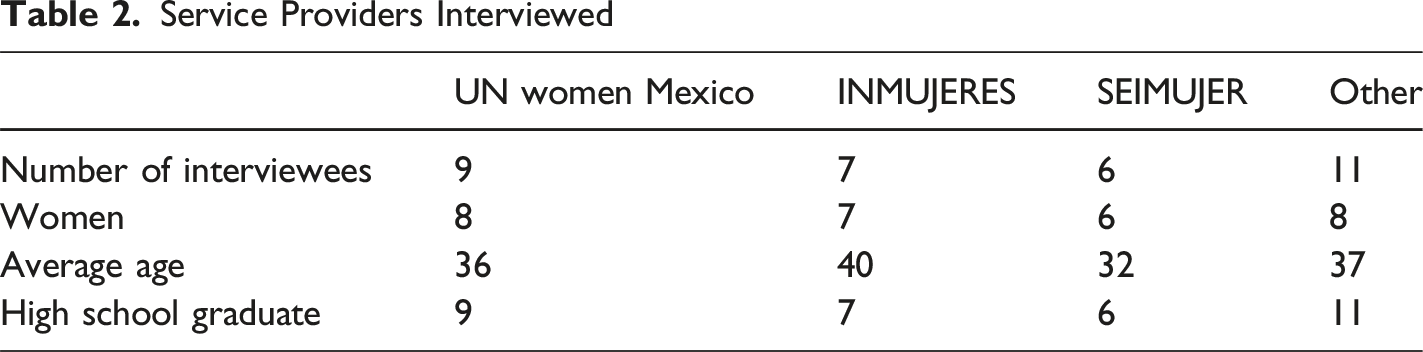
Service Providers Interviewed
Eligibility
Eligibility for community interviews required being 18 years of age or older, residing in a rural community in Michoacán, and being willing to discuss intimate partner violence, gender violence, and how these issues were understood or addressed in their communities. Participants were not required to have direct or familial experience with IPV. Instead, eligibility was based on an individual’s interest in reflecting on community norms, institutional responses, and local understandings of harm. This approach recognized that in many rural settings, IPV is understood through both personal experience and collective knowledge, and it allowed participants to engage the topic at the level they felt comfortable.
Recruitment
Participants were recruited through snowball sampling, beginning with individuals I had prior relationships with through local organizations and community work. Accommodations such as transportation support, childcare, and flexible scheduling were provided to minimize participation barriers. Interviewees were also offered the option to bring a trusted support person to the conversation. Participants were compensated for their time in the amount equivalent to US$20, and they received an additional US$2.50 equivalent for referrals that resulted in completed interviews. While efforts were made to recruit participants through SEIMUJER-led outreach events, these yielded limited results. In contrast, SEIMUJER staff interviews were facilitated by institutional leadership, who supported the project and provided access to relevant personnel and space.
Interview Procedures
Interviews were conducted in Spanish and lasted between 45 and 120 min, with most ranging from one to one and a half hours. All interviews took place in person in settings selected by participants, including homes, community centers, courtyards, cafes, private offices, and quiet outdoor spaces. Conversations were semi-structured and guided by an interview protocol that was developed through a review of prior literature on IPV help-seeking and in collaboration with Mexican scholars working on gender-based violence. The protocol was further refined during early fieldwork and through feedback from Mexican practitioners who regularly engage with survivors. It included open-ended questions about experiences of harm, help-seeking decisions, institutional perceptions, and family dynamics, and it was adapted as needed to ensure emotional safety and accommodate participant comfort and pacing.
Data Handling
All interviews were audio-recorded with informed consent, transcribed, and pseudonymized. Participants selected their own pseudonyms to promote comfort and agency. While all interviews contributed valuable context, this article primarily focuses on community member interviews, which form the conceptual and empirical core of the analysis.
Ethical and Logistical Considerations
All procedures were approved by the Institutional Review Board (IRB). Given the sensitive nature of the topic, participants were informed they could skip any question, pause or end the interview at any time, and would be offered referrals to local resources. Interviews involving survivors or disclosures of IPV were conducted with trauma-informed practices and care around setting, language, and flexibility (Ellsberg & Heise, 2005; WHO, 2001).
Participants were compensated for their time. Efforts were made to minimize risk and discomfort, particularly for rural women with limited prior engagement with researchers or institutions. At the conclusion of each interview, I summarized what I had understood the participant had shared and invited them to clarify or correct any misinterpretations. This member-checking technique, which I first learned during my internship at INMUJERES and later reinforced through applied training at UN Women Mexico, was essential in ensuring that participants felt accurately represented and empowered to shape how their narratives were recorded (Carlson, 2010; Tracy, 2010). Reflexivity was an ongoing practice throughout the study, particularly in recognizing how my own identity as a U.S.-based, Mexican-descendant researcher influenced access, interpretation, and relational dynamics.
Data Analysis
Analysis followed a grounded theory approach using iterative coding and constant comparison to identify patterns across interviews and institutional materials (Charmaz, 2014; Corbin and Strauss, 2014). Initial open coding generated emergent categories directly from the data. These categories were then examined through axial coding to develop connections among concepts, compare cases across different community contexts, and refine the relationships between themes related to harm, help-seeking, institutional perceptions, and family authority. Coding proceeded in cycles and was guided by analytic memos that documented interpretive decisions and emerging insights.
Theoretical saturation was assessed by monitoring when new interviews ceased to generate new thematic categories or substantially modify existing ones. Saturation occurred once the full range of help-seeking strategies, institutional interactions, and family dynamics appeared consistently across the community interviews.
Document analysis included SEIMUJER outreach materials such as graphics, workshop curricula, printed materials, and social media posts. These documents were analyzed using the same coding structure and then compared with interview findings to better understand the disjuncture between institutional messaging and community perspectives. Triangulating interviews, field observations, and SEIMUJER materials strengthened the analytic rigor and assisted in identifying areas where institutional discourse aligned or conflicted with lived experiences.
Preliminary findings were shared in informal follow-up conversations with several participants and community interlocutors. These member-engagement sessions allowed for clarification, correction, and contextual insight and aligned with feminist principles of knowledge co-production and accountability. This dialogic process improved the accuracy of the findings and strengthened interpretive validity.
Results
The following findings respond to the study’s central question: Why do many rural women in Michoacán reject state-centered interventions for intimate partner violence, despite institutional efforts to promote law enforcement as the appropriate response? The analysis reveals three interrelated themes: (1) a disjuncture between institutional and community definitions of violence; (2) patterns of legal disengagement driven by institutional distrust, fear of retaliation, and social stigma; and (3) the emergence of culturally grounded, non-carceral strategies for harm reduction and accountability. Together, these themes illustrate how survivors navigate IPV through community-based logics that remain invisible—or illegible—within formal legal frameworks.
Disjuncture in Definitions of Violence
SEIMUJER, the state agency tasked with addressing gender-based violence in Michoacán, promotes an expansive definition of intimate partner violence (IPV) that includes physical, sexual, emotional, economic, psychological, and patrimonial harm. Its workshops, outreach campaigns, and social media posts emphasize that violence is not limited to physical abuse and encourage women to report any controlling or coercive behavior—including destruction of property, denial of financial resources, and emotional manipulation—to law enforcement. Pamphlets distributed during SEIMUJER’s mobile outreach events specifically list signs of violence such as “restricting access to money,” “monitoring your movements,” or “isolating you from friends and family.” These materials present IPV as a broad spectrum of behaviors that should be recognized and legally addressed.
However, participants in this study often defined violence through cultural and relational lenses that diverged from these institutional framings. Rather than identifying violence based solely on behavior, many assessed it through intent, severity, and whether it threatened familial or social harmony. As a result, legal or policy-based definitions did not always resonate with participants’ lived realities. As one participant (Consuelo age 36) put it, “Violence is everywhere here, why would I expect my home to be any different?”
Ambar, a 32-year-old mother of three, began to question her relationship after attending a SEIMUJER workshop held in her rural community. Although the workshop helped her recognize some of her husband’s behaviors as “abusive”, she ultimately concluded that the help offered “did not seem practical or safe in her situation.” The workshop emphasized calling law enforcement—an option she deemed too dangerous and impractical given her remote location and lack of phone access. Her reflection suggests that while she internalized some of SEIMUJER’s definitions, they did not align with the risk calculations she had to make as a woman living in a remote area without access to a phone or nearby police presence.
Other participants emphasized intent, context, and severity rather than institutional categories. Ximena, a 33-year-old trans woman from a village near Zamora, stated, “I would say IPV is when your partner intentionally hurts you.” Javier, 24, echoed a similar perspective: “Sometimes in anger a person might throw something—it doesn’t mean you necessarily want to hurt them.” In these accounts, harm was recognized only when it was sustained, deliberate, and without provocation. One-off incidents or actions taken in the heat of the moment were viewed as understandable or forgivable.
Sexual coercion within marriage and economic control were rarely identified as forms of abuse that warranted outside intervention. Paula, 42, explained: “I know a woman whose husband got tired because she just wasn’t fulfilling her wifely duty, and the husband, well, he went elsewhere. That’s just the way men are.” Her comment illustrates a recurring pattern in which participants accepted male control over finances and sexual access as part of marital expectations rather than as coercive or violent behavior.
Community-Adjusted Definitions of IPV Components
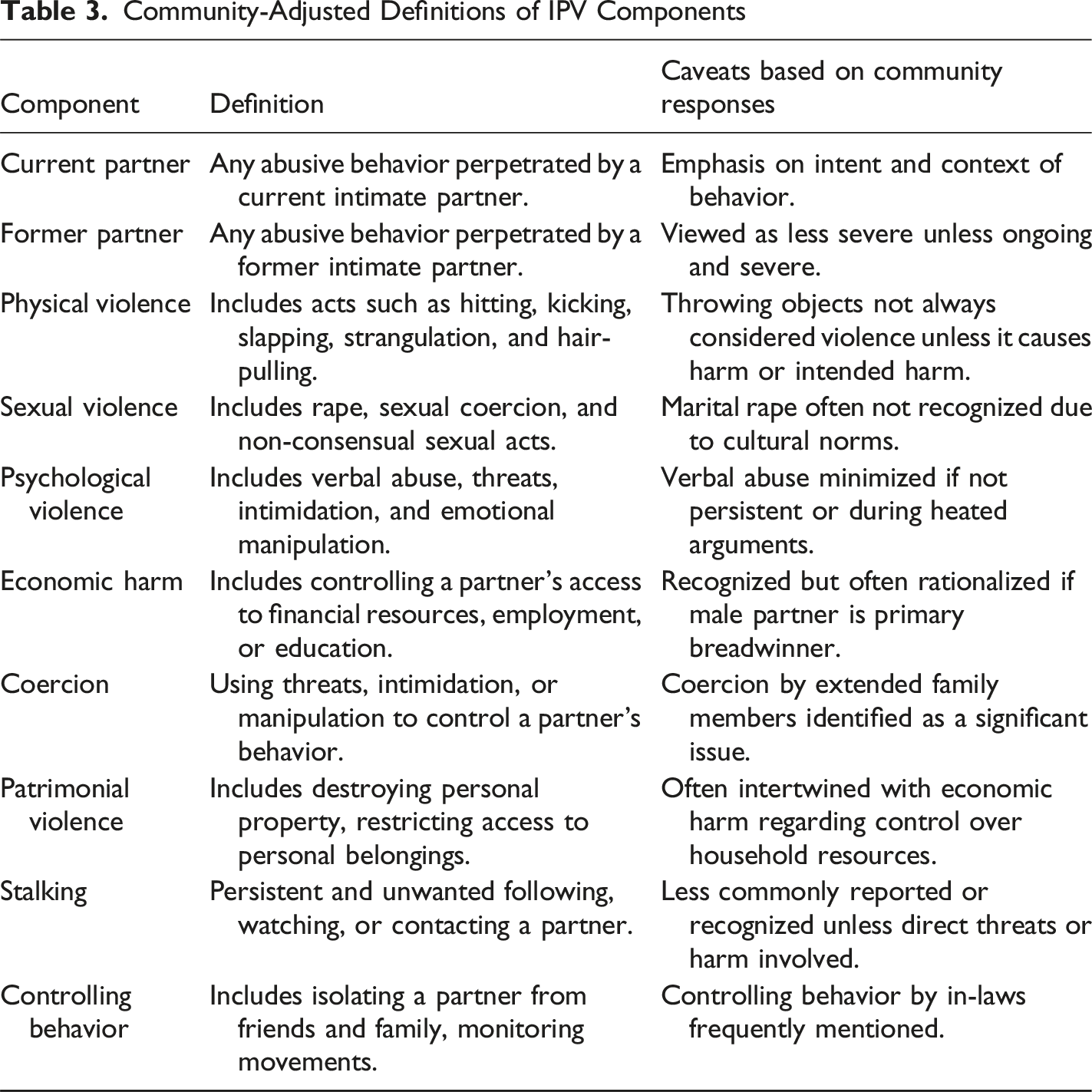
Rather than indicating misinformation or lack of awareness, these interpretations reflect a broader epistemic dissonance between community-based moral logics and state-promoted legal frameworks. Cultural norms around aguantar (to endure), respeto (respect for familial hierarchy), and the sanctity of private life shape how violence is perceived and whether it is named. As a result, many experiences that meet institutional thresholds for IPV are rendered invisible in everyday discourse—creating barriers to formal recognition and intervention from the outset.
Many participants emphasized that violence was so prevalent in their communities that certain forms of partner conflict felt comparatively minor or easily dismissed. One woman explained, “Things are always happening here… robberies, men fighting, shootings. Women have other worries.” These reflections illustrate that IPV was not minimized because it was culturally accepted, but because it was incorporated into a broader landscape of instability and competing threats. In this context, partner violence often appeared less urgent than other immediate risks.
This definitional dissonance shaped whether participants recognized their experiences as violence and whether they believed institutional help was appropriate or accessible. While SEIMUJER promoted expansive awareness, its reliance on criminal-legal solutions, Spanish-only materials, and partner-centric definitions often limited resonance in rural, Indigenous, and intergenerational household contexts. For many women, especially those living in isolated areas or navigating extended family dynamics, institutional definitions of IPV failed to account for the full range of harms they experienced.
Legal Disengagement as Survival: Fear, Stigma, and Institutional Distrust
Participants described avoiding law enforcement as a calculated decision shaped by fear, anticipated retaliation, prior negative experiences, and a general sense that police intervention would either escalate the violence or result in inaction. While institutional messaging by SEIMUJER encouraged survivors to report abuse to the authorities, many participants expressed skepticism or outright rejection of this strategy. This skepticism reflects broader trends among Latina IPV survivors, who often avoid protection orders due to perceived ineffectiveness, cultural stigma, and institutional barriers (Messing et al., 2017).
Lucia, 44, from a rural community outside Morelia, described her concern about potential consequences after reporting violence: “The police—what are they going to do to solve the problem? Even if they take him to jail, he’ll be out. Then what? The problem isn’t solved.” She emphasized the lack of protection following a report and the likelihood of retaliation, echoing a sentiment shared by other participants who feared their partners would return home angrier and more violent than before. Amalia, 38, recalled her sister’s attempt to file a police report: She told the officer she was there to report her husband for abuse. The officer just told her that they didn’t handle that here and then he kept reading the newspaper in front of him. We just left and never went back.
Her account typifies the bureaucratic apathy many participants encountered.
Martina, 52, described how she eventually received help, but only after being initially dismissed: After initially not having a good experience trying to file a police report… an officer approached me outside the station and explained that I could find resources at the Victim Care Center. When I went there, they were very accommodating… very different from my experience with the police.
Although she ultimately accessed support, the process required persistence and navigating an informal path through an individual officer rather than the system itself.
Stigma associated with calling the police or discussing family problems publicly also played a key role in disengagement. Blanca, 52, from the Pátzcuaro region, said, “We keep to ourselves here and do not like strangers in our community. I cannot imagine anyone calling an outsider, especially the police, to deal with that [IPV].” She emphasized that involving authorities would damage reputations and expose families to judgment or shame. Others feared being labeled problematic or being ostracized for publicly accusing a partner and inviting law enforcement into their community. Emilia age 42 captured this concern succinctly: “If I called the police, everyone would know within the hour. People would say I was causing trouble and that I didn’t know how to keep my home in order.” For her, the risk of community judgment outweighed the possible benefits of reporting, illustrating how social stigma can function as a powerful deterrent to institutional help-seeking.
Participants often described police as unreliable or absent altogether. Some recounted calling and receiving no response; others believed that officers would side with male partners or ignore rural cases entirely. Dani, a trans woman from the Pátzcuaro region, described a similar sense of futility when seeking help: When I tried to report what happened, the officer looked at me and said it was ‘just a fight between men.’ They laughed and told me to calm down. After that, I knew going to the police was a waste of time.
Her experience illustrates how gendered assumptions and institutional bias further eroded trust in law enforcement and reinforced participants’ decisions to disengage. Even when individuals were aware of formal options, these were often perceived as ineffective or unsafe. As a result, avoiding state systems became a protective measure—an effort to prevent escalation, humiliation, or loss of social standing.
These patterns suggest that disengagement from law enforcement was not due to lack of awareness or misunderstanding, but to a grounded assessment of personal and community risk. In the next section, I turn to the strategies participants described for navigating IPV through informal, community-based responses.
Alternative Pathways to Justice: Informal, Familial, and Community-Based Responses
When formal institutional responses felt inaccessible, ineffective, or dangerous, participants described turning to informal, community-based approaches to address intimate partner violence (IPV). These included relying on family members for intervention, seeking help from neighbors, or choosing to endure abuse in silence to avoid escalation or stigma. These decisions were not framed as passive, but as necessary strategies rooted in material constraints, fear, and the failure of state systems to offer real protection.
One woman described how community elders including his grandmother intervened when the violence escalated and resulted with a burn after being pushed towards an open flame: “The men from the council came to talk to him. They told him he was embarrassing his family and needed to change. For a while, he listened to them more than he ever listened to me.” Her account reflects a broader pattern in which respected community members, rather than formal authorities, exerted the most influence on men’s behavior and provided the practical and moral guidance that participants found lacking in state systems.
Several participants also described seeking spiritual guidance as part of how they navigated intimate partner violence outside formal legal channels. Eva, a 46-year-old woman, from outside of Morelia, recounted speaking with her local priest after learning that her husband was expecting a child with another woman. Although she had previously experienced physical violence in the relationship, she explained that it was the pregnancy (and her husband’s admission that he intended to continue seeing both the woman and the child) that prompted her to seek counsel. During their conversation, the priest encouraged her to forgive her husband, to consider the well-being of the child if her husband chose to remain involved, and to pray for him. She described this guidance not as a resolution to the harm she had experienced, but as a moral framework that emphasized endurance, family continuity, and spiritual responsibility over confrontation or formal intervention.
Ambar, a 32-year-old mother of three from La Soledad, attended a SEIMUJER workshop that helped her name the abuse she was experiencing. However, she chose not to report it. Her reasons were multifaceted: she did not own a phone, and the nearest law enforcement office was far away. She feared that “even if [she] managed to contact the police…, it would perhaps take an hour for them to arrive—if they came at all.” Beyond practical concerns, she also described intense social pressure in her community. Calling the police, she explained, could result in being labeled a troublemaker, which could lead to isolation. Her negative interactions with law enforcement—compounded by the prejudice she experienced as a Purepecha woman—left her wary of seeking institutional support. Despite SEIMUJER’s good intentions, she left feeling that “the help offered did not seem practical or safe in my situation.”
Esperanza recounted the experience of her neighbor Leticia, who sought help for her sister Almendra after a violent attack. “It was a regular morning when I heard the frantic knocking on my door,” she began. Leticia had rushed over after Almendra was burned by her husband. Esperanza provided money and cared for the children while Leticia took her sister to the nearest town and tried to find help. At the clinic, the nurse encouraged Leticia to report the abuse. However, once at the police station, they were met with indifference. “The officer at the front desk barely looked up,” Esperanza said. Leticia showed Almendra’s injuries, but was redirected from one office to another. “They spent hours being shuffled… The system was designed to wear them down. It was like they didn’t matter, like Almendra’s suffering was just another inconvenience.” Even when they finally received some help at the Victim Care Center, they were told to return to the police to file a formal report.
Lucia opted for informal intervention, she asked her father to speak with her husband instead of involving the police. When that did not have the desired effect she also considered involving her father-in-law but ultimately decided against it, fearing it would escalate tensions between families. Lucia did not believe the police would help, and she worried about the social and familial consequences of exposing private matters to outsiders. She concluded that involving the police “was not a serious option”—not because she did not know about it, but because she did not trust it. Such narratives of institutional fatigue align with findings by Frías and Ríos-Cázares (2017), who document how Mexican women often abandon legal processes after initial encounters marked by indifference or procedural confusion.
These narratives reveal the practical and cultural logic behind legal disengagement. While institutional messaging promotes police intervention, participants found greater safety and dignity in community-based responses. Informal justice—whether through family mediation, community support, or endurance—was often viewed as more reliable and less risky than formal mechanisms that too often failed to protect or respond meaningfully.
Discussion
This study examined how rural women in Michoacán understand and respond to IPV within the context of state-promoted legal interventions. The findings demonstrate a consistent disjuncture between SEIMUJER’s institutional framing of IPV—rooted in a broad, legally oriented model—and the ways community members interpret, experience, and respond to harm. While SEIMUJER defines IPV expansively to include physical, emotional, economic, patrimonial, and psychological dimensions, participants often understood violence through relational and contextual cues: Was it intentional? Severe? Repeated? Disruptive to family or community stability? These responses complicate dominant legal narratives and invite a closer examination of the assumptions that underpin formal models of justice. This mismatch between institutional and community frameworks echoes broader structural patterns across Mexico. As Frías (2021) documents, disparities in femicide rates and state responses between Indigenous and non-Indigenous regions reflect longstanding inequalities in institutional access and recognition—reinforcing the need for culturally grounded, locally responsive IPV interventions.
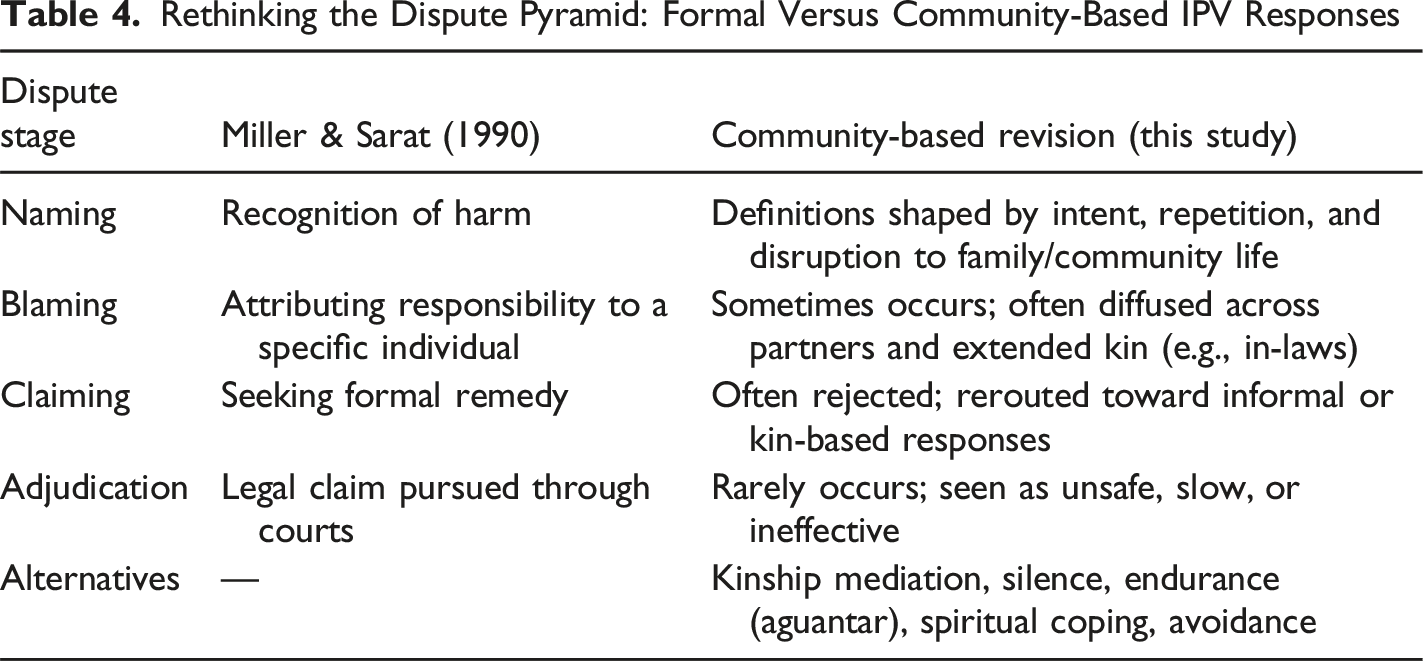
To contextualize these divergences more fully, it is necessary to revisit the sociolegal models that have traditionally guided analyses of how grievances become legal claims. This analysis revisits Miller and Sarat’s (1990) Dispute Pyramid, which posits that grievances progress in a linear path from naming, to blaming, to claiming toward formal legal resolution. However, as feminist scholars have long argued, this model presumes access to legal systems and ignores the cultural, gendered, and racialized filters through which people interpret harm (Bumiller, 1988; Crenshaw, 1991). The women in this study often named violence but rejected the formal claiming process, not due to passivity, but as a deliberate strategy shaped by institutional distrust, economic precarity, geographic isolation, and the fear of retaliation.
These findings extend existing sociolegal models of dispute transformation in ways that have not been fully articulated. While the Dispute Pyramid and the Dispute Tree help explain how people move from naming to formal claiming, neither framework accounts for the role of extended kinship structures, particularly in-laws, in shaping how women interpret, manage, or respond to intimate partner violence. Nor do these models capture the culturally grounded mechanisms of accountability that participants relied on, such as elder mediation, spiritual counsel, and community-based guidance. Moreover, the findings reveal that survivors weigh IPV within a broader hierarchy of harms shaped by poverty, instability, and pervasive community violence, a dynamic that is not visible in linear or branching depictions of legal mobilization. By foregrounding these relational and structural dynamics, this study offers a more contextually grounded account of why survivors disengage from state systems and how justice is imagined and enacted outside formal legal frameworks.
These patterns also resonate with research on women’s responses to intimate partner violence in Central America, where survivors similarly navigate harm in contexts marked by institutional weakness, social surveillance, and limited access to formal protection. Studies from Guatemala, Honduras, and El Salvador document how women frequently rely on family mediation, religious counsel, and endurance strategies rather than engaging criminal-legal systems that are perceived as ineffective, corrupt, or dangerous (e.g., Hume, 2009; Menjívar & Walsh, 2017; Viterna, 2013). As in Michoacán, these responses are not rooted in a lack of awareness, but in grounded assessments of risk, retaliation, and social consequence. Situating the present findings alongside this regional scholarship underscores that legal disengagement and informal justice practices reflect broader patterns across Latin America, particularly in settings where state protection is uneven and community-based authority structures shape women’s options for safety and survival.
Yet the Dispute Pyramid alone cannot capture the gendered, racialized, and classed forces that shape how rural women evaluate and resist legal intervention. Feminist criminologists argue that legal systems are not neutral pathways to justice, but mechanisms embedded within broader structures of power (Chesney-Lind & Morash, 2013; Richie, 2012). This study affirms and extends those critiques by showing how rural, Indigenous, and low-income women encounter IPV in contexts where calling the police is neither safe nor acceptable. Rather than ascending the pyramid toward legal resolution, participants strategically disengage from formal systems—seeking instead relational, informal, or silent means of navigating harm.
Rethinking the Dispute Pyramid: Formal Versus Community-Based IPV Responses
Moreover, this study contributes to the growing body of work informed by decolonial and Global South feminist thought. Scholars such as Speed (2006) and Merry (2001) critique the universal application of Western legal frameworks in contexts where state legitimacy is fractured or uneven. In Michoacán, where Spanish-language-only materials and a reliance on law enforcement limit access for Indigenous and rural populations, formal legal epistemologies often fail to capture the contours of everyday justice. Participants frequently named coercive control by in-laws and social surveillance as key forms of harm—dynamics absent from institutional definitions of IPV. These insights demand that justice be understood not just as legal recognition but as culturally grounded, socially intelligible responses to violence. Echoing Erwin (2006) critique of exported “best practices,” SEIMUJER’s framework often assumes a legal infrastructure and sociocultural orientation that does not align with rural realities in Michoacán.
These dynamics become even more complex when considering the relational structures that organize household authority in rural Michoacán. The findings also complicate the assumption—central to both legal frameworks and many IPV interventions—that harm originates exclusively within the intimate partner dyad. Several participants described controlling behavior and coercion enacted by in-laws, particularly mothers- and fathers-in-law, who regulated their mobility, roles, or access to resources. These dynamics were often reinforced by male partners, either through silence or active complicity. Such relational structures fall outside institutional definitions of IPV, revealing the limitations of models based on nuclear family assumptions and Western relationship norms. In contexts marked by shared living arrangements and patriarchal hierarchies, failing to account for kinship-based coercion renders key sources of harm invisible. Failing to acknowledge these relational dynamics not only obscures critical forms of harm but also renders invisible the full spectrum of actors exerting coercive control in women’s lives. Recognizing in-law coercion as a central mechanism of control is therefore crucial for understanding IPV in rural Michoacán, as it demonstrates that authority and harm often operate through multigenerational, extended-family networks rather than solely within the intimate dyad.
As Cole and Phillips (2008) document, Latin American feminist movements have long negotiated the tensions between cooptation and resistance within state-sponsored frameworks—tensions that are acutely present in SEIMUJER’s positioning. Institutional ambivalence and symbolic compliance, described by participants, reflect the global patterns of anti-feminist backlash in crime policy documented by Laidler and Mann (2008). By reframing disengagement not as a failure to mobilize legal options but as a structurally and culturally rational act, this study challenges dominant paradigms in both law and policy. Legal consciousness, as theorized by Ewick and Silbey (1998), is not simply about what people know of the law, but how they evaluate its usefulness in everyday life. The narratives shared here reflect deep knowledge of legal institutions—and a refusal to engage with systems that have proven ineffective, disrespectful, or unsafe.
In highlighting these refusals, this study contributes to feminist discussions of epistemic injustice (Fricker, 2007) by demonstrating how legal institutions privilege certain forms of harm and certain ways of naming it, while delegitimizing others. When participants did not define marital coercion, economic restriction, or control by in-laws as “violence,” it was not always due to internalized patriarchy or a lack of awareness—it was often a result of cultural frameworks that assign different meanings to harm, obligation, and relational authority. Institutional actors who fail to recognize these frameworks risk imposing solutions that feel alien, impractical, or even dangerous to the women they intend to serve.
The findings also underscore the importance of attending to non-carceral, community-based approaches to IPV. While some feminist policy responses have emphasized expanding criminal penalties and increasing arrests, participants in this study often sought protection through kinship mediation, spiritual practice, or social withdrawal. These practices reflect deeply contextualized strategies for maintaining safety and dignity within constrained environments. Rather than treating these alternatives as evidence of state failure alone, they should be recognized as forms of survivor-defined justice that merit both attention and support.
These findings underscore the need for intervention models that move beyond mandatory reporting frameworks and formal legal remedies. Policies that assume the police are the default or appropriate first responders fail to account for rural women’s grounded assessments of risk, the uneven geography of state presence, and the role of extended kin in shaping both harm and safety. Culturally responsive approaches would prioritize locally legitimate forms of accountability, such as community mediation, elder intervention, and survivor-defined safety planning, rather than one-size-fits-all criminalization strategies. They would also require meaningful linguistic and cultural accessibility, sustained engagement with Indigenous and rural communities, and the recognition that justice can be relational, incremental, and non-carceral. Without such shifts, institutional responses will continue to misalign with survivors’ lived realities and replicate the very forms of epistemic and structural violence they aim to address.
In sum, this study extends feminist and sociolegal critiques of IPV intervention by illustrating how legal disengagement in rural Mexico is neither irrational nor incomplete—it is a reflection of how justice is negotiated at the intersection of gender, geography, and institutional power. Recognizing these dynamics requires a shift in how practitioners, policymakers, and scholars define harm, justice, and legitimacy—particularly when working across cultural and political boundaries. By foregrounding how extended kinship networks, structural insecurity, and culturally grounded accountability mechanisms shape survivors’ decisions, this study broadens the conceptual boundaries of IPV intervention research. It demonstrates that legal disengagement is not a deviation from idealized models of help-seeking but a rational response to uneven state presence, competing harms, and the realities of multigenerational household authority. These findings invite a rethinking of both feminist criminological theory and sociolegal models of dispute transformation, underscoring the need for approaches that recognize justice as relational, plural, and deeply embedded in local contexts. Collectively, this analysis demonstrates the need for IPV interventions that reflect rural survivors’ own definitions of harm, safety, and accountability, rather than relying on universalized legal assumptions that rarely resonate in their everyday lives.
Limitations
As with all qualitative research, this study has limitations that should be acknowledged. The findings reflect the experiences of a non-random, purposive sample of 64 participants located primarily in rural communities surrounding Morelia, Pátzcuaro, and Zamora. This concentration limits transferability to urban contexts or to regions with different political or institutional arrangements. Snowball sampling, while effective for building trust in communities characterized by institutional mistrust and geographic isolation, may have introduced selection bias by amplifying particular networks or perspectives.
Linguistic and cultural dynamics also shaped the data in important ways. Most interviews were conducted in Spanish, which—although accessible for many—may have constrained the expressiveness of participants whose primary language is Purépecha or another Indigenous language. This limitation reflects broader structural inequities in state outreach, as Spanish is also the default language of institutional materials and IPV messaging in Michoacán. Future work should incorporate multilingual approaches that more fully capture Indigenous epistemologies of harm and justice.
One of the most significant limitations involved institutional opacity. Despite repeated attempts, no interviews with police or prosecutorial personnel were secured. This gap reflects not only methodological constraints but also the structural unwillingness of certain state actors to participate in research on gender-based violence. The absence of law enforcement voices is itself empirically meaningful: it mirrors the lack of transparency, accountability, and responsiveness that participants repeatedly described.
Finally, although the study triangulated interviews, participant observation, and institutional documents, perspectives from survivors who successfully navigated the formal legal system were less represented. Their experiences may illuminate additional pathways of legal mobilization or reveal conditions under which institutional engagement is perceived as viable. These limitations underscore the need for continued, multi-sited, and multilingual research attentive to the ethical, cultural, and political complexities of examining gender-based violence in marginalized communities.
Conclusion
This study examined how rural survivors of intimate partner violence (IPV) in Michoacán, Mexico, understand, resist, and navigate institutional responses to harm. Drawing on 64 interviews, embedded observation at SEIMUJER, and document analysis, it found three interrelated patterns: (1) a disjuncture between state definitions of IPV and community logics of harm; (2) legal disengagement driven by distrust, social stigma, and structural inaccessibility; and (3) the emergence of culturally grounded, non-carceral strategies for harm reduction and accountability. These findings challenge dominant assumptions that survivors either lack knowledge or passively avoid formal help. Instead, they demonstrate that disengagement is often an informed, survival-based strategy rooted in contextual assessments of risk, legitimacy, and feasibility.
In revisiting Miller and Sarat’s (1990) Dispute Pyramid, this study complicates linear models of legal mobilization by showing how survivors name harm but often stop short of blaming or claiming through formal channels. As illustrated in Table 4, many pursue relational, informal, or spiritual avenues to manage violence—strategies that remain illegible within state-centric and carceral frameworks. These choices are not failures, but expressions of legal consciousness grounded in cultural knowledge, material realities, and lived experience.
This research also makes theoretical contributions to feminist criminology and sociolegal studies. It expands prevailing frameworks of IPV by highlighting harms that extend beyond the intimate dyad—including coercion and control by in-laws—and reveals how institutional definitions fail to capture the full range of survivors’ experiences. In doing so, it responds to calls from Latina feminist scholars (Harper, 2017; Lopez & Pasko, 2017) to center culturally specific realities, and aligns with Global South and decolonial feminist critiques of Western legal exportation (Erwin, 2006; Santos, 2012; Speed, 2006). It also affirms what others have argued: that justice, for many survivors, is relational, context-specific, and often located outside formal institutions (Frías & Ríos-Cázares, 2017; Mendoza & Rochford, 2024).
For policymakers and practitioners, these findings offer an urgent reminder that legal reform and awareness campaigns—however well-intentioned—will fail to resonate if they ignore the cultural, linguistic, and institutional realities of those they aim to serve. Effective IPV interventions must move beyond punitive frameworks and engage with community-based logics of care, survival, and accountability. This includes recognizing the legitimacy of informal strategies like kinship mediation, spiritual practice, or even strategic silence as forms of harm reduction—not as signs of disengagement or failure.
Ultimately, this study calls for a shift in how IPV is conceptualized and addressed in rural and Indigenous contexts. Justice cannot be measured solely by formal engagement or legal resolution. It must be reimagined as a lived process—shaped by structural constraints, cultural meaning-making, and survivor-defined strategies for safety and dignity. By tracing these alternative paths to justice, this research offers both a critique of existing systems and a roadmap for more grounded, responsive, and equitable approaches to addressing gender-based violence.
Footnotes

Funding
The authors disclosed receipt of the following financial support for the research, authorship, and/or publication of this article: This work was supported by the Division of Social and Economic Sciences, (SBE #2016661) and Center for Global Peace and Conflict Studies, School of Social Sciences, University of California, Irvine.
Declaration of Conflicting Interests
The authors declared no potential conflicts of interest with respect to the research, authorship, and/or publication of this article.