




Abstract
Firearms make domestic violence more dangerous. Civil protection orders (“CPOs”) can include firearms prohibitions to separate abusers from firearms. This study reviewed 90% of CPO cases (N = 3,451) filed in South Carolina in 2019. The study found that when courts had discretion whether to issue a firearms prohibition (here, under state law), courts tended not to do so (32% of all eligible cases). When law automatically applied a firearms prohibition to cases (here, under federal law), courts typically included them (85% of all eligible cases), but not always, as 15% of petitioners who were entitled to the federal remedy were left unprotected.
Firearms are a special focus of IPV (intimate partner violence) research, law, and intervention. Firearms use in domestic violence greatly increase risk of severe injury and death (Fleury-Steiner et al., 2017; Frattaroli et al., 2021), and firearms are the primary mechanism of injury in half of intimate partner homicides (Kivisto et al., 2019). A study of risk factors for femicide found that abusers with access to firearms were five times more likely to kill their victims than abusers who did not have access to firearms (Campbell et al., 2003). In the United States, National Crime Victimization Survey data estimate that firearms are used in 3.4% of domestic violence events (Frattaroli et al., 2021). Every month in the United States, an average of 70 women are killed by intimate partners with a firearm (Everytown for Gun Safety, 2019).
Federal Firearms Prohibition
In 1994, Congress passed the Violent Gun Control and Law Enforcement Act as part of the Violence Against Women Act, Violent Crime Control and Law (1994), which prohibits those with a civil protection order (CPO) issued against them (i.e., the respondent) from shipping, transporting, possessing, or receiving firearms or ammunition, for the duration of the CPO (Crimes & Criminal Procedure, 2014). The federal firearms prohibition was upheld by the Supreme Court in 2024 (United States v. Rahimi, 2024). The prohibition requires that the respondent has “received actual notice” of the hearing at which the CPO was entered and “had an opportunity to participate.” This requirement means that the prohibition cannot be entered within “ex parte” temporary protection orders issued without notice to the respondent. The prohibition further requires that the CPO “restrain” the respondent from “harassing, stalking, or threatening” their intimate partner, or their intimate partner’s child. Importantly, for purposes of the prohibition, intimate partner means a current or former spouse, current or former cohabitant, or the parties must share a child in common (Crimes and Criminal Procedure, 1998). Thus, even in states that recognize other types of relationships as eligible for a CPO, a federal firearms prohibition cannot be enacted for a CPO in which the respondent is a dating partner or family member. Finally, the CPO has to include a finding that the respondent “poses a credible threat to the safety” of the petitioner (i.e., the person requesting the CPO), or it must prohibit the respondent from “the use, attempted use, or threatened use of physical force against such intimate partner or child that would reasonably be expected to cause bodily injury” (Crimes & Criminal Procedure, 2014). These last criteria are significant because they allow the federal firearms prohibition to apply both to CPOs granted on the merits (i.e., a judge makes a finding of fact that the respondent poses a credible threat to safety based on evidence presented in a hearing), and CPOs granted by consent (in which there is not a hearing or finding of fact). If all criteria are met, the federal firearms prohibition applies and should be issued as a component of the CPO (Mitchell, nd). Importantly, the federal firearms prohibition should then be entered into the National Instant Criminal Background System, thus ensuring that individuals with a CPO against them cannot legally purchase a firearm anywhere in the United States for the duration of the CPO (Mitchell, nd).
Although the federal firearms prohibition applies automatically by law for qualifying CPOs, judges issuing CPOs are responsible for implementing the prohibition (Kafka et al., 2021). In practical terms, this means the judge has to “check the boxes” on the CPO document indicating the federal firearms prohibition is in effect (see page four of South Carolina’s Family Court Order Protection from Domestic Abuse Act for an example). Checking such boxes should be a formality that gives both the respondent and petitioner specific notice that the prohibition applies. However, studies have shown that judges do not always follow legal guidelines (Fleury-Steiner et al., 2017; Kafka et al., 2022). If the relevant boxes are not checked, for whatever reason, the federal firearms prohibition might not be found to apply in practice for insufficient notice to the respondent, even if the CPO meets all legal criteria.
State Firearms Prohibition
While the federal firearms prohibition is a critical tool to increase the safety of those experiencing IPV, on its own it is not enough (Cloud et al., 2023). Most people have limited access to federal agents and courts, the only entities that can enforce federal criminal law. Fortunately, most states have enacted their own CPO firearm prohibitions, which may be entered whether or not the federal firearms prohibition applies. Studies confirm the importance of state firearms prohibitions: in an analysis of CPO state firearms prohibitions in 45 states, Zeoli and colleagues (2018) found that overall, state firearm prohibition laws were associated with a 10% reduction in intimate partner homicides. In addition to providing a mechanism for state and local enforcement, some states’ prohibitions go beyond federal law, providing increased protections. For example, some state CPO firearm prohibitions also include dating partners (Zeoli et al., 2018), require respondents to relinquish firearms (Zeoli et al., 2018), and permit the inclusion of state firearm prohibitions within ex parte temporary protection orders (Cloud et al., 2023; Nanasi, 2020; Zeoli et al., 2018). States with firearm prohibitions that increase protections beyond federal law showed greater reductions in intimate partner homicides (Zeoli et al., 2018).
Purpose of Study
The purpose of this descriptive study is to examine firearms prohibitions by conducting a records review of nearly all CPO cases (90%, N = 3,451) filed in Family Courts in one state (South Carolina) in one year (2019). While previous studies have examined firearms prohibitions (primarily through record reviews, court observations, or interviews; Fleury-Steiner et al., 2017; Frattaroli & Teret, 2006; Frattaroli et al., 2021; Moracco et al., 2021; Wallin & Durfee, 2020; Vittes & Sorenson, 2006; Webster et al., 2010), these studies have examined data from particular courts or jurisdictions within a state. Few studies have aimed to examine every CPO case filed statewide (but see Sorenson & Shen, 2005 for an exception). The present study adds to the literature on judicial use of firearm prohibitions by employing a statewide review of all CPO records.
Literature Review
Firearm abuse is far too common in intimate partner violence. A study of 406 CPO cases in North Carolina found that firearm abuse was present in 23% of cases, and involved behaviors such as verbal threats to shoot petitioners, displaying a gun, or pointing a gun at the petitioner (Kafka et al., 2021). This study also found that respondents had access to firearms in 46% of cases. Another study of 580 CPO filings in Arizona found that 7% of petitioners were threatened with a gun, 20% had experienced the respondent threatening to kill them, and 18% indicated that the respondent owned a gun (Wallin & Durfee, 2020). Thus, a significant proportion of petitioners requesting CPOs have been threatened with firearms, and/or their abuser owns or has access to firearms.
The first step in receiving any firearm prohibition, whether federal or state, is for one’s CPO to be granted. Previous studies have found courts grant CPOs at varying rates, including 69% in a study of a Delaware court (Fleury-Steiner et al., 2017), 80% in a study of hearings in North Carolina courts (Moracco et al., 2021); 83% in Arizona courts (Durfee & Goodmark, 2021), and 89% in a Los Angeles court (Vittes & Sorenson, 2006). Few studies have examined if firearm involvement in a case, specifically, was related to disposition of CPO cases, but these studies suggest no relationship between firearm involvement and case disposition. Moracco and colleagues’ (2021) study of CPO hearings in North Carolina found that the petitioner noting weapon use or threat (39% of cases) was unrelated to whether the CPO was granted or denied (cf. Kafka et al., 2022). An older study of 1,354 applications for a restraining order in Los Angeles found that 16% of applications mentioned a firearm in the description of abuse, but mention of a firearm was unrelated to whether a restraining order was issued (Vittes & Sorenson, 2006). The present study fills this gap in the firearms prohibition literature by examining the relationship between mention of firearms in the CPO petition, and whether a CPO is granted.
State firearm prohibitions may be granted with CPOs, either concurrently with the federal firearms prohibition, or on their own. A study in North Carolina found that, among granted CPOs, 70% included the state firearms prohibition (Kafka et al., 2022). A study of 1,388 CPO petitions filed in Arizona found that half of petitioners requested firearm removal, and half of those requests were granted (Wallin & Durfee, 2020). Even when petitioners indicate that a respondent has firearm access, or that firearms were a part of the abuse, judges do not always restrict firearms (Frattaroli & Teret, 2006; Zeoli et al., 2022). Another study of women who received CPOs in Los Angeles and New York City found that, among women who reported that the abuser owned firearms and asked the court to have the abuser’s guns removed, 49% had their request granted (Webster et al., 2010). The present study adds to the literature on judicial use of firearm prohibitions by using statewide data to examine the association between mention of firearms in the CPO petition, and whether state and federal firearms prohibitions are entered with CPOs.
South Carolina
The exercise of judicial discretion to include firearms prohibitions in CPOs granted to protect petitioners who report firearms abuse or access is a critical issue in South Carolina but has not yet been studied in the state. Domestic violence in general, and femicide in particular, is a devastating, persistent problem in the state, with South Carolina ranking in the top 10 states for rates of femicide in 23 out of the 25 years studied (Violence Policy Center, 2023). In keeping with national trends, most of these femicides occurred using firearms (Center for Gun Violence Solutions, 2023).
South Carolina’s CPO firearms prohibition makes it “unlawful for a person to ship, transport, receive, or possess a firearm or ammunition” if the court has “made specific findings” that the respondent inflicted “physical harm, bodily injury, [or] assault” on the petitioner, or “offered or attempted to cause physical harm or injury” to the petitioner “with apparent and present ability under the circumstances reasonably creating fear of imminent peril” and the court exercises discretion to include the firearms prohibition within a CPO (Domestic Violence & Code, 2016). As a result, South Carolina’s CPO firearms prohibition is only available after a contested hearing, since the court makes no findings when CPOs are entered by consent, and only if the court makes the relevant findings and decides to issue the prohibition. South Carolina’s state CPO firearms prohibition does not provide any expanded protections beyond the federal firearms prohibition, as some states do (Zeoli et al., 2018). It does not include relinquishment provisions, it does not extend to dating partners (who cannot access CPOs in the state), and it is not available in temporary ex parte orders (which the state does not have) (Domestic Violence & Code, 2016). However, it is still important, because it provides local law enforcement with a mechanism for responding to violations.
Also notable is that the South Carolina standardized petition for a CPO in Family Court is silent on the issue of firearms. It has no questions about firearm use during the abuse, firearm threats, or respondent access to firearms. The form contains just one question asking about the abuse itself, and less than one line for the petitioner to write a few words. Some petitioners do attach longer narratives describing the abuse, although there is no indication on the form that attaching a narrative is an option. The form also contains no information about the availability of a firearms prohibition -- it enables the petitioner to request 14 other types of relief, but does not provide the opportunity to request a firearms prohibition.
To illustrate the types of firearm-related behaviors that petitioners described in their CPO petitions, below are a few quotations from narratives:
“He pulled out his gun and told me he would shoot me with it if I tried to leave him.”
“He made me get on my knees numerous times, w/ gun to my temple, and had me pray out loud to God asking for forgiveness because he was convinced I had left his home the night before, stolen his truck and cheated on him. If it wasn’t convincing enough (my prayers) then he would kill me.”
“He has held a 22 magnum against my head demanding cigs. I called his bluff, but give [sic] in and got him what he wanted within the hour.”
“He went into the bedroom and when he came back out he shows me the handle of a 38 revolver in his shorts pockets. He continues yelling and says to me, ‘If you say something I don’t like, I will shoot you in the head!’ The look in his eyes made me feel fearful for my life.”
“He later came back, wearing a gun, saying that ‘someone was going to die tonight,’ either he was going to take my child or he would be dead. I hid in my house with my children for over an hour waiting for police to arrive. I was terrified that if he saw me, he would shoot me.”
Analyses
In this descriptive study, we first examine how many CPOs are granted, and among those, how many receive federal and state firearms prohibitions. We then examine how many CPO files mention weapons in general, and firearms in particular. We examine if a relationship exists between mentioning weapons in general, and firearms in particular, to (1) whether a CPO is granted; and (2) whether federal and state firearms prohibitions are included within granted CPOs. To document the components of our analysis, we present a flow chart beginning with mentioning a firearm in the petition, to whether the CPO is granted or not, to eligibility for federal and state firearms prohibitions among granted CPOs, and then finally to how many CPOs issued in eligible firearms cases actually received federal and state firearms prohibitions.
Methods
This study aimed to examine all CPO cases filed in Family Courts in South Carolina in the year 2019. We were able to obtain files from Family Courts in all but one of the state’s 46 counties. Our final sample is 3,451 files, representing 90% of the 3,830 cases filed in South Carolina in 2019. Files were in paper form; obtaining the files required the research team to travel to each courthouse and scan and redact all documents in the files. Files included petitions for CPOs and other documents such as narratives describing the abuse that were attached to the petitions, police incident reports, motions for emergency hearings, and the findings and orders of the court. The second author trained a team of law students and a PhD student in psychology to code information from the files and enter the data into a survey that tracked over forty points of data for each case. To ensure reliability, accuracy checks were regularly performed on random subsets of data coded by each student. The second author met regularly with students and resolved uncertain answers.
The files were coded for the following variables relevant to this study: (1) Demographic information for petitioners and respondents; (2) whether a weapon was involved in the case, and if so, whether the weapon was a firearm; (3) whether the firearm was used as part of the abuse, or if the respondent had access to a firearm but it was not used in the abuse; (4) whether the case resulted in a CPO; (5) whether the federal firearms prohibition was granted; and (6) whether the state firearms prohibition was granted. Note that if firearms were involved in a case, but not mentioned anywhere in the file, this is not reflected in our data. Therefore, the data may undercount the number of CPO cases involving firearms.
Participants
Demographic information was present for virtually all respondents, but files were missing a large amount of missing data for petitioners, as demographic information for petitioners is not routinely collected in some counties. Missing data ranged from 10% for petitioner age (1% for respondent age), to 21% for petitioner sex (0 missing for respondent sex), to 32% for petitioner race (<1% for respondent race). Based on the available data, most petitioners are women (95%) and most respondents are men (94%). Petitioner race included 53.7% White, 41.4% Black or African American, 3.7% Hispanic or Latino, 0.3% Asian or Asian American, and 0.1% Native American. Respondent race was similar: 47.7% White, 46.4% Black or African American, 3.7% Hispanic or Latino, 0.1% Asian or Asian American, and 0.1% Native American. Petitioner age ranged from 18-81 (Mean = 36.76, SD = 11.50). Respondent age ranged from 19–100 (Mean = 38.31, SD = 11.60).
Results
Civil Protection Orders and Percent of Federal and State Firearms Prohibitions
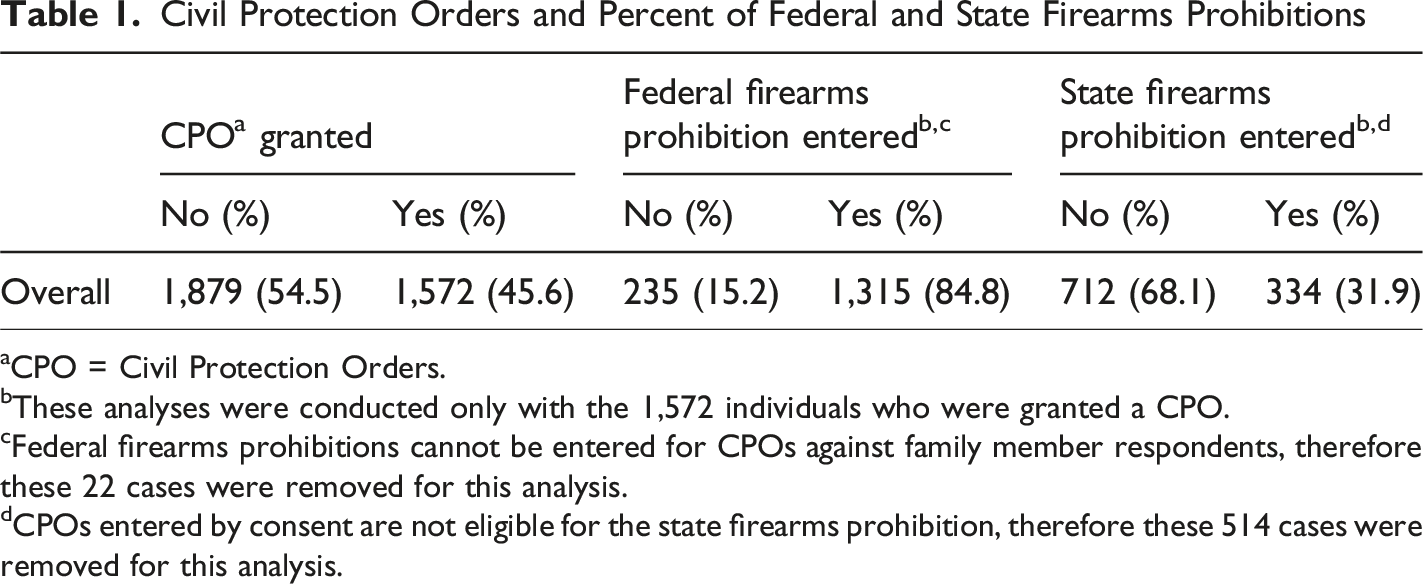
aCPO = Civil Protection Orders.
bThese analyses were conducted only with the 1,572 individuals who were granted a CPO.
cFederal firearms prohibitions cannot be entered for CPOs against family member respondents, therefore these 22 cases were removed for this analysis.
dCPOs entered by consent are not eligible for the state firearms prohibition, therefore these 514 cases were removed for this analysis.
Comparison of Weapon Involvement With Incidence of Granted Civil Protection Orders and Entry of Federal/State Firearms Prohibitions
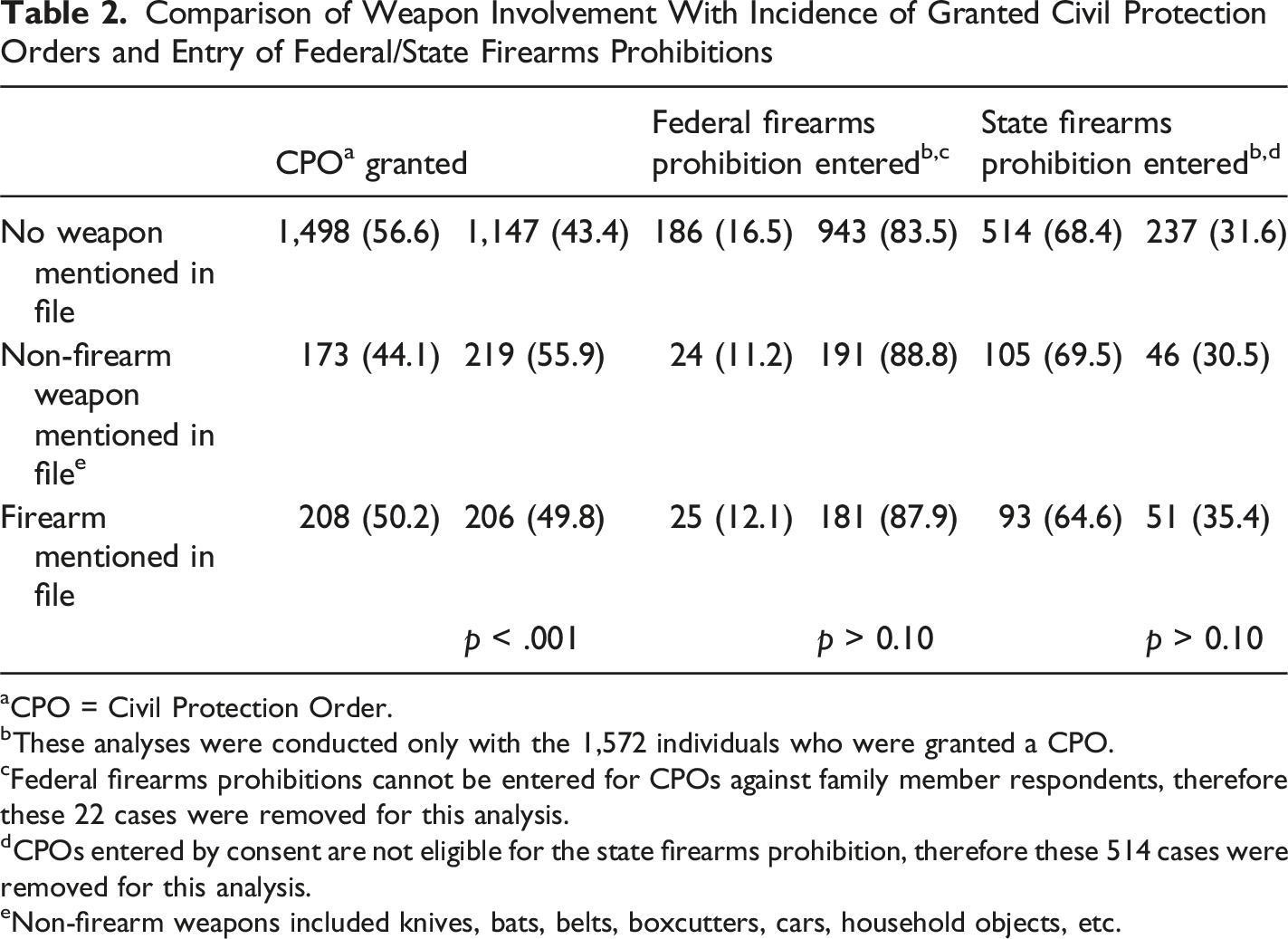
aCPO = Civil Protection Order.
bThese analyses were conducted only with the 1,572 individuals who were granted a CPO.
cFederal firearms prohibitions cannot be entered for CPOs against family member respondents, therefore these 22 cases were removed for this analysis.
dCPOs entered by consent are not eligible for the state firearms prohibition, therefore these 514 cases were removed for this analysis.
eNon-firearm weapons included knives, bats, belts, boxcutters, cars, household objects, etc.
We next examined, for individuals who received a CPO, the frequency of entry of the federal firearms prohibition in cases with and without weapon involvement (removing the 22 cases with disqualifying relationships). The percentage of cases that received the federal firearms prohibition did not vary significantly by weapon involvement (X 2 (2) = 5.653, p = 0.059), as shown in Table 2. Finally, we examined the frequency of entry of the state firearms prohibition in cases with and without weapon involvement (removing the 514 ineligible cases). The percentage of cases that received the state firearms prohibition also did not vary significantly by weapon involvement (X 2 (2) = 1.003, p > 0.10).
Next, we focus on the 414 petitions that mentioned firearm involvement. Two-thirds of these petitions stated that the firearm was used in the abuse, while another one-third indicated that the respondent had access to a firearm, but did not mention that it was used in the abuse (see Figure 1). Flow Chart of Civil Protection Order Cases in which a Firearm is Mentioned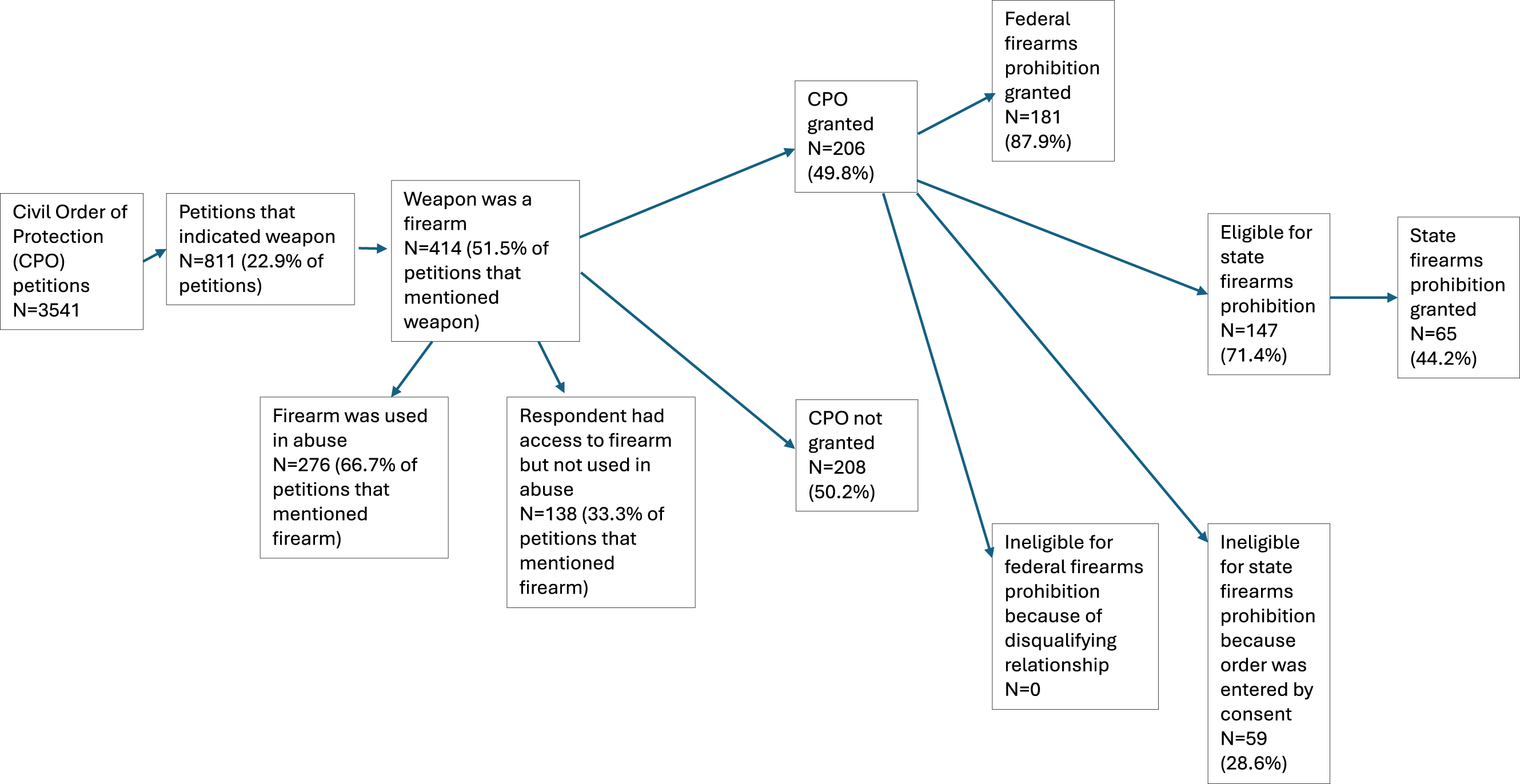
Finally, for the 414 petitions that mentioned a firearm, we examined eligibility for a firearms prohibition, as shown in the flow chart in Figure 1. Half of these cases resulted in a CPO. We then assessed if any of the 206 cases that resulted in a CPO involved parties that shared a relationship that disqualified them from the federal firearms prohibition (e.g., respondent is a parent in a sexual abuse case). All of the cases were eligible. Although all the cases in this group that resulted in CPOs qualified for the federal firearms prohibition and should have received it as per federal law, 88% actually received it on the CPO form. We next examined how many of the 206 cases that resulted in a CPO received the state firearms prohibition. As CPOs entered by consent are ineligible as per state law, 29% of the 206 cases that resulted in CPOs were ineligible for the state firearms prohibition. Among the eligible CPOs, only 44% received the state firearms prohibition.
Discussion
Overall, 46% of cases resulted in the entry of a CPO. Among the cases that resulted in a CPO and should have automatically received a federal firearms prohibition, in 15% of these cases the boxes that indicate the prohibition applies were not checked. Our data do not allow us to ascertain why the boxes were not checked, but our findings are consistent with other studies (Kafka et al., 2022). Cloud et al. (2023) note, “just because there is a law on the books it does not mean that law is fully (or even partially) implemented and enforced” (p. 5182). A much smaller proportion of cases received the state firearms prohibition (32% of eligible CPOs). Unlike the federal firearms prohibition, which applies automatically by law when certain criteria are met, courts have discretion whether to award the state firearms prohibition in eligible cases. Courts more frequently included the state firearms prohibition in cases where the petition mentioned firearms (44% of eligible CPOs), but still included it in a minority of CPOs issued to protect this group. Thus, overall, courts tended not to issue firearms prohibitions when the law gave courts discretion whether or not to do so. By contrast, courts typically (although not always) issued firearms prohibitions when the law required courts to do so. As a practical matter, courts’ tendencies not to issue the state firearms prohibition for most CPO recipients meant that local law enforcement lacked authority to take legal action if a respondent retained their firearms. These results align with those of other studies. As Kafka and colleagues (2022), summarizing across a number of studies, note, “only a small proportion of [CPO petitioners] who report firearm violence, weapon threats, or who request defendant gun restrictions ultimately receive a full [CPO] with firearm restrictions” (p. 381).
Future studies are needed to examine why judges do not grant firearms prohibitions in qualifying cases. In an older qualitative study of utilization of a CPO firearm surrender law in Maryland, judges who had issued the firearm surrender nevertheless expressed skepticism about the efficacy of the law (Frattaroli & Teret, 2006). Concerns included that the provision would not keep a determined abuser from killing the victim, and that it put police who had to serve it at risk. Interviewees also spoke of judges who personally opposed any form of gun control and did not believe domestic violence was a crime. As Kafka and colleagues (2022) note, “Statute may not be enough to influence judicial behavior…without additional training, resources, monitoring, and/or infrastructure” (p. 397).
Over 1 in 8 petitions mentioned firearm involvement, and two-thirds of these indicated the firearm was used in the abuse. However, because CPO forms in South Carolina neither seek information about firearms, nor give the petitioner the ability to request a firearms prohibition, it is likely that we missed some cases involving firearms because they were not mentioned anywhere in the files. Critically, it is also possible that the court missed these cases as well. Given the danger firearms pose in intimate partner violence, we recommend that CPO petitions seek information about firearm involvement and include a firearms prohibition as one of the forms of relief a petitioner can request. The omission of this information from the South Carolina forms likely deprives courts of the opportunity to learn about firearms involvement from petitioners. In other states, CPO forms do elicit information about whether the respondent has a firearm, and petitioners can request firearms prohibitions (e.g., see the Arizona CPO petition). Including firearm information on CPO petitions seems like a relatively straightforward step that would give courts greater insight into petitioners’ experiences.
The flow chart shown in Figure 1 illustrates that, even in cases in which firearm involvement is disclosed, few cases end up with full firearms prohibitions (i.e., both the federal and state firearms prohibitions). Of the 206 CPOs entered in cases where petitions mention firearms, only 181 include the federal firearms prohibition, and only 64 include full firearms prohibitions.
A challenge in understanding why firearms prohibitions are not more frequently utilized is the lack of accessible data on CPOs at the state level. For example, in North Carolina, data from courts does not include how many granted CPOs have firearms prohibitions, so it is difficult to know if state firearm restrictions are being implemented according to the law without individual case file research (Kafka et al., 2022). Likewise, in South Carolina, data from courts do not include information on firearms prohibitions. Furthermore, until recently, CPO case files were stored locally on paper in courthouses all over the state, requiring researchers to travel to every courthouse to scan, redact, and code the information from thousands of files, as we did, to get a comprehensive, statewide picture – and this was for only one year of data. Other than this one year, it was not possible to have even basic information about CPOs (e.g., how many are granted), much less to look at year-over-year trends. Following a recent digitization process, future researchers may be able to glean basic statewide information about CPOs from electronic court dockets, but will still need to study individual case files to gain a nuanced understanding of how the remedy is working in practice, including judicial utilization of firearms prohibitions. Expanding the data recorded and compiled by courts about individual case files can facilitate more detailed and more frequent research of the remedy.
Scholars have noted that firearms prohibitions are different from other areas of law, in that “courts have almost uniformly chosen to exercise [their] discretion in favor of nonenforcement” (Nanasi, 2020, p. 581). Numerous studies clearly demonstrate that firearms prohibitions save lives (Zeoli et al., 2022), but these laws can only save lives when they are utilized and enforced.
Footnotes
Acknowledgements
We are grateful to our research partners Jessica Pomerantz and Marie Maness.

Funding
The authors disclosed receipt of the following financial support for the research, authorship, and/or publication of this article: This research was made possible by support from the University of South Carolina Joseph F. Rice School of Law, the South Carolina Bar Foundation, the University of South Carolina ASPIRE Program and Josephine Abney Faculty Fellowship, and the Nelson Mullins Riley & Scarborough Center on Professionalism.
Declaration of Conflicting Interests
The authors declared no potential conflicts of interest with respect to the research, authorship, and/or publication of this article.